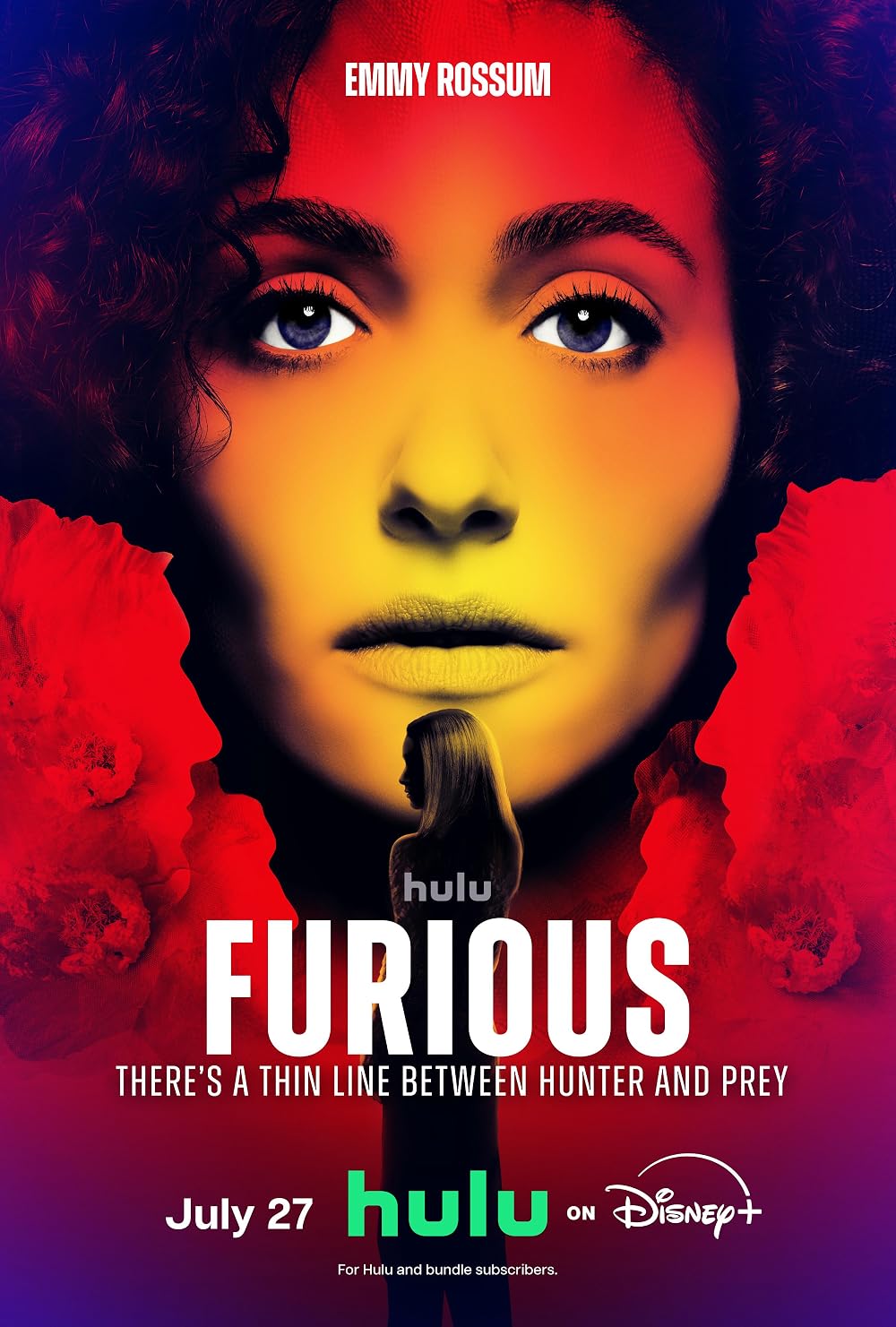
I loved ‘Furious’ and ‘Lucky’ for so many reasons, but both series depict female characters who make up stories about being attacked in order to get sympathy. Even though I’m a fan of these new series, here on ReelGirl, we’re tracking times when we see women tell fake stories of victimhood. As consumers of fictional media—books, movies, series etc— we’re so used to witnessing women lie in the imaginary world, we’re trained to reflexively distrust women’s stories. This bias is a liability that leaks into the real world when we hear women speak out about rape and assault. The characters in Furious and Lucy ARE victims of violence and they also create imaginary instances where they were attacked, the message being we can’t trust them to tell the truth.
In ‘Furious,’ serial killer, Catherine, lies about an abusive boyfriend in order to be admitted to a women’s shelter. In the series, Catherine has a long history of multiple rapes, it’s lazy writing to see her lie for sympathy.
Lucky, played by Anna Taylor Joy, applies make-up so it looks like she has. a black eye, then tells a truck driver that she’s got an abusive boyfriend to convince him to give her a ride.
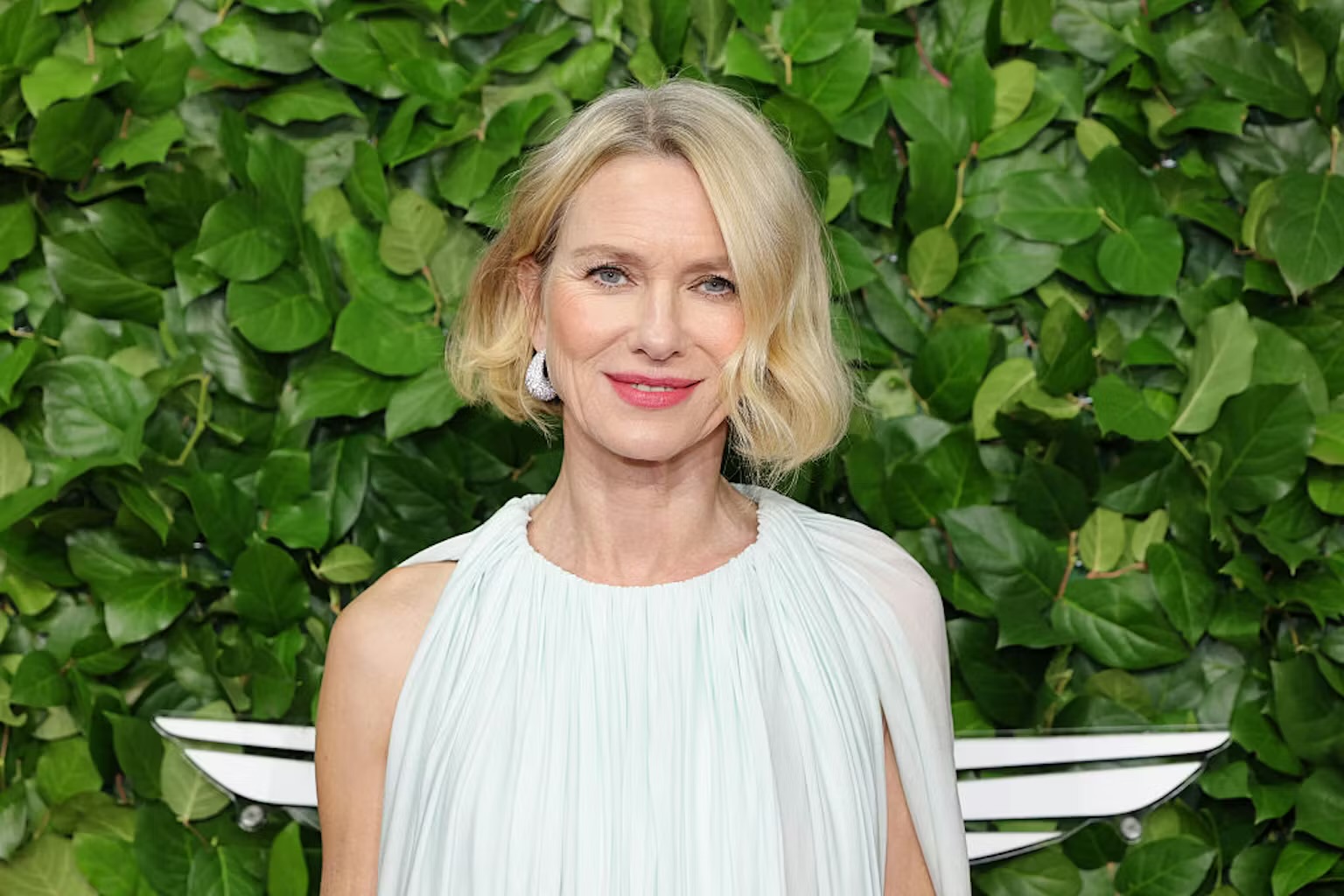
In a recent interview, when actress Naomi Watts said “Tolerate my jowls,” she made clear it’s not her job to surgically alter her face so you don’t feel uncomfortable. If her face stimulates pain for you, learn how to regulate. You feelings are not her problem. Naomi Watts is #unfawning.
I’ve been posting a lot about Ingrid Clayton’s new book and how she prefers the term fawning to codependency or people-pleasing, because when we “connect to protect” it’s often not a conscious choice but a trauma response, a nervous system reaction. Psychologist Pete Walker describes fawning as “a response to threat by becoming more appealing to the threat.”
I was thinking about how when women are young— especially when they are white and a weight preferable to the patriarchy— their bodies, to some degree, can’t help but “fawn.” Their bodies fit so perfectly into the system that rewards female compliance.
I posted a Tik Tok video about how my face, as a 57 year old woman, like Naomi, is no longer fawning. Even if a woman decides to take a path different from my own or Naomi’s, her body, on some level, is going to rebel: 57 isn’t the same as 27.
So far, that shift to #unfawning, has been disorienting and confusing to some degree, all changes are like that, but it’s also been incredibly liberating. And that part of the story seems to be, too often left out. That erasure feels like more fawning.
I can’t recall ever being so clearly in a situation where my body simply, repeatedly says: “No, I won’t do it. I won’t conform to that standard, even though, I know you believe that would make your life easier and safer.”
And surprise, my life is easier and safer #unfawning. I don’t miss men catcalling me. Why was I supposed to miss that?
Even though my body is older and supposedly less strong—debatable, I no longer smoke a pack of Marlboro Reds or drink alcohol—I feel so much safer waking down the street, just being in the world feels calmer. I don’t miss the free drinks or free food that were never really free. My body knew that too.
I think maybe the scariest thing about getting older, is when you’re young and you keep getting warned in so many ways how horrible and terrifying it’s going to be. I think that fear is one of the most powerful factors to keep women control. What if getting older isn’t something to be afraid of? What if it is, in fact, joyful?
Why do we have to give him a break? He’s running for president. Is it so much to ask in 2019 to want a leader who understands sexism? I don’t care if Biden is a good guy. I don’t care what his intent was in touching Lucy Flores or Sofie Karasek all the other women he smelled or kissed or hugged.
I’m sick of explaining sexism to men. Especially to powerful men. I don’t want to do it anymore. It takes up an enormous amount of time and energy. Not just mine, of course, but the energy of so many women. What would our lives be like, what would our country be like, if we had a leader who understood sexism, who just got it? What would happen in this country if women could spend time and energy actually fixing the problem of sexism instead of trying to convince someone that a problem exists?
Sexism is the water we all swim in.
Garchik argues: “Of course, a guy should be attuned to response when he’s overly huggy (or kisses the top of a head, rubs noses), and should cease and desist at the first signs it’s not welcome.”
Here’s the problem with that. Women and girls are trained to accept men’s hugs just like we are trained to laugh at men’s jokes. When we feel uncomfortable, we think the problem is us. We minimize the ick factor just as Biden is minimizing it now– making jokes and not saying he’s sorry.
What if women in America were just used to being taken seriously? What if that was the water we swam in? What if we were accustomed to attention from powerful men in the form of hand shakes, respect, and being looked in the eyes?
I used to produce talk radio programs and I had to explain to the liberal/ progressive male talk show host I worked with that defining someone as fiscally conservative but socially liberal was rooted in sexism. “Women don’t compartmentalize like that,” I told him. “If a woman doesn’t have reproductive rights, everything is affected: her health, her economic status, and her education, every issue.” When he told me that he’d never thought of it like that, I decided to write an article and after it was published, I got a call from Kamala Harris who was a deputy DA in Alameda County. She thanked me for writing. She told me she spends so much of her time just explaining to people that reproductive rights don’t exist is isolation but effect every aspect of women’s lives.
Kamala Harris thanked me for telling the truth. I want a president who can do that because only she is ready to change the world.
Because I’m so sick of the public referring to sexist people, places, and things as progressive or liberal, because sexism is everywhere and women are trapped in double-bind that is hardly acknowledged, getting little or no support from our “allies,” staying stuck in a matrix that doesn’t allow us to achieve real power, I came up with this list.
Reel Girl’s Top 10 List Of “Progressive” People, Places and Things That Are Sexist:
The New York Times When this publication broke the story about Harvery Weinstein’s chronic sexual harassment and assault of women, the report was illustrated with a photo of Hillary Clinton with Weinstein. That’s right, Weinstein’s behavior is Hillary’s fault. The NYT is also the publication that kept stories going about Hillary’s emails and the “corruption” of the Clinton foundation throughout Hillary’s campaign. Aside from Hillary, I’ve blogged extensively about the many instances of sexism in the stories of the NYT, from what they choose to cover to the sources they use to cover it. My complaints have been posted in Letters to the Times. Just do a search on Reel Girl to see my posts on sexism at the Times.
PBS I’ve blogged on Reel Girl about the lack of female protagonists on PBS shows for kids including the dominance of male characters on well-loved programs like “Sesame Street,” and how the “educational station” can be more sexist than the Disney channel.
Dr. Seuss With all of Dr. Seuss’s amazing creativity, the crazy-beautiful characters he drew, the names and the entire language he came up with, his spectacular imagination failed to stretch to include gender equality. Seuss’s characters are mostly male with even his crowd illustrations rarely featuring female characters. I’ve blogged a great deal on Reel Girl about Seuss’s sexism and though my blogs have been picked up and quoted by Jezebel (a “women’s news” site) Seuss’s sexism is rarely acknowledged. Seuss is a huge influence on childhood and it’s tragic that along with learning to read, kids are learning sexism, that it’s normal for girls to go missing. Recently children’s author Mo Willems signed a letter condemning Seuss’s racism but sexism isn’t mentioned in the letter.
My “progressive” male friends on social media: The men of Hollywood aren’t coming out to condemn Harvey Weinstein in the numbers that they should be, but what about my own male friends? While men I know and love regularly post about racism, police violence and other issues dear to their hearts, they rarely post about sexism and misogyny. My own posts about sexism rarely receive likes or shares or retweets from my male friends. Until our male friends join the fight for gender equality, prioritize it, consider it important, take action to support it, and stop being passive bystanders, women won’t get as far as we need to go.
My list is just a beginning, hopefully to publicize the wide reach of sexism and misogyny into almost every aspect of our lives. Feel free to add in my comment section your items of “progressive” people, places and things that are actually sexist.
I wish all the sexism and misogyny Hugh Hefner amplified and celebrated would die with him. Turns out, Hef gets to stalk into infinity: he paid $75,000 to be buried in the plot next to Marilyn Monroe.
It disgusts me that America (the world?) is celebrating this man.
Here’s an alumna’s comment from my fancy, I-was-so-lucky-to-attend-boarding school that many years later, was proven to be the site of numerous sexual assaults. Faulkner Fox writes:
At “Casino Night,” a required school event at St. George’s School, 14 and 15-year-old girls were asked to dress as playboy bunnies. Let’s just say it’s not one of my fondest childhood memories. All of the school’s sexism cannot be blamed on Hugh Hefner–of course not. But because of Hefner’s extraordinary cultural influence, one of the things we were asked to do–for fun–was dress as Playboy bunnies.”
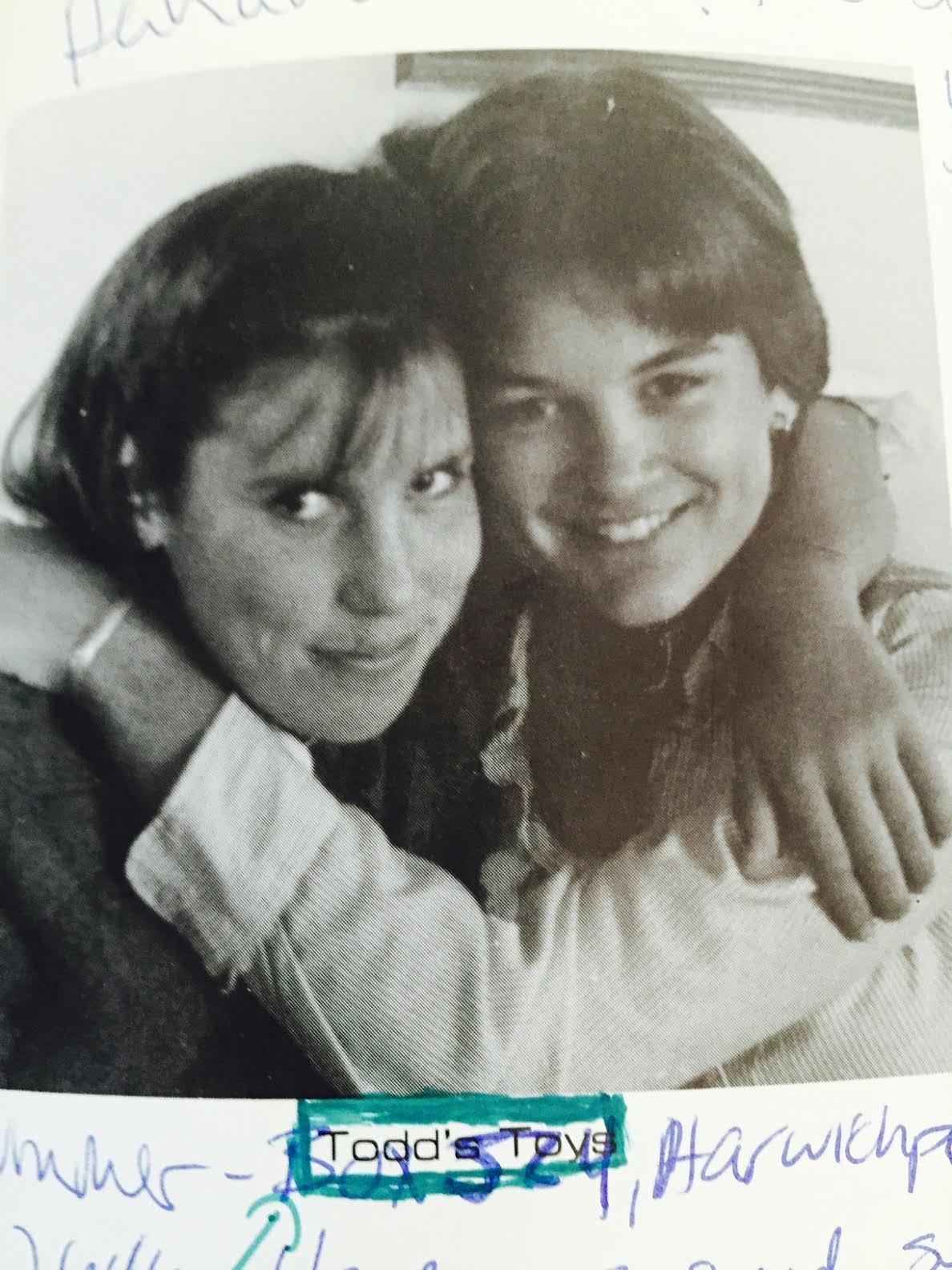
Yes, we were 14 and 15. Sexism was so insidious at St. George’s and in life that all I remember caring about was how I looked in my bunny suit. I took down the yearbook pictures on Reel Girl of Casino Night and every sexist photo I had up of St. George’s that didn’t include me, because though the shame is on the school and not the girls shown, our culture is messed up and too many people don’t get that. I don’t have me in a bunny suit but I have this gem to share, a yearbook photo from St. George’s captioned: “Todd’s Toys.”
Don’t worry: I don’t blame entitled guys like you for all the sexism and misogyny at St. George’s. You were young. I’m willing to give you some leeway. Plus I didn’t overlap with you at St. George’s — I am class of ’81; you are class of ’90 — so I don’t know how you actually behaved back then. Let’s say you never said or did one sexist or abusive thing before you got on that bus with Donald Trump in 2005.
What you did on that bus in talking with Donald Trump in 2005 directly relates to what happened to your St. George’s classmates. I’m talking about the creation and perpetuation of rape culture, the entrenched belief that women and girls don’t matter the way men do, that we are here to be grabbed, harassed, raped. Whatever a guy can get away with is fair game, worthy of laughter and high-fiving from other guys on the same messed-up bus.
Hugh Hefner helped to normalize and mainstream objectification of women. His vision touched us all. Got a personal story of how this “cultural icon” helped to infect your life with sexism? Please share it on Reel Girl.
Like many of you, I feel stunned and sickened watching our country race backwards under the rubric “make America great again.” From #Repealthe19th (a sentiment you can only call fringe if Trump is fringe) to his hopes for mass deportation (“we have some bad hombres here and we need to get them out”) Trump’s effort to whip his angry, white, male voters into such a frenzy, they’ll stampede to the polls, terrifies me.
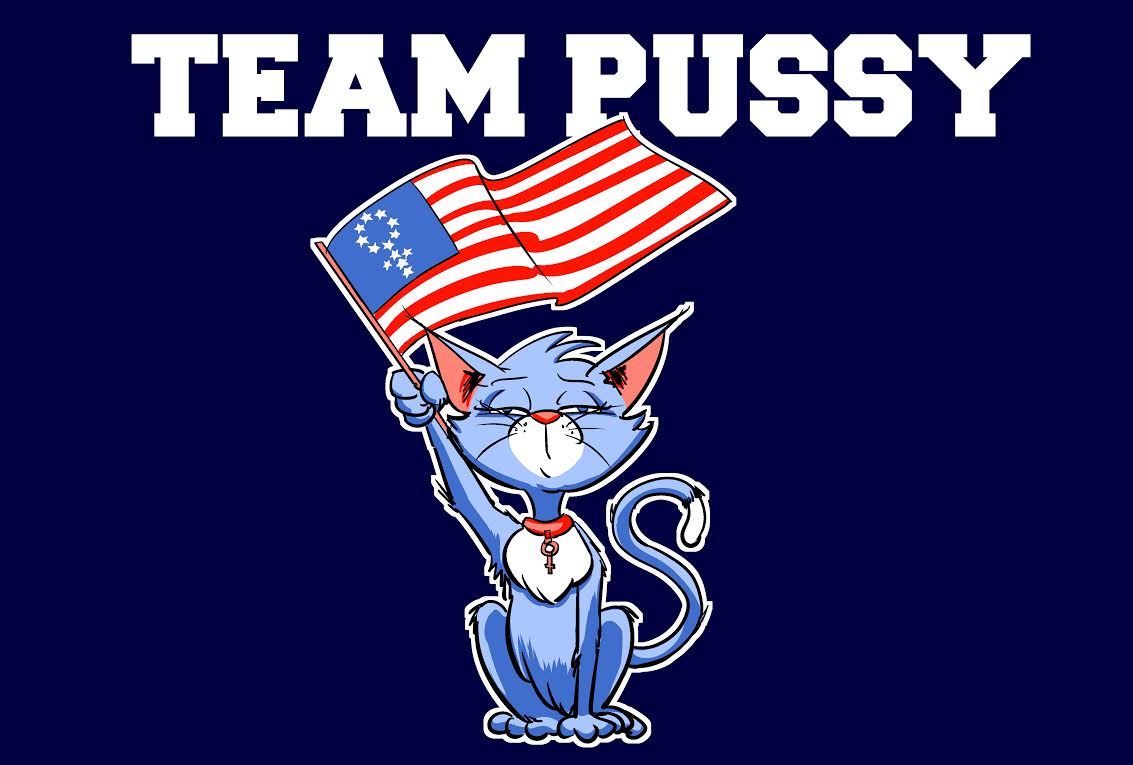
Team Pussy is a movement to get out the vote. It was created to mobilize and inspire women and men, young and old, to show up at the polls on November 8 to support women’s rights, that is human rights. Team Pussy comes at a unique moment in history. We’re on the verge of electing America’s first female president, a candidate who has worked tirelessly for thirty years to support women’s rights. Even Trump concedes she’s a fighter. We’re also in the midst of a national conversation about pussy. And it’s conversation that hasn’t always gone the way I’d like it to.
Pussy isn’t the problem, it’s the solution. By shining a spotlight on sexism in the USA, Trump has done this country a warped kind of service. His personal, overt disdain for women is exposing America’s national, covert disdain. Misogyny is so ubiquitous in our country that, ironically, it’s become invisible to so many citizens; it’s so normal and reflexive that we’re lulled into colluding with a system of sexism we hardly notice anymore. Don’t look away now. Instead, let’s ignore Scottie Nell Hughes and talk about pussy.
I first researched and wrote about “pussy” in 2001 after a male friend used the word to insult a guy who backed out of a business deal. Of course, I’d heard it before, possibly said it myself, but suddenly, it struck me as wrong to use it to imply cowardice or ineffectiveness. Why must we equate weakness with the female sex organ? Why have we for so long?
I began to wonder how one — how we — might take the wussy out of pussy.
Is it possible to change the meaning of the word, to restore to “pussy” its deserved glory? Could we use pussy as a compliment? Could pussy denote someone or something as cool or heroic or impressive? “Rosa Parks — what a pussy!”…
Pussy has so much potential, it’s a shame to limit it to the immature and derisive mocking of weak boys. Let’s give it a shot in the arm! I envision hit songs featuring “pussy” — “Who Let the Pussies Out?” or “The Real Slim Pussy” or “The Real Shady Pussy.” Hallmark-type cards that read “Thanks for being such a pussy!” Colloquial expressions: “You da pussy!” “Stand up and fight like a pussy!”…
And when, and if, Joe consummates his next business deal, I’ll be there to toast him, saying, “You’re so pussy.”
Flattered, he’ll smile.
I wrote the post before social media and “going viral” were phrases we all used, but I created a bunch of “Team Pussy” T shirts (at that time, just black with “Team Pussy” written in pink cursive) which sold out through my email in a few days. Though I was passionate about Team Pussy, I didn’t have the time or resources to dedicate to it, so I went on with life, trying to interject the word when I could. Fast forward to Trump’s video. People on social media started messaging me they were wearing their shirts or looking for their shirts. And then I watched the last debate and heard Trump asked if he would accept the results of the election, and heard him reply “I will look at it at the time.”
Let’s give the guy something to look at.The sides are so clear. You’re either on Team Pussy or Team Trump. Here’s a chance to make your choice loud and proud and inspire everyone who sees you. All merchandise features our cat and is available at our Team Pussy shop. Our favorite shirt looks just like the art posted here. Its reverse sides reads: “Vote Nov 8.” All shirts are high quality, 100% cotton with a navy blue background and come in fitted or straight cut. We also have gorgeous, durable white totes with red handles showing the same art and “I’m with her” on the reverse side. The T shirt with just the cat will be available soon. I saved 4 XL vintage “Team Pussy” shirts from 2001 and I’m making those available now at the store.
Feel free to use our Team Pussy art as your profile pic which we urge you to do at least until November 8! This image below is sized perfectly for your Twitter profile. Suggested intro Tweet: “Joined #TeamPussy to GOTV on Nov. 8. I’m with her.”
If you see a news story about someone doing something brave or cool, for example as Ijust did: Salma Hayek Claims Trump Leaked a False Story After Turning Him Down, then Tweet the story: “Salma Hayek is so pussy! #TeamPussy.” Nominate a #Pussyoftheday or give a shout out to one of your evergreen favorites: “Jessica Jones is so pussy! #GoTeamPussy.”
For Instagram, here’s art sized perfectly if you want to switch up your profile pic.
Post photos of you wearing #TeamPussy gear and our goal is to send you a free button or magnet once we get those in.
Our Team Pussy cat is worn out and pissed off, but she’s a fighter. She’s going to be out there every day with all of you, working hard to make sure Hillary Clinton wins big on November 8 with results that even Donald Trump won’t dare contest. Please join her. Thanks, pussies! Go team!
Time Magazine just published a post: Colby Student: Billy Bush Exemplifies the Hypermasculinity on College Campuses with the tagline “A student from Bush’s alma mater says not much has changed.” Here’s my story. Billy Bush and I went to the same boarding school, St. George’s in Newport, Rhode Island. You may have read about the school recently in The New York Timesor The Boston Globeor Vanity Fair because an investigation recently concluded that scores of students were raped and assaulted at the school, mostly during the 70s and 80s. While I was lucky enough not to be a victim of assault, this “elite” institution that supposedly educates “the best and the brightest,” like so many boarding schools was a bastion of sexism and racism, an old boys club where a culture of silence was encouraged and rewarded. The photo below is of me (on the left) and my friend, freshman year, in our high school yearbook from 1984. The caption reads “Todd’s toys.”
Todd was a senior prefect. The saddest thing to me about this photo is that I, at 14 years old, aspired to be liked, desired, by older boys, that I believed my value and worth was determined by whether or not older males– the guys with the power– were attracted to me. St. George’s did nothing that I can recall to recognize this sexism or to empower female students. To the contrary, the school seemed to condone misogyny. There was an annual event at St. George’s called Casino Night where all the new girls, mostly freshman and sophomores, dressed up as bunnies, as in playboy-type bunnies, complete with fishnet stockings and cotton tails on our butts. Our job was to sell the boys– who were fully clothed and pretended to gamble– candy and fake cigarettes. Casino Night was not a secret event, it took place to much fanfare in the school dining hall. Every teacher and administrator knew about it.
When I heard the Billy Bush/ Donald Trump tape I wanted to scream because it was like everything I learned in high school, the objectification of women and girls, the metamorphosis of teenager from San Francisco into a “toy” bunny plaything, was being reinforced by a would-be president of the United States of America.I felt ill and the nausea hasn’t left me since.
What are girls supposed to think and feel and be when we grow up surrounded by this kind of sexism, when it’s so normal that no one even notices it? When teachers condone it by never addressing it?
The links to the posts I wrote about St. George’s are listed below, though I removed the photos from the blogs. I had posted a photo, also from our 1984 yearbook, of a freshman girl dressed as a bunny on Casino Night. To me, the shame was on the school, not the girl, but when she told me she wanted it down, I respected her wishes. I took all the pictures of students down except for the one with me in it that you can see above.
Misogyny is so ubiquitous in America, paradoxically, it’s invisible. It’s in our schools and colleges and the air we breathe, but we don’t even notice it. I’m not 14 years old anymore. I have three daughters of my own now. I want them to have the right to control their own bodies, to find their value in their achievements not in how they appear to men, to be ambitious, creative, and inspired, to dream big and to acquire the skills to realize their vision, to be valued as people, not toys. That’s why I’m voting for Hillary Clinton for president on November 8.
To all women who loathe Trump but don’t like Hillary:
In the past week or so we have heard and seen an avalanche of (even more) unspeakable things come out of Donald Trump. Most of us are justly outraged by his attitude and actions toward women: Trump has proven he views us purely as sexual objects, reduced to—and rated ruthlessly on—how we look and our sexuality. Every day hundreds of women give myriad reasons they will not vote for him, and this is one of them.
Many of these same women also give reasons for disliking Hillary, however: she’s nauseatingly smug, she’s cold, she dresses like crap, she must be secretly lesbian. I have heard everything from “I hate those dorky headbands she used to wear” to “why can’t she stop making that awful grin-grimace?” And the number one reason I hear, time and again: I can’t vote for Hillary because she stood by her cheating husband.
At best the above statements would be right at home when judging a beauty pageant; they are all based on rating her appearance or sexuality. At worst, they’re the feminine equivalent of the oldest, most patronizing and paralyzing harassment we’ve each been exposed to forever: why don’t you give me a smile? Why don’t you dress like a girl? You think you can make [X] sexual choice? You asked for it! You’re a cold bitch, you’re a lesbian!
My fellow women: we have a chance to elect a female to the biggest power position in the world, and yet we are picking at her clothing, her smile, her sexual choices. We are basing our votes and the future of our country on our reaction to how she maintains her looks, her facial expressions, and her marriage.
Why do we do it? The simplistic answer is that sexual competition and judging – tearing down or eliminating other women – was traditionally our only source of power in most societies. Two-hundred and fifty years ago Laclos’ “Dangerous Liaisons” villainess, the Marquise de Merteuil, perfectly captured this primal female urge in her personal motto: “win or die.” For the few who have not read the book (or seen one of the film adaptations), the story can be summed up simply: women viciously destroy each other and the man wins. “When one woman strikes at the heart of another she seldom misses,” the Marquise flatly informs the Vicomte de Valmont, “and the wound is invariably fatal.” Indeed, all of the women lose big in Laclos’ tale, in particularly sexually-damning ways—Cecile, defiled, returns in shame to a convent; the Marquise is disfigured and humiliated into never showing her face or using her body again; and Madame de Tourvel is so shame-stricken and humiliated she simply dies (the ultimate sexual give-up) — while the man walks away, smirking, with all of the power in the palm of his hand.
Earlier in the 2016 election season, already disgusted with the playground taunts passing for politics, I tweeted a personal vow (which now seems hopelessly dated and innocent, given how things have circled the drain since): I will not talk about how women look for the rest of the season. I will not join in comparing Heidi Cruz to Melania Trump, I will not weigh in on Megyn Kelly, I will not critique the Trump surrogates’ clothing and makeup choices, I will not discuss Hillary’s wardrobe or everyone’s possible plastic surgery or the attire or looks of any of the reporters who are covering them. (Just to be fair, I am also not going to discuss Donald Trump’s hair, skin color, or hand size either, although I did relish that whole ridiculous defend-my-manhood exchange with Marco Rubio.) I confess: I fell off the wagon once and gleefully tweeted about Melania’s choice of the Pussy Bow blouse after her husband’s big sexual assault bomb dropped—but I have otherwise found the self-enforced ban to be very illuminating. I constantly have to censor myself: we are so conditioned to comment on and tear down other women it leaves one often speechless in finding another topic.
Once Trump paraded Bill Clinton’s accusers through the second debate and we were all newly reminded of Hillary’s marital issues I added an even more important personal ban to my list: I will not weigh in on another woman’s sexuality. Period. Does Hillary love Bill, or is it a marriage of convenience? Did she stay with him because she forgave him, because she secretly likes women better, or because she saw him as a stepping stone for her ambition? I personally hope Hillary has a rotating stable of pool boys at the local Country Club, but I will never say another word about it. I will not pass judgement on any woman’s marriage, I will not speculate on who or what gender she sleeps with, I will not entertain reports of her fidelity or lack thereof. Unless she (not her husband, her aide’s husband, her ex-husband, or any other man in her life) has broken a law with her own sexual behavior I will not form or voice an opinion. Women are not the keepers of morality, we cannot hold them responsible for any man’s sexual actions, attitudes, or behaviors. Furthermore, we cannot assume to know what goes on in their relationships. Most of us would never judge another woman for electing to divorce a cheater; why do we all feel we can condemn one for electing not to? How dare we judge any woman on who or how they choose to love, to divorce, to stay, to marry.
Which brings me back to “Dangerous Liaisons.” I do not think all women should automatically vote for Hillary because she’s a woman; that’s reductive and ridiculous. But every one of us needs to carefully examine our reasons if we choose not to vote for her: is our decision intellectually defensible, or are we allowing our Neanderthal brain, our vestigial sexual competitiveness to drag us into knee-jerk bitchiness? Do we disapprove of her policies or doubt her experience…or do we just dislike her marital situation, her sartorial choices, her personal presentation? And can we live with ourselves and our country if we let this particular man walk away, smirking, with all of the power in his tiny, little…ahem, with all of the power in his hands?
Melissa Duge Spiers is a freelance writer based in Watsonville, California, and a frequent contributor to Reel Girl. You can follow her on Instagram @mdugespiers or Twitter @MDugeSpiers.
When news broke a couple days ago that Taylor Swift broke up with boyfriend Calvin Harris, the internet brimmed with snark: How long until she sings about this breakup? Swift’s lyrics have long been criticized and trivialized, reducing her to a boy crazy one note.
Today, People Magazine posts a headline: 8 Breakup Albums by Male Artists That Didn’t Earn Them as Much of a Rep as Taylor Swift with a list including musicians generally regarded as geniuses and poets: Bob Dylan,Willie Nelson, Elvis Costello, Marvin Gaye, Frank Sinatra, and Kanye West. Guess what? All those dudes wrote about break ups multiple times in multiple albums like most artists do.
I am so fucking sick of women artists being relegated to “confessional” or “chick lit.” It starts when kids are young, babies, in the whole “just for girls” “special interest” category of children’s media. Literally, from birth, we train kids that stories about girls are not important, are less interesting, are less than. I can’t tell you how many parents have responded to me, when I tell them about this blog: “Oh, I don’t have to worry about that, I have boys.” Yes, mom and dad, you do have to worry about that. It’s up to you to seek out media for your kids– your kids— with female protagonists. It’s up to you to avoid inundating your child’s imagination with narratives and images that repeatedly teach that females belong on the sidelines. And even if you work your ass off to show your children alternatives, they’re still going to suck up gender stereotypes which are literally everywhere. So try. Try harder. Change the world, don’t be a bystander. I’m going off on a tangent. The point of this blog was an optimistic one, to congratulate People Magazine. I wrote almost the exact blog People did today on Reel Girl, years ago. The Bob Dylan song I cited wasn’t “Don’t Think Twice” but “Idiot Wind.” There are scores to choose from. Ask yourself: What can you do today to support women artists?