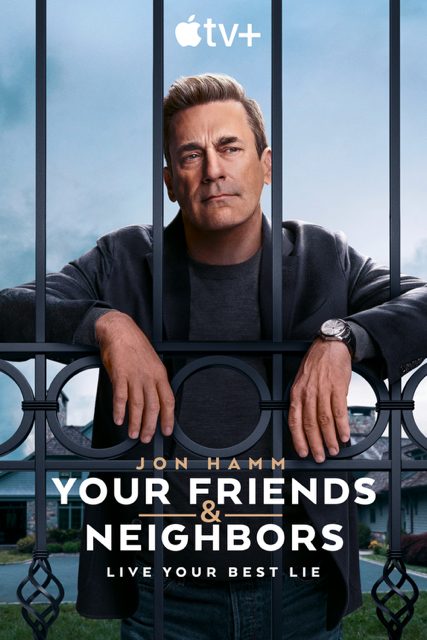
In the Apple TV series ‘Your Friends and Neighbors,’ the protaginist, Coop, played by Jon Hamm is falsely accused of sexual misconduct, he’s fired from his job, chaos ensues.
Here on Reel Girl, we’ve been tracking movies, series, and books where sympathetic male protagonists are falsely accused of sexual misconduct. Here are the series I’ve watched in THE LAST MONTH that depict charges of rape, sexual assault, violence against women, and sexual misconduct manipulated, fabricated, simply made up to manipulate victims. That’s right, the sympathy is with the victims of manipulation. Poor Coop did nothing wrong. He’s a good guy. And as a viewer, our empathy, once again, is directed to the promising man.
When we as a audience, as the public, watch this story of victimhood on repeat, we get trained in real life to look for motives, to distrust stories of sexual misconduct, violence against women, sexual assault, and rape. These stories influence our ability and capacity to believe women, and when we hear stories like Jane Doe saying she was raped by 7 men at Cornell, we have a biased filter that has created our cultural mythology, from the Bible to Greek Mythology to HBO to not believe women.
‘Your Friend and Neighbors’ makes a mockery of all the work women have done for equal rights and protection in the work force. Even the woman who Coop had sex with isn’t the villain in this story, their mutual boss wanted to fire Coop and manipulated the relationship for that end. See how vulnerable women’s rights make us all?
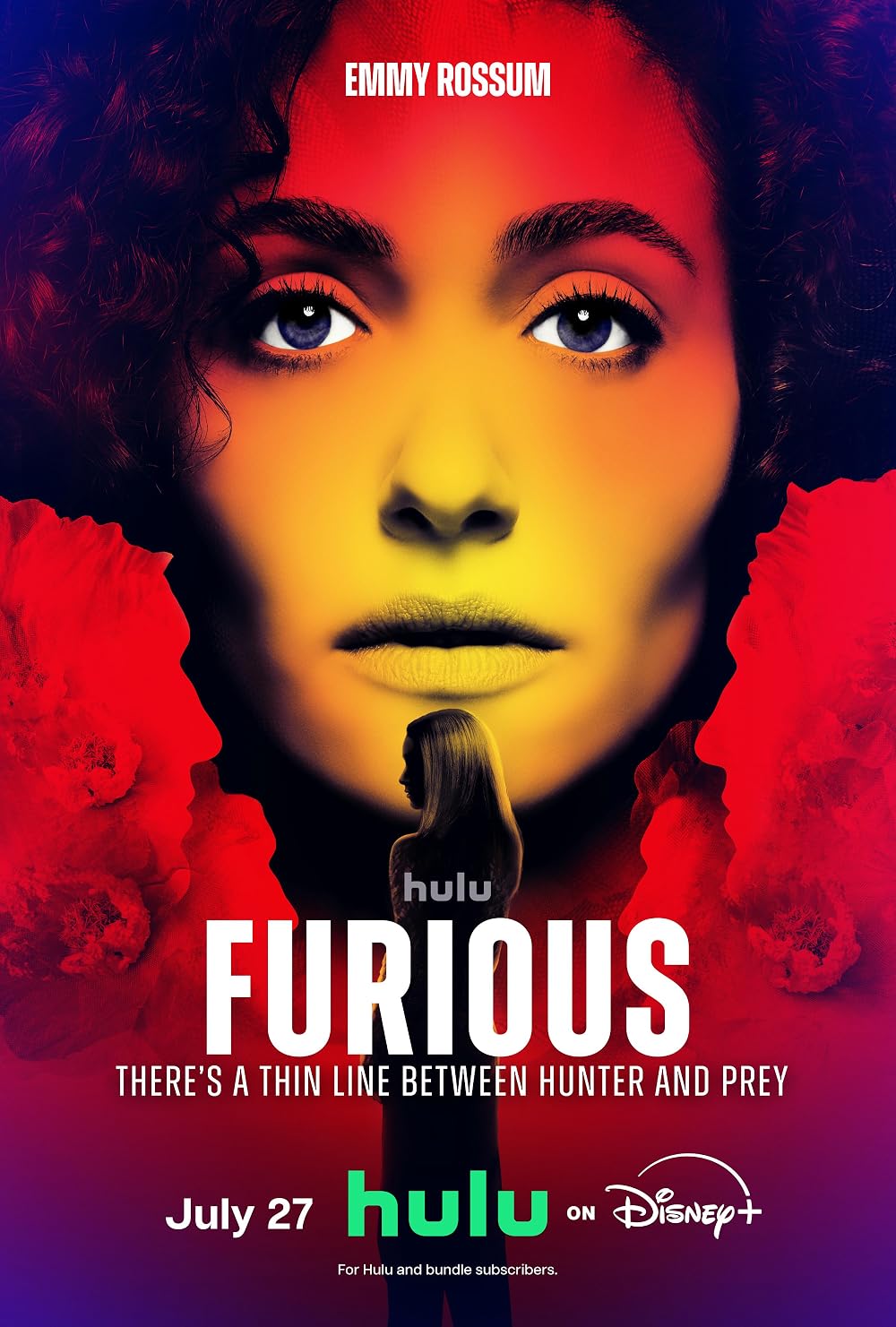
I loved ‘Furious’ and ‘Lucky’ for so many reasons, but both series depict female characters who make up stories about being attacked in order to get sympathy. Even though I’m a fan of these new series, here on ReelGirl, we’re tracking times when we see women tell fake stories of victimhood. As consumers of fictional media—books, movies, series etc— we’re so used to witnessing women lie in the imaginary world, we’re trained to reflexively distrust women’s stories. This bias is a liability that leaks into the real world when we hear women speak out about rape and assault. The characters in Furious and Lucy ARE victims of violence and they also create imaginary instances where they were attacked, the message being we can’t trust them to tell the truth.
In ‘Furious,’ serial killer, Catherine, lies about an abusive boyfriend in order to be admitted to a women’s shelter. In the series, Catherine has a long history of multiple rapes, it’s lazy writing to see her lie for sympathy.
Lucky, played by Anna Taylor Joy, applies make-up so it looks like she has. a black eye, then tells a truck driver that she’s got an abusive boyfriend to convince him to give her a ride.
Mostly, I bought The Academy because the novel is based on my former high school, St. George’s, but I’ve also been kind of intrigued by the author, Elin Hildrebrand. She’s written so many books and I hadn’t read any yet.
So first, what I liked:
This book is a total page-turner. My wandering mind didn’t wander at all. If you’re longing for a break from stress, reality, or doom scrolling, The Academy is a reliable, entertaining choice. It requires just enough brain cells to keep you focused.
HIlderbrand wrote the book with her college age daughter, Shelby Cunningham, and I think that’s pretty cool for them to partner and publish together.
The authors do an expert job weaving multiple storylines and characters into a perfectly paced, thematically connected plot, not an easy balance to pull off.
There are many female characters in this book with dialogue lines and page time that far out numbers the male characters. If you read Reel Girl, you know I call the too-often-too-few girl characters in book, movies, streaming etc the “Minority Feisty” and no need to worry about that criticism here.
But here’s what I didn’t like:
Those many female characters? They mired in shallow and sexist tropes. Charley Hicks, a fifth former/ junior is a brilliant misfit student with glasses and braids who gets a makeover and goes on to win the hottest guy of the school. If I never again in the rest of my life I read one more book or see another movie or series where a supposedly homely girl transforms into a smoke show— from Eliza in “My Fair Lady,” Sandy in “Grease,” Tai Fraser in “Clueless” (of course is based on Harriet in Austen’s Emma) Laney Boggs in “She’s All That,” “Mean Girls,” “House Bunny,” “Devil Wears Parda,” Cinderella for God’s sake— I would not complain.
And something else I’d be happy to never see again? A shallow woman punished for her sexuality. Simone Bergeron, a young history teacher seems straight out of the horror film genre in that her short skirts and over active libido, we readers know, spell her downfall. Sadly, there’s nothing compelling about Simone’s character, no particular ambition or passion, she doesn’t seem much interested in the subject she teaches or teaching at all. She just wants to be popular. I won’t give away the ending of the book but it’s pretty clear early on that no good will come to such a slut.
Another trope that shows up in the book is the “Gossip Girl” framework: an app called “Zip Zap” which posts secrets about students. Not only have we all seen this before in this same genre of rich, high school kids, but, at least for me, the secret identity mystery fell flat.
One more thing I want to note, just because I went to this school and I am kind of fascinated by this particular subplot. Director of Admissions, Cordelia Spooner, gets “Zip Zapped” for her secret policy of admitting students based on how attractive they are. Cordelia trolls the kids and their parents to get a good look at them. The book mentions St. George’s is also called St. Gorgeous, supposedly for its stunning architecture and scenic location but that everyone knows the reference is really about the student body. While I hadn’t heard the nickname before, the values at this school, when I went back in the 80s, were ridiculously focused on appearance and reputation. Back then, new girls— and that means fourteen and fifteen year olds—were expected to dress up as Playboy bunnies on what was affectionately “Casino Night.” My hope would be that the school had evolved since then but reading The Academy tells me it may be just as superficial (and sexist) as ever.
Because I’m so sick of the public referring to sexist people, places, and things as progressive or liberal, because sexism is everywhere and women are trapped in double-bind that is hardly acknowledged, getting little or no support from our “allies,” staying stuck in a matrix that doesn’t allow us to achieve real power, I came up with this list.
Reel Girl’s Top 10 List Of “Progressive” People, Places and Things That Are Sexist:
The New York Times When this publication broke the story about Harvery Weinstein’s chronic sexual harassment and assault of women, the report was illustrated with a photo of Hillary Clinton with Weinstein. That’s right, Weinstein’s behavior is Hillary’s fault. The NYT is also the publication that kept stories going about Hillary’s emails and the “corruption” of the Clinton foundation throughout Hillary’s campaign. Aside from Hillary, I’ve blogged extensively about the many instances of sexism in the stories of the NYT, from what they choose to cover to the sources they use to cover it. My complaints have been posted in Letters to the Times. Just do a search on Reel Girl to see my posts on sexism at the Times.
PBS I’ve blogged on Reel Girl about the lack of female protagonists on PBS shows for kids including the dominance of male characters on well-loved programs like “Sesame Street,” and how the “educational station” can be more sexist than the Disney channel.
Dr. Seuss With all of Dr. Seuss’s amazing creativity, the crazy-beautiful characters he drew, the names and the entire language he came up with, his spectacular imagination failed to stretch to include gender equality. Seuss’s characters are mostly male with even his crowd illustrations rarely featuring female characters. I’ve blogged a great deal on Reel Girl about Seuss’s sexism and though my blogs have been picked up and quoted by Jezebel (a “women’s news” site) Seuss’s sexism is rarely acknowledged. Seuss is a huge influence on childhood and it’s tragic that along with learning to read, kids are learning sexism, that it’s normal for girls to go missing. Recently children’s author Mo Willems signed a letter condemning Seuss’s racism but sexism isn’t mentioned in the letter.
My “progressive” male friends on social media: The men of Hollywood aren’t coming out to condemn Harvey Weinstein in the numbers that they should be, but what about my own male friends? While men I know and love regularly post about racism, police violence and other issues dear to their hearts, they rarely post about sexism and misogyny. My own posts about sexism rarely receive likes or shares or retweets from my male friends. Until our male friends join the fight for gender equality, prioritize it, consider it important, take action to support it, and stop being passive bystanders, women won’t get as far as we need to go.
My list is just a beginning, hopefully to publicize the wide reach of sexism and misogyny into almost every aspect of our lives. Feel free to add in my comment section your items of “progressive” people, places and things that are actually sexist.
Like many of you, I feel stunned and sickened watching our country race backwards under the rubric “make America great again.” From #Repealthe19th (a sentiment you can only call fringe if Trump is fringe) to his hopes for mass deportation (“we have some bad hombres here and we need to get them out”) Trump’s effort to whip his angry, white, male voters into such a frenzy, they’ll stampede to the polls, terrifies me.
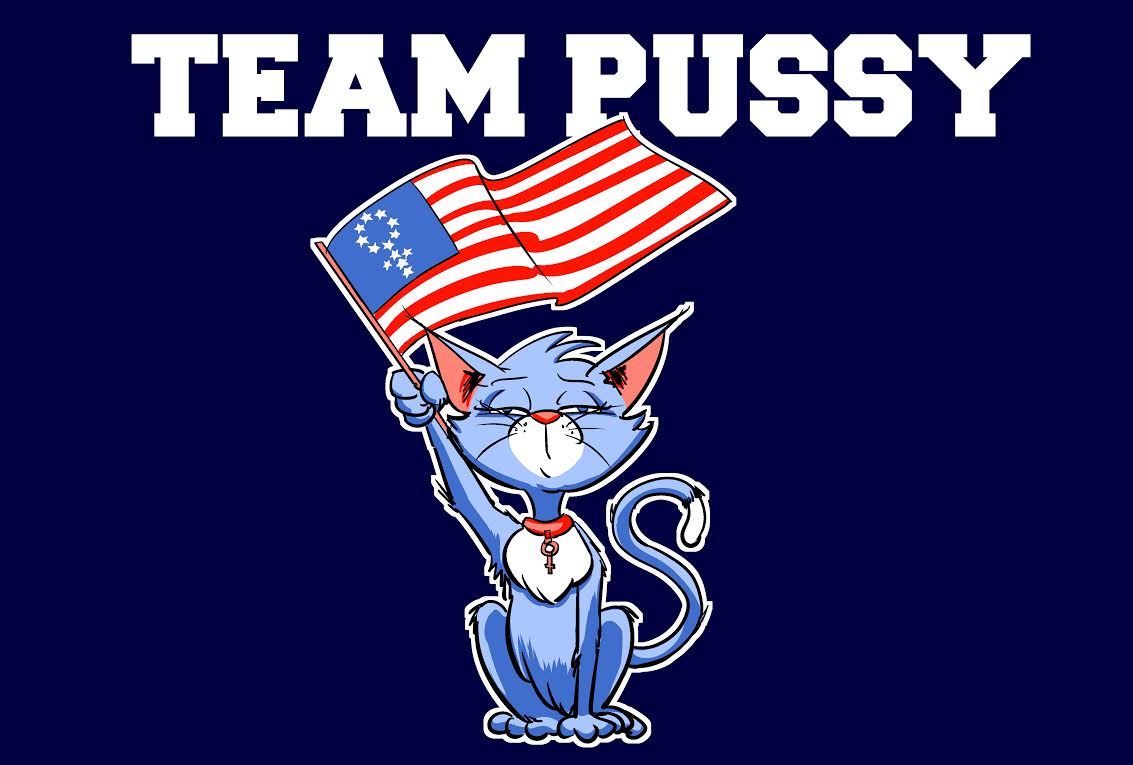
Team Pussy is a movement to get out the vote. It was created to mobilize and inspire women and men, young and old, to show up at the polls on November 8 to support women’s rights, that is human rights. Team Pussy comes at a unique moment in history. We’re on the verge of electing America’s first female president, a candidate who has worked tirelessly for thirty years to support women’s rights. Even Trump concedes she’s a fighter. We’re also in the midst of a national conversation about pussy. And it’s conversation that hasn’t always gone the way I’d like it to.
Pussy isn’t the problem, it’s the solution. By shining a spotlight on sexism in the USA, Trump has done this country a warped kind of service. His personal, overt disdain for women is exposing America’s national, covert disdain. Misogyny is so ubiquitous in our country that, ironically, it’s become invisible to so many citizens; it’s so normal and reflexive that we’re lulled into colluding with a system of sexism we hardly notice anymore. Don’t look away now. Instead, let’s ignore Scottie Nell Hughes and talk about pussy.
I first researched and wrote about “pussy” in 2001 after a male friend used the word to insult a guy who backed out of a business deal. Of course, I’d heard it before, possibly said it myself, but suddenly, it struck me as wrong to use it to imply cowardice or ineffectiveness. Why must we equate weakness with the female sex organ? Why have we for so long?
I began to wonder how one — how we — might take the wussy out of pussy.
Is it possible to change the meaning of the word, to restore to “pussy” its deserved glory? Could we use pussy as a compliment? Could pussy denote someone or something as cool or heroic or impressive? “Rosa Parks — what a pussy!”…
Pussy has so much potential, it’s a shame to limit it to the immature and derisive mocking of weak boys. Let’s give it a shot in the arm! I envision hit songs featuring “pussy” — “Who Let the Pussies Out?” or “The Real Slim Pussy” or “The Real Shady Pussy.” Hallmark-type cards that read “Thanks for being such a pussy!” Colloquial expressions: “You da pussy!” “Stand up and fight like a pussy!”…
And when, and if, Joe consummates his next business deal, I’ll be there to toast him, saying, “You’re so pussy.”
Flattered, he’ll smile.
I wrote the post before social media and “going viral” were phrases we all used, but I created a bunch of “Team Pussy” T shirts (at that time, just black with “Team Pussy” written in pink cursive) which sold out through my email in a few days. Though I was passionate about Team Pussy, I didn’t have the time or resources to dedicate to it, so I went on with life, trying to interject the word when I could. Fast forward to Trump’s video. People on social media started messaging me they were wearing their shirts or looking for their shirts. And then I watched the last debate and heard Trump asked if he would accept the results of the election, and heard him reply “I will look at it at the time.”
Let’s give the guy something to look at.The sides are so clear. You’re either on Team Pussy or Team Trump. Here’s a chance to make your choice loud and proud and inspire everyone who sees you. All merchandise features our cat and is available at our Team Pussy shop. Our favorite shirt looks just like the art posted here. Its reverse sides reads: “Vote Nov 8.” All shirts are high quality, 100% cotton with a navy blue background and come in fitted or straight cut. We also have gorgeous, durable white totes with red handles showing the same art and “I’m with her” on the reverse side. The T shirt with just the cat will be available soon. I saved 4 XL vintage “Team Pussy” shirts from 2001 and I’m making those available now at the store.
Feel free to use our Team Pussy art as your profile pic which we urge you to do at least until November 8! This image below is sized perfectly for your Twitter profile. Suggested intro Tweet: “Joined #TeamPussy to GOTV on Nov. 8. I’m with her.”
If you see a news story about someone doing something brave or cool, for example as Ijust did: Salma Hayek Claims Trump Leaked a False Story After Turning Him Down, then Tweet the story: “Salma Hayek is so pussy! #TeamPussy.” Nominate a #Pussyoftheday or give a shout out to one of your evergreen favorites: “Jessica Jones is so pussy! #GoTeamPussy.”
For Instagram, here’s art sized perfectly if you want to switch up your profile pic.
Post photos of you wearing #TeamPussy gear and our goal is to send you a free button or magnet once we get those in.
Our Team Pussy cat is worn out and pissed off, but she’s a fighter. She’s going to be out there every day with all of you, working hard to make sure Hillary Clinton wins big on November 8 with results that even Donald Trump won’t dare contest. Please join her. Thanks, pussies! Go team!
I miss you guys! I know I’ve been blogging for a couple years that I’m almost done with my book, but I’m REALLY almost done now. Finishing a book (finishing anything?) is so challenging, tying up all the loose ends, letting it go, but I could not be more excited about what I’m writing so that’s pushing me to the end. I haven’t had any time to blog, and I don’t just mean the time it takes me to write these words, but once I pound it out, I get engaged with the whole Internet world and I can get lost for hours on line, it’s a shift of energy and brain cells I can’t afford. I think I’ve written this before but being a mom has truly made me realize how carefully I have to choose where to put my energy. I get how Obama says he wear the same thing every day because his decision making reservoirs are used up. I wish more women could get away with not putting so much time and money and brain cells into how we look without getting mocked or put down, but I’m going off on a tangent here. There is one blog I’m dying to write about Roald Dahl’s BFG which I’m reading with my 7 year old daughter, so stay tuned. In the meantime, I got this amazing comment that I have to repost. The commenter encapsulates why I started my blog, the Minority Feisty, and the issue I have with most stories for kids featuring ” a strong female character” or two or three. Her comment is in response to my blog: If we can imagine talking bunnies as police in ‘Zootopia,’ why can’t we imagine gender equality? Here it is, from sellmaeth:
“Realism? You mean, like lionesses doing all the hunting (lead by a lioness) while the lazy males just eat what the lionesses bring home and murder the cubs fathered by other males?
Or male bees and ants only existing for breeding, and only being about, l don’t know, five animals in the whole hive?
Or … the daddy clownfish in “Finding Nemo” changing to mommy clownfish because that’s what that kind of fish does …
Oh, or anglerfish … tiny males have their mouths fused to the big female.
Haha. You’ll never see that in a movie.
I can imagine equality of the sexes. But I am not paid to write movie plots, I just write fanfic.
You are right, this “lone woman fights bad sexism” is getting old, and an excuse to feature sexism in the first place.
Once played pen&paper roleplay game with a dude who wanted to force me into the “token female who has to fight sexism all the time” role … in a setting that’s explicitly not sexist. (He changed the original game to suit his tastes)
He was a sexist in more ways than that. You are definitely on to something there.”
Today, we had Lucky Charms for breakfast. Not the healthiest choice, I know, but that’s how it went down. My six year old daughter counted 8 different charms on the back of the box, each with a portrait and storyline. Out of those, just 2 are female. I’m not even talking about Lucky, the leprechaun, I’m talking about the charms.
My daughter read the box to me:
Hourglass is a smarty pants scientist whose inventions don’t always turn out the way he planned. He’s bringing his toolbox to the party.
In the photo above, you can see Hourglass on the left with the hat, a lock of brown hair, and a mustache.
That one she’s pointing to is Shooting Star
a seriously silly dude. He’s bringing juggling balls to the party…even though he doesn’t know how to juggle.
Guess what one of two girls (or as I call them Minority Feisty) is named? Rainbow. She is…
“the most magical charm of all. She wants to add some sparkle to the party with a disco ball.”
Good to know her interior decorating skills are strong. What’s a girl who doesn’t want to add sparkle to her shoes, her dress, her soccer ball? Is she a girl at all?
My husband jokes that cereal boxes are like morning newspapers for kids. My three daughters fight about who gets to put the box in front of their bowl. Those boxes are seriously valuable real estate in kidworld and yet, there is a not a single female mascot on a children’s cereal box. Not a single one. I’ve written about this blatant sexism on Reel Girl for years but it was only when Raj from the hit show “The Big Bang Theory” made the same observation, that the issue got some traction. Things are going to change now, I thought. Raj has taken this issue on.
I was wrong. That episode aired three years ago. More stories keep coming and almost all of them are about males.
Reel Girls posts about sexism and children’s food packaging, girls get stereotyped or go missing:
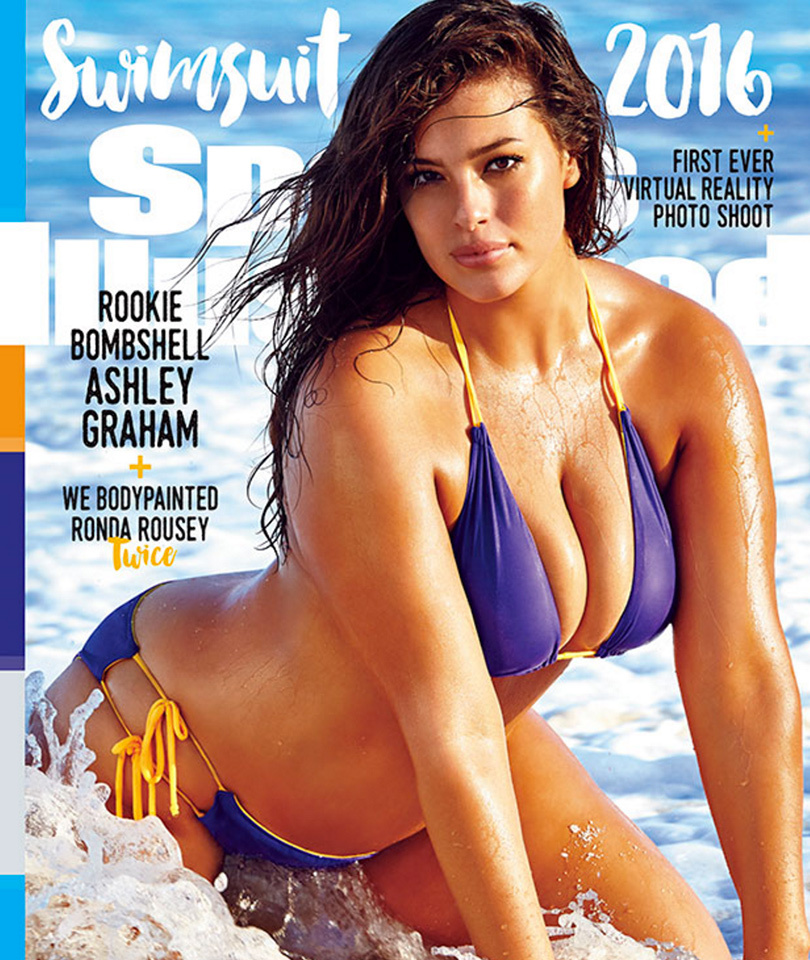
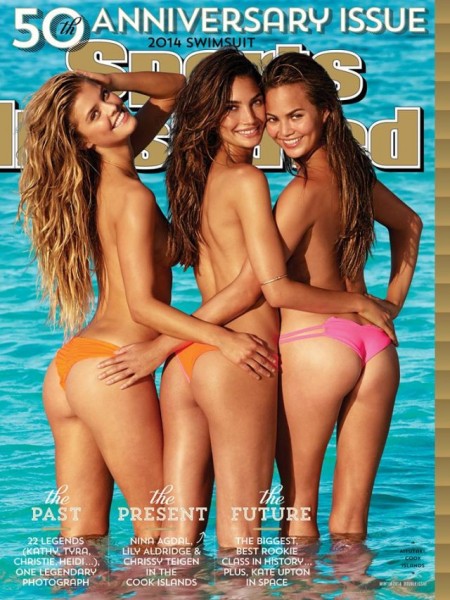
Isn’t this great, girls? Even if you aren’t skinny, you can pout doggy style in the surf! Yes, apparently, it’s true that even if you’re not a size zero, men will still want to fuck you. No worries, sweeties, you still have value in the world.
Maybe we can get a woman over 50 to pose in a bikini. Helen Mirren? Never mind that she’s a great actress, it’s her body we want to show off. What about a plus size woman of color? Now that would be a real leap towards equality.
Despite females’ increased participation in sport since the enactment of Title IX and calls for greater media coverage of female athletes, women appeared on just 4.9 percent of covers. The percentage of covers did not change significantly over the span and were comparable to levels reported for the 1980s by other researchers. Indeed, women were depicted on a higher percentage of covers from 1954–1965 than from 2000–2011.
Do you see we’re going backwards here? Putting a plus size woman on the cover of the SI swimsuit issue isn’t any kind of progress.
When Serena Williams made the cover of SI in 2015 as sportsperson of the year, she was pictured in stilettos and a black body suit, one bare leg slung over a chair.
Some defended Serena’s cover claiming it’s important to show that a woman can be powerful and sexy. But for men, it is their skill that makes them attractive. For women athletes, if they happen to be “attractive” it is in spite of their talent, not because of it. Men’s bodies are valued for what they can do while women’s bodies are valued for how they appear.
If you’re going to tell me this sexism is just innate, tritely quoting: “Women use sex to get power, men use power to get sex,” listen to me carefully: People who are not in power learn to survive and be successful by pleasing those who are in power. That need is the only thing innate about reducing talented, skilled, brilliant women to body parts. Men, as a group, not individually, are able to stay running the world as long as women, as a group, stay weak.
Here is what I blogged in 2014:
Memo to the world: objectifying fat women is objectifying women
Plus-size swimwear company Swimsuits for All set out to prove that “sexy curves go beyond a size four” by shooting its own swimwear calendar, including a picture reenacting this year’s Sports Illustrated swimsuit issue.
Are you kidding me? Do you think I’d be any happier if my 3 daughters saw that picture in the Safeway checkout line instead of this one?
All right, maybe I’d be a smidgen happier that my kids wouldn’t have to see more starving women defined as beautiful, but my goals and expectations are so much higher than what this image from Swimsuits for All represents. I want to see images of women where they are not defined by their sexuality, by whether whomever is looking at them finds them sexy or not, where what they look like in bathing suits is not the be-all end-all, where who thinks they are attractive only matters in a very particular context, like when they are with someone who they love or want to have sex with.
Swimsuits for All is in the business of selling swimsuits. The company has got to sell its product, so posing women in the merchandise that it’s marketing makes sense. I’m not indicting the company, but pretending as if seeing this image all over the internet is liberating is ridiculous. Also, it might be nice to see the women swimming in their suits. What about playing volleyball on the beach? Building awesome sandcastles? Doing something? There could be a shot of a woman or two sunbathing, as long as the “aren’t I sexy” poses were not the dominant, ubiquitous ones.
I’ve written this for a long time, but “fat” women beauty contests don’t represent progress. Women no longer paraded as meat is progress.
Still confused or want to see more images to make this point? Please take a look atReel Girl’s recent post: Why do men in America feel entitled to women? A gallery of reasons. You’ll see this famous painting by Manet (look she’s got fat rolls and she’s naked, isn’t that cool?) along with contemporary images of dressed men paired with naked women.
Yesterday, when my three daughters and I went to see “Minions,” two lingering questions I’ve had– are they really all male and if so, how did they come into being– were answered.
So, yes, now I know: the minions are all boys. When I’ve complained in the past about the utter lack of female minions, commenters responded that they’re “genderless.” In kidworld, where everything from robots to cars to planes are assigned a gender, I doubted this was the case, but I watched the new movie carefully just in case I was mistaken, that the minions were an exception to this rule. Guess what? Not only does every minion mentioned have a male name, but they are also repeatedly referred to as boys with lines delivered like: “Growing boy creatures need their strength” or “Good luck in there, boys!” or “Buckle up, boys!” So, please don’t waste your time emailing me that a 6 year old kid won’t notice what gender these creatures are.
Now, for question #2. The movie opens with a scene where the minions seem to evolve from amoeba like creatures that come out of the sea. Clearly, no female is involved in their reproduction. A male narrator describes their creation story and also how and why minions came to be: to serve an evil master. As evolution continues on the screen, we hear the narrator introduce “man.” We then see a caveman, followed by a series of other male leaders including a pharaoh and Napoleon. Around this point in the movie one of the minions, I think it was Bob, emerges from the sea wearing a pair of starfish on his chest in the first of several breast/ female jokes. Another minion sees Bob and quips: “He’s an idiot.”
Right after the narrator assures us this is going to be the same old, same old narrative we always see where one male saves the world, announcing: “One minion had a plan and his name was Kevin” I turned to my oldest daughter, who is 11. I told her I had to take a bathroom break and to watch for any female character who speaks, as none had come into the movie yet at all. My daughter responded, “Mama, the villain is a girl.” She was referring to Scarlet Overkill who she was familiar with from the many, many previews we saw of the movie. I, too, had high hopes for Scarlett even though as the only main female character in the movie, I was pretty sure she would be limited by the narrative to a Minority Feisty role.
For those who aren’t familiar with Reel Girl, Minority Feisty is the term I’ve assigned female characters in children’s movies. These females are “strong” and therefore often referred to as “feisty” by reviewers. “Feisty” is a sexist adjective. A reviewer would not label a male character, such as Superman “feisty.” “Feisty” refers to someone who isn’t really strong but plays at being strong. “Feisty” isn’t a real threat to any power structure. The Minority Feisty can refer to one or more female characters in a movie, the point being that though there can be more than one, females are shown as a minority population. The Minority Feisty represents our slow, slow, slow progress from the Smurfette Principle, a term coined by feminist writer Katha Pollitt. The Minority Feisty serves to pacify parents, so we can sigh in relief and say to ourselves: “There’s a strong female or two, this movie is feminist!” And thus, we’re all supposed to ignore and forget that girls– half of the kid population– are reduced to a tiny minority in the movie and almost never represent the protagonist.
Scarlet Overkill is one of the WORST EVER representations of the Minority Feisty. The male narrator introduces her at Villain Con: “There’s a new bad man in town and that man is a woman.” Then Scarlet is on the stage in her red dress and stilettos, saying: “Hey, a girl’s got to make a living.” She is the keynote speaker at the conference, defined as “the world’s first female supervillain.” Before Overkill came to town, she tells us, it was believed that “a woman could never rob a bank as well as a man.” Overkill proves them wrong, so YAY feminism, right? Let me remind you that the minions represent a fantasy world where little, yellow pill shaped creatures have sprouted from the sea. Why, why, why in “Minions,” and most other children’s movies, do we recycle sexism into so many stories that are otherwise imaginative and creative, because “that’s just the way it is in the real world?” Why does Scarlett Overkill have to be represented as an exception to her gender? Why can’t we show children a fantasy world where gender equality exists? “Minions” does the opposite, reproducing and in fact, managing to exaggerate sexism so that females have hardly any place or representation in the world at all.
You wouldn’t think it possible, but things get even worse for sexism and Overkill’s character. She wants the minions to steal the crown for her because she wants to be a princess– not a queen!– “because everyone loves princesses.” Is any kid watching this movie going to get a message of female empowerment from this single, sexist character? If you still have doubt, at the end of the movie, this first female greatest villain of all time, cedes her status to Gru who you know from the “Despicable Me” movies. It is he who is the real greatest villain of all time, Overkill’s 15 minutes are up.
I’m appalled and disgusted that movies like “Minions” are allowed to be made in 2015 and shown to little kids, teaching a new generation to expect and accept a world where girls go missing. If you think I’m overreacting, imagine the reverse: A movie about three female characters– Kara, Stella, and Becky, who lead an all female tribe. They defeat the first male super villain ever, while pursued in a world populated by hundreds of female villains, groups of all female police officers, troops of all female guards, and visit English pubs where almost everyone– except for the pink suited king– is also female. Would you notice the sexism? Would your kids? The fact that the lack of females in children’s movies– from protagonists to crowd scenes, from heroes to villains– isn’t glaringly obvious to us and our children shows how sexist the world is. In the fantasy world, anything is possible, even gender equality. If we can’t even imagine it, we can’t create it. Unfortunately, “Minions” teaches kids, one more time, that females don’t matter much at all.
Reel Girl rates “Minions” ***SSS*** for gender stereotyping
In the 5 years since I started Reel Girl, I’ve never done this before but comments on this post are now closed. Generally, I let most commenters post because the imbeciles inadvertently prove all of my points. But I’ve reached a point where there are too many trolls who repeat the same comments over and over and over, the same arguments (if they can be called that) which I’ve already rebutted numerous times. My energy needs to be focused on writing and creating, not reacting and responding.
In a patriarchal dystopia, once a year the public gathers for PR blitz that serves to solidify the foundations of this sexist society. This annual event celebrates narratives created by men, starring men, and produced by men with prestigious awards (golden men) bestowed by an organization made up of men. The messaging is clear: women’s stories don’t matter. Males attending this event, required to dress alike, are peppered with questions from journalists about their work while the females are encouraged to wear extravagant gowns to outdo each other. For the women, the competition is relegated to yet another beauty contest, where their looks– from hair to make-up to jewelry– are picked apart, the most common question: Who are you wearing? This ritual shuts down challenges or protests to the mantra of the civilization: Men are valued for what they do, women are valued for how they appear. This is the way it has always been and the way it will always be. It is human nature.
No, this is not a synopsis of Hunger Games 4, but the 87th Academy Awards, created by the good old United States of America, a country devoted to liberty and justice for all.
So how we explain this sexism? In 2015, 100% of the nominees for the greatest writers, the Best Adapted and Best Original Screenplay awards, the creators of our stories, are men. I really don’t get it. I thought girls were supposed to be verbal….
Cinematography– the eyes, the perspective, how we see– also 100% male nominees. What about the whole vision, the genius? The Best Director category is also made up of 100% males. No actor of color was nominated for both genders including the supporting actor category. A black woman has never never never been nominated for Best Director. This year Ava DuVernay was not chosen for her movie “Selma.”
Here’s a funny coincidence: The LA Times reports that the members the Academy of Motion Picture Arts and Sciences, the voting body, is 94 percent white, 2 percent African American, less than 2 percent Latino, and 77 percent male with the average age of 62. On Sunday night, the majority of winners will be middle aged white males.
Much has been written about the sexism and racism of the Academy Awards. I’m really blogging now to ask you to please consider not allowing your kids to see the show. Watching the Academy Awards is often a family event. It’s on early, a Sunday night, children are often lurking about. But this kind of TV is not mindless fun for kids; it’s one of the worst programs a child can take in. It’s not only the actual performance, where men win and win and win again, but the people watching in your living room, parents, relatives, friends, people who your kids look up to, will invariably be commenting on how the women look, who’s pretty, who’s neckline dips too low, and who looks too old ladyish. We are trained to judge and value women for how they appear, and if we can spare kids and their malleable brains this immersion in sexism, they will be better off for it. My advice is that if you’re watching the show, as I am, not to forbid your children from joining you because that will only make it appealing. Instead, distract them. Let them see a Miyazaki movie or something else good (links at the end of this post to great lists of Reel Girl’s recommended movies for kids) or set them up with an art project or have a friend over or play a board game if your spouse doesn’t want to watch (like mine.)
The alternative, if your child must watch, is to point out the sexism to her. Include her in Tweeting #AskHerMore every time you and she see an actress asked first, only, or mostly about her outfit. (I hope you will be Tweeting #AskHerMore if you’re watching at all) While Oscar media criticism can be educational for older kids, say 11 and up, I wouldn’t saddle younger ones with this vigilance. But I still advise not letting older kids watch. There’s the issue that you can’t control what other adults say, so unless you’re going to respond every time someone talks about how a woman looks, it’s better to have your kids out of the room. As parents, we need to do our best to create a world for our children that is the opposite of the one that the Academy Awards presents. We need to show them through conditioning that women’s stories are important.
The Academy’s snub of “Wild” really says it all.The star of the movie, Reese Witherspoon, is nominated for Best Actress and her co-star Laura Dern is nominated for Best Supporting Actress. “Wild” is beautifully directed by Jean-Marc Vallee, whose last movie, “Dallas Buyers Club,” was nominated for Best Picture and 4 other awards. In Slate, Dan Kois asks what’s the difference?
Well, Wild has sold more tickets. Wild is more artfully made—a more confident piece of filmmaking, one that finds an ingenious cinematic method to tell its intricate, emotional story. But the chief difference, of course, is that Wild is about a woman’s journey, not a man’s…
In some ways, the dismissal of Wild, and the frequent non-nomination of movies about women, calls to mind the ongoing debate in the literary world about the way critics and awards-givers dismiss “domestic fiction.” Wild is determinedly one woman’s story, and it doesn’t make a claim that Cheryl Strayed is an exceptional woman. She’s not a queen or a muse. She’s not a wife or a girlfriend. She’s flawed and sad in many of the same ways that all of us have been flawed and sad, especially in our early 20s. Her struggles are not world-historical but instead have to do with her mother, who dies unfairly early in life; with her ex-husband, whom she betrays again and again; with her body, which she numbs with heroin and casual sex, and then brutalizes hiking a thousand miles on the Pacific Crest Trail. Her struggle, in the end, is with herself.
That is to say, Cheryl’s story is a prototypical “woman’s story,” and thus one not worthy of a Best Picture nomination, apparently. In the past 20 years, only 21 movies that primarily tell the stories of women have been nominated for Best Picture, out of 125 movies nominated overall. This disparity reflects the reality of moviemaking in Hollywood, sure, but it also influences that reality. When the stories of women—those out in the world, living real human lives, existing not as auxiliary characters but as the heroes of their own stories—are deemed unsuitable of the industry’s biggest prize, it becomes harder to convince studios and producers to make those movies.
Teach your children that stories about girls and women matter. Don’t let them watch the Academy Awards.
Reel Girl rates the 87th Academy Awards ***SSS***
If you’re watching the Academy Awards on Sunday night, and you want to let your kids watch a movie, Reel Girl recommends the titles on these lists: