“As of today, Disney has quietly pulled the 2D image of Merida from its website, replacing it with the original Pixar version. Perhaps we’ll be spared an onslaught of sexy Merida merchandise yet.”
I guess Disney was right to be so terrified of creating a strong, BRAVE, female protagonist (along with Pixar studios which hadn’t had ANY female protags before “Brave.”) It looks like Merida could be turning Disney’s franchise on it’s head. That’s pretty damn heroic.
Another mistake Disney made with “Brave?” They hired a female director. They fired her, but it was too late. Brenda Chapman wrote “Brave” based on her daughter. She was furious with the character’s transformation and wrote publicly about Disney’s terrible mistake.
That’s right: Although Merida was created by a woman as a role model for girls, the male-dominated consumer product division at Disney has ignored the character’s intended benefits for young girls, sexualizing her for profit. Compared with her film counterpart, this new Merida is slimmer and bustier. She wears makeup, and her hair’s characteristic wildness is gone: It has been volumized and restyled with a texture more traditionally “pretty.” Furthermore, she is missing her signature bow, arrow, and quiver; instead, she wears a fashionable sash around her sparkly, off-the-shoulder gown. (As Peggy Orenstein noted when she broke the news of the redesign, “Moms tell me all the time that their preschool daughters are pitching fits and destroying their t-shirts because ‘princesses don’t cover their shoulders.’” I’ve heard the same from parents, as well.)
Is the sexualized image of Merida gone for good? Has Disney learned a lesson? Or will that lesson be: No more strong female characters leading a film! No more female directors writing about their daughters! Keep the females weak and quiet!
Objectifying and sexualizing girls is dangerous. A first step to abuse is always dehumanizing the victim. Propaganda, in the form of images and narratives, effectively dehumanizes on a mass scale.
Images/ narratives of Jews circa 1938
Africans circa 1931
Females circa 2013
It’s easy to look back on history and wonder: How did people ever put up with that? I’d never buy into it, not to mention expose my child to it. But what are you participating in right now that is completely accepted, not to mention celebrated, by our culture?
Be part of the solution. Demand narratives with strong female characters for your kids.
Update: New Merida may be off Disney’s site but she’s showing up all over the place including Target. Below is Target’s web page.
Thank you! I decided to be and stay childfree for the following reason: I’m asexual. The very thought of getting so close to a person repulses me. Also, I don’t like kids that much. But when people ask you this when you get a new job then that’s just horrible and a bit sad that they focus their attention towards this (you can’t get fired where I live if you get pregnant so that’s not a problem). Btw, I’m not outet do anyone but my closest friends so I guess even my parents might start asking questions…
I was intrigued by this comment, because I hadn’t heard anyone identify themselves as asexual before. I was also interested her phraseology, that she wasn’t “out” to anyone but her closest friends. That sounds like how people talk about being gay. I wondered: is asexuality is an orientation? And if so, how come I’ve never heard of it? If I thought asexuality existed at all, I imagined it was a phase, a result of some kind of trauma, something to be healed.
Because this is 2013, all I needed was Google to tell me how biased and ignorant I am.
Asexuality has 833,000 Google matches, not much compared to homosexuality at almost 27 million, but nothing to sneeze at.
An asexual person is defined as someone who does not experience sexual attraction. Asexuality differs from celibacy in that it is not a choice. Everything I found on the internet reports that asexuality is an orientation, not a defect. Asexual people have the same emotional needs as anyone else. They also can find people aesthetically attractive but still are not sexually attracted to them. They often have a romantic orientation. Emotional and romantic attraction are not the same as sexual attraction.Here is how the Asexuality Visibility Network describes it:
Many asexual people experience attraction, but we feel no need to act out that attraction sexually. Instead we feel a desire to get to know someone, to get close to them in whatever way works best for us. Asexual people who experience attraction will often be attracted to a particular gender, and will identify as lesbian, gay, bi, or straight.
Most asexual people have been asexual for their entire lives. It is not something that develops. It can be isolating and lonely to be asexual, but it doesn’t have to be. The key, as with everything, seems to be self-acceptance. Asexual people are often happy with who they are and many of them are also in long term, intimate but asexual relationships. Some are with sexual partners, but from what I’ve read so far, I don’t really get how that works. It seems to be a pretty individual thing.
After I read about asexuality, I was at a party and asked some people there about what I learned. No one I talked to had heard anything about asexuality. This group, by the way, included academics well versed in jargon like “heteronormative.”
To me, it seems like asexuality is further evidence that identity is far more complex and varied than we make it out to me. The way that many of us have one, rigid lens of looking at asexual people (as dysfunctional) that is so inaccurate, makes me think of the limited way people look at gender roles, so certain of ridiculous assumptions.
My guess is that we will be hearing more about asexuality in the future.
the black lady that does the news is a very nice lady. the only thing is she needs to wear a wig or grow some more hair. im not sure if she is a cancer patient. but its still not something myself that i think looks good on tv.
Lee responded:
Hello Emmitt–I am the ‘black lady’ to which you are referring. I’m sorry you don’t like my ethnic hair. And no I don’t have cancer. I’m a non-smoking, 5’3, 121 lbs, 25 mile a week running, 37.5 year old woman, and I’m in perfectly healthy physical condition.
I am very proud of my African-American ancestry which includes my hair. For your edification: traditionally our hair doesn’t grow downward. It grows upward. Many Black women use strong straightening agents in order to achieve a more European grade of hair and that is their choice. However in my case I don’t find it necessary. I’m very proud of who I am and the standard of beauty I display. Women come in all shapes, sizes, nationalities, and levels of beauty. Showing little girls that being comfortable in the skin and HAIR God gave me is my contribution to society. Little girls (and boys for that matter) need to see that what you look like isn’t a reason to not achieve their goals.
Conforming to one standard isn’t what being American is about and I hope you can embrace that.
Thank you for your comment and have a great weekend and thank for watching.
KTBS defends its decision to fire Lee, claiming that she violated a company policy, one that she has allegedly violated before, concerning social media.
If harsh viewer comments are posted on the station’s official website, there is a specific procedure to follow. Ms. Rhonda Lee was let go for repeatedly violating that procedure after being warned multiple times of the consequences if her behavior continued. Rhonda Lee was not dismissed for her appearance or defending her appearance. She was fired for continuing to violate company procedure.
Lee said that she has yet to see this policy.
Lee’s response to the comment couldn’t have been more calm, focused, or right on target. It gave me chills to read it. How could someone in management (if they planned on responding at all rather than ignore it, that is, allow it) have responded any better than that? Do you think they would have or could have written:
Little girls (and boys for that matter) need to see that what you look like isn’t a reason to not achieve their goals.
No one could say that but Lee, the victim of the sexism and racism. She has to speak for herself, without shame. That is the lesson to teach kids about bullying, racism, and sexism.
But instead, the lesson learned is that when Lee refused to be a silent victim, she was punished. Fired. How can a nation that acts like it is concerned about bullying, whose President speaks on the issue and says its important one for the whole country, allow this to happen?
Livingston defended herself in an on air editorial that lasted longer than four minutes. She finished her statement by thanking her colleagues, family, friends and all the others who came to her defense. Her story made headlines and she was on “Good Morning America” talking about her experience.
Just like Lee, Livingston mentioned young people:
“This was a personal attack,” Livingston said. “Calling me obese is one thing. Calling me a bad role model for our community that I’ve worked at for 15 years and especially for young girls when I have three girls was a low blow and I thought it was uncalled for and I wanted to call him out on it.”
Livingston also urged children who were victims of bullying to defend themselves, a lesson she says she teaches her own daughter. By making her speech on TV, Livingston walked her talk.
It is particularly important that women speak out publicly because, historically, women have been shamed into silence. This shaming/silence tactic is evident with everything from rape to sex tapes; again and again, it is the victim and not the perpetrator who is supposed to be humiliated.
Just yesterday, Anne Hathaway was “shamed” when someone took a photo of her. When Matt Lauer smirked during a scheduled interview on the “Today Show” that he’d seen a lot of her lately, Hathaway didn’t hide away, but responded: “I’m sorry that we live in a culture that commodifies the sexuality of unwilling participants.” By speaking out, Hathaway directed the shame back where it belongs, on Lauer for his idiotic comment when she was trying to promote her movie, on the photographer who took the photo, and on the one who paid for the picture.
The attack on Lee is sexist. No one would be upset about that hairstyle if she were male. The taunting and comments that women receive on the internet about our appearance is epidemic and shows that sexism is alive and well in America. Attacking women for how they look, just putting out the threat that women could be attacked for how they look, has been an effective way to keep women in their place for much too long. Courageous and public acts like Lee’s and Livingston’s show all women how to deal effectively with this kind of bullying.
Of course, the attack on Lee is also racist.
It’s great that media outlets, viewers, activists, and colleagues supported Livingston when she defended herself against a bully. Lee deserves that same support now. That racism and sexism are protected in America in 2012 so that a woman defending herself against it loses her job makes me sick.
Last night, like almost every Thursday night due to my tabloid addiction, I crawled in bed to relax with my new issue of Us Weekly. In a photo spread titled “Klum’s Favorite Halloween Costumes,” featuring pics from Heidi Klum’s annual party, I saw this picture of Fergie’s Halloween costume. I, literally, felt nauseated.
If you care at all about the sexualization of little girls, why would a grown woman dress up as a little girl dressed up as a woman (assuming little girls with their make-up and curled hair aspire to imitate older beauty queens and not Martians.) Talk about blurring boundaries between sexualizing little girls and adults. I just blogged about the conundrum of Batgirl, and I can barley get my mind around this costume. The bobby socks and the teddy bear? Ugh.
But here’s what Heidi Klum has to say about it: “Accessories can put a costume over the top! Fergie couldn’t have looked any better as a pageant girl.”
Right now, all I can say is GROSS. Bad move, Fergie, Heidi Klum, and Us Weekly.
The night before Susan and Rob allowed their son to go to preschool in a dress, they sent an e-mail to parents of his classmates. Alex, they wrote, “has been gender-fluid for as long as we can remember, and at the moment he is equally passionate about and identified with soccer players and princesses, superheroes and ballerinas (not to mention lava and unicorns, dinosaurs and glitter rainbows).”
Here, the writer, Ruth Padawer, sets up a series of stereotyped binary/ boy-girl opposites: soccer players and princesses, superheroes and ballerinas, lava and unicorns, dinosaurs and glitter rainbows. I waited for her to explore any reasons why our culture promotes this symbology. Unfortunately, I waited for the whole article.
Why are princesses considered to be the epitome of femininity? Could it, perhaps, have little do with with genes and everything to do with the fact that perpetuating the image of a passive, “pretty” female is popular in a patriarchal culture? Just maybe?
A few more sentences down:
Some days at home he wears dresses, paints his fingernails and plays with dolls; other days, he roughhouses, rams his toys together or pretends to be Spider-Man.
Most kids on Planet Earth would paint their fingernails if they weren’t told and shown by grown-ups that it’s a “girl thing.” Nail polish has nothing to do with penises or vulvas or genes, or even anything as deep and profound as “”gender fluidity.” To kids, nail polish is art play, brushes and paint. That’s it. Oh, right, art is for girls. Unless you’re a famous artist whose paintings sell for the most possible amount of money. Then art is for boys.
On an email that Alex’s parents sent to his school:
Of course, had Alex been a girl who sometimes dressed or played in boyish ways, no e-mail to parents would have been necessary; no one would raise an eyebrow at a girl who likes throwing a football or wearing a Spider-Man T-shirt.
What? Does this writer have young daughters? Has Padawer heard about the boy’s baseball team from Our Lady of Sorrows that recently forfeited rather than play a girl? Or what about Katie, the girl who was bullied just because she brought her Star Wars lunch box, a “boy thing,” to school? Does Padawer know Katie’s experience isn’t unusual? How rare it is to find a girl today who isn’t concerned that a Spider-Man shirt (or any superhero shirt or outfit) is boyish and that she’ll be teased if she wears it? My whole blog, Reel Girl, is about that “raised eyebrow.” Has Padawer seen summer’s blockbuster movie “The Avengers” with just one female to five male superheroes? The typical female/ male ratio? Or how “The Avengers” movie poster features the female’s ass? Think that might have something to do with why females care more than males about how their asses are going to look? You can see the poster here along with the pantless Wonder Woman. Does Padawer get or care that our kids are surrounded by these kinds of images in movies and toys and diapers and posters every day? How can Padawer practically leave sexism out of a New York Times piece 8 pages long on gender?
First sentence of paragraph 3: (Yes, we’re only there.)
There have always been people who defy gender norms.
No way! You’re kidding me. Like women who wanted to vote? Women who didn’t faint in the street?
Moving on to page 2:
Gender-nonconforming behavior of girls, however, is rarely studied, in part because departures from traditional femininity are so pervasive and accepted.
Um, wrong again. Been to a clothing store for little kids recently? Ever tried to buy a onesie for a girl with a female pilot on it? Or a female doing anything adventurous? Check out Pigtail Pals, one of the few companies that dares to stray from “pervasive and accepted” femininity. One of the few. And we’re talking toddlers here.
The studies that do exist indicate that tomboys are somewhat more likely than gender-typical girls to become bisexual, lesbian or male-identified, but most become heterosexual women.
Is the writer really writing a piece on gender fluid kids and using the word “tomboy” without irony?
Next page:
Still, it was hard not to wonder what Alex meant when he said he felt like a “boy” or a “girl.” When he acted in stereotypically “girl” ways, was it because he liked “girl” things, so figured he must be a girl? Or did he feel in those moments “like a girl” (whatever that feels like) and then consolidate that identity by choosing toys, clothes and movements culturally ascribed to girls?
Hard not to wonder. Exactly! Finally, the writer wonders. But, not for long. Here’s the next sentence:
Whatever the reasoning, was his obsession with particular clothes really any different than that of legions of young girls who insist on dresses even when they’re impractical?
Once again, I’ve got to ask: Does Padawer have a young daughter? Legions of young girls “insist on dresses” because like all kids, they want attention. Sadly, girls get a tremendous amount of attention from grown-ups for how they look. Today, my three year old daughter wanted to wear a princess dress to preschool, because she knew that if she did, the parents and teachers would say, “Wow, you’re so pretty! I love your dress.” And if it’s not a girl’s dress everyone focuses on, it could be her hair, or perhaps her shoes which are probably glittery or shiny or have giant flowers on them because that’s what they sell at Target and Stride Rite. Unfortunately, focusing on appearance is how most adults today make small talk with three year old girls.
The next two graphs are the best in the article so I will paste them in full, though notice the use of “tomboy” again with no irony.
Whatever biology’s influence, expressions of masculinity and femininity are culturally and historically specific. In the 19th century, both boys and girls often wore dresses and long hair until they were 7. Colors weren’t gendered consistently. At times pink was considered a strong, and therefore masculine, color, while blue was considered delicate. Children’s clothes for both sexes included lace, ruffles, flowers and kittens. That started to change in the early 20th century, writes Jo Paoletti, a professor of American studies at the University of Maryland and author of “Pink and Blue: Telling the Boys From the Girls in America.” By then, some psychologists were arguing that boys who identified too closely with their mothers would become homosexuals. At the same time, suffragists were pushing for women’s advancement. In response to these threatening social shifts, clothes changed to differentiate boys from their mothers and from girls in general. By the 1940s, dainty trimming had been purged from boys’ clothing. So had much of the color spectrum.
Women, meanwhile, took to wearing pants, working outside the home and playing a wider array of sports. Domains once exclusively masculine became more neutral territory, especially for prepubescent girls, and the idea of a girl behaving “like a boy” lost its stigma. A 1998 study in the academic journal Sex Roles suggests just how ordinary it has become for girls to exist in the middle space: it found that 46 percent of senior citizens, 69 percent of baby boomers and 77 percent of Gen-X women reported having been tomboys.
The piece is riddled with more gender assumptions that aren’t questioned.
When Jose was a toddler, his father, Anthony, accepted his son’s gender fluidity, even agreeing to play “beauty shop.”
But why is beauty shop feminine? We all know beauty toys and products are marketed to girls, but why? Here’s that Avengers ass poster again. In a male dominated world, women are valued primarily for their appearance. They are taught to focus on how they look and that if they do so they can get power and prestige. Appearance is the area where girls are trained to channel their ambition and competition. Oh, sorry, girls aren’t competitive or ambitious. That’s a boy thing.
On gender fluid child, P.J., the author writes:
Most of the time, he chooses pants that are pink or purple.
Wait a minute, didn’t she write a few pages back about Jo Poletti’s book Pink and Blue? Remember, pink used to be a “boy” color; it’s only recently that it’s perceived as a “girl” color?
Here might be the most fucked up quote:
When a boy wants to act like a girl, it subconsciously shakes our foundation, because why would someone want to be the lesser gender?
i am NOT the lesser gender!
why can’t people see how insulting that is? i mean, who would *openly* call a race or ability or sexual orientation “lesser” and not largely be considered a bigot?
It was that comment that inspired me to write this post, because the whole piece is insulting to girls and women. I hope it’s insulting to boys and men as well.
Sugar In My Bowl, an anthology of women writing about sex, edited by Erica Jong, will be released in paperback on June 26.
Critics have called the collection a “fierce and refreshingly frank collection of personal essays, short fiction and cartoons celebrating female desire…A smart, scrumptiously sexy romp of a read.” (Read more reviews here.) My short story, “Light Me Up,” is included in the anthology along with essays and fiction by 28 other writers.
Erica Jong talks to Reel Girl about Sugar In My Bowl:
Why did you create this anthology?
I think women have more diverse responses to sexuality than is usually known. And I wanted the opportunity to show a full range of response.
How did you choose the writers?
Notice that the anthology is almost equally divided between well-known writers and writers who are published for the first time. It was wonderful to find writers, like you, who had not been published before and to pair them with well-known writers like Eve Ensler and Fay Weldon.
When the hardcover came out last summer, in a controversial essay for theNew York Times, you wrote that after putting Sugar In My Bowl together, you wondered if younger women wanted to give up sex. You worried that the younger writers in the anthology seemed obsessed with marriage and monogamy. I admit I am obsessed with monogamy! In part because in so much fiction, the woman’s story just stops when she marries.
For women of my generation– I’m 43, Gen X– because of a lot of taboo busting by yours, being single and sleeping around was pretty safe and normal. At least if you lived in New York or San Francisco and carried condoms. It wasn’t radical to be promiscuous, it was expected. But picking just one guy to love and lust for, committing to him, having a baby with him– that is fucking terrifying. And not because it’s a novelty. I think that our generation, and those after us, see marriage more clearly for what it is: high-risk behavior.
We don’t need men to be our breadwinners or to provide social acceptance for us, so why do we still marry? Why do we, literally, put all our eggs in one basket? I think because we’re brave romantics.
Do you think that women can be obsessed with monogamy and sex? Does it have to be an either/ or situation?
I have also been concerned that the women’s story stops with marriage. In our time, the women’s story sometimes stops with divorce. People live much longer today and have many different adventures in their lives. Many of them marry several times. We don’t have women’s books that reflect this yet.
I think we get married to make a statement that this is my person, and we are determined to make things work. That sort of coupling seems essential for both straight and gay people. It’s a way of saying, here I stand. And this is my partner.
Certainly monogamy and sex can go together. For many people, monogamy is far more satisfying than zipless fuck. You have to know another person’s body to really have great sex. That kind of knowing may come with monogamy.
“The Internet obliges by offering simulated sex without intimacy, without identity and without fear of infection. Risky behavior can be devoid of risk — unless of course you use your real name and are an elected official. Not only did we fail to corrupt our daughters, but we gave them a sterile way to have sex, electronically. Clearly the lure of Internet sex is the lack of involvement. We want to keep the chaos of sex trapped in a device we think we can control.”
I totally agree with this, and it is something I wrote my story about, too. Porn and internet sex are actually the “safest” sex around.
What do you think about the future of sex as far as the promulgation of pornography? How do you talk about its negative effects without being labeled and misunderstood as an anti-sex prude?
Electronic sex is sterilized sex. It offers no risk. It is sanitized. Real sex with a partner is the opposite. Pornography has a very utilitarian function. It is specifically for getting you off, hence its predictability. Sexual literature, on the contrary, is surprising. It doesn’t just show sexual acts, but the feelings behind them. I’m all for sexual literature and kind of bored by strict pornography. What interests me in writing is the human brain revealed. Pornography does not reveal feelings. It is rather a utilitarian form for masturbation.
Author Peggy Orenstein also addresses this flip, when pro-sex is framed as anti-sex and vice versa, in her book Cinderella Ate My Daughter. Here’s what she wrote about the sexualization of girls:
“Let me be clear here: I object– strenuously– to the sexualization of girls but not necessarily to girls having sex. I expect and want my daughter to have a healthy, joyous erotic life before marriage. Long, long, long before marriage. I do, however, want her to understand why she’s doing it: not for someone else’s enjoyment, not to keep a boyfriend from leaving, not because everyone else is. I want her to explore and understand her body’s responses, her own pleasure, her own desire. I want her to be able to express her needs in a relationship, to say no when she needs to, to value reciprocity, and to experience true intimacy. The virgin/ whore cycle of the pop princesses, like so much of the girlie girl culture, pushes in the opposite direction, encouraging girls to view self-objectification as a feminist rite of passage.”
She goes on label this difference sexualizing versus sexuality. What do you think of that distinction?
I agree with Peggy Orenstein’s wishes for her daughter. I am appalled at the idea that young women give blowjobs without experiencing pleasure themselves. They are servicing men rather than experiencing eroticism themselves. I also agree that women should write their own sexual stories. We are so much more imaginative than men have supposed. We can make our sexuality even more various through our imaginations. My anthology is a first attempt to show how imaginative women can be.
I view the pop princesses as sanitized rather than erotic. Why are we attempting to claim that all women must be princesses? Isn’t that another attempt to sanitize sex?
It seems to me that the best way to combat the dominance of limited expressions of sexuality is for more women to write their own stories.
For thousands of years women have existed in a world dominated by narratives created by men.
I love that you put together an anthology about sex by women writers and mixed fiction with non-fiction. Why did you choose to include both genres?
The line between fiction and non-fiction has blurred in our age. Memoir bleeds into fiction, and fiction bleeds into memoir. What is important about a story is that it moves you. Not what genre you label it.
Do you have plans for more anthologies?
I would love to do another anthology of women’s writing. I was disappointed that I didn’t get more sexual diversity and ethnic diversity. It was not for lack of trying. I would like to do an anthology with more lesbian women’s experiences, and a wider range of ethnicities.
What are you working on now?
I am working on a novel about Isadora Wing as a grandmother.
The Lusty Lady, the nation’s only employee-owned, unionized strip club, is in financial trouble and in danger of closing down.
The SF Chronicle reports that the club, which makes an effort to employ “diverse body types and ethnically diverse dancers” has come across hard times due to the recession and internet porn. Now it’s looking for an angel investor who believes the club is a model worth saving:
..the ladies argue they are one of only two privately owned venues left in the city – the rest have gone corporate with strippers that look like Barbie dolls. They don’t serve alcohol (which also allows them to put on a totally nude show). And they made “talk to a live, nude girl” a local catch phrase.
“We’re a San Francisco institution,” said Dolores, a dancer since 2005 who named herself for Mission Dolores Park. “If you can walk into a place, pay a dollar, see a beautiful nude girl and give her a wave, there’s something to be said for that.”
When I graduated from college in the early Nineties, I became aware of a term: “sex-positive feminism.” The term is obviously problematic because it assumes other feminists are “sex negative,” a stereotype used to caricature feminists.
The “sex-positive” group includes Susie Bright, Annie Sprinkle, and Carol Queen: feminists who were often sex workers, performers, or pornographers; they were supposed to contrast with anti-pornography activists like Andrea Dworkin, Catherine Makinnon, and Robin Morgan.
At that time in the Nineties, I did think that a lot of porn exploited women. But I also thought that healthy sexuality and sexual expression were key to being a free and healthy human being. Shame is a powerful tool and society uses it to control women just as parents use it to control kids.
When I was a kid, I remember being excited when Vanessa Williams became the first African-American to win the Miss America title. I thought that was great sign for more diversity in perceptions of beauty. But then nude photos of Williams surfaced and she was forced to give up her crown. Even as a kid, I didn’t get the difference between a woman being celebrated for parading around in a bathing suit but then being shunned for posing naked for a photo.
A couple years after the Williams scandal, nude photos of Madonna surfaced. I remember bracing myself for another fall. When Madonna’s response was “Who cares?” I was so surprised and psyched. I started to wonder: what if women refused to let the fear of being shamed hold them back? What could they do? What would they be capable of?
So called “sex-positive” feminism is often portrayed as that exciting, the battle of truth versus hypocrisy; free imagination versus the uptight masses; young versus old.
But is it really?
I remember seeing the movie “The People Versus Larry Flynt,” where Flynt was depicted as a true freedom fighter, a crusader for free speech. But no matter how much I tried to be open-minded, it was clear to me that Flynt was no advocate for women’s free self-expression.
So is stripping empowering for women? It’s certainly become mainstream, showing up in everything from music videos to pole-dancing exercise classes. I suppose most women have experienced moments where it feels intoxicating to control men with their bodies. But it’s a different thing to link up those moments into a profession, to transform them into something that your financial security depends on. That seems like engaging in a losing if not risky battle, both for a dependable income and for establishing a healthy sexuality.
As author Peggy Orenstein explains so well, there is a huge difference between sexualization and sexuality. Sexualization is sexuality as performance and not a healthy, integrated sexuality. Unfortunately, sexualization has become so confused with real sexuality, it’s hard to separate it, to define what real sexuality is. One example of this is how we perceive breasts. Breasts are secondary sex characteristics, existing in part to give women pleasure. But when they are replaced by implants, breasts become homogeneous; visual stimulation for a men and a more numbed experience for women.
Which brings me back the Lusty Lady. This club boasts diverse bodies. Real breasts. So is that empowering?
I suppose it’s a question that only dancers can answers for themselves. When I interviewed Jillian Lauren, author of the book Some Girls about her sex work in Brunei, I asked her about it. Here’s what she said:
I really came into the feminist movement with a very particular viewpoint. And in the early nineties, when I was coming of age, there was this sex-positive explosion in the feminist movement. There was Susie Bright and Carol Queen and a bunch of bright, incredible women who were very vocal about being sex positive. Now I’m friends with a lot of these women. I do absolutely consider myself part of that camp. However, Its not simply about, “Sex work is so empowering, hooray.” Because that’s not how I feel anymore, now that I’m out of it and have lived with the consequences for 20 years. Sex work affected my relationship with my body, with my sexuality.It still has a ripple effect in my life. Taking your clothes off for money is a valid choice. For some women, maybe it’s the only choice. Certainly decriminalizing prostitution and having health care available for sex workers would help. But I don’t think it’s the greatest thing women can do for our souls, for the most part.
Maybe asking if the Lusty Lady is a feminist model or a sex positive one is the wrong question. Sex workers are workers. Like all workers, they should to be fairly paid and free of discrimination for age, gender, size, sexual orientation, or ethnicity. That’s a business model that every worker should be fighting for.
Last week, I found myself in Golden Gate Park with an hour of time to kill, and I wandered into the de Young. The current show is about Jean Paul Gaultier, and though the subject didn’t interest me, I so rarely get to museums these days that I bought a ticket.
Going to this exhibition was like entering another world. I lost track of time, space, and reality. The exhibition is a visual, sensory, heady experience that blew my mind.
When you enter the show, the lighting is dimmed. You are surrounded by mannequins lit up and looming over you. My perspective was immediately altered. As I tried to get my bearings, I realized that the mannequins lips and eyes were moving. One looked down and smiled shyly at me. Then he started to sing in French. Was he real? I looked down at his naked torso which was clearly plastic. Turning around, I surveyed the other mannequins. They were everywhere, twitching lips, bursting into toothy grins, and talking. It was like being in a room full of zombies. And there was room after room after room of them.
Finally, I noticed the clothing: layers of sequins, lace, and feathers. As I looked at the fashion, I felt, for the first time in my life, that I was seeing/ experiencing clothing as art. It occurred me that Jean Paul Gaultier is not an evil man who wants to keep women down by creating expensive dresses for anorexics. His intention, though the effects are not so great, isn’t bad. Women’s bodies are his canvases.
That’s not such a great position for women, of course. And the notion goes back to John Berger’s great book about art, Ways of Seeing, where he writes: “Men watch. Women watch themselves being watched.” That analysis applies not only to visual art but literature as well, where women mostly exist mostly through men’s eyes. This has happened to women for so long that it has become how we think about ourselves as well: from a male perspective. I’ve blogged about this a lot: men aren’t bad, they’re just self-centered like all humans are. That’s why we need more women artists to tell their own stories. The problem is that all art is derivative, so at this point, I don’t think its possible to tell a story without it being influenced by the thousands of years of that male perspective.
I escaped the zombie rooms for a few minutes, walking into an area with a giant, pink, quilted cube in the center. On each face of the cube was an open window with garments on faceless mannequins. I realized I was looking at the bustier Madonna wore in her Blonde Ambition tour. She is quoted:
“Gaultier’s corsets are very sexy looking, and I consider wearing them a form of personal expression. The practice is oppressive only if it is forced, and women today can choose to wear them or not; it is up to them. Plus I wore those corsets as garments–-on the outside–not as underwear hidden beneath my other clothes, the complete opposite of the way they were traditionally worn in order to achieve a certain shape. I think that inversion of the concept of the corset is what turns it into a symbol of feminine power and sexual freedom.”
I don’t agree that women have the free choice to wear what they want. Figuring out what we want can be like walking through a labyrinth. I sound like Freud here, but with so many images marketed to us and because when you look a certain way you are more easily rewarded with success and power, how can we really choose freely? Even if we choose not to “fall into that trap” is that really what we want? Rebellion adheres to the same rules as conformity if you are systematically breaking all the rules that you would otherwise be following. That’s not “free choice” either. Which brought me full circle: because we don’t really know and can’t possibly tell what free choice is given our culture and how we all internalize it, I appreciate Madonna playing with the images. Madonna’s performance– and Gaultier’s– makes you think, makes you see fashion, physical bodies, and gender in a different way. That’s pretty cool.
Under another corset, Madonna is pretty much quoted as saying just that. She explains her goal in asking Gaultier to redo the velvet cone bras for her “Vogue” video: “Playing with the idea of gender and what is masculine and feminine, and giving it a theatrical, humorous twist–it was a kind of political statement.”
I highly recommend this show but it has adult themes so don’t bring kids.
Reel Girl rates Jean Paul Gaultier: From the Sidewalk to the Catwalk ***H***
To anyone who thinks this S & M-M & M is outdated because it’s from a few years back:
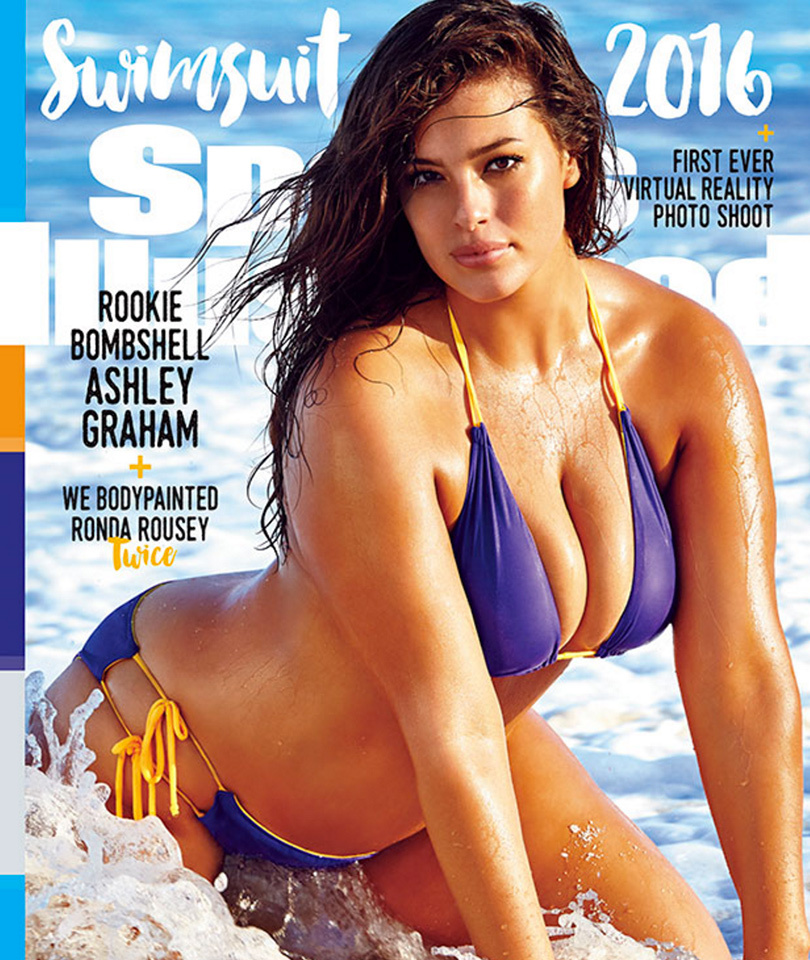
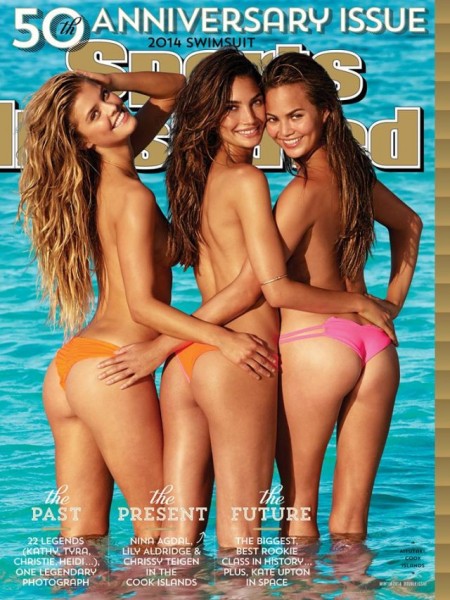
Here is Ms. Brown on back cover of the 2012 Sports Illustrated swimsuit issue:
To anyone who thinks that I just have a dirty mind and there’s nothing sexualized about M & Ms for God’s sake, here is how Sports Illustrated promotes the ad on its own Facebook page: Sports Illustrated Swimsuit: “Did you see the sexy Ms. Brown made the cover of the Swimsuit issue again!? Welllll, the back cover; Check her out.”
Keep in mind that Ms. Brown is the new female, that before her debut on TV during this year’s Superbowl, even Time Magazine called the animated M & M characters “male-centric.” Ms. Brown has since been called the feminist M & M (as opposed to the boy-crazy Ms. Green.) Brown wears glasses (that means she’s smart!) and tweets empowering messages about women’s issues.
So why is our token feminist character peeking out the window with kissy-lips waving a towel (implying she’d naked, I guess?) on the back cover of SI, so in full view of any kid whose parents have this magazine at home?
Why does M & Ms have to sexualize its female cartoon characters? Before Ms. Brown, there was only one female out of five; now there are 2 out of 6, and this is what M & Ms does to them? These cartoon characters appear in toys, games, and in full size at CVS and Party City stores.
Why are we allowing these stereotypes to sell sexism to kids in any available blank space? If M & Ms promoted racial stereotypes, there would outrage. Parents, this is not OK.
Please go to M & Ms Facebook page and tell the company to stop sexualizing females. As I posted earlier, the M &Ms marketing strategy is just as sick as using a cartoon camel to sell cigarettes to kids.
Update: I am getting comments that the M & M pictured above is actually Ms. Green, that green thing she’s waving? It’s her shell which she has stripped off and is waving to show that she’s naked. I have seriously lost my appetite for M & Ms. Gross. Thoughts?