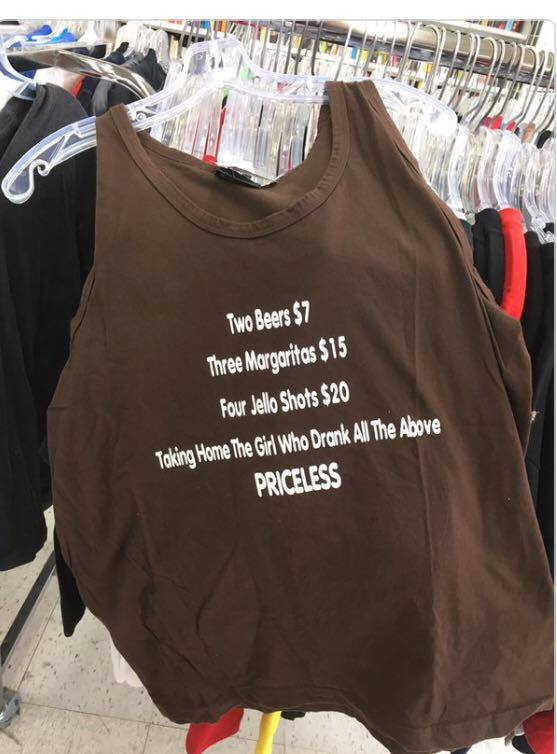
I’m exhausted by responding to endless images and narratives that normalize rape and the oppression of women. But I guess that’s the point, right? You just run out of energy. We can’t let that happen so I did some research. Turns out the shirt is made by a company called Iron Horse Helmets. Though it can be difficult in these instances to figure out who created the thing you’re trying to protest, a quote on the Iron Horse site makes it pretty clear:
Not afraid to express yourself? Good, our Tees got attitude and something to say. Make a statement or make ’em laugh with T-shirts from Iron Horse Helmets. Got a great idea for the next Iron Horse Helmet T-shirt, send it to us – we won’t give ya nothing for it, but we might use it and will be sure to take all the credit for it.
Please contact Iron Horse Helmets and tell them you’re #NotBuyingIt. Let them know promoting rape isn’t funny, it’s dangerous. I can’t believe that statement is the radical one.
Thank you for your brilliant comment, Maya. So sorry you have to grow up in a culture that is so horrifyingly sexist, but your imagination will continue to protect you. Your costume sounds great! Please send me a pic of you on Halloween. And you can call me Margot : )
Dear Mrs. Magowan:
My name is Maya, and I am an eleven-year-old girl. I am a big fan of Star Wars, and having read your blog for a long time, I am fully aware of the sexism in the movies. I could go on for hours about Princess Leia, Padme Amidala, the sparse females, and their sexual objectification (such as in Leia’s metal bikini), and I thank you for bringing attention to that issue.
Yesterday, my mom and I were browsing the website of Five Below and saw a very cool Star Wars T-shirt with pictures of many of the iconic characters, such as Luke Skywalker, Han Solo, Darth Vader, and R2-D2. I was psyched looking at the shirt, until I realized something. “Where’s Princess Leia?” She was one of the main characters of the series, in addition to being the ONLY female. She needed representation. So on a shirt dominated by males, where the heck was she? I had the same problem when we were looking for Star Wars shirts at Wal-Mart. One of them had Star Wars characters in 8-bit pixelization. It was a really cool and fun shirt, but it had the same problem: although it depicted Luke Skywalker, Han Solo, Stormtroopers, and even R2-D2, Leia – the only female character (and a totally kickbutt one at that, a perfect role model for girls AND boys) – was nowhere to be found.
Females need representation, in both girls’ AND boys’ merchandise, to show BOTH genders that in the world of fantasy, both males and females can do amazing things. So even if it IS a “boys’ shirt,” that’s no excuse for Princess Leia not to be there. I’m so glad Target realizes this, by showing Star Wars fans of both genders playing together. That advertisement sends the perfect message, and I’m grateful to Target for doing so. I would also like to thank you, Mrs. Magowan, for blogging about it and spreading the word to even more people.
I also have one more thing to share with you. Since I love Star Wars so much, I am probably going to dress in a Star Wars-themed costume for Halloween. The problem is, girls don’t have many options for Star Wars Halloween costumes. Boys have tons of Jedi, Sith, aliens, rebels, troopers, and even droids to choose from. Girls have Leia, Padme, Hera and Sabine from “Rebels,” and Ahsoka from “The Clone Wars.” That’s it. And although Padme practically has a new costume in every scene change and Leia’s wardrobe is nothing to sneeze at either, that is still very few options compared to the boys. Don’t fault the girls for that; fault the makers of Star Wars, for giving them so few choices in a franchise girls can love just as much as boys.
Even worse, my mother and I were browsing Star Wars costumes on the Internet, and almost every female costume for adults that we saw was SEXY. For every Darth Vader costume for males, there was a Sexy Sabine or Sexy Leia costume in revealing dresses that they were NEVER portrayed as wearing in the movies…or, even worse, a Sexy Darth Vader, complete with skintight “armor” and a miniskirt. Boys could have actual costumes that were actually relevant, true to the movies, heroic-looking, and covered them up well. If they were real heroes, they would be able to move, fight, and win in the outfits. Girls’ costumes needed to be sexy, skintight, and disturbingly explicit. There would be no way they would be able to move around or fight in those costumes, let alone do anything but LOOK pretty. The boys looked like heroes. The girls looked like objects for the boys to win. (On another note, wouldn’t people who wore those costumes be cold on Halloween? I mean, it’s an autumn night at the end of October. It’s going to be cold. People need to be covered up and warm, and sexy costumes are disturbingly impractical.) I decided to dress as a Jedi for Halloween. Since so many people were going to dress as human Jedi, I decided to do something different and go as an alien Jedi – a Twi’lek, which is the alien race of Hera from “Rebels”. We were browsing pictures of Twi’leks online, and all of the shown pictures looked disturbingly sexy and explicit – anorexic, supermodel-looking extraterrestrials with impossibly large breasts and barely anything to hide their privates. We had to look and look to find a picture of a Twi’lek that was actually well-covered-up, in cool Jedi robes, that actually looked appropriate. That is what I’m going as for Halloween. Interestingly, all the male Twi’leks were muscular, heroic, and not explicit at all. Hmm…I wonder why?
In conclusion, I would like to thank you for starting up this blog and making the sexism that plagues our society known to the world, especially in the fantasy inhabited by kids. When we are children, our minds are most vulnerable and open to new ideas, and when marketers shape those minds with sexism, that is a terrible thing. Thank you for helping make those ideas known to society and doing your part to eradicate sexism, empower women, and ultimately, lead to true gender equality.
Just weeks after getting rid of gender-segregated toy aisles, Target put out an inspiring new ad showing girl and boy “Star Wars” fans playing together. Check it out.
YAY Target! THANK YOU. I did all of my back to school shopping at your store and will continue to shop the hell out of your chain whenever I need supplies for my children. I’ve got to admit, part of me can’t believe this blog post has to be written at all, that I feel the need to congratulate Target and express my gratitude, that my headline isn’t satire that belongs on The Onion. But sadly, as the mom of 3 daughters, I speak from endless personal experience of the rampant sexism in kidworld where gender equality is hardly allowed to exist even in our imaginations. Here’s a video where my youngest child, like many kids in America, was teased at preschool for wearing “boy shoes” in her case, “Star Wars” sneakers.
It’s kids like her who Target is helping now, because in spite of my daughter’s promise to keep wearing those shoes, and in spite of having a feminist mom, she was “choosing” “gender appropriate” footwear by kindergarten.
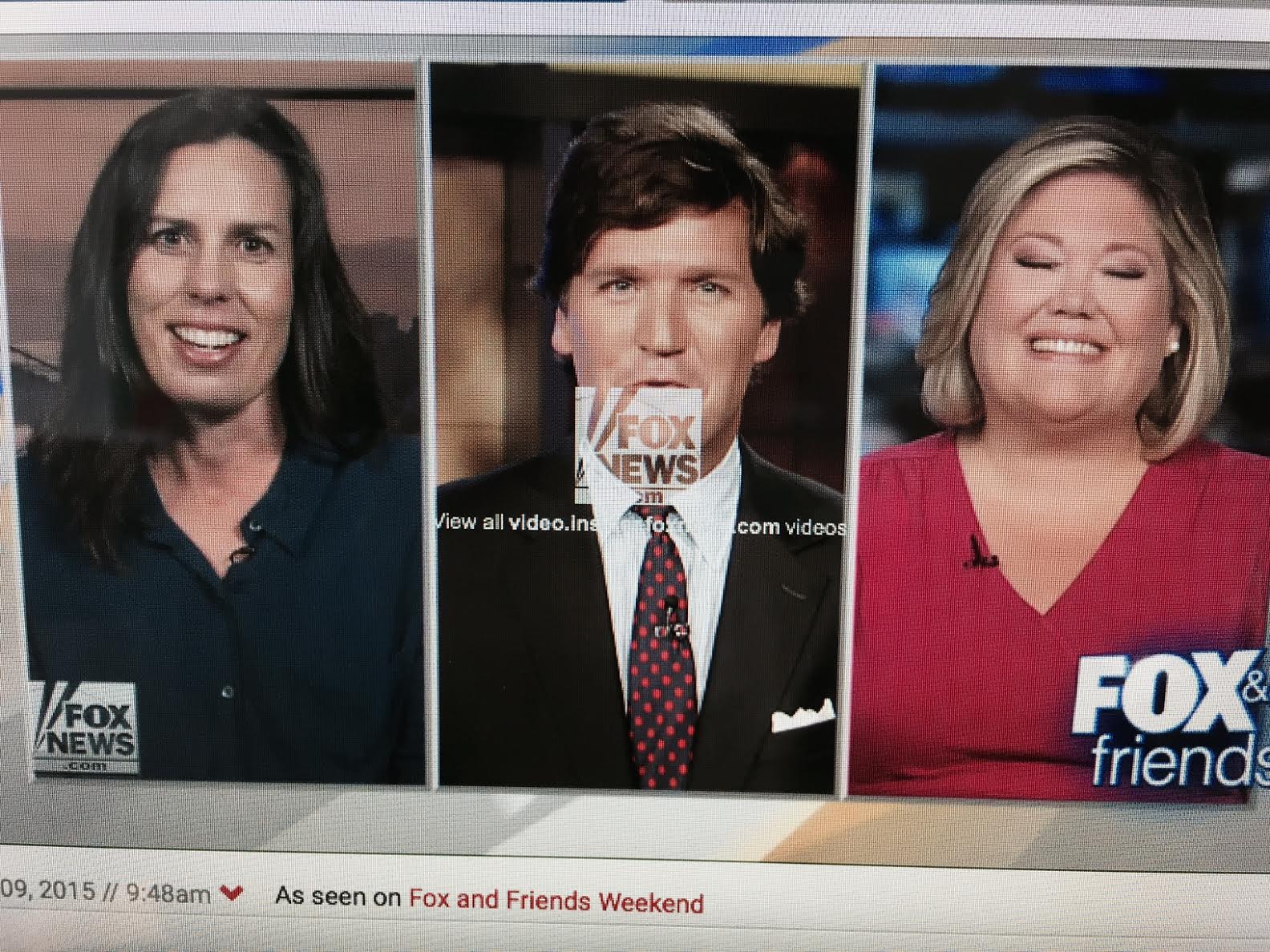
In May, I went on Fox News to support Amazon’s similar decision to drop gender categories from its toys. After I was intro-ed by an annoying gender police siren, I was told, as I’m so often told, that children just “pick “the toys they want. I’ve been repeatedly “informed” that girls are just born obsessed with how they look while boys who are denied toy weapons will bite their toast into the shapes of guns. That’s just how we are. As I told Fox News, in nicer words, we don’t have a fucking clue how we are. Our brains are wired up based on actions we engage in, and these connections are never made more rapidly or elaborately than when we’re little kids. Why wouldn’t we want to expose our children to more stories, more experiences, more colors than pink?
When we live in a world dominated by sexist mass marketing, driven by male dominated narratives from the Bible to most of Hollywood’s movies to “great” literature and art mostly by men, where men and boys create and star the shows while females, if they exist at all, are usually sexualized and on the sidelines, there isn’t much free choice, especially not for kids. Women are half of the human population but make up just 15% of protagonists in Hollywood movies, 29% of all major characters, and 30% of all speaking characters. Outlets that sell toys like Target or Amazon still have a major stumbling block: Girls and women gone missing from most of the epics being marketed. We’ve got a long road ahead to create gender equality in the fantasy world and in the real one. I commend Target and Amazon on the important steps taken so far. I look forward to witnessing many more and hopefully the great day when Reel Girl becomes obsolete.
“Tomorrowland” stars not one, but two, brilliant female characters supported by (yes, supported by) the fabulous George Clooney. Frank Walker, the innovator played by Clooney, admires, respects, and loves these girls, Athena and Casey. Casey (played by Britt Robertson) is the scientist-dreamer who saves the world, but not before Athena (played by Raffey Cassidy) recruits and saves her in multiple bad-ass scenes. Just watching Athena drive the getaway truck is awesome.
“Tomorrowland” is the movie I’ve been waiting for, the narrative I’ve been dying to show to my kids. Not only is it feminist, beyond featuring only one strong female character (the typical Minority Feisty scenario) but Casey, the protagonist, is “special” not just because of her extreme intelligence but because she’s a dreamer. Casey sees the potential for the world to be different than it is. Her courage to be optimistic, to use her world view to change the future, is depicted in multiple ways that children can easily understand. In the beginning of the movie, when Casey is arguing with her father who is worried about losing his job and becoming useless, she tells him a story he always tells her: There are two wolves who are fighting. One wolf is darkness and despair, the other wolf is light and hope. “Who wins?” Casey asks her father. He answers, “The one you feed.” At which point in the movie, I elbowed my middle daughter whose go to response when I ask her to try something new is usually: “I can’t do it. ” She will then repeat that phrase about ten times as she tries (or stops trying) to throw a bean bag into a hole, or whatever the task may be. I always tell her, “Say you can, your body believes what it hears,” and she rolls her eyes. But watching “Tomorrowland” she understood what I’ve tried to teach her, and that is seriously worth the $10 I paid for her ticket. I am totally getting her the Casey action figure. (That hat Casey is wearing is RED though it looks a little pink in this photo and the emblem reads “NASA.”)
I don’t want to spoil the movie, because you must see it and you must take your kids– but I will say I looked at the narrative as a metaphor for gender equality. The message of the movie is: If you can’t imagine it, you can’t create it. It’s really a story about the power of imagination to transform who you are and the world you live in. The evil in the film is not so much a villain but pessimism and cynicism, the idea that everything, if not already known, is knowable. One of the ways the skepticism is communicated is by broadcasting narratives– images of starvation, drought, the world exploding, which becomes a self-fulfilling prophecy. This is exactly what I believe happens with girls and boys in the world today– we show them stories and toys about how different genders are, re-create sexism, and call it “natural” and fixed.
I didn’t know “Tomorrowland” would feature two incredible female characters. I saw the preview, where Casey picks up a pin that transports her to another world, but I knew nothing of Athena. It is truly rare to see two girls dominate the screen as these characters do. So why didn’t I know “Tomorrowland” would be so special? Today, before we saw the movie, I took this pic as we entered the Metreon and Tweeted:
Thought ‘Tomorrowland’ had a female protagonist so why are my 3 daughters the only girls in this picture?
I am SO sick of this bullshit sexist advertising, but this is why I created Reel Girl, so I could tell you to take your kids to this inspiring, feminist movie.
Yes, it’s true! Tucker and I went the same boarding school in Newport, Rhode Island, St. George’s, though I was expelled sophomore year. Tucker, on the other hand, went on to marry the headmaster’s daughter in the school chapel.
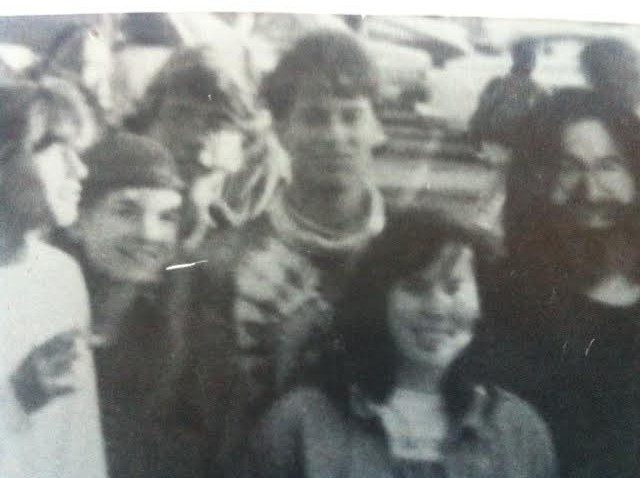
Here’s a blurry pic from the 80’s at a Grateful Dead show. I’m in the front and Tucker is to the left wearing glasses. Jerry Garcia, young, skinny, and two dimensional, is a cardboard cut out.
I don’t know if Tucker was better behaved than me at St. George’s –I was suspended for smoking a cigarette in the dorm and then kicked out the following year for drinking alcohol— or if he, like a lot of boarding school kids who made it to graduation, was just more skilled at appearing to following all those rules (including, for boys, wearing a tie daily.)
If you watch the Fox video, you can see I vehemently disagree with Tucker on Amazon’s decision– and most issues along with probably all of the other hosts on Fox News. Still, at least the network had me on to speak. I got a national platform to address about an issue I care about which is more than CNN or MSNBC has offered me recently.
I’ll leave one with one more nugget of prep school trivia. Julie Bowen, then known as Julie Luetkemeyer, the actress from “Modern Family” (and from kidworld “Planes: Fire and Rescue”) was in our class as well. As brilliant and beautiful then as now, she was probably the smartest kid in our class.
Finally, I didn’t get a chance to mention it in the 3.5 minutes I was on TV, but Amazon didn’t fully drop its filters. Read the details in my update on sexism at Amazon here.
I’m deep in Fairyworld working on my book (really, almost done) but I had to visit cyberspace to bring you this amazing news! Amazon has dropped its boy/ girl categories for toys and games. This is a huge step forward for gender equality, and it was taken because of you speaking out and creating change.
Just this weekend, I was at a soccer game for my 6 year old’s team, and another mom, knowing I have three daughters, said to me, “Your house must be so girlie!” Ugh, people say this all the time. I responded: “I try to keep their worlds big and open.” She told me she has two sons and let me know when her only daughter chose what color to paint her room, she picked pink.
“That’s the problem,” I said. “It’s not really her choice. Everything marketed to girls is pink, from Toys R Us to TV, that’s what they see.” I explained how pink used to be a “boy” color.
Her reply? “So, is everything in your house beige?”
I burst out laughing, but her comment reminded me of why I’m not a fan of the term “gender-neutral.” I prefer to use “gender inclusive.” I don’t want less colors for kids, I want more. I’m so sick of having versions of these conversations with parents about the limited gender boxes they buy into, hearing again and again about how boys will bite their toast into the shapes of guns because “that’s just how boys are.” I live in progressive San Francisco and when these words come out of smart, educated liberal parents, I’m still shocked (though my poker face is pretty good now.) At best, with children growing up in a world created by thousands of years of sexist narratives, where females are sidelined and sexualized, from the Bible to the Avengers, with brain plasticity/ development based on activities kids engage in, you’ve got to AT LEAST say that you don’t have a fucking clue what girls and boys are “naturally” like.
I’ve blogged before that I believe that people will look back on this time and be blown away by how sexist we were in the USA, that children were segregated by gender in the aisles of Target. Didn’t we learn that separate but equal doesn’t work? That so-called utopia doesn’t exist. My whole blog Reel Girl is dedicated to imagining gender equality in the fantasy world. If we can’t imagine equality, we can’t create it. It makes me sad and angry to see a whole new generation watch Hollywood movies made for kids where girls go missing. These kids get trained to accept and expect a real world where females go missing. This sexism in kidworld is so prevalent, that, ironically, it’s invisible. Parents don’t notice it. I get mocked all the time for even writing about it, for not being a real feminist because I care about trivial issues like cartoons and toys and, you know, children.
Amazon’s decision to refuse gender segregation is inspiring and exciting, but we have more work to do. Toys we sell come from the stories we tell. As I blogged in the posts If a stormtrooper had no epic, would he exist? and When Hollywood excludes girls, how can Lego market to them? until females are recognized as heroic protagonists in narratives, removing gender labels from the merchandise will only take equality so far. Kids– girls and boys– need to experience stories where females (plural, not just one, not a Minority Feisty) are front and center, being brave, making choices, and taking risks. Which reminds me, I better get back to writing mine. Huzzah Amazon! THANK YOU
Update:On her blog, Melissa Wardy, founder of Pigtail Pals writes:
But Amazon didn’t drop the gendered categories. It just moved them. To the top of the page and under the “Toys & Games” heading above the item images.
On the left side bar under “Age Ranges” we used to see “Gender” and the binary options of “Boys” or “Girls”. Now we see the left side bar offering search options of “Popular Features”, “Shop By Price”, “Age Ranges”, “Toys & Games”, “Featured Character & Brand”, and “Interest”.
This is truly great and reflects how merchants should offer toys to children and families: age and interest.
The problem is, I still see “Boy’s Toys” and “Girl’s Toys” pages, as well as this when I go in to shop “Toys & Games”…
If there were a word for that deflated sound a party blower horn makes when it runs out of air, I’d insert it here. Because shoppers will still get the following message:
Boys go out into the world, build the world, explore the world, save the world, and play hard when they play outside. Girls, on the other hand, stick close to home, think of home, decorate the home, need things to be pink, play with dolls, and sit in pink folding chairs during “Sports and Outdoor Play”.
There are no robots, globes, vehicles, nor firefighters for girls. There is no pink, dolls, princess dresses, nor homey items for boys.
Amazon still features special girls and boys pages noted at the top of the toys page and the current highlights on the girls’ page seem to be further proof that Amazon is taking a stand against gender stereotyping. On the girls’ page, you’ll find a plug for summer outdoor equipment such as swing sets, an ad for STEM toys and games and a promotion for package toy deals that allow you to bundle everything from Barbies and Avengers figurines for discounts.
I will do my own research on this, but it seems pretty obvious that keeping ‘boy’ and ‘girl’ categories for selling toys is archaic and meaningless. Amazon should get rid of them all together.
Update: As reported by Melissa and Amy, on the Amazon site, if you click on ‘Toys and Games, you’ll see this:
The good news is this small print, gender sub category is much harder to get to now. The bad news is its still there. I’m hoping Amazon is phasing the gender category out, and taking it off Amazon’s main page is the first step.
I will continue to research what Amazon is selling under ‘boy’ and ‘girl,’ but at this point, when I click on “girls,” I see a sea of pink and dolls. When I click on “boys” as Melissa wrote, I see robots, globes, and colors (except for pink.) I’m still blowing my horn, but I hope Amazon makes another move very soon to completely give up these limiting categories.
Amazon, are you listening? Your customers don’t need this kind of sexist assistance shopping, except maybe one, who wrote on Reel Girl’s Facebook page: “But my little lady brain is too small to figure out what to buy my kids without gender categories!”
Susan Prasher wanted to dress up as Darth Vader for Halloween. Her 7 year old son told her that the costume was not appropriate for “a girl.” Here’s her story.
Guest blog for Reel Girl by Susan Prasher
Growing up, I never had a doll, a Barbie or a princess dress. As a mother and a former teacher, I have seen children verbalizing, practicing and sharing experiences of social interactions with the use of dolls, which is really wonderful and joyful. One can definitely learn a lot by observing and listening to children at play with these types of toys. One thing that throws me off guard are the sheer number of princesses. With each princess, there is a new dress, a story line, and possibly a tiara. I get confused with which princess represents which movie. I’ve had the good fortune of having a best friend’s daughter explain why she felt sad that I didn’t know about the princesses and proceeded to break it all down for me. Perhaps all the role playing actually encouraged her to be an empathic person that understood and heard me.
One of my boys is obsessed with Star Wars. When searching for a new sitter, I lucked out by meeting a computer science engineering student who loves Star Wars just as much as my son does. Together, they have the most engaging conversations. The sitter is a young woman. While she did have some dolls growing up, her room is filled with Lego and items from Star Wars.
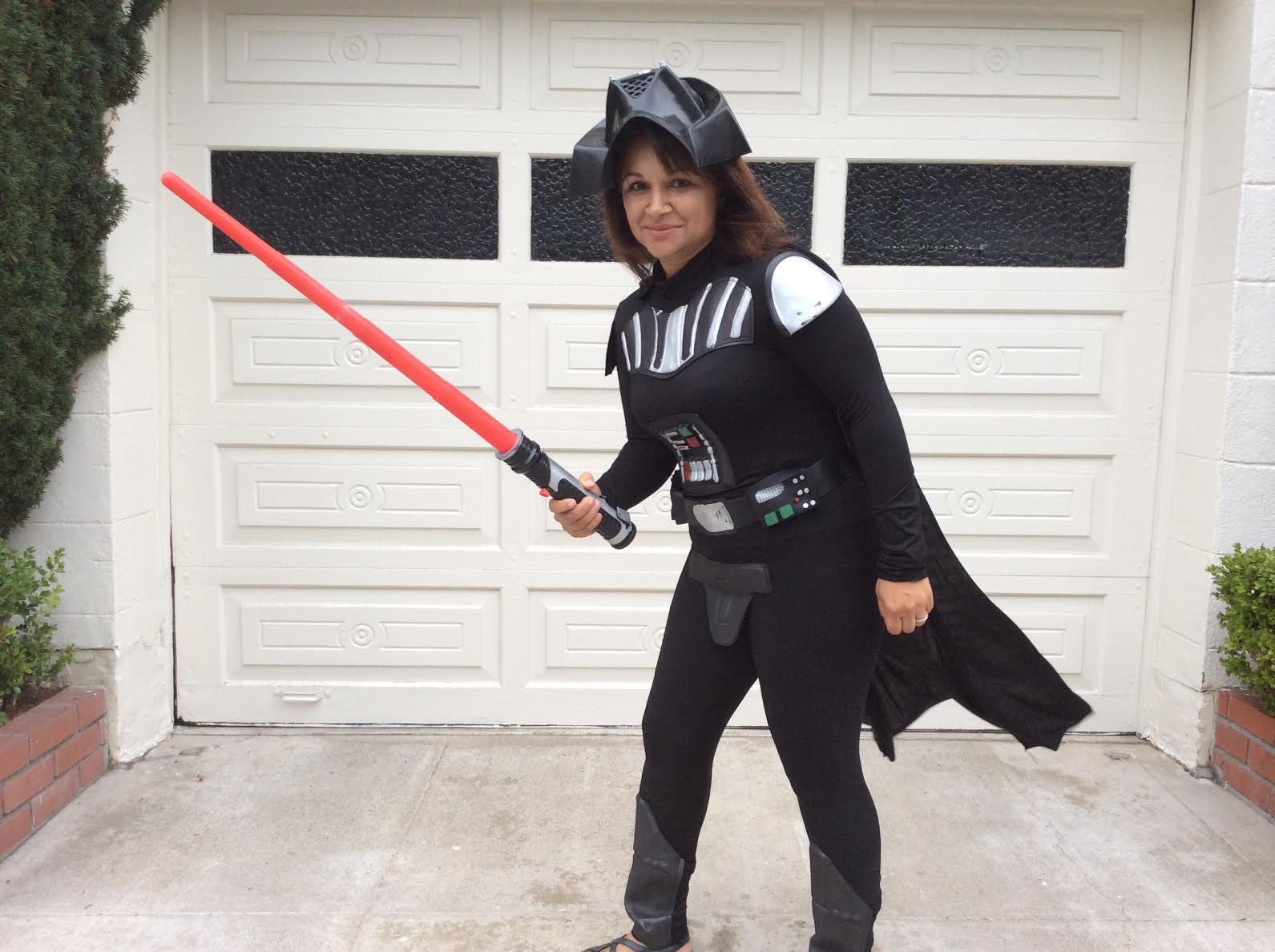
Back in August my son asked for me to please consider being one of three characters for Halloween: Princess Leia, Queen Amidala and Ashoka. I had trouble being a princess or a queen. To encourage me to consider one of these three roles, he began calling me Queen Momidala. I would banter back various lines including “Shaan, I am your mother” using a Darth Vader voice. He’d have this funny expression on his face, laugh and at some point tell me all the parts I was doing wrong. Since this was rather fun, I ordered a female version of the Darth Vader costume. And when it arrived, my son was thrilled and proud. Of course, the costume is a skin tight costume, but it’s a power suit nonetheless. The red light saber was placed on me like the finishing touch of a tiara. And that’s when it all clicked.
In the United States and in Canada, light saber sales are up. They sell like hot cakes. With the new movie coming out, you know it’s going to remain a hot toy. They are fun to play with, my kids mimic the exact movement patterns in battles and beg to attend Light Saber School. From what I’ve seen, light sabers are a source of tremendous power. There are even adult versions of these things that can do some serious damage. But is it really a toy? The science behind making one is pretty interesting. And Star Wars has inspired all kinds of advances in science as well as inspire people all around the world. In the case of our incredibly bright female sitter, she grew up loving Star Wars and is now creating a program designed to teach the art of coding.
As a teacher, I used to swap the names of characters as we read from a picture book for names of children in the class. Their eyes would light up with joy and excitement because suddenly, they were IN the story. There are females in Star Wars but what if we encouraged children to take on a role that appealed to them personally, regardless of gender? What if we reversed the gender roles in Star Wars by having all the males fill the females roles and visa versa? What if Leia became the great Jedi master and not Luke? When I suggested this reversal to my son all kinds of drama unfolded. He was upset with the mere thought of such a thing and thought that it was being disrespectful to the story. When I told him that George Lucas is an incredible writer and that it would be great to have a different version of the story, my son laughed and blew me off. He pointed out that there are some females in key roles and insists this is the story, like it or not. What I was really aiming for is a demonstration in a growth mindset and that as a female, my version of the story would be different.
We all have power, whether we hold a light saber or not. There are different kinds of power and each medium channels its own type. If I walked around with a tiara on my head, I’d be channeling a certain mindset. But the outcome is vastly different. With the use of Star Wars, little girls can be exposed to Science, which is huge, but they need to know the storyline. And yes, it involves a queen and a princess but they are welcome to take on any role of their choosing and rewrite the story.
Our friends’ daughters are like my own. It’s time to swap a bit of princess dresses, tiaras and dolls for at least one or two light sabers, even if they choose pink or purple ones, because it helps them channel a different type of power.
Susan Schrivjer, the Florida mom who started the petition against Toys R Us for selling “Breaking Bad” toys to adults, tells CNN, “Kids mimic their action figures, if you will. Do you want your child in an orange jumpsuit?”
Toys R Us banned the toy almost immediately after Schrivjer started her protest, so I want to know: Do we all finally agree that kids imitate their toys? And if we do, why are toy stores selling half-dressed, belly-baring, high heel wearing sexualized figures to little kids?
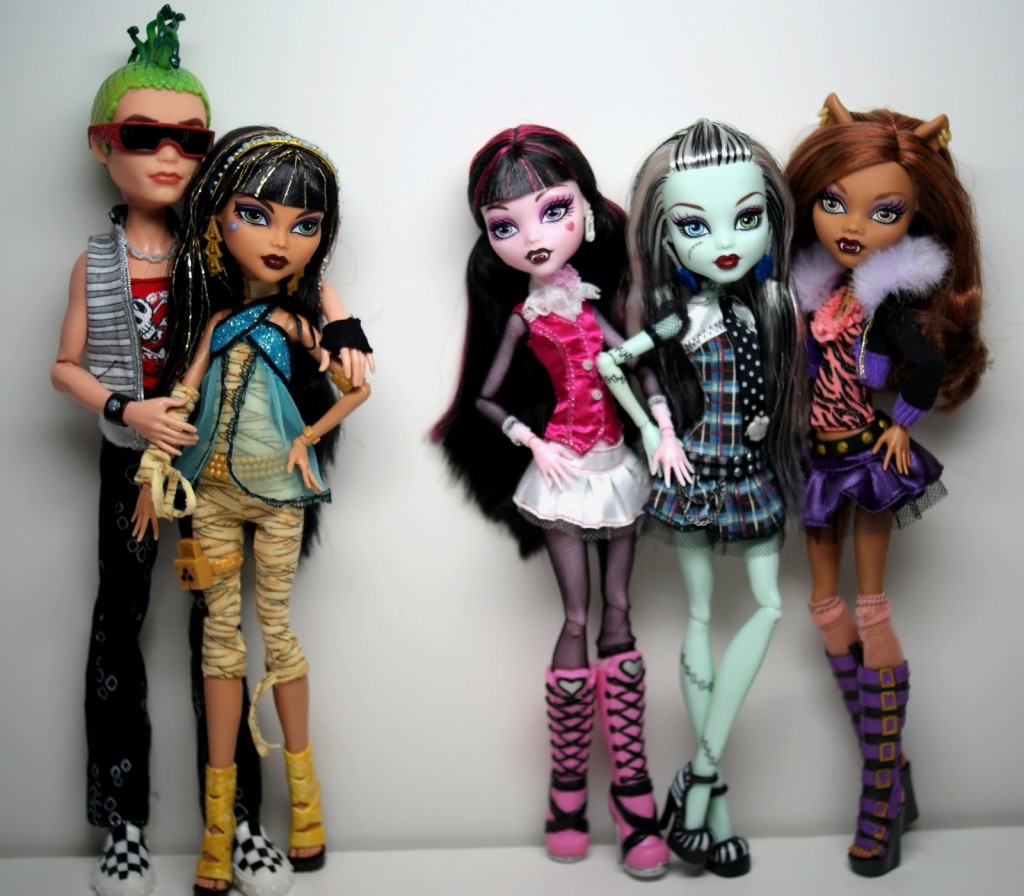
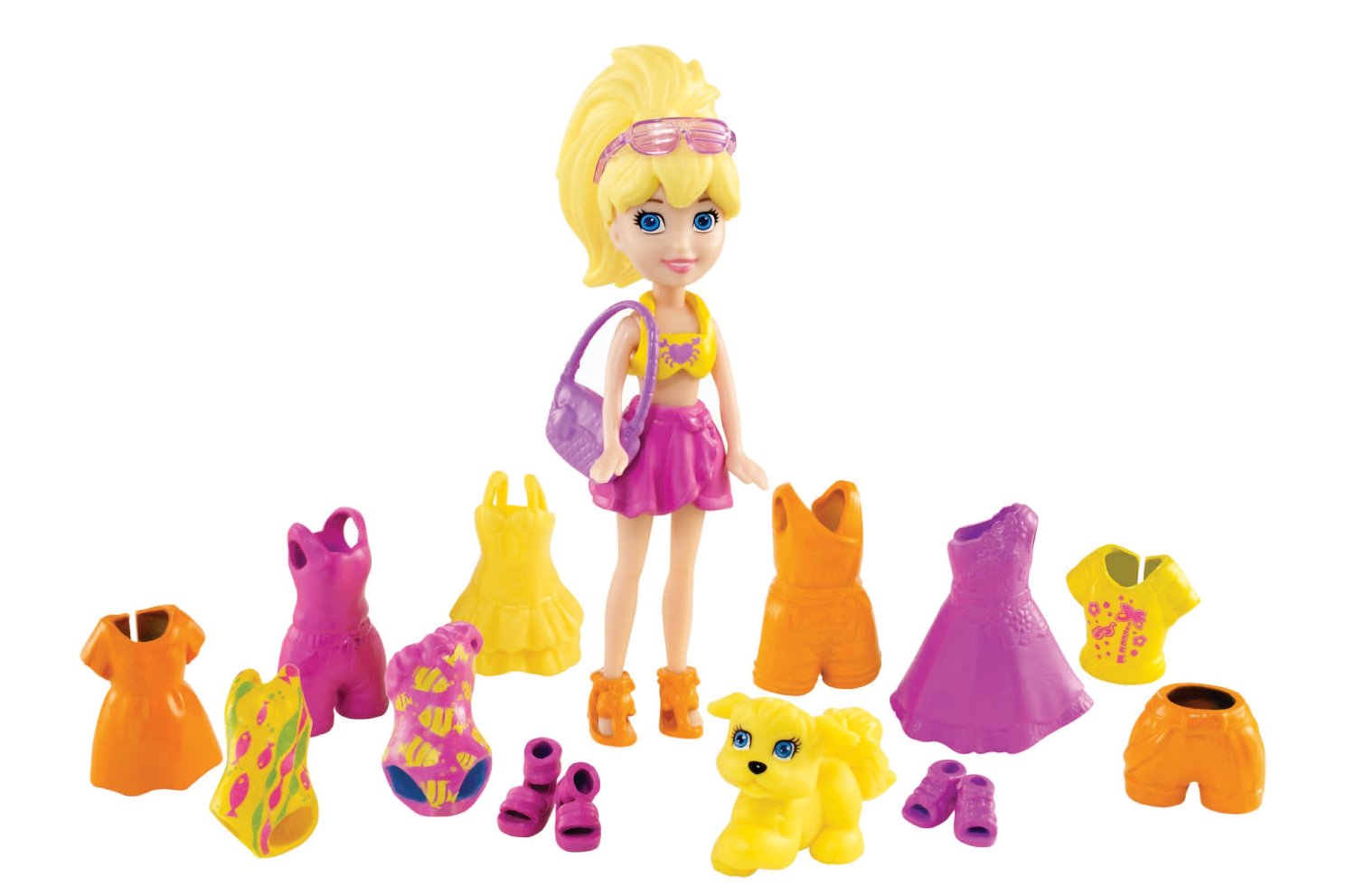
If Monster High were atypical that would be one thing, but these outfits worn by female dolls are standard. Polly Pocket is marketed to girls age 4 and up. All that kids are encouraged to do with Polly is to dress her, change her from one short skirt to the next. It was Polly and her endless tiny plastic outfits who inspired me to start this blog about the sexism marketed to kids.
The Winx girls are also marketed to little kids.
When Melissa Wardy, founder of Pigtail Pals saw this backpack on a first grader, she blogged:
Try this test: If the image can be lifted from the child’s toy/backpack/t-shirt and placed on the billboard for a strip club and not look out of place, then things are seriously fucked.
Wardy, myself, organizations like Let Toys Be Toys for Girls and Boys, and parents have created and signed petition after petition about sexism, only to be ignored in the USA. After shopping at Toys R Us, one mom wanted to know why Slave Leia was the only available Leia. Jezebel reports:
Over the weekend we received a tip from a concerned mother who had come across something very disconcerting while perusing the aisles of Toys R Us. Apparently the only available toy or figurine of the Star Wars character Princess Leia is of her in the “Slave Outfit” from Return of the Jedi. Bikini? Check. Loin cloth? Check. Chain around the neck? Check. And in case you were wondering if it was actually geared towards children, it’s listed for kids ages 4+….This is a perfect and heart-breaking example of how ingrained sexism is in geek culture. It’s not like there’s a Chewbacca toy in a banana hammock.
Wait, so @ToysRUs pulled all of the Breaking Bad figures from their shelves and still sells Barbie? Hmmmm…I wonder what is more damaging
The more we all rail against “Breaking Bad” toys, the more we ignore the sexism and affirm it as normal. It is shocking to me, as a mom of 3 young daughters, that sexism in kidworld is accepted so completely. And this acceptance goes beyond toys to media, which of course loops back to inpsire more toys. In Disney’s movie “Planes,” the fast plane, the hero of the movie, mocks the slower planes for being girly.
Plane One: What’s taking this guy so long? Is he really as good as he says he is?
Plane Two: No, better.
Plane One: Whoa! Who was that?
Plane Three: (Descending fast on top of the other two) Well, hello ladies. Ready to lose?
Plane Three goes on to leave the “ladies” in the dust.
As with the toys, this kind of sexism in movies for children is typical. In “Madagascar 3” a scene features a male penguin mocking other male penguins, “You pillow fight like a bunch of little girls.”
As with “Planes” this sexist scene is so hysterical, it’s the one chosen for the preview.
“When the worst thing we say to a boy in sports is that he throws ‘like a girl,’ we teach boys to disrespect the feminine and disrespect women. That’s the cultural undercurrent of rape…It’s not DNA we’re up against; it’s movies, manners and a set of mores, magnified in the worlds of the military and sports, that assign different roles and different worth to men and women. Fix that culture and we can keep women a whole lot safer.
I want Toys R Us– and parents– to know that it is far more damaging to sell sexist toys to kids than to sell Jesse to adults. The Florida mom asked CNN if we’d prefer our kids in orange jumpsuits. I’d like to reply with this story. A while back my 4 year old daughter was looking through a magazine, and she saw an ad for “Orange is the New Black.” She cried out, grinning, “Look Mama, so many girls!” It’s that rare for her to see an image of a group of women together in the media, no belly buttons, no cleavage, and also, by the way, not all white. She was so excited, she wanted to be in a picture with them, so I took this.
Does my daughter know these women are playing convicts? Nope. Would I allow her to watch the show? Of course not. If I saw “Orange is the New Black” action figures sold at “Toys R Us” would I buy them for her? Absolutely, because Florida mom, I’d rather see my 4 year old in an orange jumpsuit than thigh high boots.
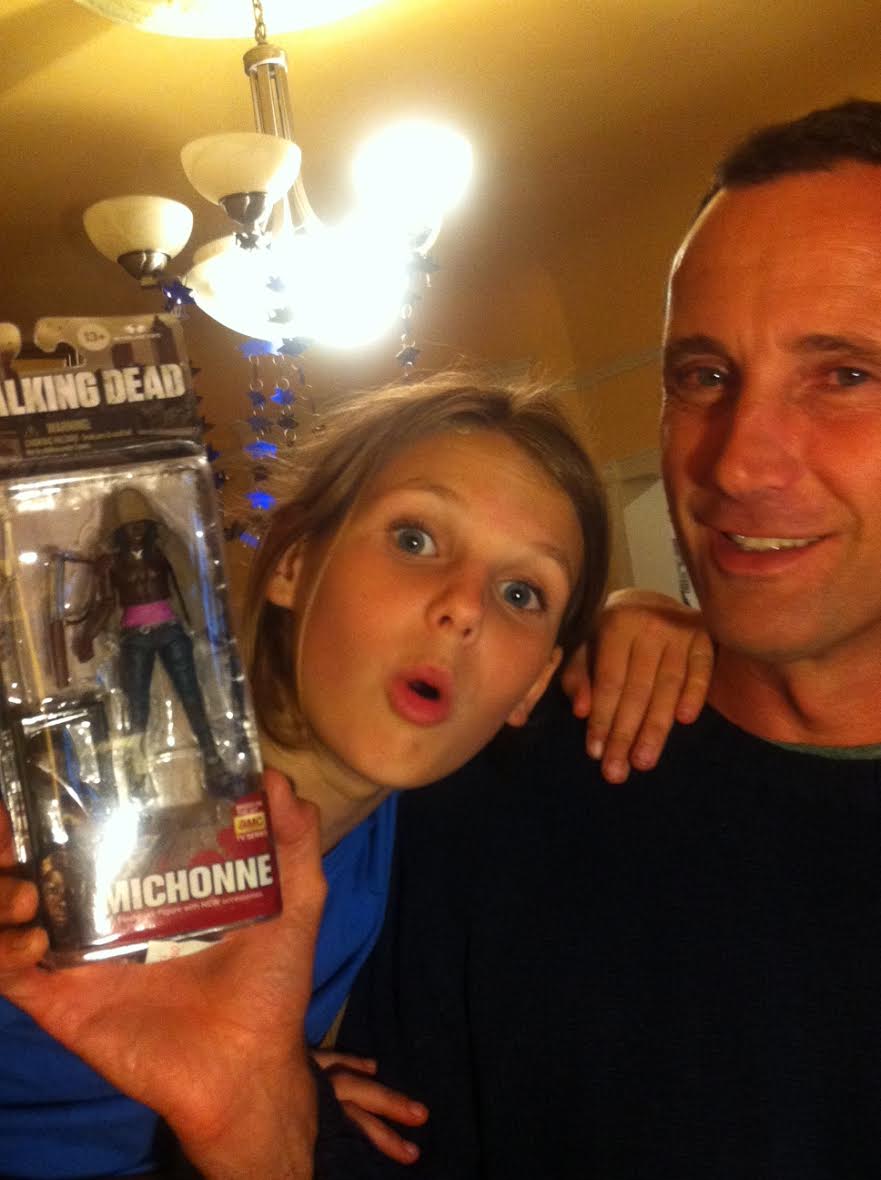
Shopping in Walgreens the other day, I saw the action figure Michonne from “Walking Dead” in the toy aisle. I’m always on the lookout for female action figures and my husband is a huge fan of the show, so I bought Michonne for him and blogged about my purchase:
You probably know how rare it is to find a female action figure, not to mention a non-white female action figure, without her breasts popping out of her shirt, wearing pants even, just sitting there on a shelf in a store and not hiding out on some obscure internet site. Let’s just say she’s far rarer than the unicorn in fantasy figure world…Though, in theory, I’d rather my kids play with Michonne than Barbie, I wasn’t sure if I planned on letting them near her, when she comes with exotic weapons and also a couple severed heads. But when my daughter heard my husband’s joyful cry after he saw the package, I thought all was lost. My concern turned out to be unfounded. Not only did he tell her he’s not sharing, but he’s not even taking her out of the package. He’s worse than the evil dad in “The Lego Movie,” pre-epiphany.
Back again in Walgreens last week, I spotted the action figure of Daenerys Targaryen from “Game of Thrones” in the toy aisle, another show my husband watches.
Though I liked GoT in many ways, it has so much rape, I couldn’t stick with it. When I saw Daenerys at Walgreens, I thought: Who are they marketing to? Surely kids don’t watch GoT? Do other women buy for these their husbands besides me? For themselves? (please, let me know) I have a feeling this “Game of Thrones” heroine will be in my house soon. I’ll buy her for my husband. If he releases her from the package, and the kids come across her, I will let them play with her, in spite of the rape fest of a show. I love the dragon on perched on her arm, and I think my children would use Daenerys to make up some incredible stories. Fingers crossed my husband buys me Jesse (I watched every episode of “Breaking Bad” cringing and biting my nails.) That is, if he can find a store that will sell the toy.
From the first time I saw FCKH8’s video, I really liked it. Perhaps, I’m a fan because of bias. When I started my blog, Reel Girl, I wrote on my “About” page:
One more reason I started Reel Girl– our movie rating system, and the values associated with that rating system, is totally messed up. So many G movies perpetuate the absolute worst kinds of gender stereotypes, yet they are supposedly “for kids.” In my opinion, this kind of repetitive imagery is way more dangerous for children than hearing the word “shit.”
“Cinderella” and all of its endless, infinite adaptations and reincarnations, in my opinion is bad for kids. “Whale Rider” in spite of swearing and drug use is good for kids. Simple concept, yet so hard to convince people of it, that I write and write and write. When I watched the FCKH8 video, I felt like: YES, this is the point I’ve been trying to make: Pay inequity is way more offensive than the word fuck. The video shows what I’ve been trying to tell. It is art. And unlike many writers out there, I am THRILLED when I see my idea coming from someone else as well because it makes me feel like I’m not crazy, like people ‘get it.’ Furthermore, I realize that in order for the world to change, people other than me have to ‘get it.’ If it’s just me with my ‘original’ idea that I’m going for, all I have is my ego, and that is a lonely, static, boring place to be plus nothing much changes at all.
So perhaps, I thought, when I read comments against the FCKH8 video by my brilliant colleagues including founder of Pigtail Pals Melissa Wardy, author of The Princess ProblemRebecca Hains, and author of Her Next Chapter Lori Day, I’m just being selfish here. I’m not thinking about the kids having no idea what they’re saying (and I do believe these girls are too young to understand what they’re talking about.) Perhaps I’m so happy not be so isolated with my vision, I’m blind to the exploitation, hypocritically exploitation I’m trying to prevent.
But after thinking this through, I still like the video. As I wrote, I agree the kids don’t understand what they are saying, this is a job for them. I never thought the kids in the ad were not acting or not reciting lines, and I don’t think the video’s intention is to make viewers assume that. So the question is: Does the ignorance of the kids make the video exploitative? My answer is still no, unless all child actors from the ones in sitcoms who speak in language far beyond their years to any commercial, all who often don’t understand what they are saying, are exploited.
The next question I asked myself: Is the FCKH8 ad exploiting girls because it’s using them to sell a product?
During the World Series last night and the night before, my family and I saw teen baseball star Mo’ne Davis in a Chevy ad. I thought the ad was beautiful. In the ad, Mo’ne says, “I throw 70 miles an hour. That’s throwing like a girl.” Millions of families saw her throw in a mini-movie and heard that line while watching the World Series. We also saw a Mazda ad with Mia Hamm, and my 11 year old, who is a fan of Hamm, said, “Why is she selling cars?” To which I responded, “It’s either her or a male athlete. I’d rather see Mia.” I want to see the images of powerful girls used to sell things, from toys to movies to clothing. These kids are not being exploited because they are being used to sell a product.
The slogans found on the FCKH8 t-shirts were appropriated from other feminist nonprofits. For example, the Feminist Majority Foundation has been selling “This is what a feminist looks like” tees since at least the mid-1990s. So despite their promises to support charities with their t-shirt sales, FCKH8 is actually siphoning money away from feminist charities by stealing their ideas.
Furthermore, quality charities have refused to take FCKH8’s money in the past, because FCKH8 is incredibly problematic. They’ve been accused widely of being transphobic (as a quick google search will show), and their anti-racist work is of dubious merit. For example, their response to Ferguson raised so much ire in the anti-racist community that Race Forward—one of the charities originally listed on FCKH8’s page—announced publicly that they were refusing donations from the company.
So to those who are saying that FCKH8 is a company that’s doing it’s best to promote social justice, and we should cut them some slack? No FCKHing way.
I agree stealing a slogan from non-profits is not ethical. I also didn’t know about using the Ferguson tragedy to sell T shirts. FCKH8 sounds like a company with a bad history. But learning this history doesn’t change how I feel about the video. I still like the video. I still like that the video is going viral and, just like the Mo’ne ad, spreading important slogans out into the world:
* Pay inequality. Women are paid 23% less than men for the exact same fucking work.
*Women who graduate university with straight A’s get paid only as much as men who graduated with C’s.
* 1 out of every 5 women will be sexually assaulted or raped by a man
* Stop telling girls how to dress and start teaching boys not to fucking rape
*We’re glad a women’s right to vote is here, but equality is messed up. It’s walking to the car without fear.
* Pretty is a compliment but here’s how the focus works to girls detriment. Society teaching girls that our body, boobs, and butt are more important than our brains leads us to thinking our worth comes from our waistline. My aspirations in life should not be worrying about the shape of my ass so fuck focusing on how I look and give me a book.
*Instead of cleaning these girls mouths out with soap, maybe society should clean up its act.
*Near the end of the ad, there is a boy in a dress. “When you tell a boy it’s bad to act like a girl it’s because you think its bad to be a girl.”
These are messages I work hard every day to promote, and I believe the ideas are presented in this video in a simple, convincing way, easy for adults– yes, adults– to understand.
Rebecca posts comments on her blog from people who are offended that these young girls spoke of rape and assault. I agree that part is disconcerting, and it is for this reason, I chose not to show the video to my 11 year old daughter who I have yet to tell about rape. That said, I’ve blogged about books for kids that deal with rape, incest, and assault wondering what age is appropriate for these stories. The answer I always get is that it depends on the kid. I want to be the first one to tell my kid about rape, sexual assault, pornography, incest, drugs etc. I don’t want her learning about these issues for the first time from books or movies or other kids. When I’ve written about these kinds of books on my blog, kids and parents have written back that their young kid does know about porn or rape based on experiences that they’ve had– talking to other kids, what they’ve seen, or instances in their own life. Now that they do know, it is important and beneficial for the kid to be able to read literature about it. Here’s one comment that I got when I wrote about Graceling:
Based on the brief snippets of content she saw, I had to not only have “the talk”, but also explain a LOT of things I never thought I’d have to address at that age. Because of this, conversely, she is now very educated on both sex, misogyny, and rape/assault/child abuse. Therefore, I think these books that are written about very serious issues — but in the comprehension style of a young person who can find the characters identifiable — is a great source of information…I have not read these books to endorse them, but now I am interested and will be checking them out at the library. Thank you.
My point is that I don’t think it’s fair to make a blanket statement that little kids should not refer to rape or assault in a video when in the real world, kids see and experience these things every day.
One more thing: As far as the video not having a trigger warning, I don’t post trigger warnings on my blog ever. My whole blog is a trigger. Everyone is unique, and I think it’s impossible to make some kind of assumption about what will trigger readers.
If for some reason you haven’t come across the video, you can watch it here.