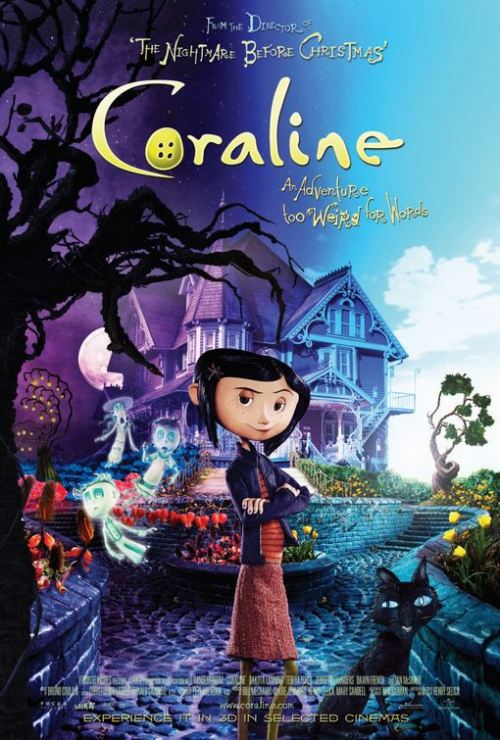
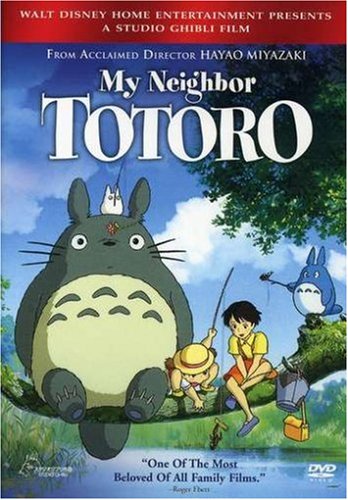
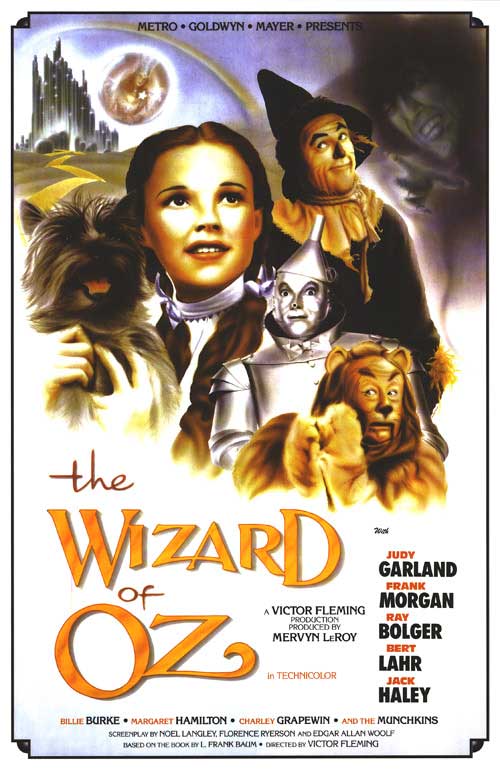
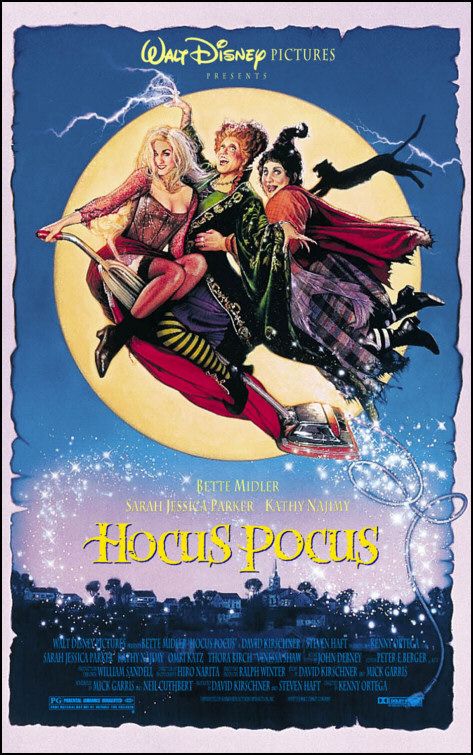
Last Halloween when no less than 3 movies came out starring males– “Hotel Transylvania,” “ParaNorman,” and “Frankenweenie”– I made a list of monster movies starring females. This list is pathetically small! I have not seen “Hocus Pocus” or “Journey to the Center of the Earth” or “Series of Unfortunate Events” but Reel Girl fans recommended all 3. Let me know if you have any movies to add.
Yesterday, my 7 year old daughter and I were shopping at Whole Foods when we saw the DVD for “Epic” in the check out line. What’s wrong with this picture?
I found out there is a term for this position, riding bitch, and you see it all over children’s media and adult media. Look how Tina Fey, the star of her sitcom, was put in her place on the cover of Rolling Stone.
So why, out out of all the images they could chosen for the DVD cover, do they pick the one that shows the female star behind the supporting male? I was talking about this with my husband, and I said, it’s like a social reflex, everyone is so scared to show a female in a power position. It’s like we’re protecting the egos of little boys the way women are supposed to protect the egos of men. But instead, we’re fucking up a new generation of kids. It is not OK to continually and repeatedly marginalize girls and force them into supporting roles, in the imaginary world and in the real one. It limits all kids.
Jon Stewart asks Malala Yousafzai, the 16 yr old activist for girls education who was shot in the head by the Taliban, how she found the courage to speak out. She replies:
Why should I wait for someone else? Why should I be looking to the government, to the army, that they would help us. Why don’t I raise my voice? Why don’t we speak up for our rights? The girls of Swat, they spoke up for their rights. I started writing daily. I spoke out on every media channel that I could, and I raised my voice on every platform that I could. I said I need to tell the world what is happening in Swat.
Malala didn’t wait around for someone to else to tell her story for her. She rescued herself through the act of writing and speaking. She risked telling the truth about her life and telling it publicly, and in doing so, she is changing the world. Please show this video to your children and teach them to do the same. I can’t wait to get Malala’s book and show it to my daughters as well.
Her breasts are much too small and do not have the lift that superhero women should have. Her jawline is fat and her neck much too long. The style of her hair is clunky and does not flow in a sense that a super human would. Her hips, waist and thighs are too big and she honestly looks fat. No one is going to want to read a comic with a fat female protagonist. I honestly recommend looking at issues of Sport’s Illustrated to get the right anatomy. Those women are the peak of human perfection, and that is what we want in this industry.
“That is what we want in this industry?” Who the fuck is “we?”
Here is my three year old daughter last Halloween as Batgirl.
Who is thinking about my kid, and girls like her, and what they want when making these “artistic” decisions?
You know what happened to my daughter on Halloween? Everyone called her Batman. At first, my daughter said nothing back to them but asked me: “Why do people keep calling me Batman?” Then, she started to quietly correct them: “I’m Batgirl.” By the end of the night, she was shouting; “I’M BATGIRL!”
I know Batgirl doesn’t have five major motion pictures about her, all featuring famous movie stars. There aren’t Batgirl toys or Batgirl clothing or Batgirl comic books everywhere you look. Why is that? There is princess shit everywhere. But, I guess, when you try to get Batgirl, or Batwoman, out into the world, you encounter some asshole in charge who tells you to make the character look like a Sports Illustrated model, because that’s what “we” want. And after all that, all the limitations put on little girls and who they are supposed to be and what they get rewarded for and recognized for and celebrated for, people actually say, time and time again, “Girls just love princesses. Go figure.”
Argh. It drives me crazy. I am grateful for DaSilvo’s comment. I am so sick of pointing out the obvious and having people still not see it and deny it exists.
UPDATE: It’s been years since I blogged on Reel Girl but I am ashamed to see this photo of my daughter’s Halloween costume. I apologize to Native Americans for my offensive insensitivity and ignorance. It seems my reason, stated above, was that she was studying the Miwok tribe in school which is an absolutely ridiculous explanation. First of all, who knows how the Miwok dressed? I know for certain they did not dress in anything like this cheap, synthetic “costume” I bought my daughter. I perpetuated a white supremacist idea that Native Americans are a monolith that all dress alike and then I acted as if I was being culturally sensitive. My hypocrisy is shocking. And of course, even if I had some perfect replica of how a Miwok truly dressed, this is a culture, not a costume. No white person should ever “dress up” as a culture, especially not one white people slaughtered. I am so sorry to the Native American people, to everyone who read this blog, and to my daughter. Also, I want to thank Cherokee Writer for her empathy. She was a reader of the blog and blogged that my intent was not ill and so she couldn’t be mad, she referenced my daughter studying the Miwok tribe. That I did not intend to be racist does not mean that I was not racist. In fact, not intending the racism is almost worse because it can be harder to call out and identify. Also, my whole blog is about pointing out sexism that often people didn’t intend. So here I am pointing out sexism and being blind to racism, like so many white women. I hope to keep learning every day how to be a better person and to become more aware of my racism and how I perpetuate it.
No one is saying DaSilvo doesn’t care about his art. No one is even saying that “Frozen” isn’t a good movie. “Ratatouille” is a great movie, and it also follows the same sexist pattern of most children’s movies where females can’t be heroes. Unfortunately, this sexism is entrenched in our culture, the stories we tell, and the heroes we create. Abnoba makes a great comment about all this on Reel Girl:
And female characters are even more difficult to differentiate because, as he says, they have to be pretty. And pretty, for Disney and other companies, has a very narrow definition. I think that we all know how Disney tried to change Merida. Disney is not only selling a movie. The Disney princess are used to sell clothes, toys, party supplies, make up…and that’s not based in how adventurous or smart they are, their beauty is a big selling point…Maybe Lino DiSalvo is not sexist, maybe he is just too frank for his own good about what that industry require from him, but I think that the comment is pointing to a very big problem in the female representation of women in animation.
You can be frank and sexist at the same time. As I blogged, I don’t think DaSilvo intended to be sexist. He thought he was stating a fact. And he actually is, but the fact is not about real differences between females and males, but about how they are represented in narratives for children in 2013.
Here’s something I wrote a while ago on the differences between drawing females and males:
Whenever I blog about the exaggerated breasts or ass of a female cartoon character, commenters respond that I have nothing to complain about: all cartoons are caricatures.
Of course, “The Avengers” model, with its pathetic 5: 1 male/ female ratio and then sexualizing that lone female, is not unique to that group of superheroes.
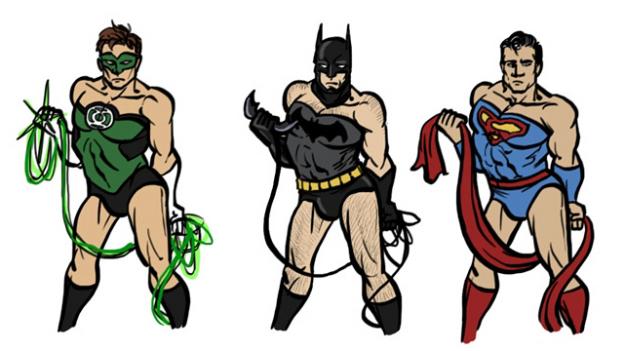
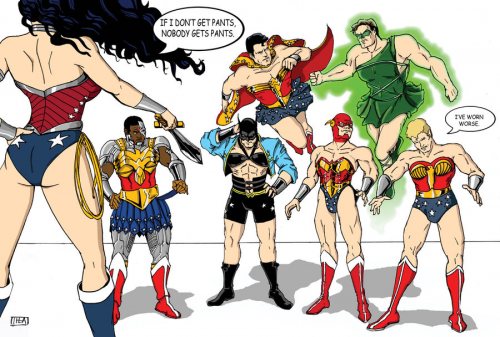
Check out the Justice League cover. Notice any similarity?
Wonder Woman with no pants was created by (and for?) grown-ups but it leads to Wonder Woman with no pants showing up as a LEGO minifig.
Females are half of the population, yet because they are presented as a sexualized minority in so many movies for adults, they are also presented as a sexualized minority in movies for kids. Those roles are then replicated in kids’ toys and most tragically, in kids’ imaginary play.
The sexist comment by Lino DiSalvo, head animator of “Frozen” is going around the web. Here’s what he said:
Historically speaking, animating female characters are really, really difficult, ’cause they have to go through these range of emotions, but they’re very, very — you have to keep them pretty and they’re very sensitive to — you can get them off a model very quickly. So, having a film with two hero female characters was really tough, and having them both in the scene and look very different if they’re echoing the same expression; that Elsa looking angry looks different from Anna (Kristen Bell) being angry.
DiSalvo’s comment was made as part of a larger interview. It’s pretty clear the animator wasn’t aware he was being offensive. How could he be so clueless? Because DiSalvo’s belief, that males come in all shapes and sizes, whereas females come in one, is so common, most people think it’s a fact.
Here is Christopher Hart teaching the differences on drawing male and female characters via Escher Girls.
With male comic characters, you can mold their bodies into many different shapes, producing a wide range of cool characters. It’s not so easy with women. Women in comics are, by and large, attractive—even the villains. Especially the villains! The Voluptuous Vixen and the Villainess are much more attractive in cutting-edge comics. So, you have less latitude in altering the body. You can’t draw brutish women or you’ll lose the attractiveness. Therefore, the changes rely less on the body types and more on the pose, costume and attitude.
Here’s another how-to video from Marc Crilley. This video is great because Crilley takes you through the steps of just how artists are trained distort female anatomy. First, Crilley draws a regularly proportioned teenage girl. Then, he demonstrates the typical pattern and process of how artists exaggerate her proportions, drawing three well-known, female animated characters.
Crilley narrates:
It’s troubling, really in a way that artists, maybe many of them male, have this way of reducing the width of the female waist when they’re drawing it to just ridiculously small proportions and you know, you do sort of fear that this contributes to women’s body image, this crazy idea of the super narrow waist, but nevertheless you see it again and again. Finally, the big difference here, the knees, the line of the knees, much, much higher than in real life. So what’s interesting is you see that the whole area of the waist is being raised up here so as to create these incredibly long legs as an exaggerated style. To me, its sort of like Barbie doll style legs…
On my Facebook feed today, Miss Representation posts on photographer and mom Ashlee Wells Jackson showing what women look like:
“Photographer and mom Ashlee Wells Jackson wants all of us to recognize and appreciate how childbirth, breastfeeding, and motherhood change women’s bodies. I’d love for both my daughter and my son to grow up seeing these images instead of the ones of ‘perfection’ they currently see every time we go to the grocery store.” – Laura Willard, Upworthy
Willard’s photo essay reminds me of the Christopher Hart’s lesson on how to draw men. Guess what, everyone? Females, just like males, come in all shapes and sizes. Females, just like males, are complex creatures with all kinds of hopes and dreams and drives and emotions. Can we please see that on the big screen? Can our children see it?
It’s amusing in a sad way that DiSalvo is so flummoxed by how to make two angry females look different. I wonder if he’s as troubled by making angry females act differently as well. There are so many ways to express and show anger: clam up, punch a wall, flush red, scowl, yell, tear out hair, groan.
The problem here isn’t just that females are supposed to look pretty all the time, but also, that what is considered “pretty” is so cookie-cutter and limited. For a male character, the act of rescuing someone or being heroic makes him attractive. For a female character, being attractive is usually limited to how she looks– her hair, smile, and body.
Ever heard of The Snow Queen? It’s a famous fairytale about a girl who rescues her brother from the powerful Snow Queen. Let’s see how Disney diminishes female power in 4 easy steps.
(2)Change the story In the original story, the girl rescues her brother. Now, she rescues her sister, keeping the trope of a damsel in distress and preventing a girl from saving a boy.
(4) Don’t let females dominate posters or previews The first preview has no Snow Queen and no females at all. Its a funny bit between two male characters.
The early poster, tellingly, is a shadow of a female figure who you can barely see.
You know what really creeps me out? Thousands of years ago, conquering armies smashed the idols of their victims and stole their stories, an extremely effective tactic to destroy a community and steal its power. Christians did this to pagans, but of course, this act is all over history. Just like the goddess morphed into the Virgin, girls are going missing under the guise of celebration. Right now, in 2013, Disney is stealing and sanitizing stories. It’s an annihilation. How long before we all forget the original story? Will our children ever hear it?
Two female hero characters is not difficult, it’s only difficult if you’re using one basic type of female character.
They also could’ve made the sidekick reindeer, Sven female instead of male. Making the reindeer character female could bring in another type of female character in the movie. Most sidekick characters in Disney Princess movies, and other Disney movies for that matter, are male and having a female sidekick character would be change of pace for the company. The female characters who aren’t villains don’t all have to be pretty, sensitive, or passive.
Making the reindeer female would also make for an interesting female animal character. Human female characters are lacking in fictional media, but female animal characters are even more lacking in fictional media.
Making the reindeer female would also make him more accurate to the species because male reindeer begin to grow antlers in February and shed their antlers in November whereas female reindeer begin to grow antlers in May and keep their antlers until they shed them next May. The movie takes place in the winter months, so Sven should’ve been female.
The sidekick snowman, Olaf could’ve also been female-gendered. In other words, there would be a “snowoman” or “snowlady” instead.
There is the Snow Queen herself, a formidable villain who’s power is treated with respect. There is Kai’s grandmother, who provides an essential catalyst to Gerda’s journey. There is the old witch woman with the enchanted garden who functions as a threshold guardian for Gerda while being characterized in a respectful manner that serves as a good subversion of the old witch trope. There is a female crow who knows how to sneak into palaces, a helpful princess who heads a side plot in which she will only marry a prince as intelligent as her (!!!), a robber and her daughter, head of a band of robbers who kidnap Gerda. The daughter is a spunky, knife wielding girl who befriends Gerda and aids her on her way. And finally, there are two women, the latter of whom helps Gerda understand the inherent power she has always had within her, a power that will ultimately save her friend, and the world.
I got that link from Fem it Up! who, like Feminist Fangirl, is boycotting the movie. I will most likely see “Frozen” as I want to know, first hand, exactly what happens to this story. Also, you know what really sucks? I have 3 young daughters, and this movie probably shows more of a heroine than most of the rest in 2013. If you doubt me, check out Reel Girl’s Gallery of Girls Gone Missing From Children’s Movies in 2013. Which is why, I suppose, Disney believes we all have nothing to complain and ought to be happy with these crumbs of feminism for our kids.
I am so mad at this idiotic government. What are we supposed to tell our kids about conflict-resolution? Seriously. What a load of hypocrites grown-ups are.
Last week, my Fifth grade daughter’s overnight trip on the Balclutha ship, that she’s been looking forward to for years, was cancelled. Today, I found out the annual sandcastle event, where all the Fifth graders in San Francisco get together on the beach for a massive sand-castle building competition, has been cancelled. That’s two landmark events of Fifth grade, not happening. My daughter’s experience of this year is dramatically altered because of this shutdown. And of course, what’s happening to her is echoed all around the country in ways much more serious and horrible.
It is amazing to me that people can be so selfish and hurt this country and its citizens in a multitude of ways all to disobey a law that is already in place. I’m speechless.
When I saw this quote circulating around Tumblr last night I assumed it was made up. Did Lino DiSalvo, Frozen‘s head of animation, really say that animating female characters is difficult because they’re so “sensitive” and “you have to keep them pretty”? Unlike male characters, who are far, far more stoic than we emotional womenfolk, amirite? But no. It appears that this is a legit thing that he actually said.
Here’s the quote:
Historically speaking, animating female characters are really, really difficult, ’cause they have to go through these range of emotions, but they’re very, very — you have to keep them pretty and they’re very sensitive to — you can get them off a model very quickly. So, having a film with two hero female characters was really tough, and having them both in the scene and look very different if they’re echoing the same expression; that Elsa looking angry looks different from Anna (Kristen Bell) being angry.
I’m going to throw up. There you have it, the whole reason for the Minority Feisty. There’s basically one type of girl. What can you possibly do with 2, or 3, or 4, or more in a story? How can they all be different? A girl is a girl is a girl, right?
When storytellers challenge the dominance of the Minority Feisty, they will be forced to challenge the sexism and stereotypes that support allowing just one female character– or a tiny minority of them– in a story as well i.e. “Don’t all angry females look the same?” This is why, obviously, the Minority Feisty trope is so pernicious and has stuck around for so long. Change her, change everything.
It’s disturbing that DiSalvo’s sexist mindset is typical of those who have the massive power to create and distribute stories to a new generation of children. A mindset, by the way, that has been dictating stories, and who and what heroes are, through history, art, religion, and politics, for thousands of years.
All I’d heard about acclaimed director Alfonso Cuaron’s new movie “Gravity” were glowing reviews until someone posted Beyond the Trailer’s review on Reel Girl’s Facebook page. Disgusted with Sandra Bullock’s screaming, hysterical, and annoying character, Beyond the Trailer refers to a recent interview where Cuaron says he chose a female lead for the movie in order to “strip it from heroists.” Beyond the Trailer says:
Are Caron and his son saying women can’t be seen as heroes? Tell that to the women who helped forge our clandestine services as spies during World War 1 and World War 2 or the Air Force’s current 60 female fighter pilots. Or how about Victoria Lee Soto and Anne Marie Murphy, teachers who used themselves as human shields between Sandy Hook shooter, Adam Lanza and their students and were fatally shot.
Of course, that list doesn’t even begin to cover all the female heroes. While Beyond the Trailer says “heroist” means “people who admire heroes,” I’d never heard the word, so I looked it up. I can’t find a definition. The interview where Cuaron uses the word also refers to his native Spanish and thick accent. Did he make the word up? Is it a Spanish word? Was it misheard? Do you know the word? Though I can’t find a definition, from the context, I can’t see what else Cuaron would mean besides, as Beyond the Trailer says, that he made a movie with a female lead because he wanted to make a movie without a hero. I, too, feel disgusted and appalled.
Here’s Beyond the Trailer’s review:
Update: After I blogged, I Tweeted Melissa Silverstein of Women and Hollywood, which is one of my favorite blogs, to get her thoughts. She Tweeted back:
maybe he meant that he wanted to make it different from the typical conversations of heroes and throw a wrench in it…I respectfully disagree and feel she was a huge hero.
Gravity is important because it is a movie that will be a part of the Oscar conversation for the duration and that means we will be talking about a female astronaut who has to basically overcome every adversity you could imagine to survive… Even the films about men that are not even a part of the Oscar conversations are about male heroes — albeit superheroes — but this film takes a woman, a scientist, an incredibly smart woman who needs to figure out how to save herself. Not a typical Hollywood movie to say the least. It’s a film about competence, about training, about science and resiliency and, yes, Sandra Bullock is a hero, and she’s a hero who actually flies in space.
1. One who worships heroes and wants to become one
2. Someone that creates or nurtures heroes Alfred Pennyworth was a heroist to Batman
From this definition, heroist doesn’t sound negative, as in someone obsessed with conventional ideas of a what a hero is. Alfred Pennyworth is a noble character. So, I still don’t get it. As far as the comments who describe the screaming reaction fits in with the story, I agree with Cat who comments here:
It isn’t gender neutral for the female character to be hysterical and incompetent while the male character is calmly trying to keep her focused and give her instructions…The issue isn’t that this film depicts one hysterical female character. The issue is that it reinforces a negative pattern and though they could have reversed the genders, they didn’t.