Since his daughter, Princess Merida, made national headlines with her makeover– she’s skinnier with tamed curls, a new off the shoulder gown, and the belt that once held her quiver has morphed into a fashion sash– King Fergus wants to know: “Where’s my makeover?”
Fergus says, “It’s not fair. I’m the King! Why are princesses always the ones who get to look pretty? Some would call me fat, hairy, and I’m missing a leg for goodness sake. Where’s my stylist?” Throughout DunBroch, Fergus has posted these before and after pics of Merida:
Now, King Fergus wants to know: “Artists, what can you do for me?”
“On May 11th Brave‘s Merida will be officially crowned as the 11th Disney Princess, the impact of which is that Disney will be selling more stuff with her on it, I guess? Anyway. Along with the “coronation ceremony,” to be held at Walt Disney World, Merida’s gotten a new redesign…”
Here’s one of my favorite pre-botox, pre-makeover Merida expressions.
Pithy analysis from Peggy Orenstein on the eventual fate of way too many of Disney’s female characters:
Because, in the end, it wasn’t about being brave after all. It was about being pretty…I’m especially creeped out by Belle who appears to have had major surgery… In addition to everything else, they’re pushing the brown girls slowly but surely to the edges…
I’ve always said that it’s not about the movies. It’s about the bait-and-switch that happens in the merchandise, and the way the characters have evolved and proliferated off-screen. Maybe the problem is partly that these characters are designed in Hollywood, where real women are altering their appearance so regularly that animators, and certainly studio execs, think it’s normal.
‘The surgery takes away their individuality and uniqueness and its sad. Most are beautiful without it but telling them that their Korean ethnic features are in fact lovely is as effective as screaming at a brick wall.
‘They wont believe you because they’ve been brainwashed to think westernization of their features is superior, I don’t think they want to look white, but a mix of white and Asian and definitely less Korean.’
This is how one “beauty” queen describes herself:
The student revealed her plastic surgery secret after photos emerged of her looking very different at school, but she said she hadn’t misled anyone.
But she defended her crown telling the Korean media: ‘I never said I was born beautiful.’
So sad because this generic look has absolutely nothing to do with “beauty” and everything to do with power, Westernization, capitalism, and status. TV host Stephen Colbert explained it well when he jokingly asked teen writer/ phenom Tavi Gevinson: “But if girls feel good about themselves, how will we sell them things they don’t need?”
How indeed? I was a huge Merida fan, as were my kids, and I bought my three young daughters several figures, books, and posters featuring her because she was cool. Here’s a framed poster over my four year old daughter’s bed so she can see her when she goes to sleep at night, along with her favorite Merida book.
Like Merida, my daughter, Rose, has wild, curly hair that she hates to have brushed.
I hope my daughter never feels that she has to look generic and homogeneous in order to be “beautiful.” I hope she always knows that her beauty comes from her spirit. That’s not some meaningless cliche. There’s nothing “attractive” about frozen-faced clones. Disney’s new, madeover Merida has absolutely nothing to offer my kids. I won’t be buying ANY merchandise with this awful, new image.
Reel Girl rates the new Merida ***SSS*** for major stereotyping.
Perhaps I am the wrong person to open this discussion, because I was raised in a house where being beautiful (if you were a girl) was everything – I was dragged from under my bed as a 6-year-old, kicking and screaming, so that my “ugly” straight hair could be permed.I was the only pre-teen I knew who was forced to wear makeup.And I existed on air-popped popcorn throughout high school because I dreaded being withdrawn from school and put on a liquid diet until I lost weight like a friend of mine.I grew up to make my living for a while from my looks, modeling and acting.So it would be silly to claim I don’t carry some baggage about beauty, and I won’t even try.
But I’m going to throw my hat into the ring anyway on the latest movement to redefine beauty, to make it more inclusive, to tell every woman she’s beautiful (yes, Dove, that’s you…and so many more).I hate it.I absolutely detest it.Why?Because even the most well-intentioned, politically correct, supportive, inclusive statements and movements can still be boiled down to this:beauty is all important.
The traditional wisdom – from my grandmother’s era – was a terse “if you’re not beautiful, cultivate a great personality, be the smartest, wittiest person in the world, be charming, develop great talents.”This seems outrageously offensive in today’s era, yes?It puts beauty in a removed and superior category which excuses the lucky ‘owners’ from doing anything else on that list (plus it reinforces the tired dichotomy of smart/witty/talented vs. beautiful).As much as we sincerely applaud the use of larger-sized models and real women in these new campaigns, the honest truth is: nothing has changed.We are still saying beauty is the defining item in women’s lives.We’re just screaming for an expanded definition.
If you take out the words “beautiful” and “ugly” in the widely celebrated, empowering “Everyone’s Beautiful!” campaigns and you substitutethe words “white” and “black” or “straight” and “gay” you begin to see how thoroughly stupid it is to waste time trying to define (or redefine) “beauty.”Go ahead, try it: “Everyone’s white! You’re white just as you are!” Or“We just need to redefine straight to include all humans! Everyone’s straight!”
It suddenly seems ridiculous (not to mention condescending), doesn’t it? These well-intentioned feel-good anthems really just posit beautiful (or white or straight) as the goal, as the “best” option, as the ultimate compliment/inclusion/approval.Think I’m exaggerating? I can guarantee that someone in response to this article will think the most insulting, awful comment they can summon is “you’re just a jealous, fat, ugly dyke!”But it’s not just those haters – it’s the advertisers, it’s the lawmakers, it’s the population, it’s each and every one of us.We all keep thinking that telling women and girls they’re beautiful is the answer, as long as we adjust the definition to include everyone.But we’re all still holding it up as the holy grail, the pinnacle of achievement, the most important thing they can be.
You know, my mother thought straight hair was disgustingly ugly (a fact she will still tell anyone to this day).As a child, did I wish she would open her beauty boundaries, recalibrate her metric, until it included my stick-straight strands?That would have saved me a lot of tears and chemical burns on my scalp, sure, but really I just remember fervently wishing she would stop focusing on my damned hair so I could go outside and swing on the monkey bars.Did my young friend wish her parents would say “honey, a few extra pounds are beautiful!” Not at all.She felt nearly the same shame and humiliation whether they praised her weight loss or put her on a diet.She simply didn’t want them or anyone else to discuss her body, in any way, good or bad – it was mortifying.She just wanted to be riding her horse.
Each one of us – me, you, Dove, everyone – needs to stop trying to expand our precious definitions (“beauty is valued, so we need to make sure everyone feels beautiful!”) and figure out why (and if) they’re important to define at all.Everyone should be accepted and given equal consideration and rights, even if we’re not all straight, we’re not all white, and we’re not all beautiful.Who cares? Let’s cultivate our talents, our charm, our smarts, our personalities.And then let’s run out and swing on the monkey bars.
“Thoughts that come with dove’s footsteps guide the world.” – Friedrich Nietzsche
Melissa Duge Spiers is a writer whose work has appeared in Adventure Sports Journal, Vermont Sports, and The Monterey Herald, among other publications. She is working on her first novel. A graduate of Barnard College, she lives in Santa Cruz, CA with her husband and four children.
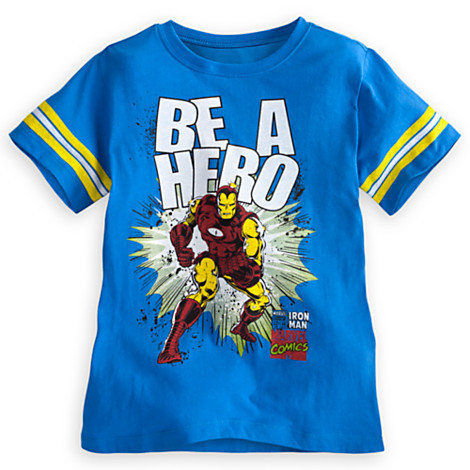
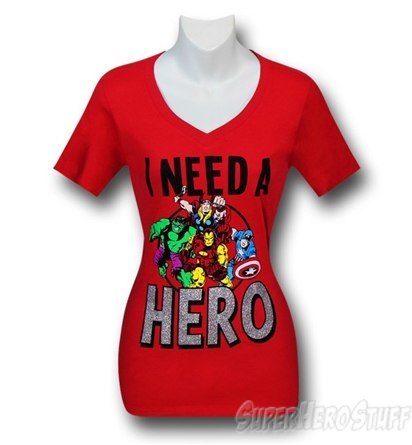
This sexism, by the way, goes beyond the specific imagery of a superhero. “Be a hero” translates to “act, take risks, make choices. “I need a hero” means “I’m a minor character. I’m passive, and I wait.”
See the difference?
The insidious problem with this stereotyped gender casting is that women are constantly sidelined and marginalized, remarkably, in the roles they play in their own lives. Females are cast in the supporting role, defined by their relationships as girlfriend, wife, mother, or helper. This sexist narrative has been going on for a long, long time, and we keep recycling it. I just saw this Virginia Woolf quote Tweeted by Bitchflicks:
And I tried to remember any case in the course of my reading where two women are represented as friends…They are now and then mothers and daughters. But almost without exception they are shown in their relation to men. It was strange to think that all the great women of fiction were, until Jane Austen’s day, not only seen by the other sex, but seen only in relation to the other sex. And how small a part of a woman’s life is that.
How small a part! But who would ever guess from looking at how women are depicted in the media– movies, TV, books, advertising– in 2013? Ironically, and this is what is so fucked up and twisted, females get to exist, get to play a part at all when they are sexualized and marginalized.
“Avengers” has the classic Minority Feisty ratio of 5 male superheroes to one female. As artist Kevin Bolk illustrates, the lone female is highlighted by her ass.
What is the solution to this sexism? Be a hero. Women, write your own stories. Make your own art. No one else can do it for us.
Update Here’s a comment from Nick:
The solution is not only for women to write their own stories, but for men to understand why this is sexist. There is a dearth of great female superheroes, and when they exist, they usually suffer from the Women In Refrigerators trope, where they die or lose their powers not doing something heroic, but assassinated while cooking in their kitchen, sometimes horrifically placed in the refrigerator, where the trope’s namesake comes from.
The solution has to be EVERYWHERE. Men and women alike should write compelling female superheroes. Some men don’t understand why Women in Refrigerators or Damsel in Distress tropes are inherently sexist, so education on this is also key.
For my part, I read up on feminist blogs like ReelGirl and watch Anita Sarkeesian videos (and the reaction videos, because she is very one-sided). I try to avoid making the same mistakes as other writers when dealing with women. I don’t ever assume I can write a compelling female character, I always question myself and I always push myself to do better.
I think that’s another good answer to this problem – each of us individually pushing the status quo.
And my response:
Hi Nick,
Totally agree the solution has to be everywhere. Thanks for this comment and for the thought and research you put into writing female characters.
Margot
Obviously, it’s a sexist world out there, and when women make art, it’s often ignored or marginalized. It would help if women were running the major Hollywood studios or had the funds to bankroll those studios, not to mention lead the prestigious organizations and comprise the boards that give awards to “great” artists.
That said, women need to keep writing and creating. Making art is risky and dangerous, engaging in the process is being a hero. Persevering is especially challenging when your work gets dismissed and rejected because stories about women aren’t valued. But, even with all of this against us, women must put our stories and visions out there. I really believe this is the only way we’ll ever achieve full gender equality.
My daughters had two incidents this week where other kids asked them why they had boy stuff. The first time was when my nine year old daughter was in ski school and another girl asked her if she had a big brother because she was wearing boy clothes. My daughter was wearing a black parka and gray ski pants. My daughter told me that she lied to the girl, saying she didn’t have a big brother but she had a boy cousin who was older. The girl was wearing white ski clothes and her skis were covered with a pink design that my daughter thought might be birds.
My husband told my daughter, “Just say to her, ‘Did you eat something pink? Because it looks like you threw up all over your skis.”
I kind of like that. I need help from you about how to respond to kids like this. I know exactly what to say to adults but I don’t want to get all intellectual on kids. I also don’t want to shame the kid, even though part of me does. Here are my three daughters, learning how to ski, being brave, taking risks, trying something new, and some little kid makes them think about how they appear? How they look? ARGH.
Have you had similar experiences and what has your kid said or you said that you felt good about?
The next event happened to my six year old daughter. Usually she gets school lunch, but that day, she brought a lunch bag to school that is blue and gray. A boy in line asked her why she had a boy lunch. A boy lunch?
Again, the last thing I want my daughter focusing on is how her lunch looks.
The focus on appearance starts so young with girls, and I hate watching it get programmed into their growing brains. Kids are resilient but girl children get so much attention for what they look like, you can literally see them learn “how I look = attention= love.” Unlearning that message, when it is reaffirmed everywhere for a lifetime, is challenging to say the least.
If there were any way to win this battle of appearance= happiness, maybe I could get behind it. But there is no way for females to feel good about themselves when their identity and power is shrouded in how they look. Even if a woman spends all of her time, all of her money, and all of her mental energy on looking good, say she’s Kim Kardashian, people will still call her “fat” and “a hairy Armenian.” No woman who is in public on any level will escape being called ugly to insult and degrade her. But even say, magically, some woman were so perfectly “beautiful,” she was immune to ever having a bad photo on the internet. That woman will age and then she will be “ugly.” There is no way for a woman to win the “beauty” game. That is why I hate that tiny baby girls are taught by parents, doctors, and teachers that their bodies are valued for how they appear and not for what they do. And one of the saddest things ever is watching little kids do this to each other, because you know who has taught them this– us.
It’s a lot like the front cover, which features Kate Upton standing in freezing Antartica in nothing but undies and an unzipped winter coat (fun fact: this almost killed her), only instead of a busty lady, the ad features a sexy M&M peeling off her shell.
Here’s Ms. Green on last year’s back cover of SI:
Here’s another image promoted with SI:
Here’s the winner of the M & Ms Hall of Shame, the S & M M & M “working the polls.”
Here’s Ms. Green getting stalked, ha ha ha.
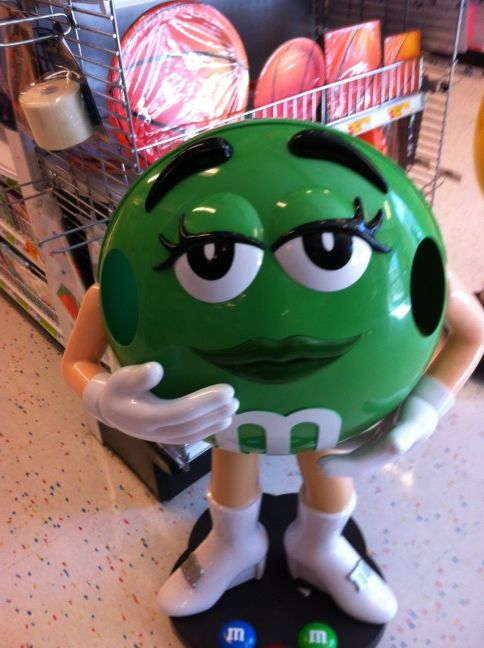
Here’s Ms. Green at Party City where my daughter and I went shopping for her birthday party.
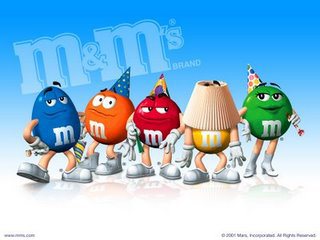
Ms. Green is one of two female M & Ms alongside 4 male M & Ms. The male M & Ms wear sneakers and act goofy. The females M & Ms wear heels and act sexy.
This male-female ratio is the same old Minority Feisty pattern we see all over kids media but the sexualization of Ms. Green is extreme, even for the run-of-the mill sexism in kid world.
Please go to M&Ms Facebook page and ask them to stop sexualizing female M & Ms. Ms. Green is everywhere. Our kids deserve more than to see females depicted in this stereotyped and degrading way.
I have an idea for a themed art show that could travel the museums of the world: “Clothed men, naked women: a retrospective.” How many galleries and halls do you think would overflow?
I just posted about repetitive gender imagery in “riding bitch,” where the female is shown behind the male on a bike, animal, imaginary creature etc. This sexism is persistent in depicting a fantasy world marketed to children. Amazing how the imaginary world is just as sexist as the real one, huh? Wonder how that happens…
Lynley Stace linked to one of my posts, and that’s when I saw Nick Cave’s new CD cover on her blog.
Stace writes:
As one woman commented on Facebook, this image is problematic because it depicts a naked woman opposite a fully-clothed man (in a suit, no less). The woman looks upset or humiliated because her face is covered and Nick Cave looks as if he’s ordering her to go to her room (i.e. he is treating her like a child).
What I would add to that comment is that the woman, judging by her youthful body, is much younger than Nick Cave. Nick Cave is currently 55 years old. That female body looks under 30. So the power is with Nick Cave in every possible respect.
Also, check this out. The image is getting as much traction as Cave can get out of it. Stace writes: “Also, the album cover isn’t JUST the album cover. Turns out this image is being used for general promotional advertising.”
I used to be a fan of Cave. No more. What really gets me is when you look at this image, you can feel how radical and cool Cave thinks he is.
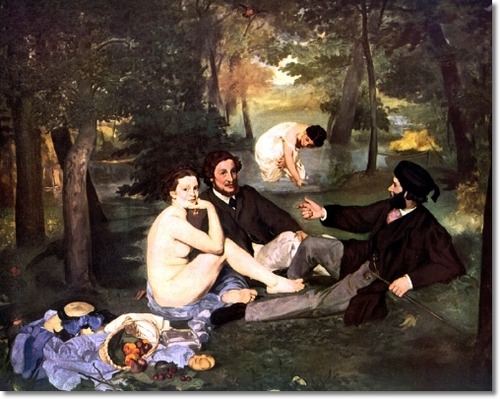
Hey, Nick, it’s been done. Throughout history, again and again. Here’s a version from Manet:
GQ:
Vanity Fair:
I could fill my entire blog with these images. Cave, you’ve lost your originality and you’re showing your 55 years. You’ve become a copy cat, a cliche, and no more an avante-garde artist than Larry Flynt was a proponent for free speech.
#NotBuyingIt
and if you agree,
Please Tweet: Nick Cave’s Push Away the Sky been there, seen that and #NotBuyingIt
More than any other pattern of sexist imagery in the fantasy worlds created for children, I hate the girl on the back of the bike, dragon, or hippogriff. Recently, I posted:
This image of male driving and the girl along for the ride is ubiquitous in the imaginary world. You almost never see a girl in front and a boy behind, or even a girl alone, and also, it’s extremely rare to see a girl on a female magical creature.
After my post, Orlando wrote in this comment:
Shall I share with you the moment when I learned to loathe Kerouac? This is it (from “On the Road”):
“In the empty Houston streets of four o’clock in the morning a motorcycle kid suddenly roared through, all bespangled and bedecked with glittering buttons, visor, slick black jacket, a Texas poet of the night, girl gripped on his back like a papoose, hair flying, onward-going, singing.”
Familiar image? What happened was two people went past; what they saw was one person plus accessories.
The Kerouac quote pretty much epitomizes the poetic subjugation of women in that repetitive image (coupled with the the adventurous title of the book, of course.) Kerouac is such a good writer and he does this image so well. And again, the image/ narrative would not be a problem if it were one of many; it is its dominance over our imaginations, the way other narratives have become restricted and repressed, even in fantasy, that is the tragedy.
I’m going to keep a running tally on Reel Girl of images normalizing what I learned is called “riding bitch.” Please let me know if you see any and PLEASE let me know if you see the reverse gender positions.
Two recent disappointments:
I was very bummed to see the usually feminist Studio Ghibli put out this image to promote “From Up on Poppy Hill”
My three daughters and I are flummoxed by On Demand’s menu categories. Under “Kids,” subcategories include: Nickelodeon, Disney Junior, Cartoon Network, on and on. Then, you list: “Girls Rule!”
We were wondering why shows with male protagonists are marketed as mainstream while “Girl’s Rule” is one category out of 20? Girls are 50% of the population, so why the niche programming?
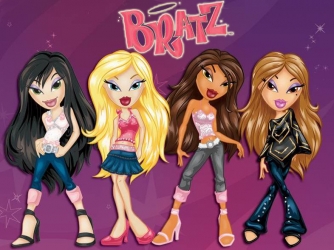
Regardless of the language you use, attributing 5% of shows to the “girl” category doesn’t feel like ruling. Especially not when the list includes shows like “Bratz” which stereotypes and demeans girls, depicting them with a myopic focus on fashion, appearance, and shopping.
A more accurate label for On Demand’s menu would be “Pink Ghetto.” Here’s Webster’s definition:
ghet·to
[get-oh]
noun, plural ghet·tos, ghet·toes.
a section of a city, especially a thickly populated slum area, inhabited predominantly by members of an ethnic or other minority group, often as a result of social or economic restrictions, pressures, or hardships
After I posted about Rhonda Lee, a meteorologist who was fired after defending her “ethnic” hair on Facebook to a racist and sexist commenter, I was thinking about black hair.
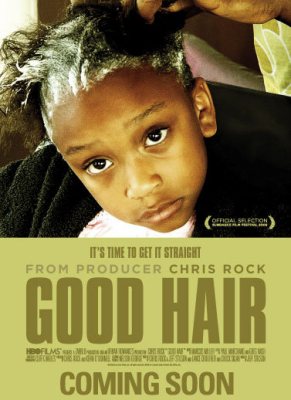
Right after I started Reel Girl, I saw an excellent documentary by Chris Rock on this subject called “Good Hair.”
The film begins with stills of Rock’s two young daughters. (I love that this film was inspired by these girls.) While we look at their pictures on screen, we hear Rock:
Those are my daughters, Lola and Zara. The most beautiful girls in the world. And even though I tell them that they’re beautiful every single day, sometimes it’s just not good enough. Just yesterday, Lola came into the house crying and said ‘Daddy, how come I don’t have good hair?’ I wonder how she came up with that that idea?
The film goes on to document just how these little girls got the idea that their hair wasn’t good enough.
In the film, actress Nia Long tells Rock:
There’s always a sort of pressure within the black community, like, oh, if you have good hair, you’re prettier or better than the brown skinned girl that wears the afro or the dreads or the natural hair style…The lighter, the brighter, the better.
Comedian Paul Mooney explains the phenomenon to Rock most concisely:
If your hair is relaxed, white people are relaxed. If you hair is nappy, they’re not happy.
“Good Hair” ends as it begins, with images of Lola and Zara shown at a playground while Rock muses: “So what do I tell my daughters? I tell them that the stuff on top of their heads is nowhere near as important as the stuff inside of their heads.”
A few months after I saw “Good Hair,” I watched nine year old Willow Smith bust out of the gender/ race matrix, exuberantly celebrating her hair and her independence with her hit song and video, “Whip My Hair.”
Willow sings:
Whip your hair back and forth,
Don’t let haters keep me off my grind,
Keep my head up,
I know I’ll be fine.
She explained the song to MTV:
Whip My Hair’ means don’t be afraid to be yourself, and don’t let anybody tell you that that’s wrong. Because the best thing is you.
Just a couple weeks ago, when this picture of Willow, now 12 years old, made the rounds on the internet, her mother, Jada Pinkett Smith, was derided for bad parenting.
Jada responded to the criticism on her FB page:
This subject is old but I have never answered it in its entirety. And even with this post it will remain incomplete. The question why I would let Willow cut her hair. First the ‘let’ must be challenged. This is a world where women, girls are constantly reminded that they don’t belong to themselves; that their bodies are not their own, nor their power or self determination. I made a promise to endow my little girl with the power to always know that her body, spirit and her mind are her domain.
Willow cut her hair because her beauty, her value, her worth is not measured by the length of her hair. It’s also a statement that claims that even little girls have the right to own themselves and should not be a slave to even their mother’s deepest insecurities, hopes and desires. Even little girls should not be a slave to the preconceived ideas of what a culture believes a little girl should be.
How cool is that? And how different is Jada Pinkett Smith’s public message to her daughter, and about her daughter, than the more conventional and ubiquitous “good mom” message from this Elizabeth Arden ad?
And speaking of beauty, there are few factors more obvious to reveal that what we call “beauty” is indicative of the time we happen to live in than hairstyles. “Beauty” is all about culture and class, status and money.
If African-American women represented the majority of CEOs in America, professors and department heads of Ivy League universities; if they dominated our boards and Academy Award winners, movie dierctors and nightly news anchors and on and on, do you think for one second any viewer would write in that the black lady on TV looks like she has cancer?
The racist comment has nothing to do with hair or “beauty” and everything to do with what it means to be black and a woman in America.
You’ve got a better chance getting into the power ranks if you look the part. Every woman knows how important her appearance is and how intimately what she looks like influences her chances of success.
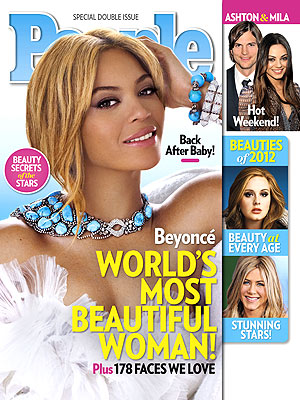
In the history of People Magazine, only two African-Americans have graced the “World’s Most Beautiful Woman” cover. I guess white people are just prettier than black people. Go figure. Note that Beyonce wins the title as a blonde.
If women ran Hollywood, do you think People would create a “most beautiful” issue at all? Or would the magazine come out with something more like “The Sexiest Woman Alive” featuring older stars on its cover? Real life “Sexiest Man Alive” winners include Pierce Brosnan at age 48, Harrison Ford at age 56, and Sean Connery at age 59.
Of course, it helps to come off as “sexy” when you’re portrayed in movie after movie as a hero and shown with “hot” sidekicks who are desperately in love with you. Though People covermen do have one thing in common with the women: Denzel Washington is the only African-American ever deemed “sexy” enough to win.
When Rhonda Lee defended her hair to a racist commenter, she wrote:
Little girls (and boys for that matter) need to see that what you look like isn’t a reason to not achieve their goals.
That’s the same reason Chris Rock made his documentary. It’s the same reason Willow Smith wrote her song, and Jada Pinkett Smith spoke up for her daughter. Is Rhonda Lee not famous enough or powerful enough to speak up for herself without getting punished for it?