When your child is complaining about something you did, perhaps you were late to pick her up (there was horrible traffic), something you said embarrassed her (you just wanted to stick up for her), or you made her take music lessons ten years ago (you thought she’d be grateful), and you want so badly to respond, “I tried my best!” I invite you to pause instead.
When you say “I tried my best” to your child, the subtext is: Give me empathy. You’re shifting the conversation from her inner world to yours and centering yourself.
Yes, you tried your best and she suffered. Both are true.
You don’t have to agree with your child’s interpretation. You don’t have to decide you did something wrong. You don’t have to abandon your own needs. You’re asking yourself: Do I have the capacity to listen to my child’s experience right now? To center her?
Because of the inherent power dynamic between parent and child, when you choose to show up for your kid with curiosity, openness, and compassion instead of immediately defending yourself, you give her real-life experience that her needs matter. She experiences her inner world is valuable and important. You can help meet her needs for authenticity, safety, and belonging. This kind of consistent coregulation gives her a foundation for navigating relationships and choices throughout her life.
In Nonviolent Communication (NVC), everyone’s needs matter.
So what about your inner world? What about your needs to matter, to be seen, heard, understood, appreciated, respected, and to experience shared reality?
I invite you to find strategies to meet your beautiful needs that don’t ask your child to take care of your emotional experience. Maybe talk to a friend, a therapist, a coach, or your partner, go for a walk or write in a journal. What resources you? Pursue that. And maybe, at some point, sharing your why, your intention, with your kid will be appropriate. But hopefully, that’s a time you consciously choose, after you’ve made room for her pain, with her consent to hear.
To learn more about Nonviolent Communication and my parent coaching, please visit my site Listen2Connect
On Reel Girl, I’ve been blogging for years about raising my kids as intuitive eaters so now we have archive of something I think is pretty rare: a record of what it was like to bring up daughters with no eating disorders. Now my kids are 22, 19, and 17. Check out this video as the latest exploration about often misguided (but not always) attempts to be “safe” and “successful” and “healthy” as a female living in a patriarchy.
Are mental health diagnoses at a young age illuminating, making way for clarity, effective medication, community, and treatment or pathologizing in a way that pigeonholes kids and keeps them stigmatized and stuck? My daughter and I talk about her “emergent borderline traits,” other diagnoses, and her healing journey on my new YouTube channel.
To learn more about our family’s story, subscribe to the channel to see future videos, and read an earlier Reel Girl post about the modality that transformed our family dynamic Kids Speak in Metaphor—Can Parents Learn How to Listen? You can also go to my site Listen2ConnectCoach.com, the About page and the Media page. To learn more about Nonviolent Communication specifically and download free Feelings and Needs lists, try the resources page.
What do you feel when you read that quote? What does it even mean?
I’m the mother of three daughters. I’ve also been coached by Bethany, and when I read her words, again and again, my needs to be seen, heard, understood, and to matter are met. Her analysis, in my experience, is so rarely articulated and so true.
The simplest way I can explain the significance of Bethany’s quote is through describing my eating disorder and recovery from it. When I was obsessed with counting calories (I grew up in the 80s) I had a lot of clarity on what was good and what was bad: cookies were bad, cottage cheese was good; Republicans were bad, Democrats were good; William Faulkner was a great writer, Jackie Collins was a bad writer. I was a teenager, the world was easily divided into binaries, I knew who I was and where I was going.
In my twenties, when I started to try to give up the bulimia, I tried so many modalities to stop the behavior. I went to private therapy, group therapy, nutritionists, 12-step programs, and nothing worked until I started to practice what today would be called intuitive eating. I got help from an organization called Beyond Hunger in Marin County that supported me to eat when I was hungry, eat whatever I wanted, and stop when I was full. To be clear, this was not an eat when-hungry-stop-when-full “diet.” Many times, as I was learning, I would finish a bag of chips when they stopped tasting good, just because I had the urge to keep crunching, but the difference was I became aware of when I was continuing on past my pleasure point. I was conscious of my choices and I learned to be self-compassionate.
But here’s the really weird thing that happened as I recovered from bulimia. Initially, I lost my orientation of right and wrong. I no longer connected with other women as easily as I had in the past. When I stopped criticizing my body, I got confused. When I stopped eating because it was lunch time or dinner time, and ate when I actually was hungry, I didn’t know how to schedule my day. When I was served a plate of food and I only wanted half of the portion or I wanted seconds, when I was in the mood for salad and not the steak that was served, when I ate because I actually wanted the food and not to protect someone’s feelings, a waiter I didn’t even know or a man who cooked for me, I felt a rush of guilt, shame, and fear.
For so many women, having an eating disorder, being sick, is easier than being healthy. Eating what I wanted, when I wanted felt so rebellious and strange. I felt like how I imagine those tigers do, like the one Glennon Doyle wrote about in her book Untamed, who was free of her cage and still couldn’t run. She was paralyzed,
I was 28 years old when I got better from bulimia and I was 34 when I had my first child. I thought I was ready. Not only had I recovered from a vicious eating disorder, I was sober. I was deeply in love with my smart, sweet boyfriend. I had a career that excited and fulfilled me, I produced talk radio programs, co-founded a non-profit that taught young women ethical leadership skills, I published commentary on politics and culture, and I advocated for women’s issues on national television. Who could be more ready for motherhood than me?
I raised all three of my daughters to be intuitive eaters which for me meant I never gave them rules about what to eat and when to eat it. I never made them finish a plate of food or rewarded “good” behavior with something like ice cream or told them not to “snack” before dinner. I filled the refrigerator and low cupboards with food that they could reach on their own. If they wanted ice cream for breakfast, they was fine with me.
This post is not about how in spite of my efforts, my daughters still grew up with disordered eating. All of them are “healthy” eaters. They eat what they want when they want, they’re adventurous with trying new kinds of food, they’re all “normal” weight.
But when my kids were little, the other moms had a really hard time with how my kids ate. When friends came over, often parents joined, and they were shocked and disapproving that my kids could eat candy whenever they wanted. I honestly believe that part of the reason these parents accepted my family’s intuitive eating, is because neither my kids or I were “overweight.” Once again, I learned, not having an eating disorder separated me from community and incited disapproval, judgement, and confusion.
In my own family, being a “healthy” eater (how I define healthy which is not controlling food, I’m not talking about eating your veggies) caused more conflict, upset, confusion, and judgement. When my kids were allowed to eat whatever they wanted and my nieces and nephews weren’t following the same “rules,” new flexibility and openness had to be reached and that path is never smooth. That journey to a different way of being and relating isn’t so so different from the readjustment sobriety can create in a family that connects and bonds at cocktail hour.
Moms want so much to keep our kids safe, and the way I was raising my daughters seemed dangerous, scary, and chaotic to so many parents. I get that because when I went through a new way of eating, that process could feel dangerous, scary, and chaotic.
Mothers pass on eating disorders, generation after generation, out of concern, love, and a desire to protect. As a woman, when you stop monitoring what you eat, when you let your own body determine what you want and when you want it, you are making a radical choice to trust yourself.
It turns out, at 34, I was not “ready” to be a mom, because no one is ever ready and there’s no perfect time. My oldest daughter never had food issues, but she struggled with behavioral challenges that I’ve written about before and what I learned from supporting her through recovery is that my insights about food didn’t go nearly far enough. It wasn’t just at the dinner table that I needed to follow the wisdom of my body, my intuition, my own unique path instead of the systems that rewarded compliance. As a woman, as a mom, as a mom of daughters, time and time again you’re confronted with a choice: Do I do what the “expert” tells me, the psychiatrist, the teacher, the lacrosse coach, the college adviser, or do I deeply listen to the needs of my daughter?
For example, it never once occurred to me, and I now I realize this lack of awareness was partly because I was born white and to a privileged family, that my daughter wouldn’t go to college. I may have been a Democrat, but I believed in all the rules and status and hierarchy of academia. While I wasn’t dependent on how much money or how much I weighed to determine my status and worth, I was still looking for external validation in my daughter’s grades and test scores. Those numbers told me if I was a good mom, if my daughter would be “safe” and “successful” in the world.
What I know now is that helping my daughters thrive in the world means prioritizing connection with them, listening to them, meeting their needs to be seen, heard, and to matter, not just in what they eat but in every aspect of their lives.
If you want to learn more about Nonviolent Communication or my parent coaching visit listen2connectcoach.com or follow me on Instagram @listen2connectcoach
When my teenage daughter was in residential treatment for behavioral health challenges, she would tell her therapists about the time my husband kicked her out of his truck on the freeway.
That never happened.
The first time my husband and I heard her story, we were shocked and defensive. “How could she say something like that?” We asked the therapist. “Is she trying to hurt us?”
“Lying is a consistent problem for her,” the therapist told us. “We’ll confront her together in a family session. If she can’t be truthful, she won’t get better.”
Finally, all in one room, my husband and I demanded our daughter tell us why she made up negative stories about us. We restated what really happened: “When you yell at us, get physical in the car and threaten us, when you grab the steering wheel, or shove the car into park and your sisters are in the back seat, we cannot continue to drive. We’ll pull over and ask you to get out to calm down. We do that to keep everyone safe. We would never force you out on a freeway.”
Our daughter’s eyes glazed over, and she wouldn’t say anything or respond to us at all. My husband and I got more agitated, frustrated, and defensive. That session ended, like so many others, in radical disconnection.
Several therapists later, when we heard the same story yet again, I rolled my eyes. “I can’t go through this in another session, it’s a waste of time and money.”
“What about just listening to her?” said the therapist.
“What?” I said. “She’s lying.”
“But what was she feeling?” asked this therapist.
“What was she feeling when the thing that never happened happened?” I said, my body stiffening.
“We’re not going to enable her,” said my husband, reciting the counsel of so many experts. “She’s manipulating us.”
“Can you listen for the emotions underneath her story?” said the therapist. “Could that be the truth for her?”
I’m a writer, skilled in translating emotion into metaphor, and still hearing the therapist emphasize feelings beneath the narrative, my brain short-circuited. “You mean how would she feel if we had left her on the freeway?”
“Yes, can you picture that?”
I closed my eyes. I felt like I had to harness every brain cell in my head to even imagine my daughter abandoned on 101 North. “She would be terrified,” I said. “Totally alone.” When I spoke those words, I felt them. I finally experienced the empathy for my daughter that always eluded me when I pictured her on a tree-lined street.
In our next family session, when the freeway story came up, I blinked and saw her standing on the shoulder, cars whizzing by. “That must’ve been really scary,” I said.
“Yes, it was scary,” she said. She went on to talk about how lonely and sad she was, and how much shame she felt for acting out— this from a kid who would never tell me what she was feeling. And tragically, I spent so many years begging and ordering her to open up. Not long before that session, I’d written in a letter to her:
“Time and time again, we’ve asked you to be honest with us, to be specific about what is happening for you, what problems you face and how you work through them, but what we get is lies or half truths and you taking a victim role. We are not asking you to be perfect. What we need is for you to approach our talks with honesty, openness and authenticity, to feel the words that you’re saying.”
I was asking my daughter to choose to feel, as if that were a conscious decision she could make—and then I expected her to somehow summon the courage to share those painful, vulnerable feelings with me, her angry and frustrated mother.
In her new book, Fawning, Dr. Ingrid Clayton writes: “My brother once told his teachers in elementary school that our parents made him sleep outside at night, in the freezing cold. He said he curled up in an empty hot tub with nothing but the cover for a blanket. This is NOT what was happening in our house, but even as a kid, I remember thinking, that is genius. Because that loneliness, that fear, that neglect…was.”
When my daughter found her own ingenious way to share her internal world with me, I didn’t meet her with curiosity. I yelled at her for lying.
All these years later, I sound like I’m judging myself, and that isn’t my intention. I want to share how desperately I wanted to connect with my daughter, how much she wanted to connect with me, and how we repelled each other like magnets. Too many mental health experts and treatment centers push parents to create and hold firm boundaries in order to achieve behavior change, instead of showing us how to connect with our kids. Professionals handing down wisdom from mountaintops can’t guide us when they don’t know how to listen to us or our children.
Reading about the Reiner family tragedy, I was struck by a similar moment of clarity when the parents spoke about their son Nick’s history in treatment. In 2015, Rob Reiner told a reporter: “The program works for some people but it can’t work for everybody. When Nick would tell us that it wasn’t working for him, we wouldn’t listen. We were desperate, and because the people had diplomas on their wall, we listened to them when we should have been listening to our son.”
Michele Reiner added, “We were so influenced by these people. They would tell us he’s a liar and he’s trying to manipulate us. And we believed them.”
My husband and I didn’t have a magical, instantaneous metamorphosis the first time we heard my daughter’s feelings underneath her words. We were still scared, defensive, and confused as we all muddled our way through recovery. But what shifted dramatically that day was our orientation, our goal, our North Star. We no longer prioritized fact-checking, scanning words for accuracy, evaluating for objective truth, and deciding how much we agreed with everything said. Instead, slowly but committed, we turned towards the principles of Nonviolent Communication (NVC) and began practicing empathic listening with each other. Developed by clinical psychologist Marshall Rosenberg, NVC centers on identifying feelings and the universal human needs beneath them. Rosenberg taught that conflict arises not from those needs, but from the strategies we use to try to meet them—and that when needs are heard, compassion becomes possible.
I have no doubt my family will spend a lifetime continuing to learn how to listen to each other, but all these years later, my daughter is happy, healthy, and though forever poetic, no longer depends on metaphor to risk expressing her truth.
Clarissa Bird is a high school junior from Austin, Texas who is frustrated by the lack of female protagonists in the media and annoyed by the negative reaction from teens and adults to ’13 Reasons Why.’ She wrote this post defending the show for Reel Girl.
It’s not hard to find a reason to hate the show “13 Reasons Why.” I’ve gotten lengthy emails from my school principal and counselor on how dangerous the show is without proper adult supervision. I’ve had a friend tell me her parents wouldn’t let her watch the show after reading an article on how it glamorizes and simplifies suicide. I’ve seen the headlines on how the show neglects the underlying causes of self-harm and how the entire plot is driven by petty teen drama. And to an extent, all of these reactions are valid. The show has major faults ranging from the over-the-top stunning actors who are just a little too hunky to play teenagers to the unbelievable teen fantasy of getting a new car for homecoming to more serious issues like subtle victim shaming and simplification of a female protagonist.
But for all of its missteps, there is something about watching one of the main characters, Clay, roll around on his crummy bike trying to uncover Hannah’s story that had my eyes glued to the screen. There was some innate pleasure I took from watching this tragic, teenage girl’s life spiral out of control as love interests and friends continually pulled the rug out from under her. In fact I liked it so much I watched all 13 episodes.
But, upon hearing people in my math class condemn the show and all those who enjoyed it, I seriously started to wonder what the heck was wrong with me for watching it. I never even seriously considered how horrible the show was before hearing classmates rail on it. Am I a terrible, selfish, psychopath because I liked this show about teen suicide? Was I really that ignorant about mental health and suicide that I thought this girl’s actions weren’t so irrational? What made this show that turned my once down to earth, sensible, classmates into condescending, drama critics so addicting to me?
13 REASONS WHY
Hannah Baker’s relationship with her parents
Although the show is criticized for the fact that Hannah’s parents seem to be completely out of touch with their own daughter’s mental state, I found their relationship to be refreshingly relatable and not too far off base. One of my friends said that her main problem with their relationship was that the parents weren’t supportive enough, but it’s hard to support someone when they’re not really telling the whole truth. In “13 Reasons Why,” Hannah faces the familiar question of how much she’s really supposed to be sharing with her parents. Most high schoolers, including myself, tend to bend the truth or offer vague explanations in an attempt to satisfy the endless stream of parental inquiries. It’s a natural part of growing up to become more independent and this includes becoming more secretive and maybe not telling my parents exactly where I was last Saturday night or why I spend so much time “out with friends”.
A girl’s reality
“13 Reasons Why” does a great job of exposing all too common high school boy’s behaviors such as sharing non-consensual photos, objectifying girls through “best” and “worst” lists, and harassing and sometimes even assaulting girls. I loved watching it for this exact reason and from the moment I heard about the show I was excited to finally have a complicated, raw view of the teenage girl. As an audience we feel bad for Hannah when Justin shares intimate photos leading students to believe he had sex with her. We feel worse for Hannah when she kisses her friend on a dare and the rumor spreads she’s bisexual. We feel the deepest, gut-wrenching pain for Hannah when she’s raped. However, the show also reveals its moral universe as somewhere that Hannah’s rape can be labelled “worse” than her friend’s rape by the same boy, because in Hannah’s case she wasn’t drinking, smoking or flirting with the guy. And although I enjoyed the realistic portrait of a girl who can’t and won’t be pinned down or labelled as one thing, I was frustrated by Clay’s simplification of Hannah. He ultimately sees her as the victim of the school’s jocks, stalkers and petty girls and continually boxes her into the wholesome, girl-next-door character trope.
Inseparable from own life
One thing this show does painstakingly well is define a clear chain of events that leads to Hannah Baker taking her own life. From the first episode of the show, Hannah is portrayed as a normal, highschool girl who just wants to fit in at a new school. Although I knew the show ended with her suicide, I couldn’t help but root for Hannah hoping that maybe there was a twist ending and she was somehow alive. But, by the final episode I was in the same mental state as Hannah which I think is the major red flag for most people because the show seems to simplify suicide and blame other people for an ultimately self-inflicted act. I understood why Hannah couldn’t see a way to keep going. I could trace back all the horrible things that had contributed to Hannah’s current state from her being called the school slut, to her friends deserting her, to her going to a party and seeing her friend get raped, and later being raped herself. If this could all happen to the sweet, naive, painfully trusting girl then it could really happen to anyone. This contradicts the standard that only mentally ill people commit suicide and instead offers up the idea that maybe our own actions have a long-lasting result on other people’s mental state.
Clay’s revenge
In “13 Reasons Why” we hear Hannah’s thirteen tapes through her charmingly innocent friend and love interest, Clay. Devastated, confused and overwhelmed by Hannah’s suicide, Clay listens to each tape and stews in the wrongdoings of his classmates. His anger gets the best of him in several scenes, like when he confronts Hannah’s stalker and when he gets in fights with the school jocks for tormenting and harassing Hannah. I couldn’t help but cheer as Clay brought justice to each perpetrator and I completely lost it when Clay went to Bryce’s (Hannah’s rapist) house to sneakily work a confession out of him. Episode to episode I couldn’t wait to see what Clay did next to somehow try and avenge Hannah’s death.
Answers
Ultimately, the main reason anyone picks up the show is try to figure why this girl killed herself. This show attempts to answer a question that may be impossible to answer over why anyone commits suicide. “13 Reasons Why” does this to the best of it abilities and although it has caused mass controversy, the show answers the burning question. Similar to murder mysteries like “Twin Peaks,” each episode clues the audience in on what really happened to Laura Palmer or in “13 Reasons Why,” why Hannah kills herself. While there’s a million problems with how the show portrays mental illness, female protagonists and suicide, I’ve got to admit every episode left me on the edge of my seat wanting more. It tells us that all these moments of Hannah finding out she has a stalker to being deserted by her best friends to being labelled as “easy” by every guy in school have led to her final decision to end her life. The show sucks you in by promising a concrete cause for suicide but the answer it gives seems simplistic, threatening and too widely applicable. Probably the biggest reason people have gotten so up in arms against the show is due the fact that they couldn’t help but watch the entire thing. I may be a drama-hungry teenager obsessed with answering every question I can, but it seems to me so is everyone else who watched the show no matter if they loved or hated it.
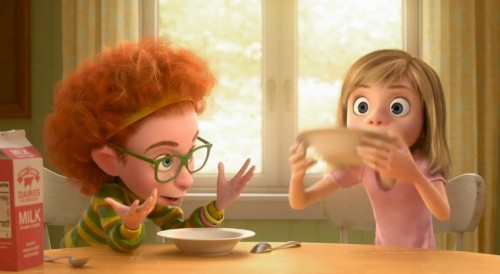
Proceed immediately to the theater and go see “Inside Out” even if you have no children. Pixar’s latest may be my favorite animated movie EVER. Powerful female protagonist CHECK. Complex female characters in supporting roles CHECK meaning “Inside Out” does NOT feature Minority Feisty!!!! Spectacular animation and compelling story telling CHECK and CHECK.
I am not alone in loving “Inside Out.” I don’t think I’ve read a negative review. My daughters and I had fascinating conversations after the movie: My six year old said she was Joy and my eight year old picked Disgust to describe herself. They talked about which emotions their friends are and different members of their family. But then they also had a talk about how they are– and all people are– all of the emotions. Other emotions personified in the movie are Sadness, Anger, and Fear. My kids talked about what emotions they didn’t see in the story– Embarrassment and Meditation which I interpreted as Serenity or Calm. We talked about which emotions branch off of others, and that all emotions need to be valued and felt which happens to be the point of the movie. That conversation began in the backseat of the car going home and is still going on today.
Riley, the star and the setting for the movie (most of it takes place in her head) is an 11 year ice hockey star from Minnesota who moves to San Francisco. I appreciated the depiction of the city, where I happen to live, as foggy-gloomy and infested with broccoli covered pizza. While I have grown to love my home, I understood Riley’s experience of it as gray and depressing. I totally had those moments as a kid and still do. Riley longs for seasons that included snow. Depicting Riley as an ice hockey fan not only highlighted her aggression, joy, and skill but cleverly showed how alienated she feels in California. There is another (another!) cool female character in the movie, Riley’s BFF from home.
The two emotions with the biggest parts in the film– Joy and Sadness– are also female. Disgust is female too. Riley’s mom is also an ice hockey fan and player, though they do make the move for the busy dad’s job.
Amy Poehler who plays Joy said she was proud to be in this movie and that it makes the world a better place. I agree.
“Tomorrowland” stars not one, but two, brilliant female characters supported by (yes, supported by) the fabulous George Clooney. Frank Walker, the innovator played by Clooney, admires, respects, and loves these girls, Athena and Casey. Casey (played by Britt Robertson) is the scientist-dreamer who saves the world, but not before Athena (played by Raffey Cassidy) recruits and saves her in multiple bad-ass scenes. Just watching Athena drive the getaway truck is awesome.
“Tomorrowland” is the movie I’ve been waiting for, the narrative I’ve been dying to show to my kids. Not only is it feminist, beyond featuring only one strong female character (the typical Minority Feisty scenario) but Casey, the protagonist, is “special” not just because of her extreme intelligence but because she’s a dreamer. Casey sees the potential for the world to be different than it is. Her courage to be optimistic, to use her world view to change the future, is depicted in multiple ways that children can easily understand. In the beginning of the movie, when Casey is arguing with her father who is worried about losing his job and becoming useless, she tells him a story he always tells her: There are two wolves who are fighting. One wolf is darkness and despair, the other wolf is light and hope. “Who wins?” Casey asks her father. He answers, “The one you feed.” At which point in the movie, I elbowed my middle daughter whose go to response when I ask her to try something new is usually: “I can’t do it. ” She will then repeat that phrase about ten times as she tries (or stops trying) to throw a bean bag into a hole, or whatever the task may be. I always tell her, “Say you can, your body believes what it hears,” and she rolls her eyes. But watching “Tomorrowland” she understood what I’ve tried to teach her, and that is seriously worth the $10 I paid for her ticket. I am totally getting her the Casey action figure. (That hat Casey is wearing is RED though it looks a little pink in this photo and the emblem reads “NASA.”)
I don’t want to spoil the movie, because you must see it and you must take your kids– but I will say I looked at the narrative as a metaphor for gender equality. The message of the movie is: If you can’t imagine it, you can’t create it. It’s really a story about the power of imagination to transform who you are and the world you live in. The evil in the film is not so much a villain but pessimism and cynicism, the idea that everything, if not already known, is knowable. One of the ways the skepticism is communicated is by broadcasting narratives– images of starvation, drought, the world exploding, which becomes a self-fulfilling prophecy. This is exactly what I believe happens with girls and boys in the world today– we show them stories and toys about how different genders are, re-create sexism, and call it “natural” and fixed.
I didn’t know “Tomorrowland” would feature two incredible female characters. I saw the preview, where Casey picks up a pin that transports her to another world, but I knew nothing of Athena. It is truly rare to see two girls dominate the screen as these characters do. So why didn’t I know “Tomorrowland” would be so special? Today, before we saw the movie, I took this pic as we entered the Metreon and Tweeted:
Thought ‘Tomorrowland’ had a female protagonist so why are my 3 daughters the only girls in this picture?
I am SO sick of this bullshit sexist advertising, but this is why I created Reel Girl, so I could tell you to take your kids to this inspiring, feminist movie.
A die hard Swift fan, here’s my daughter holding her finally finished (almost finished?) essay and her beloved guitar. I am very psyched Taylor inspired her to think about her experiences with bullying and to write about her feelings.
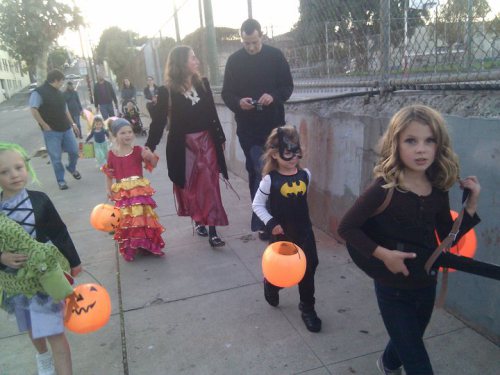
Obsessed with Taylor since 2012 (and always told she looks like her) here she is dressed as her idol on Halloween that year.
I was so happy she picked Taylor instead of a sparkly poofy princess, or witch or vampire with a costume that looks just like a princess. (Her younger sister in the background is Batgirl. Unfortunately, she has since realized Batgirl hardly exists in the world and has now lost interest in that character. Sad!)
I can’t believe we hadn’t seen this Scholastic/ Swift video! It’s so good. You must watch it with your kids. Swift is sitting around with a bunch of students and more students are Skyped in. What I loved is that first and foremost, Swift defines herself as a writer. I really appreciated my kids hearing Taylor say this because they think of her as a pop star. Taylor says that she would never want to get on stage and just sing someone else’s songs. She recommends journaling. After introducing the kids, Taylor opens the video with this statement:
I’m really excited to talk to you about reading and writing because I wouldn’t be a songwriter if it wasn’t for books that I loved as a kid and I think that when you can escape into a book it trains your imagination to think big and to think that more can exist than what you see. I think that’s been the basis of why I wanted to write songs and why writing became my career.
What’s the first question, from a 11 year old boy?
I saw that you liked the Emma Watson video about feminism, and I wanted to know what female characters influenced you in literature?
Can you see why love this video? Watch it now with you kids and find out what Taylor says! Here’s the link.