On Reel Girl, I’ve been blogging for years about raising my kids as intuitive eaters so now we have archive of something I think is pretty rare: a record of what it was like to bring up daughters with no eating disorders. Now my kids are 22, 19, and 17. Check out this video as the latest exploration about often misguided (but not always) attempts to be “safe” and “successful” and “healthy” as a female living in a patriarchy.
Are mental health diagnoses at a young age illuminating, making way for clarity, effective medication, community, and treatment or pathologizing in a way that pigeonholes kids and keeps them stigmatized and stuck? My daughter and I talk about her “emergent borderline traits,” other diagnoses, and her healing journey on my new YouTube channel.
To learn more about our family’s story, subscribe to the channel to see future videos, and read an earlier Reel Girl post about the modality that transformed our family dynamic Kids Speak in Metaphor—Can Parents Learn How to Listen? You can also go to my site Listen2ConnectCoach.com, the About page and the Media page. To learn more about Nonviolent Communication specifically and download free Feelings and Needs lists, try the resources page.
What do you feel when you read that quote? What does it even mean?
I’m the mother of three daughters. I’ve also been coached by Bethany, and when I read her words, again and again, my needs to be seen, heard, understood, and to matter are met. Her analysis, in my experience, is so rarely articulated and so true.
The simplest way I can explain the significance of Bethany’s quote is through describing my eating disorder and recovery from it. When I was obsessed with counting calories (I grew up in the 80s) I had a lot of clarity on what was good and what was bad: cookies were bad, cottage cheese was good; Republicans were bad, Democrats were good; William Faulkner was a great writer, Jackie Collins was a bad writer. I was a teenager, the world was easily divided into binaries, I knew who I was and where I was going.
In my twenties, when I started to try to give up the bulimia, I tried so many modalities to stop the behavior. I went to private therapy, group therapy, nutritionists, 12-step programs, and nothing worked until I started to practice what today would be called intuitive eating. I got help from an organization called Beyond Hunger in Marin County that supported me to eat when I was hungry, eat whatever I wanted, and stop when I was full. To be clear, this was not an eat when-hungry-stop-when-full “diet.” Many times, as I was learning, I would finish a bag of chips when they stopped tasting good, just because I had the urge to keep crunching, but the difference was I became aware of when I was continuing on past my pleasure point. I was conscious of my choices and I learned to be self-compassionate.
But here’s the really weird thing that happened as I recovered from bulimia. Initially, I lost my orientation of right and wrong. I no longer connected with other women as easily as I had in the past. When I stopped criticizing my body, I got confused. When I stopped eating because it was lunch time or dinner time, and ate when I actually was hungry, I didn’t know how to schedule my day. When I was served a plate of food and I only wanted half of the portion or I wanted seconds, when I was in the mood for salad and not the steak that was served, when I ate because I actually wanted the food and not to protect someone’s feelings, a waiter I didn’t even know or a man who cooked for me, I felt a rush of guilt, shame, and fear.
For so many women, having an eating disorder, being sick, is easier than being healthy. Eating what I wanted, when I wanted felt so rebellious and strange. I felt like how I imagine those tigers do, like the one Glennon Doyle wrote about in her book Untamed, who was free of her cage and still couldn’t run. She was paralyzed,
I was 28 years old when I got better from bulimia and I was 34 when I had my first child. I thought I was ready. Not only had I recovered from a vicious eating disorder, I was sober. I was deeply in love with my smart, sweet boyfriend. I had a career that excited and fulfilled me, I produced talk radio programs, co-founded a non-profit that taught young women ethical leadership skills, I published commentary on politics and culture, and I advocated for women’s issues on national television. Who could be more ready for motherhood than me?
I raised all three of my daughters to be intuitive eaters which for me meant I never gave them rules about what to eat and when to eat it. I never made them finish a plate of food or rewarded “good” behavior with something like ice cream or told them not to “snack” before dinner. I filled the refrigerator and low cupboards with food that they could reach on their own. If they wanted ice cream for breakfast, they was fine with me.
This post is not about how in spite of my efforts, my daughters still grew up with disordered eating. All of them are “healthy” eaters. They eat what they want when they want, they’re adventurous with trying new kinds of food, they’re all “normal” weight.
But when my kids were little, the other moms had a really hard time with how my kids ate. When friends came over, often parents joined, and they were shocked and disapproving that my kids could eat candy whenever they wanted. I honestly believe that part of the reason these parents accepted my family’s intuitive eating, is because neither my kids or I were “overweight.” Once again, I learned, not having an eating disorder separated me from community and incited disapproval, judgement, and confusion.
In my own family, being a “healthy” eater (how I define healthy which is not controlling food, I’m not talking about eating your veggies) caused more conflict, upset, confusion, and judgement. When my kids were allowed to eat whatever they wanted and my nieces and nephews weren’t following the same “rules,” new flexibility and openness had to be reached and that path is never smooth. That journey to a different way of being and relating isn’t so so different from the readjustment sobriety can create in a family that connects and bonds at cocktail hour.
Moms want so much to keep our kids safe, and the way I was raising my daughters seemed dangerous, scary, and chaotic to so many parents. I get that because when I went through a new way of eating, that process could feel dangerous, scary, and chaotic.
Mothers pass on eating disorders, generation after generation, out of concern, love, and a desire to protect. As a woman, when you stop monitoring what you eat, when you let your own body determine what you want and when you want it, you are making a radical choice to trust yourself.
It turns out, at 34, I was not “ready” to be a mom, because no one is ever ready and there’s no perfect time. My oldest daughter never had food issues, but she struggled with behavioral challenges that I’ve written about before and what I learned from supporting her through recovery is that my insights about food didn’t go nearly far enough. It wasn’t just at the dinner table that I needed to follow the wisdom of my body, my intuition, my own unique path instead of the systems that rewarded compliance. As a woman, as a mom, as a mom of daughters, time and time again you’re confronted with a choice: Do I do what the “expert” tells me, the psychiatrist, the teacher, the lacrosse coach, the college adviser, or do I deeply listen to the needs of my daughter?
For example, it never once occurred to me, and I now I realize this lack of awareness was partly because I was born white and to a privileged family, that my daughter wouldn’t go to college. I may have been a Democrat, but I believed in all the rules and status and hierarchy of academia. While I wasn’t dependent on how much money or how much I weighed to determine my status and worth, I was still looking for external validation in my daughter’s grades and test scores. Those numbers told me if I was a good mom, if my daughter would be “safe” and “successful” in the world.
What I know now is that helping my daughters thrive in the world means prioritizing connection with them, listening to them, meeting their needs to be seen, heard, and to matter, not just in what they eat but in every aspect of their lives.
If you want to learn more about Nonviolent Communication or my parent coaching visit listen2connectcoach.com or follow me on Instagram @listen2connectcoach
When my teenage daughter was in residential treatment for behavioral health challenges, she would tell her therapists about the time my husband kicked her out of his truck on the freeway.
That never happened.
The first time my husband and I heard her story, we were shocked and defensive. “How could she say something like that?” We asked the therapist. “Is she trying to hurt us?”
“Lying is a consistent problem for her,” the therapist told us. “We’ll confront her together in a family session. If she can’t be truthful, she won’t get better.”
Finally, all in one room, my husband and I demanded our daughter tell us why she made up negative stories about us. We restated what really happened: “When you yell at us, get physical in the car and threaten us, when you grab the steering wheel, or shove the car into park and your sisters are in the back seat, we cannot continue to drive. We’ll pull over and ask you to get out to calm down. We do that to keep everyone safe. We would never force you out on a freeway.”
Our daughter’s eyes glazed over, and she wouldn’t say anything or respond to us at all. My husband and I got more agitated, frustrated, and defensive. That session ended, like so many others, in radical disconnection.
Several therapists later, when we heard the same story yet again, I rolled my eyes. “I can’t go through this in another session, it’s a waste of time and money.”
“What about just listening to her?” said the therapist.
“What?” I said. “She’s lying.”
“But what was she feeling?” asked this therapist.
“What was she feeling when the thing that never happened happened?” I said, my body stiffening.
“We’re not going to enable her,” said my husband, reciting the counsel of so many experts. “She’s manipulating us.”
“Can you listen for the emotions underneath her story?” said the therapist. “Could that be the truth for her?”
I’m a writer, skilled in translating emotion into metaphor, and still hearing the therapist emphasize feelings beneath the narrative, my brain short-circuited. “You mean how would she feel if we had left her on the freeway?”
“Yes, can you picture that?”
I closed my eyes. I felt like I had to harness every brain cell in my head to even imagine my daughter abandoned on 101 North. “She would be terrified,” I said. “Totally alone.” When I spoke those words, I felt them. I finally experienced the empathy for my daughter that always eluded me when I pictured her on a tree-lined street.
In our next family session, when the freeway story came up, I blinked and saw her standing on the shoulder, cars whizzing by. “That must’ve been really scary,” I said.
“Yes, it was scary,” she said. She went on to talk about how lonely and sad she was, and how much shame she felt for acting out— this from a kid who would never tell me what she was feeling. And tragically, I spent so many years begging and ordering her to open up. Not long before that session, I’d written in a letter to her:
“Time and time again, we’ve asked you to be honest with us, to be specific about what is happening for you, what problems you face and how you work through them, but what we get is lies or half truths and you taking a victim role. We are not asking you to be perfect. What we need is for you to approach our talks with honesty, openness and authenticity, to feel the words that you’re saying.”
I was asking my daughter to choose to feel, as if that were a conscious decision she could make—and then I expected her to somehow summon the courage to share those painful, vulnerable feelings with me, her angry and frustrated mother.
In her new book, Fawning, Dr. Ingrid Clayton writes: “My brother once told his teachers in elementary school that our parents made him sleep outside at night, in the freezing cold. He said he curled up in an empty hot tub with nothing but the cover for a blanket. This is NOT what was happening in our house, but even as a kid, I remember thinking, that is genius. Because that loneliness, that fear, that neglect…was.”
When my daughter found her own ingenious way to share her internal world with me, I didn’t meet her with curiosity. I yelled at her for lying.
All these years later, I sound like I’m judging myself, and that isn’t my intention. I want to share how desperately I wanted to connect with my daughter, how much she wanted to connect with me, and how we repelled each other like magnets. Too many mental health experts and treatment centers push parents to create and hold firm boundaries in order to achieve behavior change, instead of showing us how to connect with our kids. Professionals handing down wisdom from mountaintops can’t guide us when they don’t know how to listen to us or our children.
Reading about the Reiner family tragedy, I was struck by a similar moment of clarity when the parents spoke about their son Nick’s history in treatment. In 2015, Rob Reiner told a reporter: “The program works for some people but it can’t work for everybody. When Nick would tell us that it wasn’t working for him, we wouldn’t listen. We were desperate, and because the people had diplomas on their wall, we listened to them when we should have been listening to our son.”
Michele Reiner added, “We were so influenced by these people. They would tell us he’s a liar and he’s trying to manipulate us. And we believed them.”
My husband and I didn’t have a magical, instantaneous metamorphosis the first time we heard my daughter’s feelings underneath her words. We were still scared, defensive, and confused as we all muddled our way through recovery. But what shifted dramatically that day was our orientation, our goal, our North Star. We no longer prioritized fact-checking, scanning words for accuracy, evaluating for objective truth, and deciding how much we agreed with everything said. Instead, slowly but committed, we turned towards the principles of Nonviolent Communication (NVC) and began practicing empathic listening with each other. Developed by clinical psychologist Marshall Rosenberg, NVC centers on identifying feelings and the universal human needs beneath them. Rosenberg taught that conflict arises not from those needs, but from the strategies we use to try to meet them—and that when needs are heard, compassion becomes possible.
I have no doubt my family will spend a lifetime continuing to learn how to listen to each other, but all these years later, my daughter is happy, healthy, and though forever poetic, no longer depends on metaphor to risk expressing her truth.
My three daughters, ages 4, 7, and 10, are huge fans of “The Powerpuff Girls.” They dress up and act out stories where they play Blossom, Bubbles, and Buttercup.
“Powerpuff Girls” is one of the few shows for little kids where multiple female protagonists work together to save the world, and they don’t wear revealing clothing.That may seem like a ridiculous description of a show, but the sexism in children’s media forced me to come up with my own version of the Bechdel test. The Magowan Test for Gender Bias in Children’s Media goes like this: At least two females who are friends go on an adventure and don’t wear revealing clothing. It’s scary how few shows made for kids manage to pass that simple test.
When it was announced last year that the Powerpuff Girls would be returning for a CGI special, we were thrilled. So, you can imagine my dismay when on The Mary Sue I saw this cover created by Cartoon Network and IDW for Powerpuff Girls #6.
I feel like crying when I look at this. I think I would cry if my kids saw it. How could CN sex up the “Powerpuff Girls?” It really pisses me off that after I went out of my way to introduce my children to these characters, CN exploits and distorts them.
The Mary Sue reports:
The brouhaha about the cover started when comics retailer Dennis Barger Jr., owner of Detroit’s Wonderworld Comics, called IDW out on Facebook for “taking grade school girls and sexualizing them as way older… they are wearing latex bondage wear mini dresses, which on an adult would be fine but on the effigies of children is very wrong… especially on an ALL AGES kids book marketed for children.”
Thank you Dennis Barger for not accepting this. If more comic book retailers and parents and teachers and doctors would say no, loudly and publicly, to sexualizing kids, instead of buying into this stuff, it might stop. But sadly, too many people do the opposite and act as if sexualized images of girls are just normal, which, tragically, they’ve become. Kids need to see images of girls that are not sexualized. It’s sad I had to create a blog to communicate this idea, that it’s radical and alternative while sexualizing kids is mainstream. Sexualized “make-overs” of female characters from children’s media include Merida, Dora, Strawberry Shortcake, and Queen Frostline. Yeah, this is how Candyland has changed since we were kids:
The Mary Sue reports that Dirk Woods, IDW’s VP of marketing responded to Barger with this statement:
That was actually a Cartoon Network mandated cover, by an artist of their choosing. I think they were thinking of it more along the lines of “female empowerment” than the kind of thing you guys are talking about, but certainly, we’re sensitive to the issues here. We love making comics for kids, and always want them to be appropriate. For what it’s worth, CN has been a great partner in that regard… I know an 8 year old and 10 year old really well, and always look at these kinds of things through their eyes… Half of the employees have kids here, and we pride ourselves in making comics they’ll enjoy and not give them a warped view of the world (except, you know, in a good way). Anyway, I certainly see your points, and we’ll be sensitive to these things, as I think we mostly have been.
First of all, I find it really annoying that Woods writes Cartoon Network was thinking about female empowerment as opposed to “the kind of thing you guys are talking about.” Like we’re the ones with the dirty minds here. Mr. Woods, the problem is not Barger and those who agree with them, but people who look at this sexed up image of the Powerpuff Girls and see nothing wrong with it.
Mr. Woods, you say you have two kids and that those you work with are sensitive to these issues, so let me explain the problem with seeing “female empowerment” in this version of the Powerpuff Girls you created. There’s a difference between sexualization and sexuality. Do you understand that? In her excellent book, Cinderella Ate My Daughter, author Peggy Orenstein quotes Stephen Hinshaw:
Girls pushed to be sexy too soon can’t really understand what they’re doing…they may never learn to connect their performance to erotic feelings or intimacy. They learn how to act desirable, but not to desire, undermining, rather than promoting, healthy sexuality.
Does that make sense to you? Sexualization is about performance; it’s all about being desirable to others. That’s the image your Powerpuff Girls #6 cover projects. Sexuality, on the other hand, is about understanding and connecting to your own desire. Got it? Here’s a specific example that might make sense to you. Breasts are secondary sex characteristics, and, besides feeding babies, they exist to give women sexual pleasure. Implants, while they make breasts look a certain way, are often devoid of feeling for the woman. Do you see the difference?
But why do I even need to talk about sexuality versus sexualization in relation to the Powerpuff Girls, for goodness sake? That, in itself, is the problem.
After the protest, Cartoon Network decided to pull the cover and made this statement:
In conjunction with our licensing partners, Cartoon Network Enterprises from time to time works with the artist community to reimagine and reinterpret our brands using their talents and unique points of view. This particular variant cover for The Powerpuff Girls #6 from IDW was done in the artist’s signature style and was intended to be released as a collectible item for comic book fans. We recognize some fans’ reaction to the cover and, as such, will no longer be releasing it at comic book shops.
Did I miss the apology? Because I don’t see it. It sounds to me like CN is shifting the blame to the artist which is ridiculous. Fault belongs with the network and not just because CN chose and paid for the image. The sexed up “Powerpuff Girls” are indicative of the Cartoon Network’s girl problem. CN is a channel for children and girls make up one half of the kid population, so why have female characters gone missing from CN shows?
In my count, 41 out of 47 shows on Cartoon Network feature male protagonists. I listed the shows and descriptions below. The stats get worse. Of those shows, 19 are titled for the male stars: Steven Universe, The Annoying Orange, Batman, Chowder, Courage, Dexter’s Labratory, Ed Edd and Eddy, Flapjack, Garfield, Generator Rex, Gumball, Gym Partner, Johnny Bravo, Johnny Test,Samurai Jack, Scaredy Squirrel, Sidekick, The Problem Solverz, and Uncle Grandpa. Just 4 shows feature a female character in the title. Of those, “Cow and Chicken” and “Billy and Mandy,” share the title with a male character. “Foster’s” is a show with a male protagonist, titled for the orphanage run by a woman. “Powerpuff Girls” is the only show on the Cartoon Network where girls star and get to be in the title without sharing it.
Instead of this pathetic non-apology, Cartoon Network ought to commit to creating and disseminating shows and games with powerful female protagonists. That’s what all of our kids desperately need to see.
A dog named Howie is the manager and leader of the cabana. Each episode follows Howie and his “misfit” crew having unusual adventures in the Banana Cabana.
Steven Universe is the first show created by a female. From Wiki:
It is produced by Cartoon Network Studios, and is the first show by the studio to be created by a woman.
While it features the Crystal Gems, intergalactic female warriors, the protagonist of his eponymous show is male.
The Annoying Orange stars the male orange and his BFF, a male pear (voiced by the same guy who created the show.)
Batman Need I say more?
Ben 10 Omniverse Even Wikipedia’s description seems hopped up on testosterone:
Beware the Batman Oh, look at that, just like the movies, we get multiple Batman shows.
Beyblade Shotgun Steel The protagonist is a male champion named Zero
Billy and Mandy This show looks promising, but how about calling it “Mandy and Billy” and not making Mandy wear pink?
Boomerang is cartoons from yesteryear now owned by the Turner Broadcasting System, and we all know how feminist those are. Actually, “Scooby-Doo,” “Pop-Eye,” and “Tom and Jerry” are pretty tame compared to “Bratz.” I have wondered since I was a kid, if Road Runner could be a female.
Chowder From Wikipedia: “The series follows an aspiring young chef named Chowder and his day-to-day adventures as an apprentice in Mung Daal’s catering company.”
Courage Courage is a male dog. At least he’s a pink male dog.
Cow and Chicken CN’s second show with a female protag who is also in the title, and her name comes first, and that’s a first.
DC Nation based on DC Comics, no Wonder Woman included. Need I say more?
Dexter’s Labratory Dexter is the evil genius protag of his eponymous series
Dreamworks Dragons Based on the movie “How to Train Your Dragon” the protagonist is the male Hiccup.
Ed, Edd, N Eddy No, I did not make up this show and title to parody the male domination of Cartoon Network. It’s really a show, and yes, it really stars three males with the same name.
Flapjack Stars Flapjack and Cap’n K’nuckles, both male
Foster’s From Wikipedia:
The home is run by the elderly Madame Foster, its lovable, elderly founder; her imaginary friend Mr. Herriman, the strict rule-abider and business manager; and her 22-year old granddaughter Frankie, who handles day-to-day operations.
So that’s good, right? 2 females, their name in the title. But then, there’s this:
The series focuses on the escapades experienced by the mischievous Bloo, Mac, and the array of eccentric, colorful characters inhabiting Foster’s Home, or the obstacles with which they may be challenged.
Bloo is male. Mac is male. Oh, well.
The Garfield Show Cynical male cat stars in his eponymous show, don’t even need Wikipedia to write that.
Generator Rex Yet another Man of Action studios creation. Surprise, surprise, Rex is male.
Grojband Includes marginalized females and gender stereotyping, I would not let my kids near this show.
Grojband follows Corey and his three best friends, Laney and twin brothers Kin and Kon, as they work to propel their garage band to international stardom. When they don’t have the lyrics, Corey and his friends get Trina into an emotional diary mode to write lyrics in her diary, so that Corey and his friends can perform a perfect song.
Gumball The protagonist is gumball, a male cat
Gym Partner From Wikipedia:
A boy named Adam is expelled to a middle school established for anthropomorphic zoo animals due to a spelling error making his surname “Lion”. There, he is befriended by a mischievous, eccentric spider monkey named Jake
Hero 108 Looks like Commander ApeTrully is the protag, from Wikipedia:
The storyline in a typical episode follows a formula, although the formula varies and several episodes depart from it: Commander ApeTrully goes on a mission to the castle of an animal kingdom to make peace and ask its inhabitants to join Big Green, bringing a gift of gold as a token of goodwill.
Johnny Bravo Self explanatory right?
Johnny Test Wow, this is just like the Eddies…
Kids next Door Stars 5 kids, 3 boys, 2 girls
Legends of Chima There are several tribes, each has many more male characters than females and some have no females at all
Ninjago I count one female to multiple males. Maybe I missed one, but come on, this is ridiculous.
Pokemon Again, I count mostly male characters but I actually like Pokemon because the females I’ve seen are pretty strong. What about calling it “Pokewomon?” (Update: That was a joke, apparently some of you think I’m not up on my Japanese)
Powerpuff Girls YAY See what I mean?????
Redakai The protag is Ky, this show is all a father-son quest story about power and destiny
Regular Show Protags are a BFF blue jay and raccoon, both male
Samurai Jack No explanation needed
Scaredy Squirell BFF squirrel and skunk, both male
Secret Mountain Fort Awesome About 5 monsters, all 5 are male, I kid you not.
Secret Saturdays stars Zak Saturday
Sidekick You’d think at least this could be about a female, right? But, no.
Teen Titans 3 males, 2 females. Hey CN, what about having females outnumber males in an ensemble cast?
Teen TitansGo See above
Tenkai Knights Multiple knights and unless I’m missing something, all male.
The Problem Solverz They are Alfe, Roba, and Horace, all male
Time Squad Stars Otto and features practically all male cast
Uncle Grandpa Self-explanatory, right?
Young Justice Invasion An adaptation of the DC universe with a focus on young superheroes and just as sexist in the character make up (Update: Commenters tell me YJ has adapted to have an equal number of female and male characters)
No parent would send such an email because gender-pressure/ sexism against girls is more accepted. (I’ve been calling it “subtle” as well but, really, how subtle are Target’s gender-segregated aisles?) I wish we could write emails, but people would think we’re crazy, because people don’t think they’re sexist; they don’t think sexism exists and so, unfortunately, an email won’t work. Much of my whole, damn blog is dedicated to just pointing out sexism. Sexism exists, and it exists everywhere, and it’s often celebrated and not questioned by smart, progressive, educated parents. One commenter just sent me a link to this blogger praising the NYT piece with: “girls who waltz into previously male-dominated arenas are almost uniformly applauded.”
It’s just not true. God, I wish it were.
I do have some tactics to suggest for parents to deal with sexism/ gender-pressure, but before I even go into that, it’s really important not to let this issue devolve into: who has it worse, girls or boys? When we create rigid gender boxes for our kids, everyone loses out. Everyone. This is about raising healthy, happy, children, helping their brains grow so that they can reach their potential. Defending a boy for wearing a dress and a girl for wearing a Spider-Man T is the same thing, not an oppositional thing. And it’s a much deeper issue, too, because most girls today are in a place where we can’t defend them, because they won’t put on a Superhero shirt. Obviously, the same is true about boys in dresses, even if it’s only playing dress up.
Here’s the thing: Most kids like to play with dolls, but we label them “dolls” or “action figures.” Most kids enjoy pushing objects on wheels, but we sell them either trucks or babystrollers. As I wrote, most kids would have fun painting their nails if they thought it was OK to do so. Most kids, while playing outside will pick up sticks and occasionally poke each other with them. Most parents respond to that same act with “Boys will be boys” or “Sweetie, stop that! You’ll hurt yourself and rip your dress.”
There’s this one part in the NYT article that I excerpted in my first post:
Still, it was hard not to wonder what Alex meant when he said he felt like a “boy” or a “girl.” When he acted in stereotypically “girl” ways, was it because he liked “girl” things, so figured he must be a girl? Or did he feel in those moments “like a girl” (whatever that feels like) and then consolidate that identity by choosing toys, clothes and movements culturally ascribed to girls?
While the writer doesn’t go on to explore that, the point of my first post was that adults can’t even begin to decode without first recognizing the gender-Jim Crow kidculture that our children are immersed in.
It kind of reminds me of when I had an eating disorder, and I told my therapist I felt fat. She told me that fat was not a feeling. “What?” I said, shocked. “Do you feel anxious?” she asked me. “Lonely? Frustrated?” It took me years to decode fat talk. Though I don’t say or think “I feel fat” anymore, I hear other women use those words all the time, eloquent grown-ups with large vocabularies. What are they trying to say?
Here are some ways, daily, that I decode gender talk, because though an email won’t work, saying the right thing at the right time sometimes does. Here are three main groups parents need to speak up to, even if it’s awkward, even if you feel like a bitch.
Teachers
At a parent conference, my favorite teacher glowed when he told me that my daughter played soccer like a boy. “What does that mean?” I said. “She’s good,” he said. “She goes right after the ball.” We then got in a discussion about my daughter’s behavior, and how she loved kickball, but that at recess the kids were starting divide up: girls do monkey bars, boys do kickball. I asked the teacher if he would encourage the kids to mix it up. I offered my help. When I was a parent volunteer on a field trip, the naturalist asked the kids to split in two groups, so the teacher said: “Boys on one side, girls on the other, that’s easiest.” So what if it’s “easiest” at that moment? Moves like that, in the long run, hurt kids. A teacher would never dream of saying: “White kids here, kids of color there.” I suggested a different kind of split and luckily, the naturalist backed me up, pairing them up herself.
Doctors
When my kids go to the doctor, they’re often called princesses, told their clothing is pretty, and when they leave, they’re offered a princess sticker. I asked the workers at the office not to offer the princess stickers, though it’s still a struggle because most characters who are girls are princesses. When people tell my kids they are pretty or their clothing is pretty, I change the subject, “XX is a great artist, tell the nice woman what you drew on your way over.” Or “XX loves to read, tell her about Charlotte’s Web.” As I’ve written about quite a bit, these are adults trying to be nice, trying to break the ice with kids. Help here is often appreciated when delivered the right way. Rebecca Hains just posted about taking her son to the dentist, and here is how she tried to intervene:
“Hello!” said the dentist. “I just want to count your teeth today,” he said reassuringly. “And let’s make sure they’re all boy teeth, okay?”
As my son smiled and opened his mouth per the dentist’s request, I said, “Gee, I’m pretty sure they’re all people teeth, doctor.”
The denist began the exam but seemed to have missed my point. “Let’s see. Boy tooth… boy tooth… boy tooth…”
I didn’t like where this was going. In a gentle effort to redirect his script, I asked a playful question: “Hmm…Are you sure none of them are puppy teeth?”
“Puppy teeth? No… But, uh, oh!” In a voice of mock concern, he asked, “Is this one a girl tooth?!?!”
Smiling at my son as naturally as possible, I said in a bright, upbeat tone, “Gee, it could be!” (Meaning: and there would be nothing wrong with that!)
The dentist frowned and furrowed his brow. “No, no,” he said, “this is a boy tooth. You are a boy. You don’t have any girl teeth! Phew.”
It’s hard. It’s awkward because we can’t send an email like “GET A CLUE. BE OPEN. BE KIND.” And the fucked up thing is, people are often trying to “be kind” when they push stereotypes on kids. Except when they’re not…
Other kids
My six year old was at a party yesterday with a jumpyhouse and she told me that a girl there said to her (the little sister of the party girl, no less) “You can’t come in unless you’re a pretty princess.”
“What did you tell her?” I asked. Hoping for something like “I’m brave and strong and can jump over your three-year old butt.”
My daughter said, “I told her I was Ariel.”
Ariel, ugh. But at least my daughter thought it was weird, noticed it enough to talk with me about it after. A tiny victory, but something.
If I were there, of course, I would’ve smiled and said something like, “What about Merida? She can shoot arrows and turn her mom into a bear!” And I bet they both would’ve laughed and gone in. Little kids are the easiest to intercede on, and I do it all the time.
Balancing Jane asked this question as well: what can parents do on a daily basis?
So first I would say: Do something! Speak up.
I started a blog, that helps a lot. Now I have a whole community of people and resources to help break out of gender boxes.
I seek out books and movies that feature heroic females. This blog has many recommendations and lists. A Mighty Girl is a great resource. And remember, it’s important to read books and show your sons movies featuring strong girls. The myth out there, reinforced by parents terrified their boys will wear dresses, is that girls will see movies about boys but boys won’t see movies about girls. (Nothing to do with training, nothing to do what Hollywood offers them…) Take a leadership role in proving that untrue.
I’m writing a middle grade book about strong girls. That helps, too.
As the mom of three girls, I schedule playdates with boys and invite boys to birthday parties.
Last night, I put my three year old in Superman pajamas, called her Supergirl, and said, “You’re so strong! You can fly!” We played for a while before bed.
Little things are big things.
Emails won’t work, so we’ve all got to be creative here. Tell me your ideas. Even better, report your acts.
I emailed this to the editor of the New York Times piece “What’s So Bad About a Boy Who Wants to Wear a Dress” today, though so far the New York Times email isn’t working for me and the one I made up, last name @nytimes.com isn’t working for me either. I emailed something similar to the “corrections” department yesterday, which you send in the same way you post a comment.
Dear Ms. Titunik,
In the New York Times post “What’s So Bad About A Boy Who Wants To Wear A Dress,” journalist Ruth Padawer writes:
“Of course, had Alex been a girl who sometimes dressed or played in boyish ways, no e-mail to parents would have been necessary; no one would raise an eyebrow at a girl who likes throwing a football or wearing a Spider-Man T-shirt.”
Kids and adults do much more than “raise an eyebrow” when young girls stray from gender norms. Stories that received a great deal of media attention about pressuring girls include Katie, the girl who was bullied for bringing her beloved Star Wars lunch box to school, “a boy thing;” and more recently, Our Lady of Sorrows baseball team forfeited a championship rather than play a girl. You can find the links to those stories on my blog Reel Girl which I created, as the mom of three young daughters, in response to that “raised eyebrow.”
As in those two stories above, the pressure for girls to conform often comes through bullying, but it can also be more subtle as well. That subtlety makes the sexism more insidious and harder to call out and change. For the New York Times to print “no one would raise an eyebrow at a girl who likes throwing a football or wearing a Spider-Man T-shirt,” in a story about gender no less, is untrue and irresponsible.
Margot Magowan Reel Girl
The reason this is so important to me is because the gendering of childhood is everywhere.
Just today A Mighty Girl posted about boy and girl magnets/ words:
All we can say to this one is WOW — in case girls and boys had any confusion as to what their appropriate interests should be, these gender-divided magnet sets will help clarify matters. According to this toy manufacturer, “boy words” include bike, swinging, forest, caterpillar and swimming while “girl worlds” include lipstick, jewels, clothes, glitter and dancing. How very limiting for both girls and boys!
Children are segregated; without recognizing the Jim Crow in kidworld, it’s impossible to have a real discussion about gender.
The night before Susan and Rob allowed their son to go to preschool in a dress, they sent an e-mail to parents of his classmates. Alex, they wrote, “has been gender-fluid for as long as we can remember, and at the moment he is equally passionate about and identified with soccer players and princesses, superheroes and ballerinas (not to mention lava and unicorns, dinosaurs and glitter rainbows).”
Here, the writer, Ruth Padawer, sets up a series of stereotyped binary/ boy-girl opposites: soccer players and princesses, superheroes and ballerinas, lava and unicorns, dinosaurs and glitter rainbows. I waited for her to explore any reasons why our culture promotes this symbology. Unfortunately, I waited for the whole article.
Why are princesses considered to be the epitome of femininity? Could it, perhaps, have little do with with genes and everything to do with the fact that perpetuating the image of a passive, “pretty” female is popular in a patriarchal culture? Just maybe?
A few more sentences down:
Some days at home he wears dresses, paints his fingernails and plays with dolls; other days, he roughhouses, rams his toys together or pretends to be Spider-Man.
Most kids on Planet Earth would paint their fingernails if they weren’t told and shown by grown-ups that it’s a “girl thing.” Nail polish has nothing to do with penises or vulvas or genes, or even anything as deep and profound as “”gender fluidity.” To kids, nail polish is art play, brushes and paint. That’s it. Oh, right, art is for girls. Unless you’re a famous artist whose paintings sell for the most possible amount of money. Then art is for boys.
On an email that Alex’s parents sent to his school:
Of course, had Alex been a girl who sometimes dressed or played in boyish ways, no e-mail to parents would have been necessary; no one would raise an eyebrow at a girl who likes throwing a football or wearing a Spider-Man T-shirt.
What? Does this writer have young daughters? Has Padawer heard about the boy’s baseball team from Our Lady of Sorrows that recently forfeited rather than play a girl? Or what about Katie, the girl who was bullied just because she brought her Star Wars lunch box, a “boy thing,” to school? Does Padawer know Katie’s experience isn’t unusual? How rare it is to find a girl today who isn’t concerned that a Spider-Man shirt (or any superhero shirt or outfit) is boyish and that she’ll be teased if she wears it? My whole blog, Reel Girl, is about that “raised eyebrow.” Has Padawer seen summer’s blockbuster movie “The Avengers” with just one female to five male superheroes? The typical female/ male ratio? Or how “The Avengers” movie poster features the female’s ass? Think that might have something to do with why females care more than males about how their asses are going to look? You can see the poster here along with the pantless Wonder Woman. Does Padawer get or care that our kids are surrounded by these kinds of images in movies and toys and diapers and posters every day? How can Padawer practically leave sexism out of a New York Times piece 8 pages long on gender?
First sentence of paragraph 3: (Yes, we’re only there.)
There have always been people who defy gender norms.
No way! You’re kidding me. Like women who wanted to vote? Women who didn’t faint in the street?
Moving on to page 2:
Gender-nonconforming behavior of girls, however, is rarely studied, in part because departures from traditional femininity are so pervasive and accepted.
Um, wrong again. Been to a clothing store for little kids recently? Ever tried to buy a onesie for a girl with a female pilot on it? Or a female doing anything adventurous? Check out Pigtail Pals, one of the few companies that dares to stray from “pervasive and accepted” femininity. One of the few. And we’re talking toddlers here.
The studies that do exist indicate that tomboys are somewhat more likely than gender-typical girls to become bisexual, lesbian or male-identified, but most become heterosexual women.
Is the writer really writing a piece on gender fluid kids and using the word “tomboy” without irony?
Next page:
Still, it was hard not to wonder what Alex meant when he said he felt like a “boy” or a “girl.” When he acted in stereotypically “girl” ways, was it because he liked “girl” things, so figured he must be a girl? Or did he feel in those moments “like a girl” (whatever that feels like) and then consolidate that identity by choosing toys, clothes and movements culturally ascribed to girls?
Hard not to wonder. Exactly! Finally, the writer wonders. But, not for long. Here’s the next sentence:
Whatever the reasoning, was his obsession with particular clothes really any different than that of legions of young girls who insist on dresses even when they’re impractical?
Once again, I’ve got to ask: Does Padawer have a young daughter? Legions of young girls “insist on dresses” because like all kids, they want attention. Sadly, girls get a tremendous amount of attention from grown-ups for how they look. Today, my three year old daughter wanted to wear a princess dress to preschool, because she knew that if she did, the parents and teachers would say, “Wow, you’re so pretty! I love your dress.” And if it’s not a girl’s dress everyone focuses on, it could be her hair, or perhaps her shoes which are probably glittery or shiny or have giant flowers on them because that’s what they sell at Target and Stride Rite. Unfortunately, focusing on appearance is how most adults today make small talk with three year old girls.
The next two graphs are the best in the article so I will paste them in full, though notice the use of “tomboy” again with no irony.
Whatever biology’s influence, expressions of masculinity and femininity are culturally and historically specific. In the 19th century, both boys and girls often wore dresses and long hair until they were 7. Colors weren’t gendered consistently. At times pink was considered a strong, and therefore masculine, color, while blue was considered delicate. Children’s clothes for both sexes included lace, ruffles, flowers and kittens. That started to change in the early 20th century, writes Jo Paoletti, a professor of American studies at the University of Maryland and author of “Pink and Blue: Telling the Boys From the Girls in America.” By then, some psychologists were arguing that boys who identified too closely with their mothers would become homosexuals. At the same time, suffragists were pushing for women’s advancement. In response to these threatening social shifts, clothes changed to differentiate boys from their mothers and from girls in general. By the 1940s, dainty trimming had been purged from boys’ clothing. So had much of the color spectrum.
Women, meanwhile, took to wearing pants, working outside the home and playing a wider array of sports. Domains once exclusively masculine became more neutral territory, especially for prepubescent girls, and the idea of a girl behaving “like a boy” lost its stigma. A 1998 study in the academic journal Sex Roles suggests just how ordinary it has become for girls to exist in the middle space: it found that 46 percent of senior citizens, 69 percent of baby boomers and 77 percent of Gen-X women reported having been tomboys.
The piece is riddled with more gender assumptions that aren’t questioned.
When Jose was a toddler, his father, Anthony, accepted his son’s gender fluidity, even agreeing to play “beauty shop.”
But why is beauty shop feminine? We all know beauty toys and products are marketed to girls, but why? Here’s that Avengers ass poster again. In a male dominated world, women are valued primarily for their appearance. They are taught to focus on how they look and that if they do so they can get power and prestige. Appearance is the area where girls are trained to channel their ambition and competition. Oh, sorry, girls aren’t competitive or ambitious. That’s a boy thing.
On gender fluid child, P.J., the author writes:
Most of the time, he chooses pants that are pink or purple.
Wait a minute, didn’t she write a few pages back about Jo Poletti’s book Pink and Blue? Remember, pink used to be a “boy” color; it’s only recently that it’s perceived as a “girl” color?
Here might be the most fucked up quote:
When a boy wants to act like a girl, it subconsciously shakes our foundation, because why would someone want to be the lesser gender?
i am NOT the lesser gender!
why can’t people see how insulting that is? i mean, who would *openly* call a race or ability or sexual orientation “lesser” and not largely be considered a bigot?
It was that comment that inspired me to write this post, because the whole piece is insulting to girls and women. I hope it’s insulting to boys and men as well.
With ” and debuting this season, I count six reality shows about fat people including “The Biggest Loser,” “Biggest Loser: Couples,” “Ruby” and “Celebrity Fit Club.” As America’s weight obsession baloons into ever larger proportions, so do Americans.
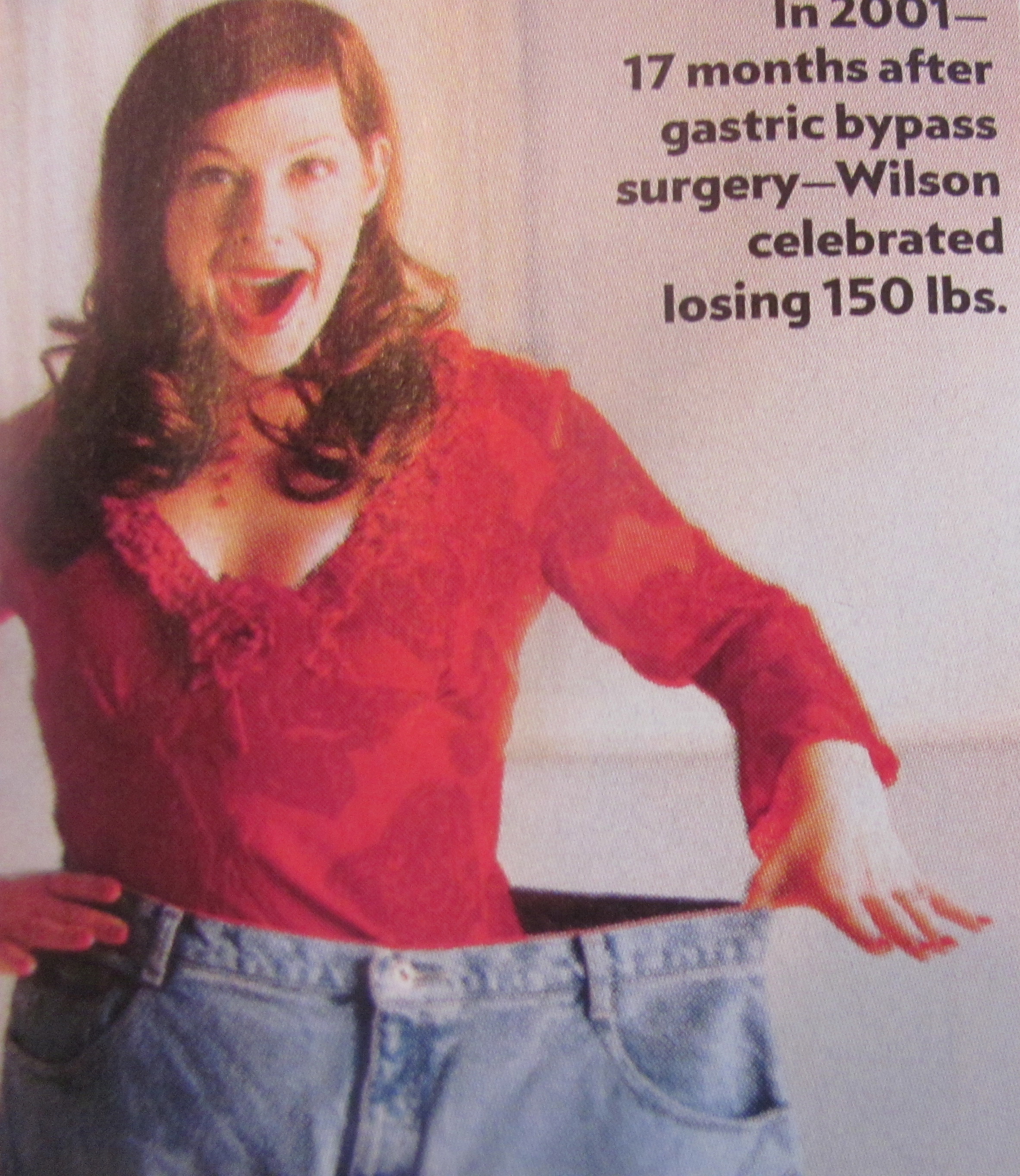
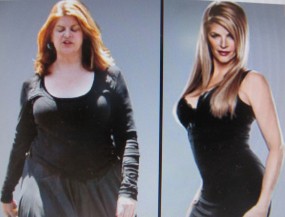
Wilson and Alley’s new programs are strikingly similar, both featuring women who famously, very publicly lost weight (Carnie with a stomach stapling broadcast live on the internet, Alley as a spokesperson for Jenny Craig) then gained it back, now returning to our screens to lose it once more.
A long article in this week’s People Magazinedetails Carnie’s new show. This time she will be guided by Oprah phenom and protege, Dr. Oz. After dramatically weighing Carnie on camera, Oz reported to his audience that she is “morbidly obese.” But no worries: Oz and “his team” have prescribed a 90 day program that includes “daily excercise and food journaling.”
Carnie tells People, “I made these beautiful, lean ground meatballs,” but Dr. Mike Rozien, Dr. Oz’s “enforcer” told her: “Dump the meatballs.” People then asks her, “Do you like to excercise?” She says: “I loathe it. I just want a big tub of buttered popcorn, and I want to lie on the couch and watch a movie.” Carnie goes on to say, “I don’t eat what I bake. I’ve never had a slice of my own cheesecake. I’ve only had a bite.”
Carnie sounds to me like a woman who has never once in her life lay down on her couch with a bowl of buttered popcorn without feeling horrible and guilty and ashamed. I’d bet the same is true for her meatballs– lean or not. And can you imagine baking a cheesecake and only allowing yourself one bite?
Carnie doesn’t have too few rules about food, she has too many. I worry about her recovery, because I honestly believe that there are more concentrated crazies in the eating disorder/ recovery world than anywhere else on the planet. Think about it– who wants to grow up and become a nutritionist? Food obsessed people. And those are the ones supposedly advising the “sick.”
I know because I was a sick one, not overweight, but bulimic. In my journey to get better, I was told by almost every therapist-expert-nutritinionist from New York to California that I would never recover, but be “in recovery” for life. At best, I could “manage my disease.” Now I think I understand why they say this. Health, to many eating disorder experts and maybe to America, means being just the perfect amount of sick; we’re supposed to be obsessed with food and dieting and our appearance; we’re supposed to have the knowledge and skill to calculate fat grams, calories, time spent excercising and BMI equations like modern day Einsteins. Understanding basic nutrition can be useful, but obsession with it– “healthy” people writing down daily food intake, multitple TV programs on fat people, a first lady’s national campaign that includes the President publicly calling his young daughter chubby– becomes unhealthy, especially confusing and damaging when it’s portrayed as it’s opposite.
Even though I was told I would never get better, I am 100%, over ten years later. What got me healthy was escaping from all the “experts” I encountered over the years; and all of their rules, restrictions, regulations, and diets they all prescribed– all different and contradictory, by the way, just like today with Dean Ornish vs Atkins vs the ever-changing food pyramid vs counting fat grams or calories or whatever’s going to be the trend in 2010– eating local? Works for me, I live in California.
When I was submerged in the eating disorder/ recovery world, I was told off the wall stuff– just like what Oz may be telling Carnie– that I was “addicted” to certain foods (or “allergic”) like sugar and flour; these were white powders that had an effect on me just like cocaine. I paid people $175 an hour to tell me this– that just like a coke addict, if I took one bite of any food that had white powder (bread, muffins, cereal– we’re talking wheat here) like any addict, I would lose all control, eat and eat and eat and never stop. This, by the way, is what every bulimic fears: if she starts eating, she will consume the whole planet. This is a central misconception she must abandon in order to get better; that there is, in fact, always a natural boundary, an end, a stopping.
This is how I recovered– already briefly written about in this blog but summarized here. I stopped writing down what I ate. I stopped trying to convince myself sugar and flour were like cocaine. (by the way, right when I got healthy, I did testing for food allergies, something not one nutritionist or therapist ever recommended to me– guess what? not allergic!)
I stopped thinking being thin was good and being fat was bad. I read an amazing book caled When Women Stop Hating their Bodies and went to a program called Beyond Hunger in Marin. This is what they taught me there: if you eat a loaf of bread, go out and buy more loaves. Same with a bag of chips. Fill your house with anything you’ve ever wanted in abundance and eat whetever you want and replenish it. As I did that and for the first time in my adult life, allowed myself to eat what I wanted, whenever I wanted, without feeling bad or guilty, I got back in touch with real hunger and real fullness; my eating disorder vanished.
It’s true that I was never “overweight” but I believe obese people, so often, along with bulimics and anoexics, regulate food more than most other people, are more conscious and more knowledgable about health and fat grams and calories than the rest. Most don’t need a national campaign to educate them further.
Oz tells Carnie she “needs to break her addiction to food….she fears passing on her addiction to her daughters. That will motivate her more than a magazine.” Carnie agrees, “I have to be a teacher to my daughters. Lola started to notice commercials on TV with people who are trying to lose weight and she looks at me. She’s thinking about this stuff and its getting to her.”
I wish Carnie would learn to listen to her body and teach her daughters to do the same instead of listening to all the noise on commercials and reality shows, including, sadly, her own. People with eating disorders don’t need more instruction and facts, they need less. Food is not a drug or a moral barometer. Food is food is food. Can we have a reality show about that?