When is it OK for kids to read YA books about rape or incest?

I just posted on the excellent Graceling trilogy and added that I would not let my 10 year old read it because of the rape and incest. I suggested 15 might be a good age. Then I went back and edited, remembering the rape and incest, while central to Bitterblue, is only implied near the end of Graceling. It’s not in Fire. So then, I thought maybe 12 years old for the first two and 15 for Bitterblue? And then, it occurred to me that rape and incest happens to kids all the time. In that case, reading about it in this context would be helpful. How ironic to censor something in a book that describes what’s happening in a kid’s real life. So, then I concluded, it’s such an individual choice. With sex, I didn’t want my kids reading about it or seeing movies that referenced it, before I had “the talk.” I wanted them to learn about sex from me first, rather than from a kid at school or from a movie. I had the conversation with my daughter last Spring, when she was nine. It went really well, and since, she’s come to me with questions, and she seems comfortable talking about it. But rape and incest, I’d like to protect her from the knowledge of a little longer.

gracelingtrilogy

I did a Google search, remembering something I’d read on dark YA lit a while ago that was good. Here’s a quote from the post and the link.

The underlying assumptions behind Gurdon’s piece seem to be rooted in the idea that children read books with heavy content and ‘go bad,’ when in fact the opposite is true. Some children lead dark lives and they read books with intense themes to find protagonists they identify with in an often hostile world. Some young adults read about rape and bullying and violence, eating disorders and self harm and mental illness, because these are things they experience.

Alas, the belief that bad things do not happen to children and young adults is not limited to naïve Wall Street Journal columnists, and it does far more damage than mere dubiously-sourced articles that attract a storm of commentary. The belief that childhood is a happy place, where bad things don’t happen, where you don’t need rose-tinted spectacles because everything is already rose-tinted, has direct and harmful impacts on children and young adults in danger.


I don’t think my child would “go bad” from reading about this stuff. Nor do I think if a child is into these books, that means she’s leading a “dark” life. I think, and I could be wrong, if my ten year old daughter picked up Bitterblue, she’d read it cover to cover.

Also, for my kids, I do believe childhood is a pretty happy place for them and should be protected as such. Obviously, that doesn’t mean Disneyworld to me. I think Disneyworld is tremendously warped. But it does mean I want my kids to experience the belief in safety and also in magic. I believe that covering up “reality” to protect a child’s developing imagination is an important part of parenting and also, of being a kid. If your child has safe boundaries, she feels brave enough to take healthy risks. Psychologist Stephen Mitchell explains this well in his excellent book, Can Love Last: the Fate of Romance Over Time:

One of the things good parents provide for their children is a partially illusory, elaborately constructed atmosphere of  safety, to allow for the establishment of “secure attachment.” Good-enough parents, to use D. W. Winnicott’s term, do not talk with young children about their own terrors, worries, and doubts. They construct a sense of buffered permanence, in which the child can discover and explore without any impinging vigilance, her own mind, her creativity, her joy in living. The terrible destructiveness of child abuse lies not just in trauma of what happens but also the tragic loss of what is not provided– protected space for psychological growth.

It is crucial that the child does not become aware of how labor intensive that protracted space is, of the enormous amount of parental activity going on behind the scenes.

What are your thoughts on all this?

Update: Heather comments that her 8 year old daughter learned about rape and incest when a classmate brought porn to school.

Based on the brief snippets of content she saw, I had to not only have “the talk”, but also explain a LOT of things I never thought I’d have to address at that age. Because of this, conversely, she is now very educated on both sex, misogyny, and rape/assault/child abuse.  Therefore, I think these books that are written about very serious issues — but in the comprehension style of a young person who can find the characters identifiable — is a great source of information…I have not read these books to endorse them, but now I am interested and will be checking them out at the library. Thank you.


Heather’s comment make me think that if your child knows about rape or incest, these books are appropriate for her or him. (I really hope parents of sons will get their kids this trilogy.)

Stunning YA trilogy: ‘Graceling,’ ‘Fire,’ and ‘Bitterblue’

In the last few months, I was able to finally finish the Harry Potter series, then the Hunger Games series, and last night, finally, Kristen Cashore’s excellent trilogy: Graceling, Fire, and Bitterblue.

gracelingtrilogy

I love this series. Every book stars a brave and complex female protagonist. Every book also features a panoply of strong and fascinating female characters. Females are spies, fighters, queens, healers, on and on. There are also great male characters. The books also have heroic gay characters and disabled characters.

These books are disturbing. They deal with rape and incest, not directly, but implied and discussed in the book. If the reader doesn’t get the horror of those acts, she misses a lot of the story. Also, each book features a passionate love affair. My oldest kid is 10, and I would not let her read these because of the rape/ incest parts of the story. I don’t yet know what age would be appropriate because I’ve learned not to trust the recommendations I see around. In fact, that’s why I started Reel Girl. IMO, Cinderella  gets a triple S for major gender stereotyping/ not appropriate for kids. I’m thinking 15 for Bitterblue because the sexual violence is central to the plot, but Graceling and Fire, age 12? But then again, rape and incest happen in the real world, so if this is going on or has happened in kids’ lives, reading about it would be a good thing. It’s such an individual choice.  Let me know if you or your kids have any experience with these books.

Reel Girl rates Graceling, Fire, and Bitterblue ***HHH****

In ‘Wildwood,’ once again, boy takes over for girl: Curtis usurps Prue’s quest

My seven year old daughter reported to me this morning that lost baby Mac of Wildwood was discovered by Curtis, not Prue. Oh, this made me mad!

wildwood

Over the weekend, I blogged about Wildwood. I love the elaborate world-building in the book, the complex characters, and the writing, but both my daughter and I were disappointed that a book we thought was about a heroic girl, Prue, turns out to be about a heroic boy, Curtis. It’s Prue’s brother who is lost. Prue ventures into the wild to save him. It’s interesting because Curtis tags along after her, and at first, Prue tries to shake him off, but he won’t go away. Now I feel like Prue’s desire to get rid of Curtis is the manifestation (man-infestation, ha!) of the struggle of so many female characters who are forced to capitulate to the male characters, again and again.

If the gender roles of Wildwood weren’t part of a larger pattern, I’d have no problem with them. But as it stands, in kids media, strong female protagonists go missing. Curtis being the one to find missing baby Mac is such a dis and so intertwined into the story, I feel as pissed off about it as I was when Percy Jackson took over Clarisse’s quest in Sea of Monsters. I hate that my kids have to see this happen again and again.

I’m not done with the book yet and am holding out hope Prue will reclaim her role as the hero of this narrative, but its not looking good.

The kick-ass Governess of ‘Wildwood’ is a brilliant character

My seven year old daughter and I are reading Wildwood. I was psyched by the description on the back of the book, which is all about a girl, Prue, rescuing her kidnapped brother. Unfortunately, early on, Prue partners up on her mission with a boy, Curtis. The story then alternates between Prue’s POV and Curtis’s, and, as my daughter pointed out, the Curtis parts are much better. While Prue is stuck in a town of boring politicians who speak about issues that Prue (and my daughter) don’t understand, Curtis gallops on a horse through the wilderness with a mysterious woman who lives with coyotes, the Governess.

If you read Reel Girl, you know that I track images in children’s media of females shown riding creatures, many of which are magical. While males are seen in this situation all the time, and the magical creature itself is often male, females, if they are get to do this at all, are relegated to a secondary position, aptly termed “riding bitch.”

Here is a beautiful illustration of the Governess and Curtis.

governess

So far, she kind of reminds me of the latest incarnation of Women Who Run With Wolves.

We are only about one third through the book, so I am hoping that

(1) Prue’s role gets more exciting

(2) The Governess continues to play an important role

(3) Prue is the one to rescue her brother

I’ll keep you posted.


From my husband’s childhood bookshelf…

This is Raven, The Frozen God, a book which migrated to our house from my husband’s childhood bookshelf.

Rven

My husband assures me that in this series (there are 5) the females are main characters. All the men, he says, are sidekicks. I’d like to know how she scales icebergs in high-heeled boots. No hints on the back of the book:

From out of the bond of slavery, there arose a warrior…a warrior feared across all lands, a warrior whose blade was stained with the blood of thousands– man and beast– who smiled as she killed, with hair as gold as summer sun, eyes as blue as the heavens, and a body which invited only love yet dealt bloody, merciless death to her enemies.

He gave me a tour of the bookshelf, all kinds of fantasy books from the 70s and 80s, mostly small and paperback, stacked alongside novels by Cormac McCarthy, Herman Hesse, and Flannery O’Connor.

bookshelf

As a kid, my husband collected the brothers Hildenbrant who are famous for illustrating Tolkein. The legend is that one brother started from one side of the page, the other from the opposite side, and they met in the middle. Finally, they wrote their own book, Urshurak, which features my husband’s favorite warrior princess. Here she is, standing over her kill.

warriorprincess

Got to say, she looks a little like me.

More sexism from books your kids are reading

After I shared my post From Diagon Alley to Panem, girls ‘choose’ pink on Reel Girl’s Facebook page, Kari commented:

A sentence in my daughter’s book for 8-12 year olds (“Creep Over: Read it and Weep” by P.J. Night):

“Her mom was really smart, just not at math–even third grade math.”

ARGH!


One of these quotes would not be a problem, but there’s a pattern of it in kids’ media. It’s what Melissa Wardy of Pigtail Pals calls the “drip, drip, drip.” No one even notices the repetition of sexism, it’s become so normal. And by the way, this sentence could describe me. I’ve posted about how much I hate helping my daughters with math. I hated math. They can tell. They read or write, I’m totally into it. They do math, my husband helps them. Thus, I pass the gender stereotype on to a new generation. There are a multitude of reasons why girls are supposed to be good at art and words, not math and sciences, many of which I’ve blogged about. But it’s not “natural” for all girls anymore than it is for girls to wear pink.

So, I’d like to ask you, as you’re reading books with your kids, please post sexist, stereotyped quotes in this comments section or on Reel Girl’s Facebook page. I’m really curious about them. I can think of one that has always bugged me from Ramona about how she has boring brown hair and brown eyes. I can’t stand reading that to my brown-eyed, brown haired daughter. Again, if this were one book, but when so many book have blonde, blue-eyed heroines, when we just saw this dichotomy again in “Smurfs 2.” Enough already.

From Diagon Alley to Panem, girls in fantasy world ‘choose’ pink

Besides finishing the Harry Potter series this summer, I got to read Catching Fire and Mockingjay, finally completing The Hunger Games trilogy.

catching-fire-book-cover

I am a huge fan of this series. Panem remains the only magical world I have read about or seen on TV or in the movies where gender equality exists. If you know of another one, please tell me. I am not referring to a world where a female protagonist fights against or overcomes sexism. I am referring to a world where there is no sexism.

In Panem, females and males are in power positions. Both genders are, consistently, commanders of armies, directors of films, murderers, heroes, doctors, victims, and presidents. Males and females can be weak or strong, compassionate or cruel, leaders or followers. Characters in Panem are portrayed as complex individuals with conflict and contradiction just like real humans.

So here’s the only passage, the only passage, in the whole trilogy where I found stereotypical sexism from the year 2013 infecting Panem. Both women and men in Panem wear make-up. Vanity depends on profession and geography, not gender, so it’s not the make-up that bugged me here.

But its Posy, Gale’s five-year-old sister who helps the most. She scoots along the bench to Octavia and touches her skin with a tentative finger. “You’re green. Are you sick?”


“It’s a fashion thing, Posy, like wearing lipstick,” I say.


“It’s meant to be pretty,” whispers Octavia, and I can see the tears threatening to spill over her lashes.


Posy considers this and says matter-of-factly, “I think you’d be pretty in any color.”


The tiniest of smiles forms on Octavia’s lips. “Thank you.”


“If you really want to impress Posy, you’ll have to dye yourself bright pink,” says Gale, thumping his tray down beside me. “That’s her favorite color.”

When I read that section, I groaned. Of course, there’s nothing wrong with one little girl among many declaring pink is her favorite color.  But, in 2013, pink has become such a symbol of the way marketers limit diversity, limit girls, and gender segregate toys and products for kids. How many colors are there in the world? How many “choices”  do little girls get? it bummed me out to see a four year old girl, the only one in the series I remember, get her love for pink affirmed.

I have many complaints about gender stereotyping in Harry Potter, but one of the scenes that really got under my skin is about pink. The Weasley twins’s magical store, Weasley ‘s Wizard Wheezes, is so cool and creative, but it turns out to be as sexist and gender segregated as as any Target. Here’s Fred Weasley doing some marketing:

“Haven’t you girls found our special WonderWitch products yet,” asked Fred. “Follow me, ladies….”


Near the window was an array of violently pink products around which a cluster of excited girls was giggling enthusiastically.


What’s the problem with this? Just a couple days ago, when I posted about sexism and gender stereotypes at the shoe store, Stride Rite, I received hundreds of comments like this one:

Normal boys will NOT wear pink…It’s just a fact of nature.


I remind you once again, that it’s not. Pink was first a “boy” color, a version of red which symbolized strength. Blue was a “girl” color, associated with the Virgin Mary. That’s why in the early Disney movies, Cinderella, Sleeping Beauty, and Alice in Wonderland all wore blue.

How many times, when challenging gender stereotypes, do we hear the argument that these limits placed on girls are just natural?

In 2013, when children and adults see, again and again, that girls in fantasy world, whether its books, TV, movies, or toys, consistently “choose” pink, it appears to validate misconceptions like the commenter’s above. And if girls “naturally” prefer pink, it follows that they are naturally drawn to all those pink things, whether its princesses, toys about make-up, shopping, or fashion.

Of course, what the persistence of pink in the fantasy world really shows, is that writers, directors, and producers all live in and are influenced by the sexist real world. That is why, obviously, that the fantasy world, a world that should have limitless possibilities, where anything is possible, often turns out to be as sexist as the real one. We ought to be showing kids something more imaginative.


Harry Potter series: glorious, amazing, and not feminist

Besides going to a lot of shitty kids’ movies this summer, I finished the Harry Potter series. That actually happened at the beginning of the summer, but I’ve avoided blogging about it. Part of the reason is I needed to work on my own book instead of blogging. But, also, I pretty much feel like I’ve said everything about Harry Potter that I have to say. Still, I promised to check in once I was finished, so I’m doing that now.

harrypotterhalfbloodprincebook

My favorite book in the series is Book 6, probably because Dumbledore is my favorite character, and Half-Blood Prince is all Harry and Dumbledore. Also, I really liked hearing about Voldemort’s childhood and witnessing how he became so evil. And I mean witnessing. J.K. Rowling doesn’t just do a flashback. She has you go into a magical pensieve where memories are stored, and then she leads you through the actual events. She’s a truly masterful story teller.

I initially thought that the most feminist of the books was 5, because Hermione has a big part, and there is, finally, a female teacher of the Dark Arts, Dolores Umbridge, who’s a great villain. But, unfortunately, after posting my views, I received quite a few comments about the alleged rape of Umbridge. You can look those posts up, if you want. The links to most everything I’ve written on Reel Girl about the Harry Potter series is cut and pasted below, most recent first. This sentence from one of my posts pretty much sums up my views:

If Harry Potter, a series with a male protagonist, titled for that male, where the author was told by her publisher to use initials to hide her gender, is considered feminist because a third of the characters in power positions are female, we have a long way to go before achieving gender equality in the fantasy world.


Reel Girl rates the Harry Potter series ***H***

Why is Weasley’s Wizard Wheezes magical store as sexist as Target? #NotBuyingIt

The Rape of Dolores Umbridge in Harry Potter?

In Harry Potter 5, female characters move closer to center

My daughters get inspired by Harry Potter

Goblet of Fire, Harry Potter, and the gender matrix

Prisoner of Azkaban and the subtle patriarchy of Harry Potter

More fat-shaming in Harry Potter, the inflating of Aunt Marge

Fat-shaming, Harry Potter, and kidlit

Finally, Reel Girl devours Harry Potter


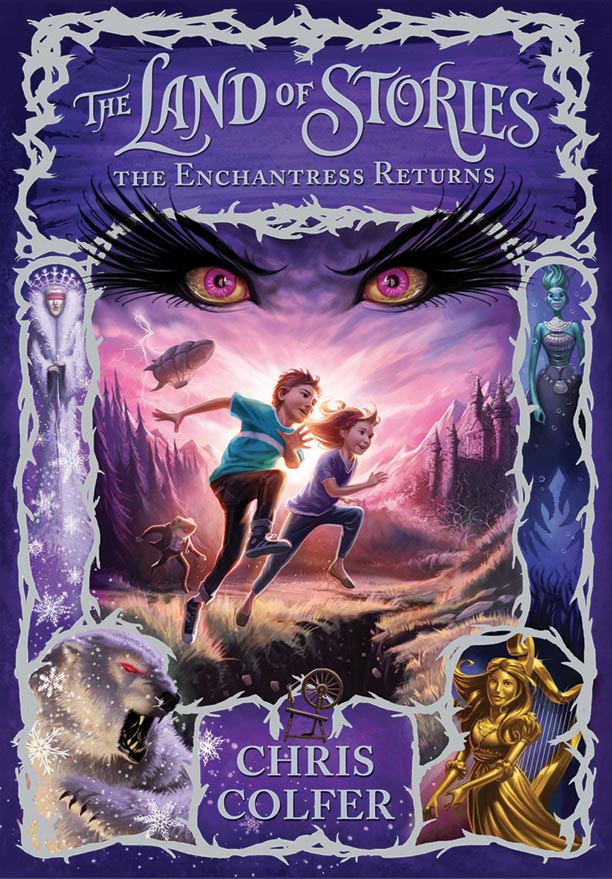
‘Land of Stories:’ Glee actor pens books starring heroic females

When I was with my six year old daughter at the book store, and she chose Land of Stories by “Glee” actor Chris Colfer, I was skeptical. Colfer is an actor. And twenty-three years old. And male. Not only that, from the back book cover, it was obvious Land of Stories is reimagined fairy tales. Been there, done that. Nonetheless, my daughter insisted, and as a rule, I generally buy my kids a book if they really want it, because from my experience, resistance only makes it more desirable.

Chris Colfer's THE LAND OF STORIES

My daughter plowed through the book, requested its sequel, and then finished over 500 pages in about a week. My daughter, now just turned 7, read most of the book herself, so I only got snips here and there, when I read it to her. From the scenes I read, I wasn’t sure how I felt about it. The protagonists are twins, Alexandra and Conner. I get annoyed by how books with a female protagonist seem to need to balance her with a co-starring male. Can’t we just see the female protag? Or what about sisters? Or female buddies? Why is that pairing so rare?

But in most parts of Land of Stories that I read, Alex is a strong and brave character. Here are a couple passages that won me over as we neared the finish of the second book, The Enchantress Returns.

“You have to save the fairy-tale world, Alex!” Conner said. “You have to save the Otherworld and Mom, too!”


Alex’s grip around her brother’s feet tightened. “I can’t save anything without you,” she said.


“Yes, you can,” he said. “It was always meant to be you! You’re the one who got us here and you’re the one who is going to get us out! You heard the ghosts– you’re the heir of magic! You’ve got to defeat the Enchantress so this world can go on!”


“I can’t do it alone,” she said, terrified to lose him.


“Yes, you can,” Conner said. “I’m really sorry about this.”


Conner kicked Alex off of him, and the vines consumed him entirely. They dragged him and Trollbella down into the ground and disappeared.


“Conner!” Alex yelled after him, but it was no use. He was gone.


Alex looked across the camp just in time to see the vines pull Red, Froggy, Jack, and Goldilocks into the ground with one, final heave.  As soon as Trollbella, Red, and the others clinging on to them had been taken, all the vines in the campsite disappeared into the ground. They had com efor the queens.


Alex got to her feet and looked around in shock. In a matter of minutes, all of her friends and her brother had been taken from her. She had no choice but to finish the quest alone– it was all up to her now.


Love it! Of course, as I reading this to my daughter, I was thinking: “Right on, Conner, get out of there. Alex needs to do this.”

Unlike Harry Potter’s magical world, this Fairy world has an almost equal number of females and males in power in the government, with a the Fairy Godmother at the head, and the evil enchantress as the villain. Here’s a passage that describes the governing group.

Hung across the wall from top to bottom were Queen Snow White and King Chandler, Queen Cinderella and King Chance, Queen Sleeping Beauty and King Chase, Queen Rapunzel. and members of the Fairy Council. And now, withe the inclusion of Red and Trollbella, the entire Happily Ever After Assembly was at the Enchantress’s mercy.

I appreciate all the subtle ways Colfer recognizes female power. The female characters are not princesses but queens and they are listed before their male partners. Red is Little Red Riding Hood and Trollbella is the leader of the Trolls. It’s great to read a story about what happens to these princesses after they marry and their adventures are supposedly over. Its also nice that Rapunzel remains unmarried. It is interesting that Colfer makes an effort to pair of the others and gives the kings big roles. It’s sort of like giving a female protags a male twin, and other passages I read, the deference of the Queens annoyed me.

Here’s the passage that made me a true fan. How does Alex find the strength to save Fairy-tale world all alone? She has a dream where goes into a cave and meets four little girls: Lucy of Narnia, Alice of Wonderland, Dorothy of Oz, and Wendy of Neverland. They five girls talk together about the various ways Alex could try to destroy the Enchantress.


She looked up at the girls and around the cave. “Now I understand the meaning of my dream,” she said. “Deep down, I knew I could never kill the Enchantress, so I was searching for another way. The cave represents my questioning and you represent the answer— because ever since I was a little girl, I’ve always thought of you when I had a problem.”

“Why is that?” said Alice.

“I suppose I’ve learned so much from you,” Alex said. “I always wanted to be as loving as Wendy, or as curious as Alex, or as brave as Lucy, or as adventurous as Dorothy– I always saw a little bit of myself when I read about each of you.”

I’m not a fan of Wendy, but I named my oldest daughter Lucy and my second Alice after those incredible characters. I really enjoyed the pages where they come together and mentor Alex, giving her sage advice from their own experience.

The writing in these books is not the greatest. There is a lot of word repetition in sentences like: “It happened so fast Alex wasn’t sure what happened.” Also, too many adverbs: “Her hair anxiously swayed above her.” But Colfer is twenty-three, for goodness sake. I’ll be following his writing career. I’m looking forward to seeing what he does next.

If you have read these two books, please let me know what you think. With the caveat that I have only read passages of them, Reel Girl rates Land of Stories ***HH***


Look what R rated book my 4 year old is reading….

Check out what book I found my 4 year old cuddled up with this morning: R. Crumb’s Genesis! No idea how she go her hands on this, but talk about sex and violence, the Bible is at the top of the list.

genesis

Maybe the Costco headlamp you see tucked under the cover wasn’t such a great idea after all. At least she turned it off. Though if you saw my last pic, note she fell asleep wearing yesterday’s clothes. Back to the Mama Factory for me, new model needed…

Reel Girl rates Genesis ***SSS*** for gender stereotyping