Yesterday, the New York Times’ announcement it was replacing Managing Editor Jill Abramson with Dean Baquet, after her brief three year tenure with no transition time and no good-bye, in what Rebecca Traister calls “a singularly humiliating firing” was one more act of sexism by the so-called liberal institution.
Several weeks ago, I’m told, Abramson discovered that her pay and her pension benefits as both executive editor and, before that, as managing editor were considerably less than the pay and pension benefits of Bill Keller, the male editor whom she replaced in both jobs. “She confronted the top brass,” one close associate said, and this may have fed into the management’s narrative that she was “pushy,” a characterization that, for many, has an inescapably gendered aspect.
Irrespective of the specific circumstances in this case, such words as “abrasive,” “pushy,” and “brusque” tend to irk professional women, who have come to recognize them from countless studies demonstrating that female leaders are almost always seen more negatively than male ones—a phenomenon also known as the competent-but-disliked dilemma.
The more critical issue, though, is that the gap in pay between women and men is quite real and stubbornly persists at 77¢ on the dollar in spite of the many advances women have made. Even after factoring in differences in occupation, education, and years of experience, according to Harvard’s Claudia Goldin, a significant gulf in female vs. male pay still exists. Still, no one seems able to do much about it.
In April, Republican senators voted down the latest bill meant to address this disparity: The Paycheck Fairness Act would have made it illegal for employers to retaliate against employees who discussed their compensation and would have allowed for more government monitoring of what workers are paid.
What about movies for children? I have three young daughters. Aside from the pink ghetto, kids’ media — whether PBS or Disney — put male characters front and center. Female characters are sidelined or not there at all — just look at the posters for children’s movies (with the exception of ‘‘Brave’’). There is no reason for the imaginary world to be sexist.
Margot Magowan, San Francisco, posted on nytimes.com
It’s upsetting and damaging that the New York Times is so sexist because it’s a force in determining which stories are “important.”
Here’s a quote I use often from Half the Sky by reporters Nicolas Krsitof (who works at the Times now) and Sheryl Wudunn (who used to work at the Times.)
When a prominent dissident was arrested in China, we would write a front-page article; when 100,000 girls were kidnapped and trafficked into brothels, we didn’t even consider it news
In honor of Jill Abramson, here’s a list of Reel Girl’s blogs on sexism at the New York Times:
Dylan Farrow’s op-ed on Woody Allen’s sex abuse was sent to many papers, all who rejected it. I am assuming the Times was one of those papers. It was columnist Nicolas Kristof who posted Farrow’s letter on his blog. Yet, the Times did publish Woody Allen’s rebuttal as op-ed.
Last week, four black feminists participated in a panel discussion hosted by the New School titled: “Are You Still a Slave? Liberating the Black Female Body.” The talk– an in depth discussion about the influence of imagery and narrative on our culture and its role in creating our actual reality– went on for almost two hours. Yet, out of all this, the media reduced trenchant analysis into a sound byte, pitting one black woman against another: “Feminist scholar bell hooks calls Beyonce a terrorist.”
I encourage you to watch the whole talk. I know you probably won’t, because, as I wrote, it’s two hours long. I didn’t intend to sit through it all myself, but I was so excited and fascinated by what these women were saying, I couldn’t stop listening to them.
These 4 women are creating new narratives and images, beyond woman as victim, sex object, slave. The discussion about Beyonce, specifically her Time cover where she’s shown in her underwear (which totally bummed me out as well when I saw it– why, why, why, the issue is about the most influential people and she’s practically naked, do you know how few women make it to the cover of Time?) is a few minutes of a larger, important talk about women, power, and the nature of reality.
Here’s how bell hooks began the discussion:
Part of why I’m so excited and proud to be here today is that I’m up here with black women who are all about redefining and creating a different kind of image, liberating the black female body
Not a fan of “12 Years a Slave,” hooks says:
If I never see another naked, enslaved, raped black woman on the screen as long as I live, I’ll be happy.
YES! I could not agree more. I am so sick of watching women get raped. After the talk, someone in the audience challenged hooks, saying she felt conflicted about hooks’ reaction to “12 Years:’
we still need to have those conversations about rape and violence on stage…how can we have those conversations, the role of slavery and colonization on women’s bodies? Can we make space for both?
Here’s how hooks responded:
Because we have been so saturated, I mean, I think one of the big lies that’s going around is, “Oh, we never talked about slavery, oh, we don’t have images of slavery.” We had “Roots” and more “Roots,” and there’ve been all these different books and productions, so that I think of that as a kind of myth building thing when people say, “Oh, we don’t have images.” Notice I didn’t say I don’t want to see anything about slavery. I don’t want to see those same tropes over and over again.
hooks speaks about some narratives that involve slavery she’d like to see, for example, when John Wollman and the Quakers met and decided they could not support slavery and believe in the god they believed in, that in fact, they owed back wages to slaves.
that would be an interesting film for me… more interesting to me as an image, as an idea than the repetitive image of victimhood, and I think that they’re all kinds of images and stories out there that could bring us into a different level of understanding.
hooks was making exactly the same point about Beyonce. She was referring to the repetition of sexualized images of women and how the inundation is an assault on our brains, especially for kids:
I see a part of Beyonce that is, in fact, anti-feminist, that is assaulting, that is a terrorist, in especially terms of the impact on young girls. I actually feel like the major assault of feminism in our society is has come from visual media… The tirades against feminism occur so much in the image making business…What I’m concerned about constantly in my critical imagination is why is it we don’t have liberatory images that are away from, not an inversion of, what society has told us, but our own sense of: what am I looking like when I am free?
The tirades against feminism occur so much in the image making business
hooks wants new images. She says:
I would never want my child to see “12 Years a Slave” because it’s the imprint of the black, female body as victimized.
Again, totally agree. Obviously, “12 Years” isn’t a movie for kids, but I see endless books and movies, supposedly feminist ones where girls are mocked for being girls, then they rise above it and prove everyone wrong. Fuck that. I hope in children’s media I never have to read about or watch another girl dressing up as a boy, fighting or cooking “as good as a boy can,” from Mulan to Tamora Pierce to Elena’s Serenade to endless Minority Feisty. The reason this trope is awful for girls– and boys– is because before your child can understand the narrative, she needs to understand sexism. Instead of having Colette in “Ratatouille” give a whole speech about male dominated kitchens, why not make a movie with a female top chef and her best friend is a female talking-cooking rat? Audiences will buy that a rodent can run a three star restaurant but not a female? Like hooks says, we are saturated with this same old, same old. If we weren’t, it would be a different story (ha.) The slavery narrative in all its forms has its place, but we need a break. It’s too dominant. There are many other stories to tell.
By the way, hooks walks her talk. She wrote Happy to be Nappy for kids in 2001, and in this discussion, she says she includes it in her most important, favorite works.
Another speaker on the panel, Shola Lynch, is a filmmaker whose most recent production is a documentary about Angela Davis.
In referring to her film as “a political crime drama with a love story at the center,” she reframes Davis’ narrative. Next, Lynch is making a movie about Harriet Tubman, who she calls an “action heroine.” Can you believe there hasn’t been a movie about Harriet Tubman? Lynch says that even though Tubman’s story is true, people don’t “believe” it. The same phenomenon happened with the Davis movie. About selling that film, Lynch says:
So then I have conversations where somebody’s like, “Oh, it’s a great film as a documentary, but the only reason I would support it is I have to know who the main male characters are because it’ll be flipped to be a narrative, women’s stories don’t sell”… Her story is true, but not possible. People don’t believe it. But it’s all true.”
Talking about why she would rather make movies about heroes than victims, Lynch refers to “symbolic annihilation:”
Symbolic annihilation is two things: not seeing yourself, but it’s also seeing yourself only denigrated, victimized etc, and what that does to you. We can talk about all the things that denigrate us, but I’d rather shift the camera, shift my gaze, and look for the images and the people and the places that feed me. I really do think, you talk about children, the more we create our culture, our cultural images– the books you write, the films I make, the alternatives, that these are artifacts that live, and they speak to people whether we’re there or not, bodies of work, and that is critical. I want to give one example. My daughter, she’s 4. She’s never known me not working on the Angela Davis film which took 8 years. She was so excited when I could show her the trailer. ..The trailer is like 2 minutes long and she watched that trailer over and over and over again…She would point out all the characters, she loved going ‘That’s Angela’s mom.” So she created Angela’s family and a sense of community just by watching this thing over and over again. But that’s not what I wanted to share. So she’s a little girl, she wants to be a princess, I’m trying to convince her she wants to be a warrior princess, that’s blonde and poofy and glam. She woke up one morning and her hair was all out, just like, you know, big, out, out, out. Usually it’s like, “Oh mom, my hair is too puffy.” This morning, after watching the trailer over and over again, she said, “I have Angela Davis hair.” So I thought I was making this political crime drama with a love story at the center etcetera, etcetera, etcetra, but I was also making another image for young people to see and to perhaps relate to. And I was blown away, because I can tell her she’s beautiful all day long. I’m her mom, doesn’t count. The more we create the alternative universe which then becomes the universe.
Another panelist, writer Marci Blackman, echoes Lynch’s point:
My characters are the people who I grew up seeing every day who I don’t see, not just in literature, I don’t see them on TV…They weren’t there in the worlds that I was inhabiting when I would sit and go to the library and read, so I decided I wanted to write them, and I wanted to write people like me who I wasn’t seeing in the books either. I wanted to create these characters and put them out there, and I think what you say about self-representation and putting it out there to count as a counteract against these other images.
The journey to freedom has also been so much about the journey of imagination, the capacity to imagine yourself differently, counter-hegemonically, and that’s why the imagination is so important because Shola imagined Angela Davis in a different way from the images we had of her. That imagination of oneself, I would like us to end on that note and people can speak about creativity, because it is striking to me and I didn’t think about this when we were putting the panel together that for each of us, creativity and the uses of imagination have been what led us into the freedom we have. It has been what enhances my life every day. To be able to think and create and leap and jump beyond where I feel like we have been told, theoretically, intellectually that we should go.
Imagination inspires reality inspires imagination in an endless loop. It’s magic. That’s the point bell hooks was making about Beyonce. If you still don’t get it, here’s one last quote from hooks and then watch the video for yourself.
We can gather strength from the diversity of people’s stories, the diversity of people’s imagination.
As of this posting, Camp Reel Stories, a summer camp in the Bay Area that teaches girls to create media, has raised $17,350 of their $20,000 goal. They have 59 hours to raise the rest of the funds. Please help. I donated money and I hope you, too, take this opportunity to help a girl tell her story.
Camp Reel Stories believes that when women are better represented behind the scenes in the media, they will be better reflected on the screen. Camp Reel Stories is a non-profit summer program designed to empower 13-18 year old women with the skills to create their own media, to view current media critically and thoughtfully, and to aspire to leadership in their field.
Here’s a repost of my interview with Camp Reel Stories founder, Esther Pearl.
Bay Area’s Camp Reel Stories teaches girls to make movies
Last year, Esther Pearl and Zoe Boxer founded Camp Reel Stories, a media camp in the Bay Area for girls ages 13 – 18. Excited by the concept and curious about how the camp helps girls turn big dreams into practical action, I interviewed Pearl. Her responses are below. I cannot wait until my kids are old enough to experience this magical place.
What inspired you to found Camp Reel Stories?
I have worked in film and media production for 15 years, and though I really loved my work I was often disappointed in the lack of female characters on the projects I worked on and how few female colleagues I had. When I became a parent to a little girl I dug deeper into this inequity and what I found was astonishing.
From 2006 to 2009, not one female character was depicted in G-rated family films in the field of medical science, law, politics, or as a business leader. In these films, 80.5% of all working characters are male and 19.5% are female, which is a contrast to real world statistics, where women comprise 50% of the workforce[1]. Even more staggering is the fact that this ratio, as seen in family films, is the same as it was in 1946. These statistics are enormously detrimental to young women’s impressions of themselves and their perceived value in the world. While this is disheartening, this also means there is a vast untapped market for both talent and products that represent the diversity of our society.
I look at this as a great opportunity to create change in not only the lack of equity in the industry, but a creative opportunity to create new filmmakers and producers that are excited about creating characters and storylines that interest them.
My partner and I created Camp Reel Stories (CRS) as a fun way to connect young women with professional mentors, give them story telling and production skills to tell stories that reflect their unique point of view, while incorporating media literacy and leadership workshops. CRS believes that when women and girls are better reflected behind the scenes they will be better reflected on the screen.
What do you teach the girls during the sessions? What do you think they get out of their time at the camp?
Our campers get a lot! They learn filmmaking and production from leaders in the field, they take media literacy and leadership workshops. The girls work in small teams and have an adult producer that guides them the process and in just one week they write, shoot and edit a short film. Last year we had six films completed and this year we will have even more! They also have the collaboration and creative skill building process mirrored for them as they see they professional mentors work together to create not only great short films, but a fun camp experience.
How many campers attend?
In 2013 we held our inaugural camp and we had 32 campers. This year we will have 2 summer camps and can take up to 90 girls, and those spaces are filling fast. You can apply at http://campreelstories.com/apply
What do the alumni go on to do?
Thus far we have 50% of of campers signed up again this year. We have elected 2 student board members from our first cohort to the CRS board to help grow our organization. Two of CRS films were accepted into a local film festival and were screened for a huge audience just this past Friday night and other festivals have asked me to submit their work. 100% of attendees surveyed from the CRS pilot camp said through CRS they learned how gender equity in the media affects the way women are perceived in the media, 85% now view the media more critically and 92% felt more comfortable in their leadership ability, felt their skills as filmmakers improved and plan to continue making films. 20% of our campers have made changes or created an educational plan for a career in the media.
Also many of our campers have used what they learned in camp to speak to their classes and schools about gender inequity in the media, sharing knowledge about the Bechdel test and to organize screenings of films with strong female characters.
What are some examples of media that you think promotes positive images or girls and women?
This is a tough one, because as an adult and a parent of young children I have a different lens than our campers about what a positive image is. The media has made it harder and harder to decipher between a celebrity and a role model. This is something I talk about a lot with my own kids and with our campers. There is a difference between a Kardashian and an actress, it’s important to acknowledge that.
Personally I have seen a lot of films that have really interesting characters and relationships that wouldn’t always be appropriate for a younger audience and I like complicated characters. Recently I saw and loved, Enough Said, Short Term 12, The Bling Ring, Philomena and Frances Ha.
With my daughter and son I find it so hard to find interesting characters in films that we all can enjoy. We all really like the Miyazaki films and we are introducing films from awhile ago since the pickings are slim currently. Some of those are Bend it like Beckham, Black Stallion, Mary Poppins. And everyone loved Brave and Despicable Me.
The campers also seem to be able to access to Netflix, Hulu and other online resources to search out media that they can relate to. I was surprised that so many teenagers were familiar with some 80 and 90s classics, such as Breakfast Club, Harold and Maude, Amelie since they can’t find a lot of current media they can relate to.
What do you do during the rest of the year? Do you plan to expand? What are your goals for the camp?
The rest of the year is spent planning the future of Camp Reel Stories. This year we will triple in size, we will offer 2 summer camps and an afterschool program in the fall. 40% of our campers are on financial aid so I am always fundraising to make sure that anyone that wants to attend can. The films from last year have been entered in several film festivals and now are being selected and screened. I also try to collaborate with as many like minded organizations as possible.
We hope to offer camps in other locations the just the Bay Area in 2015 and we are researching those opportunities now.
What is a typical day at camp like?
Each day is a little different, but we incorporate icebreaking and leadership activities into every morning. The girls are on an accelerated schedule, so they have to get to know one another AND learn filmmaking quickly so that they can get to creating their films. Everyday they learn about some part of the creative process and immediately get hands on experience in that area. On Monday morning 30-40 girls who don’t know one another walk into a room, but the end of the day the have formed a small team and have an idea of what they want to make. That process is impressive and we are amazed at how quickly the girls can set aside their differences to get on to the creative process.
Tuesday they learn storyboarding, audio and video and work with their team to finalize their story. They also take a media literacy workshop so that they can see the direct correlation to the lack of representation both behind and in front of the camera. Wednesday they shoot, Thursday they learn to edit, and they edit a rough cut of their project and then at the end of the day show it to their fellow campers and get creative feedback. Friday they fix, by either reshooting or reediting, anything that they want and on Saturday they screen it at a Camp Reel Stories film festival which 250 people attend.
It is amazing to see these young women come out of their shell in the course of the week and I can’t wait to see what this year brings. We are restructuring a bit since we got requests for both more time to shoot and more media literacy.
It sounds like a lot of work, but we also have a lot of fun. In the end we are so proud of the work that the campers have done and the community created, not only with the campers, but with our volunteers, professional mentors and families. It’s quite exciting to see everyone fired up to create media that is more interesting and reflects the diverse fabric of our lives.
Last December, Salon did a story on why R. Kelly continues to be a star with legions of fans, in spite of the many allegations of sex abuse against him. The reporter who broke the story on R. Kelly is quoted in Salon:
DeRogatis’ response is blunt and troubling and worth reading in full. Throughout his career, DeRogatis interviewed two dozen women, sifted through “hundreds of pages of lawsuits” with nauseating details of abuse and intimidation tactics used against them, and felt the emotional rawness of women whose lives have been ruined. “The saddest fact I’ve learned is: nobody matters less to our society than young black women,” he said.
I was thinking about DeRegatis as I continue to ponder the lack of news coverage in the USA of 234 missing Nigerian girls. I’ve been asking this for years, but what if the Western world took any notice of gender Apartheid of the Taliban before 9/11? What if those women, their education level, their health, their financial state had been important to American political leaders? What if American citizens cared that women worldwide are denied human rights? What if Americans saw the lack of human rights for women as a political issue and not a cultural one?
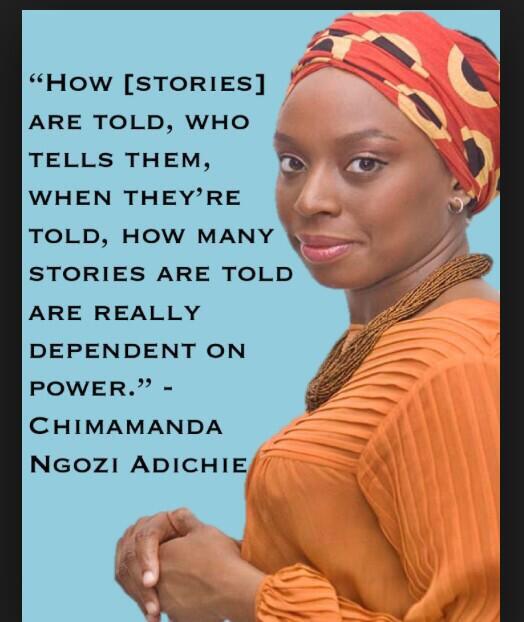
I just saw this on Soraya Chemaly’s Facebook page.
Adiche’s quote is basically the whole reason why I started this blog. What stories get told? What stories are important? What stories matter? How do the images and narratives that we are saturated with– that our kids are saturated with– reinforce whose bodies are important and whose bodies are worth $12? What are you doing to change the stories your children hear or to train them to accept and expect a world where girls and women go missing?
If George Eliot hadn’t pretended to be male, she may never have been published at all. If J.K. Rowling hadn’t taken her publisher’s advice to obscure her gender, she may not have created the Harry Potter franchise and become a billionaire and then a millionaire because she gave so much money away. If rape survivors choose to publicly tell their stories, with their real names and photos they risk a lifelong victimization by a sexist culture.
I wish this culture didn’t make it so preferable for women to keep their stories and gender secret and hidden.
I’m grateful to every woman who publicly tells her story.
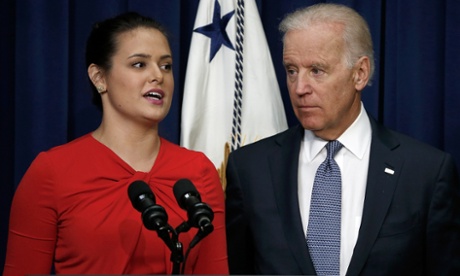
Thank you to Madeleine Smith, a graduate of Harvard University who was raped while attending college and spoke at the release of the first report of the White House Task Force to Protect Students from Sexual Assault. You’re a hero and you’re changing the world for women, something you can’t do without a face and a name. Other women will hear you and see you and they will choose to tell their secret stories too. Seeing you puts the shame where it belongs, back on the perpetrators.
Thank you to another hero, Ashley Sapp of the Survivor Stories Blog Interview Project. In honor of Mother’s Day, the project features an interview per day with a survivor of any form of violence against women (VAW) including domestic violence, rape, sexual assault, female genital mutilation, forced/child marriage, and sex trafficking.
When women stay silent and invisible, all women and girls are affected. We all learn that our stories– whatever they may be– are not important and don’t matter. When women tell the truth publicly, they give us all permission and inspiration to do the same.
Please watch and share this video about putting an end to sexual assault on college campuses in the USA. (Also featuring Vice President Biden, Daniel Craig Benicio del Toro, Dulé Hill, Seth Meyers, and Steve Carell.)
The federal government on Thursday released the names of 55 colleges and universities that are under investigation for their handling of sexual violence or harassment complaints. Many of the schools responded by saying they take the allegations seriously and are evaluating their sexual-assault policies and procedures.
Thank you, President Obama, for taking action to protect the human rights of girls and women.
I can’t find an image of a character in a classic thneed, but here’s the Lorax in a pink, thneed hat, which is almost as good.
So what’ve you got? Please attach images or references in the comment section here (baby pics welcome) or on Reel Girl’s Facebook page or Tweet @margotmagowan. Use #MalesInPink with your posts so I can keep track.
Help give a pink a new image. Colors are for everyone!
Gracias,
Margot
Update: More #MalesInPink
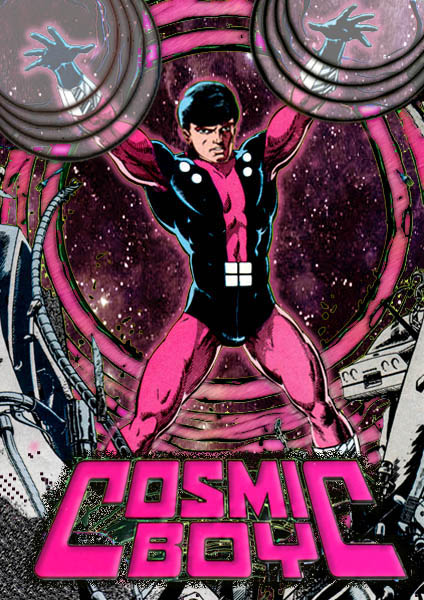
Cosmic Boy (thank you Abnoba)
Little Mac from Nintendo’s Punchout (thank you wearmorethan)
Rugby refs wear pink (thank you nigelthedragon)
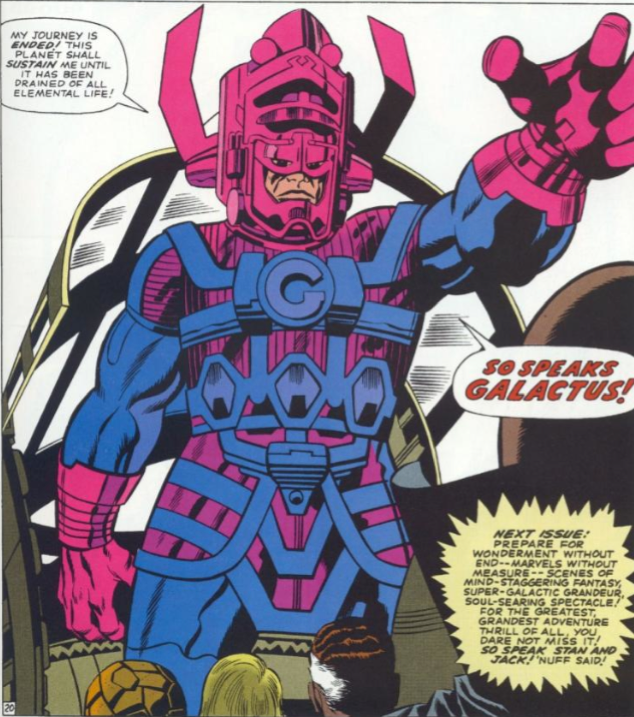
Galactus (thank you Abnoba)
Brainiac and the actor who played him on Smallville (thank you Abnoba)
Isn’t The New Yorker supposed to be a serious magazine? Slate reports on the 5,000 word profile of actress Scarett Johansson by so-called journalist Anthony Lane:
Would it be construed as trespass, therefore, to state that Johansson looks tellingly radiant in the flesh? Mind you, she rarely looks unradiant, so it’s hard to say whether her condition [pregnancy] has made a difference.
Johansson was, indeed, gilded to behold. She seemed to be made from champagne.
Then came the laugh: dry and dirty, as if this were a drama class and her task was to play a Martini.
Johansson’s backside, barely veiled in peach-colored underwear …
… using nothing but the honey of her voice …
What the fuck? This is The New Yorker. I write this whole blog about gender equality in the fantasy world, and how are we ever going to get anywhere when the “best” writers for our “best” magazines repeatedly reduce actresses to objects? This guy’s job title is film critic. As Esther Breger writes in The New Republic: “Try to imagine The New Yorker running this about Matthew McConaughey, or Michael Fassbender.”
Perhaps, it won’t surprise you that Lane, though the most prestigious, is not near the first interviewer to comment on Johansson’s underwear.
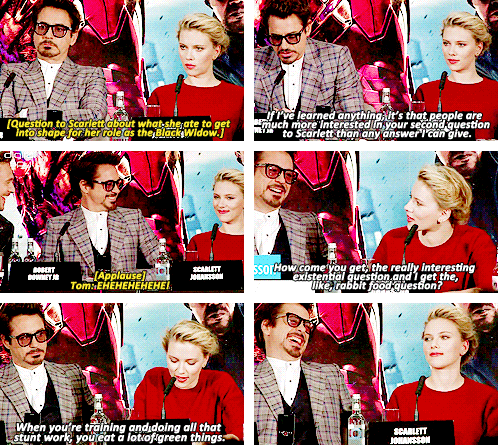
In another earlier interview, after Robert Downey Jr comments on the sexist questions directed at Johansson, she says to him: “How come you get the really interesting existential question and I get the, like, rabbit food question?”
Even at the Oscars, where we celebrate the highest artistic achievements in film, reporters often focus more on a woman’s appearance than what she has accomplished. This Sunday night we’re encouraging the media to #AskHerMore!
Part of the inspiration for the hashtag was Cate Blanchett’s irritated response at a previous awards show when the camera panned her body up and down. Blanchett asked: “Do you do that to the guys?” PolyMic reported: “Blanchett’s reaction shows yet another subtle moment of sexism that even the most successful women have to deal with.”
It’s kind of sad that these moments are considered “subtle.” Enough already. When will the media treat women like actual human beings?
When Cate Blanchett accepted her Oscar a couple weeks ago, she told the world that movies with women at the center are not a niche market, that those movies make money. I couldn’t agree more. And it’s not just my opinion, or Blanchett’s, of course. “Catching Fire” starring Jennifer Lawrence as Katniss Everdeen is the highest grossing movie of 2013 while “Frozen,” starring sisters Elsa and Anna, just crossed the billion dollar mark in worldwide ticket sales.
So why do we still think of women and girls, one half of the human population, like some kind of special interest group? As the mom of three young daughters, I am particularly frustrated by how this gender myth– that boys won’t engage in media about female protagonists– is perpetuated in kidworld, where stores like Target or Toys R Us divide merchandise into generalized and stereotyped boy/ girl aisles and On Demand categorizes TV shows starring girls into a separate group.
There’s another place we really need to stop segregating kids and that’s in the girl empowerment community. There are so many great “best of” lists that go around the internet featuring media with strong girls, but too often, there’s a persistent preposition problem: books about girls are promoted as for girls. Books about girls are for everyone.
New York Public Library’s site just put out a great list featuring books like Inside Out and Back Again by Thanhha Lai, The Skin I’m In by Sharon Flake, and Breath, Eyes, Memory by Edwidge Danticat, among others. Typically, this is how the list is headed:
Girl Power: Books for Bold Women.
The listmaker goes on to introduce her amazing books with this qualifier:
Smart, strong women deserve books filled with smart, strong female characters. Luckily, there are many books with protagonists who speak out for justice, make courageous choices, and know that womanhood is beautiful. That’s why we’ve compiled a list of recommendations for the woman who expects her fiction to be as bold as she is. From Haitian short fiction to literature of the southern immigrant experience, these books will make you believe in girl power.
Smart, strong people deserve books filled with smart, strong female characters.
If I didn’t see this happen so many times, I wouldn’t blog about it, but here’s the thing: I’m grateful dedicated people are making these lists, but as long as we keep segregating the fiction world, we’ll segregate the real one. Please, keep an eye out for how often you see media about women and girls marketed as for women and girls. If you’re a parent, please seek out books, movies, games, and apps featuring powerful female protagonists for your sons as well as your daughters.
Update: Please sign the petition from Let Toys Be Toys For Girls and Boys asking publishers of children’s books to stop marketing to books to girls or boys.
Titles like “The Beautiful Girls’ Book of Colouring” or “Illustrated Classics for Boys” send the message that certain books are off-limits for girls or for boys, and promote limiting gender stereotypes.
How can a story or a colouring page be only for a girl or only for a boy? A good book should be open to anyone, and children should feel free to choose books that interest them. It’s time to Let Books Be Books.