My sister, Kim Magowan, has an excellent short story in the Gettysburg Review. “Nothing In My Mouth” follows a young woman in Amsterdam who tries to redeem herself after making a heartbreaking mistake. Order the Winter issue here.


My sister, Kim Magowan, has an excellent short story in the Gettysburg Review. “Nothing In My Mouth” follows a young woman in Amsterdam who tries to redeem herself after making a heartbreaking mistake. Order the Winter issue here.
Yesterday, I posted about the excellent and amazing Disney made for TV movie: “Avalon High.” The story is about the reincarnation of heroes and villains from the King Arthur legend of Medieval times to a contemporary high school in the U.S. The protagonist of the show, Allie– brave, smart, strong, and kind– turns out to be…King Arthur. With that gender flip, this Disney movie shows girls and boys that females can be heroic and at the center of the action.
Then, I got this comment from Lesley:
SPOILER SPOILER
In the book, the Allie character is NOT King Arthur, but the Lady of the Lake, who gives Arthur the powerful Excalibur. Will is Arthur. The twist is that there are hints she is Elaine (her character is called “Ellie” in the book) the weepy victim of unrequited love dumped by Lancelot. So, she turns out to be a crucial element in Will’s development as king but she doesn’t become king herself.My daughter Callie and I both loved this movie for the same reasons you did, and we were crowing with delight at the changed ending!
As I wrote back to Leslie, I am totally shocked. I can’t think of another time– tell me if you can– where a kid’s book has been changed by the kid’s film (not grown up film) to be more feminist.
I am amazed Disney did this. Really. And also, Meg Cabot, the writer: WTF? Lady of the Lake? She is not cool, powerful, or that important in the story. If you are seeking remnants of evidence of female power, she will do, but obviously, King Arthur is the central figure in the legend. The best line of the movie is when Mordred says to Allie something like: “You? I thought maybe you could be Lady of the Lake, but Arthur?”
The translation of that quote goes way beyond the specific characters of Arthur and Lady of the Lake: Mordred is saying that a girl can’t be a hero and Allie shows that villain how wrong he is. I love how that is done here, through the characters and action, and not in the usual, boring way where the bad guy says something to the effect of– ew, you’re a girl. That, to me, kind of reinforces sexism: we’re all supposed to get the insult is wrong but too often, we don’t see it in the story beyond a moral/ ethical issue. Here, we get it: Don’t underestimate me. I won’t underestimate myself either.
It’s interesting because right after we saw the movie, I went to Amazon to buy my daughter the book, and I didn’t buy it. I wasn’t sure exactly why I didn’t want to. The cover didn’t grab me. I know, don’t judge a book by its cover, but Meg Cabot’s other books looked very pink and seemed to be about girls who were mostly interested in boys. Of course, that could easily be the marketing department who designs the cover. Maybe I thought I needed to do more research, and I didn’t have time right then. Whatever the reason, I didn’t click “buy.” Thank goodness Lesley commented because if I got that book, I would have been so pissed and disappointed. Though Lesley is more considerate than me with her spoiler alert, I feel it is my duty to warn you : )
I NEVER thought I would say this but KUDOS TO DISNEY. I am quite curious to know the story behind this adaptation. And also, Hollywood: Are you listening? Here is an example of how to use some imagination and innovation– 2 things you are, after all, supposed to be known for, supposed to encourage– to remake a classic without girls going missing. This gender flip is not about “girls being boys” or “girls acting like boys” or any other ridiculous justification to keep girls on the sidelines because that’s just where they belong as we recycle the same narratives, generation after generation.
After I read Lesley’s comment, I saw something quite incredible posted by Sara on Reel Girl’s FB page. Here is the new Rolling Stone cover, and quoting Vulture: “Why is Tina Fey Lois Lane?”

Why is Tina Fey riding bitch? This same old image of the male driving, the girl along for the ride is ubiquitous in the imaginary world. Why did Rolling Stone put Tina Fey, one of the most successful women in the world, in that position?
Vulture writes:
Tina Fey co-hosted the Golden Globes to universal praise. Her seven-season critical darling 30 Rock — which is still really damn funny — is ending in two weeks. She has seven Emmys, two Golden Globes, three Producers Guild awards, four SAG awards, and a Mark Twain prize. She’s synonymous with contemporary humor. Out of curiosity, Rolling Stone, what would it take for her to be Superman on the cover?
It’s been three days of straight rain starting out Winter Break. These books are helping us get through:
Imogen: The Mother of Modernism and Three Boys
I think this book just came out. In any case, I saw it for the first time a couple days ago, and I love it.
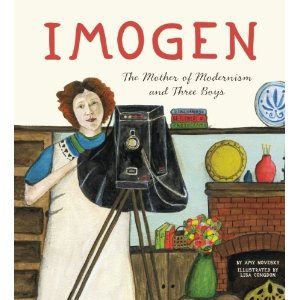
Imogen is the real life story of the great photographer, Imogen Cunningham. What I love most about this book is that it shows the challenge of being and artist and a mother and how that challenge was not only overcome but used to create art. Reading this book made me think of a post I wrote some time ago: Why aren’t there more women artists? The theory I wrote about– and that this book shows– is that in order to create, if you’re a mom as well, you need to be healthy as possible. The tortured, romanticized Marlboro Man, separated from the rest of life, doesn’t apply. This book shows all that beautifully.
Reel Girl rates Imogen: The Mother of Modernism and Three Boys ***HHH***
The Little Old Lady Who Was Not Afraid of Anything
My daughters adore this story about a woman who goes off by herself in the woods to gather herbs, spices, nuts, and seeds.

When she starts back home, she is followed by a pair of shoes. Not freaked out one bit by shoes without feet in them, the woman says: “Get out of my way you two big shoes! I’m not afraid of you!” A pair of pants is added, a shirt, and on and on, each with a different movement: the shoes go clomp, clomp; the pants go wiggle, wiggle, the shirt goes shake, shake. You get the idea.
So my confession here is that I have a hard time with repetition. It gets on my nerves. Goldilocks is an absolute nightmare for me. I get so bored reading the same thing over and over, knowing more of the same is to come. But repetition is in so many stories for kids because they love it; it helps them learn, too. My three daughters get so excited when they know what’s coming next. They call out all the sounds with huge grins on their faces. I love the old lady, so this book works for us.
Reel Girl rates The Little Old Lady Who Was Not Afraid of Anything ***HHH***
Zita, the Spacegirl
This graphic novel features one of the few female superheroes. Zita is very cool.
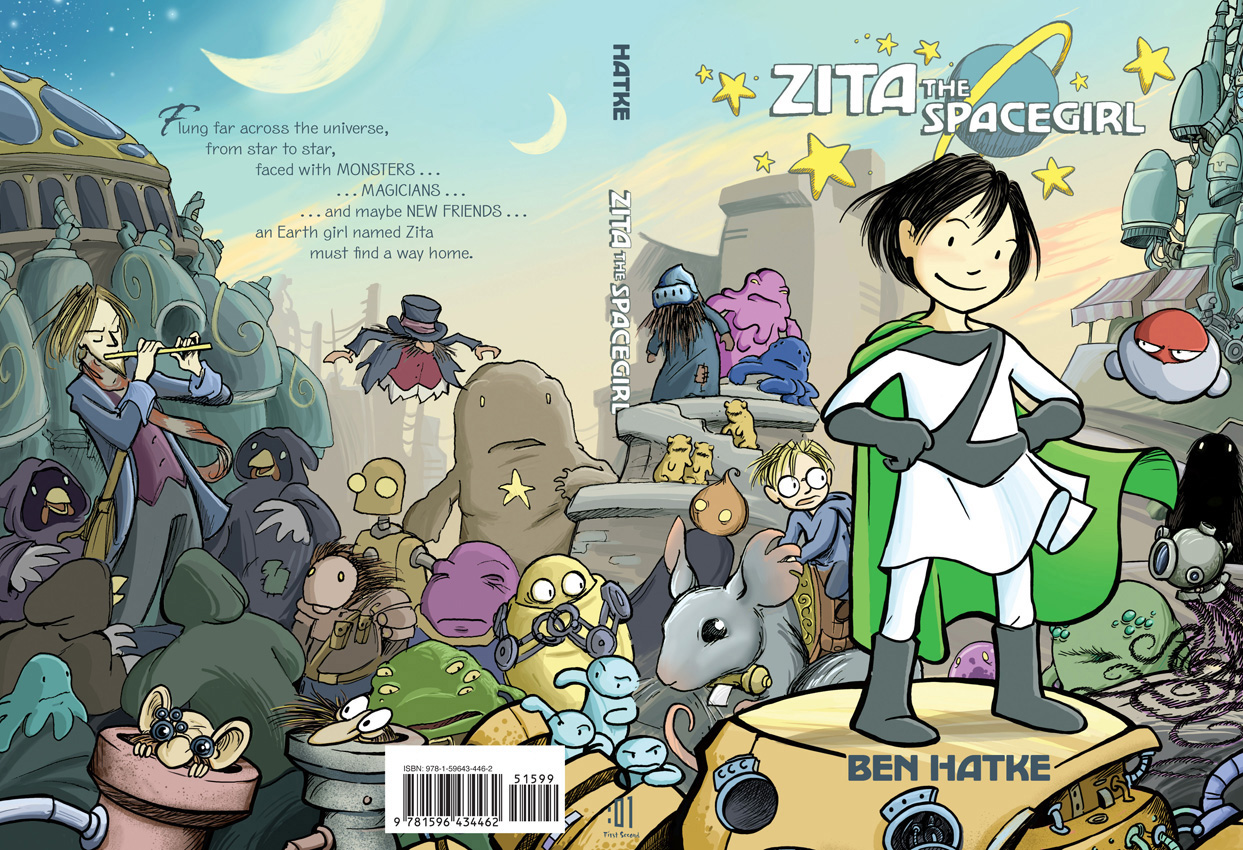
This epic describes Zita’s journey from earth to another world, all to rescue her friend, Joseph. This story features monsters, magicians, and all kinds of scary space creatures. My only issue is that most (all?) of the other characters in this story appear to be male. Unfortunately, that gender division– when the female gets to be the protagonist, she is surrounded by males– is all too common in kids media. Still, I cannot wait to see the movie. I wish someone would make it.
Reel Girl rates Zita, the Spacegirl ***HH***
This week Reel Girl recommends 3 classics:
George and Martha: The Complete Stories of Two Best Friends
The George and Martha series is practically perfect. The characters are great, smart, compassionate, and real. Their friendship is magical and special; there is nothing saccharine about this pair. The stories are beautifully illustrated and as short and poetic as haikus.

Of course, I love that the entire series is based on a cross-gender friendship; it’s impossible to label this series for girls or for boys.
As with most books that feature a character of each gender in the title, George comes first. This annoys me. If this sequence happened once in a while, or even half the time, it would be no big deal, but the consistency of this pattern in kidlit is quite amazing.
Reel Girl rates George and Martha ***HH***
A Bargain for Frances
I named my first daughter Lucy after the heroine from Narnia, my second Alice after you know who, and I almost named my third Frances. I didn’t because Frances doesn’t hold the iconic stature in my imagination as the other two (no one did except for Dorothy, but because that isn’t one of my favorite names, I went with Rose.) But I will always love Frances.

The entire series is great, but Bargain is my favorite. Thelma, Frances’s frenemy does some serious mean plotting, but Frances uses smarts to get her back. The only issue with this story is that young kids won’t get it. It takes some sophistication to keep up with Frances’s revenge. One thing I love about this story is how it shows the high-level strategies going on behind an “innocent” tea party game.
Other books are great to see how Frances copes with her little sister, Gloria, and also to witness the cross gender friendship between Frances and Albert.
If you have a kid who loves to make up songs, this is the perfect book for him.
Reel Girl rates A Bargain for Frances ***HHH***
Madeline

Madeline is one of the absolute best children’s books of all time. Madeline’s spirit is remarkable. She’s not afraid of mice or tigers or teetering on a bridge over the Seine. When she gets her appendix out, she proudly bares her scar. And when you read the book, you get to take a trip through the most beautiful places in Paris. You can’t beat that.
Reel Girl rates Madeline ***HHH***
Writing a Middle Grade book has been one of the best experiences of my life. I am learning so much, and every day is a new adventure, both in my story and the real world.
About five years ago, I wrote a novel and though it got me an agent, the book didn’t sell. Editors universally told my agent: great writing, not enough plot/ motor. ( An adapted part of the novel is published as a short story in an anthology that came out last year from Ecco, Sugar In My Bowl)
Plot had never really interested me, as a reader and as a viewer of movies as well. Most important to me is character and then, in books, language. Watching movies, I would often space out during the plot and then, five minutes later, have no idea what was going on.
In my book that didn’t sell, most of the action takes place in the character’s head. I still love to read books like that and, like any writer dealing with rejection, can think of many examples of writers in that style– Virgina Woolf, come on, people! But you know where that style absolutely will not fly? A Middle Grade book, a book for kids. Kids don’t want to read pages of introspection. They want action, adventure, but still, thank goodness, they want loveable characters.
Writing the MG book has shown me why plot is important in general: a fiction writer needs to show, not tell. Everyone knows that, but I never really understood it until this book. A writer can describe a character but what really shows the reader who she is her actions. It’s like how I tell my kids, “It’s not what you say, it’s what you do.” You know how I learned that, I mean deeply learned it? From being a parent. I can talk at my kids until I’m blue in the face, or I can show them. The latter is the only thing, the only thing, that really works. I think that is why being a parent is so challenging; if you’re yelling at your kid, you’ve got to look at your own pattern of behavior and who wants to do that?
Before, when I was told that all narratives had a pattern, I was kind of annoyed. Weren’t we all more original than that? Recently, I turned to Joseph Campbell’s Hero with a Thousand Faces, a book that I’d first read in my early twenties. Back then, and now at 43, it’s obvious that the “universal quest pattern” is tailored to male experience. For example, Campbell has sections on “Woman as Temptress” and also, throughout, females are the prizes to be won, the reward at the end of the adventure, or as with Odysseus, symbolic of homecoming.
I wondered, for a female hero, do we just flip the genders to complete the quest pattern?
In some ways, yes. As I’ve blogged about quite a bit, if women were mostly in power positions, if women had written most of the narratives that create our “universal” cultural imaginary, men would be sidelined, sexual objects, and relegated to the romance section.
This comes to the title of my post: the rescue. “The rescue” is such a great, useful narrative tool and this is why: the rescue simultaneously shows bravery and compassion. That can be a difficult combination to pull off. Writers want to be economical and concise, and how better to do that than with a rescue? And who better to rescue than a love object? As I blogged earlier, in 2012, this rescue act often undergoes a gender split: female rescuers, when they exist at all, get a monopoly on compassion, (it’s labeled a feminine “inclination to help.”) Men pull off the brave stunts and the rescue is often about ego.
“Inclination to help” doesn’t create heroes, it waters down drama. Writers need to raise the stakes, not lower them, or the story is a bore. Writers don’t raise the stakes because humans are tragic and neurotic, we love pain blah blah blah. Writers raise the stakes so the readers will “get it;” feel it. A kid feels like “the walls are caving in” when she has to move to a new city, share a room with her sister, share a toy, invite someone she doesn’t want to to her party; a writer literally will show the walls caving in, a world being destroyed.
So this is how I’ve come to understand internal action, action in a character’s head and physical action. I believe in the pattern Joseph Campbell lays out, and believe that it is a universal human experience/ sequence: (the call to adventure; refusal of the call; supernatural aid– the “helpers” I just blogged about; crossing the first threshold and on and on. Read the book, it’s great.) But here is where I differ with Campbell. I don’t think this pattern is representative of a life story, that a narrative mirrors the trajectory of a life experience compacted. I think its the opposite: the narrative pattern is the magnification of a moment. These moments we experience every day. Many “little” moments are heroic and feel heroic to us. Getting out of bed for my three year old, cleaning our room, sitting down to write. On a slightly larger level: quitting a job, starting a job, going to a new school, going on a trip, making a new friend, learning a new skill. We take risks that may seem small to an observer but to us, in our hearts and our heads, they are full of drama and symbolism.
This is why it gets me so upset that females aren’t protagonists in children’s media nearly enough. That in the rare occasions that females do get to star, most often they are surrounded by male characters; that females, except for the pink ghetto, almost always exist in the minority. Males have whole cast of characters to help them take risks and achieve their dreams. Females don’t.
But instead of lecturing you about now much a new model is needed, I’m going to get back to writing that book and show you.
OK, at the very least, can we all agree that we have no fucking idea what boys and girls are “naturally” like?
Buzzfeed has a great post “16 Ways The Toy Industry Is Stuck in the Stone Age” that you should check out. Here is one photo:

This is a rattle for babies! Babies.
I know its easy to gasp at this post, as great writer Lisa Belkin tweets she did. I went bug-eyed. But, more importantly, we all need to look at how this marketing influences us as parents. No one is immune.
Just today, I went with my daughter’s class to a show at the Contemporary Jewish museum on writer Ezra Jack Keats. Keats’s Snowy Day is the first published children’s book by a white author to feature an African-American protagonist. Much of the show was devoted to the breaking of this boundary, and the all white world of kid lit. Next series of art in the show? A book where Peter, the protag is upset that a baby girl is coming into the family and everything is getting painted pink. His transition? In the end, the boy helps his dad pinkwash the new room.
I felt like it was so ironic that we were just talking about color and breaking boundaries and stereotypes, and then this. How many books we read lovingly to our kids, how many movies do we take them too, that show them, repeatedly, in so many ways that girls wants diamond ring rattles while boys want saw rattles? And the challenge is Keats books aren’t plastic and tacky, they are drop-dead gorgeous.

So how do we find our way out of the gender matrix? A first step, I think, is trying not to point the finger at others, be aware of our own biases as best as we can, and, most importantly, how we may passing those biases on to our kids.
Before I go into the gender issues of the fourth Harry Potter book, Goblet of Fire, as usual, I want to say: the book is great. I am going straight to the next one: Order of the Phoenix.
I didn’t love this Harry Potter as much as the others; this is the first time I’ve read a new one and not adored it more than the last. The first chapter was great and terrifying. But after that, 200 pages of Quidditch and Ministry politics bored me. Too many names and characters. Of course, it also annoyed me that the Quidditch heroes and ministry bigwigs are all male.
If it were not for the last 150 pages, I would be giving the book a harsher review right now. But that last section, oh my God, it is terrifying. The plot twists are so boggling and compelling, I reached multiple level of shock. I watched the movie last night and thought it was good, but there is just no way the film can replicate the complexity or the terror of these pages.
Here’s a passage describing Harry’s first look at Voldemort:
It was as though Wormtail had flipped over a stone and revealed something ugly, slimy, and blind–but worse, a hundred times worse. The thing Wormtail had been carrying had the shape of a crouched human child, except that harry had never seen anything less like a child. It was hairless and scaly-looking, a dark, raw, reddish black. It’s arms and legs were thin and feeble, and it’s face–no child alive ever had a face like that–flat and snakelike, with gleaming red eyes.
The thing seemed almost helpless; it raised its thin arms, put them around Wormtail’s neck, and Wormtail lifted it. As he did so, his hood fell back, and Harry saw the look of revulsion on Wormtail’s weak, plae face in the firelight as he carried the creature to the rim of the cauldron. For one moment, Harry saw the evil, flat face illuminated in the sparks dancing on the surface of the potion. And then Wormtail lowered the creature into the cauldron; there was a hiss, and it vanished below the surface; Harry heard its frail body hit the bottom with a soft thud.
Eek. Chills. And this goes on, relentlessly, for pages of scary shit.
As far as the rest of the book and my thoughts on it, the Harry Potter gender matrix remains firmly intact. Mad-Eye Moody, a character I loved, is the fourth Dark Arts teacher to be male. Will we ever get a female?
Bertha Jorkins, the only female Ministry official I’ve noticed, is present in her absence as deconstructionists would say.
The villain of the book is male. I can’t name a female Death Eater.
Winky and Rita Skeeter are new female characters with key parts. Winky’s part is small but important.
Mostly, I am pissed about Fleur Delcour. The only female champion to compete, one out of four. Not only did she suck as a competitor, in the book and the movie, but the male competitors, Krum and Cedric, have much bigger parts. And Fleur is half-Vela? What is up with the Vela? They’re supposed to be sirens?
I actually felt like the whole Triwizard tournament was contrived, a plot device. Why would Hogwarts create danger when there is so much danger already? When Dumbledore apologizes to Harry at the end for putting him in danger, I said to my TV “You should be sorry.”
I continue to love Hermione, but it annoys me how she is always above it all. Ron gets pissed at Harry for getting all the attention. I am pissed at Harry for getting all of the attention. But Hermione, she’s OK with it. Why? Obviously, when she waves her hand in the air, wanting to be called on, she is desperate for recognition.
Hermione doesn’t care about Harry’s stardom, because that is the role of the female, specifically the Minority Feisty, in kidlit. She is brave, she is smart, she is strong, but her purpose, and this could not be more true with Hermione, is to help the male on his quest.
Why is being the designated “helper” a bad thing? Helpers exist in all myths, be they fairy godmothers or talking animals. They exist in myths because they exist in real life. Anything we accomplish, we don’t do alone. That is not to say that helpers don’t turn into betrayers or monsters later in the story; that can happen, but helpers are always there; no one accomplishes anything without help. Recognizing that and opening up to it, helps dreams come true. But too often, females are cast in the role of helper, not quester. So who supports females as they risk taking actions to accomplish their dreams? Whether in the form of a cheerleader, a smiling/ applauding first lady, or a Hermione, men are shown, if they dare to achieve, they will have support. Women, not so much.
One thing I did like about Hermione– and this may surprise you– is her transformation into “beauty.” I liked that Rita Skeeter called her pretty before she turned against her and that Hermione won the admiration of Qidditch stud, Victor Krum. The reason I liked this take on Hermione is because I could not be more sick of the smart/ mousy-beautiful/ dumb dichotomy females are forced into. The ugly feminist and dumb beauty queen are flip sides of the same coin; stereotypes that keep all women down. What if women didn’t have to choose? What if we could be smart and beautiful? Think more women would run for office or become CEOs? Women are taught the more success they achieve, the more unattractive they will become. Men are told the opposite. How do you think that affects ambition and motivation? With Hermione in this book, J. K. Rowling broke out of the gender matrix, and I applaud her for it.
My nine year old daughter read most of the last third of the book with me. It was kind of funny because she kept telling me she didn’t want to listen until I got to the underwater part and I can totally see why. That girl has good taste. Later, when I complained about it, she told me later that she had no idea what happened it the beginning of the book. It’s true, it’s a confusing opening after the first pages.
After we finished, my daughter drew this.

It’s adorable, but, aside from some exceptions as mentioned above, I feel like this series is such a lesson in, a replication of, the gender matrix. There it is in her picture: 2 boys, 1 girl; boy is the lead; the text celebrates his competition and victory.
Look at the cover:

It’s not so much J. K. Rowling that I take issue with, but all the people that told me this is a feminist series. It’s not. Yes, it has more female characters than most, but it has a lot of characters. These are 7 books, some over 500 pages. As I keep writing about it, this is a great series, but it’s Harry’s story.
Reel Girl rates Goblet of Fire ***H***
Look what happened today at breakfast: 3 kids spontaneously pulled out books and started to read. I got to drink my coffee in peace! Moments like this are so rare, I took a photo, and I’m posting it, even though the picture is not that great.

Rose, age 3, is reading Giant Meatball. (She can’t read but doesn’t know that.)
Alice, age 6, is reading Green Eggs and Ham. She is just starting to really read and love it. Dr. Seuss’s rhyming word patterns are great for this stage, though his total lack of female characters drives me bats.
Lucy, age 9, is reading Wildwood. I am going to blog about this book; it’s great and stars a sister who courageously rescues her little brother.
Just posted about one of my favorite Halloween books, The Witch Who Was Afraid of Witches. It’s got sisters, a great mom, a cross-gender friendship, and magical power. What more could I ask for? Well, check this out:

Yesterday, when I posted about how the female in so much media is constantly moored on the back of the bike or the back of the Hippogriff, someone told me there is a term for that position: “riding bitch.” With 258,000 matches, Google agrees.
Here, in the story, Roger decides it would be more fun to be a witch than a ghost. He was right.
Savor this image. I wish that, both in fiction and in reality, more females got the chance to steer their own way.
Since monster movies for kids starring girls seem so rare, I thought I’d tell you about one of my children’s favorite Halloween books.

The Witch Who Was Afraid of Witches is about three witch sisters. The youngest one, Wendy, always gets left out because she can’t do anything cool. On Halloween, her broom is broken, and she is left alone to take care of the house. A boy, Roger, dressed up as a ghost trick-or-treats at Wendy’s house. Roger convinces Wendy that all she needs to trick-or-treat is a new broom. Not realizing she’s a real witch, he takes her to his house to get one. It is at the Roger’s house, that Wendy discovers her power. She makes Roger’s old house broom fly. Roger and his mother are amazed and impressed. More adventures ensue and that culminate with Wendy making her first real friend and also, her sisters coming to respect and including her.
The book we have is an I Can Read it and has been a favorite for learning how to read.
Reel Girl rates The Witch Who Was Afraid of Witches ***HHH***