Shall I share with you the moment when I learned to loathe Kerouac? This is it (from “On the Road”):
“In the empty Houston streets of four o’clock in the morning a motorcycle kid suddenly roared through, all bespangled and bedecked with glittering buttons, visor, slick black jacket, a Texas poet of the night, girl gripped on his back like a papoose, hair flying, onward-going, singing.”
Familiar image? What happened was two people went past; what they saw was one person plus accessories.
The Kerouac quote pretty much epitomizes the poetic subjugation of women in that repetitive image (coupled with the the adventurous title of the book, of course.) Kerouac is such a good writer and he does this image so well. And again, the image/ narrative would not be a problem if it were one of many; it is its dominance over our imaginations, the way other narratives have become restricted and repressed, even in fantasy, that is the tragedy.
First things first: I loved Prisoner of Azkaban. I could not put it down. I am onto book 4. That is a big deal for me. Since I started Reel Girl, I have read the first book of many series, because I want to get a good idea of what is out there. It is rare that I keep going and going, but with Harry Potter, I cannot stop.
Prisoner of Azkaban is my favorite book so far, and I loved the first two. For me, reading Harry Potter is like being in an incredible relationship where you fall more in love everyday.
Part of the reason I was so into this book was the dementors, terrifying and compelling new characters. J. K. Rowling’s description of them is one of the scariest I have read in kidlit:
Standing in the doorway, illuminated by the shivering flames in Lupin’s hand, was a cloaked figure that towered to the ceiling. Its face was completely hidden beneath its hood. Harry’s eyes darted downward and what he saw made his stomach contract. There was a hand protruding from the cloak and it was glistening, grayish, slimy-looking, and scabbed, like something dead that had decayed in water.
But it was only visible for a split second. As though the creature beneath the cloak sensed Harry’s gaze, the hand was suddenly withdrawn into the folds of its black cloak.
And then the thing beneath the hood, whatever it was, drew a long, slow, rattling breath, as though it were trying to suck something more than air from its surroundings.
An intense cold swept over them all. Harry felt his own breath catch in his chest. Th ecold went deeper than his skin. It was inside his chest. It was inside his very heart…
The scabby hand looking like it had decayed in water! EEK.
So are we clear, I love Harry Potter?
Not only do I love it, J.K. Rowling is the writer. She can call herself the androgynous “J.K.” if she wants to, for God’s sake. And, if she wants to create an imaginary world that is a patriarchy, it is her right to do so.
But this is what I want to write about it: Harry Potter’s world, both the Muggle one and Hogwarts, are patriarchies. Before I read Harry Potter, I was often told that the series is populated with strong females, and it is. But the females are sidelined to the males, and it’s important to recognize that there is not gender equality in this popular series the way there is in the The Hunger Games. The reason this inequality is important to acknowledge is because the imaginary world, 99% of the time, is sexist. If we cannot imagine equality, we cannot create it.
Okay, have I qualified my criticism enough?
Here we go. I am going to point out how the sexism of Hogwarts and the Muggle world that I have already referred to in previous posts is further advanced in Prisoner of Azkaban.
First, the book cover:
The cover shows Harry riding Buckbeak, the Hippogriff, with Hermione clinging to his back. How many times have you seen this image of male in front, girl behind? It’s all over kidlit, in movies and in books, and my God, its all over the grown up world. It’s everywhere on the streets when you see a guy on his bike, the woman behind him. Do you ever see a female alone on her dragon? What about a dragon that is also a female, like in for example the reverse of “How to Train Your Dragon,” which features a male rider and male beast. Do you ever see a female rider with the male behind her, clinging to her back? This gendered, repetitive image sends the message that the male drives while the female is along for the ride. It’s a powerful message and it’s everywhere in the imaginary world. I was disappointed to see it in Harry Potter.
Then there is Lupin. I loved Lupin, but he is the third male Defense Against the Dark Arts teacher, the most important class at Hogwarts.
Sirius Black is a great character, but also male. I loved discovering the history of friendship between Harry Potter’s dad, Lupin, Sirius, Peter Pettigrew, but they are all male. Lily, Harry’s mother, apparently hung out with the group, but she wasn’t an animagus. She was the only female.
Mrs. Weasley and Mrs. Dursley are both homemakers while Mr. Weasley and Mr. Dursley have careers that factor into the plot.
Percy Weasley is the Head Boy. For a while, I couldn’t even figure out if there is a Head Girl. I have, now, seen the Head Girl referred to, but I don’t know her name or what she does. She has no role in the book so far.
The Minister of Magic is male and the headmaster of Hogwarts is male. Hogwarts was started by two males and two females 1000 years ago and that is progressive, but the two houses started by the males, Gryffindor and Slytherin, dominate the series.
Chang Cho, the Ravenclaw seeker, is the only girl on the team. Would there be a Quidditch team with only one male? Is there a female captain? So far the rivalry between Slytherin and Gryffindor is between two male captains.
To me, it seems like Quidditch is a boy’s game in which girls are allowed to play. I feel the same way about the series.
Oh my god, Ta-Nehisi Coates knows how to write an Opinion piece. Here he is in The New York Times talking about the relationship between intuitive eating and historical affluence and how this all relates to culture and politics. It is an exceptionally clever way of framing the discussion.
I left the first of these dinners in bemused dudgeon. “Crazy rich white people,” I would scoff. “Who goes to a nice dinner and leaves hungry?” In fact, they were not hungry at all. I discovered this a few dinners later, when I found myself embroiled in this ritual of half-dining. It was as though some invisible force was slowing my fork, forcing me into pauses, until I found myself nibbling and sampling my way through the meal. And when I rose both caffeinated and buzzed, I was, to my shock, completely satiated.
Like many Americans, I was from a world where “finish your plate” was gospel. The older people there held hunger in their recent memory. For generations they had worked with their arms, backs and hands. With scarcity a constant, and manual labor the norm, “finish your plate” fit the screws of their lives. I did not worry for food. I sat at my desk staring at a computer screen for much of the day. But still I ate like a stevedore. In the old world, this culture of eating kept my forebears alive. In this new one it was slowly killing me…
..Using the wrong tool for the job is a problem that extends beyond the dining room. The set of practices required for a young man to secure his safety on the streets of his troubled neighborhood are not the same as those required to place him on an honor roll, and these are not the same as the set of practices required to write the great American novel. The way to guide him through this transition is not to insult his native language. It is to teach him a new one.
Intuitive eating is about so much more than eating. It’s about learning how to listen to your body and listen to yourself. It’s about self respect and independence and health and not giving a shit what other people think or say about you.
If you don’t know how to listen to your body, learn. Buy the books When Women Stop Hating Their Bodies or Preventing Childhood Eating Problems. Raise your kids to be intuitive eaters. That is, honestly, the best way to stop “wasting food.” And it sure makes meal times more pleasant.
Yesterday, I posted about the fat-shaming of Dudley Dursley in the Harry Potter series, specifically quoting from the opening of Chapter 2, Prisoner of Azkaban which I’d just read. I have since finished the chapter. So this what happens: Unable to contain his anger when the evil, annoying, and fat Marge constantly puts his parents down, Harry uses magic illegally to inflate her, making her even fatter. To readers, this punishment comes off as humorous and deserved.
I have not seen “The Prisoner of Azkaban” yet, but looking at the image from the movie pasted below, and after reading J.K. Rowling’s prose, I am wondering if there is a child who could watch (or read about) the fate of wicked Aunt Marge and not burst into laughter. Can you even look at these images and not smile? And again, if this fat-evil-stupid-comic imagery happened once in a while, it would be no big deal, but its ubiquity in kids’ media trains kids that it’s normal to laugh at fat people.
Reading into night, I was also fascinated that Harry’s act– so far– remains unpunished. Underage wizards are not permitted to practice magic in the Muggle world, and Harry assumes he will be expelled for his act. Yet, when Cornelius Fudge , the Minister of Magic, meets Harry on Daigon Alley, he assures Harry that he took care of the infraction, deflating Aunt Marge and erasing her memory. Harry wonders why this reaction is so different from the time when he was wrongly blamed for the magic done by Dobby, the house elf, in Book 2. At that time, Harry received a letter of warning from the Ministry threatening expulsion.
Obviously, there is some reason in the plot why Harry is forgiven, given a cozy room in the Leaky Cauldron instead of a letter of expulsion. But the subdued reaction thus far underscores the deserved punishment for Aunt Marge.
I have been trying to think if there are any fat protagonists in kidlit. Please tell me if you know of any: not sidekicks, main characters. So far I’ve thought of one: Wilbur. I just blogged about how Charlotte’s Web may be the best book ever. without even thinking about that. Could E. B. White get any more original?
I am reading Prisoner of Azkaban, the third Harry Potter installment. Here’s the first paragraph of Chapter Two:
Harry went down to breakfast next morning to find the three Dursleys already sitting around the kitchen table. They were watching a brand new television, a welcome-home-for-the-summer present for Dudley, who had been complaining loudly about the long walk between the fridge and the television in the living room. Dudley had spent most of the summer in the kitchen, his piggy little eyes fixed on the screen and his five chins wobbling as he ate continually.
Do fat people always sit around and watch TV? Are fat people obsessed with their refrigerators? Do they eat all day long? Are fat kids spoiled and self-indulgent? Are there thin people who are lazy and addicted to television?
Before you argue that my irritation with the portrayal of Dudley means that I want to censor artists with my PC views– the fat, evil character is a cliche. It’s not original, and its ubiquity in kidlit doesn’t show imagination or innovation. You know what would be creative? Fat heroes in kidlit, showing fat characters who are good, magical, and smart. Fat characters who are leaders, not followers. Fat protagonists, not the sidekicks or comic relief.
When you teach your kid that people come in different shapes and sizes, as well as colors and genders, and one is no better than the other, it sucks to read in books and see movies where fat characters are continually derided and made fun of by the hero of the book. In most of kidlit, as well as movies, when others are teased or mocked, there is usually a lesson to be learned: bullying is bad. But fat characters are exceptions to that rule: making fun of them and teasing them is often portrayed as justified and deserved.
I just watched the movie Chamber of Secrets, the second Harry Potter, where Crabbe and Goyle, Malfoy’s dumb sidekicks are lured into a trap by cupcakes: their appetites are their stupidity.
As I just posted, I’ve only read books one and two so far. Commenters told me that Dudley redeems himself in later books, and also that Mrs. Weasley is a positive fat character. But does Dudley’s later redemption justify the mockery? Does Mrs. Weasley just happen to be fat, or is her fat part of her character and the dilemmas she finds herself in? Dudley’s fat is Dudley.
Ming-Li looked up and tried to imagine the sky silent, empty of birds. It was a terrible thought. Her country’s leader had called sparrows the enemy of the farmers–they were eating too much grain, he said. He announced a great “Sparrow War” to banish them from China, but Ming-Li did not want to chase the birds away. As the people of her village gathered with firecrackers and gongs to scatter the sparrows, Ming-Li held her ears and watched in dismay. The birds were falling from the trees, frightened to death! Ming-Li knew she had to do something–even if she couldn’t stop the noise. Quietly, she vowed to save as many sparrows as she could, one by one…
This story is based in truth: Sparrows were eating up grain so Mao’s solution was to make the Chinese people bang pots and walk the land for days. Exhausted sparrows fell dead from the sky. As a result of the sparrow massacre, crops were decimated by insects free of predators. The Chinese people went into years of famine and millions died. In this fictionalized version, Ming-Li saves her people by rescuing the sparrows and coming to a true understanding of what farming really is.
Reel Girl rates Sparrow Girl ***HHH***
Stone Girl Bone Girl
I first heard about the young fossil hunter, Mary Anning, in an Ivy and Bean book. I was thrilled to learn more about her in this beautifully illustrated story. Anning begins her life surviving a lighting strike that killed her nanny. She is passionate about finding fossils and is teased for it by the kids at school who call her “stone girl, bone girl.” In 1811, when Anning was 12 years old, she discovered an Ichthyosaurus skeleton, one of the most important fossil finds is history. She goes on to survive her father’s early death, her work supported by two rich female benefactors. I love that this book also features those powerful, wealthy, ethical, smart women. How often do you see that combo in kidlit?
Reel Girl rates Stone Girl Bone Girl ***HHH***
The Story of Ruby Bridges
In 1960, four African-American girls were ordered to integrate two white elementary schools in New Orleans. Ruby Bridges was sent to William Frantz Elementary as the only African-American student. When children and parents taunted her and police did nothing to protect her, the national guard was sent in to escort her to and from school. At that point, the white kids stopped going to school. Ruby stayed on and learned her lessons. One day her teacher saw her stopped in front of the taunting crowd, moving her lips. Later, Ruby told her teacher that she was praying for those people. Eventually, the white kids came back to school. This story is amazing on many levels; it is remarkable to see how brave Ruby is and that she has such a great, strong spirit.
Reel Girl rates The Story of Ruby Bridges ***HHH***
I’m reading Charlotte’s Web to my six year old daughter, and I am absolutely stunned by how beautiful this book is. It is poetry from start to finish.
In case you forgot, here’s the first line:
“Where’s Papa going with that ax?”
Here are the last two lines, impossible for me to read without getting chills:
It is not often that someone comes along who is a true friend and a writer. Charlotte was both.
This book is a literary feast. Not only is it about a writer and writing, but the language and word play throughout are Shakespearean. Charlotte’s Web is full of reversals and symmetry, perhaps the most moving (and central) one is that we spend the book worrying about Wilbur’s violent death and at the end, it is Charlotte who dies peacefully.
Speaking of death, Charlotte’s Web tackles this scary and complicated reality in an authentic, touching way, that kids can understand without getting freaked out. That is, when reading Charlotte’s Web, kids experience their emotions about death in a safe way.
And of course, the book features two of the best female characters in kidlit: Charlotte and Fern.
Somehow, I missed reading this book to my older daughter. If you haven’t read it recently, you’ve got pick it up. It will make your day. My sister who is an English professor lent me an amazing edition called The Annotated Charlotte’s Web (pictured above) that is full of footnotes, letters from E.B. White, Hamlet analogies, and notes about Garth Williams, the illustrator, as well. It’s fascinating to read.
I’ve only finished The Sorcerer’s Stone and Chamber of Secrets, and I’m going to give you my bottom line first: I love the Harry Potter books.
The series is brilliant and engaging, suspenseful and so well plotted. Most of all, I love the characters. J.K. Rowling creates a magical world with heroes who readers can relate to and admire and also scary, evil villains who we passionately root against. Rowling does a great job of hooking the reader into these relationships. We see real friendships and rivalries form through a series of events that we were there for, that we witnessed and were a part of; that, for me, that is the most engaging aspect of the book.
So here’s my history with Harry Potter:
I saw a couple of the movies but had a hard time following them because I hadn’t read the books. Therefore, though they were beautiful to watch, I didn’t quite get what all the fuss was about.
When my daughter was in first grade, I started reading the books to her. But when reading time was over, she was rushing down into her bed, hiding under her covers with a flashlight, reading late into the night. The next day at reading time, our reading time, she would be 100 pages ahead. Left in the dust, I was lost. No matter how she tried to fill me in, I grew frustrated with the fragments that made no sense to me, and I gave up. Liberated, my daughter finished the series on her own (then went back and read the whole thing again and again.)
My third challenge with Harry, I’ve written about before on Reel Girl: I wish J. K. Rowling had made a female character front and center. Hermione is a great character, but she is there to support and help Harry on his quest. There are many other strong female characters but, still, I don’t feel the total gender equality in this imaginary world the way I do in The Hunger Games. Hogwarts is run by men (don’t get me wrong, I adore Dumbledore). So far, Harry’s main rivals: Voldemort, Snape, and Malfoy are also male. Not only that, but why is J.K. Rowling “J.K.”?
One more complaint so far, fat people don’t come off so well. Poor Dudley is portrayed as selfish, spoiled, and greedy, personified by his body and eating pattern which is constantly mocked. I don’t like Dudley, of course, but I feel sorry for him getting such a bad rap because he is fat. The reason I bring this up is because making fun of fat characters happens so often in kids’s books. But so far (I have to keep writing “so far” because there are 7 long books) it doesn’t seem that in the series fat equals evil with any consistency. I LOVE how J. K. Rowling mocks the vain and idiotic Gilderoy Lockhart. She wins lots of points with me here: I am happy to see a man be so in love with his reflection. As we know, mirrors and females have a long, long history in kidlit.
So while I have some issues, finally reading Harry Potter on my own– no kids, no movies– I cannot put it down! It is as good as I was told it would be. A boarding school for wizards and witches may be the best setting for a series of all time.
Reel Girl ratings are based on girlpower and I’ve only read the first two books: Reel Girl rates Harry Potter 1 & 2***H***
While on vacation for a month, I read three absolutely incredible Young Adult books, all starring kick-ass heroines. I’m dying to tell you about them.
Besides Hunger Games, these three stories are the first YA books I’ve read since starting Reel Girl.
Because my three daughters are ages 3 – 9, and because I’m writing a Middle Grade novel, I’ve mostly stayed away from Young Adult books. I don’t have the time to read everything I’d like to (and I really enjoy reading books intended for 43 year olds as well!) But because I have never trusted the rating system of kids’ media– what is deemed “acceptable” or “good” for children and what is not– I decided to venture into YA territory on my own.
Here are my reviews:
Wild Magic by Tamora Pierce
This book is gripping from start to finish. The story follows an intrepid and extremely likeable heroine, Daine, as she discovers her power and uses her magic to save her world. Daine starts out fearing her mysterious skills, her “difference,” but under the guidance of a mentor and a new community of friends and allies, she leans how to wield and tame her wild magic.
The only thing in this whole book that I feel could be inappropriate for young kids is a reference to Daine’s mom being raped. That reference describes bandits who murdered her mother and reads something like, “They would have passed by the house but my mother was pretty.” Otherwise, there is no sex in this book. I gave it to my almost nine year old daughter to read, and she loves it.
Like most girl-centered books for kids, this is a feminist story within the context of the patriarchy: it’s a narrative about the rare women who achieve, for example, who are able to become knights. There is more than one powerful female, which is great, but as usual, while reading, I longed for a magical world gender equality simply exists.
I don’t like this cover much. Daine looks naked and the image does nothing to communicate the magic or power of the book.
Wild Magic is mysterious and beautiful story.
Reel Girl rates Wild Magic ***HHH***
Graceling by Krsitin Cashore
This is my favorite of the three books I read. I could not put it down. The villain is one of the scariest and most compelling bad guys who I’ve ever read about.
This book is violent. Katsa, the heroine, like many in her land, is born with a “grace,” a special talent. Her particular talent is killing. Katsa’s grace is exploited by a power-hungry king who she must serve.
Graceling, like Wild Magic, is the story of how the heroine discovers the true meaning of her magic, how to own it and use it for good.
Though I adored this book, I don’t recommend it for Middle Grade readers. I don’t mind the violence. I’ve blogged about violence in kids’ media quite a bit but to quickly recap: Narratives are metaphors, magnifications of moments that, if successful, allow the reader to experience intense emotions.
Narratives raise the stakes so that experience can happen. We’ve all felt like we were “being attacked” or that “the world was caving in.” Narratives show us that actually happening. The story of David and Goliath is a metaphor, so much so that it’s become part of our language; it’s much more than a story of murder.
In the same vein, to the individual, cleaning out a closet can be a monumental task. We are all the heroes of our own lives. To communicate how huge and overwhelming something so mundane really feels, you don’t write about someone cleaning her closet, you write about Psyche sorting seeds as a matter of life and death.
So this is why I don’t mind violence at all, our psyches are intense, as are the emotions of little kids (and grown-ups.) A good and successful narrative depicts that.
Sex, on the other hand, I mind a lot. I don’t think kids should read about sex before they are ready to, and Graceling is an intensely sexual tale. It’s really a love story between Katsa and another graceling, Po. I love Po. Love him! His relationship with Katsa is so great because he is in awe of her power. He helps her to see it and develop it.
On some level, I suppose a little kid could read this story and totally miss the love affair, but I don’t recommend that. It would be leaving out so much. There are also references in the book to incest, more obtuse than the love story, but without getting that aspect of the tale, the reader misses how creepy the villain is.
Reel Girl rates Graceling ***HHH*** (not for MG Readers!)
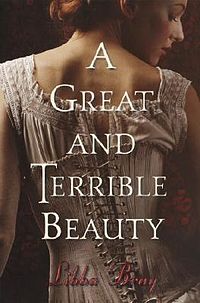
A Great and Terrible Beauty by Libba Bray
Wow, I wish this book was around when I was a kid.
Gemma Doyle is another heroine who fears her magic. This story, like the other two, shows how she comes to understand her power and use it. I loved reading about the secret society of powerful women (the Order) and the power they wield. Also, the setting is a boarding schools for girls in the Victorian Era. How can you resist that?
This book is also the story of an intense and complex mother-daughter relationship, something most teens can relate to.
Even more so than Wild Magic or Graceling, this book is very much about females struggling within the patriarchy. Again, the conflict is very well done, but also again, I long for kids to just be able to see females being strong without claiming the right to be as strong as boys. Can you imagine boys proudly claiming the reverse? It’s patronizing.
There is sex in this book. I don’t recommend it for MG readers.
I hate this cover. At best, we have the tired patriarchy/ corset metaphor; at worst, a “bodice-ripper.” Ugh.
Reel Girl rates A Great and Terrible Beauty ***HHH*** (one more time, not for MG readers!)
Sugar In My Bowl, an anthology of women writing about sex, edited by Erica Jong, will be released in paperback on June 26.
Critics have called the collection a “fierce and refreshingly frank collection of personal essays, short fiction and cartoons celebrating female desire…A smart, scrumptiously sexy romp of a read.” (Read more reviews here.) My short story, “Light Me Up,” is included in the anthology along with essays and fiction by 28 other writers.
Erica Jong talks to Reel Girl about Sugar In My Bowl:
Why did you create this anthology?
I think women have more diverse responses to sexuality than is usually known. And I wanted the opportunity to show a full range of response.
How did you choose the writers?
Notice that the anthology is almost equally divided between well-known writers and writers who are published for the first time. It was wonderful to find writers, like you, who had not been published before and to pair them with well-known writers like Eve Ensler and Fay Weldon.
When the hardcover came out last summer, in a controversial essay for theNew York Times, you wrote that after putting Sugar In My Bowl together, you wondered if younger women wanted to give up sex. You worried that the younger writers in the anthology seemed obsessed with marriage and monogamy. I admit I am obsessed with monogamy! In part because in so much fiction, the woman’s story just stops when she marries.
For women of my generation– I’m 43, Gen X– because of a lot of taboo busting by yours, being single and sleeping around was pretty safe and normal. At least if you lived in New York or San Francisco and carried condoms. It wasn’t radical to be promiscuous, it was expected. But picking just one guy to love and lust for, committing to him, having a baby with him– that is fucking terrifying. And not because it’s a novelty. I think that our generation, and those after us, see marriage more clearly for what it is: high-risk behavior.
We don’t need men to be our breadwinners or to provide social acceptance for us, so why do we still marry? Why do we, literally, put all our eggs in one basket? I think because we’re brave romantics.
Do you think that women can be obsessed with monogamy and sex? Does it have to be an either/ or situation?
I have also been concerned that the women’s story stops with marriage. In our time, the women’s story sometimes stops with divorce. People live much longer today and have many different adventures in their lives. Many of them marry several times. We don’t have women’s books that reflect this yet.
I think we get married to make a statement that this is my person, and we are determined to make things work. That sort of coupling seems essential for both straight and gay people. It’s a way of saying, here I stand. And this is my partner.
Certainly monogamy and sex can go together. For many people, monogamy is far more satisfying than zipless fuck. You have to know another person’s body to really have great sex. That kind of knowing may come with monogamy.
“The Internet obliges by offering simulated sex without intimacy, without identity and without fear of infection. Risky behavior can be devoid of risk — unless of course you use your real name and are an elected official. Not only did we fail to corrupt our daughters, but we gave them a sterile way to have sex, electronically. Clearly the lure of Internet sex is the lack of involvement. We want to keep the chaos of sex trapped in a device we think we can control.”
I totally agree with this, and it is something I wrote my story about, too. Porn and internet sex are actually the “safest” sex around.
What do you think about the future of sex as far as the promulgation of pornography? How do you talk about its negative effects without being labeled and misunderstood as an anti-sex prude?
Electronic sex is sterilized sex. It offers no risk. It is sanitized. Real sex with a partner is the opposite. Pornography has a very utilitarian function. It is specifically for getting you off, hence its predictability. Sexual literature, on the contrary, is surprising. It doesn’t just show sexual acts, but the feelings behind them. I’m all for sexual literature and kind of bored by strict pornography. What interests me in writing is the human brain revealed. Pornography does not reveal feelings. It is rather a utilitarian form for masturbation.
Author Peggy Orenstein also addresses this flip, when pro-sex is framed as anti-sex and vice versa, in her book Cinderella Ate My Daughter. Here’s what she wrote about the sexualization of girls:
“Let me be clear here: I object– strenuously– to the sexualization of girls but not necessarily to girls having sex. I expect and want my daughter to have a healthy, joyous erotic life before marriage. Long, long, long before marriage. I do, however, want her to understand why she’s doing it: not for someone else’s enjoyment, not to keep a boyfriend from leaving, not because everyone else is. I want her to explore and understand her body’s responses, her own pleasure, her own desire. I want her to be able to express her needs in a relationship, to say no when she needs to, to value reciprocity, and to experience true intimacy. The virgin/ whore cycle of the pop princesses, like so much of the girlie girl culture, pushes in the opposite direction, encouraging girls to view self-objectification as a feminist rite of passage.”
She goes on label this difference sexualizing versus sexuality. What do you think of that distinction?
I agree with Peggy Orenstein’s wishes for her daughter. I am appalled at the idea that young women give blowjobs without experiencing pleasure themselves. They are servicing men rather than experiencing eroticism themselves. I also agree that women should write their own sexual stories. We are so much more imaginative than men have supposed. We can make our sexuality even more various through our imaginations. My anthology is a first attempt to show how imaginative women can be.
I view the pop princesses as sanitized rather than erotic. Why are we attempting to claim that all women must be princesses? Isn’t that another attempt to sanitize sex?
It seems to me that the best way to combat the dominance of limited expressions of sexuality is for more women to write their own stories.
For thousands of years women have existed in a world dominated by narratives created by men.
I love that you put together an anthology about sex by women writers and mixed fiction with non-fiction. Why did you choose to include both genres?
The line between fiction and non-fiction has blurred in our age. Memoir bleeds into fiction, and fiction bleeds into memoir. What is important about a story is that it moves you. Not what genre you label it.
Do you have plans for more anthologies?
I would love to do another anthology of women’s writing. I was disappointed that I didn’t get more sexual diversity and ethnic diversity. It was not for lack of trying. I would like to do an anthology with more lesbian women’s experiences, and a wider range of ethnicities.
What are you working on now?
I am working on a novel about Isadora Wing as a grandmother.