I have a in the City Brights section of SF Gate. New blogs coming here soon. Thanks for reading!
Blogging for SF Gate
Reply

I have a in the City Brights section of SF Gate. New blogs coming here soon. Thanks for reading!
 Are women athletes celebrated more for what they can do or for how they look? Here’s a photo of Winter Olympics 2010 silver medal winner in Ladies Super Combined, Julia Mancuso. Have women athletes made any progress winning endorsements, acclaim, recognition, and money for their skill rather than their appearance? Here’s something I wrote about Summer Olympics 2000 and the state of female athletes that was reprinted in a bunch of papers. Tell me what you think about how we’re doing now.
SAN FRANCISCO — In the photo she’s wearing a tight two-piece suit. Legs parted, head thrown back, eyes closed, she smiles.
The woman is not a Playmate of the Month but Olympic high jumper Amy Acuff in Esquire magazine’s cover story/pictorial entitled “America’s Ten Sexiest Athletes.” But on closer examination, Amy is not lying down; she is jumping.
A perusal of recent issues of men’s magazines reveals the latest sex symbol is the female athlete.
Sports Illustrated features Olympic swimmer Jenny Thompson topless with her hands covering her breasts. And Gear has a photo of the Australian women’s soccer team, all players completely naked with their arms and legs placed strategically.
It’s no coincidence that this fascination with women athletes as soft-core porn stars comes right as women are making enormous strides in achieving parity with men in the Olympics. One step forward, two long jumps back.
At the 2000 Summer Games in Sydney, more women will compete in more sports with more media coverage than ever before. With 4,400 participants, women will represent a record 42 percent of the competitors. Most exciting, women will be competing in what were once exclusively male domains. New categories for women include weightlifting, pole vaulting, water polo, tae kwon do and the triathlon.
But the slew of wet T-shirt pictorials reveals a powerful cultural bias. The American public is still uncomfortable seeing women as successful athletes and celebrating them for embodying the qualities that athletes possess. Magazines like Maxim are undermining hard-won progress by reducing all female competition to just another beauty contest.
Athletes are valued for what their bodies can do, not how they look.
Athletes are competitive, ambitious and they know how to win, but those attributes just aren’t ladylike. Photographing sports superstars in lace panties and sheer camisoles keeps them safely inside the parameters of womanhood.
While girls learn early on they will be judged for their looks, boys learn that athleticism equals attractiveness. Ever since high school, the jocks were the big men on campus, a guy’s skill made him hot and the best player sealed his status by getting the prettiest girl.
The grown-up world isn’t much better. Male athletes are worshipped for their achievements. Joe DiMaggio won Marilyn Monroe, and that wasn’t because he looked good in his uniform.
For women, athletic skill doesn’t equal desirability. In a capitalist world, the girl with the most money wins. Blond and buxom tennis star Anna Kournikova makes $11 million to $15 million in endorsements, though she has never won a professional tournament. Her earnings equal those of Martina Hingis, who has earned her money by winning 26 career titles, and are much more than 43-time winner Monica Seles’ $7.5 million or defending U.S. Open champ Serena Williams’ $6 million.
Even a pretty female player isn’t valued like a male player. Tiger Woods gets $47 million; Michael Jordan, $40 million, and 70-year-old Arnold Palmer makes $19 million.
The excuse is that men make big money because their sports make more money from television contracts, but it’s all a vicious circle. When women aren’t valued for their skills, aren’t trained properly and aren’t celebrated the way male athletes are, they’re at a severe disadvantage.
While many call this just bad luck, the law calls it illegal. More than 20 years ago, Title IX, which demanded gender equity in sports funding, began to be enforced. A generation of women growing up under it is a major reason why female athletes have been able to make the advances they have.
Even with this law, females make up only one third of interscholastic and intercollegiate athletes.
Summer 2000’s gold medal favorite, Stacy Dragila, was once told women don’t have the upper body strength to pole vault. Today, pole vaulting is the most popular new women’s event, with Dragila holding the world record.
For reaching that record last summer, Dragila got only half the $60,000 prize money that men get for the same competition. But, she was able to generate more income and media coverage for her sport by posing with other track and field women for a sexy calendar.
Athletics should be the one place where there truly is a meritocracy, where women are rewarded for how high they can jump, how fast they can run or how much they can lift. But once again, the rules are different for women.
This summer, along with their shotputs and discuses, female Olympic competitors will need lipstick, good lighting and lingerie if they want to get the gold.
 I got my kids Superman pajamas at Target a couple years ago; they still fit. We call them Supergirl PJs (though I guess they should be referred to as Superwomen– is there a Superboy?) The PJs have the Superman crest on the front, which lights up, and mesh red capes which attach with velcro. The girls transform when they put these PJs on; they start leaping and high kicking. Last night, three year Alice said to her dad, “Now I will defeat you and then you will work for me!” Then she leaped off the couch onto his back and said, “See, I can fly when I have the cape!”
Watching how my kids act wearing these outfits reminds me again how important it is to get girls out of their “pretty” dresses. Alice is a great hiker, but when she wears her flowing princess stuff to the park, she can’t climb or run, she trips and falls, losing her confidence, then whining. Wardrobe choices are subtle– and not so subtle– early training for what kinds of actions the kids get comfortable with, and if they mainly experience their bodies as something pretty to look or something that can do cool stuff. That’s why all the toys where girls get trained to dress dolls– paper dolls, plastic dolls, sticker dolls, magnetic dolls– drive me crazy.
Beacuse these are PJs, only worn around the family at night, the girls wear them happily without their usual self-consiousness about other kids possibly seeing them and making fun of them for being in “boy stuff.”

Update: If sex really is an addiction, Tiger should have apologized to all the women he used as drugs.
At this morning’s press conference, Tiger said he was sorry to his family, his wife, his kids, his fans, his sponsors, but he left out the more than a dozen women he had sex with. Tiger further objectified these women when he only referred to them in his speech as the “temptations” of power and fame.
Tiger, do you get that women are human? Or does that insight come later in your recovery– around day 56 or so?
When porn star Jocelyn James calls a press conference, flanked by Gloria Allred, it’s challenging to have sympathy for anybody in this story. But Tiger had sex with Jocelyn for three years– along with many other women. What enabled him to do that if she’s so sub-human? At the press conference, Tiger apologized to his wife, as he should, of course; he supposedly loves her. But the skill many men acquire to divide women into wives or whores really creeps me out. If there really is such a thing as sex addiction, this dichotomy must fuel it. I imagine any 12 step recovery program would require that Tiger make amends to those he used as part of his “addiction.”
I’m not saying Rachel Uchitel and the porn stars and models and single moms who slept with Tiger are all victims; they could very well be sex addicts themselves who used Tiger just to get off, get fame, or money. But, as far as I know, they aren’t the ones in intensive recovery programs making public apologies. Tiger is. Maybe he’s not there yet in his program, or maybe his other amends will be as private as he famously is. But it would be nice if Tiger– or Kobe Bryant or Bill Clinton or whomever the latest sex scandal powerguy is– added to his standard mea culpa that he’s sorry for treating women like tissue paper. Because these so called private matters become so public, and I’m sick of seeing women split up into homemaker or homewrecker all over the media. I’d like an apology for subjecting women to that all over again.
Here’s what I wrote yesterday:
Are the rumors true? God, I wish she’d just take 300 million or whatever it is and get out of there.
See what I mean about “wife school?” Stand by your man, cheer him on, no matter what.
Gross. Women are biologically capable of putting up with anything! “Family” is so important to us, nothing else really matters. What a horrible example to all of us married people. A talk show host I used to work with would disagree, he’d say it’s a good move, it shows family values, you stick around no matter what. And then I would say: but reverse their genders– the story becomes unimaginable.
Young woman golf star falls in love with her friend’s hot “manny.” They marry and have two kids; she keeps winning tournaments and doing endorsements. After a few years of appearing as the perfect family, wife and husband get in a huge, violent fight. He goes after her with one of her golf clubs. Soon after, the public starts to learn she’s been sleeping around, about 15 men come out and claim they were with her, including porn stars and hosts. (Does “hostess” in this context even have a male equivalent meaning?) He takes off his wedding ring and retreats with the kids to his home country. Everyone says he is not the kind of guy to take this behavior, he will get the money he can and divorce her; he’ll never take her back. Photographs show up of her in sex rehab in the South. Then they are

pictured at the rehab together. An announcement is coming tomorrow…
You can see the sexism, too, in how the public reacted to the alleged violent fight; because it was a woman who supposedly attacked a man, even sending him to the hospital, there were jokes about the reports of abuse on Letterman and SNL. Lots of people were saying, empathically, that whatever happened, it was a private matter; police should just stay out of it and the media should back off and leave the couple alone. But domestic violence isn’t a private matter; it needs to be investigated, not ignored. Victims typically recant their stories. It’s not anyone’s right to let himself get beat up or murdered by his mate. It’s against the law.
So I guess today, Tiger will ask for forgivenss for his sexual indiscretion, just like Bill Clinton, Ted Haggard, Jim Baker and Kobe Bryant before him. (I think I’ll start a list.) I actually believe in forgiveness, I think it’s a skill you can learn just like any other skill. I learned that at a class I took at Stanford taught by Fred Luskin; the class was amazing. Also, anyone who has ever been through a 12 step program knows forgiveness is a crucial step towards recovery, for totally selfish reasons, you must forgive to get well. Forgiveness, by the way, doesn’t mean Elin has to stay with Tiger, or that anyone has to stay with anyone. It means you get to move on with your life and devote your considerable energy to something else instead of nurturing the grudges you were clinging on to for years.
My issue with Tiger and Elin is really that I am so sick of this same, old story, just watching it again again, the version I get of it, as a person in the world, the repetitive scenario: the cheating, powerful guy and his loyal wife. It bores me. I’m so tired of it. I want a new narrative. And I don’t mean the occasional exception (I’m trying to think of a powerful woman that’s cheated and her husband and he’s taken her back after public humiliation to insert here.) I want new archetypes, repeated upon centuries and ingrained into our subconscious, then translated back into our stories, movies, lives, and tabloids. I’m craving something original.
 In this month’s Details, cover boy, Robert Pattinson, takes part in one of the most that I’ve seen in mainstream media. I’m bummed, because before coming across this expose, I wasn’t a fan, but I kind of liked Pattinson and his Twilight series.
In Details, Pattinson is pictured several times, always fully dressed, next to totally naked or almost naked women. In one photo, he lies next to a woman who is in a bathtub, her hands gripping the faucets behind her, as if restrained. In another photo, he wears a button down shirt, a blazer, and sunglasses while the woman with him wears nothing but transparent stockings; a third photo shows two naked women, one lying on the ground in a glass coffin type encasing, reminscent of Snow White; there’s just a head shot of Pattinson in the background.
All this you could almost chalk up to typical Details magazine. Not Pattinson’s fault, but the photographer and photo editors telling everyone what to do.
But then Pattinson’s has a quote that clarifies his position on women: “I really hate vaginas. I’m allergic to vagina. But I can’t say I had no idea, because it was a 12-hour shoot, so you kind of get the picture that these women are going to stay naked after, like, five or six hours. But I wasn’t exactly prepared. I had no idea what to say to these girls. Thank God I was hungover.”
What’s weird is that the interviewer, Jenny Lumet, who as in most celebrity profiles, has already chummily inserted herself into the story, chattily telling readers how she and Pattinson drink beer together and trade jokes as they walk by a sex shop. But now, she doesn’t follow up on his statement at all. She just asks him what his mother will think of the soft porn photo shoot.
If it were me there interviewing him, I would have asked Pattinson to clarify: “What do you mean you hate vaginas? You don’t like the way the feel? The way they look? They scare you?”
Or I might say, “I know just what you mean! And penises can be really weird too– veiny and hairy. Frankly, I don’t think genitals should be seen in daylight at all. Twelve hours under bright lights is way too long to be around so many vaginas!”
On the cover of the magazine, Pattinson’s face is shown inbetween a woman’s legs, facing out, half smiling at the camera. His eyes tell his audience, “This is exactly where I belong, and as soon as you stop looking at me, I’m going to turn around and preform the best cunnilingus this woman has ever had.” Maybe the young star felt vulnerable, and he was trying to backtrack, get some control. Or maybe he really does hate vaginas. Does that mean he’s gay? I would’ve asked.
Cheerladers are bad. There’s no other way to say it. I don’t care if they’re of color or fat or have athletic skill. Being a cheerleader means you’re the sideshow, your role is to make the main event look good; you are not and never will be the star.
Witnessing the archetype blonde haired, blue eyed, super skinny cheerleader transform to allow more diversty in movies like High School Musical only makes me sad; it’s like when Mo’ Nique hosted a reality show on a fat girl beauty contest, or when there was an African-American model on the cover of Vogue and Anna Wintour wrote a self-congratulatory Letter From the Editor about it. Is it progress that women of color get to be anorexic too? Or that fat women are allowed to compete against each other so that a panel of judges can decide who is the prettiest?
The big problem with the cheerleader role is that it serves as a teen training ground for the model of the perfect heterosexual relationship; it’s like wife school. The hot girl cheers on her talented guy, standing by her quarterback, loyally, faithfully, whether he wins or loses; her admiration is constant and her love is true.
Who doesn’t have fantasy about her partner being totally focused on her, sticking around no matter what, celebrating when she does well, cheering her up every time she’s down? We all want that. But men, the guys in power, got to actually create that reality for themselves and reproduce it everywhere.
If you watched any of the superbowl, you likely saw dueling couples: former Playboy bunny Kendra Baskett with her Indianoplois Colt husband, Hank Baskett, versus Playboy model Kim Kardashian, girlfriend of Saint, Reggie Bush. Kim proudly flashed her nails for the cameras, painted with Reggie’s name and his number, 25. Rumor has it that if Bush won, he would propose, making Kardashian a real life trophy wife.
Maybe cheerleaders will be Ok with me when there are all male squads who rally on the pro-women teams at giant sporting events watched all over the world; when those guys are considered a catch, the hyper-sexual mates for the celebrated women athletes. I wonder if Kim can play soccer?
 Garfield isn’t the only cartoon hero relentlessly mocked for his weight.
I was shocked at the continual stream of fat jokes while watching the animated hit, Kung Fu Panda. The story is about a panda, Po, who dreams of becoming a martial artist instead of a noodle seller like his father. What holds him back is his weight. The Furious Five, a pack of martial artists he idolizes– who are all male except for a token female voiced by Angelina Jolie– constantly make fun of Po’s weight. When these characters mock Po, surprisingly they retain their hero status; they are not portrayed as cruel bullies. Kids watching this movie see that it is OK and justified to put Po down for his body size. It’s espcially odd to witness teasing behavior shown as acceptable and funny, because making fun of others is a constant theme in kids movies; but it’s always potrayed as bad and wrong, acted out by the villians, not the good guys. Unless, I guess, the teasing is focused on fatness. Then it’s OK, just funny and true. Po’s teacher, Si Fun, constantly beats him up to convince him to quit his training, because he’s too fat to succeed. This prediction seems justified also.
In one scene, Po explains that the brutal training and beatings he suffers are mild compared to the pain

he experiences every day “just being me.” Then he looks down sadly at his big stomach, equating “me” with his body size, obviously feeling a lot of shame.
Po explains that when he’s upset, he eats. The turning point in his training comes when Si Fun realizes that Po can be motivated to perform amazing acrobatic feats by a jar of cookies on a high shelf. They begin to train with food as a reward. Po does pushups over hot coals while trying to slurp noodles from a bowl of soup. Po and Si Fun battle over a bowl of dumplings. It’s good, I guess, that Po doesn’t end up becoming thin in order to be a master. But the way this movie uses fat and food to advance its plot line and character development is truly odd and confusing if you’ve taught your kids– as I have– not to experience food as a reward and not to think fat people are bad, or to be made fun of, or that they are not as good as thin people. After about two hours of fat jokes, my kids came out of the movie with lots of questions about why being big is funny and bad why don’t I think so too?
Another popular animated movie, Wall-E (also named for its star male character) has a central plot line where the fat aliens are mocked. The aliens have evolved into an existence where machines do everything for them. They are fat, lazy, and nasty. Lucy asked me during the movie, “Why do they all look like that?” I guess I was supposed to say, “because they don’t get exercise. They’re lazy.” The message that fat people lie around all day and that if you don’t work out, you will look like a fat, pink alien is not something I want my daughter to learn. She’s six years old. I’d rather her do the monkey bars and play soccer because she loves it and it’s fun. I’d like my girls to learn to use their bodies out of joy and pleasure, not fear, for as long as possible– their whole lives?
 There are usually no major female characters in Garfield cartoons. The stories focus around Garfield, his owner Jon, and his frenemy, Odie the dog. Jon has a love interest now and then, as does Garfield, but I don’t think Garfield ever returns the affection.
Garfield gets one G because he sets a rare example by not caring much what other people think of him. His indifference to the opinions of others fascinated me when I was a kid and still does. It’s mostly Jon that worries about Garfield’s weight.
When Lucy and Alice watched the cartoon this morning, Jon put Garfield on several different scales, weighing him along with other animals to show Garfield’s weight was incorrect for his species. I’m not that upset about the constant focus on Garfield’s weight and the accompanying fat jokes on his cartoon. Maybe because Garfield’s male. Or because he’s been in this position for so long– the cat has got to be healthy, he’s been around for at least 35 years. Or maybe because he doesn’t care at all what other people think of him, so why should I?
I am glad that my kids– except for math and science class and annual doctors appointments– are pretty unfamiliar with the bathroom scales, featured all over this cartoon.

The subtitle of this collection is: And Other Stories of Strong Women. It’s a great book, with exciting narratives and beautiful illustrations. Every story is fabulous. I’ve done many searches on Amazon and in bookstores and somehow never saw this book, so I was thrilled when Lucy got it as a Christmas gift. It has a quite a bit of text per picture, so younger kids may get bored.
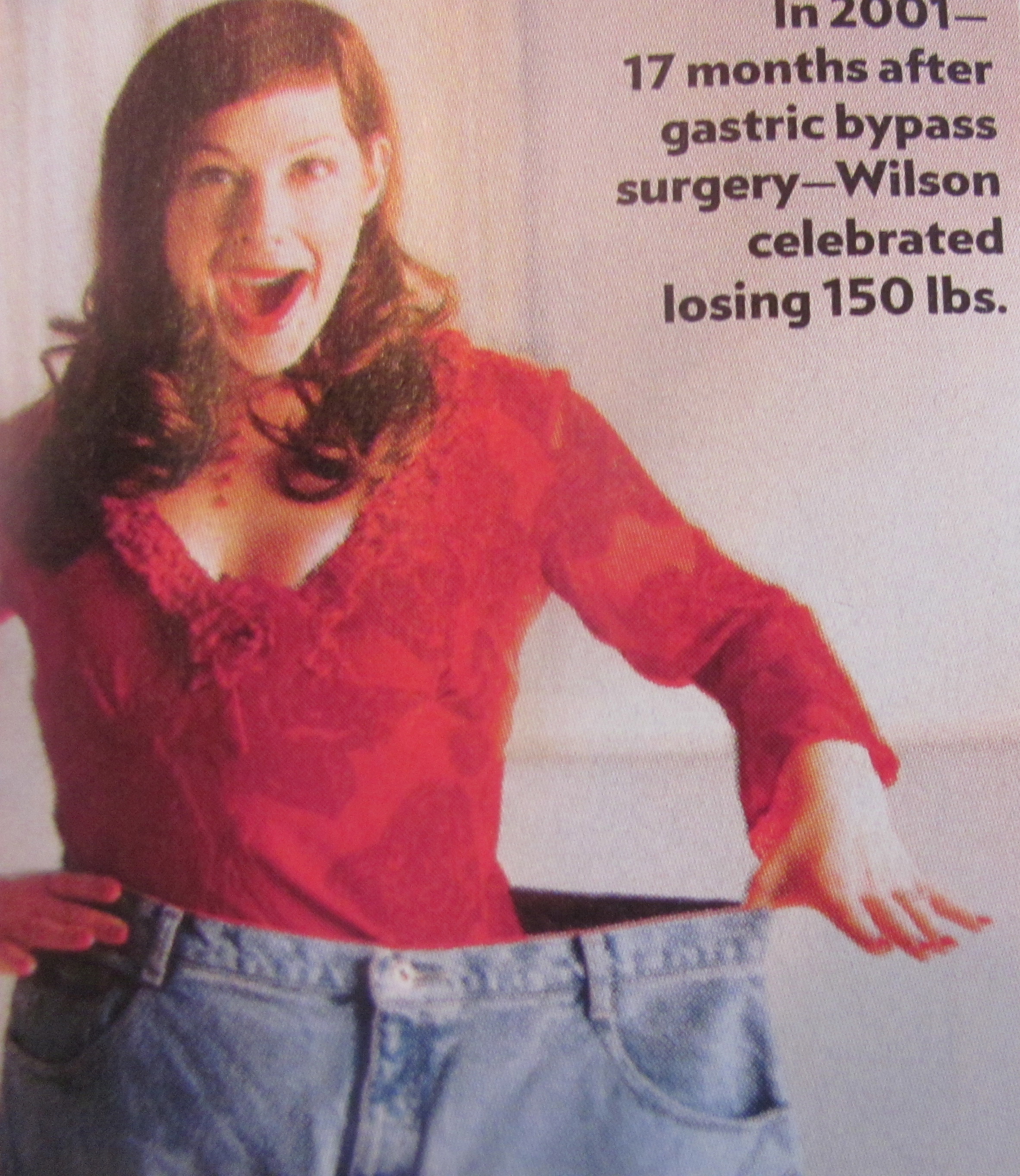 With ” and debuting this season, I count six reality shows about fat people including “The Biggest Loser,” “Biggest Loser: Couples,” “Ruby” and “Celebrity Fit Club.” As America’s weight obsession baloons into ever larger proportions, so do Americans.
Wilson and Alley’s new programs are strikingly similar, both featuring women who famously, very publicly lost weight (Carnie with a stomach stapling broadcast live on the internet, Alley as a spokesperson for Jenny Craig) then gained it back, now returning to our screens to lose it once more.
A long article in this week’s People Magazine details Carnie’s new show. This time she will be guided by Oprah phenom and protege, Dr. Oz. After dramatically weighing Carnie on camera, Oz reported to his audience that she is “morbidly obese.” But no worries: Oz and “his team” have prescribed a 90 day program that includes “daily excercise and food journaling.”
Carnie tells People, “I made these beautiful, lean ground meatballs,” but Dr. Mike Rozien, Dr. Oz’s “enforcer” told her: “Dump the meatballs.” People then asks her, “Do you like to excercise?” She says: “I loathe it. I just want a big tub of buttered popcorn, and I want to lie on the couch and watch a movie.” Carnie goes on to say, “I don’t eat what I bake. I’ve never had a slice of my own cheesecake. I’ve only had a bite.”
Carnie sounds to me like a woman who has never once in her life lay down on her couch with a bowl of buttered popcorn without feeling horrible and guilty and ashamed. I’d bet the same is true for her meatballs– lean or not. And can you imagine baking a cheesecake and only allowing yourself one bite?
Carnie doesn’t have too few rules about food, she has too many. I worry about her recovery, because I honestly believe that there are more concentrated crazies in the eating disorder/ recovery world than anywhere else on the planet. Think about it– who wants to grow up and become a nutritionist? Food obsessed people. And those are the ones supposedly advising the “sick.”

I know because I was a sick one, not overweight, but bulimic. In my journey to get better, I was told by almost every therapist-expert-nutritinionist from New York to California that I would never recover, but be “in recovery” for life. At best, I could “manage my disease.” Now I think I understand why they say this. Health, to many eating disorder experts and maybe to America, means being just the perfect amount of sick; we’re supposed to be obsessed with food and dieting and our appearance; we’re supposed to have the knowledge and skill to calculate fat grams, calories, time spent excercising and BMI equations like modern day Einsteins. Understanding basic nutrition can be useful, but obsession with it– “healthy” people writing down daily food intake, multitple TV programs on fat people, a first lady’s national campaign that includes the President publicly calling his young daughter chubby– becomes unhealthy, especially confusing and damaging when it’s portrayed as it’s opposite.
Even though I was told I would never get better, I am 100%, over ten years later. What got me healthy was escaping from all the “experts” I encountered over the years; and all of their rules, restrictions, regulations, and diets they all prescribed– all different and contradictory, by the way, just like today with Dean Ornish vs Atkins vs the ever-changing food pyramid vs counting fat grams or calories or whatever’s going to be the trend in 2010– eating local? Works for me, I live in California.
When I was submerged in the eating disorder/ recovery world, I was told off the wall stuff– just like what Oz may be telling Carnie– that I was “addicted” to certain foods (or “allergic”) like sugar and flour; these were white powders that had an effect on me just like cocaine. I paid people $175 an hour to tell me this– that just like a coke addict, if I took one bite of any food that had white powder (bread, muffins, cereal– we’re talking wheat here) like any addict, I would lose all control, eat and eat and eat and never stop. This, by the way, is what every bulimic fears: if she starts eating, she will consume the whole planet. This is a central misconception she must abandon in order to get better; that there is, in fact, always a natural boundary, an end, a stopping.
This is how I recovered– already briefly written about in this blog but summarized here. I stopped writing down what I ate. I stopped trying to convince myself sugar and flour were like cocaine. (by the way, right when I got healthy, I did testing for food allergies, something not one nutritionist or therapist ever recommended to me– guess what? not allergic!)
I stopped thinking being thin was good and being fat was bad. I read an amazing book caled When Women Stop Hating their Bodies and went to a program called Beyond Hunger in Marin. This is what they taught me there: if you eat a loaf of bread, go out and buy more loaves. Same with a bag of chips. Fill your house with anything you’ve ever wanted in abundance and eat whetever you want and replenish it. As I did that and for the first time in my adult life, allowed myself to eat what I wanted, whenever I wanted, without feeling bad or guilty, I got back in touch with real hunger and real fullness; my eating disorder vanished.
It’s true that I was never “overweight” but I believe obese people, so often, along with bulimics and anoexics, regulate food more than most other people, are more conscious and more knowledgable about health and fat grams and calories than the rest. Most don’t need a national campaign to educate them further.
Oz tells Carnie she “needs to break her addiction to food….she fears passing on her addiction to her daughters. That will motivate her more than a magazine.” Carnie agrees, “I have to be a teacher to my daughters. Lola started to notice commercials on TV with people who are trying to lose weight and she looks at me. She’s thinking about this stuff and its getting to her.”
I wish Carnie would learn to listen to her body and teach her daughters to do the same instead of listening to all the noise on commercials and reality shows, including, sadly, her own. People with eating disorders don’t need more instruction and facts, they need less. Food is not a drug or a moral barometer. Food is food is food. Can we have a reality show about that?