The Velmas

Driving home from school today, Lucy kept shouting out the window, “Those meddling kids!” She’s a huge Scooby-Doo fan, and I like the show too. Yes, I wish Scooby or Scrappy were a girl, but there are two main female characters and they do all solve mysetries together as a team. Daphne is the “pretty one,” a glossy red head who always worries about messing her hair and wants to shop; Velma is “the smart one” who usually figures out the crucial clue; she has short hair and wears glasses.

So in the car, Lucy said, “Let’s play Scooby-Doo, I want to be Daphne.”

I said, “I want to be Velma. Velma is soooo smart!”

So Alice said, “I want to be Velma.”

Lucy said, “No, I want to be Velma!”

I said, “No, I’m Velma. I said so first.”

So we all fought over it and then decided we would all call each other Velma, even baby Rose could be Velma.

(This is, by the way, the exact same thing I do in the morning to get them to eat raisin bran instead of coco puffs, I say: “I want the raisin bran. I LOVE raisin bran! Yum!” Then I get myself a bowl.  Of course, I’d rather not incite fighting, but there’s plenty to go around so its all good, I think.)

Still Looking for Alice…

This week’s People Magazine has a “sneak peak” at Tim Burton’s Alice in Wonderland. Johnny Depp, as usual, pictured front and center as the Mad Hatter. To his left, a Dodo, to his right, Helena Bonham Carter as the Red Queen. At least there’s one female, but where is Alice in this promo for her movie???

Please check out the comments I got under my last blog entry about Alice, also mentioning Up and Fantastic Mr. Fox and the lack of females. The commetator thought these movies were not sexist, because there was a Mrs. Fox and in that movie, a kid also had a love interest who was a girl. Can you imagine a movie called Fantastic Ms. Fox where all three villians were female as was Ms. Fox’s whole possy? It would be some crazy feminist movie.

Chubby!

Today Lucy called me chubby. I told her what I always tell her, “There’s nothing wrong with being chubby. People come in all sizes. Some people are small, some are big, some have dark hair, some have yellow hair. People are different.”

She said,”You’re the only person in the whole world that thinks that.”

The first time I heard her call someone fat, it was her father, about six months ago. So I said my line, “There’s nothing wrong with being fat.” And my husband looked at me and said, “You think I’m fat?”

No one would call either of us fat or chubby unless she was a kid who thought she was saying a bad word. Unfortunately, Michelle Obama’s obesity campaign is exacerbating America’s weight obsession . It’s a continuation of the unrelenting focus on female body sizes and what they should look like.

For example, there’s no step towards health or progress of awareness that tabloids have become as obsessed with anorexic stars as they are with fat ones. It’s another headline to sell magazines, a popular thing to yell out for attention whether you’re a magazine, a first grader, or a first lady.

It drives me crazy when people whisper, “She’s a size double zero!” Why don’t they headline that the actual clothing sizes have gotten drastically smaller. There was no double zero ten years ago. There wasn’t even a zero. You rarely saw a size 2 in a store. I know this because I am a petite person. I am the same size now that I was then but now it’s a different number.

I wish Michelle Obama would focus the nation on empowering women, and healthy weights would follow. But I guess that’s too radical and first ladies need causes that are non-threatening, preferably child centered. At least now she’s got Laura Bush as her role model.

(Please also see my post on diets and also .)

Puff, the Magic Dragon

This story used to make me so sad, I could barely stand it. Whenever I heard Peter, Paul, and Mary sing it, I’d have to turn it down, get out of the room, or cover my ears, and I’m referring to my time as a parent. Jackie Paper comes no more? Puff’s “head is bent in sorrow, geen scales fell like rain…Puff, that mighty dragon, sadly slipped into his cave.” Does he just die? Alone like that? After all that frolicking in the mist, that’s how it all ends? Horrible. I can’t take it.

But now everything is OK. After all these years, a beautifully illustrated version came out in 2007, where a girl saves the day, saves Puff, saves us all. The lyrics are ilustrated just as you can imagine, until the text repeats the chorus for the final time. Then a girl is shown climbing down a hill, spotting puff, who smiles gleefully  at her. On the next page, she strokes him under hs chin while he presses his nose toward her forehead, her father looking on in the background, also smiling.

Thank God Peter Yarrow had a daughter and was inspired to come out with this book. In his author’s notes, he writes that he recorded a special CD with Bethany (which comes with this book.) Lenny Lipton writes in his author’s notes that when he was in Hawaii, a friend asked him how he came to set the book in Hanalei, and he said he’d never heard of Hanalei. (I never realized the island sounded Hawaiian until I read this.)  He goes on to write, “There are many what-ifs along the way with Puff. I left a poem in Peter Yarrow’s typewriter, and he added  some new lyrics and turned it into a song.”

This book makes me think Yarrow, Lipton, and Yarrow’s daughter were as troubled by Puff’s sad story as me and probably millions of parents and kids. My mom got this book for my daughters, and now when we hear the song, Granny tells how Puff was so sad, but then Alice came! My three year old lights up every time she hears that. It’s amazing this song has transformed from tragic and all male into a happy, girlpower story just with a couple illustrations (see, guys, that’s all a little imagination takes.) The interpretation that this song was about marijuana/ addiction has never consoled me. This beautiful book does.

The Supergirls

Check out this written for SFgate by Woodhull Institute alumn Lisa Hix. The article, about a new book called The Supergirls, claims that SF author Mike Madrid is finally giving superheroines their due. Yay, it’s about time!

I love this quote from Madrid, author of The Supergirls, just because it is so right on: “When I was growing up in the ’60s, a lot of guys didn’t like the women in comics, because they thought they were useless and annoying. The women were there to escalate the danger. They were supposed to be members of the team, but often times they created extra work because the men had to rescue them.”

How many of us have sat in movie theatres screaming at the women not to do all the stupid things the films’ writers, directors, and producers make these actresses do? It’s mind programming on such a massive scale, getting audiences all over the world accustomed to seeing women act passive, frightened, and dumb.

I haven’t seen this new book, but am excited to check it out. When I got Wonder Woman for my daughter, she asked me “Why is she always in her underwear?” So I’m hoping at least some of these supergirls have clothes on and no implants along with doing brave things; I’ve been so disappointed in female superheroines of the past, with their tiny skirts and missle  breasts, looking like sex fantasies of teen boys instead of girlpower. I’m a little nervous that the author of The Supergirls is a guy, but I’m giving him the benefit of the doubt because he sounds so smart. Ratings on this book coming as soon as I get it.

The Seven Chinese Sisters ***GGG***

The book begins with a double page illustration of all the sisters lined up, smiling, but looking directly at the reader. I’m always trying to teach Lucy to look people in the eye when she is talking to them and to speak with a strong voice. I get no help from all these shy princesses and shy girls in movies and books, always coyly looking away. Even books I like such as Louder Lily and Shrinking Violet are about timid girls; it frustrates me that acting shy is so often presented in kid lit and kids’ media as the essence of femininity. Are there any books about shy boys? Please let me know, I want read them to my kids. God knows there are shy boys in real life and this giant discrepancy in the fiction world makes no sense. I guess when the girls appear shy, it’s an easy way to make boys seem brave.

These seven sisters are courageous and cool and beautiful. Each sister has a special skill– driving a scooter as fast as the wind, the ability to speak to dogs, catching any ball no matter how high. All these talents come in handy  when a dragon kidnaps the baby and her older sisters must rescue her (so it’s also a good opportunity to teach kids about foreshadow.)

The dragon is bright red and the pictures are vivid and magical looking. My three year old absolutely loves the picture of the dragon grabbing up the baby sister, she’ll just stare at it for minutes at a time. There are many action shots including the girls speeding up the mountian in the scooter, leaping high to slap the dragon, catching the baby when she is tossed through the air.

I also like this story because it turns out the dragon is wicked because he is so lonely. I’m always telling my kids that’s why people are bad or mean– they didn’t get enough love and just need more. I hope this is true.

Kell on Earth

I’ve been a Kelly Cutrone fan since she first appeared as Whitney Port’s boss on The Hills, MTV’s hit reality show about young women trying to get rich and famous in LA (problem is, they are already rich and famous from being on the show– very meta– but the program, somehow avoids showing any of that, except you’ll see Heidi Montag and her apparently totally unemployed husband, Spencer, move from their condo to a huge, gorgeous house with crazy views.)

For those who don’t know of her, Kelly owns a fashion/ PR company called People’s Revolution. Whitney Port got a job there when her Teen Vogue internship was up, and then brought along her friend Lauren Conrad. Then Whitney moved to NYC to work for Diane Von Furstenburg for a season, but now she’s back working with Kelly who is suporting/ mentoring her as she tries to launch her own fashion line.

So in case you can’t tell, I’ve been watching this MTV show since Laguna Beach days. None of these shows are for kids, but for a tired mom at the end of the day– perfect. It’s a great, mindlesss accompaniment to reading my weekly tabs. When the kids are asleep, my husband is working, I have some quiet, alone time for just half an hour, about once a week. There’s nothing like it.

Kelly Cutrone fascinates me because she works in the model/ fashion business but her hair is always kind of stringy, pulled back in a pony tail. She wears black head to toe, usually a long sleeved shirt black shirt and pants, no make up. Yet, you see her critiquing models and fashion all the time– and she’s right on with everything she says. How does she do it? How does she live and work in this world, be so succesful and not internalize any of it? It’s like she has magical powers, can get close to kryptonite and be immune. Is it that putting on great fashion shows is just like she’s creating any kind of a product, like say, sofas, so of course she’s not going to get all upset because she doesn’t look like her sofa?

On an Episode of The City, Kelly famously told a model, Ali, that she was too thin. It was great to hear that kind of honesty on this insane show (of course Ali denied it and freaked out, she was born thin, has always been thin, has hgh metabolism) though I don’t really see Ali’s body as much different than the multitude of skinny girls on the show.

I think its cool that Kelly has her own very successful business, looks like she employs almost allwomen and mentors them too. I’d like to have her on my side. It’s actually Kelly Cutrone that gave me the push to start blogging. I was reading in the NY Times Style section sometime in December I think, an article about fashion shows, and how some bloggers have reached the same status as fashion mags and these editors are up in arms about it. Kelly is quoted saying something like, “Would I put a blogger from Oklahoma in the front row next to an editor an Elle? Yes.” Before that, as a writer who achieved some level of success freelancing in “old media”, I was avoiding blogging– anyone can do it? you don’t have to pitch an editor? You don’t get paid for your wrting? Who reads it? I’m still a new blogger and don’t understand completely why I’m doing it (or even what an RSS feed is) but if Kelly is into it, so am I.

Kell on Earth is a new reality show just  about Kelly. Again, not for kids, but I’ll definitely check it out.

I Prefer My Misogyny Straight Up

For those of you who think I am pro-censorship, I’m posting something I wrote years ago about Eminem. I wrote this when I was talk radio producer for KGO and the male radio hosts were upset about Eminem’s lyrics.

I am more into parent education than I was when I wrote this. Though then and now, I didn’t think Eminem was good for little kids. What annoyed me so much back then is the same thing as today– protestors who normally don’t care much about sexism or women focusing on the wrong issue, the way Eminem described inequality instead of actual inequality. I remain passionately committed to helping women get into a position where they can tell their own stories.

This op-ed is from sfgate.com. I hope its not illegal to post the whole thing but I can’t believe they’d really care. Here it is.

‘I prefer my misogyny straight up’
MARGOT MAGOWAN
Wednesday, July 12, 2000

I LIKE hip-hop music. I know I’m not supposed to because so many of the songs have horrifyingly violent, sexist or homophobic lyrics.

Hip-hop is also the most innovative thing to happen to music in a long time.

When you compare hip-hop to its biggest rival for domination of the music charts – the corporate-created Backstreet Boys and N’Sync, and pop-princess clones Britney Spears and Christina Aguilera – rappers/producers like Dr. Dre and Method Man are infinitely more talented. Hip-hop is captivating precisely because it tells a story, overlaying lyrics on top of familiar backbeats, creating songs that are at once new and familiar.

The story hip-hop tells may be disturbing or degrading, but that’s no reason to shun it. As art has always done, hip-hop describes our times, exposing a sometimes ugly world – of drugs, sexism, poverty and violence – that middle-class America may prefer to hide away.

In the ’60s, Bob Dylan enraged those who upheld the status quo. Today, we have a whole new slew of musical poets.

Just like they did with Dylan, the older generation asks, “How can you listen to this awful music? There’s no melody! And those lyrics!”

Baby boomers protest that THEIR songs were about peace and love, while hip-hop celebrates killing and humiliates women.

But surely rock ‘n’ roll stars have never been known for their kindness to women. The Rolling Stones cranked out hits like “Under My Thumb,” “Brown Sugar” and “Little T & A,” sneered through lyrics like “You make a dead man come” and glorified violence in songs like “Midnight Rambler.”

Sexual violence in lyrics wasn’t limited to bad boy bands either. Old peaceniks Jerry Garcia and Neil Young sang songs like “Down by the River” about murdering a lover. Ever since Elvis shook his pelvis, music has shocked, and the older generation just didn’t get it.

Critics charge that hip-hop crosses a line, most recently fingering rap sensation Eminem, who sings about raping his mother and slicing up his wife in front of their daughter.

But Freudians would tell you Eminem’s mother rage and sexual fantasies are pure id, the uncensored subconscious struggling for self expression. The views of Sigmund Freud, of course, are infamous for his distorted views on women, though that doesn’t stop us from studying him in our best educational institutions. Nor should it.

Hip-hop may be more shocking and graphic than your run-of-the-mill shapers of Western thought, but I prefer my misogyny straight up. Movies like “Pretty Woman,” in which Julia Roberts plays a prostitute with a heart of gold, may be prettier packaging, but if you think women are “hos,” just tell me so.

Tales of sex and violence aren’t limited to male artists. “Goodbye Earl” by the Dixie Chicks and Macy Gray’s “I Committed Murder,” two recent hits by women artists, both detail violent killings with unrestrained glee. Angry young women muttering obscenities include Alanis Morissette, Courtney Love and Ani DiFranco.

Nor is disdain for men by women artists a new fad. Sylvia Plath, the late poet and darling of ’60s English lit majors, famously compared male genitalia to turkey necks and gizzards. Never one to shy away from sex or violence, she once said she “eats men like air.”

The difference, of course, is when women say these things, it really is just art. Because men are the guys with power, their expressions of domination, violence and sexual exploitation contribute to a culture where women really are forced into limited categories of queens or hos, where masculinity is defined by how many babes you score, and where women often are left powerless and exploited.

But sanitizing music is just shooting the messenger; it can’t transform a sexist culture. Warning stickers on CD covers are no protection from the deeply entrenched social realities that hip-hop pushes right in your face.

Women won’t feel threatened by lyrics when they overcome real inequities and get real power. Women will then be too busy making art and making deals to waste time wondering if they should side with the radical right, clamoring to keep obscenities out of Wal-Mart.

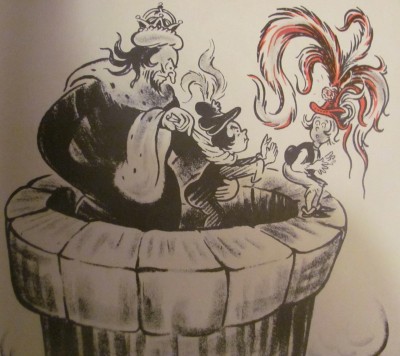
The 500 Hats of Bartholomew Cubbins

Since I started this blog, I’ve been avoiding writing about Dr. Suess.

He’s one of the best kid lit author-illustrators of all time, talented and creative with the creatures he dreamed up and the wise and hilarious things they say– words that make perfect sense even though they don’t. I’m not familiar with the history of children’s books, but I feel like Seuss’s rhyming style revolutionized kid lit, inspiring generations to read.

But there’s a big problem in his stories: the girls are missing; they’re so invisible that going into Seussworld becomes creepy, like being transported to a dystopia where females don’t matter at all.

If you think I’m over-reacting, take a look at The 500 Hats of Bartholmew Cubbins. I read it to my kids tonight. It’s such a long book– about 40 pages and atypical Seuss with lots of text. Just one sentence mentions the existence of women: “Lords and ladies stared from the widows of their turrets, wondering what the strange stream of hats could mean.” There is no lady shown in the accompanying picture or in any of the pages of illustrations that follow, including crowd shots of the city of Didd and the people at court. Every single character in this story is male: the king, Bartholomew, the boy in the title, the gaurds, coachmen, noblemen, lords, record keepers, wise men, archers, magicians, the executioner, and the king’s

nephew.

Along with every college student in America, I received Oh, the Places You’ll Go for graduation. I love the book and still read it when I get depressed. But the uplifting tone almost abandons me when I read: “You’re the guy who’ll decide where to go.”

To all those people that say the words don’t matter (we’re talking about writers herewords matter!)  you’d notice, I think you’d care, if you’re about to graduate from college and embark on the professional world and you receive a gift of poetic maxims that’s supposed to inspire and invigorate you, when they, in fact, exclude you. Say you’re a guy, and you get a book that says: “You’re the girl who’ll decide where to go.” Trust me, you’d notice. And all I’m asking is how could a writer as prolific as Dr. Seuss, a guy who probably made up more creatures, at least of the hairy mammal species, than exist on the planet, a writer whose sheer production of stories rivals Joyce Carol Oates, who knows he is teaching and inspiring little kids to read for the first time– how could he exclude girls to the extent he did?

Oh, the Places You’ll Go has a few females, most notably standing on line in the Waiting Place. Possibly a long eye-lashed elephant is feminine. But certainly not the Hakken Kraks howling, the monsters who pop out of manholes, the strange birds who mix up their right foot with their left; not one of the bearded boom band players is a girl.

Horton hatches an Egg features a leading female– a bad mother bird who abandons her egg to vacation off in Florida (typical kid lit bad mom who abandons her child) Horton is a father-son story about the amazing nurturing characteristics of a determined elephant (nevermind that Seuss’s much loved elephants are, in reality, a matriarchal society) Horton reappears, showing his same super-paternal tendancies in a book where he rescues a Who.

A girl character sneaks her way into Seuss stories now and then– there’s Cindy Lu, the Who in The Grinch Who Stole Christmas, who catches him stealing her tree. Cat and the Hat has a sister character, though she’s drastically outnumbered  by males: her brother who narrates the story, the pissed off fish, Thing One and Thing Two, and the cat, of course. You do see the missing mother’s shoe.

Dr. Seuss– just like the guys at Pixar and Disney– is so creative in so many ways, why does he become trite and cliche when it comes to gender? Why is it so beyond the male imagination to create a magical world where girls and boys are equally important?