Mrs. Wonderland

Some British guy just proposed to Alice on the TV commercial previewing the movie. I am so bummed. I’ve been hoping they didn’t fuck up Alice in Wonderland. Now, I’m worried.

Alice replies, “This is all happening so fast. Let me just take minute.” Then she goes down the rabbit hole. Maybe this ad is skewing the story, and the film is not really about this (which would still annoy me with lame advertising, but not as much as if they really messed up the movie) Isn’t Alice a kid, anyway? Doesn’t she fall asleep while her sister is reading her a book without pictures? Maybe that abstinence only study for sixth graders is relevant after all (see my last post.)

I am frustrated that the plotlines of so many (all?) contemporary movies with girls in big parts always feature marriage as central issue.

Yes, now the girl protagonist is often reluctant to marry, she doesn’t go off with the first guy who kisses her out of unconsciousness; she doesn’t make the obvious, predictable choice (see Mulan, Ariel, Belle and now possibly Alice escaping off to Wonderland) but the plotline is still focused on marriage, rebellion within the safest possible framework. I’d prefer no marriage debate at all, just like in the boy movies. Did Fantasic Mr. Fox or Up have its main characters face this dilemma? In case you didn’t see them, rhetorical question. Actually, I didn’t even see Up and I know I’m right.

I hope Tim Burton doesn’t pull a Dora and turn another cool girl into a Princess. I’d feel better if the film had a female director and a female star whose name I recognized instead of promoting Johnny Depp all over the place. Things are not looking good, but it’s Alice in Wonderland for God’s sake, I’m holding out hope.

Abstinence only headlines

It’s all over the internet that a study has found abstinence only programs may work for teens. The headlines fail to mention to mention the teens being studied are sixth and seventh graders! Barely “teens.” I’d be encouraging these kids not to have sex too. It’s a completely different demographic and maturity level than highschool kids. Its so misleading for the media to present the story this way.

I saw Naomi Wolf on Joy Behar’s show the other night talking about “sexual gradulaism.” I love that term  which I am pretty sure she made up. Wolf wants to bring back heavy petting and argues that when girls learn about their own bodies and how they work, they delay sex and don’t get pregnant. Research of lower teen pregnancy rates in Europe where sex ed is part of the curriculum (and female sexuality seems to me much more accepted and celebrated than in my puritanical home country) back her up. Though the guy on the show with Wolf would not shut up about abstinence. I think his name was Steve, because Naomi kept saying, “Were you abstinent until marriage, Steve?” Steve thought his personal behavior wasn’t relevant to the discussion.

Fiona’s Fairy-tale Five ***GGG***

This is a totally random book, part of the Shrek franchise, cheaply made and printed (the same soft, stapled cover as My Little Pony & Berenstain Bears series.) I have no idea how it got on our bookshelf, but I love it. It’s hilarious.

I’m mostly a Shrek fan, because the whole message that beauty is found on the inside is communicated in an original and effective way. The final makeunder when Fiona transforms into an ogre is well done. I’m so sick of the “beauty and the beast” scenario repeated ad infintum in kids movies and adult ones (see latest Judd Apatow flick) where the overwieght, dorky stoner scores the beauty. I do look forward to the day when the hot guy falls for the “ugly” or fat girl– in cartoon world and the grown up one– because her humor or brains make her so compelling. But at least two beasty green creatures in love is one step in that direction. I have my other complaints about Shrek: he’s the star in his eponymous movie, and Fiona’s storyline is the typical princess scenario culminating with the marriage and happily ever after.

I was most disappointed with Shrek 3 where Fiona’s part is drasticaly reduced, becoming primarily a father/ son story, with Justin Timberlake as the new co-star. Now I know what was happening when Fiona was MIA. Fiona’s Fairy-tale Five is about the drama back at the castle when Shrek went off on his (very male) quest to find an heir.

Fiona is home having a baby shower with her friends Snow White, Sleeping Beauty, Rapunzel etc when Prince Charming storms the castle, trying to stage a coup. The princesses must stop the festivities and defend the castle. Charming is one of my favorite movie bad guys; I love how his suaveness comes off as smarmy and how he’s so un-charming. The story shows the gang of princesses work together (rare to get to see princesses in any kind of group and functioning as a team) to vanquish Charming. It’s fun to see all the princesses in one story and also totally consistent with the Shrek movies which always feature mutiple fairy tale characters meeting up. I think this flimsy book would make a great movie, so much better than boring Shrek 3.

All the princesses surprise themselves and each other, becoming brave heroines. I especially like how Sleeping Beauty snaps out of her daze with some awesome fight moves and when Fiona’s mom says to her, “You didn’t actually think you got these fighting skills from your father, did you?”

Winners Never Quit


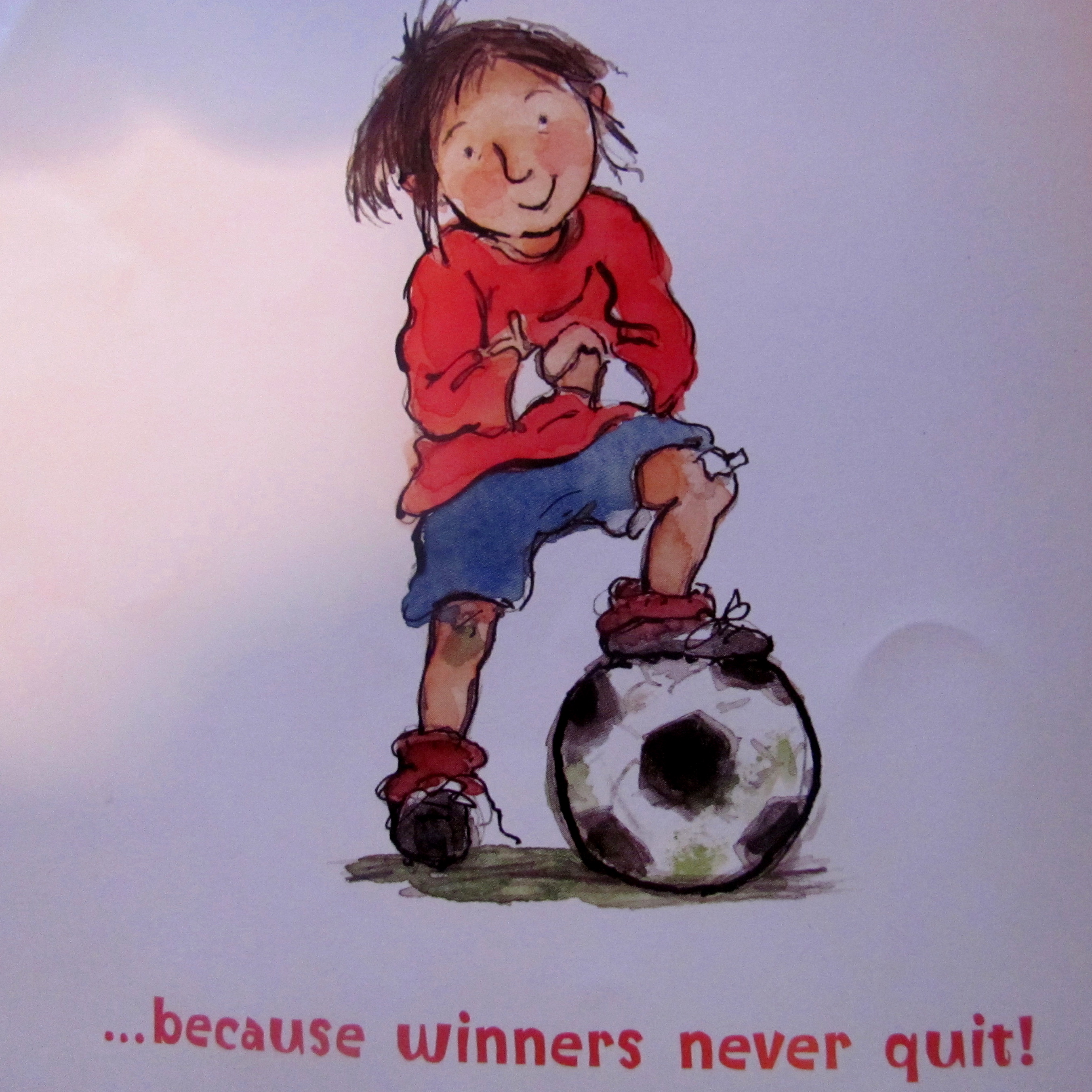
This book is by famed soccer player, Mia Hamm. It’s about her childhood when she spent her days playing soccer with her family. “Tap, tap, tap. Her toes kept the ball exactly where she wanted it. She’d kick the ball straight into the net. Goal! Everybody on her team would cheer.”

But then Mia has a bad day, and she doesn’t score any goals; there’s no cheering for her. Her older brother puts his arm arund her and says, “Better luck next time.” But Mia says “I quit,” and storms off the field.

The next day when she shows up to play, her brother won’t let her. “Sorry, Mia. Quitters can’t play on my team.” Mia is forced on the sidelines, just watching. The next day she is allowed to play again, and when she doesn’t make the goal “she feels tears in her eyes.” She hears whispering that she’s going to quit, but she realizes she loves playing soccer even more than she hates losing, and she keeps playing. “Maybe she’d score a goal, maybe she wouldn’t.”

Obviously the message here is that its not whether you win or lose, its how you play the game. But its shown as a real life story, in a way kids can understand; Mia has intense emotions readers witness her learning how to deal with.

I feel like Mia wrote this book just for my daugter Lucy who is incredibly athletic at everything she tries– soccer, T-ball, basketball, air hockey (she didn’t inherit this from me.) At six years old, it is kind of rare to see a kid so aggressive, not wandering off the field or playing house in the goal. Lucy just keeps going after that ball. I obviously want to encourage her passion and skill. But she does cry when she doesn’t play well and says things like, “I’m terrible, I’m the worst.” And when she gets mad, she cheats.

I don’t understand her drive and skill because I wasn’t into sports as a kid. So I especially value this book, because it shows girls that competition is OK, which is something I wish I’d learned in sports and way beyond. I think it’s crucial to teach girls how to compete openly and ethically for victories that matter, so they don’t funnel those drives into backhanded ambitions too often focused on beauty, boys, and popularity, the venues through which girls have historically been allowed to win power.

Humans are competitive. Girls, too often aren’t taught how to deal with that, or even told that to engage in competition is bad. You’ve got to be especially wary where I live, in San Francisco, where many “progressive” schools believe every kid should be in the school play, on the team etc. I get this up to point, but learning to play fair, to want to win, that it feels good  when you do, are important lessons, key to helping girls grow into successful women.

At the end of the book, there are several photographs of Mia Hamm winning trophies, being carried by her teammates, and action shots of her playing soccer as a kid. I love all this imagery, illustrated and real, of a girl displaying her amazing skills and enjoying winning.

Thank you Mia Hamm!

Outside Over There ***GGG***

Sadly, just like two of my other favorite childrens’ book authors, Dr. Seus and William Steig, Maurice Sendak often leaves female characters completely out of his stories or gives them tiny parts.

Outside Over There is different–the three main characters are female. it’s a perfect story: strange, scary, and feminist. This book would make a great movie (are you listening Spike Jonze and Dave Eggers– or some female moviemakers out there?) It’s about  a brave girl who rescues her baby sister after she is stolen away by goblins.

The prose is classic Sendak– concise and beautiful. It begins, “When Papa was away at sea, and Mama in the arbor, Ida played her wonder horn, to rock the baby still, but never watched.” The accompanying illustrations are creepy and intense. The mother is shown in a daze, staring out to sea, obviously missing her husband horribly, not paying any attention to Ida who holds her crying baby sister. You can feel the aloneness and the abdonment the whole family is experiencing, but especially Ida, who is trying her best to take care of the baby, before she makes her fateful mistake of not watching.

Goblins sneak in the window and steal the baby, leaving one made of ice (an image that’s never completely left me) When Ida turns to hug the baby and feels her melt, she makes a fist: ” ‘They stole my sister away,’ she cried. ” ‘To be a nasty goblin’s bride.’ ” She climbs out her window into “outside over there” guided by the voice of her father from the sea. When she finds the goblins, she plays her horn until they dance into such a frenzy “they quick churned into a dancing stream.” Ida grabs up her sister, and brings her home to their mother, still in the arbor, now holding a letter from their father: “I’ll be home one day, and my brave, bright little Ida must watch the baby and her Mama for her Papa who loves her always. Which is just what Ida did.”

Like his much more famous book Where the Wild Things Are, this adventure story is told in less words than this review. Sendak is amazing. I wish more people knew about his best book.

If women ran the MPAA…

The following standards would urge caution for parents: any movie

1. where the leading woman is ten years younger (or more) than the leading man

2. where the mother’s real life age is the same as the guy playing her son

3. with a sidekick best friend who is super attractive but supposed to be unattractive because she’s wearing glasses

4. where the girl in glasses gets a makeover

5. where all the female roles are girlfriends or supporting

6. with cheerleaders

male frontal nudity is OK

female frontal nudity is OK only if it’s shown as a quick glimpse, coming out of the shower or in the locker room, not in a lingering sexual way (or the whole movie gets an NC-17 or X rating)

Amelia Bedelia


Every parent has a book that drives her crazy, that she hopes and prays her kid will not choose yet again, that she dreads reading. For me this book is Amelia Bedilia. Worse than Eloise, the fairies, even the ponies, AB is so annoying. That’s the point of all the stories, she misunderstands– whether its how to clean a house or play baseball.

Kids do think its funny when grown ups don’t get something obvious. The other day, my brother-in-law came out of the kitchen with a banana on his head, asking my three year old, “Have you seen a banana anywhere?” She was cracking up. The kid could not stop laughing. She thought it was the most hilarious thing she’d ever seen.

If Alice laughed like this when I was reading, I would forgive Amelia for being so irritating. But Alice sits there, totally straight faced– yet intrigued- while Amelia sprinkles face powder all over the sofa after she was told to dust it.

Amelia is so annoying, she doesn’t even fit in my rating system. She’s does nothing for girlpower, but she’s not really stereotyping either. Hate her.

The Three Little Wolves & the Big Bad Pig


This story gets a ***GG*** rating, and it has no major female characters. How is this possible?

Because it breaks stereotypes with a simple reversal. When I read stories, I often make gender switches in my head, to reveal the kinds of characteristics and plotlines we’ve heard so many times that we just take them for granted as something believable or successful. Anytime a story does the shake up for me, inspiring a jaded reader to think in a new way, I’m grateful. Next to the helpless, passive princess, wolves are probably the most maligned creature in fairy tale world. (About ten years a go, another writer made the same kind of connection when she compiled an anthology of myths about brave female protagonists called Women who Run with the Wolves.)

In the first scene of Three Little Wolves, we see these wolves as vulnerable, they are shown with their mother, described as cuddly, with soft fur and fluffy tails. Their mother urges them to go out in the world with the warning, “But beware of the big, bad pig.”

The story follows the classic model, describing the wolves’ adventures and challenges as they attempt to build safe homes for themselves, continually destroyed by the malicious, resourceful pig. I highly recommend this book. It’s so funny and poetic, reminiscent of Steig stories, and it has a beautiful ending.

Should kids’ books be rated?

The novelist and blogger, thinks they should.

I was thrilled to see this topic in the NY Times book blog. Though most comments to his post seem to disagree with him, thinking kids books should not be rated, that to do so is some horrible form of censorship.

I don’t see that at all. I see it as censoring the censors. Ha! Their ridiculous standards and values have ruled over our kids for far too long in an insane monopoly– I’m raging about the MPAA again. I know the MPAA doesn’t rate books, but they set a standard of what is “good” and what is “bad” that everyone seems to follow along with.

I’m not sure if Buchsbaum would agree or disagree with my major complaint that the typical censor/ rating types are not sensitive to or even aware of  or don’t believe things are damaging that I think are damaging and vice versa. His complaints seem to be with with adult themes and content finding their way into teen books.

Buchsbaum does rightly point out, anyway, that ratings are a guide, not censorship. Who has the time to read every kids book? See every movie? Examine every toy etc. I created this blog so parents could have some kind of resource to know about some alternatives out there to all the sterotypes the general media programs to our kids 24/7.

Phaedra ***SSS***

Phaedra is an adult play that I went to see last night with another adult, and this is supposed to be a blog about kids media, but I have to write about this play for the sake of womankind. But before I do, I want say– I had a great time going out–Moms, you’ve got to do it. Grown up time! Whoo-hoo! No cartoons! And spending time with my friend, having a glass of champagne at the Huntington Hotel was lovely. The play was well acted and engaging, but it got me so mad. I did try to imagine it in its time, before feminism blah blah blah.

It was a play about Greek mythology– what did I expect? Well, Greek mythology often illustrates the world in flux, before male domination completely took over, so often a powerful woman or two slips through in her full glory of female power as a goddess or a queen or heroine or something. Right before I went, I heard this play was about an older woman falling for a younger man, so I assumed, I wouldn’t be watching yet another Hollywood movie scenario of older man paired with nubile ingenue, that I was going to get a glimpse of female sexual empowerment.

But, no. The damn Greeks did not come through for me, and I was a philosophy major and should’ve known better. The play is by Racine, who I bet even by French/ Seventeenth century standards wasn’t the most progressive guy in town. It was obviously, also his interpretation of an ancient story, which, should we say, would differ from my own take on it if I were a famous playwright myself instead of blogging about famous playwrights.

Phaedra, the star of the play is totally humiliated and degraded for allowing lust to exist in her heart. It destroys her and her family and her lover. She is married to Theseus but falls in love/lust with his son, Hippoltytus. Another thing that annoyed me about the play, by the way, is the supposedly over the hill Theseus was way hotter, more charismatic, and a better actor than his stringy haired son, moping aound in his ill-fitting baggy leather pants. Nonetheless, Queen Phaedra confesses her love to this son, gets rejected by him (read major, pathetic humiliation here, moaning all around the stage, twisting her hair, punching her breast) and then Phaedra lets her husband beleive that Hippoltytus raped her (a popular, contemporary “myth” women have to deal with every day which is an issue I have with letting my complaints go b/c of the time). Theseus then curses his innocent son, who loved an innocent young woman, and the son soon dies. End of play– the theme being, repeated by most characters, that reason is good/ strong while love/lust is weak and bad.

I know the Greeks have done a lot of great things for civilization such as creation of goverment etc, but my (not orginal) beef with them is their central philosophical tenet of dualisms, popularized and further institutionalized, of course, by Descartes. Basically, the Greek philosophers believe: (1) the mind and body are separate (2) the mind/ reason is good, true, stable, immortal (3) the body is weak, defiled, emotional, untrustworthy, mortal (4) The way we understand and experience the world can be sorted into these dualisms. Guess which category those gender polar opposites, man and woman fall into? Answer of course: man– mind, reason, good; woman– emotion, body, bad

Here is what I think: the mind is part of the body (and located throughout the body– modern science now supports that if you care). Emotions are intelligent. The world does not separate into simple oppositions as former president, George Bush, would have liked, and maybe if we had not all been so influenced by the dualistic Greeks, we wouldn’t have so unanimously agreed to fight a complex war with a multitude of factions and tribes we can’t even understand. And, finally, just one more thing about the damn Greeks, their dualisms, and my re-occuring eating disorder theme– belief in these dualisms is why we are so messed up about food. Just listen to your body! It’s smart. Not some stupid calorie/ fat gram reasoned, researched, fact supported chart, which has no idea who you are or what you need. Let your body guide you and stop being at war with it. We are all going to die. Not sure how to deal with that, but that’s the real struggle underneath all of this, right? Did Rousseau– of noble savage fame– write any plays???