If Castro forced Knight to give birth 5x, another kind of hell

A couple days ago, shocked that psychopath Ariel Castro might be charged with murder, I posted on Reel Girl: Focus on the torture and rape of 3 women, not fetuses

Here’s what I wrote:

Multiple news sources are reporting that prosecutors may seek the death penalty against Ariel Castro, bringing aggravated murder charges in connection with 5 pregnancies that he terminated by starving and punching Michelle Knight. A murder charge would be a terrible mistake in bringing Castro to justice. Castro raped and tortured three women. Isn’t that evil enough? That the prosecution would shift the focus to fetuses to bring the worst charges against Castro mitigates the value of the lives of these women and sickens me.

The only way to stop the epidemic of violence against women in America is to empower them financially, physically, socially, culturally. Charging Castro with murder of fetuses does the opposite. If Castro can be charged with murdering fetuses, than a woman getting an abortion, even if that woman was raped Michelle Knight herself, she, too, would be “murdering” fetuses. Castro tortured, raped, and assaulted these women in multiple, horrific ways. Keep the focus on the women, not the fetuses, and bring Ariel Castro to justice for his evil crimes.

Since that post, I have been unliked, unfollowed, and only further convinced that prosecuting Castro for murder is the wrong crime and fails to do justice to these women. There’s a post on Slate with a similar argument: “Should Ariel Castro Be Prosecuted for Fetal Homicide? Maybe. But we should focus on the harm he did to the women he’s accused of abducting.” Writer Emily Bazelon argues:

I still think, though, that there would be something very strange about executing Castro for the harm he did to fetuses, as opposed to the harm he did to three living and breathing women.

And what if Castro had allowed the fetuses to live? What if Michelle Knight had been forced to give birth 5 times in captivity to babies fathered by a rapist? That would have been its own hell. But would that use, manipulation, and violation of Knight’s body be recognized by our legal system beyond rape charges?

A regime, whether enforced by a government or a madman, that forces women to have abortions is the same regime that can force them to give birth. Reproductive rights are human rights, and violating them ought to carry the severest of penalties. But when will violating the human rights of women be recognized by the U.S. legal system as the heinous crime it truly is?

Ex-wife of Ariel Castro charged him with domestic violence, case dropped

In 2005, Grimilda Figueroa, the ex-wife of Ariel Castro, the man who imprisoned, beat, and sexually abused three women for ten years, brought domestic violence charges against him. Court documents state that Figueroa suffered two broken noses, broken ribs, a knocked-out tooth, two dislocated shoulders, and a blood clot on the brain.

Jezebel reports:

However, nothing could be done to protect Figueroa and her children as her lawyer didn’t show up for the court hearing, and the case was dropped. Apparently her counsel cautioned her against speaking for herself, and she didn’t make any objection to the judge’s decision to dismiss the protection order. Both Figueroa and Castro were judged to have “waived their right to any further hearing”, the case’s final document stated. Tragically, Figueroa died last year.

How did the judge decide to dismiss such a case for something so simple as a lawyer not showing up? Why don’t we have better legal resources for victims of domestic violence? How ill-equipped, poorly run, understaffed, and overworked must our legal system be to let a case like that slide? It’s infuriating and heartbreaking to yet again witness the ease with which such cases are dismissed.


America is failing half of its citizens. This violent man, Ariel Castro, was more protected by our legal system than the women he abused. In 2013, there is slavery in America’s backyard and we look the other way and just let it happen. Here are the stats one more time from National Coalition Against Domestic Violence):

One in four women (25%) has experienced domestic violence in her lifetime.

85% of domestic violence victims are women.

Women ages 20-24 are at the greatest risk of nonfatal intimate partner violence.

Nearly three out of four (74%) of Americans personally know someone who is or has been a victim of domestic violence.

On average, more than three women are murdered by their intimate partners in this country every day.

Domestic violence is one of the most chronically under reported crimes.

Only approximately one-quarter of all physical assaults, one-fifth of all rapes, and one-half of all stalkings perpetuated against females by intimate partners are reported to the police.

How are we going to stop it? Support the feminist movement. Here’s a report published in SFGate, 2012:

A new study on violence against women conducted over four decades and in 70 countries reveals the mobilization of feminist movements is more important for change than the wealth of nations, left-wing political parties, or the number of women politicians.


The study in the latest issue of American Political Science Review (APSR), published by Cambridge University Press for the American Political Science Association (APSA), found that in feminist movements that were autonomous from political parties and the state, women were able to articulate and organize around their top priorities as women, without having to answer to broader organizational concerns or mens’ needs. Mobilizing across countries, feminist movements urged governments to approve global and regional norms and agreements on violence.
The scope of data for the study is unprecedented. The study includes every region of the world, varying degrees of democracy, rich and poor countries, and a variety of world religions – it encompasses 85 per cent of the world’s population. Analyzing the data took five years, which is why the most recent year covered is 2005.

2005 also happens to be the year that Ariel Castro’s wife brought the charges against him and her lawyer didn’t care enough to show up in court.

Violence against women in America’s backyard, from Amanda Berry to U.S. Military

Last night, I was glued to the television as Amanda Berry’s chilling, horrific story unfolded, watching the details of how she was able to get help and rescue her six year old daughter, along with two other prisoners, Gina DeJesus and Michelle Knight. The three of them were held captive, most likely as sex slaves, possibly by three brothers, for ten years.

911

Amazed by the courage and resilience of these women, I am baffled and disgusted that people ever dare to claim that we live in some kind of post-feminist wold. In 2013, 90% of violence worldwide is perpetuated against women. There is sex slavery and human trafficking in America’s backyard. And still, stopping this violence couldn’t be lower on the U.S. priority list. We actually had to fight to pass the Violence Against Women act.

Just yesterday, the chief of the U.S. air force’s sexual assault prevention branch was arrested because he was charged with sexual assault. The guy who is supposed to be protecting women, in an institution that is supposed to be protecting Americans, is assaulting them. If that disconnect doesn’t show how fucked up America is on the issue of violence against women, I don’t know what does.

Today, the pentagon is supposed to release a report that states there are more than 70 sexual assaults involving military personnel every day. Every day. The U.S. military. Where do you think this report is going to be in today’s news cycle? How long will it stay in the news? Who is going to keep it there? Which politicians are going keep bringing attention to the crimes against women? Who is going to lead the action to finally stop it?

The violence that happened to Amanda Berry, GIna DeJesus and Michelle Knight is all of our responsibility. These sex crimes and gender crimes are not perpetuated by the Taliban or some another foreign government but are happening right here in the USA.

Violence against women is an epidemic in this country: One in four women (25%) has experienced domestic violence in her lifetime and on average, more than three women are murdered by their intimate partners in this country every day. Every day.

Yet, when it comes to women, too many politicians become most concerned with depriving them of basic health care and sex education. It was just reported that Elizabeth Smart, another courageous woman who was kidnapped as a teen and held as a sex slave, spoke to a forum on human trafficking. Smart explained the damaging repercussions of abstinence only education and how it can prevent victims from trying to escape:

Smart said she “felt so dirty and so filthy” after she was raped by her captor, and she understands why someone wouldn’t run “because of that alone.”

Smart spoke at a Johns Hopkins human trafficking forum, saying she was raised in a religious household and recalled a school teacher who spoke once about abstinence and compared sex to chewing gum.

“I thought, ‘Oh, my gosh, I’m that chewed up piece of gum, nobody re-chews a piece of gum, you throw it away.’ And that’s how easy it is to feel like you know longer have worth, you know longer have value,” Smart said. “Why would it even be worth screaming out? Why would it even make a difference if you are rescued? Your life still has no value.”


Thank God Elizabeth Smart has the courage to speak publicly about what happened to her. Thank God Amanda Berry had the courage to scream yesterday. It’s time for the United States to stop pointing the finger at everyone else and get a clue. Be the leader of the free world that you claim to be. Set an example. Stopping violence against women should be this country’s highest priority.


Thank you, Eve Ensler

Eve Ensler is the founder of V-Day and One Billion Rising, movements to end violence against women. End it. That’s exactly how Ensler thinks, and that’s why she is one of my heroes.

eve-lacombe

Here’s info about One Billion Rising:

 ONE IN THREE WOMEN ON THE PLANET WILL BE RAPED OR BEATEN IN HER LIFETIME.

ONE BILLION WOMEN VIOLATED IS AN ATROCITY

ONE BILLION WOMEN DANCING IS A REVOLUTION

On V-Day’s 15th Anniversary, 14 February 2013, we are inviting ONE BILLION women and those who love them to WALK OUT, DANCE, RISE UP, and DEMAND an end to this violence. ONE BILLION RISING will move the earth, activating women and men across every country. V-Day wants the world to see our collective strength, our numbers, our solidarity across borders.

What does ONE BILLION look like? On 14 February 2013, it will look like a REVOLUTION.

Driving my three daughters to school this morning, I heard Ensler on the radio talking about her journeys around the world to record stories from women about the invisible but widespread violence that so many people continue to ignore. Ensler said that in the U.S., people always ask her if she gets overwhelmed. She said (paraphrasing here to the best of my memory): “Of course I get overwhelmed. You should get overwhelmed! Are we so fragile, that we are afraid to feel? If you can’t feel, you cant act, and you can’t change.”

It reminded me of something I read recently, that humans are designed to experience emotions. Our bodies– without the controlling interferences so many of us use like drugs, food, or staying stuck in our heads– are designed to experience emotions in waves. They crest and then they recede. It’s what our anatomy is set up for. They don’t kill us, we survive. What would happen if we stopped being so afraid to feel? How do you think our world would change?

Here’s an excerpt from Ensler’s latest book, I Am an Emotional Creature.

I AM AN EMOTIONAL CREATURE

“I love being a girl.
I can feel what you’re feeling
as you’re feeling it inside
the feeling
before.
I am an emotional creature.
Things do not come to me
as intellectual theories or hard-shaped ideas.
They pulse through my organs and legs
and burn up my ears.
I know when your girlfriend’s really pissed off
even though she appears to give you what
you want.
I know when a storm is coming.
I can feel the invisible stirrings in the air.
I can tell you he won’t call back.
It’s a vibe I share.

I am an emotional creature.
I love that I do not take things lightly.
Everything is intense to me.
The way I walk in the street.
The way my mother wakes me up.
The way I hear bad news.
The way it’s unbearable when I lose.

I am an emotional creature.
I am connected to everything and everyone.
I was born like that.
Don’t you dare say all negative that it’s a
teenage thing
or it’s only only because I’m a girl.
These feelings make me better.
They make me ready.
They make me present.
They make me strong.

I am an emotional creature.
There is a particular way of knowing.
It’s like the older women somehow forgot.
I rejoice that it’s still in my body.

I know when the coconut’s about to fall.
I know that we’ve pushed the earth too far.
I know my father isn’t coming back.
That no one’s prepared for the fire.
I know that lipstick means
more than show.
I know that boys feel super-insecure
and so-called terrorists are made, not born.
I know that one kiss can take
away all my decision-making ability
and sometimes, you know, it should.

This is not extreme.
It’s a girl thing.
What we would all be
if the big door inside us flew open.
Don’t tell me not to cry.
To calm it down
Not to be so extreme
To be reasonable.
I am an emotional creature.
It’s how the earth got made.
How the wind continues to pollinate.
You don’t tell the Atlantic ocean
to behave.

I am an emotional creature.
Why would you want to shut me down
or turn me off?
I am your remaining memory.
I am connecting you to your source.
Nothing’s been diluted.
Nothing’s leaked out.
I can take you back.

I love that I can feel the inside
of the feelings in you,
even if it stops my life
even if it hurts too much
or takes me off track
even if it breaks my heart.
It makes me responsible.
I am an emotional
I am an emotional, devotional,
incandotional, creature.
And I love, hear me,
love love love
being a girl.”

Happy-V-Day


Roughhouse with your kid, it’ll make her brain grow

I first saw the post “The Importance of Roughhousing with your kids” on the Pigtail Pals Facebook page, where I get much of my information. I wish Melissa Wardy were the editor of the New York Times, because the post she linked to is about a year old, and I’d never seen it, heard of it, or heard any of the information about roughhousing before I saw it on her page.

On the blog, Art of Manliness, the post reads:

Helping your child develop a resilient spirit is one of the best things you can do as a parent. The ability to bounce back from failures and adapt to unpredictable situations will help your kids reach their full potential and live happier lives as adults. And an easy way to help boost your kids’ resilience is to put them in a gentle headlock and give them a noogie.

Roughhousing requires your child to adapt quickly to unpredictable situations. One minute they might be riding you like a horse and the next they could be swinging upside-down. According to evolutionary biologist Marc Bekoff in his book Wild Justice, the unpredictable nature of roughhousing actually rewires a child’s brain by increasing the connections between neurons in the cerebral cortex, which in turn contributes to behavioral flexibility. Learning how to cope with sudden changes while roughhousing trains your kiddos to cope with unexpected bumps in the road when they’re out in the real world.

This theory resonated with me because if I could define health in one word it would be “resilience” and sickness would be “stuck.”

Roughhousing as a positive influence for kids seems consistent with what Po Bronson wrote about years ago in Nurture Shock: New Thinking About Children. According to Bronson’s research, you don’t compliment the kid on the finished task, but on the effort. The most important skill for success and happiness is learning to tolerate frustration and learning to work through it. Rewarding the process, not the end goal. (Artists, are you listening?)

A similar thesis is presented in a new, popular book: How Children Succeed: Grit, Curiosity, and the Hidden Power of Character. The author, Paul Tough argues that the qualities that matter  aren’t test scores, but emotional intelligence, skills like perseverance, curiosity, conscientiousness, optimism, and self-control.

Optimism is also now understood not as a personality trait but a skill set: making a plan of action, seeking advice from others, training to look at problems as a temporary setback to be overcome.

Art of Manliness describes roughhousing as just that:

Additionally, roughhousing helps develop your children’s grit and stick-to-itiveness. You shouldn’t just let your kids “win” every time when you roughhouse with them. Whether they’re trying to escape from your hold or run past you in the hallway, make them work for it. Playtime is a fun and safe place to teach your kids that failure is often just a temporary state and that victory goes to the person who keeps at it and learns from his mistakes.

Remarkably, back to testing:

Psychologist Anthony Pellegrini has found that the amount of roughhousing children engage in predicts their achievement in first grade better than their kindergarten test scores do. What is it about rough and tumble play that makes kids smarter? Well, a couple things.

First, as we discussed above, roughhousing makes your kid more resilient and resilience is a key in developing children’s intelligence. Resilient kids tend to see failure more as a challenge to overcome rather than an event that defines them.  This sort of intellectual resilience helps ensure your children bounce back from bad grades and gives them the grit to keep trying until they’ve mastered a topic.

In addition to making students more resilient, roughhousing actually rewires the brain for learning. Neuroscientists studying animal and human brains have found that bouts of rough-and-tumble play increase the brain’s level of a chemical called brain-derived neurotrophic factor (BDNF). BDNF helps increase neuron growth in the parts of the brain responsible for memory, logic, and higher learning–skills necessary for academic success.

I love this theory from a feminist perspective as well. I am so sick of hearing about “boy energy.” As I’ve written about extensively on this blog, girls are not intrisically quieter than boys. Boys’s roughhousing is tolerated, but girls are told to settle down and be quiet. They are rewarded when they do. I see this all the time, and I’m sure you do too. Not to mention ridiculous generalizations like girls are “artsy” and literary, quiet activities. Girls are “artsy” when its about construction paper and Elmers’ glue. If we’re talking great artists, paintings that sell for the most money, or shows at the MOMA, all of a sudden, it’s boys who are artsy. The same is true with “great” writers; wow, men are verbal! Who knew? Not to mention “cooking” becomes masculine when we’re talking about great chefs and who gets the most cooking shows and awards. “Masculine” and “feminine” qualities have everything to do with stereotypes and status.

But I digress. Check out this whole post on roughhousing, it’s really great.

Reality TV hits new low: ‘Biggest Loser’ kids infiltrate Scholastic News

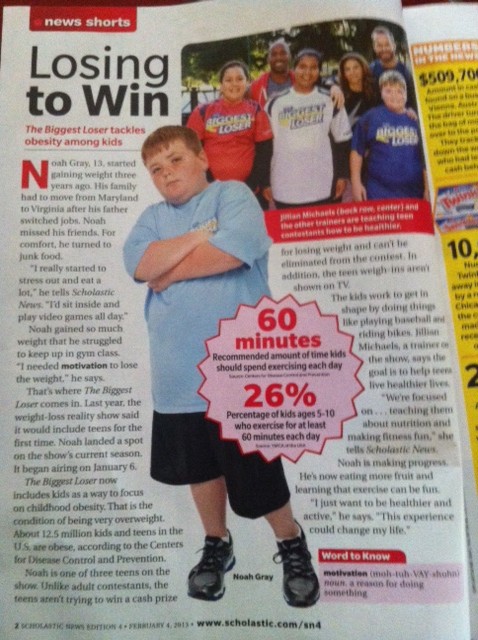
Today, when my fourth grade daughter brought home her weekly Scholastic News, which she has to read weekly for homework, I was horrified to see a full page article endorsing the new “The Biggest Loser” episodes with kids.

biggestloser

Kids don’t belong on reality TV at all, not to mention on a fat-shaming show that stereotypes and stigmatizes children based on their current body type.

Bitch’s take on the Biggest Loser kids episodes:

At one point in last week’s season premiere, Jillian Michaels talks to the three kids about bullying, and tells them she’s here to help. While Michaels may have the best of intentions, her brand of helping means changing the kids to conform to the bullies’ standards, not challenging the norms that make the bullying okay in the first place. It’s fine if teens want to eat healthy and get in shape—go for it you healthy teens!—but exploiting fat kids on national television in an environment that is known to be unrealistic and risky just so NBC can get more ratings is all kinds of wrong. And the more research we see, the more we learn that fat and health aren’t as closely related as we thought—which makes The Biggest Loser: Chubby Kid Edition even worse.

The non-profit About-Face blogs:

this odious piece of programming’s definition of mentoring means exposure to fat shaming, intensely restrictive diets, and excessive exercise. The Biggest Loser is synonymous with fueling a national environment that promotes fat phobia, body shaming, and unhealthy means of weight loss…But attempting to integrate youth into the most fat-shaming, weight loss glorifying TV show in America just to expand the target audience is horrifying. Our society is already massively confused about the relationship between size and health and riddled with misconceptions that one is an indicator of the other.

Even the LA Times writes about the show:

There’s certainly an argument to be made that reality TV has no business putting kids in the limelight. There is just no telling how it might impact young lives 20 years from now.

At the very least, the idea of putting kids on this program to improve their health is highly debatable. In fact, when my daughter told me that there was an article that made her uncomfortable, I assumed she was talking about the debate section of the mag, where one kid supports something and another kid is against it. But, no. “The Biggest Loser” piece is on page 2, presented with zero controversy. My daughter told me that she felt sorry for the boy, because people were making him feel bad for being fat. She said, “This is horrible. Why would they do that?” Am I supposed to tell her NBC just cares about his health?

Asexuality is an orientation, not a defect

A couple weeks ago, when I wrote a post about childfree women, I got this comment:

Thank you! I decided to be and stay childfree for the following reason: I’m asexual. The very thought of getting so close to a person repulses me. Also, I don’t like kids that much. But when people ask you this when you get a new job then that’s just horrible and a bit sad that they focus their attention towards this (you can’t get fired where I live if you get pregnant so that’s not a problem). Btw, I’m not outet do anyone but my closest friends so I guess even my parents might start asking questions…

I was intrigued by this comment, because I hadn’t heard anyone identify themselves as asexual before. I was also interested her phraseology, that she wasn’t “out” to anyone but her closest friends. That sounds like how people talk about being gay. I wondered: is asexuality is an orientation? And if so, how come I’ve never heard of it? If I thought asexuality existed at all, I imagined it was a phase, a result of some kind of trauma, something to be healed.

Because this is 2013, all I needed was Google to tell me how biased and ignorant I am.

Asexuality has 833,000 Google matches, not much compared to homosexuality at almost 27 million, but nothing to sneeze at.

An asexual person is defined as someone who does not experience sexual attraction. Asexuality differs from celibacy in that it is not a choice. Everything I found on the internet reports that asexuality is an orientation, not a defect. Asexual people have the same emotional needs as anyone else. They also can find people aesthetically attractive but still are not sexually attracted to them. They often have a romantic orientation. Emotional and romantic attraction are not the same as sexual attraction.Here is how the Asexuality Visibility Network describes it:

Many asexual people experience attraction, but we feel no need to act out that attraction sexually. Instead we feel a desire to get to know someone, to get close to them in whatever way works best for us. Asexual people who experience attraction will often be attracted to a particular gender, and will identify as lesbian, gay, bi, or straight.

Most asexual people have been asexual for their entire lives. It is not something that develops. It can be isolating and lonely to be asexual, but it doesn’t have to be. The key, as with everything, seems to be self-acceptance. Asexual people are often happy with who they are and many of them are also in long term, intimate but asexual relationships. Some are with sexual partners, but from what I’ve read so far, I don’t really get how that works. It seems to be a pretty individual thing.

After I read about asexuality, I was at a party and asked some people there about what I learned. No one I talked to had heard anything about asexuality. This group, by the way, included academics well versed in jargon like “heteronormative.”

To me, it seems like asexuality is further evidence that identity is far more complex and varied than we make it out to me. The way that many of us have one, rigid lens of looking at asexual people (as dysfunctional) that is so inaccurate, makes me think of the limited way people look at gender roles, so certain of ridiculous assumptions.

My guess is that we will be hearing more about asexuality in the future.


Kristof writes column and my new comment gets posted underneath!

The bad news is the NYT still hasn’t posted my comment on its sexist coverage of the rape of Jyoti Singh Pandey in India. The good is that Nicolas Kristof, one of the world’s greatest modern feminists, wrote an amazing column for Sunday’s NYT: “Taking Violence Against Women Seriously:”

Gender violence is one of the world’s most common human rights abuses. Women worldwide ages 15 through 44 are more likely to die or be maimed because of male violence than because of cancer, malaria, war and traffic accidents combined. The World Health Organization has found that domestic and sexual violence affects 30 to 60 percent of women in most countries.

In some places, rape is endemic: in South Africa, a survey found that 37 percent of men reported that they had raped a woman. In others, rape is institutionalized as sex trafficking. Everywhere, rape often puts the victim on trial: in one poll, 68 percent of Indian judges said that “provocative attire” amounts to “an invitation to rape.”

Americans watched the events after the Delhi gang rape with a whiff of condescension at the barbarity there, but domestic violence and sex trafficking remain a vast problem across the United States.


That’s just a couple graphs. You should read the whole thing, its all so important.

No comments taken there, but Kristof invites you to go to his blog “On the Ground” to post comments. There, he writes a few graphs ending with:

Then on top of all that, I’ve been thinking of the events in Steubenville, Ohio, in which football players allegedly carted a comatose 16-year-girl around and raped her, possibly even urinated on her. We’ve got so much work to do right here at home — and Congress can’t even bother to renew the Violence Against Women Act or the Trafficking Victims Protection Act! Grrr. Read the column and post your thoughts.


In case you’re not familiar with the Violence Against Women Act, it was just stalled in congress, by the good old government of the USA, because violence against women isn’t a problem in America, right? Here are some stats from the National Coalition Against Domestic Violence:

One in four women (25%) has experienced domestic violence in her lifetime.

85% of domestic violence victims are women.

Women ages 20-24 are at the greatest risk of nonfatal intimate partner violence.

Nearly three out of four (74%) of Americans personally know someone who is or has been a victim of domestic violence.

On average, more than three women are murdered by their intimate partners in this country every day.

Domestic violence is one of the most chronically under reported crimes.

I think it’s interesting that Kristof invites you to go to his blog if you want to comment. It looks the same as the NYT site in many ways, but I wonder if there’s a different procedure for comment approval? On the blog I posted this comment which got approved, basically the same as the first as best as I can recall:

Hi Mr. Kristof,

I was shocked to read in the NYT a post on this story from Jan 11 (http://www.nytimes.com/2013/01/12/world/asia/for-india-rape-victims-fami… Jyoti Singh Pandey’s name is not printed. The NYT explains this:

“The daughter — whose name is being withheld because it is illegal to name a rape victim in India without permission from the victim or her next of kin — showed as a very young girl a love for school, her father remembered.”

Why would an American publication follow Indian law on how to report on rape? At what other time does a country’s laws dictate how its news is reported in The New York Times? Especially when the US media keeps calling India sexist, unlike us. Why would an American publication follow India law in how it reports a crime? If this law referred to political dissidents from India, would the New York Times refuse to print their names?

Not only that, but days earlier, Jyoti’s father told the Mirror: “We want the world to know her real name,” says Badri Singh Pandey…“My daughter didn’t do anything wrong, she died while protecting herself. I am proud of her. Revealing her name will give courage to other women who have survived these attacks. They will find strength from my daughter.”

I commented on the NYT piece but my comment has not yet been approved. I blogged about it here: http://reelgirl.com/2013/01/dear-new-york-times-her-name-is-jyoti/


Why am I going on and on to you about one damn comment? Because so much of the issue here is that women don’t get a name, a voice, or space to tell their own stories, and that issue is what this blog, Reel Girl, is all about.

The NYT has posted my comments before and posted a similar comment to mine, from Ann, who I just found out, went to the NYT from Reel Girl. So what’s the big deal?

If one person makes the comment, its better than no one making it, but it would have more impact if people were allowed to see that many others responded in a similar way.

What the New York Times did– censoring the identity of a victim of a crime because India law requires that– is not only disgraceful but harmful to women. I am shocked that the NYT would not only capitulate to India law in its reporting of a crime, but to go ahead and state that it did, as if that were perfectly OK. It’s not OK. Can you imagine if American publications always followed the laws of the country they were reporting on when stating the facts of a crime? What kind of news would we have?

If crimes against women are treated this way, as if its acceptable, violence against women will never stop.

Dear New York Times, her name is Jyoti

Last night, I posted “New York Times refusal to print Indian rape victim’s name is America’s rape culture” just before bedtime.

jyoti

I rarely blog at night, because afterwards, I can’t sleep. After blogging, I couldn’t stop thinking about Jyoti’s story, and I couldn’t quiet down. I went to Reel Girl’s FB page. Under my post, someone wrote they’d gone to the NYT comments section: “I wrote ‘her name is Jyoti” the editor never approved the comment.’ I went to look in the comment section and someone had made a kind of similar comment under the name “Disgusted.”

I made a comment, too, and it hasn’t been approved yet. I’m sure The NYT will get around to it. It’s a weekend, after all, they approved “Disgusted.” But I’m posting here as well.

Please go to The NYT site and tell them “Her name is Jyoti.” Her father wants the world to know it. He is proud of his daughter. He hopes that Jyoti’s story will give rape survivors the courage to speak out. He wants the violence against women to stop, and he knows that goal is unreachable as long as the world continues to ignore the truth about women’s lives.

I’m reposting a shortened version of last night’s post below:

“In a post about the family of Jyoti Singh Pandey, the Indian woman who was gang raped and murdered in India, the New York Times refused to print her name. Here’s the publication’s explanation for why:

The daughter — whose name is being withheld because it is illegal to name a rape victim in India without permission from the victim or her next of kin — showed as a very young girl a love for school, her father remembered.

In covering this story, the U.S. media has widely referred to India’s “sexist culture.” So why in reporting this crime would The New York Times adhere to the laws of a sexist culture? Why would an American publication follow Indian law on how to report on rape? At what other time does a country’s laws dictate how its news is reported in The New York Times? If India’s law applied to political dissidents, would the New York Times refuse to print names?

Not only is this capitulation startling, but days earlier, Jyoti’s father, Badri Singh, told The Mirror that he wants the world to know his daughter’s name:

We want the world to know her real name,” says Badri Singh Pandey, an airport worker who had just returned home when a Delhi hospital called to say his 23-year-old daughter had been in an “accident.” “My daughter didn’t do anything wrong, she died while protecting herself. I am proud of her. Revealing her name will give courage to other women who have survived these attacks. They will find strength from my daughter.” Indian officials have refused to name her, and mainstream Indian media still refers to her as “Amanat,” or “treasure.”

Singh’s nameless daughter, “a treasure,” had an “accident.”

If a country cannot speak of rape, how can it stop it? And why is the U.S. news coverage of rape just as lopsided and distorted as India’s is?”

Nothing screams ‘bad mom’ like toddler cavities

I took my three year old to her first dentist appointment today. She’s actually almost four and not a toddler at all. According to my dentist, I should’ve taken her for her visit when she was two. I know this because I have two other kids, neither of whom made it to the dentist at age two. All their teeth are going to fall out, right, so what’s the point?

dentist2


I’m just kidding, I know the point. Good habits! Also to make sure gums are healthy and stay healthy. The philosophy is preventative care, catching problems early and avoiding problems altogether.

Or you could be cynical and say because of fluoride in the water, kids don’t get cavities like they used to and dentists still need to make a living.

Frankly, the main reason my youngest child hasn’t been to the dentist is scheduling. Every time I tried to make an appointment for all three kids, my head would spin and the receptionist and I would give up.

So the good news is… no cavities. All three kids! Nothing screams “bad mom” like your little kid’s cavities, so I’m cool, right?

Actually, no. Not by most dentists’s standards, certainly not according to my kids’s dentist.

The dentist gave my kids and me a giant, smiley tooth packet which reads:

The way you eat also affects your teeth…Foods that are sticky or gummy really hang on to your teeth. Starchy foods, like crackers, chips, and cereal, and foods with sugars in them like dried fruits, candy, and cookies, also can be a problem. One solution is to brush after every time you eat. Another is not to snack often.

I was asked:

Do my kids drink juice? Yes

Do my kids snack? Yes.

Do my kids eat candy? Yes, whenever and whatever they want though I didn’t put it quite that way. Why pick a fight, right?

We were also given a yellow piece of paper with two columns: good snacks and bad snacks and told to avoid refined sugars and starches.

Though I teach my kids about nutrition, I have done everything in my power not to divide foods into “good” and “bad.”

Basically my kids have the same eating and brushing habits I do, which isn’t rocket science. Even the dentist form I filled out out asks about the mother’s cavities in the past year and the dentist also asked me if I flossed my own teeth.

Like my kids, I eat what I want, when I want. I would summarize it this way: my teeth are important to me, but they are not the most important thing to me. Teeth are the most important thing to your dentist. They should be, she’s a dentist. But if you follow her advice, is that the life you want to lead?

I go to a great dentist, and if he had his way, I would get X-rays once a year (too pricey and why get “tiny amounts” of radiation?) He wants to fit me for a mouth guard to wear at night because I clench my jaw. He says a mouth guard would protect my teeth. I told him I was sure he was right, but that I know myself and there was no way I would wear a mouth to ensure that kind of perfection.

I don’t think of myself as lax when it comes to my teeth. I brush at least twice a day, I floss every night, I get my teeth professionally cleaned every four months. My kids do the same, except they regularly miss check ups which I regularly reschedule. Teeth, while important (and I know gums affect the heart and all that) are not the most important; I take my dentist’s advice with a cube of sugar.

One more thing I’m not a fan of at the dentist’s office: the stickers:

batmansticker

This made me sad about my daughter who loves Batgirl. It’s only a matter of time before she realizes that her superhero is invisible and caves to Ponyworld.