Thank you, Daisy Coleman, for telling us shame belongs to rapist, not survivor

The Maryville rape has taken a new turn with this post on xoJane:

I’m Daisy Coleman, The Teenager At The Center Of The Maryville Rape Media Storm, And This Is What Really Happened.

Thank you, Daisy Coleman, for telling your own story.

Please read Coleman’s story and share it. And then ask yourself, what happens when women tell the truth about their lives? How could the world change?

Whether a woman tells her story or not is her choice, but how much of a “choice” does she really have? I wrote “The shame of rape” on this topic for Salon. Ten years later, in too much media and public opinion, shame still goes to the wrong person.

When will we learn to honor rape survivors as the heroes that they are instead of shaming them into silence?

The “shame” of rape

The


When 7-year-old Erica Pratt was abducted on July 22 and tied up in a basement by her kidnapper, she chewed through the duct tape that covered her mouth, freed her hands and feet, and broke through a door to escape. Electrified by the young girl’s feat, the media celebrated Pratt with a prolonged blitz of coverage. She smiled luminously for cameras as awed police officers praised her bravery. Her photo graced the front pages of newspapers across the nation, and she was named Time magazine’s “Person of the Week.”

When Tamara Brooks and Jacqueline Marris were abducted at gunpoint nine days later from a remote teenage trysting spot in Lancaster, Calif., they devised a plan to break free by stabbing their abductor in the neck. When one girl had the chance to escape, she didn’t take it for fear that the other girl — whom she hadn’t met before that night — would be killed if she abandoned her. These were brave and loyal girls — heroines who endured mind-numbing terror before police found them and killed their captor, who authorities believe was preparing to murder them and dump their bodies.

But Brooks and Marris were not honored by Time magazine or identified as heroes in other media outlets. Why not? What made their story so different?

Just as newspapers and the networks were scrambling to cover the story, they learned that the girls had been sexually assaulted during their ordeal. Because most mainstream media observes a self-imposed policy of withholding the names and faces of sexual assault victims, the coverage abruptly, and somewhat awkwardly, ground to a halt.

Newspapers and TV broadcasters explained the shift as a matter of courtesy. But in concealing the identities of the young women on the grounds that rape is so intimate and horrendous that they should be spared undue attention, the media helped to promote the unspoken societal belief that somehow, when sexual assault is involved, the victim is partly — or wholly — to blame, and should be hidden from view.

TV stations began digitally obscuring the girls’ faces. Newspapers like the New York Times rushed to delete the names and photos of the girls from the next day’s paper. Some publications, like USA Today, had already gone to press, and printed the story with photos and names on the front page.


The lopsided coverage was especially disorienting because early in the story, the girls’ identities were broadcast everywhere — constantly — as a means of saving their lives. The idea was to familiarize as many Americans as possible with the girls’ names and faces so that average citizens might assist in tracking them, and their kidnapper, down. And it worked. But once the teens went from being kidnapped youths to rescued rape survivors, their status changed. They were branded with the Scarlet R. They had been raped. It was suddenly better for them, and us, to contemplate this shame without fanfare.

In effect, the girls disappeared twice — once when abducted, and again when the media erased them.

The policy of hiding the rape survivor makes the media complicit in shaming and stigmatizing her. It reinforces the myth that women are too weak, traumatized and tainted to decide whether they want to tell their own stories — of victory, not victimhood. And this assumption becomes a self-fulfilling prophecy. If raped women were granted the same status as Erica Pratt, there would be no reflex to make them disappear. Their survival would be cause for public honor and respect. Their rescues would be complete; their recovery would begin with heartfelt acceptance by everyone who prayed for their return.

Silence and shame protected the Catholic Church and one of its dirtiest secrets for years. And church officials made the right assumption: If you can’t see it, no one will believe it is happening and, more importantly, victims who are shamed and controlled will be quiet, silenced by a sense of complicity and sin. What if all those alleged male sexual assault survivors who went on “60 Minutes” and “20/20″ had their faces covered with a gray dot? What if no newspapers or magazines had been willing to publish their names? How much credibility or validity or power can you have when you have no face and no name? Would the public have believed these things had happened if faces had not been attached to the charges?

You can’t put a faceless woman on the cover of Time magazine.

Not all rape survivors take the media’s cue and withdraw. Many have told their stories as part of their recovery, most famously authors like Maya Angelou in “I Know Why the Caged Bird Sings” and Dorothy Allison (“Bastard Out of Carolina”), and singers including Fiona Apple and Tori Amos. Current bestselling author Alice Sebold has said repeatedly in interviews that she could not have written “The Lovely Bones” until she wrote the story of her rape in her first book, “Lucky.”

With each of these acts of bravery has come further acknowledgment that rape is a horrible event and that everyone abhors it, yet hypocrisy — public and institutional — still exists. Rapists are rarely successfully prosecuted. For every 100 rapes reported in this country, only five rapists end up in prison. Sentences are relatively light, averaging just 10.5 years, and the usual time served is approximately five years.

U.S. Attorney General John Ashcroft doesn’t support the notion that a raped woman should have the right to an abortion. And U.S. foreign policy does not include sanctions, even strongly stated warnings, against countries like Saudi Arabia where men are allowed to rape their wives, and married women raped by men other than their spouses are punished for adultery. In Pakistan, when a young woman was ordered raped by a tribal council as punishment when her brother was seen in public with a woman not in his family, the U.S. State Department took no action.

At the same time that it is no longer socially acceptable to blame or stigmatize a rape survivor for what has happened to her, it appears to be socially unacceptable to recognize her as a hero and honor her for survival. But that may be about to change, thanks, in large part, to Marris and Brooks, two rape survivors who demanded to be seen.

A day after she was rescued and her identity had been quickly masked in the media, Marris appeared on KABC, the local Los Angeles news station, to talk frankly, without embarrassment, about her ordeal. She revealed, among other details, the fact that she and Brooks had tried to escape by stabbing their abductor in the neck.

A few days later, Brooks and Marris both appeared on the “Today” show to tell the story of their capture and captivity, a gripping account in which they described being threatened with a loaded gun, smashing their abductor in the face with a whiskey bottle, and later watching him die.

When asked why they chose to talk about their experience, Brooks said that she wanted to do it, and came forward with the support of her parents, who braved some criticism about the decision. She and Marris, Brooks said, “want to get the message across to everybody to never give up on anything. If you ever give up, you’ve lost. Whatever obstacles you have, you’ve got to fight your way through it.”



Watch this former Disney exec try to hijack your kid’s imagination

This video is so sick and creepy. Holy shit.

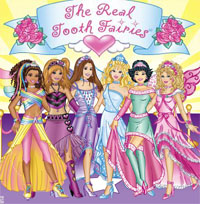
Sign this petition to keep these super-skinny, Barbie-princess clone “Real Tooth Fairies” far away from your child’s developing brain.

realtoothfairy small FINAL

Update: Real Tooth Fairies removed the video from YouTube. Guess they really didn’t want you to see it. Here’s the transcript.

Hey Fox News, here’s some ‘anti-science’ feminism for you

Right after director/ rapist Roman Polanski publicly blames the pill for masculinizing women, the guys at Fox News express related terror about the future of America. A new Pew study reveals that women are now breadwinners in 40% of households.

Jezebel reports:

Fox News contributor Erick Erickson, not one to be outdone, explained that women are naturally submissive because of “biology”:

“I’m so used to liberals telling conservatives that they’re anti-science…When you look at biology, when you look at the natural world, the roles of a male and a female in society and in other animals, the male typically is the dominant role. The female, it’s not antithesis, or it’s not competing, it’s a complementary role.

I cracked up when I watched the video because I was just about to post on Reel Girl this title: “Scientific” studies on gender turn out to be biased, who knew? More on that soon.

If there’s one thing that drives me crazy, it’s trendy evolutionary psychologists and social Darwinists going off incessantly for the last twenty-five years about how everything is the way it is– sexism, racism, white privilege, standards of beauty and on and on– because our biology makes it so.

Bullshit. You can call me anti-science, Fox News Dudes, but evolutionary psychologists went way too far in pinkwashing childhood, inadvertently exposing the roots of ridiculousness buried deep in biogender theory. A few months ago, Elizabeth Sweet wrote a great piece in the New York Times summarizing:

Moreover, expert opinion — including research by developmental and evolutionary psychologists — has fueled the development and marketing of gender-based toys. Over the past 20 years, there has been a growth of “brain science” research, which uses neuroimaging technology to try to explain how biological sex differences cause social phenomena like gendered toy preference.

That’s ridiculous, of course: it’s impossible to neatly disentangle the biological from the social, given that children are born into a culture laden with gender messages. But that hasn’t deterred marketers from embracing such research and even mimicking it with their own well-funded studies.

Sweet goes on to describe the aggressive gender-marketing aimed at children, marketing which starts, by the way, before the baby even exits the womb. When people speak to boy babies in strong voices and female babies in lilting voices, when so much of what we we do and how we act– including parents, teachers, and doctors— is based on cultural expectations of how girls and boys are supposed to be, how can we pretend to be beyond bias?

And then, of course, children grow up. Last week, the New York Times published a lengthy magazine article on female desire which argues previous  “scientific” studies on sex drive show a cultural bias. Turns out women may not be “naturally” monogamous.

A meta-analysis done by the psychologists Janet Hyde and Jennifer L. Petersen at the University of Wisconsin, Madison, incorporates more than 800 studies conducted between 1993 and 2007. It suggests that the very statistics evolutionary psychologists use to prove innate difference — like number of sexual partners or rates of masturbation — are heavily influenced by culture.

Does new science debunk old science? Looks like evidence is showing evolutionary psychologists weren’t so scientific after all.

Can we at least agree on this: we live in a culture that, for thousands of years, has punished women for expressing sexuality while rewarding men. How can we possibly, objectively measure sex drive?

Hypothetically, say men ruled the world, and say that men were also incapable of giving birth. Would it be so surprising for the group in charge to come up with this theory: Every time women have sex with us, they fall in desperately in love. They want to marry us, be with us forever and ever. In fact, getting married is the happiest day of a woman’s life. Naturally monogamous, women will never stray.

Sounds like a pipe dream to me.

Calling it out: Backwards, sexist propaganda of 2013

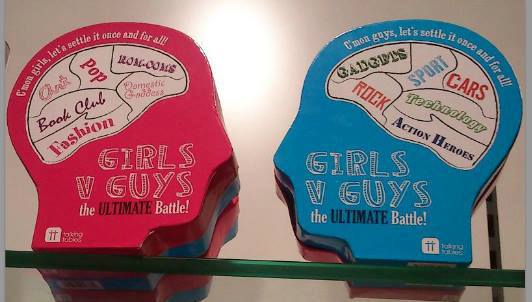
Let Toys Be Toys for Girls and Boys posted this image on its Facebook page:

backwards

This product was seen at the John Lewis store in High Wycombe. Not familiar with this UK institution, I looked it up to find it has almost 650,00 likes.

I imagine the day this product is on display in a museum, an artifact. People will look at it, baffled, not even understanding. Students will study how backwards the world was in 2013, wondering how and why our culture allowed and accepted sexism as if it were okay or funny or normal. Can you imagine a game showing a Caucasian brain battling an African brain along with a bunch of stereotyped categories?

Today, Salon posts: On Facebook, hating a religious or ethnic minority gets you banned, but hating half of humanity gets you Likes.” Women, Action, and Media wrote an open letter to Facebook detailing how pics of breastfeeding women get banned when images of rape don’t.

The latest global estimate from the United Nations Say No to Violence Campaign is that the percentage of women and girls who have experienced violence in their lifetimes is now up to an unbearable 70%. In a world in which this many girls and women will be raped or beaten in her lifetime, allowing content about raping and beating women to be shared, boasted and joked about contributes to the normalisation of domestic and sexual violence, creates an atmosphere in which perpetrators are more likely to believe they will go unpunished, and communicates to victims that they will not be taken seriously if they report.

Here’s an ex-girlfriend shooting target seen at an NRA convention this Spring.

exgirlfriend

Violence against women is epidemic. A first step to abuse is always dehumanizing the victim. Propaganda, in the form of images and narratives, effectively dehumanizes on a mass scale. Here’s some propaganda marketed to kids:

Images/ narratives of Jews circa 1938

nazibook


Africans circa 1931

tin_tin_in_congo11


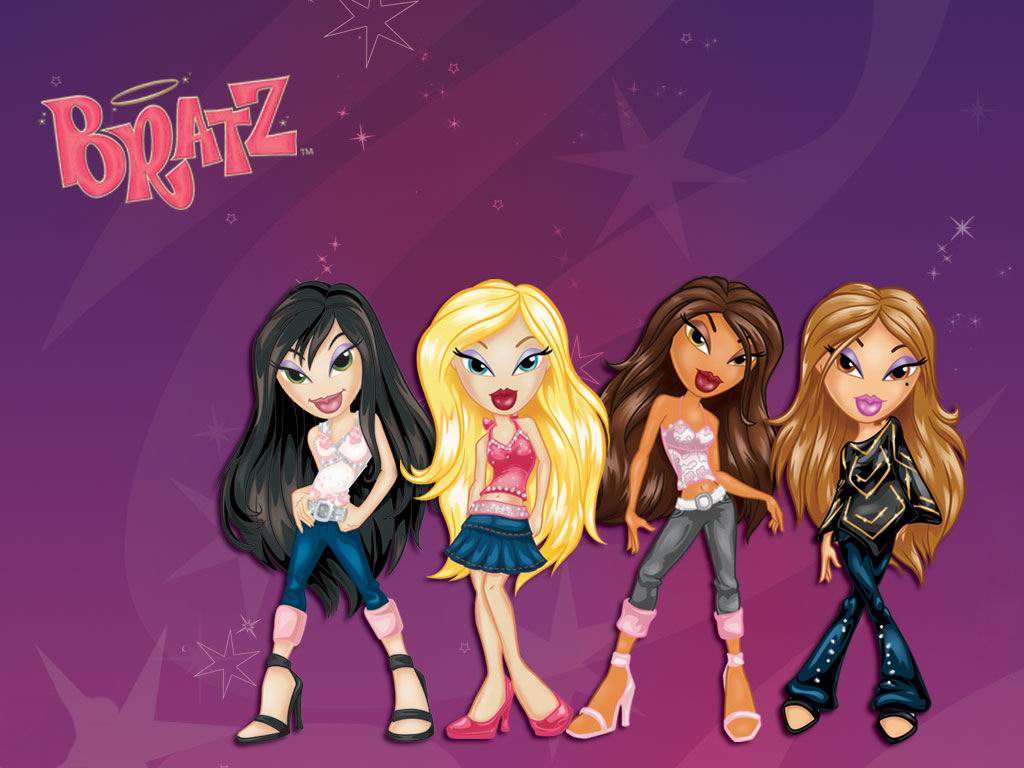
Females circa 2013


bratzwallpaper-source_4cj


It’s easy to look back on history and wonder: How did people ever put up with that? I’d never buy into it. But what are you participating in right now that is completely accepted, not to mention celebrated, by our culture?

meridamakeover

Propaganda works in steps and stages. The product marketed may not be as extreme as a bloody, scantily clad woman, but it’s likely to be a sexualized female, one that is, remarkably, often advertised to kids.

So tell John Lewis to stop selling sexism or join Women, Action, and Media’s campaign and to get Facebook sponsors to stop promoting violence against women or post on Target’s site that you’re not buying its new doll. Please do something for your kids. Take action to end everyday sexism because it numbs all of us to the mass objectification of women.


After massive protest, Disney pulls new Merida from site

Exciting news! Today, Rebecca Hains, blogger and media studies professor, reports:

“As of today, Disney has quietly pulled the 2D image of Merida from its website, replacing it with the original Pixar version. Perhaps we’ll be spared an onslaught of sexy Merida merchandise yet.”

YAY! Check out the link, it’s true! BRAVE Merida is back.

I guess Disney was right to be so terrified of creating a strong, BRAVE, female protagonist (along with Pixar studios which hadn’t had ANY female protags before “Brave.”) It looks like Merida could be turning Disney’s franchise on it’s head. That’s pretty damn heroic.

Another mistake Disney made with “Brave?” They hired a female director. They fired her, but it was too late. Brenda Chapman wrote “Brave” based on her daughter. She was furious with the character’s transformation and wrote publicly about Disney’s terrible mistake.

Of the debacle Hains writes:

That’s right: Although Merida was created by a woman as a role model for girls, the male-dominated consumer product division at Disney has ignored the character’s intended benefits for young girls, sexualizing her for profit. Compared with her film counterpart, this new Merida is slimmer and bustier. She wears makeup, and her hair’s characteristic wildness is gone: It has been volumized and restyled with a texture more traditionally “pretty.” Furthermore, she is missing her signature bow, arrow, and quiver; instead, she wears a fashionable sash around her sparkly, off-the-shoulder gown. (As Peggy Orenstein noted when she broke the news of the redesign, “Moms tell me all the time that their preschool daughters are pitching fits and destroying their t-shirts because ‘princesses don’t cover their shoulders.’” I’ve heard the same from parents, as well.)

Is the sexualized  image of Merida gone for good? Has Disney learned a lesson? Or will that lesson be: No more strong female characters leading a film! No more female directors writing about their daughters! Keep the females weak and quiet!

It’s up to you. This could be a turning point. Parents, please use your voice and your wallet to keep strong, heroic females showing up in narratives and images marketed to your kids. Right now, girls are missing from children’s media and when they do appear, they’re sexualized. This is normal. Not healthy, but tragically, perfectly normal.

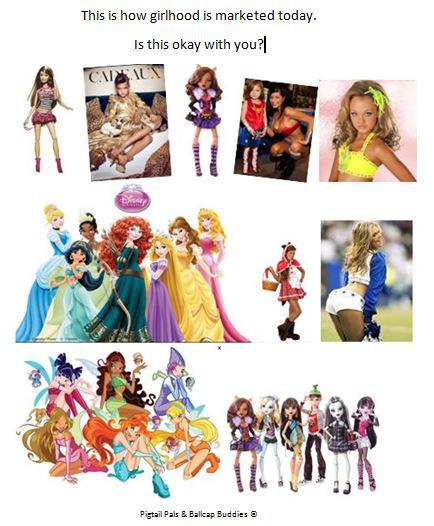
Yesterday, Melissa Wardy posted this image on her Pigtail Pals Facebook page, reminding us Merida’s new image was not created in a vacuum.

pigtails

Objectifying and sexualizing girls is dangerous. A first step to abuse is always dehumanizing the victim. Propaganda, in the form of images and narratives, effectively dehumanizes on a mass scale.

Images/ narratives of Jews circa 1938

nazibook

Africans circa 1931

tin_tin_in_congo11

Females circa 2013

bratzwallpaper-source_4cj


It’s easy to look back on history and wonder: How did people ever put up with that? I’d never buy into it, not to mention expose my child to it. But what are you participating in right now that is completely accepted, not to mention celebrated, by our culture?

Be part of the solution. Demand narratives with strong female characters for your kids.

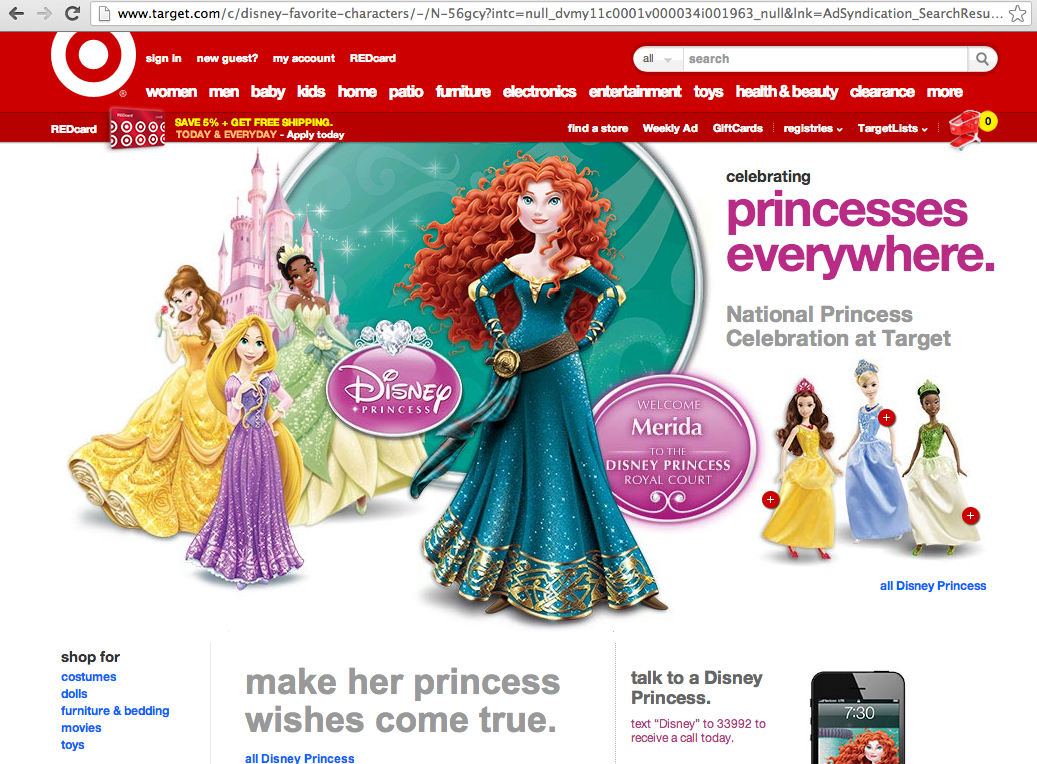
Update: New Merida may be off Disney’s site but she’s showing up all over the place including Target. Below is Target’s web page.

meridatarget


King Fergus of ‘Brave’ demands to know: ‘Where’s my makeover?’

Since his daughter, Princess Merida, made national headlines with her makeover– she’s skinnier with tamed curls, a new off the shoulder gown, and the belt that once held her quiver has morphed into a fashion sash– King Fergus wants to know: “Where’s my makeover?”

"BRAVE"

Fergus says, “It’s not fair. I’m the King! Why are princesses always the ones who get to look pretty? Some would call me fat, hairy, and I’m missing a leg for goodness sake. Where’s my stylist?” Throughout DunBroch, Fergus has posted these before and after pics of Merida:

meridamakeover

Now, King Fergus wants to know:  “Artists, what can you do for me?”

Fergus won’t be getting a makeover because male characters are allowed to occupy a whole range of looks (including rats or planes) and personalities. Male characters aren’t clones. Please sign the petition to Disney: “Say No to the Merida Makeover, Keep Our Hero Brave.” (100,000 signatures and counting!)

Thoughts that come with Dove’s footsteps by Melissa Duge Spiers, guest post

Perhaps I am the wrong person to open this discussion, because I was raised in a house where being beautiful (if you were a girl) was everything – I was dragged from under my bed as a 6-year-old, kicking and screaming, so that my “ugly” straight hair could be permed.  I was the only pre-teen I knew who was forced to wear makeup.  And I existed on air-popped popcorn throughout high school because I dreaded being withdrawn from school and put on a liquid diet until I lost weight like a friend of mine.  I grew up to make my living for a while from my looks, modeling and acting.  So it would be silly to claim I don’t carry some baggage about beauty, and I won’t even try. 

makeup_set

But I’m going to throw my hat into the ring anyway on the latest movement to redefine beauty, to make it more inclusive, to tell every woman she’s beautiful (yes, Dove, that’s you…and so many more).  I hate it.  I absolutely detest it.  Why?  Because even the most well-intentioned, politically correct, supportive, inclusive statements and movements can still be boiled down to this:  beauty is all important. 

The traditional wisdom – from my grandmother’s era – was a terse “if you’re not beautiful, cultivate a great personality, be the smartest, wittiest person in the world, be charming, develop great talents.”   This seems outrageously offensive in today’s era, yes?  It puts beauty in a removed and superior category which excuses the lucky ‘owners’ from doing anything else on that list (plus it reinforces the tired dichotomy of smart/witty/talented vs. beautiful).  As much as we sincerely applaud the use of larger-sized models and real women in these new campaigns, the honest truth is: nothing has changed.  We are still saying beauty is the defining item in women’s lives.  We’re just screaming for an expanded definition.    

If you take out the words “beautiful” and “ugly” in the widely celebrated, empowering “Everyone’s Beautiful!” campaigns and you substitute  the words “white” and “black” or “straight” and “gay” you begin to see how thoroughly stupid it is to waste time trying to define (or redefine) “beauty.”  Go ahead, try it:  “Everyone’s white! You’re white just as you are!” Or  “We just need to redefine straight to include all humans! Everyone’s straight!” 

It suddenly seems ridiculous (not to mention condescending), doesn’t it? These well-intentioned feel-good anthems really just posit beautiful (or white or straight) as the goal, as the “best” option, as the ultimate compliment/inclusion/approval.  Think I’m exaggerating? I can guarantee that someone in response to this article will think the most insulting, awful comment they can summon is “you’re just a jealous, fat, ugly dyke!”  But it’s not just those haters – it’s the advertisers, it’s the lawmakers, it’s the population, it’s each and every one of us.  We all keep thinking that telling women and girls they’re beautiful is the answer, as long as we adjust the definition to include everyone.  But we’re all still holding it up as the holy grail, the pinnacle of achievement, the most important thing they can be. 

curlingiron

You know, my mother thought straight hair was disgustingly ugly (a fact she will still tell anyone to this day).  As a child, did I wish she would open her beauty boundaries, recalibrate her metric, until it included my stick-straight strands?  That would have saved me a lot of tears and chemical burns on my scalp, sure, but really I just remember fervently wishing she would stop focusing on my damned hair so I could go outside and swing on the monkey bars.  Did my young friend wish her parents would say “honey, a few extra pounds are beautiful!” Not at all.  She felt nearly the same shame and humiliation whether they praised her weight loss or put her on a diet.  She simply didn’t want them or anyone else to discuss her body, in any way, good or bad – it was mortifying.  She just wanted to be riding her horse.

Each one of us – me, you, Dove, everyone – needs to stop trying to expand our precious definitions  (“beauty is valued, so we need to make sure everyone feels beautiful!”) and figure out why (and if) they’re important to define at all.  Everyone should be accepted and given equal consideration and rights, even if we’re not all straight, we’re not all white, and we’re not all beautiful.   Who cares? Let’s  cultivate our talents, our charm, our smarts, our personalities.  And then let’s run out and swing on the monkey bars.

 “Thoughts that come with dove’s footsteps guide the world.” – Friedrich Nietzsche

Melissa Duge Spiers is a writer whose work has appeared in Adventure Sports Journal, Vermont Sports, and The Monterey Herald, among other publications. She is working on her first novel. A graduate of Barnard College, she lives in Santa Cruz, CA with her husband and four children.

Read Melissa Duge Spiers previous posts on Reel Girl: “ChapStick sticks it to women” and “No comment! A commentary on the ChapStick story.”


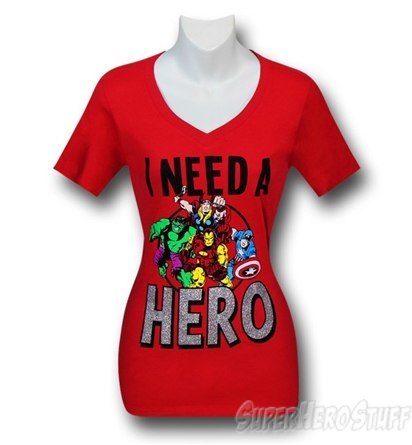
Marvel markets sexism with Avengers T-shirts

Just saw Marvel’s sexist T-shirts on the Huffington Post (there’s some link to Reel Girl but I can’t find it?)

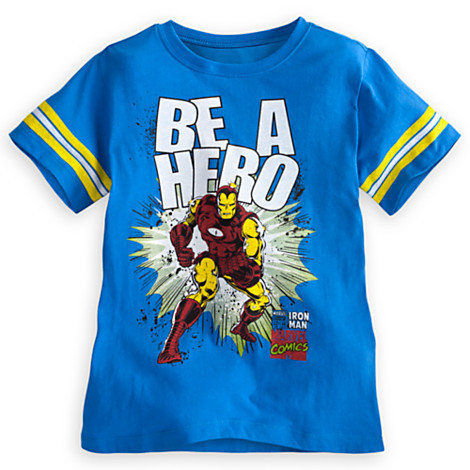
Marvel’s T-shirt for boys.

original

Marvel’s T for girls.

girls

Argh!

This sexism, by the way, goes beyond the specific imagery of a superhero. “Be a hero” translates to “act, take risks, make choices. “I need a hero” means “I’m a minor character. I’m passive, and I wait.”

See the difference?

The insidious problem with this stereotyped gender casting is that women are constantly sidelined and marginalized, remarkably, in the roles they play in their own lives. Females are cast in the supporting role, defined by their relationships as girlfriend, wife, mother, or helper. This sexist narrative has been going on for a long, long time, and we keep recycling it. I just saw this Virginia Woolf quote Tweeted by Bitchflicks:

And I tried to remember any case in the course of my reading where two women are represented as friends…They are now and then mothers and daughters. But almost without exception they are shown in their relation to men. It was strange to think that all the great women of fiction were, until Jane Austen’s day, not only seen by the other sex, but seen only in relation to the other sex. And how small a part of a woman’s life is that.


How small a part! But who would ever guess from looking at how women are depicted in the media– movies, TV, books, advertising– in 2013? Ironically, and this is what is so fucked up and twisted, females get to exist, get to play a part at all when they are sexualized and marginalized.

“Avengers” has the classic Minority Feisty ratio of 5 male superheroes to one female. As artist Kevin Bolk illustrates, the lone female is highlighted by her ass.

avengers

What is the solution to this sexism? Be a hero. Women, write your own stories. Make your own art. No one else can do it for us.

Update Here’s a comment from Nick:

The solution is not only for women to write their own stories, but for men to understand why this is sexist. There is a dearth of great female superheroes, and when they exist, they usually suffer from the Women In Refrigerators trope, where they die or lose their powers not doing something heroic, but assassinated while cooking in their kitchen, sometimes horrifically placed in the refrigerator, where the trope’s namesake comes from.

The solution has to be EVERYWHERE. Men and women alike should write compelling female superheroes. Some men don’t understand why Women in Refrigerators or Damsel in Distress tropes are inherently sexist, so education on this is also key.

For my part, I read up on feminist blogs like ReelGirl and watch Anita Sarkeesian videos (and the reaction videos, because she is very one-sided). I try to avoid making the same mistakes as other writers when dealing with women. I don’t ever assume I can write a compelling female character, I always question myself and I always push myself to do better.

I think that’s another good answer to this problem – each of us individually pushing the status quo.

And my response:

Hi Nick,

Totally agree the solution has to be everywhere. Thanks for this comment and for the thought and research you put into writing female characters.

Margot


Obviously, it’s a sexist world out there, and when women make art, it’s often ignored or marginalized. It would help if women were running the major Hollywood studios or had the funds to bankroll those studios, not to mention lead the prestigious organizations and comprise the boards that give awards to “great” artists.

That said, women need to keep writing and creating. Making art is risky and dangerous, engaging in the process is being a hero. Persevering is especially challenging when your work gets dismissed and rejected because stories about women aren’t valued. But, even with all of this against us, women must put our stories and visions out there. I really believe this is the only way we’ll ever achieve full gender equality.

Here are a couple posts I wrote on the issue of women making art: What if Van Gogh took Prozac? and Why aren’t there more women artists?

Update Miss Representation started a petition against these shirts. I signed and hope you do too.

Girls are as self-centered as all kids

Girls are not born more open-minded or altruistic. Girls read stories about boys and watch movies about boys because they are trained to. (Thank you, PBS. Please see my last post.)

Doesn’t every psychologist and teacher tell us that kids need to be “mirrored?” To create healthy self-esteem, parents aren’t supposed to project their own opinions on to little kids, but reflect what the kid expresses: “You are lifting the box! You’re smiling!” etc.

So why do the “experts” forget mirroring when it comes to gender? Why do we show our kids a warped, stereotyped mirror and then exclaim, “Look at that, girls just love princesses!” Girls want to see girls. They are just as self-centered as all children are. Unfortunately, in kid world, representations of females are severely limited. They will take what they can get.

There’s a positive side to this. We can train all kids to stay open to diverse stories by exposing them to all kinds of protagonists. Please read your kids books, show your kids movies, tell your kids stories and help them write their own, do imaginary play featuring strong female characters. It will help their brains grow not to mention their self-esteem.

reelgirl2.gif

When girls go missing in children’s media, a new generation learns to accept sexism

I posted a comment on Reel Girl from 14 yr old Jessica who wrote about how when she calls out sexism, people say she’s bonkers. A 13 yr old replied to her:

You are definitely not alone or bonkers! In fact, you are intelligent enough to know that sexism is still present in our society. I am 13 and I share the same experiences with you! I never tried to advocate feminism openly in public because I know how ignorant, oblivious , and stubborn people are that they would not accept the truth, or flatly deny the existence of sexism. I would have had the courage if there was such a thing such as a feminist campaign club in my country. At least my sister and all of you here understand sexism!


It makes me so mad and frustrated that neither of these girls, 30 years younger than me, feels like she has a public voice to tell her story. I am happy that they wrote on this blog, and I hope that they will continue to write and refuse to believe that the sexism they experience in their world is trivial and doesn’t matter.

If this isn’t sexist:

M&M_spokescandies

And this isn’t sexist:

Rice-Krispies-Box-Small

And this isn’t sexist:

arthur1

Is this sexist?

obama2

This photo of Obama’s inner circle is from the March issue of Vogue magazine.

When girls go missing in children media, it acclimates a whole new generation to expect and accept sexism. It’s an annihilation of half of the population. So why do parents accept sexism in a fantasy world created for children? When did it become normal to us? And why are teenage girls afraid to talk about what they see?