14 yr old girl writes when she calls out sexism, people call her bonkers

I get a lot of people telling me the issues that I blog about are stupid, irrelevant, or don’t exist at all and how miserable my children must be to have me as a mother. Then, once in a while, I get a comment like this from Jessica. Thank you, Jessica! You rock.

Hello, I’m only 14 but I’m just commenting here to express how so so so grateful and relieved I am to FINALLY find out that I’m not the only one who pays attention to all the sexism that is really all around us, even when everyone else I know thinks I’m over reacting and have gone bonkers. Especially people my age.
Whenever my little sister turns on the TV to watch cartoons, I can’t help but start counting how many female characters there are, yet only to groan in frustration afterwards because there are always more male characters. And the main characters are never females. That is, unless the show’s target audience are girls.
Or whenever I read a book, or watch a movie. It’s always the same. Always.
Even the fact that we’re supposed to use our Dad’s surname as our own, instead of our Mom’s.
I feel truly angry about all this. I wish there were something I could do.
Yet I’ve learned keep it to myself, because whenever I tell someone, anyone, they just roll their eyes like I’m crazy. I’m just a stupid little girl. No one takes it seriously. No one takes ME seriously But they should. Because all this has to change.
It’s really sad how other girls/women don’t even seem to care. I honestly don’t understand. How could anyone think that sexism is “gone”?!
Anyway, I’m so grateful that I have found this blog. Thank you so much. I’m sure you are a very, very good mum.

Thank you again,
Jessica

Don’t think sexy M & Ms are marketed to kids? Remember Joe Camel?

If you’re going to argue that kids aren’t the market for M & Ms’ sexist ads, children are attracted to animation. You can debate whether that’s natural, conditioning, or a mix of both, but anyone who has a child knows her eyes go to cartoon characters like a magnet. That’s why the U.S. government banned Joe Camel.

joecamel

If a company is going to use cartoon characters to sell products, not to mention a self-described “family brand” whose product is candy, it should take the responsibility not to promote sexism in its advertising. That’s bad for kids. This mom won’t be buying any more M & Ms. I hope you join me.

Please Tweet or go to M &Ms Facebook page #NotBuyingIt

M & Ms tells customer it’s a ‘family’ brand

Check out this post from a customer on M & Ms’ FB page:

I’m sorry, but I’m confused… Yesterday I received an e-mail from you stating that you could not print my message of “Effing Luv U” on my personalized order for a Valentine’s gift for my husband due to the “family-nature of your brand.” But the family-nature of your brand supports advertisement such as this!? MY order was for my husband only, not an advertisement for millions to see.

An adult woman is not permitted to send a sexually suggestive message to her husband, but this ad is appropriate for the ‘family-nature’ of the  M & Ms brand?

swimsuit

Or this?

mmgreen

Or this?

sportslastyear

Or this?

msshell2

M&Ms’ hypocrisy reminds me of Miss America contestants getting punished when nude photographs are discovered, public breast-feeding banned as obscene, or Howard Stern complaining about Lena Dunham’s nudity on “Girls.” Sexuality is widely accepted in our culture in specific and contrived ways that are often degrading to women. Selling gender stereotypes to kids is what a “family-brand” should refuse to do.

If you’re going to argue that kids aren’t the market, children are attracted to animation. You can debate whether that’s natural, conditioning, or a mix of both, but anyone who has a child knows her eyes go to cartoon characters like a magnet. That’s why the U.S. government banned Joe Camel.

joecamel

If a company is going to use cartoon characters to sell products, not to mention a self-described “family brand” whose product is candy, it shouldn’t promote sexism in its advertising.That’s bad for kids. This mom won’t be buying any more M & Ms. I hope you join me.

Please Tweet or go to M &Ms Facebook page #NotBuyingIt


M & Ms sells sexism to kids

When tobacco companies used a cartoon camel to sell cigarettes to kids, the U.S. government stepped in to stop the manipulation.

joecamel

When M & Ms uses extreme gender stereotypes to sell sexism to kids, it’s supposed to be funny. Here’s the back cover of the 2013 swimsuit issue of Sports Illustrated.

swimsuit

If M & Ms used a marketing campaign based on racial stereotypes, would we think it was funny? Apparently not. There’s an uproar about SI using people of color from all around the world as fashion props. That’s offensive and gross and so is this: Ms. Green getting stalked ha ha ha.

coconut-mms1

The first anti-stalking law wasn’t passed until 1990 and the crime is still only slowly gaining recognition and credibility as a serious infraction. Stalking hurts females: 4 out of 5 victims are women. Obviously, M & Ms still thinks a dangerous situation is a joke.

Here’s Ms. Green “working the polls.”

mmgreen


Here is Ms. Green at Party City, where my daughter and I went shopping for her birthday celebration.

partycty

When I went on M & Ms Facebook page to complain, I saw this picture of Red.

red

Wow. Talk about gender stereotypes. Not even “Mr.” Red?

Please Tweet: “M & Ms Stop selling sexism to kids #NotBuyingIt”

Please go to M & Ms Facebook page and ask them to stop selling sexual stereotypes to children.

SI swimsuit issue has new pic for M & Ms Hall of Shame

Here she is, sexy Ms. Green, as seen on the back cover of Sports Illustrated’s 2013 swimsuit issue.

swimsuit

Jezebel describes the image:

It’s a lot like the front cover, which features Kate Upton standing in freezing Antartica in nothing but undies and an unzipped winter coat (fun fact: this almost killed her), only instead of a busty lady, the ad features a sexy M&M peeling off her shell.

Here’s Ms. Green on last year’s back cover of SI:

msshell2

Here’s another image promoted with SI:

sportslastyear

Here’s the winner of the M & Ms Hall of Shame, the S & M M & M “working the polls.”

mmgreen

Here’s Ms. Green getting stalked, ha ha ha.

coconut-mms1


Here’s Ms. Green at Party City where my daughter and I went shopping for her birthday party.

partycty

Ms. Green is one of two female M & Ms alongside 4 male M & Ms. The male M & Ms wear sneakers and act goofy. The females M & Ms wear heels and act sexy.

mcharacters1

This male-female ratio is the same old Minority Feisty pattern we see all over kids media but the sexualization of Ms. Green is extreme, even for the run-of-the mill sexism in kid world.

Please go to M&Ms Facebook page and ask them to stop sexualizing female M & Ms. Ms. Green is everywhere. Our kids deserve more than to see females depicted in this stereotyped and degrading way.

Clothed men, naked women: a retropsective

I have an idea for a themed art show that could travel the museums of the world: “Clothed men, naked women: a retrospective.” How many galleries and halls do you think would overflow?

I just posted about repetitive gender imagery in “riding bitch,” where the female is shown behind the male on a bike, animal, imaginary creature etc. This sexism is persistent in depicting a fantasy world marketed to children. Amazing how the imaginary world is just as sexist as the real one, huh? Wonder how that happens…

Lynley Stace linked to one of my posts, and that’s when I saw Nick Cave’s new CD cover on her blog.

nickcave-pushtheskyaway

Stace writes:

As one woman commented on Facebook, this image is problematic because it depicts a naked woman opposite a fully-clothed man (in a suit, no less). The woman looks upset or humiliated because her face is covered and Nick Cave looks as if he’s ordering her to go to her room (i.e. he is treating her like a child).

What I would add to that comment is that the woman, judging by her youthful body, is much younger than Nick Cave. Nick Cave is currently 55 years old. That female body looks under 30. So the power is with Nick Cave in every possible respect.


Also, check this out. The image is getting as much traction as Cave can get out of it. Stace writes: “Also, the album cover isn’t JUST the album cover. Turns out this image is being used for general promotional advertising.”

advertising

I used to be a fan of Cave. No more. What really gets me is when you look at this image, you can feel how radical and cool Cave thinks he is.

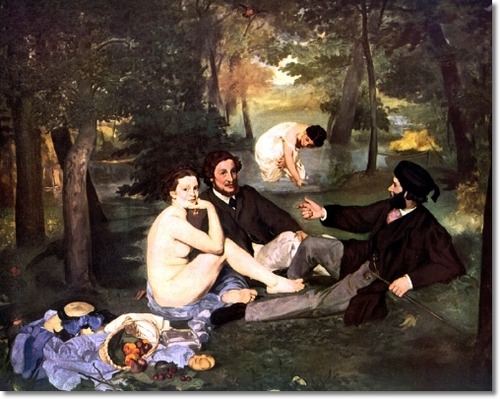
Hey, Nick, it’s been done. Throughout history, again and again. Here’s a version from Manet:

manet

GQ:

gq

Vanity Fair:

scarlett-johansson

I could fill my entire blog with these images. Cave, you’ve lost your originality and you’re showing your 55 years. You’ve become a copy cat, a cliche, and no more an avante-garde artist than Larry Flynt was a proponent for free speech.

#NotBuyingIt

and if you agree,

Please Tweet: Nick Cave’s Push Away the Sky been there, seen that and #NotBuyingIt


Riding Bitch: new images

More than any other pattern of sexist imagery in the fantasy worlds created for children, I hate the girl on the back of the bike, dragon, or hippogriff. Recently, I posted:

This image of male driving and the girl along for the ride is ubiquitous in the imaginary world. You almost never see a girl in front and a boy behind, or even a girl alone, and also, it’s extremely rare to see a girl on a female magical creature.

After my post, Orlando wrote in this comment:

Shall I share with you the moment when I learned to loathe Kerouac? This is it (from “On the Road”):
“In the empty Houston streets of four o’clock in the morning a motorcycle kid suddenly roared through, all bespangled and bedecked with glittering buttons, visor, slick black jacket, a Texas poet of the night, girl gripped on his back like a papoose, hair flying, onward-going, singing.”
Familiar image? What happened was two people went past; what they saw was one person plus accessories.

The Kerouac quote pretty much epitomizes the poetic subjugation of women in that repetitive image (coupled with the the adventurous title of the book, of course.) Kerouac is such a good writer and he does this image so well. And again, the image/ narrative would not be a problem if it were one of many; it is its dominance over our imaginations, the way other narratives have become restricted and repressed, even in fantasy, that is the tragedy.

I’m going to keep a running tally on Reel Girl of images normalizing what I learned is called “riding bitch.” Please let me know if you see any and PLEASE let me know if you see the reverse gender positions.

Two recent disappointments:

tinalois

I was very bummed to see the usually feminist Studio Ghibli put out this image to promote “From Up on Poppy Hill”

poppyhill


When females direct, female nudity advances the plot

On Salon, Daniel D’Addaro writes:

In the run-up to Sunday night’s “Girls” season premiere, the old repetitive war over the show’s content took on a new dimension: Radio shock jock Howard Stern attacked neither the youth nor the perceived entitlement of showrunner/star Lena Dunham, but her display of her body. Stern called Dunham “a little fat girl who kinda looks like Jonah Hill and she keeps taking her clothes off and it kind of feels like rape … I don’t want to see that.” New York Post TV critic Linda Stasi took a similar tack, calling Dunham “a woman with giant thighs, a sloppy backside and small breasts … compelled to show it all.”

In trying to figure out why so many are offended by Lena Dunham’s nudity, D’Addaro interviewed people from editor Jane Pratt of xoJane (“It may not be that she’s driven to show us her body however that body looks. It may be that it’s just part of the story line”); to SF nude activist Gypsy Taub (“Nudity in our society is associated with sex, and a nude woman is automatically considered a ‘slut’ and someone who is asking to be disrespected or raped.”)

dunhamphone

In an interview with Metro on January 8, director Sarah Polley expressed what appears to be a similar view on female nudity to Dunham’s. Here’s the question and response:

There’s a scene featuring a forest of female pubic hair: a bunch of women showering at the gym. We don’t see that much in Hollywood films. I know. Women’s bodies in films are either highly objectified and sexualised or, past a certain age, made fun of. In North American films, there’s no sort of routine nudity so I wanted something that wasn’t particularly eventful for them in that moment.

polley

Famous art critic John Berger said: “Men watch. Women watch themselves being watched.” In Hollywood,  over 90% of directors are male. We’ve all grown up saturated with those images. Could it be that all of us, women and men, have almost no idea what women look like through women’s eyes or from the perspectives of women’s experiences? What does that vantage point show us? Anyone know? Hopefully, more female directors will get the courage and opportunity to give us their best guess.


Crimes against women buried in reporting of world news

So here is post #5 picking on the New York Times for its sexist reporting of the rape of Jyoti Singh Pandey.

Nicolas Kristof’s column made me think of the excellent book that he wrote with his wife, Sheryl Wudunn, Half the Sky. The thesis of that book is that “in the 19th century, the paramount moral challenge was slavery. In the 20th century, it was totalitarianism. In this century, it is the brutality inflicted on so many women and girls around the globe: sex trafficking, acid attacks, bride burnings and mass rape.”

So obviously and sadly, Kristof and Wudunn are two of the few to recognize that stopping violence against women needs to be the highest priority.

But here is what I was thinking of specifically: Wudunn and Kristof are Pulitzer prize winning journalists, and they wrote Half the Sky because they were shocked by how stories about men were consistently on the front page while stories about women were invisible:

A similar pattern emerged in other countries. In India, a “bride burning” takes place approximately once every two hours, to punish a woman for an inadequate dowry or to eliminate her so a man can remarry — but these rarely constitute news. When a prominent dissident was arrested in China, we would write a front-page article; when 100,000 girls were kidnapped and trafficked into brothels, we didn’t even consider it news.

And by the way, they are talking about front page news in the American publications that they worked for.

Refusing to print Jyoti Singh Pandey’s name is another way to keep her invisible.

I’ve got to ask, one more time: Why is it acceptable for the New York Times to follow India law in how it reports the facts about crimes against women?

Please read “The ‘Shame’ of Rape” a piece I wrote for Salon about the U.S. media’s sexist coverage of crimes against women.

Kristof writes column and my new comment gets posted underneath!

The bad news is the NYT still hasn’t posted my comment on its sexist coverage of the rape of Jyoti Singh Pandey in India. The good is that Nicolas Kristof, one of the world’s greatest modern feminists, wrote an amazing column for Sunday’s NYT: “Taking Violence Against Women Seriously:”

Gender violence is one of the world’s most common human rights abuses. Women worldwide ages 15 through 44 are more likely to die or be maimed because of male violence than because of cancer, malaria, war and traffic accidents combined. The World Health Organization has found that domestic and sexual violence affects 30 to 60 percent of women in most countries.

In some places, rape is endemic: in South Africa, a survey found that 37 percent of men reported that they had raped a woman. In others, rape is institutionalized as sex trafficking. Everywhere, rape often puts the victim on trial: in one poll, 68 percent of Indian judges said that “provocative attire” amounts to “an invitation to rape.”

Americans watched the events after the Delhi gang rape with a whiff of condescension at the barbarity there, but domestic violence and sex trafficking remain a vast problem across the United States.


That’s just a couple graphs. You should read the whole thing, its all so important.

No comments taken there, but Kristof invites you to go to his blog “On the Ground” to post comments. There, he writes a few graphs ending with:

Then on top of all that, I’ve been thinking of the events in Steubenville, Ohio, in which football players allegedly carted a comatose 16-year-girl around and raped her, possibly even urinated on her. We’ve got so much work to do right here at home — and Congress can’t even bother to renew the Violence Against Women Act or the Trafficking Victims Protection Act! Grrr. Read the column and post your thoughts.


In case you’re not familiar with the Violence Against Women Act, it was just stalled in congress, by the good old government of the USA, because violence against women isn’t a problem in America, right? Here are some stats from the National Coalition Against Domestic Violence:

One in four women (25%) has experienced domestic violence in her lifetime.

85% of domestic violence victims are women.

Women ages 20-24 are at the greatest risk of nonfatal intimate partner violence.

Nearly three out of four (74%) of Americans personally know someone who is or has been a victim of domestic violence.

On average, more than three women are murdered by their intimate partners in this country every day.

Domestic violence is one of the most chronically under reported crimes.

I think it’s interesting that Kristof invites you to go to his blog if you want to comment. It looks the same as the NYT site in many ways, but I wonder if there’s a different procedure for comment approval? On the blog I posted this comment which got approved, basically the same as the first as best as I can recall:

Hi Mr. Kristof,

I was shocked to read in the NYT a post on this story from Jan 11 (http://www.nytimes.com/2013/01/12/world/asia/for-india-rape-victims-fami… Jyoti Singh Pandey’s name is not printed. The NYT explains this:

“The daughter — whose name is being withheld because it is illegal to name a rape victim in India without permission from the victim or her next of kin — showed as a very young girl a love for school, her father remembered.”

Why would an American publication follow Indian law on how to report on rape? At what other time does a country’s laws dictate how its news is reported in The New York Times? Especially when the US media keeps calling India sexist, unlike us. Why would an American publication follow India law in how it reports a crime? If this law referred to political dissidents from India, would the New York Times refuse to print their names?

Not only that, but days earlier, Jyoti’s father told the Mirror: “We want the world to know her real name,” says Badri Singh Pandey…“My daughter didn’t do anything wrong, she died while protecting herself. I am proud of her. Revealing her name will give courage to other women who have survived these attacks. They will find strength from my daughter.”

I commented on the NYT piece but my comment has not yet been approved. I blogged about it here: http://reelgirl.com/2013/01/dear-new-york-times-her-name-is-jyoti/


Why am I going on and on to you about one damn comment? Because so much of the issue here is that women don’t get a name, a voice, or space to tell their own stories, and that issue is what this blog, Reel Girl, is all about.

The NYT has posted my comments before and posted a similar comment to mine, from Ann, who I just found out, went to the NYT from Reel Girl. So what’s the big deal?

If one person makes the comment, its better than no one making it, but it would have more impact if people were allowed to see that many others responded in a similar way.

What the New York Times did– censoring the identity of a victim of a crime because India law requires that– is not only disgraceful but harmful to women. I am shocked that the NYT would not only capitulate to India law in its reporting of a crime, but to go ahead and state that it did, as if that were perfectly OK. It’s not OK. Can you imagine if American publications always followed the laws of the country they were reporting on when stating the facts of a crime? What kind of news would we have?

If crimes against women are treated this way, as if its acceptable, violence against women will never stop.