Dear Stride Rite, until you stop gender stereotyping, we’re through

Dear Stride Rite,

Today, I walked by your store on California Street in San Francisco, and I was saddened by how differently you market shoes to girls and boys. What’s with your gender stereotyping? I don’t get it. Aren’t girls and boys feet pretty similar? Don’t all kids need shoes where they can be active? Please tell me why Stride Rite markets shoes to little kids as if girls and boys are completely different species. As author Rebecca Hains writes, according to Stride Rite, girls are pretty and boys are active. This kind of gender stereotyping limits all kids.

Here’s the huge poster selling shoes to girls in the window of the San Francisco store.

girlsssss

According to Stride Rite, girls like pink, purple, sparkles, and princesses.

Here’s your poster selling shoes to boys.

boy

Boys are powerful. They like orange, blue, red, yellow, and black.

The shoes displayed below the girl poster are also– surprise, surprise– pink, purple and sparkly. The shoes displayed below the boy poster feature Spider-Man and Captain America shoes.

fullphoto

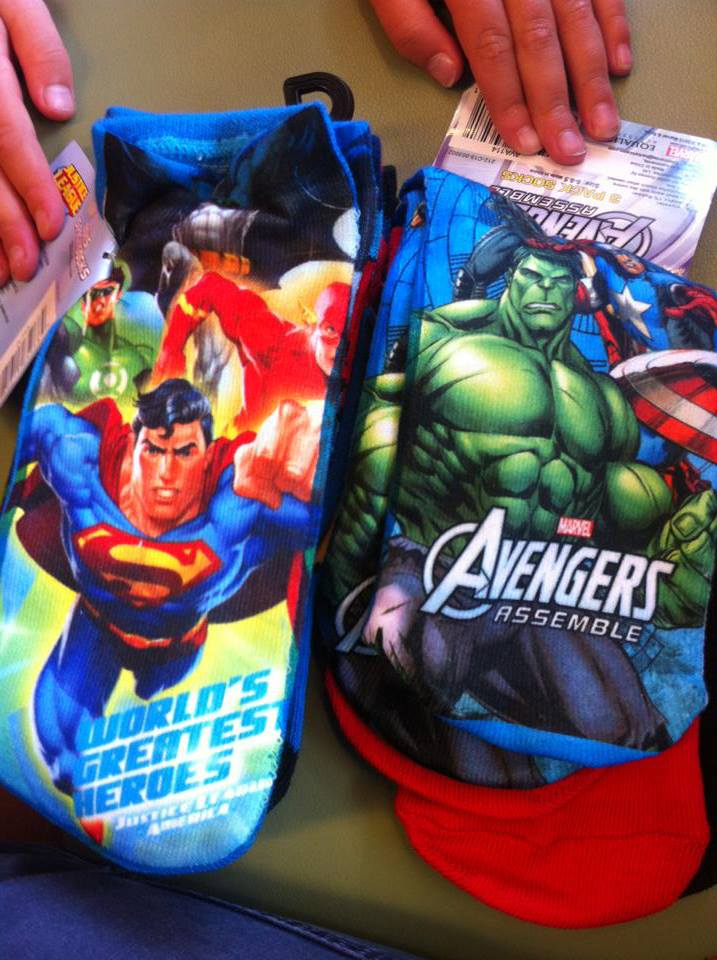
Where are the female superheroes at Stride Rite? Not on the socks you sell. Those are my daughter’s hands in the picture. She was looking for Wonder Woman.
socks

Apparently, Wonder Woman isn’t one of the world’s greatest superheroes. Isn’t she a member of the Justice League? Where’d she go? What about Black Widow? Why has she gone missing from the Avengers Assemble? And while we’re looking for MIA powerful females, where’s Leia with her lightsaber? Why isn’t she part of the Stride Rite Star Wars shoes marketing plan?

Here are my three daughters ages 4, 7, and 10 wearing Stride Rite shoes.

kids

Unfortunately, we will no longer be shopping at Stride Rite.The way you guide girls to one side of your store and boys to the other is manipulative and destructive. My youngest child chose her orange shoes from the “boy” side, but every year, my kids get more influenced by marketing such as yours. Their choices become more limited as they repeatedly see that girls are supposed to be so radically different than boys, only wear certain colors, and behave in a certain “feminine” way. For as long as I can, I hope to protect my kids from learning that boys are valued for what they do, while girls are valued for how they appear. That means not shopping at Stride Rite.

Sincerely,

Margot Magowan

Please go to Stride Rite’s Facebook page to tell them to stop gender stereotyping.

Update: On Reel Girl’s Facebook page, Lizards and Lullabies posted this email just received from Stride Rite. Guess they’re working hard to snag back to school shoppers. Makes sense, that’s why my family went shoe shopping.

prinesswishes

I couldn’t click on the commercial link so I went to You Tube. Ugh, it’s really awful.  As one commenter Tweets:

wish like a princess? They’ve found a way to make a princess EVEN MORE passive!

Here’s the ad:

Update: This comment, posted on Pigtail Pals Facebook page, makes me so frustrated. Diana got way more than a confused look from the sales associate when her daughter dared to step beyond gender limits at Stride Rite:


“We just went into a Stride Rite store for my 4yo daughter and she was drawn to the “boys” side with the Spider Man shoes. The sales associate actually stopped her and said “Oh honey, those are for boys. Let’s get you something prettier over here.”
I told the sales associate that she was free to pick a shoe from whatever side she wanted and that pretty wasn’t defined by pink, purple and glitter, nor was it the only quality we wanted in a sneaker.
We walked out with Spider Man sneakers that light up and are awesome. I did mention to the woman that while we appreciated her friendliness, we did not appreciate her gender stereotyping and making my daughter feel like she shouldn’t be excited about black, red and blue shoes with eyes that light up.”


And one more thing, while I’m here. All that “pretty,” shiny stuff on girl’s shoes gets scuffed up and falls off pretty fast. When it does, parents are likely to buy kids new shoes, which is great for business and also, creating lifetime consumers. Check out this post: Are girl’s shoes designed to disintegrate?

 

‘When the worst thing we say to a boy is he throws like a girl, we teach boys to disrespect the feminine and disrespect women’

I’ve blogged twice about the sexist preview for “Planes,” and after seeing the movie today, I’m afraid I’ve got to blog about this awful scene once more. The sexist scene actually opens the movie. It sets the tone for the whole film, which is the opposite of what I thought the scene was going to do. When I saw the preview, I thought the plane who mocks the slow flyers by calling them “ladies,” was having a moment of arrogance. The movie would redeem him when he went through his transition. But I couldn’t have been more wrong. The sexist joke is his fantasy, the fantasy of a humble crop duster with a fear of heights who wishes he were a racer. The scene is sexism in fantasy world in sexism in fantasy world. Isn’t that meta? It’s the dream sequence of a “likeable” character. Can you imagine a hero making a racist joke and being likeable? In a movie for little kids? Yet, that’s how much sexism we have to wade through before females are allowed to win a race in animation. Here’s the text/ preview, all voices are male:

Plane One: What’s taking this guy so long? Is he really as good as he says he is?

Plane Two: No, better.

Plane One: Whoa! Who was that?

Plane Three: (Descending fast on top of the other two) Well, hello ladies! Ready to lose?


Plane Three goes on to leave the “ladies” in the dust.

Today, in the New York Times, Frank Bruni writes about his discussion with Chris Kilmartin, author of “The Masculine Self.”

“We start boys off at a very early age,” Kilmartin told me during a recent phone conversation. “When the worst thing we say to a boy in sports is that he throws ‘like a girl,’ we teach boys to disrespect the feminine and disrespect women. That’s the cultural undercurrent of rape.”

“Planes” teaches kids just that, and that’s only the beginning of the movie.

Following the sexist fantasy in “Planes,” the narrative progresses exactly as “Turbo” does, the movie for kids that came out just a few weeks ago. Dusty, the male protagonist of “Planes,” is told by his friend he’ll never be a racer: “That’s not what you’re built for.” This is the same conversation Turbo has with his brother who tells him that because he’s a snail, he can’t race. But guess who proves the naysayers wrong, that the hero can do anything, soar to the highest heights, be brave, courageous, and make his dreams come true? Unless, of course, he happens to be a “lady.”

Today, if you see a movie for children, it will most often have a male protagonist, while females, who are, in fact, half of the kid population, are presented as if they were a minority. Within that minority, there will be a strong female or two who reviewers will invariably call “feisty.” I call these characters the “Minority Feisty.” The trope has evolved from the Smurfette principle in that there is often more than one, and she is presented as strong. But rarely is she the protagonist. Her power, lines, and screen time are carefully and consistently circumscribed to show that she is not as important as the male star. Still, the Minority Feisty is supposed to pacify parents, making them feel that, unlike those sexist films of yesteryear, this movie is contemporary and feminist.

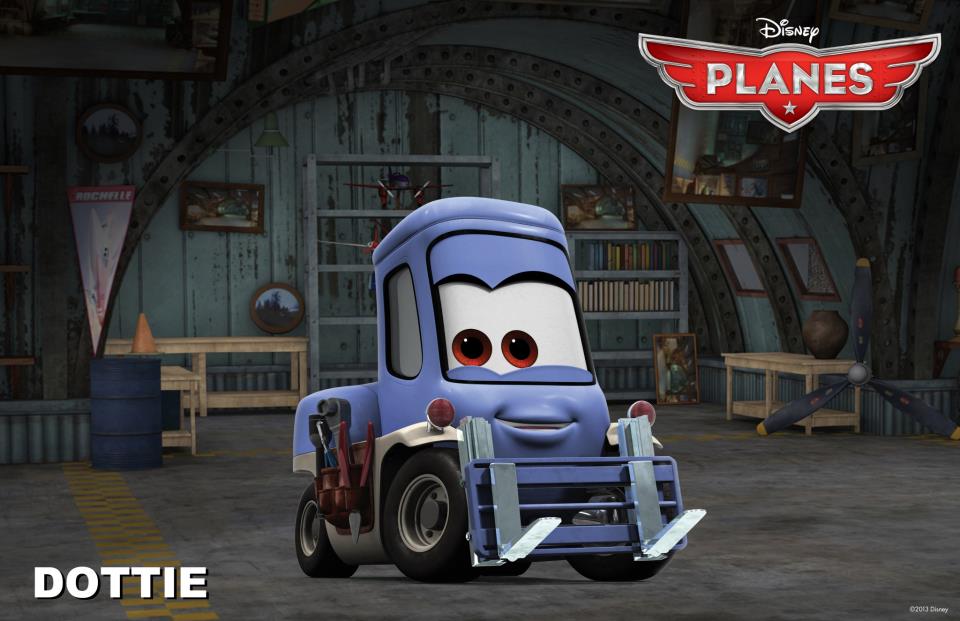
There are strikingly similar Minority Feisty in “Planes” and “Turbo:” Dottie and Paz are both mechanics and both shown in blue. Isn’t that progressive? At first, I thought these mechanics were a coincidence. Then I realized that “female mechanic” is classic Minority Feisty. All the parents watching can think: look a female mechanic! Isn’t that wonderful? And then overlook that Dottie and Paz exist only to help the male hero accomplish his quest in movies that marginalize and demean females.

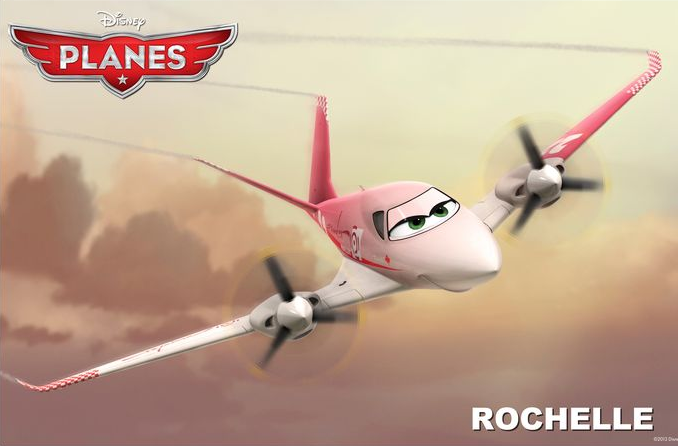
The actual race in “Planes” is totally dominated by male competitors. There are just two female racers: Ishani and Rochelle. “Turbo” has only one, and I missed her name. Both female racers in “Planes” are objects of lust for the males who have bigger parts. One scene is an extensive serenade/ mariachi sequence that sends Rochelle, the pink girl plane, into fits of desire. I thought I was going to throw up. Everyone else in the theater was laughing.

In both “Planes” and “Turbo,” there is an evil champion male rival who is the protagonist’s major competition. In “Planes,” he’s called Ripslinger, “the king of racing.” In “Turbo,” the role is filled by the macho Guy Gagne. Why not do something wild and crazy and put a female in the evil champion role? Dusty’s mentor, his major relationship in the movie, is also with, surprise, surprise, another male: Skipper. Turbo is guided to winning by Tito, a taco maker, who is also cursed with a brother who doesn’t believe in him but comes to see his gifts by the end of the movie. Nice parallel, huh?

There is actually a third movie about a competition this summer. “Monster University” is about rival fraternities. Rival fraternities. Not one of these movies shows kids that females can win. Even worse, as I began this post with, “Planes” mocks female competitors as losers.

Why do parents put up with this repeated sexism in movie after movie?

There’s an excellent post about “Smurfs 2,” yet another male dominated movie for kids that came out this summer, in The Atlantic: The Banal, Insidious, Sexism of Smurfette.

In The Smurfs 2, there are a lot of Smurfs. And they all have names based on their unique qualities. According to the cast list, the male ones are Papa, Grouchy, Clumsy, Vanity, Narrator, Brainy, Handy, Gutsy, Hefty, Panicky, Farmer, Greedy, Party Planner, Jokey, Smooth, Baker, Passive-Aggressive, Clueless, Social, and Crazy. And the female one is Smurfette–because being female is enough for her. There is no boy Smurf whose identifying quality is his gender, of course, because that would seem hopelessly limited and boring as a character.

These characters, originating as they did in mid-century Europe, exhibit the quaint sexism in which boys or men are generic people–with their unique qualities and abilities–while girls and women are primarily identified by their femininity. The Smurfs 2, which premiered last weekend and came in third at the box office, doesn’t upend the premise of Smurfette…Today, a blockbuster children’s movie can invoke 50-year-old gender stereotypes with little fear of a powerful feminist backlash.


The author doesn’t expand beyond “Smurfs 2″ as far as the sexism marketed to children in movies this summer, but the erasure of female characters is shockingly consistent. And shocking in that it’s not shocking. Not only is there no fear of powerful feminist backlash, when I write about this annihilation in kids’ movies, I often get comments like: You call yourself a feminist? Why don’t you write about something more important than cartoons? Who cares?

About the rape culture, author Kilmartin is paraphrased in the New York Times:

It’s not DNA we’re up against; it’s movies, manners and a set of mores, magnified in the worlds of the military and sports, that assign different roles and different worth to men and women. Fix that culture and we can keep women a whole lot safer.

Kids learn from what they see again and again and again. You can tell girls that they can be anything they want to be until you’re Smurfblue in the face, but if you don’t show them, your words are meaningless. Why not show kids more movies where powerful females win? A crop duster can win a flying race around the world and a snail can win the Indy 500, but a female can’t win anything? What does that teach children? That “you aren’t what you’re built to be” unless you’re built a girl. Suddenly, your options get pretty limited.

Why, I want to know, is the imaginary world, a place where anything should be possible, so sexist? Why aren’t more parents demanding gender equality for their kids during this crucial period in their lives?

Reel Girl rates “Planes” ***SS*** for gender stereotyping

Watch sexist previews for “Madagascar 3,“Pirates : Band of Misfits,” and “The Lorax.”

See Reel Girl’s Gallery of Girls Gone Missing from Children’s Movies in 2013


‘Sea of Monsters’ best female characters in summer movie for kids

Finally, I saw a decent movie today (with my two older kids along with a cousin): “Sea of Monsters.” Afterwards, my seven year old said, “I just want to watch the beginning again and again.” I loved the beginning too! It’s all about how Thalia, the daughter of Zeus, gave up her life to save her three friends: Annabeth, Luke, and Grover. Here’s the actress who plays young Thalia. I can’t find a good shot from the movie.

thalia0_

As a result of Thalia’s bravery, instead of dying, she’s transformed into a tree. The tree provides a magic barrier to protect Camp Half Blood. The plot of “Sea of Monsters” is that this tree is poisoned, so not only is Camp Half Blood vulnerable to monsters, but Thalia is dying. In order to save Thalia, the Golden Fleece must be recovered.

Annabeth, daughter of Athena, is the one who realizes the golden fleece is what is needed to save Thalia. The daughter of the goddess of wisdom, Annabeth is the smart one. Her role as the courageous, brilliant best friend of the hero, Percy, is similar to Hermione’s role in the Harry Potter series.

annabeth

A third strong female is Clarisse, daughter of Ares, the god of war. Clarisse is ambitious and competitive.

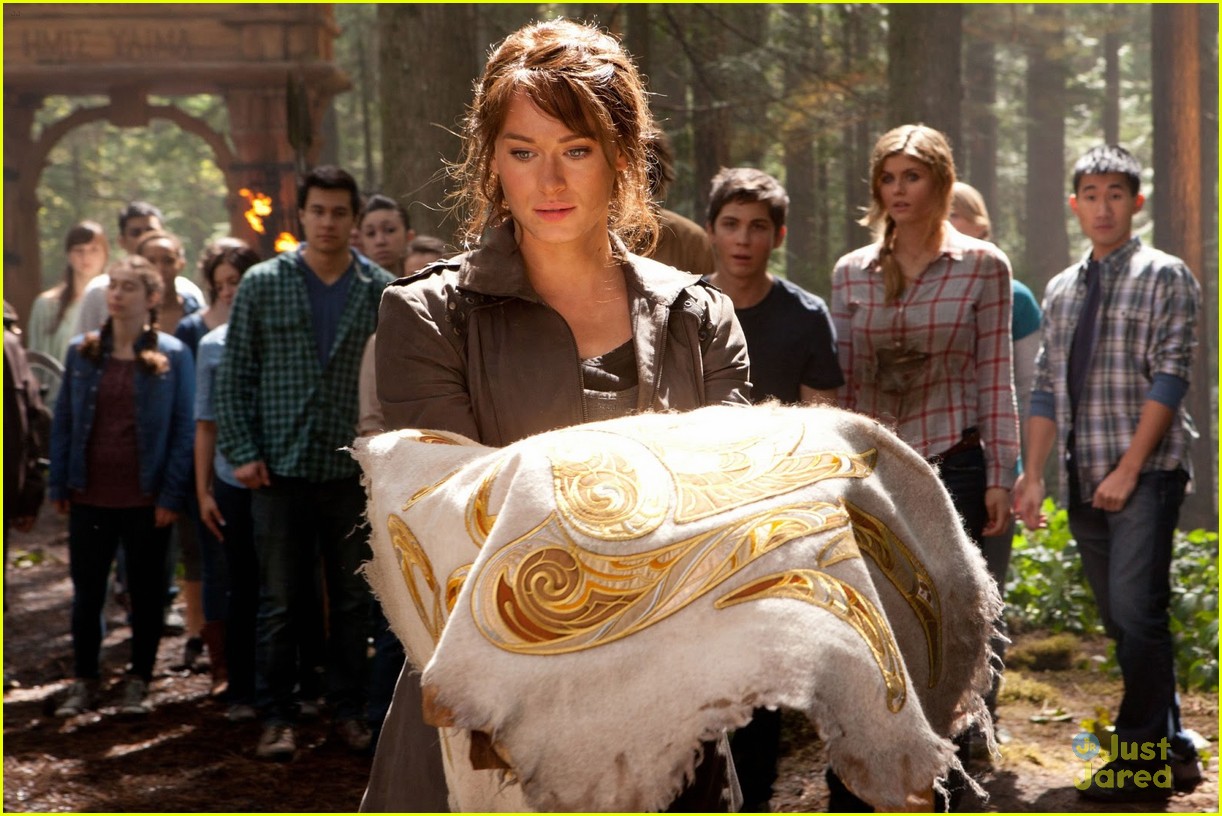
For these three characters, I encourage you to take your kids to this movie, though I wouldn’t take a kid under 6. But, I don’t want to mislead you. “Sea of Monsters” is Percy’s movie. He is the hero. The quest of recovering the golden fleece is actually assigned to Clarisse, but when she can’t pull it off, guess who steps in to save the world? The way Percy takes over Clarisse’s quest really annoyed me in the book. It annoyed me slightly less in the movie, because the way this is presented, instead of it being all about Percy, it’s more like Clarisse realizes she needs to work with others. It’s great to see Clarisse be the one to place the fleece on the tree; her important action restores Thalia to life.

clarisse

Kids watching “Sea of Monsters” not only get to see one girl helping another, but the whole movie is driven by Annabeth’s friendship for Thalia. “Sea of Monsters” is one of the very few this year to pass the Magowan Test for Gender Bias in Children’s movies. The Magowan Test is inspired by the Bechdel test. The criteria is (1) At least two females who are friends (2) go on an adventure (3) and don’t wear revealing clothing.

This movie is kind of cheesy. I don’t know why the special effects look so fake as opposed to the Harry Potter movies or the Lord of the Rings movies. Also, while the books are really funny, and the pacing is perfect, the humor doesn’t work in the movie. Scenes that are supposed to make you laugh are just goofy. That said, if I had to pick one movie to take kids to this summer, “Sea of Monsters” would be it.

Reel Girl rates “Sea of Monsters” ***H***

In ‘Planes’ males soar, females get grounded

I’ve blogged twice about the sexist preview for “Planes,” and after seeing the movie today, I’m afraid I’ve got to blog about this awful scene once more. The sexist scene actually opens the movie. It sets the tone for the whole film, which is the opposite of what I thought the scene was going to do. When I saw the preview, I thought the plane who mocks the slow flyers by calling them “ladies,” was having a moment of arrogance. The movie would redeem him when he went through his transition. I couldn’t have been more wrong. The sexist joke is his fantasy, the fantasy of a humble crop duster with a fear of heights who wishes he were a racer. The scene is sexism in fantasy world in sexism in fantasy world. Isn’t that meta? It’s the dream sequence of a “likeable” character. Can you imagine a hero making a racist joke and being likeable? In a movie for little kids? Yet, that’s how much sexism we have to wade through before females are allowed to win a race in animation. Here’s the text/ preview:

Plane One: What’s taking this guy so long? Is he really as good as he says he is?

Plane Two: No, better.

Plane One: Whoa! Who was that?

Plane Three: (Descending fast on top of the other two) Well, hello ladies. Ready to lose?

Plane Three goes on to leave the “ladies” in the dust.

Following this sexist fantasy, the narrative progresses exactly as “Turbo” does. (As I’m writing this, I’m thinking “Turbo” also starts with a fantasy about being in the Indy 500. Am I right?) The male protagonist, Dusty, is told by his friend he’ll never be a racer: “That’s not what you’re built for.” Same conversation Turbo has with his brother who tells him that he’s a snail, he can’t race. Guess who proves him wrong, that he can do anything, soar to the highest heights, be brave, courageous, and dare to make his dreams come true?

There is also a strikingly similar Minority Feisty in both movies. Dottie is the mechanic in “Planes.”

Dottie_(Planes)

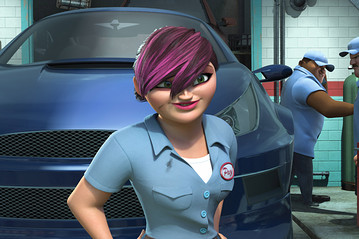
Paz is the mechanic in “Turbo.”

paz

Look at them both in blue. Isn’t that progressive? At first, I thought these mechanics were a coincidence. Then I realized that “female mechanic” is the classic Minority Feisty role. All the parents watching can think: look a female mechanic, isn’t that great? And overlook that the roles of Dottie and Paz are minor. They are there to help the male hero accomplish his quest.

The race in “Planes” is dominated by male competitors. There are only two female racers: Ishani and Rochelle. “Turbo” had one, I missed her name.

Rochelle

Both female planes are objects of lust for the males who have bigger parts in the movie. One scene is an extensive serenade/ mariachi sequence that sends Rochelle, the pink girl plane, into fits of desire. I thought I was going to throw up. Everyone else was laughing.

As in “Turbo” there is an evil champion male rival who is the protagonist’s major competition. In “Planes,” its Ripslinger, “the king of racing.” He’s the one I saw in front on all the movie posters, not Dusty. I guess Disney is hoping to market the toy.

Disney-Planes-Movie-Poster

In “Turbo,” that role is filled by Guy Gagne.

guy-gagne

Why not do something wild and crazy and put a female in the evil champion role?

Dusty’s mentor, his major relationship in the movie, is with another male, Skipper.

skipper-popup

My kids have seen three animated movies about competitions this summer: “Monster University,” “Turbo,” and “Planes.” Not one of these movies shows kids that females can win. Even worse, as I began this post with, “Planes” mocks female competitors as losers.

Why do parents put up with this repeated sexism in movie after movie?

There’s an excellent post in The Atlantic today: The Banal, Insidious, Sexism of Smurfette. I haven’t seen “Smurfs 2” which came out last week. The post begins:

In The Smurfs 2, there are a lot of Smurfs. And they all have names based on their unique qualities. According to the cast list, the male ones are Papa, Grouchy, Clumsy, Vanity, Narrator, Brainy, Handy, Gutsy, Hefty, Panicky, Farmer, Greedy, Party Planner, Jokey, Smooth, Baker, Passive-Aggressive, Clueless, Social, and Crazy. And the female one is Smurfette–because being female is enough for her. There is no boy Smurf whose identifying quality is his gender, of course, because that would seem hopelessly limited and boring as a character.

These characters, originating as they did in mid-century Europe, exhibit the quaint sexism in which boys or men are generic people–with their unique qualities and abilities–while girls and women are primarily identified by their femininity. The Smurfs 2, which premiered last weekend and came in third at the box office, doesn’t upend the premise of Smurfette…Today, a blockbuster children’s movie can invoke 50-year-old gender stereotypes with little fear of a powerful feminist backlash.


Please go to The Atlantic and read the post. The art accompanying it is great. But the author doesn’t expand beyond “Smurfs 2” as far as the sexism marketed to children in movies this summer. The erasure of female characters is shockingly consistent. And shocking in that it’s not shocking. Not only is there no fear of powerful feminist backlash, when I write about this annihilation in kids’ movies, I get comments like: You call yourself a feminist? Why don’t you write about something more important than cartoons? Who cares?

Kids learn from what they see. Brains seek out patterns and repetition. You can tell girls that they can be anything they want to be until you’re Smurfblue in the face, but if you don’t show them, your words are meaningless. A crop duster can win a flying race around the world and a snail can win the Indy 500, but a female can’t win a thing? “You aren’t what you’re built to be” unless you happen to be built a girl. Suddenly, your options become pretty limited. Why is the imaginary world, a place where anything should be possible, sexist? Why aren’t more parents demanding equality for their kids?

See Reel Girl’s Gallery of Girls Gone Missing from Children’s Movies in 2013

Reel Girl rates “Planes” ***SS*** for gender stereotyping


New York Review of Books tells you who’s important: men

This from VIDA on intellectuals/ thought leaders:

New York Review of Books’ Summer 2013 issue. So, VIDAs, wouldn’t you say it’s time to cancel your subscription or write to the editor or something? I mean, WTH??

VIDA

A couple things really get me about this snobby sexism:

(1) Progressive does NOT equal feminist. A couple weeks ago a study came out that the New York Times, that bastion of liberalism, quotes 3.4 men for every woman. Slate reports:

The endless trend pieces about how women accessorize, parent, and hook up today have failed to materialize into equal representation across the newspaper. In the Times, men are individuals who are quoted to represent countries, corporations, academics, and citizens; women are quoted to represent other women.


The UNLV students who did this study conducted a similar study in 2010 about NPR with similar results. Did you read that part about NPR?

I write a lot about how PBS, the “education/ liberal/ progressive” station is just as male focused in its shows for kids as Disney.

(2) Feminine does NOT equal artsy unless absolutely no status is involved. If you are in kidworld, you deal a lot with stereotypes about how boys are active and girls are artsy, as if this is a biological truth. This “reality” has nothing to do with biology and everything to do with raising, affirming, and validating quiet and well-behaved girls. When it comes to artists in the grown-up world with big shows who make lots of money, they’re almost all men. J. K. Rowling, already hiding her gender with one name, just used a made up male name to write a detective story. Don’t get me started on “chicklit” versus literary geniuses. Who decides who is a genius? Why, the New York Review of Books, of course!

To complain email editor@nybooks.com or Tweet:  Where are the women? #NotBuyingIt

New video on sexualization of girls shows influence of media on kids

Tina Wolridge sent me this message:

I work for the American Psychological Association. This is my work project. This video titled, “GIRLS TALK: SEXUALIZATION OF GIRLS”, shows the reactions and commentary of 6 middle school girls towards various forms of media, pop culture, and people who are associated with or directly influenced by over-sexualization of girls.
Can you share with others?


I really like the video, and I’m happy Wolridge made it. It’s important to hear girls give their own point of view about what they see and experience in the media. These girls are smart, perceptive, and articulate. They also seem real and passionate, not rehearsed or coached. Watching the video, though, I still feel like these girls believe there is some “right” way that a woman should look. It kind of reminds me of how it makes my skin crawl when I hear people talk about how this movie star or that one is too skinny. I feel like responding to those kinds of comments, “Fuck you. Can you just stop talking about her size?” I understand the point of the focus on appearance in this video, but it still makes me sad that these girls have to spend so much time thinking about this. Maybe that’s part of what makes the video powerful but I wish the emphasis were addressed more directly. Michelle Obama is celebrated by the girls for looking “right.” It’s good to show examples of the positive but can you imagine Barack being celebrated for his outfits? I posted something on Reel Girl a while back from a Vanity Fair article by Michael Lewis where Obama actually says he only wears gray or blue suits because he doesn’t have the mental energy to focus on what he is wearing. I get that. Especially since I’ve become a mom, or maybe it’s also being in my 40s, but there is only so much brain power I have. There’s only so much time. I need to choose carefully what to focus my mental energy on. We all do.

And one more thing this video brought up for me. Sexuality is different from sexualization. I don’t know if these girls know that. I want to end this post with a quote from Peggy Orenstein on this issue. Hopefully, these girls will grow up into women who celebrate and honor their sexuality. Female sexuality should not be oppositional to being smart or successful. Females, like males, shouldn’t have to make that choice. These girls are too young to understand sexuality but I worry that sexualization has already become conflated with sexuality for them. Here’s the Peggy Orenestein quote:

“Let me be clear here: I object– strenuously– to the sexualization of girls but not necessarily to girls having sex. I expect and want my daughter to have a healthy, joyous erotic life before marriage. Long, long, long before marriage. I do, however, want her to understand why she’s doing it: not for someone else’s enjoyment, not to keep a boyfriend from leaving, not because everyone else is. I want her to explore and understand her body’s responses, her own pleasure, her own desire. I want her to be able to express her needs in a relationship, to say no when she needs to, to value reciprocity, and to experience true intimacy. The virgin/ whore cycle of the pop princesses, like so much of the girlie girl culture, pushes in the opposite direction, encouraging girls to view self-objectification as a feminist rite of passage.”


The pussyification of American society is awesome


Today, Jezebel posts about the sexist Tweets of “UW-Madison ‘semi-celeb’ David Hookstead.” Here’s one:

David Hookstead @dhookstead The pussyification of American society is sad. Remember when you were expected to be tough, and not worry about what people said?


I am so sick of people using female sex organs to imply weakness or cowardice. Back in the 90s, when I was a philosophy major in college, I studied deconstruction and Luce Irigaray and how our language is so distorted, it can be impossible to speak without sexism. You can look at words like “hysterical” which originate from the idea that wombs made women crazy. “Pussy” is another perfect example. Enough already. We owe it to humans to use “pussy” not as as insult but as a compliment. I wrote “You Pussy!” for Salon in 2001, long before Facebook and Twitter. David Hookstead, you are no pussy.

You pussy!

If ever there was a word in need of rehab, it is this feline expletive reserved for wimps.

“What a pussy!” shouted my friend Joe. He was complaining to me about a business partner who backed out of a deal at the last minute. Joe wanted sympathy, but I was snagged on the word “pussy.”

The night before Joe’s outburst, I’d been channel surfing and caught Barbara Walters interviewing Jane Fonda about her performance in Eve Ensler’s wildly successful play, “The Vagina Monologues.”

“You can’t talk about vaginas,” Fonda said to Walters, “and not talk about this remarkable ability they have to give birth. It’s awesome. If penises could do what vaginas could do, they’d be on postage stamps. I mean, vaginas are absolutely extraordinary.”

Listening to Fonda, I thought, “We have come a long way, baby.” Just a few years ago, producers forbade actress Cybill Shepherd to utter the V-word on her own TV show. It was, they said, obscene.

I noted the further progress of female genitalia in mainstream media when I spotted fresh-faced actress Claire Danes sporting a “V-Day” T-shirt on the cover of March’s issue of Marie Claire, in which women like Brooke Shields, Marisa Tomei and Calista Flockhart were asked, among other things: If your vagina could talk, what would it say, and if it could wear clothes, what would it wear?

So pussy power was in the air when Joe launched his diatribe. Suddenly it struck me as wrong that the word “pussy” is used to imply cowardice or ineffectiveness. Why must we equate weakness with the female sex organ? Why have we for so long?

I began to wonder how one — how we — might take the wussy out of pussy.

Is it possible to change the meaning of the word, to restore to “pussy” its deserved glory? Could we use pussy as a compliment? Could pussy denote someone or something as cool or heroic or impressive? “Rosa Parks — what a pussy!” or “John McCain is way pussy!” or “New York is a big ol’ pussy!”

At the moment, “pussy” isn’t even used to slight women directly. It is reserved for men, used among them to make fun of one another. It’s “sissy” for male heteros. It’s the politically correct big boy’s way of calling somebody a fag. And, please, don’t get me started on “pussy-whipped.”

People say “dick,” they say “asshole,” they say “prick,” but they do it with respect. Those words have power and punch, the way the word “cunt” has power. But “cunt” makes people shudder; they judge, perhaps wrongly, the user of the word. Meanwhile, poor “pussy” lies there limp, pathetic and, until this moment, defenseless.

Ensler does a fabulous soliloquy to “cunt” in “The Vagina Monologues.” Perched on a stool in her black cocktail dress, barefoot, throwing back her head, shaking her Louise Brooks haircut, she says the word “cunt” for about 10 minutes, obviously relishing each repetition. But what does she say about pussy? If she said anything, I couldn’t remember. Is pussy so forgettable?

To find answers — and to solicit allies in rehabilitating the word — I went to novelist and essayist Erica Jong, a pioneer in reclaiming language in her own writing, and a recent star of “The Vagina Monologues.”

Jong told me that there are, in fact, a couple of references to pussy in the “Monologues,” though they’re mostly humorous, such as “Don’t let him tell you it smells like roses when it’s supposed to smell like pussy!”

She thinks changing the popular meaning of the word is possible. “If we use it with positive intent, it will become positive,” she said. “I really don’t know how long it will take. Language changes, but changes slowly. It depends on the usage — whether the new connotation catches on.”

Jong warned it wouldn’t be easy. “My feeling is that we’re on the verge of reclaiming ‘cunt,’ a fine old Middle English word, but we’re not there yet with ‘pussy,’” said Jong. “Pussy remains humorous, if not insulting. At the moment pussy is a laugh word. It always gets them rolling on the floors in ‘Vagina.’”

Jong suggested I go to the vagina mama herself, Ensler, to ask her advice.

“I like the sound of ‘pussy,’” Ensler told me, smiling. “I think it’s a good word.”

She agreed that it’s different from cunt. “A cunt is someone who dreams the big dream. You are ambitious. You want to go the distance.” Hillary Rodham Clinton, she told me, is a cunt.

Pussy, she said, is more personal. “Pussy is wet, juicy and inviting. It could be used as a word of empowerment or honor. It’s a feisty word. There’s a little fear, a little danger there — you better be nice if you want my pussy.”

Pussy has so much potential, it’s a shame to limit it to the immature and derisive mocking of weak boys. Let’s give it a shot in the arm! I envision hit songs featuring “pussy” — “Who Let the Pussies Out?” or “The Real Slim Pussy” or “The Real Shady Pussy.” Hallmark-type cards that read “Thanks for being such a pussy!” Colloquial expressions: “You da pussy!” “Stand up and fight like a pussy!”

And when, and if, Joe consummates his next business deal, I’ll be there to toast him, saying, “You’re so pussy.”

Flattered, he’ll smile.

‘Nashville’ brings multiple strong female characters to small screen

My husband and I just finished watching season one of “Nashville.” It is such a fun show to watch and not what I expected at all. I thought “Nashville” was going to center on a stereotyped washed up 40something queen of country (played by Connie Britton) usurped by a young, shallow-ambitious bitch (played by Hayden Pantierre.) I was prepared to see one female pitted against another, female ambition demonized, and all the catfights ensue over men and beauty.

HAYDEN PANETTIERE, CONNIE BRITTON

Instead, “Nashville” stars two smart, talented, and complex women who are primarily defined by their professions. Country star Rayna James is in the prime of her career. I was trying to think of another 40someting female in the imaginary world who is portrayed as successful, kind, hot, and a good mom. Usually female characters have to pick and choose, not allowed to be mothers and successful, beautiful and smart (whereas, of course good fathers must be successful to provide and being successful makes them hot.)

“Nashville” is a soap opera. I won’t deny that. But it’s well acted and if you like country music, it’s addictively entertaining.  It also feels to me– though I nothing about it– pretty authentic to the town of Nashville, like we are getting to see and hear about real places. Watching the show feels like learning about a whole different world than my own. Even better, there is a third super-talented female country writer/ singer character, Scarlett O’Connor, in the show.

Nashville

“Nashville” is written by Callie Khouri of “Thelma and Louise” fame, who once again celebrates cool female protagonists in this narrative. Rare and remarkable. I can’t wait for season two.

Reel Girl rates “Nashville” ***HH***

Teach kids Jane Austen 10 pound note when learning sexist U.S. currency

In the California public school system during first grade, kids learn about U.S. currency. I was bummed to watch my daughters spend hours studying, sorting, organizing, and diagramming endless stacks of male profiles. I still have a four year old to go through the training. It sucks. While this is supposed to be a math lesson, it’s yet another space where children see that males are important while females go missing. Six year olds learn– often with no authority figure like a teacher even mentioning the sexism– that males are leaders and females are invisible.

How different would our world be if our children grew up in a world where they saw female faces on the bills and coins they used every day? Really, what would have to change?

Well guess what? The land of the free and the brave may be remarkably sexist, but the Bank of England made the crazy, brazen, radical step of putting a woman author on money. Do you think they were closer to being courageous because they have a queen already there?

This is the great Jane Austen. Please show this bill to your kids. It’s really important that they see it.

10-pound-note-1374993971

CNN reports:


In the United States, there is no shortage of notable women, but bank notes haven’t been updated since 1929, nine years after women gained the right to vote.

All of the paper money in the United States features men — nine presidents, two former treasury secretaries and one Benjamin Franklin.

Don’t let your children go through this sexist history lesson without acknowledging the inequity. A world where females go missing shouldn’t seem normal or okay to kids.

Here are some tips I discovered when my children learned about U.S. currency in first grade that may be helpful to you.

Show your kids other currencies where females are featured on money. This can be fun. Some money is beautiful or cool to look at. It’s all fascinating. You can learn a lot about people and their countries. This new Jane Austen bill is great opportunity. Let your kids know that U.S. bank notes have not been changed since 1929, 10 years after women got the vote. Ask your children who they would put on money if they could honor someone. Help them design a bill. Play store with their currency.

I have no doubt that in good, old Capitalist USA, when women are featured on currency as much as men are, it will be a signpost, maybe more than any other, of gender equality in America.

Reel Girl rates U.S. currency ***SSS*** for major gender stereotyping


My three daughters review ‘Turbo’

You’ve heard it all from me before. Basically, if you added up all of the speaking time of the female characters in “Turbo,” you might get 5 minutes of dialogue. “Turbo” reminds me of “Ratatouille” in that animators really seem to believe that it’s easier to convince audiences a talking rat can cook, or a snail can win the Indy 500, than a female character can be a great chef, a champion racer, or the star of her own movie.

Here are my three daughters reviewing “Turbo.”

Reel Girl rates “Turbo” ***SS*** for gender stereotyping

A note on Reel Girl’s ratings and gender stereotyping. I’ve seen comments about movies I gave a high S rating to (“Monster University” and “Despicable Me 2” most recently) that the male characters in these movies are not typical males. They are complex. Therefore, the gender stereotyping isn’t that bad. I strongly disagree with that assessment. I don’t see the lack of complex male characters as a problem in animated movies for kids. From “Toy Story” to “The Lion King” to “Ratatouille,” there are great male protagonists. Not only that, there are so many male characters in these movies, heroes and villains, cool dudes and geeks, athletes and artists, on and on, that kids get to see all kinds of male representation. Female characters, on the other hand, are barely there, passive, and sexualized. Females are erased and seeing that repeated pattern negatively affects both girls and boys. I can’t think of a better way to address stereotyping of male characters than to show kids strong females who are the stars of their own movies, with males helping and supporting them on their quests.