Today, on Facebook, my friend, Jennifer, posts this:
As a person with multiple food allergies, I am officially getting annoyed that so many items are marked with “gluten-free” or whatever. I do not have a gluten problem, and I’m feeling very left out. Why don’t other intolerances/allergies matter? OH, because they’re not part of a FAKE WEIGHT-LOSS SCHEME. (Note: Gluten intolerance and celiac disease is real and I take it very seriously. But repurposing legit food restrictions as a diet is idiotic.) Thank you.
She’s totally right and what gets me about all this gluten-free bullshit is the smug people acting like they care about health when all they care about is being thin. Gluten-free, for most people, is just another diet. Honestly, I don’t even know if dieters masquerading as “healthy” people realize they’re fooling themselves. The biggest clue is the way the “healthies” act about the “fatties.” Healthies are terrified of fatties. They don’t want to be near them. They feel contaminated by them. Most of all, they feel superior to them. What drives me crazy about this bias is that it is seriously unhealthy to obsess about calories or fat grams or carbs or gluten or whatever the current trend is all day long. It’s a black hole of hell that many women fall into, never to return.
And, mark my words (here they are, in print) this obsession with gluten? It will shift. I blog a lot on Reel Girl about how “scientific” studies are often biased, and I cannot think of a better example of that than whatever the current doctor or expert is saying about health and what we should eat.
Speaking of, please think twice before you tell your kid what to eat. When my daughters get food in a restaurant, I always remind them to eat what their tummy wants. “Whoever put that food on that plate has no idea how hungry you are,” I say. Even here at home, I tell them “Only you really know how much to eat.” Can you imagine if someone treated you like so many parents treat their kids, making you eat steak if you really want a salad? Making you “finish” your food if you realized you didn’t want to eat it? Bribing you with the reward of one food if you consume another? No wonder why so many kids grow up with eating disorders.
Before you give me the whole “I’m not a short-order cook” argument, please read my posts (some linked below) on Reel Girl about food, health, eating, and eating disorders, because that’s the last thing I am besides a periodontist, or, probably, a member of Apple’s tech support team.
Please, don’t judge people by how much they weigh. You haven’t got a clue how healthy they are. Consider yourself lucky if you know how healthy you are.
Creativity is not icing on the cake. It is the cake.
Artists have a false reputation of being neurotic, pessimistic, and depressed. But artists, if they are depressed, create in spite, not because of depression. I wrote a blog about this controversial view presented in the book Against Depression by Peter Kramer. His whole theory is basically this: Creating consistently requires a sense of optimism. You’ve got to believe there is a way to tell your story or paint your picture. It makes sense. You’ve got to be resilient. Your plot is going to fall apart hundreds of times, and you’ve got to figure out a way to put it all together and make it work.
The grievance story is something that you, the “victim,” repeat over and over in your head. The way to forgive, to move on, is to tell a new story where you are the hero.
In anger management, you learn the same thing. The feeling of anger lasts 90 seconds. 90 seconds. Please check out this amazing video about the teen brain where Neuroscientist Jill Bolte Taylor says the same thing. So what keeps the anger going for hours, days, years, a lifetime? The story you tell yourself about the event. That is where you can intercede and step in. Change the story. Become the hero, not the victim.
Creativity — our ability to invent, conjure, envision, think divergently, and change the status quo — is essential to a thriving democracy and is rooted in children’s creative play.
I was talking to a teacher friend recently who said that 10 or 15 years ago, if she asked her Kindergarten class what their favorite colors were, she heard many different answers. Now, she still hears the boys name many different colors, but the girls almost all say pink…
Doesn’t that suck? A classroom of girls and all the colors in the world, and this is what they say? What are the longterm affects of groupthink in little kids?
I keep asking on Reel Girl: Why do parents put up with the gender stereotypes marketed to little kids? At least with “progressive,” urban parents, those in my world, I think a major reason is that they believe it’s just a phase, so harmless. Kids will grow out of loving pink or loving princesses. But kids who learn groupthink instead of creativity will have a harder time thinking independently. And I mean really independently, not reactively, which is just another form of groupthink. Again, you’ve got to watch Taylor’s teen brain video.
On developing brains, psychologist/ author Stephen Mitchell writes in one of my favorite books ever, Can Love Last?:
However, the traditional dichotomy of nature versus nurture that has dominated Western philosophy and psychology has been profoundly challenged by recent advances in neurophysiology. The stratification model of human experience, nature versus nurture– was predicated on the assumption that human biology was a complete package at birth…
The brain of the newborn, we now know, is only partially developed. Nerve cells and neural pathways are incomplete at birth; they are shaped to a considerable extent by the baby’s experience with others.
Mitchell is echoed by neuroscientist Lise Eliot, author of Pink Brain, Blue Brain. She writes:
“Babies are born ready to absorb the sounds, grammar, and intonation of any language, but then the brain wires it up only to perceive and produce a specific language. After puberty, its possible to learn another language but far more difficult. I think of gender differences similarly. The ones that exist become amplified by the two different cultures that boys and girls are immersed in from birth. This contributes to the way their emotional and cognitive circuits get wired.”
Both Mitchell and Eliot support the idea that humans are born into the world with “potentials.” Qualities humans are designed for can “turn on” or “emerge.”
These ideas on brain development take on the basic assumptions of Enlightenment, the driving theory behind the last century, which Mitchell summarizes as “a correct, rational, scientific, fantasy-free way to understand the world.” Mitchell summarizes the Enlightenment world view into three basic assumptions:
(1) All genuine questions have answers
(2) All true answers are discoverable and teachable to others
(3) All answers are in principle compatible
Mitchell describes reality, or realities, instead where fantasy and reality continually create each other. He writes:
It is the hallmark of the shift in basic psychoanalytic sensibility that the prototype of mental health for many contemporary psychoanalyitc authors is not the scientist but the artist. A continual objective take on reality is regarded as neither possible nor valuable in contrast to the ability to develop and move in and out of different perspectives of reality.
I’m not a scientist. I’m a writer and a mom, and I’m appalled by what people are calling “natural.” In the future, people are going to look back on this time and be mystified by what we did to little kids.
My radio was on scan. I was driving when I heard a woman’s voice sing the first line:
When people ask of me
What would you like to be
Now that your not a kid anymore…
I really wanted to hear what she was going to say, so I turned up the volume.
I know just what to say
I answer right away
There’s just one thing
I’ve been wishing for…
Here it comes…
I want to be Bobby’s girl
I want to be Bobby’s girl
That’s the most important thing to me…
At which point I said, to no one, “Seriously?”
Apparently, yes. Here’s the next verse:
And if I was Bobby’s girl
If I was Bobby’s girl
What a faithful, thankful girl I’d be
“This is a joke, right?” I said.
Each night I sit at home
Hoping that he will phone
“Come on, woman, go out. Get a life.” And then she says this:
But I know Bobby has someone else
Wait a minute, here. Hold on. After all that, Bobby has someone else? You are fucking kidding me.
Here’s the finish.
Still in my heart I pray
There soon will come the day
When I will have him all to myself…
I want to be Bobby’s girl
I want to be Bobby’s girl
That’s the most important thing to me…
And if I was Bobby’s girl
If I was Bobby’s girl
What a faithful, thankful girl I’d be
What a faithful, thankful girl I’d be
I want to be Bobby’s girl
I want to be Bobby’s girl
I want to be Bobby’s girl
I knew it was an oldie, but I Googled for the details (and to check the lyrics.) Turns out the song is from 1962. That doesn’t make me feel less depressed. It’s not like I can say, “Look how far we’ve come, now we’ve got ‘Blurred Lines.’
What’s so upsetting to me about this idiotic song is that it describes a young woman’s fantasy life. Her dreams. Not her hum drum existence, but what she aspires to be.
Your heart-breaking attempts to look younger is the reason your daughter doesn’t dream about her future.
Silverman is talking about a hit show in the year 2013. What are women dreaming about right now? Really? What do we aspire to be? What are girls dreaming about? What do we think will make us happy? And don’t we grown-ups get how important it is for our kids to see us risk and try and fall on our face and get up again and go further? Every time take some step towards chasing our biggest dreams, no matter how small a move we make, we give others permission to do the same. It’s so much more fun to be your own girl.
Actress, comedian, and talk show host, Whoopi Goldberg, was a “Star Trek” fan as a kid.
She’s spoken about her ecstatic reaction when she saw U.S.S. Enterprise crew member, Uhura, on TV for the first time.
“Well, when I was nine years old Star Trek came on. I looked at it and I went screaming through the house, ‘Come here, mum, everybody, come quick, come quick, there’s a black lady on television and she ain’t no maid!’ I knew right then and there I could be anything I wanted to be.”
Do you see how reality influences fantasy influences reality and creates our world? Just to remind you, that’s the same world that our kids live in. Art inspires us to dream big, except when it doesn’t.
I was given drugs, then coerced into going topless for a shoot. I learned the hard way that my body was not my own.
After a series of horrible experiences, Sky quit modeling. She got a job acting as a warrior princess. That role changed her life, how she saw herself, and how she experienced the world.
During my time on the show, on six episodes from the fourth to the fifth seasons, I kicked butt. Off screen, I was trained in numerous fighting techniques, in archery and horseback riding. On screen, I hung with a Christ figure called Eli; I had a same-sex lover and a boyfriend of a different race than mine; I threw bombs and walked along high wires. I killed so many bad guys that they began to look the same…Gender was not relevant in the Xenaverse. There, a girl or a boy could be a warlord or a farmer, a bard or a sad sack needing protection.
If playing and seeing powerful females in fiction is so inspiring and life changing, why, again and again, in kids’ media, do girls go missing? Why do we hardly ever see female protagonists? This summer, all the movies that came out for little kids– and I saw every one– starred a male character. When I blog about this pattern of sexism– as I did, regarding the lack of female competitors and winners in “Planes”– I receive hundreds of comments dripping with sarcasm like this one.
The actual race in Planes is totally dominated by male competitors.” How shocking! You mean in real life the actual race is not dominated by male competitors?… This stuff is silly nonsense.
WTF? This is a movie about planes who talk to each other, and the commenter is concerned about “real” life? “Turbo” is a movie about a snail who wins the Indy 500. A snail. Who talks. And befriends a human. (A human male, by the way, with a brother, but I digress.) And that’s all well and fine, but a female winning a race, that is totally unbelievable.
I can go on and on with examples of sexism in the fantasy world justified because there’s sexism in the real one. In “Lion King” the lionesses have to sit around, doing whatever skinny, weak, old Scar wants because only lions can lead a pride. Yet, Simba is BFFs with a Warthog and a meerkat, not to mention, he sings and dances. All that is totally plausible? “Ratatouille” is a movie about a rat who can cook. We get to see just one female chef, Colette, who has a brief monologue explaining the lack of females in the movie. French kitchens are sexist so the film is too, got that?
While we’re talking about “real life,” here’s a question for you. If, when it comes to gender, writers and producers of movies for kids, not to mention viewers, are such sticklers for “reality,” why are there so many, should we say, discrepancies? Reel Girl commenter, Nebbie, keeps a list of male characters in animation who, in the “real” world, would be female:
1) Barnyard movie and video game, Back and the Barnyard: male cattle with udders
2) The Madagascar movies and specials, The Penguins of Madagascar: Joey the male kangaroo with a pouch, male hornets with stings, King Julien the dominant male ring tailed lemur (Only female kangaroos have a pouch, ring tailed lemurs are matriarchal.)
3)Bee Movie: male worker bees, male bees with stings, Mooseblood the male bloodsucking mosquito (Only female bees, wasps, including hornets, and some ants have a sting because the sting is a modified oviposito)
4)Turbo: male snails, Burn the one female snail (Garden snails are hermaphrodites)
5) A Bugs Life, The Ant Bully, and Antz: male worker ants (Worker ants, bees, and wasps are all sterile females, the males are drones and they die soon after they mate with the queen– fertile female– ant, bee, or wasp.)
6) The Jungle Book: male elephant herd and leader (elephants are matriarchal)
7) Fantasia: female ostriches with male black and white plumage
8) Puss in Boots: The Three Diablos: Gonzalo the male tortoiseshell kitten (Most tortoiseshell cats are female. A male cat can only be tortoiseshell if it has Klinefelter’s Syndrome– XXY, usually sterile– has chimerism, or has mosaicism.)
9) Finding Nemo: Marlin the clownfish stays male after his wife died (Clownfish are protoandrous hermaphrodites; they are born male and the the most dominant male turns female when the dominant female is removed from the group.)
What’s so creepy about this is how often what is “natural” is used to justify sexism. Girls “naturally” love pink, princesses, shopping, and gazing at themselves in the mirror. Bullshit.
So here’s my question: Why, as parents, do we allow our kids to see, again and again, an imaginary world with the same manufactured sexism as the real world? It limits children, to say the least.
In the fantasy world, anything is possible. If we can’t even imagine a world without sexism, we can’t create it. And we must. If we live in a classist, racist society where women of color are maids for rich, white people, we owe it to children to show them a world where women of color are depicted as leaders and heroes. Recycling sexist narratives keeps a new generation stuck in a biased world. Don’t we want something better? When will Uhura get to captain the ship?
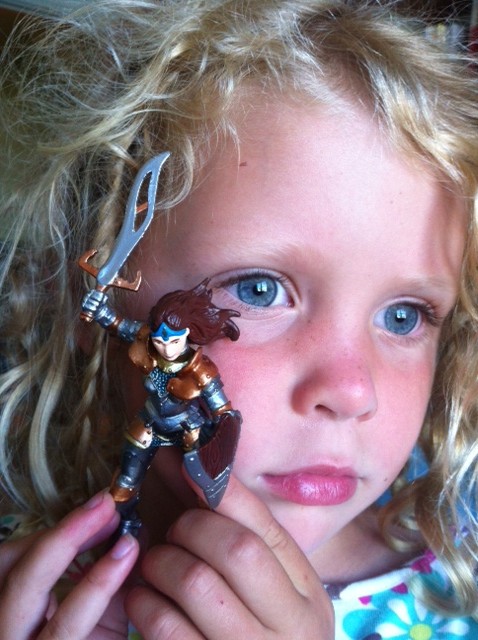
Having been out at a pool for a little too long yesterday, my daughter asked me to take a pic and post her favorite toy, Sunburn, on Reel Girl. Here are the two of them.
I’m being asked where to get her. To clarify, my daughter named her Sunburn. I bought her in a store in San Francisco. Will find out more about her…
I’m reposting Reel Girl’s list of great movies starring girls because I just updated it. Please let me know if you have movies to add. I’m also posting my initial preamble to my recommendations, explaining why it took me so long to make the list and why Reel Girl’s list is hard to get on.
This is a list of girl centered movies with strong girls. That sentence may seem redundant but sadly, it’s not. Many girl centered movies feature a girl who is a princess in distress or a cheerleader trying to keep a boyfriend or Barbie worrying about how to dress for the prom.
Or, if Hollywood allows a strong girl to appear in a movie that is not about a typical, cookie cutter “feminine” dilemma, her screen time is limited; her role is supporting: she is there to help the boy on his quest.
To clarify: the following is a list of movies with strong female main characters where the narrative is based on her brave quest.
This is not a list of HHH (triple Heroine) movies. Some movies may be included on this list such as a Barbie adventure or Kim Possible that would not get a HHH because of the main character’s plastic looks or typical princessy dilemma, but the movie is listed here because, in spite of that stereotype, it is still centered on a brave female hero who has cool adventures.
A few movies are not included on this list even though they are centered on a girl and her brave quest because the movie is simply too awful, meaning boring. “Judy Moody,” unfortunately, fits that category.
Wow, this is why it has been so hard for Reel Girl to recommend, but here we go.
These movies are for kids, not young adults.
Remember, these are movies to show your sons as well as your daughters.
This is a list in progress. Please send in your suggestions.
Reel Girl’s list of great movies starring strong girls:
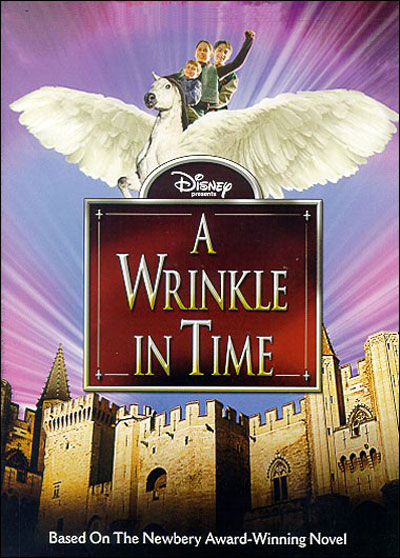
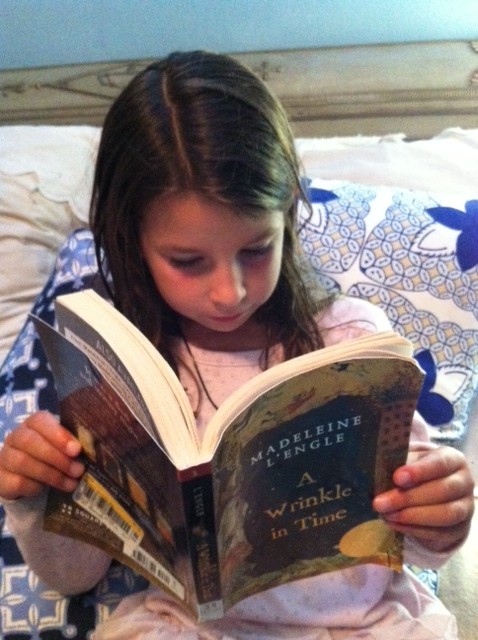
After finishing the book this morning, we downloaded the movie, “A Wrinkle in Time.”
It’s really good. Watching it, I realized there’s even a female I missed mentioning in my review of the book: the Happy Medium. Though in the movie, this character is played by a man, yet still referred to as she.
No surprise that the book is better. The special effects are low budget and cheesey, but I don’t think my kids noticed.
One scene from the movie that is better than the book is when Mrs. Which explains a tesseract, or a wrinkle in time. In the book, Mrs. Which brings a string together, in the movie a piece of material, to show how a bug can shortcut across a big space by ‘wrinkling’ the distance. In the movie, Mrs. Which refers to the bug as “she.”
One last cool thing about the movie. My four year old daughter burst out: “I want to be Meg! Don’t you?”
Professor and blogger Rebacca Hains appeared on “Fox and Friends” today and made excellent points about the ramifications of gender segregated toys and what we’re teaching kids through sexist marketing. The show started with Sabrina Schaeffer of Independent Women’s Forum, justifying gender segregation in toy stores:
It doesn’t mean that girls can’t go on to do anything that little boys can go on to do. It’s just that they like to play differently, and that’s okay.
This is a common argument for gender segregation of little kids. Nothing wrong with marketing make-up and dress up and shopping toys to girls. It’s just play, silly. No big deal.
The show ends with this point from Hains:
some girls want the chemistry set. And they shouldn’t feel like it’s just for boys. If we don’t say, “Hey, these are jobs for men and these are jobs for women,” why would we say, “These are toys for boys and toys for girls,” when toys are really kids’ work?
Don’t we want more female chemists? How is that going to happen?
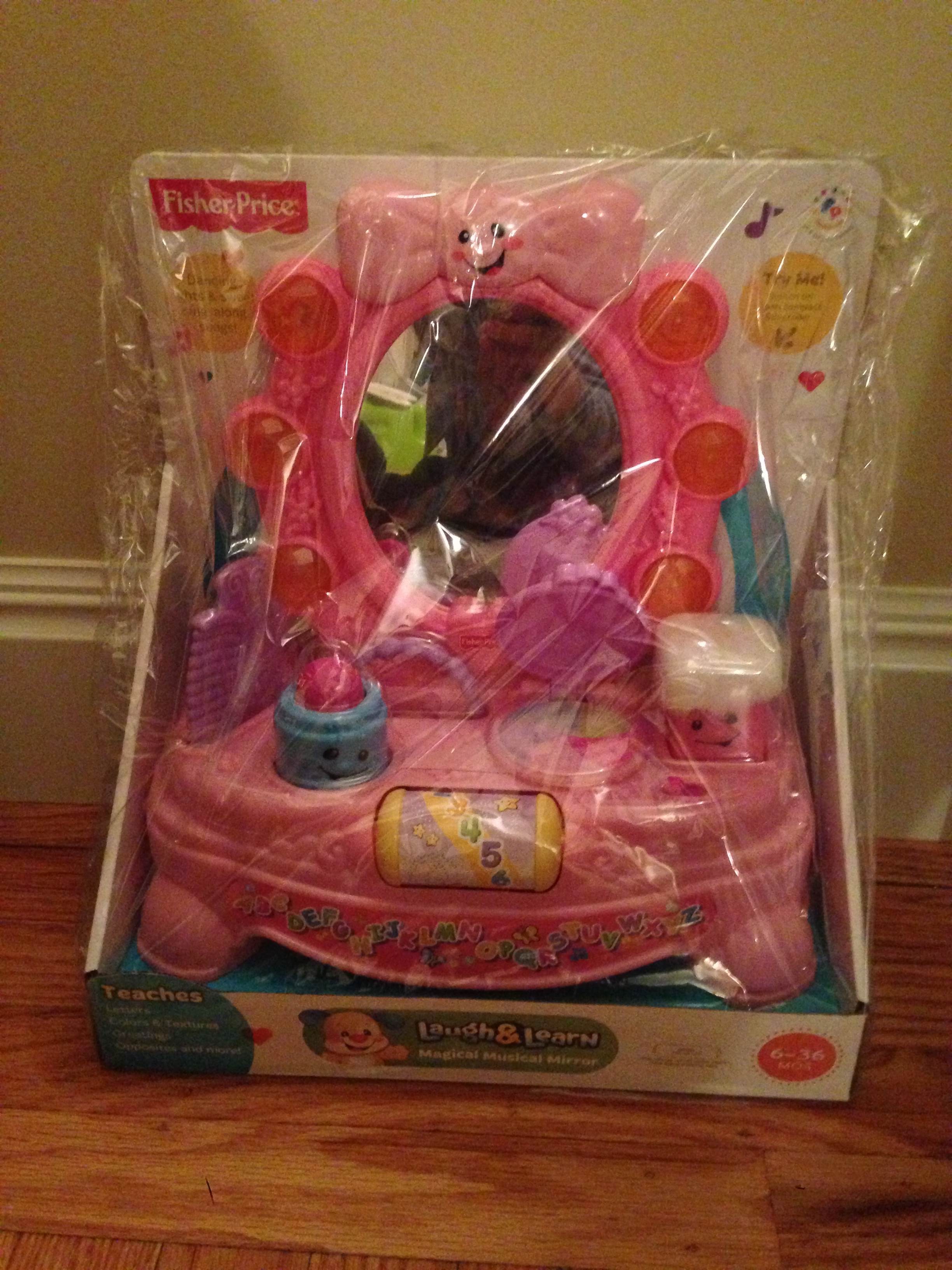
Check out what my friend’s 6 month old daughter just received from her grandmother. (Can you read “teaches” and “laugh and learn?” below) 6 month old child, from her grandmother.
I just finished A Wrinkle in Time, and I have chills. This is the book I have been waiting to read. Not only do I love the story and the characters, but it’s beautifully written.
So many books I love with strong female protagonists like The Wizard of Oz, Lion, the Witch and the Wardrobe, Alice and Wonderland, The Golden Compass, surround the girl with males, males, males. So many writers seem comfortable allowing a female be powerful as long as her gender is resresented by a minority of characters in the book. Not so with Wrinkle. Not only do we have Meg, but also Meg’s mother, a scientist. Wrinkle is, in fact, all about science. How cool is that?
Besides Meg’s mother, there is a trio of powerful and magical females: Mrs. Whatsit, Mrs. Who, and Mrs. Which. That’s not all. Near the end of the book we meet another amazing female, the incredible Aunt Beast. In Wrinkle in Time, readers see five powerful females mentor a female protagonist. Does anyone know of another narrative on earth where we see this? If so, please tell me, because from my experience, this scenario is like seeing a unicorn in the real world.
Here’s the passage where Aunt Beast names herself for Meg:
“What should I call you, please?” Meg asked.
“Well, now. First, try not to say any words for a moment. Think within your own mind. Think of all the things you call people, different kinds of people.”
While Meg thought, the beast murmured to her gently. “No, mother is a special,a one-name; and a father you have here. Not just friend, nor teacher, nor brother, nor sister. What is acquaintance? What a funny, hard word. Aunt. Maybe. Yes, perhaps that will do. And you think of such odd words about me. Thing, and monster! Monster, what a horrid sort of word. I really do not think I a am a monster. Beast. That will do. Aunt Beast.“
Part of what I love about this passage is that every writer goes through a similar process as she thinks of how to name a character. So often, a writer will assign this kind of powerful character the male gender, but the character could be any gender as this writing shows.
For much of Wrinkle, there is the typical one female (Meg) to two male (Charles Wallace and Calvin) trio. But given all the female characters in the book, Meg is still, not a Minority Feisty.
Narratives mimic real life and real life mimics narratives, it’s all the same thing really. If we are willing to recognize it, we all get to the point where we realize we must do it alone. Sometimes that thing is dramatic, when we give birth or it could be when we write a novel or when we confront someone we’ve been afraid to. But it can also be something like cleaning your house or making your bed. If you live your life heroically, realizing only you can do it, happens all the time, without resentment but with a sense of destiny. It is this revelation upon which endless narratives are based, but so often, in fiction, this human situation is assigned to males. I just wrote about an exception to this rule in Land of Stories. Here it is in Wrinkle the whole sequence: Someone else do it, I can’t; okay, I will. I must be me, here I go. Resistance, choice, action:
Meg could no longer stand it,and she cried out desparingly, “Then what are you going to do? Are you just going to throw Charles Wallace away?”
Mrs Which’s voice rolled formidably across the hall. “Ssilencce cchilldd.”
But Meg could not be silent. She pressed closely against Aunt Beast, but Aunt Beast did not put the protecting tentacles around her. “I can’t go!” Meg cried. “I can’t! You know I can’t.”
“Did annybbodyy ask yyou ttoo?” The grim voice made Meg’s skin prickle into gooseflesh.
She burst into tears. She started beating at Aunt Beast like a small child having a tantrum. Her tears rained down her face and spattered Aunt Beast’s fur. Aunt Beast stood quietly against the assault.
“All right, I’ll go!” Meg sobbed. “I know you want me to go!”
“We want nothing from you that you do without grace,” Mrs. Whatsit said, “or that you do without understanding.”
Meg’s tears stopped as abruptly as they had started. “But I do understand.” She felt tired and unexpectedly peaceful. Now the coldness that, under Aunt Beast’s ministrations, had left her body had also left her mind. She looked toward her father and her confused anger was gone and she felt only love and pride. She smiled at him, asking forgiveness, and then pressed up against Aunt Beast. This time Aunt Beast’s arms went around her.
Mrs. Which’s voice was grave. “Whatt ddoo yyou unnnddersstanndd?”
“That it has to be me. It can’t be anyone else. I don’t understand Charles, but he understands me. I’m the one who’s closets to him. Father’s been away for so long, since Charles Wallace was a baby. They don’t know each other. And Calvin’s only known Charles for such a little time. If it had been longer, then he would have been the one, but–oh, I see, I understand. It has to be me. There isn’t anyone else.”
In the passage where Meg fights IT, just as Harry Potter with Voledemort, she wins by using love over hate. This is the scene I was longing for in kidlit while reading all 7 of the Harry Potter series. Reading ‘A Wrinkle in Time’ felt, to me, like a starving person getting food.
Though Wrinkle is not without sexism. Here’s a scene from the planet Camazotz:
She walked along the quiet street. It was dark and the street was deserted. No children playing ball or skipping rope. No mother figures at the doors. No father figures returning from work.
There are other instances like that one, but there is so much positive here. Wrinkle is a writer’s book, too. I’ll leave you with one last passage that is one of the most beautiful metaphors for creativity, God, raising children, life, that I’ve ever read. Here’s Mrs Whatsit explaining a sonnet to Calvin.
“It is a very strict form of poetry, is it not?”
“Yes.”
“There are fourteen lines, I believe, all in iambic pentameter. That’s a very strict rhythm or meter, yes?”
“Yes,” Calvin nodded.
“And each line has to end with a rigid rhyme pattern. And if the poet does not do it exactly this way, it is not a sonnet, is it?”
“No.”
“But within this strict form, the poet has complete freedom to say whatever he wants, doesn’t he?”
“Yes,” Calvin nodded again.
The trick here, for me anyway, is figuring out what the form is. Sometimes, we believe that the “rules” are the rule, that they are “natural.” For example, in so many narratives for kids, not to mention adults, like Ratatouille, have seen a Minority Feisty complain about sexism, instead of getting to see a female hero. That is “rule” that desperately needs to be broken. The resistance, choice, action is a rule I believe in.
Many of you have asked me to clarify what ages books are appropriate for. It’s hard for me to say that. We get different things about books at different times.
When I look at books or movies for my kids, the number one offensive thing is sexism. I would rather my kids hear swear words than see Cinderella any day. I’ve also written quite a lot of Reel Girl about violence. I don’t like gore, but much of violence in stories is metaphorical, it raises the stakes to depict visually what we, as humans, feel. Can you imagine dreams without violence? My daughter whipped through Wrinkle in Time. She just turned 7. I’m 44 and I’m blogging about it. I could tell my daughter really liked it, and she read a lot of it by herself. I’m not sure what she ‘got.’ I remember being confused by parts of this book as a kid. I do know that while reading this book, my daughter saw many females being brave and heroic, respected, admired, and loved my the males in their lives.