Why do you think that police thought so little of the killer’s videos ranting misogyny? In 2014 in America the hatred of women is accepted as a normal part of our culture. What if, instead, misogyny were considered a sign of something sick in a person and in a society? How would our world be radically different?
Suffice it to say that the killer was a misogynist, and that lots of women have reacted to his rampage by reflecting on how women are denied full personhood.
If you haven’t yet, please read these posts about the Santa Barbara massacre:
Rather than seeing Elliot Rodger as a product of society, the media has depicted him as a bloodthirsty madman, a mere glitch in the system.
The post goes on to point out that Rodger is not a “glitch” of the system, but a product of it.
Could the Santa Barbara massacre finally teach us to prosecute ‘gender crimes’ in the USA? Violence against women in this country is epidemic. What are we doing to stop it? What are we doing to educate the public about it? When the Santa Barbara massacre is discussed on all the news shows, do you think CNN, MSNBC, and Fox News will have on experts who will speak about violence against women?
If we called ‘gender crimes’ what they are, they would receive the elevated level of attention and punishment that hate crimes do. By identifying ‘gender crimes,’ we could also better address how to stop them, allocating more funding towards education and prevention. Right now, there is far too little public awareness of the ubiquity of violence against women, and insufficient funding for education, prevention, prosecution, or protection for women. “Glitches” happen every single day.
I’m reposting a blog I wrote about prosecuting gender crimes a few years ago in reference to Joran Van Der Sloot who killed Natalie Holloway and then went on to kill Stephany Flores.
Prosecute ‘gender crimes,’ Van der Sloot first up
Posted on
Joran Van der Sloot, the alleged killer of Natalee Holloway, the co-ed who disappeared in Aruba in 2005, was captured tonight in Chile. He’s under suspicion for the stabbing death of 21 year old Peruvian Stephany Flores. On June 2, Flores’s body was found in Lima, Peru in a hotel room registered to Van Der Sloot.
Van der Sloot was arrested twice for Holloway’s killing. He was released twice due to lack of evidence. Part of the “lack of evidence” included Van der Sloot talking on video about Holloway’s death and how her body was taken out to sea. This video “did not incriminate” Van der Sloot because he claimed he was just trying to “impress a drug dealer.”
Violence against women is epidemic, but perpetrators like Van der Sloot, too often don’t get punished and become repeat offenders. There is little public awareness of the ubiquity of the crimes, and insufficient funding for education, prevention, prosecution, or protection for women.
When the media covers stories about victims like Natalee Holloway, it’s usually in the most sensationalistic, ineffective way. If the women are attractive, white, and middle class, as she was, networks endlessly recycle former cheerleading or prom photos. But rarely do Larry King, Greta van Susteren, or Bill O’Reilly and co. accompany these horrific stories with facts about how widespread violence against women is, featuring direct service workers, experts in the field, who can educate the public with real statistics and solutions.
Today, in the Bay Area, Roselyne Swig, founder of Partners Ending Domestic Abuse took a step towards helping to stop the violence in a more effective way. Swig convened a summit in San Francisco with leaders from Bay Area organizations committed to ending violence against women. Swig’s hope is that these Bay Area organizations will collaborate, providing a leadership position, bringing public awareness to this widespread issue, taking action to end it.
JaMel Perkins, Board President of Partners, opened the summit by sharing terrifying statistics including some of these:
31% of American women report being physically or sexually abused by a husband or boyfriend.
Around the world, 1 in 3 women are beaten, coerced into sex or physically abused.
Women of all races and ethnicities are equally vulnerable to violence by a domestic partner.
Homicide is the leading cause of death for pregnant women.
77% of those deaths occur in the first trimester.
Abused women are 60% more likely to require hospitalization while pregnant.
90% of our homeless population are victims of abuse.
The health-related costs of rape, physical assault, stalking and Homicide committed by domestic partners exceed $5.8 Billion each year. Nearly $4.1 billion of this is spent on direct medical and mental health care services.
1 in 5 female high school students reports being physically or sexually abused by a dating partner.
The summit was attended by representatives from Bay Area organizations including SF Child Abuse Center, Blue Shield Against Violence (the leading private DV funder in the state), La Casa de la Madres, the police department and DA’s office who convened to network and collaborate.
“Domestic violence is something we should all be concerned about,” said Swig. “We need to create a collaborative voice.”
Marcia Smolens of HMS Associates, a local lobbying group, urged advocates to use social media to bring awareness to the issue of domestic violence to create change.
Judy Patrick, President and CEO of the Women’s Foundation of California, said that the goal of her foundation is to ensure that women and families are safe, healthy, and economically secure.
Marj Plumb of the Women’s Policy Institute trains women leaders who work in direct service to affect change in Sacramento. Women working on the front lines need the skills to lobby legislators to make policy that will help women and prevent violence.
Plumb had the women at the summit break into groups and identify problems and solutions to eradicate violence. Most groups felt that education was key, including curriculum for kids at middle school level, educating families, cultural awareness, and men.
I wish the media was a better educator. It’s such a missed opportunity. Domestic violence, and all violence against women, should be renamed as “gender crimes,” receiving the elevated level of attention and punishment that hate crimes do. The word “domestic” has always softened the crime for me, a crime that’s already not taken nearly seriously enough. Too often, crimes against women are written off as cultural issues, a misunderstanding, a married woman can’t possibly be raped by her husband or alcohol was involved so no one is to blame, or she’s to blame, or the guy who said he raped her was “just bragging.”
If the Taliban had been named worldwide for what it was– gender apartheid– maybe there would have been the universal outrage against it that people felt for South Africa’s racist government. Instead, most Americans, even good old San Francisco liberals, looked away, ignoring a regime where women were beaten and murdered, daily by their husbands and fathers as part of “cultural ritual.”
This year Yale student Annie Le was murdered and stuffed into a wall; UVA star Lacrosse player, Yeardley Love was murdered by fellow lacrosse player, George Hughley; Bruce Beresford-Redmond, a producer of the show “Survivor” is the prime suspect in the murder of his wife, Monica Beresford-Redmond, who was found dead in Mexico.
All of these killings received media attention, because these women were young, attractive, or middle class. Would we know about Peruvian Stephany Flores if Natalee Holloway hadn’t been killed by the same suspect? Maybe, her father is wealthy, but she’s got a strike against her: she’s not white. How many gender crimes happened today worldwide that we don’t know about? How many are happening right now?
Statistics say that in America 3 women are murdered by their husbands and boyfriends every day.
I love “Nashville.” It’s my favorite show on TV, and I watch it weekly with my husband (who is a musician) and my 10 year old daughter who is an aspiring musician.
I’ve blogged before about the reasons why this show is so great: female protagonist, female supporting roles, complex/ realistic relationships between women, women who are defined, first and foremost, by their professions not love interests, a 40 something woman in her career prime is lusted after by multiple hot men, and the music is great. But I have to do one more blog about this show, because after we watched it last night, I said to my husband, “I don’t think I’ve ever seen a female mentor another female on TV.” I’m so used to seeing women stereotyped and pitted against each other. It’s one of the reasons the whole Minority Feisty thing upsets me so much, females are continually isolated from each other– an old, effective tool for domination. I’m not saying women should stand in a circle and sing kumbaya. Not only is that boring, it’s not realistic. But in “Nashville,” you see women work through conflict and then come out on on other side in ways unpredicted and unexpected. It’s really inspiring to watch. If you didn’t know, Callie Khouri of “Thelma and Louise” fame writes the show. It’s great and I encourage you to watch it with your kids (I recommend for age 9 and up, if they know about sex. There are no graphic or long sex scenes but there are brief ones and sex is alluded to.)
Reel Girl rates “Nashville” ***HHH*** (up one H this season to highest heroine rating)
Last week, Disney admitted that they have no plans for any Princess Leia merchandise in the Disney store, a situation of distinct irony for reasons I hope I don’t have to explain.
Of course, this is far from the first time I’ve noticed Leia’s absence. There are so many LEGO “Star Wars” sets but few feature female characters. The origin of that problem obviously is the lack of females in the “Star Wars” movies, but still, why does Leia go missing? If you search on the internet, you can find her in LEGO sets, but as my daughters and I go about our day, walking through toy stores or book stores or Target, we see Leia hardly anywhere. My seven year old and I did spot her one time, and we bought the set but were disappointed that the scene depicted was where she was clad in a metal bikini chained to Jabba the Hut. Do you really want your kids playing with this story? It wouldn’t be so bad if there were many scenes and outfits for Leia, but unfortunately, that’s not the case.
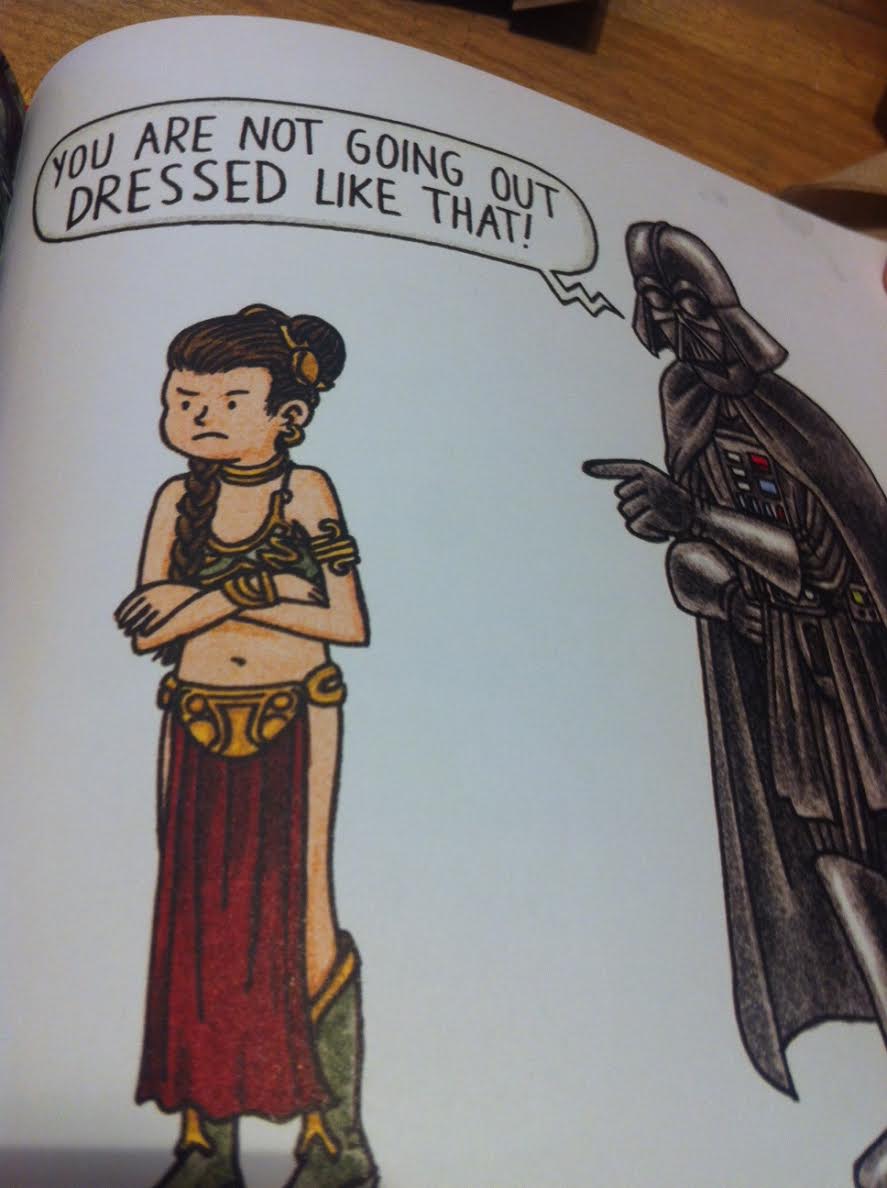
My 5 year old daughter and I go to Whole Foods most mornings where I get a cup of coffee and she reads the rack of kids books. Yesterday, she picked up Darth Vader’s Little Princess, the companion book to the New York Times best-seller Darth Vader and Son. But unlike Luke’s studious and heroic upbringing, in this story, young Leia likes to talk on the phone and paint her nails. The metal bikini she wears is presented as her independent, rebellious choice and not the outfit she was forced into when she was Jabba’s slave:
In case my 5 year old doesn’t get that Leia exposing her body is her choice as a growing, independent female, here is the same message in text and image on another page of the book:
Let’s just say that if I were to write a story about the young Leia, it would be completely different than this sexist, not funny at all, I honesty hope not a best-seller book.
I’m so mad about the degradation and annihilation of Leia not only for girls but for boys. Here is a great opportunity for boys to experience, play with, and admire a heroic female character and that chance has been swiped away from them.
It’s not just the Disney store and the Whole Foods book racks (and all book racks), but Leia also can’t be found among the “Star Wars” clothing merchandise, for example the socks and shoes sold at Stride Rite. When my daughter wore her “Star Wars” shoes, she was teased by other little kids in her class for wearing “boy shoes.” A ridiculous premise in the first place, but why exaggerate this boy/ girl “Star Wars” split by excising Leia?
It’s not only Leia who is missing from Stride Rite. Black Widow, the female Avenger is gone, as is Wonder Woman, the female that used to be shown with the Superfriends. Check out these socks.
Thousands of years ago, conquering armies smashed the idols of their victims and stole their stories, an extremely effective tactic to destroy a community and steal its power. Christians did this to pagans, but of course, this act is all over history. Just like the goddesses morphed into the Virgin, girls are going missing right now in 2014.
There are many disturbing passages in Kelsey Osgood’s memoir about her struggle with anorexia, How to Disappear Completely, but one of the most chilling is the description of her active pursuit of the disease:
I would get so thin that I would be the physical embodiment of sadness, and there would not be a flicker of doubt in the universe that I was exactly that: thin and sad. I would be consumed and ravaged by thiness, by the pursuit of it…I didn’t need something to have; I needed something to be…It never occurred to me to lose weight in any healthy way, to strive for a body that ‘looked good.’ I wanted to be repulsively thin, and I knew how people got that way, by being anorexic.
With this passage, Osgood debunks the myth that anorexia is dieting gone too far. In reality, anorexia is its own entity, an identity, a discipline, a religion.
Osgood grew up in suburban Connecticut, and she longed to be unique and special. In her local library, she devoured books by women or about women’s lives including Girl, Interrupted, I Never Promised You A Rose Garden, Prozac Nation, Sybill, and Wasted. Osgood writes:
It wasn’t a particularly well-stocked establishment, but there were still many books about young people, mostly girls, who felt crazy or who were crazy. I didn’t think I was crazy, but kind of wished I were. Crazy people were privy to a universal truth, I thought, destined for artistic greatness, their words indelibly scalded into the collective unconscious.
Combining those two goals, for artistic greatness and identity, anorexia seems like the perfect solution:
Becoming a professional patient, a ‘hopeless case’ seemed akin to selling one’s possessions and dropping out to live on a commune or defecting to Canyon Ranch for a long term detox. And besides, one of the most ‘hopeless cases’ I read about actually ended up confounding the doctors’ prognoses, recovering, and then writing books, so what were a few years lost to psychosis if you ended up a famous author on the other end? If I were actually crazy, I would be allowed to exit, at least for a while, the real world, a place I found at once deeply overwhelming and utterly lacking. I wouldn’t have to do the things I always considered pointless, like take math tests or sit up straight or tell white lies. I wouldn’t have to be what I thought I was: short, stumpy, decidedly unglamorous, not outstanding in any particular way. Normal. Or maybe nothing at all.
With these descriptions of anorexia, Osgood has written a hugely important and unique book. I’ve read so many eating disorder memoirs myself, and as Osgood points out, again and again, those stories romanticize the sickness.
The lowest weight one reached remain a point of pride, not shame…Nine times out of ten, writing about anorexia beguiles the at-risk population for all the wrong reasons and the person writing about his or her own struggle fuels the fire by producing a long, hubristic poem, a elegy, an ode to a presence gone and dismissed. An homage. The writers know they’re up on the invisible podium to speak out about their journey to the brink of death (oh, yeah, and back) and they know too, that the ones listening closest are the young ones eager to enlist in the starving armies.
Eating disorder memoirs just like the internet’s “proana” and “wannarexic” communities, act as a how-to, showing girls how to be best anorexic they can be. Recovery communities are full of people who trade tips on how to be a better anorexic, comparing weights, a competitive training ground. Osgood’s book is different because she never acts as if sickness is cool or desirable or inspiring or beautiful. Here’s a typical description of a patient:
She would lift the phone off the receiver and dial with the ends of her long, yellow fingernails…her skin was covered with stretch marks, jaundiced and flaky. The room stank of dead cells…
Osgood attempts to do what no other eating disorder memoir I’ve ever read has done: she de-glamorizes anorexia and exposes it as the ugly, stuck, boring, waste-pool that it is. How to Disappear completely also illuminates the paradox of the narrative females too many females in our culture are stuck in: only as victims can they be heroes, only when practically invisible can they exist.
So intrigued by this original and insightful book, I went to Osgood with some questions. Here’s our interview.
I started my blog Reel Girl because I have three daughters, and I was appalled by the lack of strong female protagonists and female heroes in kid culture. What do you think about the lack of female heroes, how the thin, “pretty” girls are the ones who get to star in the limited roles offered, to exist at all, really? Part of what “inspired” you wanted to become anorexic was the stories you read when you were a girl, the eating disorder memoirs and crazy girl memoirs. If young women’s stories involved other narratives besides the thin/ crazy/ pretty victim, do you think that would make a difference as far as girls’ attraction to anorexia?
Yes, I definitely think it would make a difference. Or at least, I think it would be a good start! I read an article recently that pointed out that even in books for very young girls––under ten, that is––the heroines are more often than not “scrappy” or “very small.” I think that might have started from a good place, but one that assumed a more male logic––big is better, so the underdog, who should win in the fable, should be small––on a female population. Eventually, it kind of curdled into what we have now, which is that no heroines are anything other than slim. As for me, what attracted me to the narratives of mental instability as a teenager was this idea that in order to be creative, one had to be melancholic or tortured. In some ways, I think I thought if you were psychically tortured, you wouldn’t have to work; that was a creative output on its own, and if you wanted to write a book post-facto then it would just pour out of you as if divinely inspired (insanity as a state of religious transcendence was also something I very much believed it.) Now, having been tortured and subsequently written a book, I can safely confirm that this is NOT what happens! It’s just as difficult a slog as ever.
While you go out of your way to describe not to glamorize anorexia, to show the ugliness of the disease, you’re still writing a book about it. You went to visit all of your former hospitals and you write about Googling people you were hospitalized with. Is it possible to write a book about how boring anorexia is and not be fascinated by the disease? Are you still fascinated and compelled by it?
I think no, it isn’t possible to do it without being, on some level, fascinated by it. I was hoping to reverse the narrative and to ask some questions about the disease that had never been asked before. But ultimately, yes, I am still interested in it, though I think “fascinated” might be a little strong. A writer often works on a book for years before it gets published, so by the time they’re invited on radio shows and panels, they’re often a little bored of the topic by virtue of having wallowed in it for so long! That was my experience, anyway. I am interested now not so much in anorexia as a disease but in the ways we define mental illness as a culture––because I believe it’s very much still culturally defined, particularly with regard to behavioral problems like anorexia and addictions, though the establishment would love us to believe they have more of an idea than they do that it’s biologically locatable.
When I had an eating disorder (I was bulimic, not anorexic) I was often told– in the recovery community, no less– that I would never get better. The best I could do was “manage” my disease. Today, I am 100% cured. My eating disorder is gone. Did you have the experience of people telling you the same thing? Do you consider yourself cured? Was writing the book part of putting the sickness to rest? The recovery community is so sick, so how do people get better? Is it possible?
Yes, this absolutely happened to me! I don’t know if I remember anyone saying that I would never recover point blank, though I’m sure it happened over my ten years in treatment. The eating disorders recovery community has completely absorbed the 12-step belief that once you are sick, you are always sick. I cannot fathom why anyone would find this empowering––comforting, maybe, because you don’t have to use your agency or blame yourself or give up your safety blanket completely, but empowering? No, no, no. It drives me insane (pun so not intended) these days to see personal essays about anorexia or bulimia in which the writer states that, “Eating disorders are like alcoholism––they never fully go away.” And there are many of them. I become literally enraged. I used to blame the writer, but then I realized, he or she was probably told this by some group therapist at a treatment center and thought, “Well, she must know what she’s talking about, because she’s a counselor and I’m one of the ‘crazy’ ones.’” But the truth is that how we define sick and well and normal and aberrant and psychiatrically compromised and stable is still mostly cultural, which is not to say that it’s “made up,” but rather that we have a choice as to how we want to shape our narratives, and what we want to tell struggling young people that they are capable of. Do we want them emerging into the world believing they can only have part of life? That, to me, is crazy.
I consider myself fully recovered, definitely, and I am not afraid to say that when asked. There is perhaps one cell in my whole body that pines for the days of starvation, but that cell is considered a total weirdo by all her cell friends. In all seriousness, though, there was a time when I would have considered being “recovered” unfathomable or, more importantly, shameful––that is, I believed it meant the crumbling of the will, not the assertion of it. Now, I see all the passivity and misguidedness and wastefulness endemic to anorexia and it baffles me that I ever considered devoting my life to it.
Perhaps writing the book helped me to bring my personal struggle to a close, although I would have to point out that one needs to be at least mostly well to write a book (it’s almost a test of endurance, psychologically and physically!) Does that mean I think everyone needs to write about his or her journey to recover? Absolutely not. My book is paradoxical in that the narrative I created was about resisting narratives––a friend once compared it to David Foster Wallace’s attempt, in The Pale King, to write about boredom without being boring (and yes I took that as an enormous compliment)––which some might see as impossible. I mean, even if the narrative is oppositional, it’s still, at its core, a narrative. So I still was seduced by the prospect of telling my own story, but in the end, recognized and continue to recognize that the story will never be fully knowable. If that makes sense, which I’m sure it doesn’t.
One thing that I said about getting better in the book I think is really key, and that is moving away from the eating disorder as a topic on which one dwells. I mean this as much in regard to recovery––and the psychoanalytic instinct to wonder where the “origin” of one’s problems are––as I do with regard to the dwelling necessary to being actively ill. What I mean by this is: at some point, get out of therapy, and try to conceive of yourself as something other than a patient. (This is easier as you get older––when the same people you were once doing bong rips with are now becoming clinical psychologists, you start to realize that the adult-child dynamic you once thought present in therapy was not quite as clear as you once thought!) If your therapist is good, he or she will be leading you in that direction already. I said the opening statement in the book with regard to my little friend who is now a grown-up; I immediately noticed, when we met up years after being hospitalized together, how curious of a spirit she was, and how much I could tell she wanted to experience. She learned, as I did, that if you are actively anorexic, you simply cannot have a wide variety of experiences. I found that for me personally, becoming a spokesperson for “awareness” felt in many ways similarly constricting in that I was still forcing myself to identify as an anorexic (recovering, recovered, whatever.) It’s still succumbing to the desire to label ourselves, which I’d like to push back against, personally. So that didn’t really work for me. But it works for some people, I guess?
You write that anorexia is unique in that people seek it out, they want to be sick, whereas alcoholics, for example, wish they could drink like normal people. But sickness, especially mental illness in the artistic community seems comparably romanticized. One of my favorite books about this phenomenon is “Against Depression” by Peter Kramer. He wrote this book, because while touring for his best-seller “Listening to Prozac,” people often asked him: What if Van gogh took Prozac? What about Kierkegaard?” Kramer believes that artists created not because of mental illness but in spite of it. He writes that while qualities of the disease of depression– alienation, hyper-sensitivity– are romanticized, other common and frequent symptoms such as disorganization, poor memory, irritability, difficulty changing intention into action, paranoia, anxiety, lack of resilience, vulnerability to harm, paralysis, hostility, impatience etc are often downplayed or ignored. Kramer believes that alienation– the ability to step back and look at the culture or political bodies while separate from them– can be a useful skill. But getting stuck in alienation is a sickness. Depression is a ‘stuck switch,’ an impairment in the stress/ response system. When I blogged about his book, I wrote “Basically he’s saying artists don’t need a little bit of depression to create art any more than women need a little bit of anorexia to be fit.” Long intro, but here are my questions: Did you write your book, in part, to show the other symptoms of anorexia, the ones not glamorized?
I did, particularly the existential torment I found so hard to live with. Now, I often speak at schools, and I’ve had to rethink yet again what is effectively dissuasive. I remembered as a teenager not caring a whit about things like bone density and heart damage and lanugo––almost like a rock and roll, I’m-so-dark-death-doesn’t-scare-me kind of thing––so I never lead with medical consequences. Instead, I tend to start with social stuff; I tell them about how, right after I graduated college, I became painfully aware of the fact that my friends were growing and maturing and I was not. I couldn’t go to a restaurant, let alone have a romantic relationship! So I started to really conceive of what my life would look like: attenuated, though my death would be long and slow; painfully boring and isolated; and basically not very meaningful. By that I mean, I wouldn’t be able to do anything significant in the world, because I would likely be too tired. Childless, also, that was very depressing. When I say this to kids, I can tell they hear me; they want to be in lock-step with their friends, and I’m basically telling them that will never happen if they choose this path. (Granted, it probably won’t happen for a whole other host of reasons, but that’s for them to find out!)
Given this comparison, do you still think anorexia is unique in being a disease that people seek out?
Yes I do. That is, I think it is unique in that the population attracted to it is perhaps the most conscious of its aspirations. But I do think that generally, while it’s unlikely someone may endeavor to become depressed or to nurture the behaviors of a depressive, there is a certain pride in being diagnosed––with basically anything—these days, which is very bizarre. Not so long ago, people fought tirelessly against being put in a box. Now, I feel like people are THRILLED to be in the box. So often people report to me with palpable glee that their therapist told them they probably have x, or y, or z. Recently a friend of mine bragged that her therapist told her she was a little psychotic. (She isn’t.) And I was like, “Why is she so happy about this?”
There is so little tolerance for non-pathological “bad feelings” that I think people either create the pathologies or fall into the psychiatric establishment’s hands and allow their behavior to be labeled pathologized. Being diagnosed (again, with basically anything) kills two birds with one stone, too: it allows you to feel special/different, but also to fit in, because psychiatric problems are the contemporary norm. This all sounds very conspiracy theory-esque, and I don’t mean to suggest that there is not such a thing as organic mental illness, or that all psychiatrists are out to medicate us into a Brave New World-style stupor, but I do think we compulsively ferret out the wrong in people even when it’s not there, or when exposing it and obsessing over it is potentially more harmful than helpful.
What do you think about the cynical/ skeptical world view: If I’m miserable, I’m smart and unique but happy people are stupid? The idea that joy is superficial rather than a profound choice? How do your views on this relate to anorexia and eating disorders?
I think this is a very real belief many people have, and I myself had it for years, and that any expectation of feeling ONE way all the time is reductive and stupid and possibly harmful. Something counterintuitive happened to me on my journey to wherever it is that I am now: I realized that for me to be “happy” meant to be intellectually engaged, and I happen to be more interested in things that many people might consider dark or depressing. So in some way, I still think a lot about objectively “sad” topics, but the end result is with me feeling more fulfilled than I would be if I were to convince myself that it had to be sunshine and rainbows all the time.
Are you writing another book? What are you working on now?
I tell myself every day I need to start on book two! And I want to, I really do, but I keep procrastinating by writing essays and shorter pieces. I was going to write another memoir, about the time I spent as a writer’s assistant to a true crime author who was dying of Lou Gehrig’s Disease, but I’m sort of second-guessing it. Requests taken!
Arthur Sulzburger’s new letter defending the firing of Jill Abramson is condescending and offensive.I’m going to go through it here, and then paste the whole text at the end of this blog. What is so amazing to me is that you’d think Sulzburger would, at the very least, address the gender inequity at the Times and then claim that Abramson’s firing has nothing to do with it. Instead, he acts as if the New York Times is a utopia where sexism doesn’t exist. It’s a strange ploy when the sexism at the Times has been well documented, most recently as having the worst gender inequality on record as far as male/ female bylines of all the top circulating newspapers in the USA.
So it begins:
Perhaps the saddest outcome of my decision to replace Jill Abramson as executive editor of The New York Times is that it has been cast by many as an example of the unequal treatment of women in the workplace. Rather than accepting that this was a situation involving a specific individual who, as we all do, has strengths and weaknesses, a shallow and factually incorrect storyline has emerged.
We just can’t accept reality, that is the problem, the sad thing about the story.
He goes on:
Fueling this have been persistent but incorrect reports that Jill’s compensation package was not comparable with her predecessor’s. This is untrue. Jill’s pay package was comparable with Bill Keller’s; in fact, by her last full year as executive editor, it was more than 10% higher than his.
Sulzburger’s use of “comparable” is comparable (ha ha) to his spokesperson Eileen Murphy’s earlier use of the phrase that Abramson’s package wasn’t “meaningfully less” than Keller’s was. Let me ask you this: Who has ever negotiated a salary or negotiated anything, for that matter, and believes that numbers were not “comparable” or had no “meaningful” difference? That’s what negotiations are, haggling over differences of amounts which one negotiator claims is insignificant and the other claims it’s actually a big deal. And if that number difference is so insignificant and not a big deal, except to a finicky little crybaby, why would a different number have been offered at all? If it really doesn’t matter, the same amount should be offered, right?
Next, Sulzburger writes:
But it doesn’t help to advance the goal of pay equality to cite the case of a female executive whose compensation was not in fact unequal.
Silly us, we’re “not helping” but really missing the point. We’re focusing on just one manager who just happens to be a woman. It’s us that are being sexist, asking for special treatment for girls, when the pay was barely unequal in the first place. Not only this tone more of the condescending denial drivel, but Sulzburger doesn’t address that Abramson asked for more money, then she was fired.
Next, he writes:
Jill is an outstanding journalist and editor, but with great regret, I concluded that her management of the newsroom was simply not working out.
During her tenure, I heard repeatedly from her newsroom colleagues, women and men, about a series of issues, including arbitrary decision-making, a failure to consult and bring colleagues with her, inadequate communication and the public mistreatment of colleagues.
So here Sulzburger writes that “women and men” complained about Abramson, as if the face that women complained as well implies complaining about Abramson’s management style has nothing to do with sexism. This, when it’s well documented that both “women and men” have negative responses to assertive female leader. Again, what is so disturbing about Sulzburger’s letter is he doesn’t acknowledge– or even see to get– systemic sexism exist and the New York Times is not immune.
Moving on:
Since my announcement on Wednesday I have had many opportunities to talk to and hear reactions from my colleagues in the newsroom. While surprised by the timing, they understood the decision and the reasons I had to make it.
Is he acknowledging that it’s fucked up to fire Abramson right after she asked for a raise?
The conclusion makes me want to throw up:
We are very proud of our record of gender equality at The New York Times. Many of our key leaders – both in the newsroom and on the business side – are women. So too are many of our rising stars. They do not look for special treatment, but expect to be treated with the same respect as their male colleagues. For that reason they want to be judged fairly and objectively on their performance. That is what happened in the case of Jill.
Equality is at the core of our beliefs at The Times. It will always be.
To see Reel Girl’s posts on sexism at the New York Times click here.
Sulzburger’s full letter is pasted below.
Since my announcement on Wednesday I have had many opportunities to talk to and hear reactions from my colleagues in the newsroom. While surprised by the timing, they understood the decision and the reasons I had to make it.
Perhaps the saddest outcome of my decision to replace Jill Abramson as executive editor of The New York Times is that it has been cast by many as an example of the unequal treatment of women in the workplace. Rather than accepting that this was a situation involving a specific individual who, as we all do, has strengths and weaknesses, a shallow and factually incorrect storyline has emerged.
Fueling this have been persistent but incorrect reports that Jill’s compensation package was not comparable with her predecessor’s. This is untrue. Jill’s pay package was comparable with Bill Keller’s; in fact, by her last full year as executive editor, it was more than 10% higher than his.
Equal pay for women is an important issue in our country – one that The New York Times often covers. But it doesn’t help to advance the goal of pay equality to cite the case of a female executive whose compensation was not in fact unequal.
I decided that Jill could no longer remain as executive editor for reasons having nothing to do with pay or gender. As publisher, my paramount duty is to ensure the continued quality and success of The New York Times. Jill is an outstanding journalist and editor, but with great regret, I concluded that her management of the newsroom was simply not working out.
During her tenure, I heard repeatedly from her newsroom colleagues, women and men, about a series of issues, including arbitrary decision-making, a failure to consult and bring colleagues with her, inadequate communication and the public mistreatment of colleagues. I discussed these issues with Jill herself several times and warned her that, unless they were addressed, she risked losing the trust of both masthead and newsroom. She acknowledged that there were issues and agreed to try to overcome them. We all wanted her to succeed. It became clear, however, that the gap was too big to bridge and ultimately I concluded that she had lost the support of her masthead colleagues and could not win it back.
Since my announcement on Wednesday I have had many opportunities to talk to and hear reactions from my colleagues in the newsroom. While surprised by the timing, they understood the decision and the reasons I had to make it.
We are very proud of our record of gender equality at The New York Times. Many of our key leaders – both in the newsroom and on the business side – are women. So too are many of our rising stars. They do not look for special treatment, but expect to be treated with the same respect as their male colleagues. For that reason they want to be judged fairly and objectively on their performance. That is what happened in the case of Jill.
Equality is at the core of our beliefs at The Times. It will always be.
We are very proud of our record of gender equality at The New York Times
The screenwriter has said that “Belle” was initially inspired by her seeing the painting of Dido and Elizabeth at Scone Palace in Scotland. The painting, worth seeking out online, gets more beautiful the more you look at it. In the ease of their postures and the warm and confident expressions of their faces, one can see that those young women knew something – their own worth and each other’s.
While she was an undergraduate at the University of St. Andrews in Scotland in the 1990s, Misan Sagay visited the nearby Scone Palace, where a rare double portrait caught her eye. Painted in the Gainsborough style of aristocratic figures in an Arcadian landscape, the canvas showed two young women swathed in lustrous satin, gleaming pearls circling their swan necks. The vivacious one on the left is biracial; her unhurried companion is white.
Ms. Sagay, who is Anglo-Nigerian, studied the wall label. It read: “Portrait of Lady Elizabeth Murray, circa 1778.”
Naturally, Ms. Sagay was curious. What of the woman on the left, whose forearm Elizabeth clasps so fondly?
In 2009 Amma Asante, a British-born filmmaker of Ghanaian parentage, received a screenplay written by Ms. Sagay. Attached was a postcard reproduction of the painting. Even before reading the script, Ms. Asante recalled, “I was inspired by the image.” She said that in European paintings of the late 18th century, blacks were often depicted as lower-class figures to affirm the higher status of the white subject. “I knew how unique it was,” she said, “that the black woman was not looking with adoration at the white woman, and that the white woman was tenderly touching her companion.”
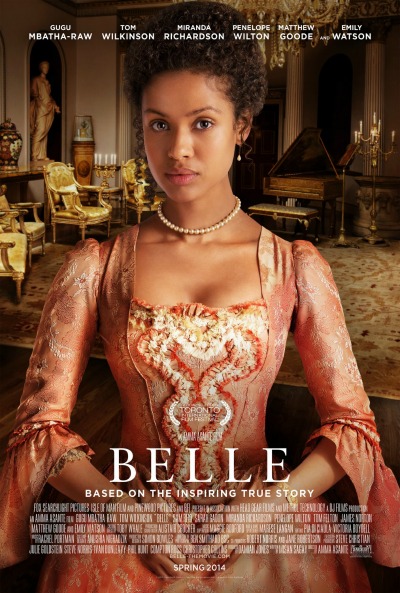
I just saw “Belle.” It is so good. I have no time to blog right now, but I’ve got to tell you how extraordinary this film is.
I’m going to list the reasons, and hopefully, I’ll have time to come back later and tell you more. It’s remarkable I saw this movie today because I just blogged about the talk where feminist scholar bell hooks said she was sick of seeing black women being raped on screen, how she was willing to see more films about slavery, but it had to be a different take than black woman as victim. At the same talk, flimmaker Shola Lynch said she wanted images that fed her. Watching “Belle” is like satisfying a craving I’ve had for my whole life. The narrative turns many stereotypes on their heads, and that is beautiful to see.
#1 Black female protagonist
Dido Belle is the star of this movie. I’m going to call her Dido from now on because that’s how she’s referred to in the film. I’m guessing “Belle” made a better title. How many films have we all seen where the black girl is the BFF of the white girl? In this movie, the blonde, blue-eyed cousin has the supporting role. Dido is the hero of this movie, she is the one with alll the screen time, who makes choices, takes risks, and goes through a transition.
#2 Female cousins are not cardboard opposites or rivals
One cousin is black, the other white but both girls are both smart, compassionate, and beautiful, there is not an “attractive” one and a “smart” one. They are complex. And, get this, are you sitting down? They are friends. They love each other. There is complexity and also conflict but not in a cookie cutter way.
#3 Class, race, and gender are all addressed brilliantly
This is the first film I’ve seen that addresses intersectionality like this. There are so many great lines and plot points that show the complexity of these issues. I’ll list a few. Dido is the daughter of a an English aristocrat and a slave. When Dido’s mother dies, her father comes to take her to his estate. A captain of the English navy, he leaves Dido with his uncle, the most powerful judge in England. Dido’s father can’t return because he is following the king’s orders, and he dies. This all happens in the first 10 minutes of the movie. The captain leaves Dido his money, 2000 pounds a year. So Dido is a rich woman, an heiress.
Dido’s white cousin gets no money from her family because her father is a “scoundrel” who, after her mother died, married another woman. All his money is going to his new family. The cousin must marry wealth, she has no income of her own and British law forbids inheriting from her grandfather because– do you watch Downton Abbey– she’s female.
So great lines ensue when the cousin says to Dido, this is not an exact quote “I envy you, you are free. I must marry money, and I’m forbidden from making any on my own. I am my future husband’s property.”
That line is there to remind the audience that women were slaves. Women’s bodies belonged to men. Women were not allowed to have their own income. I’ve had so many debates with people, and I have since high school, where I’m told “Women were never slaves.” Huh? Not only are women descended from slaves fairly recently in human history– think about laws about property, income, the vote which in the USA we’ve only had for 94 years– but in much of the world in 2014 women are still slaves.
There are more great plot points. The cousins get in an argument and the white one calls the black one illegitimate. Dido says, “My father loved me. You are the one who was abandoned by your father and that is why you are in the financial state you are in.” It’s clear the cousin agrees, she’s the “illegitimate” one.
#4 Role of art in passing down narrative
There are many points in the movie where paintings are shown. When Dido first goes to the estate, as a little girl, she looks at a painting of her grandafther with a black boy servant/ slave.
At another point, Dido sees a painting of a slave bowing down worshipfully to a white man and remarks how paintings are like reality.
The movie makes clear how we are all affected and influenced by the “media” of the day, at that time, black people shown in repetitive images as inferior to whites.
In contrast, Dido and her cousin are painted together as equals. In the movie, they are the same size, right next to each other. In this painting, the real one, the white girl is more prominent, but it was radical at the time. I am glad in the actual movie both figures are the same prominence. The painting is commissioned by the uncle and at the end of the movie, whe nthey show the real painting. I cried. I didn’t know it existed.
Art creates reality and reality creates art. I love how “Belle” makes this truth a central theme of the movie.
I’ve got to research this movie, but I’m curious what role that painting had in inspiring the fillmmaker and keeping Dido’s story alive.
#5 Role of capitalism is race/ gender/ class
The movie addresses how the slave trade was crucial to the British economy. That is the reason so many people supported slavery. This brings to light how entrenched industries are today in our culture– the billion dollar beauty business for one– and how people benefit financially on all kinds of levels by maintaining inequality.
#6 Great roles for FIVE women in this movie!
There are many strong female characters. All the acting is great– Miranda Richardson, Emily Watson are in the movie. (Tom Wilkinson is amazing, as always, playing the uncle.)
#7 Romance
“Belle” is loved and adored by a man for her brilliance and strength. There is no sex and one kiss but you feel the heat between the characters, rare indeed. In fact, this movie is so sqeaky clean, I wonder if the director and producers etc wanted parents to feel comfortable bringing their children to it. It’s not a “children’s movie” but I think it’s a great one for kids to see. I’m going to take my 10 year old daughter. As I just wrote, there is no sex/ nudity, and I would take my 8 year old to see it as well, except that you need to understand sex/ reproduction to get the whole white blood/ black blood legal issue. I have not had “the talk” with my 8 year old yet, so I’m not going to bring her.
Also, in order to understand the movie, your child will need to understand the concept of insurance. The central debate of the narrative is that a slave trade boat threw its “cargo” overboard because there was a lack of water and they were going to die anyway. The insurance company argues it doesn’t have to pay because the “cargo” could have been saved, that diseased slaves were thrown overboard because the insurance was worth more than the humans.
With those caveats (if they know about sex and if they can understand the basic concept of insurance) I’m recommending “Belle” for kids 8 years old and up.
Reel Girl rates “Belle” ***HHH***
Update: “Belle” was inspired by the painting. From SFGate:
The screenwriter has said that “Belle” was initially inspired by her seeing the painting of Dido and Elizabeth at Scone Palace in Scotland. The painting, worth seeking out online, gets more beautiful the more you look at it. In the ease of their postures and the warm and confident expressions of their faces, one can see that those young women knew something – their own worth and each other’s.
While she was an undergraduate at the University of St. Andrews in Scotland in the 1990s, Misan Sagay visited the nearby Scone Palace, where a rare double portrait caught her eye. Painted in the Gainsborough style of aristocratic figures in an Arcadian landscape, the canvas showed two young women swathed in lustrous satin, gleaming pearls circling their swan necks. The vivacious one on the left is biracial; her unhurried companion is white.
Ms. Sagay, who is Anglo-Nigerian, studied the wall label. It read: “Portrait of Lady Elizabeth Murray, circa 1778.”
Naturally, Ms. Sagay was curious. What of the woman on the left, whose forearm Elizabeth clasps so fondly?
In 2009 Amma Asante, a British-born filmmaker of Ghanaian parentage, received a screenplay written by Ms. Sagay. Attached was a postcard reproduction of the painting. Even before reading the script, Ms. Asante recalled, “I was inspired by the image.” She said that in European paintings of the late 18th century, blacks were often depicted as lower-class figures to affirm the higher status of the white subject. “I knew how unique it was,” she said, “that the black woman was not looking with adoration at the white woman, and that the white woman was tenderly touching her companion.”
Did you see that line? “I was inspired by the image.”
Jill’s total compensation as executive editor was not meaningfully less than Bill Keller’s, so that is just incorrect. Her pension benefit, like all Times employees, is based on her years of service and compensation. The pension benefit was frozen in 2009.
“Meaningfully less”? WTF does that mean? But the actual money is only part of the issue here. Since I graduated from college, I’ve been told: When offered a salary, women accept that number while men take it as a negotiation point. Women must learn to ask for more, I was told. Yet, the response to Abramson indicates, once again, that when a man asks, it’s normal. When a woman does, she’s a pushy bitch who may end up losing her job.
How many women do you think are asking for a raise today after watching the fate of Jill Abramson? Oh, right, that’s the point.