Feminism, class, and the problem of privilege: Gloria Feldt responds to Reel Girl

In defense of Sheryl Sandberg’s much maligned Lean In, I compared the book to No Excuses by former President of Planned Parenthood, Gloria Feldt. That book, which I read a couple years ago, has a similar thesis. It focuses on strategies that can help women succeed in the workplace, and it debuted with no feminist uproar.

Feldt responded to Reel Girl’s post:

Thanks for making the comparison between my book and Sheryl’s. You hit the nail on the head in many ways. I’d just like to say for the record that since my goal is to move women forward toward parity in top leadership positions, I’m thrilled that a woman like Sheryl in a powerful corporate position is so willing to say these things.

She and I have discussed that there is a need to be able to work in the system and to change it. I tend to come down more on the side of changing the system, but then movement building has been my career.

And I’m doing it again with Take The Lead (www.taketheleadwomen.com) if anyone wants to check it out and possibly hop on board to help us reach leadership gender parity by 2025.
sandbergl

Here is my comment back to Gloria.

Dear Gloria,

Thank you for your comment to Reel Girl. I’m grateful for your long career in helping women and happy that you wrote No Excuses which I learned so much from. I appreciate your support of Sheryl Sandberg’s book, though in some ways, your email perpetuates a misconception about “sides” that I want to address. You write:

 I tend to come down more on the side of changing the system, but then movement building has been my career.


There are no sides here. Women can’t change the sexist system if they the lack basic skills do so. This may not seem like a huge deal in your comment, but this schism is presented and replicated all over the media when discussing Sandberg’s book, just last Sunday again on “60 Minutes,” and it can be distorting.

In 1998, When I was 28, I cofounded the Woodhull Institute for Ethical Leadership to address this lack of skills and also, the class divide in feminism. So many young women, including me, had big dreams, but little idea as to the practical tools of how to achieve them. It was like we’d missed out on a basic training course that the men had taken.

Woodhull’s mission was to train women ages 22 – 35 in the skills they too often lacked. We saw this age period as crucial for women to lay the ground work for successful careers, a time where they needed support and training that they weren’t getting. There weren’t non-profits that focused on career development of this demographic, so we created Woodhull.

Modules at Woodhull included: media training, negotiation, advocacy, how to get published, financial literacy, how to write a business plan, and public speaking. Every Woodhull module included a component on ethics. There’s no point in becoming a leader if you can’t be an ethical one, give back, help people, and do your part to change the world for the better.

Woodhull also provided graduates with an on-going support network and mentorship. Woodhull graduates include Lateefah Simon, who went on to become a MacArthur Genius, Jennifer Siebel Newsom, who went on to co-found Miss Representation, and Courtney Martin, who went on to publish  Perfect Girls, Starving Daughters, among many other Woodhull success stories.

Woodhull ran into challenges raising money. Foundations wanted to give money to non-profits that served 100% inner city/ low income women. Even when 2/3 of Woodhull constituents came from inner city/ low income and were scholarshipped, foundations weren’t interested in that ratio. Woodhull didn’t want to adapt to funders, because part of the reason Woodhull was founded was to bridge the class divide. Women who came to Woodhull valued that diversity. Many said they had no other place to address class differences and similarities openly and to learn from each other. Again and again, we witnessed that young women, across the board, whether from the richest or poorest families, didn’t know basic financial literacy or had difficulty receiving applause without flinching.

Then and now, I’ve got to wonder: When women with access to money and power aren’t achieving, how does that affect all women? Where are women in power? Why are they so invisible? How can we change that? What happens when a rare woman gets to the top, writes a book about her view from up there, and gets attacked for it? As Gloria Steinem wrote, “Only in women is success viewed as a barrier to giving advice.”

You don’t get much more privileged by birth in America than me. My great-grandfather was Charles Merrill, the founder of Merrill Lynch. He was an early investor in Safeway stores, and my grandfather became CEO of that company, building it into the world’s largest supermarket chain. My father was also a CEO of Safeway until he left the company to buy the San Francisco Giants. I think that part of the reason I became a feminist so early is because in the world that I grew up in, the gender disparity was huge. Sometimes it seemed like all of the men were running the world and all of the women were dieting.

Following my college graduation, many of the privileged men I had grown up with went on to start their own companies, open restaurants, publish novels, and produce films. Most of the women I knew, who were smart, creative, and had a sincere desire to have a positive impact on society, took low-paying, low status jobs for big corporations or non-profits.

What I also noticed in these women, and not the men, and an issue that you address in No Excuses, was a profound ambivalence towards success and power, basically what it means to be successful and powerful as a woman in America. For all of these reasons, I founded Woodhull.

The class divide among women, whether it manifests as the stay-at-home vs working mommy wars or feminists against Sheryl Sandberg, is the major challenge keeping women from achieving parity. Even the foundation and non-profit worlds systemically reinforce this fatal gap. If women can’t bridge the class divide, we’ll stay stuck, but if we can overcome it, nothing will stop us.

I can’t wait to check out www.taketheleadwomen.com

Best,

Margot Magowan

Great resource for books with strong, female protagonists! Check out In This Together Media

After Jezebel posted about Reel Girl’s Gallery of Girls Gone Missing From Children’s Movies in 2013 and the general lack of narratives for kids with strong female protagonists, I received a Tweet from In This Together Media. That’s a publishing company founded by best friends Carey Albertine and Saira Rao, with a goal to put out smart, funny Middle Grade and Young Adult books starring complex, believable, female protagonists.

Intrigued and excited, I interviewed co-founder Carey Albertine.

claus
Why did you create In This Together Media?
We started In This Together Media to publish better quality books for and
about girls– stories where the main character’s whole reason for being
isn’t to be kissed, or the other extreme, to be some kind of superchick. We
wanted to broaden the narrative possibilities, and that comes from more
layered, nuanced characters.

 What is the mission of ITTM?
First and foremost, we publish GREAT stories. And we strive to show the
girls’ and women in our books– and their relationships with each other– in
an authentic way. Organizations like Miss Representation and The Geena Davis
Institute are doing fantastic work to raise awareness on the issue of gender
representation in the media. We see our part as putting out better content.

How many books are available now?

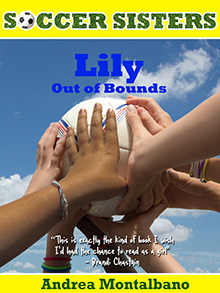
We have three books out right now– Soccer Sisters: Lily Out of Bounds, Mrs.
Claus and the School of Christmas Spirit, and Playing Nice. We have another
10-15 in development for 2013-2014. Most are for Middle-Grade and Young
Adult audiences but we also have an Early Chapter book series in
development.

Where can you buy them?

Both the print and digital versions are available on Amazon. Very soon, you
will be able to get them on all the major platforms. Plus, supporting local
libraries and independent bookstores is very important to us and we are
broadening our presence in both.

How are they selling?

We are thrilled (and humbled) by how well things are going so far. Soccer
Sisters is a middle-grade series that is catching on with soccer playing and
non-soccer playing readers alike. The author and the series’ spokesperson,
Brandi Chastain, were on The Today Show not long ago promoting the book and
we get emails regularly begging for the next installment.  Mrs. Claus was
the #1 Christmas Kids’ Books on Amazon for most of December. And Playing
Nice has over 70 reviews on Amazon and Goodreads. Teenagers love it but so
do 30 somethings who can relate to the travails of high school!

Do your books have a consistent theme or characteristics?

We like all kinds of stories from Adventure to Contemporary Fiction to
Fantasy. But I think the one thing that ties all of our books together,
besides the female characters, is humor. We like books and writers who make
us laugh.

Untitled-1

How did you and your partner come up with the idea for he company? You
both had several other jobs in media. Did your previous professional
experience help you to see the need for ITTM and is ITTM your full time job
now?

It all started when Saira asked me to meet up for drinks to discuss
conceiving of the next Dora the Explorer.  Yes, we realize how hubristic
that must sound!  One year and a thousand iterations later, In This Together
Media was born. It is hard to imagine anything more fun than sitting around
and coming up with stories with one of your oldest and dearest friends.

We’ve both had a few different careers on the way to figuring out what we
wanted to be when we grow up from stand-up comedienne to lawyer to
television news producer to published author. Strangely enough, these
different experiences have given us the tools we needed to be successful.
And being mothers hasn’t hurt either. We share a deep love for reading and
writing and stories.

Where do you see ITTM in 5 years? Do you plan to expand beyond books into
TV, movies, toys, apps, clothing?

World domination. Just kidding.  But seriously, we create stories that we
think can live and grow on a lot of different platforms. So, yes, we expect
to expand into movies and TV, toys and maybe things we can’t even dream
about today. We think BIG. We could definitely be accused of having
delusions of grandeur!

Do you see a lack of strong female protagonists in MG and YA books?

I think YA and MG books have more female protagonists than television or
movies. And there are great examples of interesting, strong girls in some of
these books. But I am troubled by the YA trend of innocent naif meets
worldy-beyond-his-years young man made famous by a certain Vampire series. I
don’t think Romance has to be THE driving plot of every YA book. I also find
that the way female relationships are portrayed is not authentic to my own
experience. I have met few mean girls– mostly, my friends have been the
most important support system in my life. We don’t want to whitewash or show
perfect girls and relationships. We just want them to feel real.

playingnice

I love this question and response from your site: “Do I have to be a girl to read your books or a woman to write with/for you? Absolutely not! Our stories are compelling thrill rides that appeal to girls and boys alike. And we welcome writers with a Y Chromosome to join our team.” One challenge with the “girl empowerment” community, on line and
elsewhere, is that many parents assume it’s not about boys at all. But until
parents read their sons books with girls and take them to movies aboutgirls, gender segregation will continue and so will stereotyping, along with myths that girls will watch movies about boys but boys won’t watch movies about girls etc. How do you market ITTM and what is your plan, if any, to deal with the gender segregation challenge so intensely aimed at kids today?

Thank you thank you for bringing this up!  It is very important to us to
challenge this notion that boys are not interested in stories about girls.
How absurd! It would be a sad world if half the population is not interested
in the other half. We refuse to accept it. My son loves “boy” stuff but also
adores My Little Pony and Strawberry Shortcake. We hope we can help
dismantle the whole notion of “girl” stuff and “boy” stuff.

What are your favorite YA and MG books?

The classics– Roald Dahl and Madeleine L’Engle for Middle-Grade. “Proud
Taste of Scarlet and Miniver” by E.L. Konigsberg was one of my favorite
books as a girl. And Rick Riordan and the Percy Jackson series deserves
every bit of accolades it has received– so good! We have a book club of 4th
and 5th graders and they tell me what to read. They are on top of it. I just
started S.S. Taylor’s “The Expenditioners” and it is great. For Young Adult,
I am about to start “The Fault in Our Stars”. John Green is the man.

Visit in In This Together Media to learn more.

Girls Gone Missing in Gaming: What happened to Krystal?

Feminist Frequency has created an excellent must-watch video on the lack of strong, female characters in gaming, specifically the “damsel in distress” trope. The video begins with the story of Krystal, the fierce and magical protagonist of the game Dinosaur Planet.

The narrator of the video, Anita Sarkeesian, describes Krystal as she was originally meant to be:

The game was to star a 16 year old hero named Krystal as one of two playable protagonists. She was tasked with traveling through time, fighting prehistoric monsters with her magical staff, and saving the world. She was strong, she was capable, and she was heroic.

But as development neared completion, the strategy for the game changed. It was rewritten and redesigned, released in 2002 as StarFox Adventures for the GameCube. Sarkeesian describes the new incarnation:

Krystal has been transformed into a damsel in distress and spends the vast majority of the game trapped inside a crystal prison waiting to be rescued by the new hero, Fox McCloud. The in game action scenes that were originally built for Krystal were converted to feature Fox instead. Crystal is given a skimpier, more sexualized outfit.


Here’s the new Krystal.

krystal-tricky-fox-mccloud-22760695-800-1000

Sarkeesian continues:


The tale of how Krystal went from protagonist of her own epic adventure to the passive victim in someone else’s game illustrates how the damsel in distress trope disempowers female characters and robs them of the chance to be heroes in their own right.

Watching what happened to Krystal on a few minutes of video, I felt like I was watching what’s happened to women throughout history; we’re minor characters in a story that someone else has written. Sarkeesian says: “I’ve heard it said that ‘In the game of patriarchy women are not the opposing team, they are the ball.’ ”

Here’s how the video goes on to describe the “damsel in distress” trope that dominates our cultural mythology:

The Damsel in Distress is a plot device in which a female character is placed in a perilous situation from which she cannot escape on her own and must be rescued by a male character, usually providing the core incentive or motivation for the protagonist’s quest.

Think about how the weak and passive female is so intricately built into our cultural narrative. She’s in stories we’ve heard from birth, from Greek mythology to the Bible to Hollywood. She’s in the books and films that win our highest awards and accolades.

Because the human brain put events into context in order to understand them, this repetitive narrative gets embedded into our minds. If this trope were just one story of many, there would be no issue. It’s the constant repetition, the ubiquity of this story line, especially in the fantasy world marketed to children, that’s so alarming. Girls and boys don’t get to see females act, make important choices, take healthy risks, and become leaders. This sexist narrative affects who we are, how we see each other, and who we become.

This video from Feminist Frequency shows you what happens when a character tries to break free of this restrictive narrative. She’s put right back into her crystal prison. How is Krystal going to get out of there when the guy who’s supposedly rescuing her is the problem? There’s only one way she can break free. She must write her own story.

Here’s the video:

You can read the transcript here.

Update: While making this video, Sarkeesian was the subject of a brutal and organized harassment campaign. On Feminist Frequency, she blogged:

In addition to the aggressive actions against me that I’ve already shared, the harassers launched DDoS attacks on my site, attempted to hack into my email and other social media accounts and reported my Twitter and YouTube accounts as “terrorism”, “hate speech” or “spam”. They also attempted to “dox” and distribute my personal contact info including address and phone number on various websites and forums (including hate sites).

Thank you, Sarkeesian, for having the courage to tell your story while people kept trying to shut you up. We all really need to hear it.

Another cool thing Sarkeesian did: she begun her video with this quote:

This series will include critical analysis of many beloved games and characters, but remember that it is both possible (and even necessary) to simultaneously enjoy media while also being critical of it’s more problematic or pernicious aspects.


She likes games, got it? She likes to play them. She doesn’t want them to be sexist. She wants strong female protagonists. It’s not that fun attacking loveable characters who make up the fabric of America. And guess what? You can be a fan of “Ratatouille” and still be disheartened and discouraged that it’s yet another kids movie where females go missing. Unless we want to live on an island or a mountain top, this is the world we exist in, so stop telling women to shut up or get out already. Attempting to silence female voices– in games, movies, videos, or on the internet– won’t work anyway, because we won’t stop telling our own stories. That’s just human nature.

Update: My six year old daughter watched this video and totally ‘got it.’ Obviously, I’ve talked to her a lot about media literacy, but it was great to have her see this POV coming from someone other than her mom. This video is a great educational tool, and I hope that you show it to your kids.

‘Oz, the Pathetic and Misogynistic,’ only the beginning of sexist year in movies for kids

Maybe the blatant misogyny of the new Oz movie has a positive side. Critics are calling out the sexism, unable to ignore that Dorothy, one of the greatest heroines of kidlit, is being shafted, cast aside, so Hollywood can make a hero out of a famous imbecile and imposter just because he’s a guy.

In the New York Times today, critic Manohla Dargis writes:

The bigger bummer, though, is that the studio that has enchanted generations with Tinker Bell and at least a few plucky princesses has backed a movie that has such backward ideas about female characters that it makes the 1939 “Wizard of Oz” look like a suffragist classic.

Dargis goes on to cite a series of gender cliches promulgated in the movie:

A little sisterly outrage would have been appropriate because, among other offenses, the filmmakers have thrown over Dorothy — one of the greatest heroines in children’s literature and Hollywood cinema — for a two-bit magician and Lothario with female troubles. In Baum’s first book and in the 1939 film the witches are powerful forces for good and wickedness in the Land of Oz. In “Oz the Great and Powerful,” a witch not only falls for the man Oz, she also turns green from envy when he cozies up to a pretty blonde. (Yeah, the baddie is a brunette.)


I wrote about Oz’s sexism a month ago. I suspected it was coming from the title of the movie “Oz, the Great and Powerful.” This moniker and glorifying adjectives while Hollywood refuses to allow female names in titles for kids movies. Also, I’ve read all of the L. Frank Baum books. There are so many great heroines in this series to make movies about, including Ozma, who happens to be the real ruler of Oz, and they pick the phony wizard?  Finally, I had a good idea what to expect from ‘Oz’ because I’m the mom of three young girls. For 10 years now, I’ve been watching sexism aggressively marketed in movies for children and then replicated in the toys, clothing, apps, and games derived from those movies where, except for the Pink Ghetto, males always star and females are invisible.

Parents, please think about what your kids are learning about gender when they go to the movies. Again and again, they see males front and center. Females are sidekicks or not there at all. That is the definition of marginalized. This sexism is happening in the imaginary world, a place where anything should be possible. Instead, leaving girls out acclimates a new generation to expect and accept a world where girls go missing. It’s an annihilation.

Please look at Reel Girl’s Gallery of Girls Gone Missing From Children’s Movies in 2013. Here’s what I wrote about the Gallery:

Of the 21 movie posters for young kids pictured below, only 4 appear to feature a female protagonist; 16 seem to feature a male protagonist and 10 are named for that male star. In one case, “Peabody and Mr. Sherman,” the movie is titled for its 2 male protagonists.

You can find out more about what’s coming up in 2013 here. Unfortunately, ‘Oz, the Pathetic and Misogynistic,’ is just the beginning of a long, sexist year in store for our kids, direct from Hollywood.


Thea Stilton: great series about a pack of cool, smart females ***HHH****

I admit, because I’m one to judge a book by its cover, or a movie by its poster, I was slightly bummed when yesterday, at the book store, my six year old daughter chose Thea Stilton and the Dancing Shadows. Ballet dancers and girls. Can we get any more cliched with gender roles?

dancingshadows

Also, while I didn’t know Thea, I am sort of familiar with her brother, Geronimo. My nine year old has one of his books on her shelf. Why put his name at the top of Thea’s book? If you think that is an irrelevant detail, just conisder how actors fight for top billing and the kind of status, power, and salary that placement conveys.

The good news is that Thea Stilton totally rocks. My daughter and I have not been able to put the book down. This morning, she was still reading it on the way to school to the point of car sickness, finally, letting me tear it away from her so that I could come home and blog about it.

The first page of the book is a letter from Thea:

Hello, I’m Thea!

I’m Geronimo Stilton’s sister. As I’m sure you know from my brother’s best-selling novels, I’m a special correspondent for The Rodent’s Gazette…Unlike my ‘fraidy mouse brother, I absolutely adore traveling, having adventures, and meeting rodents from around the world.

Thea is way cooler than Geronimo. She hangs out with an eclectic pack of female mice friends who call themselves the Thea Sisters. The next 5 pages of the book describe each character. They come from different countries: China, Peru, Tanzania, Australia, and France. They have different passions, aspiring to be an ecologist, scientist, sports journalist, car mechanic, or fashion writer. As far as the fashion writer, whose favorite color is pink, Colette is one out of 6 female characters, and I have no issue with her look or career choice. The problem with pink, princesses, or for that matter, anorexic fashion models, is not they exist at all, but their dominance over representations of females in the media. One out of six into fashion is okay with me.

In this particular adventure, the Thea Sisters are off to Milan, Italy for a ballet competition where they investigate corruption; the judges have been bribed. The story is filled with interesting facts coupled with illustrations about Italy, ballet, and the history of dance. In this way, the book reminds me a little of the Magic Tree House series. Characters have funny names like Madame Rattlova and Professor Ratshnikov. There is a lot of word play and puns about mice and cheese. Two characters are described as different as “provolone and parmesan.” All of this makes the book really fun to read with daughter. There is a lot of opportunity to explain new words and jokes in a context that she was curious about and really wanted to understand. Reading this book with her, I felt like I was watching her brain grow.

While Geronimo has 53 books of his own, Thea has just 14, but we are excited to read them all, especially, for me, the ones that have nothing to do with ballet. Thea Stilton and the Dragon’s Code and Thea Stilton and the Blue Scarab Hunt look great.

Reel Girl rates Thea Stilton and The Dancing the Shadows ***HHH***

L. Frank Baum would hate new Oz movie

A new post on film.com Why ‘Oz the Great and Powerful’ Is A Major Step Back For Witches and Women is so great about what a bummer this movie is. Please read the whole thing.

A couple of important quotes:

Baum was a feminist. He was an avid supporter of women’s suffrage, and was happily married to the outspoken, intelligent, and energetic  Maud Gage

And this:

But even more troubling and disappointing about Sam Raimi’s 3D spectacle “Oz The Great and Powerful” is what character it chooses to crown as its hero: The Wizard.

Why is this sad and troubling? Well, as you go through the Oz series, one fact can’t help but jump out at you:  The feisty, heroic characters of Oz are all young women. Dorothy returns, again and again, to have adventures in Oz. “Tik-Tok of Oz” features a Dorothy surrogate in Betsy Bobbin (no Toto for Betsy! Her animal companion is a mule named Hank.)  Glinda often reappears to do battle.  General Jinjur leads an all-female coup against the Scarecrow, and despite its failure, Baum lovingly stops in to see how she’s faring in the common Munchkin life.

But most intriguing and revolutionary of them all is Princess Ozma, who actually makes her first appearance in “The Marvelous Land of Oz” as a young boy named Tip. Tip is the “hero” of the book until it’s revealed an evil witch named Mombi did a magical gender reassignment, and Tip becomes Ozma, restored not only to her rightful throne, but to her own feminine self. It’s a strange and fascinating twist for both Tip and the audience alike, and one with very modern implications.


I have asked again and again: WHY DIDN’T HOLLYWOOD MAKE THE OZMA MOVIE? SHE IS THE RIGHTFUL RULER OF OZ! THE WIZARD??? THE CHARLATAN? ALL THAT, JUST TO GET A  MALE PROTAGONIST.

Film.com explains it this way:

No doubt the focus group responsible for “Great and Powerful” convinced themselves that female protagonists weren’t marketable…


Hollywood, we want strong, complex female protagonists. DO YOU HEAR? This is bullshit. Teens, little kids, parents, we are all sick of this sexist crap.


High school sophomore calls out lack of complex female characters in media

When Tavi Gevinson was 11 years old, she founded the fashion blog, Style Rookie. Soon Style Rookie was drawing 30,000 visitors a day, got featured in the New York Times, and Gevinson was invited to Fashion Week.

tavi-gevinson1

Gevinson started blogging because, she was trying to “reconcile all these differences that you are told you can’t be when you’re growing up as a girl. You can’t be smart and pretty. You can’t be a feminist who is also interested in fashion. You can’t care about clothes if it’s not for the sake of what other people, usually men, will think of you.”

TGBloggers-Under-21-1

I am so impressed that a pre-teen had the courage to express herself like this. Wow. Her words hit the nail on the head, too. I am so psyched that she calls out the smart or pretty choice foisted on girls and women. It’s bullshit, just a way to keep females down and frightened of power, and teen girls need to know that.

Three years after creating Style Rookie, Gevinson decided to move on from fashion, founding a new feminist site for teen girls, Rookie Magazine, featuring content almost entirely by them.

Gevinson introduced her venture in a TED talk. She begins with the words: “I am a feminist.” Take that Taylor Swift and Katy Perry. Gevinson’s talk is awesome and focused on the theme of female characters in TV and movies. She says that her generation sees few female characters to admire.

“We get these two dimensional superwomen who maybe have one quality that’s played up a lot, like, you know, a Catwoman type who plays up her sexuality a lot and it’s seen as power. But they’re not strong characters who happen to be female, they’re completely flat and they’re basically cardboard characters. The problem with this is is that then people expect women to be that easy to understand… In actuality, women are complicated. Women are multifaceted. Not because women are crazy, but because people are crazy and women happen to be people.”

I will definitely be following Rookie Magazine.

Here’s the TED talk.


She-Hulk author, Marta Acosta, talks to Reel Girl about her book

After the posts around the internet including Reel Girl criticized the new She-Hulk Diaries for appearing like superhero chicklit, author, Marta Acosta, contacted me.

she-hulk-cover-3_4_r536_c534

Acosta wrote:

I was a little flummoxed at the initial reaction to the She-Hulk announcement since I thought people would look me up and see that I’m primarily a satirist and I’ve always addressed issues of gender, race/ethnicity, and class. In fact, I use humor because I can go beyond preaching to the choir and perhaps make people think differently about those issues

Of course, when you’re a Mexican-American, people expect you to write magical realism. When you’re a woman and write a social satire, they assume it’s a romance novel and that you’re anti-feminist. Romance is its own genre with very strict conventions…and I’ve learned that romance writers and fans are generally pretty hardcore feminists. (You should check out the hilarious Smart Bitches website.)

Christine, the author of Rogue Touch, is the penname for a literary fiction writer whose books address gender issues.

Anyway, I like writing comedy and I loved writing She-Hulk, which really focuses on Jennifer Walters trying to have a more normal life, despite the insane time demands of her job as an attorney. The real challenge was finding humor in a character who is described as “painfully shy,” and I hope I succeeded.

ciao!

Intrigued, I asked Acosta some questions. Here’s her take on She-Hulk Diaries.

Why did you write She-Hulk Diaries? Are you a fan of comic books?

My fantastic agent, Peter Steinberg, came up with the idea, and I said, yes, please, I’d love to write it. I liked comic books as a child, but I certainly couldn’t afford them. My older cousin would lend them to us. I’ve always been a fan of speculative stories and tend to prefer darker stories with an element of humor, like Buffy, The X-Files, Battlestar Galactica, Dark City, eXistenz, Firefly, BBC’s Being Human, Misfits…

What is She-Hulk Diaries about?

I can’t really reveal too much now, but the story follows Jennifer Walters, She-Hulk’s human identity, as she finds a new job at a high-powered law firm and is assigned an important case with a mysterious scientist client. Jennifer is as shy as She-Hulk is brazen, and she’s determined to have a personal life besides her work and superhero responsibilities, and that means more social and cultural activities, making more friends and, yes, having a healthy romantic relationship. Between her case load, new superhuman activity, and a terrifying trend in NYC, there aren’t enough hours in the day.

Would you describe it as chick-lit, and what do you think of that term? Who do you hope the book will reach?

I hope my book will reach people who will appreciate my comedy. I use humor to entertain, and I also use it to offer different perspectives on issues of gender, race/ethnicity, and social class. When I was writing political satire, I used humor to get across arguments that might otherwise be rejected by those not already in the choir.

I don’t care one way or the other about the term chick lit. It was used as a way to market humor written by women. It was twisted into an insult, which isn’t uncommon for anything that is female-dominated. I like funny women so I’m absolutely going to pick up funny books written by women.

I don’t think women have to join in on the bashing to prove we’re serious thinkers. Men watch and read all kinds of vacuous crap and no one ever criticizes them and magazines don’t lament that men’s reading is making them brain dead.

Were you surprised by the initial negative reaction to Hyperion’s press release about She-Hulk Diaries?

I was! I’ve been writing positive female characters in a succession of novels, and I’ve frequently written about gender issues so I thought people would at least find out who I am before assuming that my story is about a weak woman obsessed with finding a man. My last novel, Dark Companion, nominated as Best Fiction for Young Adults by the American Library Association, has a feminist theme about exploitation. My Casa Dracula series features a wacky, but bright, brave, and goodhearted Latina who writes unsellable political horror stories.

One young blogger who bashed the She-Hulk novel referred to me as “an authoress.”  I love that! Lately I’ve been calling myself a poetess, because I have poetry in my books, but I’m going to switch to authoress.

The Hollywood Reporter said the book was based on 50 Shades of Gray. I admire the madcap ease with which they made that crap up. People assume it’s based on The Carrie Diaries. I’d guess it’s closer to Samuel Pepsys Diaries…except without the Black Death, although I’d include that if I could have found a place for it. (Favorite book on the Black Death, probably Connie Willis’s Doomsday Book.

The issue for me with the cover of She-Hulk Diaries cover is that we are so desperate for female superheroes– kids and grown-ups.  We want them! We’ve had 5 Spiderman movies, 7 Batman movies, and we’re still waiting for Wonder Woman to hit the big screen. My three year old daughter dressed up as Batgirl for Halloween and everyone called her Batman. She didn’t understand, because she doesn’t know how invisible Batgirl is yet. I dread the day she finds out not only is Batgirl “not cool” but she hardly exists. She-Hulk Diaries is not for kids, but there is a “trickle down sexism” effect when characters adults love become movies The LEGO sets, video games, clothing, and apps marketed to kids all are based on these narratives and when girls go missing that sexist representation effects how all kids learn about gender, who is important and who gets to do the fun stuff. I know we are talking about a cover here, but when our images of strong females are so lacking, for me, it’s a bummer to see lipstick. Do you see She-Hulk Diaries as challenging or perpetuating this kind of sexism all over the media? Do you see a lack of powerful and heroic female protagonists in media for kids?

Here’s the deal with covers: they have to grab attention as quickly as possible as both an actual book and as a tiny image for online sales. I love the cover because it instantly says “funny book about a different kind of woman.” Green and purple are Shulky’s iconic colors, and they could have done a green briefcase because much of the book is about her legal work. Or they could have done an image of a purple gun because she goes to the shooting range. Or…you see where I’m going. Conveying humor in cover art is really difficult, and you just can’t overthink cover art.

I didn’t write She-Hulk as a polemic on sexism (though that would have been fun too), but Jennifer/Shulky is always the smartest person in the room, the bravest, and she has the kindest heart. Although she’s personally shy, she doesn’t hesitate to defend those who need an advocate, and she speaks up for herself, too.

As for the lack of powerful and heroic female protagonists, Hollywood, particularly film, is a boys’ club, and those guys assume that both boys and girls are interested in boy stuff, but only girls will be interested in girl stuff. Case in point: J.K. Rowlings’ publisher asked her to use her initials so that boys wouldn’t be scared off the Harry Potter books.

I’m stunned by movies and shows that don’t even bother to include female characters who do more than act as decoration. I’m continually disappointed by the crap that’s marketed to women. Of course, most of it is written, directed, and produced by men who seem to be basing their knowledge of women on characters in other movies written, directed, and produced by men. I don’t know about children’s programming, but I watch lots of British shows because I like the strong, complex women characters and diversity.

Most men are never going to get it, so women should just make our own movies. There are certainly enough women with the money and talent to produce female-positive shows in this country.

I think men would “get it” if they were not trained early, from birth, to see girls as “other,” if female characters in shows marketed to kids were not condemned to the Pink Ghetto where they do “girl stuff.” Look at Reel Girl’s Gallery of Girls Gone Missing From Children’s Movies in 2013. When female characters are marginalized in almost every movie, what are little kids learning about gender? Are your sons growing up to be a new generation of men who are never going to “get it?” All kids would benefit from seeing strong, cool female protagonists, and as we have seen, there is a huge market for it.

The whole Hollywood myth “girls will watch boys characters but boys won’t watch girls” is because (1) that is all that is offered (2) female characters are relegated to the Pink Ghetto; Girls are obsessed with princesses not because they have a pink gene but because that is practically the only time females get to be front and center (3) Parents are just beginning to notice and challenge their own sexism and read boys stories about girls, take boys to movies about girls, play with toys about girls, but this is hard to do when females are relegated to the Pink Ghetto. It’s why we desperately need more female characters and why “Hunger Games” was so successful. Boys loved the story and girls were psyched to read about a strong, female protagonist.

That said, She-Hulk is not a book for kids. After hearing from Acosta what the book is about and why she wrote it, I’m excited to read it. I’ll let you know what I think.

Find out more about Marta Acosta and her books at www.martaacosta.com


What’s the difference between Gloria Feldt’s ‘No Excuses,’ and Sandberg’s ‘Lean In?’

A couple years ago, I read No Excuses: Nine Ways Women Can Change How We Think About Power by Gloria Feldt, the former CEO of Planned Parenthood. While reading the recent criticism all over the internet of Sheryl Sandberg’s new book, Lean In, I thought of Feldt’s similar book. I couldn’t remember a feminist backlash against that author. Was I remembering Feldt’s thesis incorrectly?

9781580053884

Here is how No Excuses is described on Amazon:

In No Excuses, feminist icon Gloria Feldt argues that the most confounding problem facing women today isn’t that doors aren’t open, but that not enough women are walking through them.


Whoaa– Feldt wrote about that? Did feminists freak out?


From the boardroom to the bedroom, public office to personal relationships, she asserts that nobody is keeping women from parity — except themselves.


OK, that’s not a true statement about the world, obviously, and having read the book, from what I remember, that is not what Feldt writes either. In the book, Feldt teaches women how to think about power in a different way in order to embrace it. For example, she talks about how women, having been on the bad end of the power spectrum for so long, often identify power negatively, as “power over,” as dominance. Feldt encourages women to, instead, look at power as “power to,” as competence.

The synopsis goes on:


Through interviews, historical perspective, and anecdotes, examines why barriers to gender equality still exist in American society and discusses how to break them down through organized efforts using movement-building principles.


Ah…this sentence seems seems more ambiguous than the last one. Barriers still exist. The book discusses how to break them down with organized efforts and movement building.

Feldt employs a no-nonsense, tough-love point of view to expose the internal and external roadblocks holding women back, but she doesn’t place blame; rather, she provides inspiration, hope, and courage — as well as concrete “power tools” to aid women in securing equality and justice for themselves — articulated with personal warmth and humor. No Excuses is a timely and invaluable book that helps women equalize gender power in politics, work, and love.


So does this thesis sound familar to you? Can you imagine if Sandberg called her book No Excuses? She’d be tarred and feathered, which she basically has been, in our contemporary way. Sandberg was quoted out of context in the New York Times and Washington Post, not to mention all over the internet, to make her seem like a selfish bitch.

The Washington Post piece is headlined:

Sheryl Sandberg’s ‘Lean In’ campaign holds little for most women

Here’s the lede:

”She had it all — a husband, children, a beautiful home, a seat on the board of a billion-dollar company, a nine-figure net worth of her own. But there was one thing Sheryl Sandberg didn’t have. “I always thought I would run a social movement,” Sandberg said in the PBS/AOL documentary series “Makers.”

But Sandberg wasn’t actually saying she wrote a book because she wants a new toy. Her quote is from a documentary, “Makers,” when she was being interviewed about her career. Sandberg explained that she always thought that she would work at a non-profit and not in the private sector. Here’s the full quote:

I always thought I would run a social movement, which meant basically work at a nonprofit. I never thought I’d work in the corporate sector.

The New York Times printed a correction. The Washington Post has not.

As Gloria Steinem wrote on her Facebook page in her defense of Sandberg: “Only in women is success viewed as a barrier to giving advice.”

In the Guardian today, Jill Filipovic addresses the backlash:

Sandberg did what feminists are always asking powerful women in business and politics to do – stand up for gender equality – which is why it’s so disappointing to see many in the feminist camp essentially telling her to shut up and sit down.

Feldt started out as a teen mom from rural Texas. Most of us know Sandberg as a rich exec at Facebook. So is class bias a good reason to determine that Sandberg has nothing to say to help America’s women?  On the contrary. Didn’t anyone just watch “Makers” for goodness sake? History has shown that when feminism can’t overcome its own prejudices, the move forward is much slower than it needs to be.


My daughters get inspired by Harry Potter

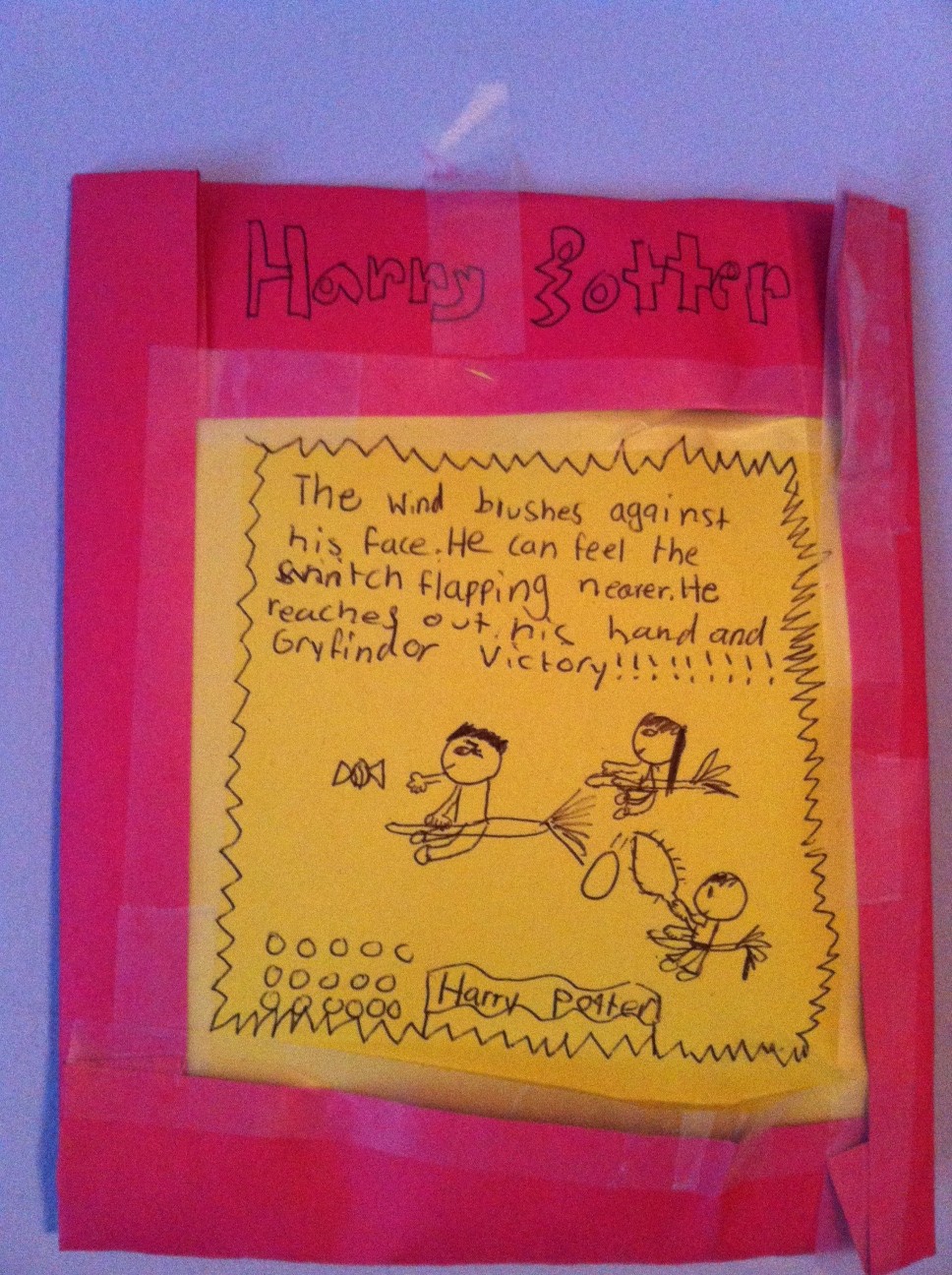
When my nine year old daughter was reading the Harry Potter series for the third time this year, she drew this picture: harrylucy

This scene didn’t happen in the book but she was inspired by the book.

Lucy’s drawing shows a typical gender matrix you see all over children’s media: 2 boys, 1 girl; boy in front, girl behind; text supports male competition and victory.

Last year, when she was asked to write a story during school, Lucy used a male protagonist. When I asked her why she chose a male, she said, “Because everybody did.”

Can you imagine if in a class of third graders, every kid wrote about about female protagonists? Do you think the teacher would notice?

I just blogged about how my six year old daughter has started reading Harry Potter. Last night, we took turns reading to each other. We are at the part in the book where Harry is with Hagrid, shopping for his first broom in Daigon Alley. Alice, like Lucy, was inspired to create her own scene.

witchphoto

She made up this character, a witch and her cat soaring through the sky on a broom surrounded by many crescent moons. I was pretty psyched about this witch, but then again, we’re only on Book 1. Do you think it’s possible to get through this wonderful series, not to mention her childhood, with her still drawing magical, powerful females, and putting them front and center in her stories?