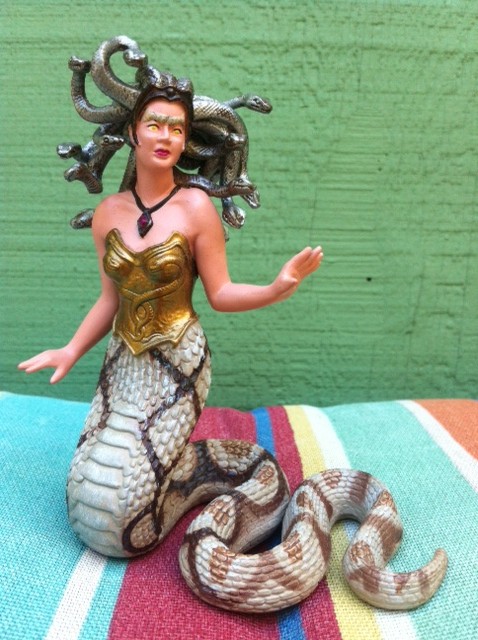
I found her at the same store I got this one, the Ark in San Francisco.

Actress, comedian, and talk show host, Whoopi Goldberg, was a “Star Trek” fan as a kid.

She’s spoken about her ecstatic reaction when she saw U.S.S. Enterprise crew member, Uhura, on TV for the first time.
“Well, when I was nine years old Star Trek came on. I looked at it and I went screaming through the house, ‘Come here, mum, everybody, come quick, come quick, there’s a black lady on television and she ain’t no maid!’ I knew right then and there I could be anything I wanted to be.”

Do you see how reality influences fantasy influences reality and creates our world? Just to remind you, that’s the same world that our kids live in. Art inspires us to dream big, except when it doesn’t.
Last week, actress and writer Jennifer Sky wrote an Op-Ed for the New York Times about her experience working as a model.
I was given drugs, then coerced into going topless for a shoot. I learned the hard way that my body was not my own.
After a series of horrible experiences, Sky quit modeling. She got a job acting as a warrior princess. That role changed her life, how she saw herself, and how she experienced the world.
During my time on the show, on six episodes from the fourth to the fifth seasons, I kicked butt. Off screen, I was trained in numerous fighting techniques, in archery and horseback riding. On screen, I hung with a Christ figure called Eli; I had a same-sex lover and a boyfriend of a different race than mine; I threw bombs and walked along high wires. I killed so many bad guys that they began to look the same…Gender was not relevant in the Xenaverse. There, a girl or a boy could be a warlord or a farmer, a bard or a sad sack needing protection.
If playing and seeing powerful females in fiction is so inspiring and life changing, why, again and again, in kids’ media, do girls go missing? Why do we hardly ever see female protagonists? This summer, all the movies that came out for little kids– and I saw every one– starred a male character. When I blog about this pattern of sexism– as I did, regarding the lack of female competitors and winners in “Planes”– I receive hundreds of comments dripping with sarcasm like this one.
The actual race in Planes is totally dominated by male competitors.” How shocking! You mean in real life the actual race is not dominated by male competitors?… This stuff is silly nonsense.
WTF? This is a movie about planes who talk to each other, and the commenter is concerned about “real” life? “Turbo” is a movie about a snail who wins the Indy 500. A snail. Who talks. And befriends a human. (A human male, by the way, with a brother, but I digress.) And that’s all well and fine, but a female winning a race, that is totally unbelievable.
I can go on and on with examples of sexism in the fantasy world justified because there’s sexism in the real one. In “Lion King” the lionesses have to sit around, doing whatever skinny, weak, old Scar wants because only lions can lead a pride. Yet, Simba is BFFs with a Warthog and a meerkat, not to mention, he sings and dances. All that is totally plausible? “Ratatouille” is a movie about a rat who can cook. We get to see just one female chef, Colette, who has a brief monologue explaining the lack of females in the movie. French kitchens are sexist so the film is too, got that?

While we’re talking about “real life,” here’s a question for you. If, when it comes to gender, writers and producers of movies for kids, not to mention viewers, are such sticklers for “reality,” why are there so many, should we say, discrepancies? Reel Girl commenter, Nebbie, keeps a list of male characters in animation who, in the “real” world, would be female:
1) Barnyard movie and video game, Back and the Barnyard: male cattle with udders
2) The Madagascar movies and specials, The Penguins of Madagascar: Joey the male kangaroo with a pouch, male hornets with stings, King Julien the dominant male ring tailed lemur (Only female kangaroos have a pouch, ring tailed lemurs are matriarchal.)
3)Bee Movie: male worker bees, male bees with stings, Mooseblood the male bloodsucking mosquito (Only female bees, wasps, including hornets, and some ants have a sting because the sting is a modified oviposito)
4)Turbo: male snails, Burn the one female snail (Garden snails are hermaphrodites)
5) A Bugs Life, The Ant Bully, and Antz: male worker ants (Worker ants, bees, and wasps are all sterile females, the males are drones and they die soon after they mate with the queen– fertile female– ant, bee, or wasp.)
6) The Jungle Book: male elephant herd and leader (elephants are matriarchal)
7) Fantasia: female ostriches with male black and white plumage
8) Puss in Boots: The Three Diablos: Gonzalo the male tortoiseshell kitten (Most tortoiseshell cats are female. A male cat can only be tortoiseshell if it has Klinefelter’s Syndrome– XXY, usually sterile– has chimerism, or has mosaicism.)
9) Finding Nemo: Marlin the clownfish stays male after his wife died (Clownfish are protoandrous hermaphrodites; they are born male and the the most dominant male turns female when the dominant female is removed from the group.)
What’s so creepy about this is how often what is “natural” is used to justify sexism. Girls “naturally” love pink, princesses, shopping, and gazing at themselves in the mirror. Bullshit.
So here’s my question: Why, as parents, do we allow our kids to see, again and again, an imaginary world with the same manufactured sexism as the real world? It limits children, to say the least.
In the fantasy world, anything is possible. If we can’t even imagine a world without sexism, we can’t create it. And we must. If we live in a classist, racist society where women of color are maids for rich, white people, we owe it to children to show them a world where women of color are depicted as leaders and heroes. Recycling sexist narratives keeps a new generation stuck in a biased world. Don’t we want something better? When will Uhura get to captain the ship?
Having been out at a pool for a little too long yesterday, my daughter asked me to take a pic and post her favorite toy, Sunburn, on Reel Girl. Here are the two of them.
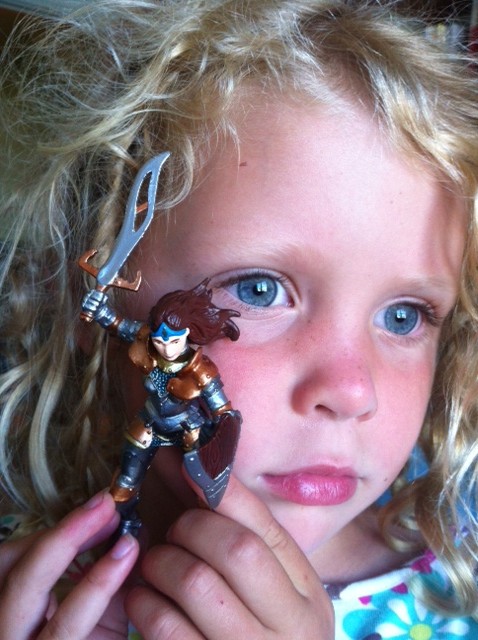
I’m being asked where to get her. To clarify, my daughter named her Sunburn. I bought her in a store in San Francisco. Will find out more about her…
We got this at the Ark.
I’m reposting Reel Girl’s list of great movies starring girls because I just updated it. Please let me know if you have movies to add. I’m also posting my initial preamble to my recommendations, explaining why it took me so long to make the list and why Reel Girl’s list is hard to get on.
This is a list of girl centered movies with strong girls. That sentence may seem redundant but sadly, it’s not. Many girl centered movies feature a girl who is a princess in distress or a cheerleader trying to keep a boyfriend or Barbie worrying about how to dress for the prom.
Or, if Hollywood allows a strong girl to appear in a movie that is not about a typical, cookie cutter “feminine” dilemma, her screen time is limited; her role is supporting: she is there to help the boy on his quest.
To clarify: the following is a list of movies with strong female main characters where the narrative is based on her brave quest.
This is not a list of HHH (triple Heroine) movies. Some movies may be included on this list such as a Barbie adventure or Kim Possible that would not get a HHH because of the main character’s plastic looks or typical princessy dilemma, but the movie is listed here because, in spite of that stereotype, it is still centered on a brave female hero who has cool adventures.
A few movies are not included on this list even though they are centered on a girl and her brave quest because the movie is simply too awful, meaning boring. “Judy Moody,” unfortunately, fits that category.
Wow, this is why it has been so hard for Reel Girl to recommend, but here we go.
These movies are for kids, not young adults.
Remember, these are movies to show your sons as well as your daughters.
This is a list in progress. Please send in your suggestions.
Reel Girl’s list of great movies starring strong girls:
Spirited Away HHH
My Neighbor Totoro HHH
Kiki’s Delivery Service HHH
Ponyo HHH
Mulan HH
Alice In Wonderland (2010) HHH
The Golden Compass HHH
Barbie Fairytopia: Mermaidia HH
The Powerpuff Girls HH
Wonder Woman HH (2009)
Nausicaa of the Valley of the Wind HHH
Coraline HHH
The Wizard of Oz HHH
Mary Poppins HH
Pippi Longstocking HH
The Lion, the Witch and the Wardrobe HHH
The Last Unicorn HH
The Secret World of Arrietty HHH
Avalon High HHH
Wrinkle in Time HHH
Matilda HHH
Nim’s Island HHH
Brave HHH
Epic HH
The Croods HH
Ramona and Beezus HH
Kit Kittredge: An American Girl HHH
Fly Away Home HHH
Movies suggested to me that I have not yet seen:
The Secret Garden
Anne of Green Gables
Tinker Bell
Tinker Bell sequel
The Voyage of the Dawn Treader
Nancy Drew
National Velvet
Samantha: An American Girl Holiday
The Fox and the Child
Leafie a Hen Into the Wild
The Cat Returns
Whisper of the Heart
The Secret of N.I.M.H.
Castle in the Sky
The Wolf Children Ame and Yuki
Empress Chung
Yobi the Five Tailed Fox
Akeelah and the Bee
Wild Hearts Can’t Be Broken
Nanny McPhee
An American Girl: McKenna Shoots for the Stars
Heidi
Ronia the Robbers’ Daughter
Sailor Moon, the movie 1 & 2
Pippi Longstocking sequels
Madeline
The Worst Witch
Return to Oz
The Secret of Roan Inish
Laura’s Star
Olive, the Other Reindeer
Home on the Range
Cave of the Golden Rose
Cardcaptor Sakura
The Girl Who Leapt Through Time
Totally Spies
More Reel Girl lists
After finishing the book this morning, we downloaded the movie, “A Wrinkle in Time.”
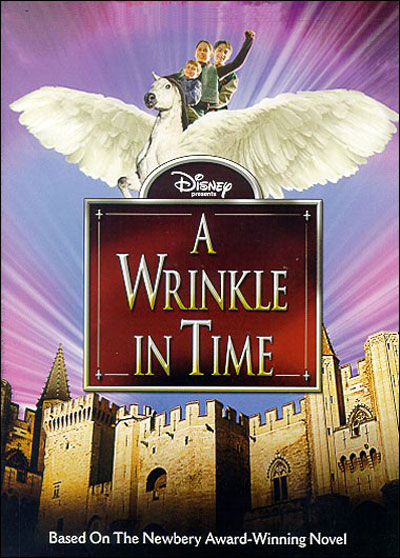
It’s really good. Watching it, I realized there’s even a female I missed mentioning in my review of the book: the Happy Medium. Though in the movie, this character is played by a man, yet still referred to as she.
No surprise that the book is better. The special effects are low budget and cheesey, but I don’t think my kids noticed.
One scene from the movie that is better than the book is when Mrs. Which explains a tesseract, or a wrinkle in time. In the book, Mrs. Which brings a string together, in the movie a piece of material, to show how a bug can shortcut across a big space by ‘wrinkling’ the distance. In the movie, Mrs. Which refers to the bug as “she.”
One last cool thing about the movie. My four year old daughter burst out: “I want to be Meg! Don’t you?”
Professor and blogger Rebacca Hains appeared on “Fox and Friends” today and made excellent points about the ramifications of gender segregated toys and what we’re teaching kids through sexist marketing. The show started with Sabrina Schaeffer of Independent Women’s Forum, justifying gender segregation in toy stores:
It doesn’t mean that girls can’t go on to do anything that little boys can go on to do. It’s just that they like to play differently, and that’s okay.
This is a common argument for gender segregation of little kids. Nothing wrong with marketing make-up and dress up and shopping toys to girls. It’s just play, silly. No big deal.
The show ends with this point from Hains:
some girls want the chemistry set. And they shouldn’t feel like it’s just for boys. If we don’t say, “Hey, these are jobs for men and these are jobs for women,” why would we say, “These are toys for boys and toys for girls,” when toys are really kids’ work?
Don’t we want more female chemists? How is that going to happen?
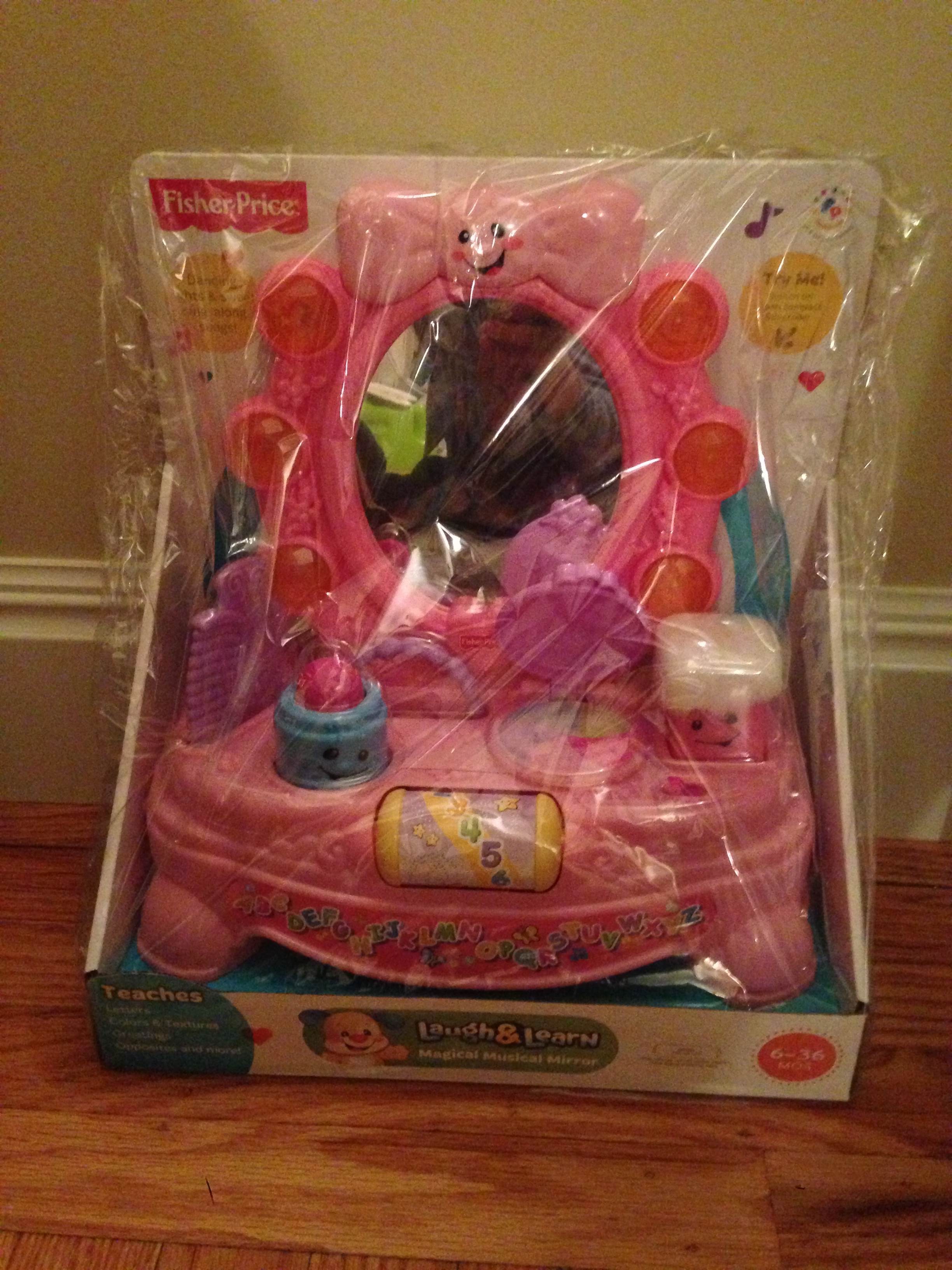
Check out what my friend’s 6 month old daughter just received from her grandmother. (Can you read “teaches” and “laugh and learn?” below) 6 month old child, from her grandmother.
Watch the video and read the transcript here.
I just finished A Wrinkle in Time, and I have chills. This is the book I have been waiting to read. Not only do I love the story and the characters, but it’s beautifully written.
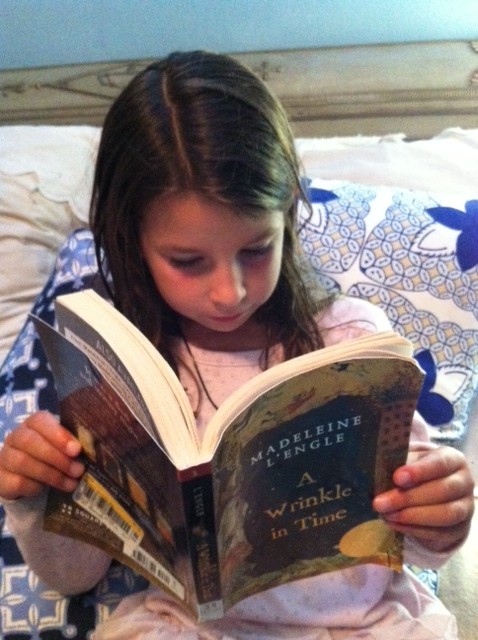
The protagonist, Meg, is not a Minority Feisty.
So many books I love with strong female protagonists like The Wizard of Oz, Lion, the Witch and the Wardrobe, Alice and Wonderland, The Golden Compass, surround the girl with males, males, males. So many writers seem comfortable allowing a female be powerful as long as her gender is resresented by a minority of characters in the book. Not so with Wrinkle. Not only do we have Meg, but also Meg’s mother, a scientist. Wrinkle is, in fact, all about science. How cool is that?
Besides Meg’s mother, there is a trio of powerful and magical females: Mrs. Whatsit, Mrs. Who, and Mrs. Which. That’s not all. Near the end of the book we meet another amazing female, the incredible Aunt Beast. In Wrinkle in Time, readers see five powerful females mentor a female protagonist. Does anyone know of another narrative on earth where we see this? If so, please tell me, because from my experience, this scenario is like seeing a unicorn in the real world.
Here’s the passage where Aunt Beast names herself for Meg:
“What should I call you, please?” Meg asked.
“Well, now. First, try not to say any words for a moment. Think within your own mind. Think of all the things you call people, different kinds of people.”
While Meg thought, the beast murmured to her gently. “No, mother is a special,a one-name; and a father you have here. Not just friend, nor teacher, nor brother, nor sister. What is acquaintance? What a funny, hard word. Aunt. Maybe. Yes, perhaps that will do. And you think of such odd words about me. Thing, and monster! Monster, what a horrid sort of word. I really do not think I a am a monster. Beast. That will do. Aunt Beast.“
Part of what I love about this passage is that every writer goes through a similar process as she thinks of how to name a character. So often, a writer will assign this kind of powerful character the male gender, but the character could be any gender as this writing shows.
For much of Wrinkle, there is the typical one female (Meg) to two male (Charles Wallace and Calvin) trio. But given all the female characters in the book, Meg is still, not a Minority Feisty.
Meg saves the world alone.
Every hero gets to a point where she realizes that she, and only she, can save the world and she must do it alone. (That premise was hilariously mocked by the ‘one man’ video. If you haven’t watched it yet, you should. What I liked about the video was how clearly it demonstrated the repetition of one MAN.)
Narratives mimic real life and real life mimics narratives, it’s all the same thing really. If we are willing to recognize it, we all get to the point where we realize we must do it alone. Sometimes that thing is dramatic, when we give birth or it could be when we write a novel or when we confront someone we’ve been afraid to. But it can also be something like cleaning your house or making your bed. If you live your life heroically, realizing only you can do it, happens all the time, without resentment but with a sense of destiny. It is this revelation upon which endless narratives are based, but so often, in fiction, this human situation is assigned to males. I just wrote about an exception to this rule in Land of Stories. Here it is in Wrinkle the whole sequence: Someone else do it, I can’t; okay, I will. I must be me, here I go. Resistance, choice, action:
Meg could no longer stand it,and she cried out desparingly, “Then what are you going to do? Are you just going to throw Charles Wallace away?”
Mrs Which’s voice rolled formidably across the hall. “Ssilencce cchilldd.”
But Meg could not be silent. She pressed closely against Aunt Beast, but Aunt Beast did not put the protecting tentacles around her. “I can’t go!” Meg cried. “I can’t! You know I can’t.”
“Did annybbodyy ask yyou ttoo?” The grim voice made Meg’s skin prickle into gooseflesh.
She burst into tears. She started beating at Aunt Beast like a small child having a tantrum. Her tears rained down her face and spattered Aunt Beast’s fur. Aunt Beast stood quietly against the assault.
“All right, I’ll go!” Meg sobbed. “I know you want me to go!”
“We want nothing from you that you do without grace,” Mrs. Whatsit said, “or that you do without understanding.”
Meg’s tears stopped as abruptly as they had started. “But I do understand.” She felt tired and unexpectedly peaceful. Now the coldness that, under Aunt Beast’s ministrations, had left her body had also left her mind. She looked toward her father and her confused anger was gone and she felt only love and pride. She smiled at him, asking forgiveness, and then pressed up against Aunt Beast. This time Aunt Beast’s arms went around her.
Mrs. Which’s voice was grave. “Whatt ddoo yyou unnnddersstanndd?”
“That it has to be me. It can’t be anyone else. I don’t understand Charles, but he understands me. I’m the one who’s closets to him. Father’s been away for so long, since Charles Wallace was a baby. They don’t know each other. And Calvin’s only known Charles for such a little time. If it had been longer, then he would have been the one, but–oh, I see, I understand. It has to be me. There isn’t anyone else.”
In the passage where Meg fights IT, just as Harry Potter with Voledemort, she wins by using love over hate. This is the scene I was longing for in kidlit while reading all 7 of the Harry Potter series. Reading ‘A Wrinkle in Time’ felt, to me, like a starving person getting food.
Though Wrinkle is not without sexism. Here’s a scene from the planet Camazotz:
She walked along the quiet street. It was dark and the street was deserted. No children playing ball or skipping rope. No mother figures at the doors. No father figures returning from work.
There are other instances like that one, but there is so much positive here. Wrinkle is a writer’s book, too. I’ll leave you with one last passage that is one of the most beautiful metaphors for creativity, God, raising children, life, that I’ve ever read. Here’s Mrs Whatsit explaining a sonnet to Calvin.
“It is a very strict form of poetry, is it not?”
“Yes.”
“There are fourteen lines, I believe, all in iambic pentameter. That’s a very strict rhythm or meter, yes?”
“Yes,” Calvin nodded.
“And each line has to end with a rigid rhyme pattern. And if the poet does not do it exactly this way, it is not a sonnet, is it?”
“No.”
“But within this strict form, the poet has complete freedom to say whatever he wants, doesn’t he?”
“Yes,” Calvin nodded again.
The trick here, for me anyway, is figuring out what the form is. Sometimes, we believe that the “rules” are the rule, that they are “natural.” For example, in so many narratives for kids, not to mention adults, like Ratatouille, have seen a Minority Feisty complain about sexism, instead of getting to see a female hero. That is “rule” that desperately needs to be broken. The resistance, choice, action is a rule I believe in.
Many of you have asked me to clarify what ages books are appropriate for. It’s hard for me to say that. We get different things about books at different times.
When I look at books or movies for my kids, the number one offensive thing is sexism. I would rather my kids hear swear words than see Cinderella any day. I’ve also written quite a lot of Reel Girl about violence. I don’t like gore, but much of violence in stories is metaphorical, it raises the stakes to depict visually what we, as humans, feel. Can you imagine dreams without violence? My daughter whipped through Wrinkle in Time. She just turned 7. I’m 44 and I’m blogging about it. I could tell my daughter really liked it, and she read a lot of it by herself. I’m not sure what she ‘got.’ I remember being confused by parts of this book as a kid. I do know that while reading this book, my daughter saw many females being brave and heroic, respected, admired, and loved my the males in their lives.
Reel Girl rates Wrinkle in Time ***HHH***
If there’s one really useful thing I’ve learned in my 10 years so far of being a parent, it’s not to pigeonhole my kids. Kids change, and when I assign attributes of a certain stage as if they were permanent personality traits, I can see how it limits them. I get the urge to do this. It’s nice to for a parent to feel like a child has a clear identity. Also, if you have multiple kids, putting them in different categories can smooth things out. Every child has her little box and as a parent, you can work to protect those boundaries for her. Pigeonholing kids can reduce conflict in the short term.
The first way I clearly learned that pigeonholing had a negative effect was with food. Since my kids could eat, I encouraged them to try different foods, that there are no “good” foods or “bad” foods. My kids don’t have to eat broccoli and then get dessert. We don’t even do dessert. They can eat what they want, when they want. There is much writing about this on Reel GIrl, more from when I first started this blog then now, because we are practically food conflict free in our house. The segue is that, because of this philosophy, I never said: “This kid likes pizza, that one likes bagels.” Instead, I told them that their taste buds change all the time, and to keep trying foods, even if they think they don’t like them. I honestly believe, just that, has kept their eating open and flexible. They are risk-takers with food, which may not seem to a big deal for an adult, but it is for a kid.
Obviously, I’m also against pigeonholing because I hate how women are continually fragmented: the smart one or the pretty one. Humans are complex. Pigeonholing them is an a illusion of a simplicity.
Finally, not to get too Buddhist here, but change is the only thing that is real. It’s scary for everyone, but I think it’s much healthier to train kids to embrace it rather than avoid it.
Why I’m writing all this right now is because Princess Free Zone just posted a New York Times article: Mystery of the Missing Woman in Science. It’s great, please read the whole thing, but here’s a quote I love:
And this is true. It’s called brain plasticity. Your brain changes and grows for your whole life, based on your experiences. Your brain grows most rapidly, when you are a kid. The more experiences, the better.
After I shared my post From Diagon Alley to Panem, girls ‘choose’ pink on Reel Girl’s Facebook page, Kari commented:
A sentence in my daughter’s book for 8-12 year olds (“Creep Over: Read it and Weep” by P.J. Night):
“Her mom was really smart, just not at math–even third grade math.”
ARGH!
One of these quotes would not be a problem, but there’s a pattern of it in kids’ media. It’s what Melissa Wardy of Pigtail Pals calls the “drip, drip, drip.” No one even notices the repetition of sexism, it’s become so normal. And by the way, this sentence could describe me. I’ve posted about how much I hate helping my daughters with math. I hated math. They can tell. They read or write, I’m totally into it. They do math, my husband helps them. Thus, I pass the gender stereotype on to a new generation. There are a multitude of reasons why girls are supposed to be good at art and words, not math and sciences, many of which I’ve blogged about. But it’s not “natural” for all girls anymore than it is for girls to wear pink.
So, I’d like to ask you, as you’re reading books with your kids, please post sexist, stereotyped quotes in this comments section or on Reel Girl’s Facebook page. I’m really curious about them. I can think of one that has always bugged me from Ramona about how she has boring brown hair and brown eyes. I can’t stand reading that to my brown-eyed, brown haired daughter. Again, if this were one book, but when so many book have blonde, blue-eyed heroines, when we just saw this dichotomy again in “Smurfs 2.” Enough already.
Besides finishing the Harry Potter series this summer, I got to read Catching Fire and Mockingjay, finally completing The Hunger Games trilogy.

I am a huge fan of this series. Panem remains the only magical world I have read about or seen on TV or in the movies where gender equality exists. If you know of another one, please tell me. I am not referring to a world where a female protagonist fights against or overcomes sexism. I am referring to a world where there is no sexism.
In Panem, females and males are in power positions. Both genders are, consistently, commanders of armies, directors of films, murderers, heroes, doctors, victims, and presidents. Males and females can be weak or strong, compassionate or cruel, leaders or followers. Characters in Panem are portrayed as complex individuals with conflict and contradiction just like real humans.
So here’s the only passage, the only passage, in the whole trilogy where I found stereotypical sexism from the year 2013 infecting Panem. Both women and men in Panem wear make-up. Vanity depends on profession and geography, not gender, so it’s not the make-up that bugged me here.
But its Posy, Gale’s five-year-old sister who helps the most. She scoots along the bench to Octavia and touches her skin with a tentative finger. “You’re green. Are you sick?”
“It’s a fashion thing, Posy, like wearing lipstick,” I say.
“It’s meant to be pretty,” whispers Octavia, and I can see the tears threatening to spill over her lashes.
Posy considers this and says matter-of-factly, “I think you’d be pretty in any color.”
The tiniest of smiles forms on Octavia’s lips. “Thank you.”
“If you really want to impress Posy, you’ll have to dye yourself bright pink,” says Gale, thumping his tray down beside me. “That’s her favorite color.”
When I read that section, I groaned. Of course, there’s nothing wrong with one little girl among many declaring pink is her favorite color. But, in 2013, pink has become such a symbol of the way marketers limit diversity, limit girls, and gender segregate toys and products for kids. How many colors are there in the world? How many “choices” do little girls get? it bummed me out to see a four year old girl, the only one in the series I remember, get her love for pink affirmed.
I have many complaints about gender stereotyping in Harry Potter, but one of the scenes that really got under my skin is about pink. The Weasley twins’s magical store, Weasley ‘s Wizard Wheezes, is so cool and creative, but it turns out to be as sexist and gender segregated as as any Target. Here’s Fred Weasley doing some marketing:
“Haven’t you girls found our special WonderWitch products yet,” asked Fred. “Follow me, ladies….”
Near the window was an array of violently pink products around which a cluster of excited girls was giggling enthusiastically.
What’s the problem with this? Just a couple days ago, when I posted about sexism and gender stereotypes at the shoe store, Stride Rite, I received hundreds of comments like this one:
Normal boys will NOT wear pink…It’s just a fact of nature.
I remind you once again, that it’s not. Pink was first a “boy” color, a version of red which symbolized strength. Blue was a “girl” color, associated with the Virgin Mary. That’s why in the early Disney movies, Cinderella, Sleeping Beauty, and Alice in Wonderland all wore blue.
How many times, when challenging gender stereotypes, do we hear the argument that these limits placed on girls are just natural?
In 2013, when children and adults see, again and again, that girls in fantasy world, whether its books, TV, movies, or toys, consistently “choose” pink, it appears to validate misconceptions like the commenter’s above. And if girls “naturally” prefer pink, it follows that they are naturally drawn to all those pink things, whether its princesses, toys about make-up, shopping, or fashion.
Of course, what the persistence of pink in the fantasy world really shows, is that writers, directors, and producers all live in and are influenced by the sexist real world. That is why, obviously, that the fantasy world, a world that should have limitless possibilities, where anything is possible, often turns out to be as sexist as the real one. We ought to be showing kids something more imaginative.