“On May 11th Brave‘s Merida will be officially crowned as the 11th Disney Princess, the impact of which is that Disney will be selling more stuff with her on it, I guess? Anyway. Along with the “coronation ceremony,” to be held at Walt Disney World, Merida’s gotten a new redesign…”
Here’s one of my favorite pre-botox, pre-makeover Merida expressions.
Pithy analysis from Peggy Orenstein on the eventual fate of way too many of Disney’s female characters:
Because, in the end, it wasn’t about being brave after all. It was about being pretty…I’m especially creeped out by Belle who appears to have had major surgery… In addition to everything else, they’re pushing the brown girls slowly but surely to the edges…
I’ve always said that it’s not about the movies. It’s about the bait-and-switch that happens in the merchandise, and the way the characters have evolved and proliferated off-screen. Maybe the problem is partly that these characters are designed in Hollywood, where real women are altering their appearance so regularly that animators, and certainly studio execs, think it’s normal.
‘The surgery takes away their individuality and uniqueness and its sad. Most are beautiful without it but telling them that their Korean ethnic features are in fact lovely is as effective as screaming at a brick wall.
‘They wont believe you because they’ve been brainwashed to think westernization of their features is superior, I don’t think they want to look white, but a mix of white and Asian and definitely less Korean.’
This is how one “beauty” queen describes herself:
The student revealed her plastic surgery secret after photos emerged of her looking very different at school, but she said she hadn’t misled anyone.
But she defended her crown telling the Korean media: ‘I never said I was born beautiful.’
So sad because this generic look has absolutely nothing to do with “beauty” and everything to do with power, Westernization, capitalism, and status. TV host Stephen Colbert explained it well when he jokingly asked teen writer/ phenom Tavi Gevinson: “But if girls feel good about themselves, how will we sell them things they don’t need?”
How indeed? I was a huge Merida fan, as were my kids, and I bought my three young daughters several figures, books, and posters featuring her because she was cool. Here’s a framed poster over my four year old daughter’s bed so she can see her when she goes to sleep at night, along with her favorite Merida book.
Like Merida, my daughter, Rose, has wild, curly hair that she hates to have brushed.
I hope my daughter never feels that she has to look generic and homogeneous in order to be “beautiful.” I hope she always knows that her beauty comes from her spirit. That’s not some meaningless cliche. There’s nothing “attractive” about frozen-faced clones. Disney’s new, madeover Merida has absolutely nothing to offer my kids. I won’t be buying ANY merchandise with this awful, new image.
Reel Girl rates the new Merida ***SSS*** for major stereotyping.
Before I write about Reel Girl’s pick of the week, I’ll come clean on two issues: I never do this feature once a week, and I have not read The Doll People in full. I have read enough to know the book is charming and stars no less than three adventurous female characters. My six year old daughter is obsessed with the book, and finished it without me. I just bought her the two sequels. I’m inspired to tell you about now, because I just looked at her book report and it looks like a report made for Reel Girl. Here it Alice’s homework verbatim, worksheet questions in bold.
Title: The Doll People
Author: Ann M. Martin and Laura Godwin
How many pages? 256
Main characters? Anabelle, Tiffany, Auntie Sarah
The Best Part: is when they found Auntie Sarah. She was in the attic but her dress was stuck under a suite case. So Tiffany and Annabelle had to try to get her dress unstuck.
Did you enjoy the story? Yes
Why? Annabelle and Tiffany. They were brave a lot. They were very smart and read a lot of books.
Because I am one to judge a book by its cover, I probably wouldn’t have chosen this one. It’s about dolls and the one shown here has a pink skirt and a pink bow. This book came into our house because my older daughter’s friend, Calvin, gave it to her for her birthday when she was in first grade. I’m glad it found a way in past my prejudice.
What I love most about this book is that Auntie Sarah disappeared because she was so adventurous, she couldn’t stay safe, confined in her dollshouse home. Sarah’s niece, Annabelle, has the same spirit and this story is about how she gets the courage to follow her heart and how her family also comes to accept and admire her rebellious nature.
Based on Alice’s review along with sections I read, Reel Girl rates The Doll People ***HHH***
Someone commented on Reel Girl’s Facebook page: please note what age books are appropriate for. My daughter is almost seven. She loved it. It’s a chapter book. I think 6 – 10 would be ideal. Let me know if your kids have read it.
Women writers, have you ever been told that your female protagonist isn’t “likeable”? Ever been told that after you wrote an autobiographical novel? When my agent sent mine out, that was the response we got. The editors said, “Great writing, but that character, she’s not nice enough.” That response reminds me of strangers on the street, shouting out at me to me to smile. (I’m 44, when will that stop?) Author Ayelet Waldman said at a reading that she gets that same comment about likeability almost every time she writes. It was on Waldman’s Facebook page today that I saw this link to an excerpt from an interview with novelist Claire Messud in Publishers Weekly. Here’s to characters that are ALIVE.
I wouldn’t want to be friends with Nora, would you? Her outlook is almost unbearably grim.
For heaven’s sake, what kind of question is that? Would you want to be friends with Humbert Humbert? Would you want to be friends with Mickey Sabbath? Saleem Sinai? Hamlet? Krapp? Oedipus? Oscar Wao? Antigone? Raskolnikov? Any of the characters in The Corrections? Any of the characters in Infinite Jest? Any of the characters in anything Pynchon has ever written? Or Martin Amis? Or Orhan Pamuk? Or Alice Munro, for that matter? If you’re reading to find friends, you’re in deep trouble. We read to find life, in all its possibilities. The relevant question isn’t “is this a potential friend for me?” but “is this character alive?”
One quick note that I didn’t realize when I read the 5th book, but was pointed out to me later. As for what the centaurs do to Dolores Umbridge–take a look at what centaurs were known for in Greek mythology and what Umbridge’s reaction is after her experience.
I know that this was J.K. Rowling’s very subtle wink to readers with a similar education/background in classics (which would be very very very very few, and would include NONE of the children reading her books, I am certain), but it is still a little off-putting to realize what exactly Hermione (because I suspect she would have known) and Rowling herself (who certainly did know) were willing to put even such an evil character through.
Not to ruin your enjoyment of the books! I love J.K. Rowling, and I am incredibly awed at her ability to include such subtle layers into her story. I love the stories and I love the realness of her world. I just wish Umbridge could have gotten her comeuppance in the (relatively gentle) way I’d originally read it, rather than in the brutal way it must have gone.
After reading Emily’s comment, I did a Google search and found several posts about the rape of Dolores Umbridge. Here’s one from Dollymix:
It is surprising that Rowling, known for the intense research of things she puts into her books, would use centaurs to “punish” Umbridge. Some evidence provided by Rowling helps to point us in the direction of discovering Umbridge’s true punishment. Umbridge’s usually neat appearance is changed in her hospital bed: her “mousy hair was very untidy and there were bits of twig and leaf in it, but otherwise she seemed to be quite unscathed” (2, p849). Despite lack of physical evidence, the students know something terrible has happened to her because of her physical and apparent mental states. When Ron jokingly makes the sound of hoof beats, Umbridge frantically sits up in her bed and looks for the source of the noise. Her reaction to this sound and her shock like state are symptoms commonly experienced by rape victims (RAINN). Why Rowling chose to punish Umbridge this way when she could have used many other means is unknown. The rape of Professor Umbridge is perhaps one of the most horrifying instances of violence against women in the entire series.
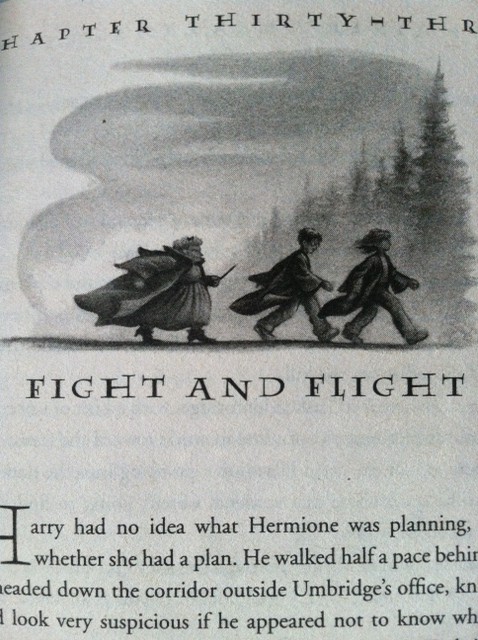
It is fascinating to me that the very illustration I picked for my post to show how strong the female characters are becoming in Harry Potter #5, could be a scene of Hermione leading Umbridge to her rape.
The fact that Harry is not in the lead, looking down while Hermione strides ahead, is surrounded by females, and has no idea where he is going– all of which I noted as unusual in this image and also the text– now seems to be constructed just in this way to absolve him. How disappointing that I noticed the narrative shifted here but could have missed the real significance as to why: one female goes against another in a vicious way, the other female is raped, and Harry is in the clear.
Imagine if Harry were the one to lead Umbridge into the forest to give her up to the sinister centaurs. Imagine if a male writer came up with rape as a punishment for an evil female character. I’m reeling from this analysis. What are your thoughts?
Update: On Reel Girl’s Facebook page, I’m getting lots of comments defending Hermione and J.K. Rowling, writing that this is not a rape scene. I want to believe that, but I cannot get over the fact that I picked this exact scene in my previous post because I noted something was different about it. That seems too strange to be a coincidence. If Rowling did not intend this scene to imply rape, I am feeling annoyed with her for sending an evil female off, at the hands of another female, to mythological creatures known for rape.
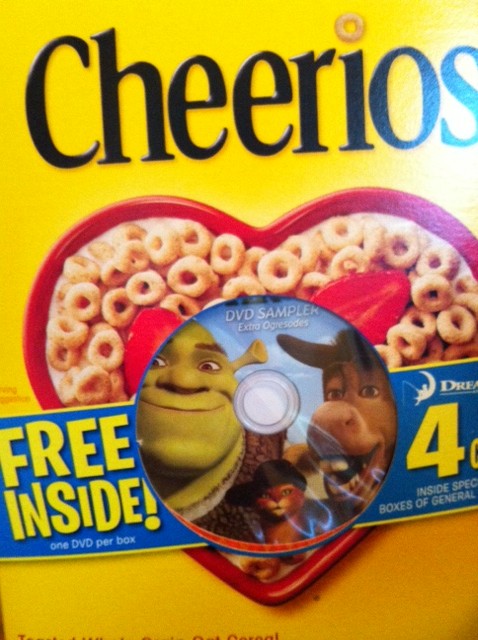
My four year old daughter loves Cheerios, and last night, my husband brought home a new box. Excited for breakfast this morning, we got it out. Here’s what we saw on the front: Shrek, Puss In Boots, and Donkey, 3 male characters from “Shrek.”
Besides “Shrek,” there are 3 other Cheerios collectible DVDs where we can “catch up with all our favorite DreamWorks characters.”
Unlike other cereal brands that have their own mascots, a cast of no less than 100% male characters, Cheerios borrows its crew from DreamWorks. But, apparently, these favorites don’t privilege females either, to say the least. “How to Train Your Dragon” pictures a boy and his male dragon, the two stars. We do see a girl riding bitch. Then, there’s “Kung Fu Panda” starring…Kung Fu Panda! And finally, Madagascar showing 6 male characters: the zebra, lion, and 4 penguins. Where is the hippo, the Minority Feisty in that movie?
Hippo does show up in the “fame game” on the reverse side of the box.
See, there she is down on the left. There are 8 characters and she is the only female. The game your kids play is “match each character to what they are famous for.” While characters are known for “Training the Furious Five” or “Being the Dragon Warrior,” what’s the hippo known for? “Loving a Giraffe.” No joke. Incidentally, my six year old daughter told me that hippo’s feelings are not reciprocated; giraffe never wants to dance with her.
See that little box to the right with the Croods character? He’s one the males from that movie too.
I write this a lot, but if this Cheerios box were one of many images kids see, it would not be a big deal. But again and again, kids see females go missing. It’s totally normal in their world. They don’t think anything of it and neither do we. But females are half of the population, so why are they presented as a tiny minority in kidworld practically everywhere outside of the Pink Ghetto? It’s an annihilation that acclimates a whole new generation to expect and accept a world where females go missing. Hey, Cheerios, can you make at least half of the characters on your box female? There’s no reason for the imaginary world to be sexist.
As if LEGO, with its idiotic, dumbed down LEGO for girls, its pet-shops and hot tubs, isn’t offensive enough, now this? A worker calling out, “Hey babe!” Are you kidding me?
Before I write one word about my thoughts on the fifth book in the Harry Potter series, Order of the Phoenix, let me be clear. I bow at the feet of J.K. Rowling. She is a masterful storyteller. I am already onto Book 6. I can’t stop. I should say that my nine year old daughter is appalled that is has taken me months to complete Order, a book she finished in three days. My slow pace has forever shattered her view of the talents and skills and grown ups. We have our limits, now she knows. In my defense, I’m always reading about 7 – 10 books simultaneously, but this fact means nothing to her. She just shakes her head at me, her eyes sad.
In this fabulous installment, Rowling addresses a few of my on-going gender complaints with the series: no female Dark Arts teacher, no female head of Hogwarts, no super evil female villain, and no female Quidditch captain. With the wicked, Dolores Umbridge, Rowling creates a villain so wicked that reading about her made me feel weak in my knees.
Umbridge fascinates, in part, because she takes on typical characteristics of femininity: she is often seen in pink, speaks “sweetly,” often with a ladylike “ahem,” before voicing yet another shocking decree. Umbridge’s office is sickeningly prissy:
The surfaces had all been draped in lacy covers and cloths. There were several vases full of dried flowers, each residing on its own doily, and on one of the walls was a collection of ornamental plates, each decorated with a large, technicolor kitten wearing a different bow around its neck.
Swathing this evil woman in fluff reveals that “sugar, spice, and everything nice” is a put on, not just for Umbridge, but no one can live up to this persona. Lace, kitties, and a quiet, “polite” voice is simply another studied costume.
When Harry insists Voldemort is alive, he is sent to Umbridge’s office for detention to do lines in a chilling scene:
“You haven’t given me any ink,” he said.
“Oh, you won’t need ink,” said Professor Umbridge with the merest suggestion of a laugh in her voice.
Harry pressed the point of the quill on the paper and wrote: I must not tell lies.
He let out a gasp of pain. The words had appeared on the parchment in what appeared to be shining, red ink. At the same time, the words had appeared on the back of Harry’s right hand, cut into his skin as though traced there by a scalpel– yet even as he stared at the shining cut, the skin healed over again, leaving the place where it had been slightly redder than before but quite smooth.
Harry looked around at Umbridge. She was watching him, her wide toadlike mouth stretched in a smile.
“Yes?”
“Nothing,” Harry said quietly…
And on it went. Again and again Harry wrote the words on the parchment in what he soon came to realize was not ink, but his own blood.
Creepy! I had to put the book down at that point and go consult with my daughter on the high level of Umbridge’s madness and meanness.
Important, complex female characters in Order don’t stop with Umbridge. Luna Lovegood, the misfit, smart, intuitive girl who befriends Harry has a real, spiritual connection with him, so much so that I would call actually them soulmates, in a non-romantic way. One of my favorite parts of this series is how Rowling creates cross-gender friendships and partnerships with no romantic tension clouding the relationship.
And then, with Angelina, finally, we get a female Quidditch captain. I was psyched to see a female in this part, but I can’t say I was that impressed with Angelina. She whined a lot and didn’t do much to save the team. Similarly, I was disappointed with Cho, Harry’s romantic interest who devolves in this book into a hyper-sensitive, sniveling, annoying character. At the very least, I wish Rowling could’ve written a scene or two showing how good Cho is and how Harry is in awe of her skill, is attracted to her because she can play, not just because she is pretty.
Tonks is a new witch on the scene, but I have to say that her klutziness reminded me of one of my least favorite characters in kidfiction, the good hearted imbecile, Amelia Bedelia.
At the end of the book, we meet Bellatrix Lestrange, a horrific, terrifying character who murders the brave, loyal, but arrogant Sirius. Though sad at Sirius’s death, and so sad for poor Harry, I was pleased to see a female be so instrumental in the plot as clearly, that means Lestrange is a character who will stay important to the action of the book.
Chapter Thirty-Three, pictured above, shows an image rarely seen out of the Pink Ghetto in kidlit: two female characters to one male, and he is not in the lead. The opening text underscores Hermione’s important position:
Harry had no idea what Hermione was planning, or even whether she had a plan. He walked half a pace behind her as they headed down the corridor outside Umbridge’s office, knowing it would look very suspicious if he appeared not to know where they were going.
While I think Hermione’s role will always be loyal friend, I like how she got to play her part in this book. Hermione essentially figures out that Voldemort is luring Harry into a trap and she warns him, yet Harry refuses to listen. This is an important role in the story, and I’m glad Hermione gets to play it.
So bottom line: Order is the best book for females so far in the Harry Potter series. Still, as I keep writing, clearly, this is Harry’s world. The rest of us just live in it. Thank you, Rowling, for allowing us the visit.
Turns out, the Dove ad was created mostly by men including the director, creatives, DP, editor, and some producers. Interesting when today, women make up only 3% of advertising’s creative directors.
CREDITS
Client: Dove
Agency: Ogilvy & Mather Brazil
Chief Creative Officer: Anselmo Ramos
Executive Creative Director: Roberto Fernandez /Paco Conde
AD: Diego Machado
CW: Hugo Veiga
Sketch Artist: Gil Zamora
Producer: Veronica Beach
Junior Producer: Renata Neumann
Business Manager: Libby Fine
CEO: Luis Fernando Musa
Group Account Director: Valeria Barone
Account Director: Ricardo Honegger
Production Company: Paranoid US
Director: John X Carey
Executive Producer: Jamie Miller / Claude Letessier
Line Producer: Stan Sawicki
Director of Photography: Ed David
—Long Version
Executive Producer: Jamie Miller / Claude Letessier
Producer: Stan Sawicki
Editor: Phillip Owens
Music: Subtractive
Sound mix: Lime Studio
Composer: Keith Kenniff
Mixer: Sam Casas
Executive Producer: Jessica Locke
Production Sound: Tim O’Malley
Color Grading: Company 3
Colorist: Sean Coleman
—Short Version and Cinema
Editorial Company: Rock Paper Scissor
Executive Producer: Carol Lynn Weaver
Editor: Paul Kumpata
Assistant Editor: Niles Howard
Online: A52
Executive Producer: Megan Meloth
Producer: Jamie McBriety
Music: Subtractive
Composer: Keith Kenniff
Sound mix: Lime Studio
Mixer: Sam Casas
Executive Producer: Jessica Locke
Production Sound: Tim O’Malley
Color Grading: Company 3
Colorist: Sean Coleman
I love Melissa Duge Spiers’s post: “Thoughts that come with Dove’s footsteps” on Reel Girl and count myself among those unimpressed by the ad. I blogged about Dove’s pseudo-feminism a year ago, when the company released a study and promoted stats that “only 11% of girls feel beautiful.” Then, I wrote a parody: “New study reports only 10% of boys feel beautiful.” A headline you won’t see, because when it comes to males “beauty” just isn’t that important.
Perhaps I am the wrong person to open this discussion, because I was raised in a house where being beautiful (if you were a girl) was everything – I was dragged from under my bed as a 6-year-old, kicking and screaming, so that my “ugly” straight hair could be permed.I was the only pre-teen I knew who was forced to wear makeup.And I existed on air-popped popcorn throughout high school because I dreaded being withdrawn from school and put on a liquid diet until I lost weight like a friend of mine.I grew up to make my living for a while from my looks, modeling and acting.So it would be silly to claim I don’t carry some baggage about beauty, and I won’t even try.
But I’m going to throw my hat into the ring anyway on the latest movement to redefine beauty, to make it more inclusive, to tell every woman she’s beautiful (yes, Dove, that’s you…and so many more).I hate it.I absolutely detest it.Why?Because even the most well-intentioned, politically correct, supportive, inclusive statements and movements can still be boiled down to this:beauty is all important.
The traditional wisdom – from my grandmother’s era – was a terse “if you’re not beautiful, cultivate a great personality, be the smartest, wittiest person in the world, be charming, develop great talents.”This seems outrageously offensive in today’s era, yes?It puts beauty in a removed and superior category which excuses the lucky ‘owners’ from doing anything else on that list (plus it reinforces the tired dichotomy of smart/witty/talented vs. beautiful).As much as we sincerely applaud the use of larger-sized models and real women in these new campaigns, the honest truth is: nothing has changed.We are still saying beauty is the defining item in women’s lives.We’re just screaming for an expanded definition.
If you take out the words “beautiful” and “ugly” in the widely celebrated, empowering “Everyone’s Beautiful!” campaigns and you substitutethe words “white” and “black” or “straight” and “gay” you begin to see how thoroughly stupid it is to waste time trying to define (or redefine) “beauty.”Go ahead, try it: “Everyone’s white! You’re white just as you are!” Or“We just need to redefine straight to include all humans! Everyone’s straight!”
It suddenly seems ridiculous (not to mention condescending), doesn’t it? These well-intentioned feel-good anthems really just posit beautiful (or white or straight) as the goal, as the “best” option, as the ultimate compliment/inclusion/approval.Think I’m exaggerating? I can guarantee that someone in response to this article will think the most insulting, awful comment they can summon is “you’re just a jealous, fat, ugly dyke!”But it’s not just those haters – it’s the advertisers, it’s the lawmakers, it’s the population, it’s each and every one of us.We all keep thinking that telling women and girls they’re beautiful is the answer, as long as we adjust the definition to include everyone.But we’re all still holding it up as the holy grail, the pinnacle of achievement, the most important thing they can be.
You know, my mother thought straight hair was disgustingly ugly (a fact she will still tell anyone to this day).As a child, did I wish she would open her beauty boundaries, recalibrate her metric, until it included my stick-straight strands?That would have saved me a lot of tears and chemical burns on my scalp, sure, but really I just remember fervently wishing she would stop focusing on my damned hair so I could go outside and swing on the monkey bars.Did my young friend wish her parents would say “honey, a few extra pounds are beautiful!” Not at all.She felt nearly the same shame and humiliation whether they praised her weight loss or put her on a diet.She simply didn’t want them or anyone else to discuss her body, in any way, good or bad – it was mortifying.She just wanted to be riding her horse.
Each one of us – me, you, Dove, everyone – needs to stop trying to expand our precious definitions (“beauty is valued, so we need to make sure everyone feels beautiful!”) and figure out why (and if) they’re important to define at all.Everyone should be accepted and given equal consideration and rights, even if we’re not all straight, we’re not all white, and we’re not all beautiful.Who cares? Let’s cultivate our talents, our charm, our smarts, our personalities.And then let’s run out and swing on the monkey bars.
“Thoughts that come with dove’s footsteps guide the world.” – Friedrich Nietzsche
Melissa Duge Spiers is a writer whose work has appeared in Adventure Sports Journal, Vermont Sports, and The Monterey Herald, among other publications. She is working on her first novel. A graduate of Barnard College, she lives in Santa Cruz, CA with her husband and four children.