LOVE


LOVE
One more thing that really bothered me about Disneyland– and again, it’s not so different than San Francisco: I heard parents berate their kids for wasting food. I heard a mom yell at her kid because the girl did not finish her pink mountain of cotton candy. Seriously.
It’s not that I can’t understand parental frustration and anger when your child doesn’t eat what she’s asked for. You’ve stood on the line. You paid $5 for the cotton candy and the kid doesn’t eat it? It’s annoying, no doubt. But take a look at what you’re doing: you are making your kid eat that crap because you don’t want to “waste” it?
I suppose your other option is to refuse to buy your kid the cotton candy. But in my experience, not allowing her to have the “forbidden” food only glamorizes it, making her want it even more.
My daughter did the same not eating thing to me when I got her the cotton candy (which is HUGE otherwise how could they charge that much money?) She had about three bites. Literally. There was a tiny, furry cave in the mountain. Then she said her tummy didn’t want anymore. I always tell her to listen to her tummy about how much to eat. I threw it out in one of the many waste baskets that Disneyland so generously provides. (I’m not being sarcastic here. I was really impressed by all of the waste baskets at Disneyland, color coded for recycling, again just like San Francisco. There are also water fountains everywhere. Disneyland is also incredibly well equipped for people with disabilities, all of the rides and swimming pools, but I digress.) Wow, just realized I wrote my daughter “did the same thing to me.” See? We take it all so personally.
Here is what you are doing when you tell your kid not to waste food: you make her feel shame, guilt, and worry associated with eating. (And for goodness sake, haven’t you ever thought you could eat more than you actually could? Do you want someone berating you? Or do you just do it to yourself in your own head? Stop that, too.)
When you berate your kid for wasting food, not only do you make her feel shame, guilt, and worry but you make her concerned about your approval in association with her eating. In this day and age, your kid has enough to do maintaining her ability to listen to and respond to her own hunger cues, to her own body. Your focus should be supporting her in that. Unfortunately, there are many ways in our current culture for a brain, especially a female brain, to get wired up to make guilt, shame, and worry part of the human eating experience. Many of those factors parents can do very little about. But no longer ordering your kid not to waste food is one thing you CAN do something about. So bite your tongue. Think about or feel your own issues around “wasting” food, but don’t project your issues onto a little kid.
To be sure, food waste is a national problem: 20 to 30% food in the U.S. is wasted. Not only that, 10% of U.S. energy is used to put food on the table so global warming is affected by food waste. Nor is it debatable that American rates of obesity are growing, believed to hit 42% by 2030. Americans have a disordered relationship with food, but berating a kid is a short-term, simplified, superficial “solution” that exacerbates the problem instead of healing it. Also, in the long run, a kid with who has a healthy relationship with food is less of a strain on the family budget than a kid with an eating disorder. So get creative with leftovers. (There are more great tips for raising healthy kids on a budget in the book Preventing Childhood Eating Disorders.)
Admonishing your kid not to waste food may not make her fat (I just wrote that as a headline so people who put their kids on diets would read this post) but it can easily contribute to making her eating disordered and her mind crazy. It’s not worth it. One might even call it a waste.
Maurice Sendak died this week at age 83. Sendak, along with William Steig, is among absolute favorite writers and illustrators of books for children.

Like Steig, Sendak’s writing is poetry and also like Steig, Sendak doesn’t have nearly enough female characters.
Sendak does have some great females in his books that you may never heard of. Soon after I started this blog, I wrote about my favorite Sendak book, Outside Over There, all about a brave girl who rescues her baby sister. My brother-in-law recently sent me a YouTube of “Really Rosie,” a Sendak cartoon with great music by Carole King. Rosie is the imaginative director who casts characters and decides which stories are good and which are not, kind of like the job I’d like to have.

I spent the last two days in Disneyland, and to my surprise, I didn’t even feel like I was in another world. I thought I would take lots of photos of pinkification and gender-stereotyped-marketing, come back and post them on my blog, and you’d all be shocked and appalled. But I didn’t see much in Disneyland that I don’t see every single time I go to Target or Safeway or turn on my TV.
Disneyland’s “magic” has completely infiltrated our everyday life. In Disneyland, wherever we went, everyone called my daughter “Princess” and handed her free stickers of girls in poofy dresses just like they do here when we visit her doctor’s office.
The significant difference that I kept noticing between Disneyland and San Francisco is that various signs and people kept telling me to have a magical time, that this was a place for my imagination to run free.
Yet, as I strapped myself into my eighteenth car or rocket or clam shell, it occurred to me there are few times in my life that I am encouraged to be this thoughtless. I sit back, relax, and enjoy the ride while I am handed the same fantasies, images, and narratives repeatedly. That’s when I realized that the passivity and homogeneity that Disneyland perpetuates in my mind and body, with all of its highly controlled thrills, is as deadening to actual imagination as pornography is to sex. Too much exposure (and we all have way too much exposure) messes with our brains and puts humans in danger of losing the ability to be stimulated by the real thing.
One of my favorite books ever is called Can Love Last: The Fate of Romance Over Time. Author Stephen Mitchell proposes that contrary to popular belief, romance doesn’t fade naturally in long term relationships. We kill it. And we kill it because it’s terrifying to lust for and depend on the same person. The more you need your partner, the more courage is required to risk perpetually experiencing the roller coaster highs and lows that come with being desperately attracted to him. Mitchell argues that instead of committing to that dangerous ride, for a lifetime, no less, we flatten our romantic partners into something more stable.
Here’s what Mitchell writes about pornography:
Rather than being a measure and consequence of the power of naturally occurring sexual desire, pornography is a measure of the extent to which people tend to prefer controlling desire through contrivance rather than being surprised by desire that spontaneously arises. Do not underestimate the power of contrivance. If I desire you, a real person, and if I long for not just sexual contact but a romantic response, I may be in big trouble. In fact, there is no way to escape big trouble! Because what I want from you makes me dependent upon you, makes me hostage to your feeling towards me, I naturally want some control over my fate. What I want is for you to love me, to find me attractive and exciting, precisely when I want you…This is what makes the contrivance of pornography so useful. Pornography operates on the “what if?” principle. What if I found myself desiring someone, and what if it happened to be this very person in this picture? on this videotape? on this computer screen? Guess what? I can have him or her. A close cousin of the oldest profession, prostitution, pornography offers the wonderful combination of stimulation in the context of simulation–risk-free desire. It is like shooting fish in a barrel. You can’t miss.
Porn is often considered exciting, daring, risky, or imaginative, but it’s just the opposite: a safe roller coaster instead of a real one.
Disneyland, of course, operates on that very principle. Controlled thrills– “stimulation in the context of simulation”– manufactured, repetitive images that don’t inspire individual creativity but paralyze real imagination. Disneyland is like porn for kids.
Whenever I blog about the exaggerated breasts or ass of a female cartoon character, commenters respond that I have nothing to complain about: all cartoons are caricatures.
There’s a difference between exaggerating muscles and exaggerating someone’s butt. Here’s artist Kevin Bolk’s take on “The Avengers.”

Of course, “The Avengers” model, with its pathetic 5: 1 male/ female ratio and then sexualizing that lone female, is not unique to that group of superheroes.
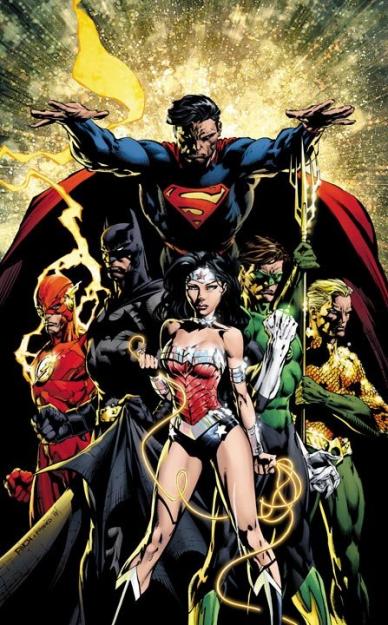
Check out the Justice League’s latest cover. Notice any similarity?
Here’s the artist Coelasquid’s “If Superheroes Posed Like Wonder Woman.”
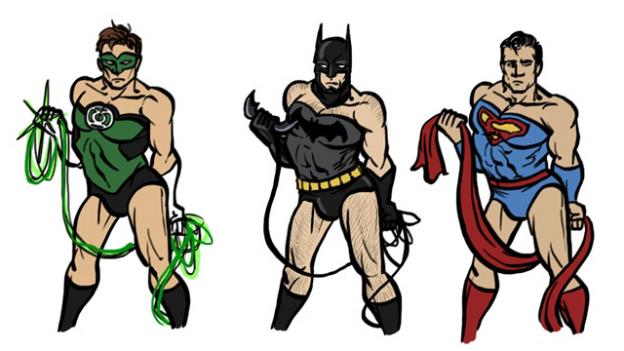
I love Coelasquid’s art because it shows so clearly that it’s not only the clothes put on female characters but the poses they are in.
Though of course, the clothes don’t help much. Here’s Theamat’s “If I Don’t Get Pants, Nobody Gets Pants:”
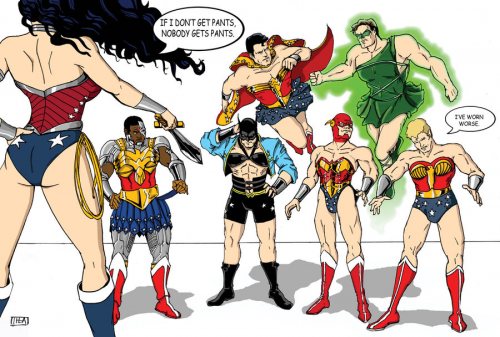
Wonder Woman with no pants was created by (and for?) grown-ups but it leads to Wonder Woman with no pants showing up as a LEGO minifig.

Or most recently, in the ensemble movie “Pirates!” for kids, in theaters right now, there’s one female and she shows up looking like this:

Females are half of the population, yet because they are presented as a sexualized minority in so many movies for adults, they are also presented as a sexualized minority in movies for kids. Those roles are then replicated in kids’ toys and most tragically, in kids’ imaginary play.
Female characters account for only 16% of all characters in movies for kids.
Here’s an interesting coincidence: across the board in all professions, women at the top don’t make it past 16%.
Do you think limiting females in the imaginary world limits them in real life? Unfortunately, your kids do.
This weekend “The Avengers” broke all box office records by grossing $200.3-million in its domestic debut.

By all accounts, I hear this is a great movie, but here is why I’m concerned. The male/ female ratio in this ensemble movie is 6:1.
The problem is that this same gendered ratio shows up in most movies made for kids. Even though The Avengers” is not for kids, the superhero theme is obviously kid friendly. I bet the images of “Avengers” superheroes from the movie will now be replicated in toys, video games, T-shirts, and sippy cups.
Even if these specific stars are not replicated in kidworld, the “successful” Holllywood formula will continue to be. Unless Hollywood actively does something about it, females will continue to be represented as a tiny minority in kids films. That sexism then infiltrates kids toys and then kids imaginary play in a huge viscous circle.
This is Hollywood, people! Fantasy. You can make up anything. Please make half of the characters in movies for kids female.
When you continually have only one female in movies for kids, it’s almost impossible to keep from limiting and stereotyping her. The more females you have, the more story lines you need to come up with, the more creative you must be.
Hollywood, I know “The Avengers” is for adults, but please don’t keep mirroring this male/ female ratio in kids movies. It teaches kids (KIDS!) that boys are more important and get to do more things than girls do. That’s not fair to children and their growing brains.
After seeing the preview for Aardman’s “Pirates” I posted a pretty scathing commentary: Porno or pirate movie for kids?

Some commenters were upset that I judged the movie without seeing it. I wasn’t judging the movie, I was writing about the preview, about how movies are advertised and marketed.
But now, I’ve finally seen the movie and am sorry to report that it’s more sexist than I thought.
When I saw the preview, I was upset that Cutlass Liz, the female pirate, was ogled and hooted at by the male pirates. She wears tight clothing and a belly shirt. Basically, the female pirate is totally sexualized.
But here was my mistake: From the preview, I believed that Cutlass Liz had a major part in the movie. I thought that in spite of her appearance, she would be portrayed as a bad ass, that she’d have a major role in the narrative as a competitor with the Captain (the star of the movie) for the “Pirate of the Year” award.
Cutlass Liz is only in three scenes. She’s a minor character in the film with almost no lines or action sequences at all. One of the few scenes she’s in is a fantasy one: the Captain imagines that he gets awarded the coveted trophy and also the admiration, lust, and batted eyelashes of Cutlass Liz.
After I trashed the preview, I was told by commenters that Queen Victoria has a strong part. In some ways, she does. At one point she rips of her constricting clothing (how original!) and gets into a duel with the Captain. But she is also portrayed as Charles Darwin’s sexual fantasy. Gross. Why?
Another female is the Surprisingly Curvaceous Pirate. Ironically, she is not curvaceous like Liz, who constantly swishes her hips, or Victoria, who has a hugely exaggerated posterior. SCP has the fate of many heroic females in kidworld: she dresses as a male in order to have adventures and be powerful. She wears a beard and has hardly any lines. Her biggest scenes are when she is naked in a bathtub. More sexist jokes ensue here. Ha ha ha.
The best female character in “Pirates” is the dodo. Her role is central to the plot of the movie, but she can’t talk.
The sexist jokes start with the first lines of the movie where the Captain refers to “scantily clad mermaids” and don’t stop until the finish when Darwin laments about impressing women. Female characters exist mainly for that reason: to provide inspiration for the male characters to be strong, brave, and adventurous.
The only slightly redeeming thing as far as sexism in this movie for kids is the way that the compassionate captain and his crew fail to live up to standards of masculinity, choosing the dodo bird, their friend, over recognition and gold.
Reel Girl rates “Pirates: Band of Misfits” ***SS*** Don’t expose your kids to the sexist stereotypes that this film relentlessly promotes.
By the way, after the leper community complained about bias, Aardman did, in fact, change the line in the movie about the “leper” boat. Now it’s called a “plague” boat.
Yes, it’s true. I’m infiltrating the enemy. Headed to Ground Zero with my camera phone. I’ll report back next week on what I found there xo
Julia Bluhm is 14 years old. Sick of seeing photo and after photo of teens photoshopped in Seventeen Magazine, she started an on line petition asking the magazine to feature just one authentic picture a month.

Yesterday, Bluhm took her petition and its going on 50,000 signatures to Seventeen’s office in New York City. Though Seventeen met with Julia, they refused to grant her request. Here is what the magazine had to say about Julia’s petition:
We’re proud of Julia for being so passionate about an issue — it’s exactly the kind of attitude we encourage in our readers — so we invited her to our office to meet with editor in chief Ann Shoket this morning. They had a great discussion, and we believe that Julia left understanding that Seventeen celebrates girls for being their authentic selves, and that’s how we present them. We feature real girls in our pages and there is no other magazine that highlights such a diversity of size, shape, skin tone and ethnicity.
In other words:
We met with the kid, OK? Please get off our backs and let us get out of this PR mess as gracefully as possible.
Listen, it may not seem like a big request, but if Seventeen published one un-photoshoped picture of a teen per month, it would be pretty obvious that all of the other photos in our magazine are photoshopped.
If SeventeenMagazine made girls that aware that they are aspiring to look like the non-humans who the magazine celebrates, our readers might be less inclined to purchase all of the fine make-up, hair products, and clothing advertised in the pages of our magazine.
Unfortunately for Julia and all teen girls, those advertising dollars keep our photoshopped magazine on the racks and pay our salaries.
No other major magazines are refusing to feature one regularly un-photoshopped picture, why should we? Just because our audience is teens? That’s not fair!
If Seventeen took the risk of showing actual girls in our magazine for girls, we risk coming off not as glamorous as our competitor fashion magazines. We are in the business of selling glamor for goodness sake. Again, the more unattainable that glamor is, the more likely girls are to feel insecure, the more likely they are to believe that they need to spend money on the products we’re selling. Get it now?
Sorry, Julia, but we need girls to stay quiet, obedient, and obsessed with their appearance. It’s good for business.
Please do not buy Seventeen’s September issue. Please share and Tweet this info, use hashtag #notbuyingSept17.
Also, please keep signing Julia’s petition. Even better, ask your daughters and sons if they want to sign too.
Honestly, I am so excited for “Brave.” As you’ve probably heard, the animated film coming out this summer will star Pixar’s first ever (FIRST EVER!!) female protagonist. I also suspect that the movie is based on the book Brave Margaret which I love. But I had to laugh when I saw this by Claire Hummel/ Shoomlah on the blog Animation Anomaly.
Hummel is so right, this scene is so old, so done. I just blogged about the Jean Paul Gaultier show which was all about corsets. Not only is the corset-image tired to see AGAIN in a movie, but Hummel makes another great point: corsets didn’t exist in Medieval times.
I really, really hope that “Brave” is a movie where we can just see a female heroine being brave and powerful, not one who is mainly rebelling and struggling within the confines of the patriarchy (get it? “the corset”) Disney princess style i.e. Jasmine, Mulan, and Belle. I am so starved to see a female being heroic as in “The Hunger Games” where gender is not the main issue. This is fantasy movie; this is animation. Anything is possible, even, yes, gender equality!
I hope that the protag’s main rebellion in “Brave” is not that she actually wants to pick who she marries. (Whoo-hoo! Can you imagine that being the main plot of movie starring a male?) Or that the protag has to pretend to be male in order to have adventures. Why do little girls have to see that so much? “Girls can do anything boys can do!” That is so patronizing. Ugh. Girls don’t even know about sexism yet for God’s sake. When my daughter was four and saw “Mulan,” she was confused and asked me: “Why can’t girls fight?” I had to explain sexism so she could understand the plot of the movie.
Please Pixar, show much more imagination than this tired corset metaphor suggests. I know you will, I know you will, I know you will.