A man dressed in an Elmo costume was seen in Rossi Playground on Saturday attempting to approach and hug neighborhood children. In addition to approaching children, he yelled obscenities and derogatory remarks. This man was also spotted at parks in New York City.
My first thought was: Elmo, for goodness sake. Holy shit. What is the world coming to?
But my second thought was this. The disturbing story attests to a thesis of my blog, Reel Girl, that is often disputed or questioned: “Lovable” characters created to appeal to children can also be dangerously manipulative of those children. In many cases, that’s why they were created, right? To sell products or push an agenda. Just because a character has oversized pupils doesn’t mean he’s good for kids. Maybe that sounds paranoid or trivial, but children are malleable and vulnerable. Parents should be aware of who they let in their home, even under the badge of PBS (which has a cast of characters just as male dominated as Disney.) G-rated movies can be more sexist, racist, or classist than R movies. That’s why parents should trust their own instincts, be aware, and make careful, informed decisions. There’s a potential monster side to every Elmo
Andreozzi & Associates, a law firm that said it represented the anonymous accuser, said in a statement on Tuesday afternoon that “he wants it to be known that his sexual relationship with Mr. Clash was an adult consensual relationship.” The statement added, “He will have no further comment on the matter”…“We are pleased that this matter has been brought to a close, and we are happy that Kevin can move on from this unfortunate episode,” said Sesame Workshop, the organization that produces “Sesame Street.”
The organization did not say when — or even whether — Mr. Clash would return to work at “Sesame Street.” On Sunday, he took a leave of absence when it became clear that TMZ was going to publish an article about the accusation of inappropriate and possibly illegal conduct.
Update: Jezebel reports: “Well, turns out our collective sigh of relief was short-lived. Though puppeteer Kevin Clash’s first accuser recanted his claims one week ago, Clash officially resigned from Sesame Street today. Though it’s not mentioned in Clash’s official resignation, his departure coincides with new allegations from a second accuser, who claims Clash began a sexual relationship with him when the accuser was just 15.”
I think I just bought half of the “dolls/ action figures” compiled and recommended by A Mighty Girl, and I don’t even feel guilty about my spree. I am hoping that I can hold on to the Wonder Woman in her invisible airplane until Christmas, but it is so cool, I don’t know… Toys are so key to imaginary play. When kids are given these kind of tools, instead of plastic hairbrushes, make-up, and dolls to dress, so aggressively marketed to girls, their narratives go wild. You’ve got to check these products out. Some, like the Jane Austen doll, are not available. (BOO-HOO) Several, when you click on them, say that only a few are left. It really makes me get how much of this is about MARKETING. Who knew about these toys? Yes, Wonder Woman remains in her underwear. Baby steps, here. We are desperate for MORE stories featuring female heroes. A much wider variety of costumes and poses are needed in the toys of kidworld. (Does this image show the importance of a pose or what?) But for what’s available out there, A Mighty Girl’s new resource is unmatched.
Look what I saw while shopping at Walgreen’s: 6 boxes feature male characters, 2 boxes feature female characters.
It’s bandaids, you say, who cares?
These images matter because they normalize the lack of females for little kids. Girls gone missing seems normal, and you know where this lack of females, half of our population, is normal? Congress, the Supreme Court, boardrooms, and top levels of most professions all across America.
If you can’t imagine it, you can’t be it. It’s as simple as that. How sad that our imaginary/ fantasy world is so sexist that females go missing, get stereotyped, sidelined, or show up as a minority. It doesn’t have to be this way. It’s the fantasy world, anything should be possible. So why is the imaginary world as sexist as reality? What does that sexism teach little kids?
Consider the variety of roles that males are shown that they can play. Compare that to the limited roles that females are shown that they can play.
One reason that it is so hurtful to show females in a minority all the time is because that limitation makes it easy to stereotype them. The more females you have, the more narratives you’ve got to come up with.
By the way, if you’re wondering about Angry Birds, 5 Angry Birds are female: Female Red Bird, Female White Bird, Jewel (Angry Birds Rio only), White Bird and Pink Bird.) Here are a couple descriptions:
Unlike the other birds, the Female Red Bird isn’t an actual species that is used in the game, rather it only serves as a background character used in various materials to promote the game, and is also seen in the ending sequence upon completing Hogs and Kisses, alongside a solo Red Bird. A plush toy version of her was released along with a plush toy version of the Female White Bird.
The Female White Bird is a bird only seen in Angry Birds Seasons. She is a female bird like the White Bird. She only serves as a background character and only appears on wallpapers in Hogs and Kisses, and her existence has led to many beliefs that the basic White Bird is male. She has a naive, maybe nervous expression.
Where the Female Red Bird is approximately the same size as the Red Bird, one image implies that the Female White Bird is significantly smaller than both the White Bird as well as the Female Red Bird. She has the same face as the White Bird, but only with makeup, a bow, and lipstick.
I’ve blogged about games before: Sexist apps for little kids and the card games Slamwich and Sleeping Queens. But now Reel Girl has a whole new category. My family has started a weekend ritual of evening board games during quiet time instead of reading, so I’m looking at lots of games. The switch in routine is a struggle for me, because I love reading and kind of dislike board games. It’s not that I hate them, I just didn’t get the point. I’d rather be reading. But according to my kids’ teachers, there is a point: math and verbal skills, art skills, rule following, winning and losing, and together time. The teachers are also right that my kids are at such different reading levels, that it is fun (when they’re not cheating or fighting) to do something together.
My first rec is Hedbanz. This game is super fun. All my kids, ages 3 – 9, can play this game and feel challenged at different levels. One kid holds a card with a picture up to her forehead (actually, most people place them there in headbands, thus the name of the game, but we lost our bands.) She asks yes or no questions (Am I alive, am I an animal etc) Because of the simple pictures, it’s easy for the three year old to feel like she’s a part of it. The older kids, obviously, like to guess the answer faster.
Needless to say, I love that the box that features two girls and one boy playing together and no sexist pictures.
Please send me your game recs! Reel Girl rates Hedbanz ***HHH***
I emailed this to the editor of the New York Times piece “What’s So Bad About a Boy Who Wants to Wear a Dress” today, though so far the New York Times email isn’t working for me and the one I made up, last name @nytimes.com isn’t working for me either. I emailed something similar to the “corrections” department yesterday, which you send in the same way you post a comment.
Dear Ms. Titunik,
In the New York Times post “What’s So Bad About A Boy Who Wants To Wear A Dress,” journalist Ruth Padawer writes:
“Of course, had Alex been a girl who sometimes dressed or played in boyish ways, no e-mail to parents would have been necessary; no one would raise an eyebrow at a girl who likes throwing a football or wearing a Spider-Man T-shirt.”
Kids and adults do much more than “raise an eyebrow” when young girls stray from gender norms. Stories that received a great deal of media attention about pressuring girls include Katie, the girl who was bullied for bringing her beloved Star Wars lunch box to school, “a boy thing;” and more recently, Our Lady of Sorrows baseball team forfeited a championship rather than play a girl. You can find the links to those stories on my blog Reel Girl which I created, as the mom of three young daughters, in response to that “raised eyebrow.”
As in those two stories above, the pressure for girls to conform often comes through bullying, but it can also be more subtle as well. That subtlety makes the sexism more insidious and harder to call out and change. For the New York Times to print “no one would raise an eyebrow at a girl who likes throwing a football or wearing a Spider-Man T-shirt,” in a story about gender no less, is untrue and irresponsible.
Margot Magowan Reel Girl
The reason this is so important to me is because the gendering of childhood is everywhere.
Just today A Mighty Girl posted about boy and girl magnets/ words:
All we can say to this one is WOW — in case girls and boys had any confusion as to what their appropriate interests should be, these gender-divided magnet sets will help clarify matters. According to this toy manufacturer, “boy words” include bike, swinging, forest, caterpillar and swimming while “girl worlds” include lipstick, jewels, clothes, glitter and dancing. How very limiting for both girls and boys!
Children are segregated; without recognizing the Jim Crow in kidworld, it’s impossible to have a real discussion about gender.
The night before Susan and Rob allowed their son to go to preschool in a dress, they sent an e-mail to parents of his classmates. Alex, they wrote, “has been gender-fluid for as long as we can remember, and at the moment he is equally passionate about and identified with soccer players and princesses, superheroes and ballerinas (not to mention lava and unicorns, dinosaurs and glitter rainbows).”
Here, the writer, Ruth Padawer, sets up a series of stereotyped binary/ boy-girl opposites: soccer players and princesses, superheroes and ballerinas, lava and unicorns, dinosaurs and glitter rainbows. I waited for her to explore any reasons why our culture promotes this symbology. Unfortunately, I waited for the whole article.
Why are princesses considered to be the epitome of femininity? Could it, perhaps, have little do with with genes and everything to do with the fact that perpetuating the image of a passive, “pretty” female is popular in a patriarchal culture? Just maybe?
A few more sentences down:
Some days at home he wears dresses, paints his fingernails and plays with dolls; other days, he roughhouses, rams his toys together or pretends to be Spider-Man.
Most kids on Planet Earth would paint their fingernails if they weren’t told and shown by grown-ups that it’s a “girl thing.” Nail polish has nothing to do with penises or vulvas or genes, or even anything as deep and profound as “”gender fluidity.” To kids, nail polish is art play, brushes and paint. That’s it. Oh, right, art is for girls. Unless you’re a famous artist whose paintings sell for the most possible amount of money. Then art is for boys.
On an email that Alex’s parents sent to his school:
Of course, had Alex been a girl who sometimes dressed or played in boyish ways, no e-mail to parents would have been necessary; no one would raise an eyebrow at a girl who likes throwing a football or wearing a Spider-Man T-shirt.
What? Does this writer have young daughters? Has Padawer heard about the boy’s baseball team from Our Lady of Sorrows that recently forfeited rather than play a girl? Or what about Katie, the girl who was bullied just because she brought her Star Wars lunch box, a “boy thing,” to school? Does Padawer know Katie’s experience isn’t unusual? How rare it is to find a girl today who isn’t concerned that a Spider-Man shirt (or any superhero shirt or outfit) is boyish and that she’ll be teased if she wears it? My whole blog, Reel Girl, is about that “raised eyebrow.” Has Padawer seen summer’s blockbuster movie “The Avengers” with just one female to five male superheroes? The typical female/ male ratio? Or how “The Avengers” movie poster features the female’s ass? Think that might have something to do with why females care more than males about how their asses are going to look? You can see the poster here along with the pantless Wonder Woman. Does Padawer get or care that our kids are surrounded by these kinds of images in movies and toys and diapers and posters every day? How can Padawer practically leave sexism out of a New York Times piece 8 pages long on gender?
First sentence of paragraph 3: (Yes, we’re only there.)
There have always been people who defy gender norms.
No way! You’re kidding me. Like women who wanted to vote? Women who didn’t faint in the street?
Moving on to page 2:
Gender-nonconforming behavior of girls, however, is rarely studied, in part because departures from traditional femininity are so pervasive and accepted.
Um, wrong again. Been to a clothing store for little kids recently? Ever tried to buy a onesie for a girl with a female pilot on it? Or a female doing anything adventurous? Check out Pigtail Pals, one of the few companies that dares to stray from “pervasive and accepted” femininity. One of the few. And we’re talking toddlers here.
The studies that do exist indicate that tomboys are somewhat more likely than gender-typical girls to become bisexual, lesbian or male-identified, but most become heterosexual women.
Is the writer really writing a piece on gender fluid kids and using the word “tomboy” without irony?
Next page:
Still, it was hard not to wonder what Alex meant when he said he felt like a “boy” or a “girl.” When he acted in stereotypically “girl” ways, was it because he liked “girl” things, so figured he must be a girl? Or did he feel in those moments “like a girl” (whatever that feels like) and then consolidate that identity by choosing toys, clothes and movements culturally ascribed to girls?
Hard not to wonder. Exactly! Finally, the writer wonders. But, not for long. Here’s the next sentence:
Whatever the reasoning, was his obsession with particular clothes really any different than that of legions of young girls who insist on dresses even when they’re impractical?
Once again, I’ve got to ask: Does Padawer have a young daughter? Legions of young girls “insist on dresses” because like all kids, they want attention. Sadly, girls get a tremendous amount of attention from grown-ups for how they look. Today, my three year old daughter wanted to wear a princess dress to preschool, because she knew that if she did, the parents and teachers would say, “Wow, you’re so pretty! I love your dress.” And if it’s not a girl’s dress everyone focuses on, it could be her hair, or perhaps her shoes which are probably glittery or shiny or have giant flowers on them because that’s what they sell at Target and Stride Rite. Unfortunately, focusing on appearance is how most adults today make small talk with three year old girls.
The next two graphs are the best in the article so I will paste them in full, though notice the use of “tomboy” again with no irony.
Whatever biology’s influence, expressions of masculinity and femininity are culturally and historically specific. In the 19th century, both boys and girls often wore dresses and long hair until they were 7. Colors weren’t gendered consistently. At times pink was considered a strong, and therefore masculine, color, while blue was considered delicate. Children’s clothes for both sexes included lace, ruffles, flowers and kittens. That started to change in the early 20th century, writes Jo Paoletti, a professor of American studies at the University of Maryland and author of “Pink and Blue: Telling the Boys From the Girls in America.” By then, some psychologists were arguing that boys who identified too closely with their mothers would become homosexuals. At the same time, suffragists were pushing for women’s advancement. In response to these threatening social shifts, clothes changed to differentiate boys from their mothers and from girls in general. By the 1940s, dainty trimming had been purged from boys’ clothing. So had much of the color spectrum.
Women, meanwhile, took to wearing pants, working outside the home and playing a wider array of sports. Domains once exclusively masculine became more neutral territory, especially for prepubescent girls, and the idea of a girl behaving “like a boy” lost its stigma. A 1998 study in the academic journal Sex Roles suggests just how ordinary it has become for girls to exist in the middle space: it found that 46 percent of senior citizens, 69 percent of baby boomers and 77 percent of Gen-X women reported having been tomboys.
The piece is riddled with more gender assumptions that aren’t questioned.
When Jose was a toddler, his father, Anthony, accepted his son’s gender fluidity, even agreeing to play “beauty shop.”
But why is beauty shop feminine? We all know beauty toys and products are marketed to girls, but why? Here’s that Avengers ass poster again. In a male dominated world, women are valued primarily for their appearance. They are taught to focus on how they look and that if they do so they can get power and prestige. Appearance is the area where girls are trained to channel their ambition and competition. Oh, sorry, girls aren’t competitive or ambitious. That’s a boy thing.
On gender fluid child, P.J., the author writes:
Most of the time, he chooses pants that are pink or purple.
Wait a minute, didn’t she write a few pages back about Jo Poletti’s book Pink and Blue? Remember, pink used to be a “boy” color; it’s only recently that it’s perceived as a “girl” color?
Here might be the most fucked up quote:
When a boy wants to act like a girl, it subconsciously shakes our foundation, because why would someone want to be the lesser gender?
i am NOT the lesser gender!
why can’t people see how insulting that is? i mean, who would *openly* call a race or ability or sexual orientation “lesser” and not largely be considered a bigot?
It was that comment that inspired me to write this post, because the whole piece is insulting to girls and women. I hope it’s insulting to boys and men as well.
“Girls’ toys are often about beauty and the home, while toys for boys are mostly about being active, building things and having adventures,” said Laura Nelson, a neuroscientist who led the campaign against Hamleys last year and runs Breakthrough, a project combating stereotyping in schools. “Gender-specific color-coding influences the activities children choose, the skills they build and ultimately the roles they take in society.”
The post goes into stats about pay equity and gender segregation in the professions. Right here is basically the whole reason why I started Reel Girl: the sexism in kidworld is so blatant, so offensive, so pernicious and yet, happily accepted and celebrated by smart, educated, progressive parents who carefully teach their kids how to separate garbage.
I would go on, but I’m really trying (REALLY TRYING) not to blog for one more month, and I have a couple more links I need to tell you about.
Think there’s a non-profit out there to help teen girls with low self-esteem by providing free breast enhancements?
The problem is the bully, not the kid! The bully, not the kid.
One more for you on the Jonah Lehrer plagarism scandal. In my opinion, The New Yorker is being silly-indignant by getting on Lehrer for “self-plagarism” (is that even a real term?)
All blogs are repetitive; they are more like speaking than print writing.
That said, making up and cutting and splicing Bob Dylan quotes in a digital age, when they can be fact-checked by anyone in 2 seconds, is kind of amazing.
Salon.com has a great piece on how the Lehrer phenomenon was allowed to happen, how it has in the past and will again, largely because of the role the media plays in creating and perpetuating the “boy-genius” myth.
Ha ha ha. M & Ms is so hilarious. Doesn’t the picture on this package just crack you up?
It’s been a while since I blogged about the intensely sexist marketing of M & Ms candy. But then, someone posted about the new Coconut M & Ms on my Facebook page, and I was so disgusted by what I saw.
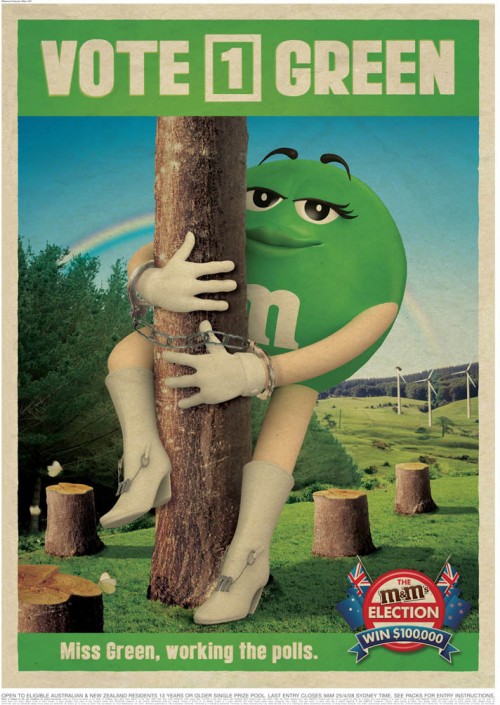
By now, we’re all familiar with Ms. Green, her high heeled white go-go boots and spidery eyelashes. Now she’s got a pink flower pasted on her head. And there is Yellow (Mr. Yellow?) above her, falling out of a tree while trying to catch his binoculars.
In this picture-narrative we also see John’s Berger’s classic analysis of historical sexism in art-life: Men watch; women watch themselves being watched.
It’s M & Ms, you say. Who gives a shit?
First of all, these cartoon images appeal to kids. Why sexualize them? Why sexualize candy? Secondly, the images promote gender stereotypes that are insidious, ubiquitous, and in this particular scene, actually dangerous.
Parents, do you really want your daughters and sons to see a ‘sexy’ female getting stalked on an M & Ms package as if it’s funny? As if it’s normal?
And why does M & Ms persist in a sexist marketing strategy that continually degrades, humiliates, or stereotypes its female characters? If M & Ms promoted racial stereotypes, would that be okay?
Luckily, Coconut M & Ms is a limited edition. I wonder what they’ll come up with next. Any guesses?
Here’s a brief retrospective that may give you some ideas:
Miss Green as the S & M/ M & M:
The naked Ms. Green, coyly dangling her stripped off her skin, I mean shell, on the back cover of the 2012 Sports Illustrated swimsuit issue:
To those of you who argue that sexualized M & Ms appear only in adult spaces (kind of like the cartoon camel that marketed cigarettes to kids?) the stalking M & Ms image is right there on the package.
Most importantly, educate M & Ms: tell them that stalking isn’t funny, it’s dangerous. Cut and paste this info from the National Center For Victims of Crime:
While the impact of stalking is commonly minimized by society, the actions of stalkers can be extremely threatening and dangerous to their victims. Stalking can escalate to violence. Stalking victims frequently live in fear and terror. Often they are forced to alter their lives significantly in attempts to find safety and freedom from the harassing behavior of former spouses, ex-partners or strangers.
I spent the last two days in Disneyland, and to my surprise, I didn’t even feel like I was in another world. I thought I would take lots of photos of pinkification and gender-stereotyped-marketing, come back and post them on my blog, and you’d all be shocked and appalled. But I didn’t see much in Disneyland that I don’t see every single time I go to Target or Safeway or turn on my TV.
Disneyland’s “magic” has completely infiltrated our everyday life. In Disneyland, wherever we went, everyone called my daughter “Princess” and handed her free stickers of girls in poofy dresses just like they do here when we visit her doctor’s office.
The significant difference that I kept noticing between Disneyland and San Francisco is that various signs and people kept telling me to have a magical time, that this was a place for my imagination to run free.
Yet, as I strapped myself into my eighteenth car or rocket or clam shell, it occurred to me there are few times in my life that I am encouraged to be this thoughtless. I sit back, relax, and enjoy the ride while I am handed the same fantasies, images, and narratives repeatedly. That’s when I realized that the passivity and homogeneity that Disneyland perpetuates in my mind and body, with all of its highly controlled thrills, is as deadening to actual imagination as pornography is to sex. Too much exposure (and we all have way too much exposure) messes with our brains and puts humans in danger of losing the ability to be stimulated by the real thing.
One of my favorite books ever is called Can Love Last: The Fate of Romance Over Time. Author Stephen Mitchell proposes that contrary to popular belief, romance doesn’t fade naturally in long term relationships. We kill it. And we kill it because it’s terrifying to lust for and depend on the same person. The more you need your partner, the more courage is required to risk perpetually experiencing the roller coaster highs and lows that come with being desperately attracted to him. Mitchell argues that instead of committing to that dangerous ride, for a lifetime, no less, we flatten our romantic partners into something more stable.
Here’s what Mitchell writes about pornography:
Rather than being a measure and consequence of the power of naturally occurring sexual desire, pornography is a measure of the extent to which people tend to prefer controlling desire through contrivance rather than being surprised by desire that spontaneously arises. Do not underestimate the power of contrivance. If I desire you, a real person, and if I long for not just sexual contact but a romantic response, I may be in big trouble. In fact, there is no way to escape big trouble! Because what I want from you makes me dependent upon you, makes me hostage to your feeling towards me, I naturally want some control over my fate. What I want is for you to love me, to find me attractive and exciting, precisely when I want you…This is what makes the contrivance of pornography so useful. Pornography operates on the “what if?” principle. What if I found myself desiring someone, and what if it happened to be this very person in this picture? on this videotape? on this computer screen? Guess what? I can have him or her. A close cousin of the oldest profession, prostitution, pornography offers the wonderful combination of stimulation in the context of simulation–risk-free desire. It is like shooting fish in a barrel. You can’t miss.
Porn is often considered exciting, daring, risky, or imaginative, but it’s just the opposite: a safe roller coaster instead of a real one.
Disneyland, of course, operates on that very principle. Controlled thrills– “stimulation in the context of simulation”– manufactured, repetitive images that don’t inspire individual creativity but paralyze real imagination. Disneyland is like porn for kids.
After gathering 55,000 signatures of people disgusted by LEGO’s sexist Friends sets for girls, SPARK representatives finally met with LEGO execs last Friday.
SPARK brought three main requests to LEGO:
First, we want to see more girls and women characters across all LEGO lines. My report to LEGO showed that 86.6% of characters are men, which is a major gender gap, and one reason that girls may no longer feel welcomed by LEGO products. A failure to include better representation of girls and people of color in prominent and non-stereotyped roles makes it harder for kids to see themselves in the product, and less likely to want to play with it. By increasing the number of visible women throughout the product lines, LEGO can more easily welcome girls to the building experience beyond the Friends.
Second, we want to see girls featured in more LEGO ads, and we want to see boys featured in ads for the LEGO Friends. If LEGO’s intention with the creation of the Friends line is to bring girls into the LEGO experience fully, they need to show girls engaged with toys aside from the Friends – and if they want boys to be comfortable playing with the Friends line, they need to show that, too. LEGO’s marketing has been very gendered over the last couple of decades, and research has shown that 76% of kids who see boys and girls in commercials are likely to think that toy is for everyone, compared to 40% of kids shown an ad featuring only boys or only girls. Simply making an effort to balance gender representation in ads is an easy way to make kids feel welcome.
And finally, as LEGO expands the Friends line, we want to see the inclusion of sets designed around non-stereotyped activities for girls: spaceships, politics, firefighting, architecture, teaching and business. Making the Friends line a truly representative line of options for girls and boys will diminish the stereotype threat we see in it now, as well as help keep girls engaged in the cognitive development offered by LEGO products. While the initial offerings in the LEGO Friends line are stereotyped and problematic, they do have the potential to get girls back into the LEGO brand – but LEGO also needs to make sure they have offerings for girls whose interests aren’t as focused on beauty. We also want to see more focus on and celebration of Olivia’s inventor’s set and treehouse – while these are great products in the current Friends line, they receive no commercial attention.
Let’s keep an eye out at as new LEGO sets come out on how many females are featured in the sets and how many girls and moms are pictured on boxes and in TV ads. Hopefully LEGO will be making some changes.
Great job, SPARK. Thank you for being such a great advocate for girls. Read SPARK’s full report of the meeting with LEGO here.