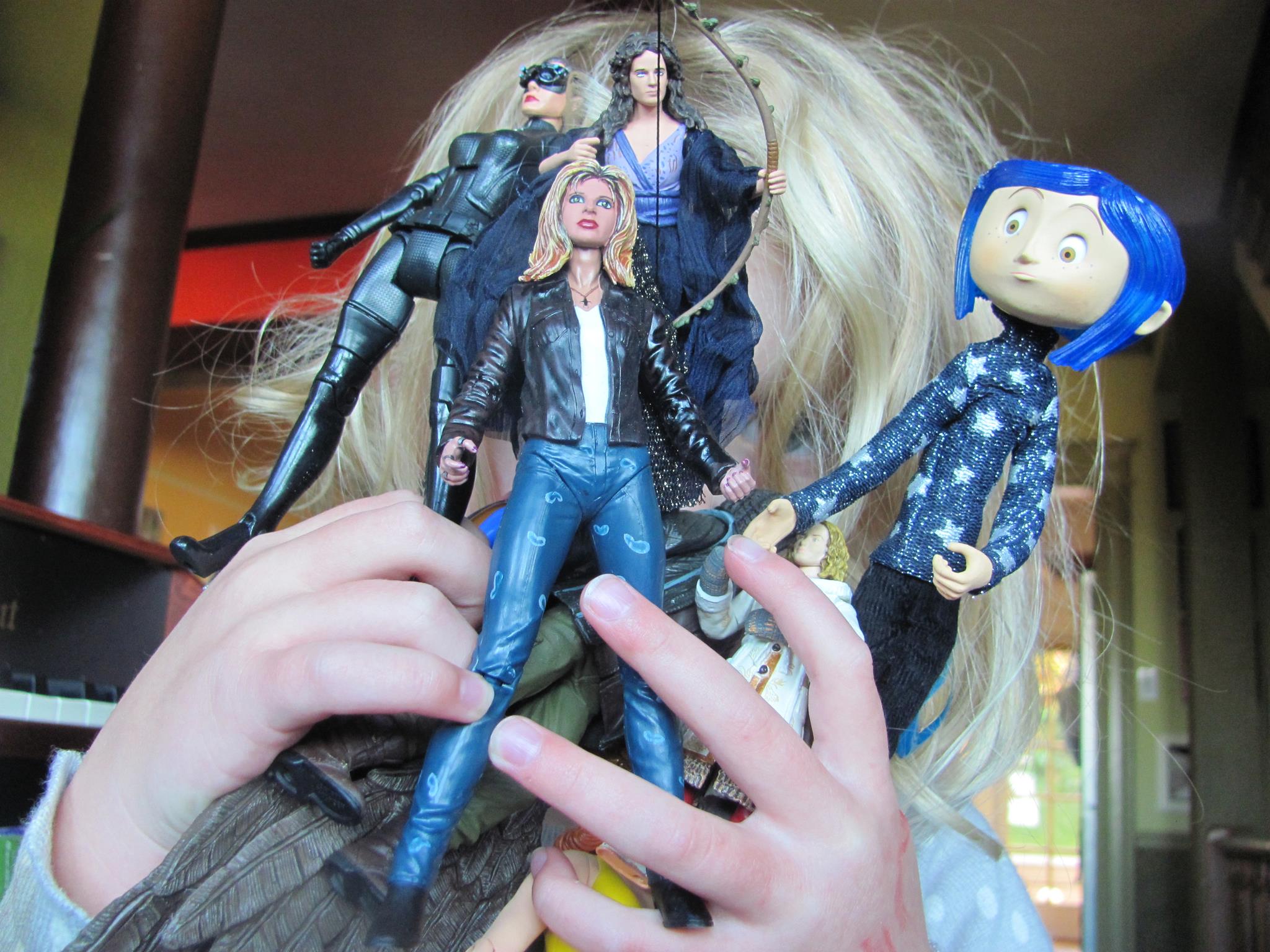
My daughter, Rose, with her new Christmas friends: Catwoman, Buffy, Serafina Pekkala, Hawkgirl, Lyra Silvertongue, and Coraline.
My favorite is Coraline. She belongs to Rose’s older sister, Alice, who loved the book.
These characters are so much better than the ones photographed above for Reel Girl’s header just after Christmas, three years ago, when I started this blog. I took that photo because, as the mother of three young daughters, I was so freaked out and disgusted by the grinning plastic strewn around our living room.
I’m going to post a photo of the whole new crew soon. There are about 15, and I think, seriously, if this group doesn’t comprise all of the non-sexualized female action figures out there, it’s most of them.
Thank you to A Mighty Girl and Toward the Stars. It is on these new sites that I found all of my daughters’s Christmas presents this year. Let’s just say the figures above are not aggressively marketed or found in my neighborhood Walgreens along side the Barbies, stacks of princess coloring books, or Monster High dolls. Cool, inspiring female figures do exist and can be found in targeted searches. But for the most part, they are not mainstream. Coraline costs $100.
We need more figures to be more accessible to more people. Before we can have more female action figures made or mass marketed– featured in games or embossed on clothing sold at Target– we need more movies, TV programs, and books with strong female protagonists. Since the beginning of time, stories have always been the best marketing tool.
When heroic females go missing from stories, they go missing everywhere.
I have always loved Pigtail Pals for its cool clothing, its brilliant founder, Melissa Wardy, and its high quality product. But today, I have one more reason for romance, something that trumps all other loves: today, my three year old daughter dressed herself. She chose all of her own clothing, from underwear to socks, and arrived upstairs for breakfast, fully prepared for the day. What was she wearing, you ask? Lucky for you, we stopped at Whole Foods on the way to school and I got a photo:
All black. Hee hee. Except for the blue socks, of course, which, I’m sure you notice, match. Hallelujah! (Where is her arm though? I can’t wait to show her this. She looks like ghost-girl.) But best of all, and this goes back to Pigtail Pals, check out the back of her T-shirt:
My daughter loves the words, the colored-spiral of them, the bumpy feel, and also, how incredibly soft the material is.
Seeing this outfit reminded me of what a great Xmas shopping destination Pigtail Pals is if you are looking for clothing for children.
Melissa Wardy founded Pigtail Pals when she had a baby daughter, named her after Amelia Earhart, and then couldn’t find a single onesie that showed a girl with a plane on it. Then, Melissa realized she couldn’t find children’s clothing showing girls doing much of anything at all. So she came up with some designs and started a company. Years later, Pigtail Pals has grown into a successful business and Wardy is coming out with a book on “redefining girly.”
Here are Pigtail Pals best-selling ‘Full of Awesome’ T-shirts.
I keep giving you these sites for shopping because there are alternatives out there. It sucks that sometimes we have to look so hard for them, but I think the more we talk about them, (along with the way marketing, in general, is shifting to FB, Twitter) we can get the word out to more people.
Final photo of a proud three year old, her shirt covered in doughnut crumbs just in time for school.
I LOVE TowardTheStars.com so much, I interviewed the founder, Ines Almeida.
The pics I posted below include images of girls b/c that is what Reel Girl is about, and I love collecting these images. Check out Merida’s expression, how cool is she? And in all the Merida dolls, I never saw this one before. That’s why I love TowardTheStars, Ines culls through everything and finds the best. My oldest daughter is also into detectives and spies, so I posted some of those images, and a few other toys/ games that I’m buying. So this is my personal list. TowardTheStars has all kinds of great toys and products for kids.
Why did you start TowardTheStars?
I have an engineering degree in Computer Science for all of my life I have been part of male-dominated environments where I was a minority. My career progressed from engineering to management and executive roles and during this journey I was confronted with the gender biases from others and with my own limiting beliefs that sometimes stopped me from voicing my opinions or applying for a particular role.
As I started coaching my female colleagues, I found out that we shared a lot of common patterns: we struggled with the lack of female role models, and we were trying to overcome the “fairy tale syndrome”, a need to be perfect, congenial and at the same time highly effective. This left little space for taking healthy risks and for being audacious.
Six years ago a little girl came into my life, Ally, she was 2.5 years-old at the time. As I spent more time with her and started to look at the world through her eyes and started experiencing the messages she was getting all day long from society, toys, media and marketing, I started becoming more uncomfortable with what I was experiencing. I was looking at the root cause for all my own limiting beliefs; I was looking at the reason why my colleagues struggled to speak up, why women were risk-averse, why girls don’t pursue science, engineering, technology, math, sports and leadership.
Ally was surrounded by toys, books and media that were constantly telling her that her worth came from her external appearance. Everything related to science, maths, leadership, risk taking, audacity, sports seemed to be missing from products targeted to girls.
I decided to do something about it and started to raise awareness with parents and educators via social media. I created my own ipad app with empowering stories for girls 7Wonderlicious, I created a small website with a list of empowering books for girls and another focused on short youtube videos with all the PSAs and documentaries I could find about gender stereotyping and sexualisation of girls, it was all cobbled together very quickly. My community grew to 100,000 people online across several social media channels. This year I decided to leave my corporate executive role in IT to launch TowardTheStars a global online marketplace for empowering gifts for girls. It is a natural progression and I am now pulling together all the work achieved previously into one single site and committing all my time to this worthy cause that I am so passionate about.
What are your most popular items?
We have a couple of small clothing businesses with empowering messages that are doing extremely well turning over close to 1000 dollars in the first month.
Products that support charitable causes are also very popular, people love to know that by buying a gift they are helping to improve the lives of girls somewhere in the world. We have fair trade gifts that are handmade by Indigenous communities in Africa and Australia for example.
Of course my book site (now fully integrated with TowardTheStars) is also extremely popular, people love to discover books with young bold female protagonists. I also spent years compiling top quality resources for parents, our parenting books are a huge hit, parents are always very grateful and enthusiastic when they discover that there is expert advice in book form that will help them counter stereotypes, sexualisation, body image issues etc.
Do you mostly support small businesses?
My goal with TowardTheStars is to create a venue for parents, educators, businesses, independent producers and not for profits to come together to discover new innovative ways to put an end to the stereotypes that are so prevalent in our society and in products targeted at children. I strongly believe that small businesses, artists and craftspeople are central to this movement because until we create great alternatives we are stuck with media and toys that belong in the middle ages.
This is why I invested in developing a true multisided marketplace where people can setup their shop in a few minutes and list their items directly on the site. This was a huge software development project but now the movement can grow organically. New independent producers join every day. It is a real pleasure to wake up every morning and discover new delightful items listed on the site. This girl empowerment intension box was listed last week for example, I was delighted to discover Ann’s work for the first time because she found TowardTheStars and decided to join us.
TowardTheStars will always give more visibility, priority and support to small businesses; I consider them my partners in crime and will do anything within my reach to make them successful. These are the people that welcomed me into the community two years ago and inspired me to create this venue.
TowardTheStars also provides products from larger businesses via our affiliate model with Amazon.com. We do this for the following of reasons:
To give access to parents and educators to our growing list of empowering books that was created more than 2.5 years ago. We want to ensure our amazing authors are represented within our community. I am privileged to be able to call some of these authors and experts my friends, many have supported this project from its inception.
To ensure that our community has access to products related to STEM that are less likely to be produced by small businesses.
To ensure our community has access to good alternatives being created by the large corporations. Great movies like Brave by Pixar, series like Doc McStuffins by Disney or anything from Studio Ghibli.
By providing a comprehensive range of products that counter stereotypes and/or are gender neutral we keep our community coming back to the site, which of course will benefit our small businesses too.
How does a business join your site? What are you looking for?
As soon as they register and login they are able to create their own shop and list their items, it is very user friendly and a business can setup shop in just a few minutes. Of course all items must comply with the strict guidelines that we put together with the help of some of the top child development experts in the world. This site will remain free of sexualisation and stereotypes. I review all listed products myself.
This video gives an excellent summary of what we are looking for.
My hope and dream is that this movement will inspire many others to innovate and produce great stereotype free products. I am already quite impressed with the level of conversation between buyers and sellers. The community is keen to provide feedback and our small business quickly respond to the desires and feedback of the parents and educators. Several of our businesses have already adapted/evolved their products based on feedback. We had a number of awesome t-shirts listed on the site with really great empowering designs and quotes but they were only available in pink initially, after some feedback from the community our sellers were happy to provide new colour options.
What are your future plans for TowardTheStars?
Continue to provide great resources and options to parents and educators looking for media and toys for their children;
Continue to support and engage small businesses and independent producers, inspiring them to innovate and produce outstanding items;
Do as much as I can to drive visibility to the site and promote the great work of our businesses, make them successful;
Expand our community functionality on the website to enable real conversations and ideas to emerge.
Get help! This project is growing fast. I am looking to expand my team as I am literally working night and day. I barely get any sleep. I am tired but very happy!
Sam Gordon is the first female football player ever to be shown on a Wheaties box. She is nine years old.
We are a cereal eating family. At any given time, we have about 7 boxes in our pantry. My children’s favorites right now are Cheerios, granola, and Special K with strawberries. My kids are also obsessed with looking at, or if they can, reading the boxes. Each one will place the box in front of her bowl to give her “privacy” and easy access to the info. (Don’t ask me, but apparently, my husband also did this as a kid, and from the time and energy marketers put into these boxes, my guess is it’s a common practice.)
About a year ago, I blogged about the awful, horrible, offensive Special K box . Check out who my daughters get to read about in the morning:
That’s right, this woman’s weight loss gave her “a sense of pride I’ve never felt before.” She’s telling my daughters that the biggest accomplishment of her life is losing weight. That’s just the lesson I want my daughters to digest along with their morning cereal.
Around the time I blogged about Special K, I posted pics of the “junk” cereal boxes. Even I was shocked at the total lack– LACK– of female characters. If a female does show up on the box, she is literally marginalized.
Here’s Cocoa Pebbles. On the front of the box, there’s Fred, waving at us. At the top of the box, you can see buddies, Fred and Barney, driving cars and having fun.
More fun for Fred and Barney can be found on the back on the box. There they are playing a racing game with their cars. A game you can access on your smart phone as well. How cool is that?
Where’s Wilma? Is she car racing? Is she in a game at all? No, silly. Women can’t drive! They’re not fast, they don’t compete, they don’t care about winning. Women are above all that boy stuff. Women, just like the Special K lady, care about “health.”
There’s Wilma, on the side of the box, hoping kids are getting enough Vitamin D.
I know its easy to gasp at this post, as great writer Lisa Belkin tweets she did. I went bug-eyed. But, more importantly, we all need to look at how this marketing influences us as parents. No one is immune.
Just today, I went with my daughter’s class to a show at the Contemporary Jewish museum on writer Ezra Jack Keats. Keats’s Snowy Day is the first published children’s book by a white author to feature an African-American protagonist. Much of the show was devoted to the breaking of this boundary, and the all white world of kid lit. Next series of art in the show? A book where Peter, the protag is upset that a baby girl is coming into the family and everything is getting painted pink. His transition? In the end, the boy helps his dad pinkwash the new room.
I felt like it was so ironic that we were just talking about color and breaking boundaries and stereotypes, and then this. How many books we read lovingly to our kids, how many movies do we take them too, that show them, repeatedly, in so many ways that girls wants diamond ring rattles while boys want saw rattles? And the challenge is Keats books aren’t plastic and tacky, they are drop-dead gorgeous.
So how do we find our way out of the gender matrix? A first step, I think, is trying not to point the finger at others, be aware of our own biases as best as we can, and, most importantly, how we may passing those biases on to our kids.
The more I think about this one line describing the building toy created to appeal to girls, the more it gets to me. The Atlantic reports:
“Sterling’s basic conceit — that by playing to girls’ inclination to help and imbuing their designs with practical purpose she can get them designing and building.”
So the stereotype here is that girls are kind and sweet and just want to help people, or lambs, whatever; there is something uniquely feminine about “helping.” By the way, I would have absolutely no problem with this view of girls if it were true. My issue here, and my obsession with feminism in general, isn’t driven by a need for justice or even compassion for women. It’s that these stereotypes are bullshit. They are not true. And, personally, I don’t think basing entire civilizations on bullshit is, ultimately, good for anyone.
An “inclination to help” is a rescue fantasy. Different words, same thing. There is no gender split.
Rescue fantasies have existed in stories since the beginning of time. When stories are mostly written by males, it is often the case that females become the subject (or one could say, no doubt, object) to be rescued. What is brilliant about GoldieBlox is that instead of creating the story so that the female identifies with the little lambs who need saving, she gets to be the rescuer.
Ever heard of a prince with “an inclination to help” a maiden in distress? It sounds ridiculous, right?
There is no need, except for a sexist one, to use tamer words for narratives starring girls. All humans want to be actors, people who act, the main actors in our own lives; all humans have fantasies about being heroes. The gender difference is that far more often, males get to express and act on those fantasies.
At the center of Sterling’s creation are several strategies for getting girls to build: engage them with a story, challenge them to build with a problem-solving purpose, use materials that are warm or soft to the touch (no metal) and have shapes with curved edges, and presented in colors that American girls in the year 2012 tend to be attracted to. The toy set includes the story of its heroine, “GoldieBlox and the Spinning Machine” (available as a book or iOS app), five character figurines (Goldie’s “friends”), and building kit that includes plastic elements and a ribbon…
Sterling’s basic conceit — that by playing to girls’ inclination to help and imbuing their designs with practical purpose she can get them designing and building — is echoed in the work of Christine Cunningham, a vice president of the Museum of Science in Boston and director of the Engineering is Elementary program. Like Sterling, Cunningham has found that if you embed an engineering dilemma in a story, girls will have more interest in figuring out the challenge. For example, she says, kids’ kits for electrical engineering, which is one of the most heavily male of the different kinds of engineering, tend to ask kids to build circuits to make a light turn on or a fan blow air. When Cunningham set about to redesign an electrical-engineering activity with girls in mind, she and her team embedded it in a story about a girl living on a ranch who needs to keep a trough filled with water for the baby lambs…
Does it somehow undermine the goals of gender equality and girls’ empowerment to engage them in engineering by buying into and relying on so many stereotypes about girls in the first place? Cunningham says we need to keep in mind, by the time they’ve reached the age of five (the youngest age GoldieBlox is recommended for), many girls will already have well developed gender identities, and oftentimes that identity will be quite, for lack of a better word, girly. “How can we take the places that girls are and develop the same kinds of innovative problem-solving skills? … We’re very much based in, ‘what is the reality of the now?’ And how do you work with that? Are there small ways you can push the meter to bring in these kinds of skills?”
I want to address the issue of gender stereotypes in more detail, because in my last post, I only made one reference in parentheses:
One thing I LOVE about this toy is that Sterling created a narrative with a female protagonist around the activity of building. While I don’t necessarily agree with her reason for this tactic (“Boys like to build, girls like to read”) I do think that there are not enough stories starring females that revolve around action, adventure, and building.
So to go further with this. The whole stereotype that girls are verbal and boys like math is bullshit. That is not to say it doesn’t exist, but that it is both culturally created and more myth than reality.
By the way, Sterling doesn’t dispute this. She doesn’t seem much concerned with why the gender gap exists. She just wants to bridge it.
A couple things I want to say about this female verbal/ male spatial skills. Number one: sexism is passed down generation to generation. I just had my parent-teacher conference. My daughter’s fourth grade teacher told me that her writing skills are great. “Now lets talk about her math,” she said. “I’m sure you’ve seen this.” She then pointed to a series of questions about “mode” and “median” that my daughter had answered incorrectly. Actually, I hadn’t seen it. Not really. I went on to tell the teacher that I write, I like to write. I go over my daughter’s writing, I teach her about topic sentences and paragraph structure. When she writes a story, I tell her it’s got to have a problem, called the plot. I’ve taught her that her main character has to go through some kind of transition. But when it comes to math, all I do is see if she’s filled in the blank. I have no interest in math. I don’t like math. My first reaction when my daughter’s teacher showed us that she wasn’t “getting it” was to turn it over to my husband. He can do that. That’s what I did with soccer. And that’s not a bad option, but it’s not really overcoming the sexism.
My second point about this gender dichotomy is that it only exists, like all feminine skills, when it’s relegated to low status. Girls are artsy when it’s about construction paper and Elmer’s glue. But what about art as an occupation? Making big money, shows at the MOMA? Suddenly, art is for men. “Great” literature is predominantly by men and prizes awarded to writers are won by men. So how is that possible if women are the verbal ones? The same gender split is true with cooking, a girly activity for a child, but give it some status– a great restaurant in France, master chef on a TV show, males dominate again. My theory: calling girls artsy and readers is just another way we reinforce well-behaved, quiet girls.
Now for those little lambs girls want to save. Girls are no more kind-hearted or sweet than boys are. Girls do need a purpose and a narrative but boys do too. The gender difference is that boys pick up that narrative from the world around them, everywhere they look, males solve problems, save the world, act, and get to be heroes. Girls don’t see that story.
The reason I love Goldieblox is not the soft toys or the little lambs, but that Sterling creates a narrative with a female protagonist around a building toy. All of us– boys and girls, children and adults– frame our actions in stories.
I once took a class on forgiveness at Stanford, and the teacher, Fred Luskin, told us that in order to forgive, we must rewrite our story so that we are the heroes. Holding grudges happens when you are the victim in the story, and you repeat and repeat that same narrative in your head.
We are all creating narratives in our heads all the time, constantly. Unfortunately, way too many stories out there show females as victims and stuck on the sidelines. Thank you to Debbie Sterling for being innovative and changing the narrative.
Stanford educated engineer, Debbie Sterling, was always bothered by how few women were in her program. (Of 181 students in her program, she was the lone female.) It’s not that she didn’t understand why the gender gap existed. She related. As a child, her parents didn’t play LEGO or Lincoln Logs with her. It never occurred to them– or to her– to encourage exploration in building toys. Sterling didn’t get interested in engineering until high school. Now, she’s found a way to get more girls into building earlier. And guess what? Her tactic doesn’t involve turning a toy pink.
Sterling created Goldieblox. She describes it as “a book and a construction toy combined. It stars Goldie, the girl inventor and her motley crew of friends who go on adventures and solve problems by building simple machines.”
One thing I LOVE about this toy is that Sterling created a narrative with a female protagonist around the activity of building. While I don’t necessarily agree with her reason for this tactic (“Boys like to build, girls like to read”) I do think that there are not enough stories starring females that revolve around action, adventure, and building. Most action toys– Batman, Star Wars figures, Superman on and on– have stories that go with them. If you gave a kid a Darth Vader figure without a billion dollar marketing movie machine, let’s just say that toy wouldn’t sell so well. While there is no Goldieblox blockbuster in theaters, helping children to create a story around a character is key to inciting interest and play. I create stories in order to get my kids dressed in the morning or into the bath. Narratives are the most powerful tools we have. Sterling uses narrative brilliantly to sell her toy, not only in the product itself but in the video she created to raise the money she needed to get it in production.
Here’s the video she made for Kickstarter. Please watch, it’s so inspiring.
After this went around the web, Sterling surpassed her goal of 5,000 orders. Goldieblox is in production. Not only that, the company has already started receiving orders from toystores. Goldieblox.com was just launched and you can order your toys there.
Sterling says, “The thing is 89% of engineers are male, so we literally live in a man’s world. Yet 50% of the population is female. So if we want to live in a better world, we need girls building these things too, We need girls solving these problems.”
I started Reel Girl just after Christmas almost three years ago, so freaked out by the pile of pink toys my three daughters received, most involving some form of dressing dolls: paper, wooden, plastic, magnetic, tiny, large, soft, and hard. I have to say, this year, with sites like A Mighty Girl’s and Toward the Stars, new toys like Goldieblox, books and DVDs I’ve sought out (Reel Girl recommends) this is the first year since I had children that I am actually excited about Christmas shopping.
I can’t wait until Christmas and my kids get Serafina together with Merida and Katniss, there will be an army of archers.
But, I’m kind of bummed about Hawkgirl.
Is it me or are her breasts seriously distracting?
Her head is cool, her wings are cool, but I don’t know if I can get past that bright yellow cleavage. The whole point of buying these toys is to give kids an alternative so why the torpedo breasts? I get that my kids were not foremost in the toy designer or comic book artist’s mind, but I wish they were. They should be, right? I have 3 girls, but I don’t think I’d be psyched to give this toy to my son either.
But tell me what you think. And what you think a kid would think. Just don’t compare big breasts to big muscles. If you feel tempted, read this post.
Update: So I showed Hawkgirl to my husband: “What do you think of her?” He said: “First she blinds them with her boobs, then she attacks!”
Basically, he thinks she’s fine as long as she’s one of many, diversity is key. He reminded me of a castle the girls had filled with all kinds of magical creatures. Barbie was there, but she was just one of so many different figures. I think I agree. So at this point, it looks like Hawgirl will make it under the tree. I’ll update you on the post-Xmas reaction.
Look what my six year old daughter and I saw for sale at the place for kids where she got her hair cut. Who can tell me: is she an eraser herself or just lost in a pile of erasers? Either way, gross.