List of 55 colleges under federal investigation for mishandling sexual assault

Here’s the list of the 55 colleges under federal investigation for mishandling sexual assault. Is your college on the list? My alma mater, University of Colorado at Boulder is here. If you are also an alumna, tell the institution you will donate no funds until they take action to protect the human rights of their students. If you are a student or if your child is a student, or if you know or care about a student at one of these institutions, contact the school and make your voice heard. Do something to end the epidemic of violence against women and girls in the USA.

•Arizona State University

•Butte-Glen Community College District

•Occidental College

•University of California-Berkeley

•University of Southern California

•Regis University

•University of Colorado at Boulder

•University of Colorado at Denver

•University of Denver

•University of Connecticut

•Catholic University of America

•Florida State University

•Emory University

•University of Hawaii at Manoa

•University of Idaho

•Knox College

•University of Chicago

•Indiana University-Bloomington

•Vincennes University

•Amherst College

•Boston University

•Emerson College

•Harvard College

•Harvard University – Law School

•University of Massachusetts-Amherst

•Frostberg State University

•Michigan State University

•University of Michigan-Ann Arbor

•Guilford College

•University of North Carolina at Chapel Hill

•Minot State University

•Dartmouth College

•Princeton University

•Cuny Hunter College

•Hobar and William Smith Colleges

•Sarah Lawrence College

•Suny at Binghamton

•Denison University

•Ohio State University

•Wittenberg University

•Oklahoma State University

•Carnegie Mellon University

•Franklin and Marshall College

•Pennsylvania State University

•Swarthmore College

•Temple University

•Vanderbilt University

•Southern Methodist University

•The University of Texas Pan-American

•College of William and Mary

•University of Virginia

•Washington State University

•University of Wisconsin-Whitewater

•Bethany College

•West Virginia School of Osteopathic Medicine

230 Nigerian schoolgirls sold as brides to militants

Two weeks ago in Chibok, a village in North Eastern Nigeria, 230 schoolgirls were kidnapped. There was no word of what happened to these missing girls until Monday when a schoolteacher, Samsn Dawah called the villagers together.

We have heard from members of the forest community where they took the girls. They said there had been mass marriages and the girls are being shared out as wives among the Boko Haram militants


Dawah tells the Guardian:

My wife keeps asking me, why isn’t the government deploying every means to find our children


Did I find out about this horrific story on Google News? The front page of New York Times? The cover of Time or Newsweek? Anywhere in Time or Newsweek or a U.S. newsweekly? No. I heard about these girls sold into slavery from Gloria Steinem’s Facebook page where she posted the link with this statement:

230 schoolgirls were kidnapped in the north-eastern Nigerian village of Chibok two weeks ago and potentially sold to militants. We’re trying to make sure it gets the attention it deserves so that authorities take swift action. Please stand in solidarity with the families of the girls and spread the word! #Freeourgirls #BringBackOurGirls


When Pulitzer Prize winning journalists Nicolas Kristof and Sheryl WuDunn wrote Half the Sky, they explained the need for their book:

When a prominent dissident was arrested in China, we would write a front-page article; when 100,000 girls were kidnapped and trafficked into brothels, we didn’t even consider it news.


Please don’t be passive bystander to gender Apartheid and sexual slavery– or should I just say Apartheid and slavery– in 2014. Speak out. Share this story. Sign this petition. Don’t let these girls disappear.

Here’s another quote from Half the Sky:

in the 19th century, the paramount moral challenge was slavery. In the 20th century, it was totalitarianism. In this century, it is the brutality inflicted on so many women and girls around the globe: sex trafficking, acid attacks, bride burnings and mass rape….

Misogyny is not a “cultural” issue. It’s a human rights issue. Stop the violence against women.

Obama tells America: ‘It’s up to all of us to put an end to sexual assault’

Please watch and share this video about putting an end to sexual assault on college campuses in the USA. (Also featuring Vice President Biden, Daniel Craig Benicio del Toro, Dulé Hill, Seth Meyers, and Steve Carell.)

The Wall Street Journal reports:

The federal government on Thursday released the names of 55 colleges and universities that are under investigation for their handling of sexual violence or harassment complaints. Many of the schools responded by saying they take the allegations seriously and are evaluating their sexual-assault policies and procedures.


Thank you, President Obama, for taking action to protect the human rights of girls and women.

When will the USA take sexual assault seriously?

Today, I received an email from Jennifer Siebel Newsom, founder of The Representation Project, with the subject: “How Harvard Is Failing Its students.”

Dear Friend,


This week, in an open letter to the Harvard Crimson, a young woman called out one of the country’s most prestigious universities for failing to adequately help her and other survivors of sexual assault on campus.

The anonymous letter, titled “Dear Harvard: You Win,” details how the student spent months living in the same building as her alleged assailant and how she was shamed by administrators who ignored her complaints or blamed the attack on her own behavior.[1]

This isn’t an isolated incident – sexual assault can happen anywhere and to anyone – but when even our most revered (and best funded) universities are failing to properly address the crime, it’s indicative of a much wider cultural problem.

Someone is sexually assaulted in the United States every two minutes, and yet so many of our political leaders seem ill-equipped to even discuss the issue, let alone lead policy change.[2] Our media reinforces this culture of silence by shaming survivors (women and men), while our courts excuse criminal behavior with harmful gendered concepts like “boys will be boys.”[3]

April is Sexual Assault Awareness Month (SAAM) in the U.S., and an opportunity for all of us to take action to fight this national epidemic. This week, tweet this list of 5 easy ways to get involved during SAAM. And use the resources at Know Your IX to examine and improve your current or former school’s sexual assault policy.

Let’s work together to make sure the voices of survivors continue to be heard, and to end “rape culture” once and for all.[4]

Onwards,

Jennifer Siebel Newsom, Imran Siddiquee & The Representation Project team


I blog about this all the time, but it’s baffling to me that the USA, the so-called leader of the free world, from its “greatest” universities to its own military, refuses to take women’s rights seriously. In a rare exception, former U.S. president, Jimmy Carter, has written a new book about this issue: A Call To Action: Women, Religion, Violence, and Power. ThinkProgress reports:

Former President Jimmy Carter is issuing a call to action to end the abuse and subjugation of women, which he refers to as the “worst and most pervasive and unaddressed human rights violation on Earth…

There’s significant data to back up his claims. The World Health Organization (WHO) estimates that one in three women around the world is subject to sexual violence at some point in her life. In many parts of the world, women still aren’t receiving adequate health care and education. Every year, about 14 million girls under the age of 18 are given away as child brides, and an additional 4 million women and girls are bought and sold into slavery. And according to the United Nations, at least 125 million girls in Africa and the Middle East have undergone female genital mutilation….

Carter’s book makes the case that the United States is at least partly responsible for perpetrating the ongoing violence against women around the globe, since the U.S. wields such great international influence. The former president also sees issues of violence and abuse occurring within America’s borders, particularly as the issue of properly handling sexual assault causes on college campuses and military bases has recently come to a head.

“Exactly the same thing happens in universities in America that happens in the military. Presidents of universities and colleges and commanding officers don’t want to admit that, under their leadership, sexual abuse is taking place,” Carter noted. “Rapists prevail because they know they’re not going to be reported.”


Carter’s thesis is similar to Pulitzer Prize winning journalists, Nicolas Kristof and Sheryl WuDunn, who wrote Half the Sky in 2009:

in the 19th century, the paramount moral challenge was slavery. In the 20th century, it was totalitarianism. In this century, it is the brutality inflicted on so many women and girls around the globe: sex trafficking, acid attacks, bride burnings and mass rape….


When a prominent dissident was arrested in China, we would write a front-page article; when 100,000 girls were kidnapped and trafficked into brothels, we didn’t even consider it news.


Kristof and WuDunn are referring to front page news for the American publications they worked for. The whole world is affected when the USA doesn’t take brutality against women seriously. When our own policies and practices, from our justice system to our media, protect sexual assault perpetrators and victimize survivors, every woman is affected by this misogyny. Even if she hasn’t been sexually assaulted, she must to fear it, she grows up fearing it, knowing that if it happens to her, her voice is likely to be silenced, her words ignored, that her experience won’t matter and her story won’t be told. That basic reality influences every female on this planet. I wrote “The Shame of Rape” for Salon in 2002. Either things have gotten worse since then, or we’re just more aware of how bad things are, which I suppose you could call progress.

The “shame” of rape

The


When 7-year-old Erica Pratt was abducted on July 22 and tied up in a basement by her kidnapper, she chewed through the duct tape that covered her mouth, freed her hands and feet, and broke through a door to escape. Electrified by the young girl’s feat, the media celebrated Pratt with a prolonged blitz of coverage. She smiled luminously for cameras as awed police officers praised her bravery. Her photo graced the front pages of newspapers across the nation, and she was named Time magazine’s “Person of the Week.”

When Tamara Brooks and Jacqueline Marris were abducted at gunpoint nine days later from a remote teenage trysting spot in Lancaster, Calif., they devised a plan to break free by stabbing their abductor in the neck. When one girl had the chance to escape, she didn’t take it for fear that the other girl — whom she hadn’t met before that night — would be killed if she abandoned her. These were brave and loyal girls — heroines who endured mind-numbing terror before police found them and killed their captor, who authorities believe was preparing to murder them and dump their bodies.

But Brooks and Marris were not honored by Time magazine or identified as heroes in other media outlets. Why not? What made their story so different?

Just as newspapers and the networks were scrambling to cover the story, they learned that the girls had been sexually assaulted during their ordeal. Because most mainstream media observes a self-imposed policy of withholding the names and faces of sexual assault victims, the coverage abruptly, and somewhat awkwardly, ground to a halt.

Newspapers and TV broadcasters explained the shift as a matter of courtesy. But in concealing the identities of the young women on the grounds that rape is so intimate and horrendous that they should be spared undue attention, the media helped to promote the unspoken societal belief that somehow, when sexual assault is involved, the victim is partly — or wholly — to blame, and should be hidden from view.

TV stations began digitally obscuring the girls’ faces. Newspapers like the New York Times rushed to delete the names and photos of the girls from the next day’s paper. Some publications, like USA Today, had already gone to press, and printed the story with photos and names on the front page.


The lopsided coverage was especially disorienting because early in the story, the girls’ identities were broadcast everywhere — constantly — as a means of saving their lives. The idea was to familiarize as many Americans as possible with the girls’ names and faces so that average citizens might assist in tracking them, and their kidnapper, down. And it worked. But once the teens went from being kidnapped youths to rescued rape survivors, their status changed. They were branded with the Scarlet R. They had been raped. It was suddenly better for them, and us, to contemplate this shame without fanfare.

In effect, the girls disappeared twice — once when abducted, and again when the media erased them.

The policy of hiding the rape survivor makes the media complicit in shaming and stigmatizing her. It reinforces the myth that women are too weak, traumatized and tainted to decide whether they want to tell their own stories — of victory, not victimhood. And this assumption becomes a self-fulfilling prophecy. If raped women were granted the same status as Erica Pratt, there would be no reflex to make them disappear. Their survival would be cause for public honor and respect. Their rescues would be complete; their recovery would begin with heartfelt acceptance by everyone who prayed for their return.

Silence and shame protected the Catholic Church and one of its dirtiest secrets for years. And church officials made the right assumption: If you can’t see it, no one will believe it is happening and, more importantly, victims who are shamed and controlled will be quiet, silenced by a sense of complicity and sin. What if all those alleged male sexual assault survivors who went on “60 Minutes” and “20/20″ had their faces covered with a gray dot? What if no newspapers or magazines had been willing to publish their names? How much credibility or validity or power can you have when you have no face and no name? Would the public have believed these things had happened if faces had not been attached to the charges?

You can’t put a faceless woman on the cover of Time magazine.

Not all rape survivors take the media’s cue and withdraw. Many have told their stories as part of their recovery, most famously authors like Maya Angelou in “I Know Why the Caged Bird Sings” and Dorothy Allison (“Bastard Out of Carolina”), and singers including Fiona Apple and Tori Amos. Current bestselling author Alice Sebold has said repeatedly in interviews that she could not have written “The Lovely Bones” until she wrote the story of her rape in her first book, “Lucky.”

With each of these acts of bravery has come further acknowledgment that rape is a horrible event and that everyone abhors it, yet hypocrisy — public and institutional — still exists. Rapists are rarely successfully prosecuted. For every 100 rapes reported in this country, only five rapists end up in prison. Sentences are relatively light, averaging just 10.5 years, and the usual time served is approximately five years.

U.S. Attorney General John Ashcroft doesn’t support the notion that a raped woman should have the right to an abortion. And U.S. foreign policy does not include sanctions, even strongly stated warnings, against countries like Saudi Arabia where men are allowed to rape their wives, and married women raped by men other than their spouses are punished for adultery. In Pakistan, when a young woman was ordered raped by a tribal council as punishment when her brother was seen in public with a woman not in his family, the U.S. State Department took no action.

At the same time that it is no longer socially acceptable to blame or stigmatize a rape survivor for what has happened to her, it appears to be socially unacceptable to recognize her as a hero and honor her for survival. But that may be about to change, thanks, in large part, to Marris and Brooks, two rape survivors who demanded to be seen.

A day after she was rescued and her identity had been quickly masked in the media, Marris appeared on KABC, the local Los Angeles news station, to talk frankly, without embarrassment, about her ordeal. She revealed, among other details, the fact that she and Brooks had tried to escape by stabbing their abductor in the neck.

A few days later, Brooks and Marris both appeared on the “Today” show to tell the story of their capture and captivity, a gripping account in which they described being threatened with a loaded gun, smashing their abductor in the face with a whiskey bottle, and later watching him die.

When asked why they chose to talk about their experience, Brooks said that she wanted to do it, and came forward with the support of her parents, who braved some criticism about the decision. She and Marris, Brooks said, “want to get the message across to everybody to never give up on anything. If you ever give up, you’ve lost. Whatever obstacles you have, you’ve got to fight your way through it.”

Woody Allen’s op-ed shows disregard for child abuse

When I heard that The New York Times was going to publish an op-ed by Woody Allen refuting Dyan Farrow’s account of his sexual abuse, I thought he would write about how serious child abuse is and that he had been wrongly accused of this terrible crime. Instead, he uses his word count to trivialize sex abuse, repeatedly implying that any rational person ought to automatically believe his story of innocence. Otherwise, Allen uses his word count to go off on tangents characterizing Farrow as a vindictive and scorned woman.

In one of many attacks on Farrow, referring to Justice Wilk’s opinion about his relationship with Soon-Yi, Allen writes:

He thought of me as an older man exploiting a much younger woman, which outraged Mia as improper despite the fact she had dated a much older Frank Sinatra when she was 19.


So Allen’s point is that Mia is a liar and hypocrite because she also had an experience with a much older man? Could it be that she knows, first hand, about power imbalance? Obviously, Woody still sees nothing wrong with the relationship.

For his entire op-ed, Allen writes nothing to indicate that he gets child abuse is epidemic. Here’s his opening sentence:

TWENTY-ONE years ago, when I first heard Mia Farrow had accused me of child molestation, I found the idea so ludicrous I didn’t give it a second thought.


Accusations of child molestation are not “ludicrous” and actually do deserve “a second thought.” It’s disturbing that Allen just assumes the charge is no big deal and thinks that everyone ought to know how idiotic such a claim is. What if we all shared Allen’s views about how to react to claims of sexual abuse? How would children fare?

Allen makes the same point again and again.

I naïvely thought the accusation would be dismissed out of hand because of course, I hadn’t molested Dylan and any rational person would see the ploy for what it was.


Why would “any rational person” see this “ploy”? Unless we all automatically bought in to all the stereotypes about vindictive, lying women and credible, powerful men, one would hope accusations of child abuse would be taken seriously. Statistics show the chances of being sexually assaulted is 1 in 3-to-4 for girls (before they turn 18), 1 in 5-to-7 for boys (before they turn 18), 1 in 5 for women, 1 in 77 for men.

In Rolereboot, Soraya Chemaly writes:

That everyone “knows” girls and women lie about sexual assault is a dangerous and enduring myth. A survey of college students revealed that the majority believed up to 50% of their female peers lie when they allege rape, despite wide-scale evidence and multi-country studies that show the incidence of false rape reports to be in the 2%-8% range. Yes, there are false claims, but they occur in roughly the same numbers as false claims for other crimes. As the Equality for Women’s Charles Clymer pointed out recently, based on FBI and Department of Justice information, “The odds of the average straight man (the target group overwhelmingly concerned with this) in the U.S. being accused of rape are 2.7 million to 1.”


Yet, Allen goes on, continuing to describe the ludicrousness of the charges:

Now, suddenly, when I had driven up to her house in Connecticut one afternoon to visit the kids for a few hours, when I would be on my raging adversary’s home turf, with half a dozen people present, when I was in the blissful early stages of a happy new relationship with the woman I’d go on to marry — that I would pick this moment in time to embark on a career as a child molester should seem to the most skeptical mind highly unlikely.

Allen’s sarcasm is offensive. If he wishes for anyone to take his defense seriously, he ought to at least attempt to express some recognition of the seriousness of Dylan’s charges. Instead, he comes off as narcissistic at best and delusional at worst.

Celebrities wash hands of Dylan’s abuse, call it private matter

Dylan Farrow wrote an open letter to Woody Allen in the New York Times, documenting his sexual abuse. It’s the first time Dylan has written publicly about the event.

What’s your favorite Woody Allen movie? Before you answer, you should know: when I was seven years old, Woody Allen took me by the hand and led me into a dim, closet-like attic on the second floor of our house. He told me to lay on my stomach and play with my brother’s electric train set. Then he sexually assaulted me. He talked to me while he did it, whispering that I was a good girl, that this was our secret, promising that we’d go to Paris and I’d be a star in his movies…


Last week, Woody Allen was nominated for his latest Oscar. But this time, I refuse to fall apart. For so long, Woody Allen’s acceptance silenced me. It felt like a personal rebuke, like the awards and accolades were a way to tell me to shut up and go away. But the survivors of sexual abuse who have reached out to me – to support me and to share their fears of coming forward, of being called a liar, of being told their memories aren’t their memories – have given me a reason to not be silent, if only so others know that they don’t have to be silent either…


What if it had been your child, Cate Blanchett? Louis CK? Alec Baldwin? What if it had been you, Emma Stone? Or you, Scarlett Johansson? You knew me when I was a little girl, Diane Keaton. Have you forgotten me?…

Today, Cate Blanchett washes her hands of the accusations, responding:

It’s obviously been a long and painful situation for the family and I hope they find some sort of resolution and peace

Alec Baldwin, in his typical aggressive style, also claims this mess is none of his business, Tweeting:

What the f&@% is wrong w u that u think we all need to b commenting on this family’s personal struggle?

So the sexual abuse of a seven year old child is a family matter? Funny, that’s the same claim people make about domestic violence. It’s private. Don’t get involved. Stay out. This is none of your business. I’m just curious: Whose business is it when children are sexually abused?

On Twitter, I follow Wall Street Journal writer Rachel Dodes Wortman. She ReTweeted this from Mark Harris, a journalist for EW:

A) “Innocent until proven guilty” and “All accusations are true” don’t go well together. B) I don’t know. C) YOU don’t know. So don’t guess?

To which I responded:

Do you know what happened during that trial? ‘Innocent until proven guilty’ when justice system doesnt protect?

Harris Tweets me back:

There was no trial. There was no charge.

My response:

presiding judge found evidence inconclusive, and felt that

their report had been “sanitized”and “colored by their loyalty to Mr. Allen.

I’ve received more Tweets, like these:

There’s a time that finally the world needs to step back because we can’t be helpful. We just complicate matters

If you can solve this, if you know the truth, you personally, it is your business. Otherwise you are intruding.

That you don’t see that this is not our business is your issue, not mine.

How long are we going to look the other way when children are sexually abused? Dylan’s letter is in a blog by New York Times columnist Nicolas Kristof. Kristof is also the author, with his wife, Sheryl WuDunn, of Half the Sky. In that book, they write:

When a prominent dissident was arrested in China, we would write a front-page article; when 100,000 girls were kidnapped and trafficked into brothels, we didn’t even consider it news.

What happened to Dylan Farrow, and girls everywhere, around the world matters. It isn’t just our business, it’s our moral imperative to listen.

Lena Dunham, creator and star of the TV show “Girls,” feels differently than Blanchett and Baldwin, Tweeting:

“To share in this way is courageous, powerful and generous.” She adds: “Grateful my timeline is full of so much love and respect for Dylan.


‘We are human beings first’

Great quote from Gloria Steinem (via Ms. Magazine)

We are human beings first, with minor differences from men that apply largely to the act of reproduction. We share the dreams, capabilities, and weaknesses of all human beings, but our occasional pregnancies and other visible differences have been used — even more pervasively, if less brutally, than radical differences have been — to mark us for an elaborate division of labor that may once have been practical but has since become cruel and false.


And Steinem wasn’t even talking about toys. Well, specifically about toys. Target, are you listening? Can we all please stop training a new generation to accept gender stereotypes as “natural?”

Who needs stoning when there’s Twitter?

Did you see the disgusting Tweets when Olympic medal winning gymnast Beth Tweedle took part in a Q and A?

colmc71 coco bald @SkySportsNews #Sportswomen On a scale of 1/10 how pig ugly would you class yourself?


Maxstormer Max Stormer Beth Tweddle, why did you turn down the role of Lord Voldermort? #sportswomen


Trolling went on for two hours straight. The Telegraph reports:

WILL AP MCCOY BE RIDING YOU AT THE NEXT GRAND NATIONAL?

And that’s not taking into account such comments as: “Do you think pregnancy is a poor injury excuse and women should be able to run it off?” and “are all sportswomen lesbians?”

Perhaps Sky should have pulled the gym mat out from under the whole thing at that stage.

Because what followed was almost two hours of trolling: a torrent of vile insults and misogyny. Tweddle was only able to answer a handful of questions and even those were deliberately misconstrued.

<noframe>Twitter: Finlay Gillon –  At what point in your life did you know that Gymnastics was going to be a major part of it ?

BETH: I LOVED IT FROM THE AGE OF 7 BUT IT TOOK OVER FROM THE AGE OF 12 #SPORTSWOMEN

Twitter responded to this comment by calling this World Champion sportswoman a “slut” and “bitch”. She was asked whether she wanted “cock” or “anal”. Someone even posted a picture of Jimmy Savile.


Did you get the part about how Tweedle is an Olympic medalist? Instead of being recognized as a hero– as male medalists are– she is publicly shamed and reduced to a sex object. This kind of reaction happens so often to women in public, that I’ve come to believe it’s like a modern day stoning. In the USA, we don’t use the Taliban to silence women, but the media serves to keep women quiet, hidden, and isolated. Come out, and we’ll get you.

This week, 19 yr old tennis player, Eugenie Bouchard, became the first Canadian woman to advance to the semi-finals of the Australian Open in nearly thirty years. In her post game interview, what was she asked? Who would she would date.

Female politicians also get reduced to sexist cliches by the media. After the brutal attacks on Wendy Davis, gubernatorial candidate in Texas, a republican came out to defend her. The Huffington Post reports:

Conservatives are attacking Texas state Sen. Wendy Davis (D) for misrepresenting her background, in particular the hardships she faced as a young single mother. But one Texas Republican is defending Davis’ record, saying the gubernatorial candidate wouldn’t be subject to the same criticism if she were male.


On Sunday, a Dallas Morning News article pointed out some discrepancies in the stories Davis has told — including when she was divorced from her first husband, how long she lived in a trailer and how she paid for law school. In response, conservatives such as Rush Limbaugh have labeled her a “genuine head case” and claimed she had a “sugar daddy.”


Some pundits have even suggested that Davis was a negligent parent for leaving her children with her second husband while she attended Harvard Law School in the early 1990s.


Becky Haskins, a Republican who served with Wendy Davis on the Fort Worth City Council, told the Fort Worth Star-Telegram on Tuesday that Davis was a hard worker who did what she needed to do for her daughters.

“If this involved a man running for office, none of this would ever come up,” Haskins told the Star-Telegram. “It’s so sad. Every time I ran, somebody said I needed to be home with my kids. Nobody ever talks about men being responsible parents.”


Moving on to actresses, when she was body panned by a camera at the SAG Awards, Cate Blanchett crouched down and said, “Do you do this to the guys?”

PolyMic reports:

Blanchett’s reaction shows yet another subtle moment of sexism that even the most successful women have to deal with.


And that’s exactly it, because this treatment happens to public women. When men get more power and success, they are admired. But when women achieve go public with their ambition and accomplishments, the media warns us we are likely to be humiliated. With the risks so great and the rewards so low, how many women are going to try to put their visions out into the world? I guess that’s the point., right?

But here’s some good news. In response to Wheedle’s treatment, Telegraph reports:


What’s been refreshing, in the wake of this latest incident, is the way Tweddle’s treatment has been reported. Far from encouraging women to engage in ‘Twitter silences’ or boycotts, we’re speaking up and doing as Criado-Perez suggested after her experiences last summer: shouting back at trolls.


Sky released this statement:


We’re committed to supporting women’s sport and Beth’s Q&A was a chance for fans to engage with one of Britain’s most successful sports stars,” it said. “We’re appalled that some people chose to abuse her. This experience highlights some of the unacceptable and offensive attitudes that can be encountered by women in the public eye.

New Statesman did an article about it, and Everyday Sexism also responded.

Keep shouting back at the trolls. Don’t be a passive bystander. Really, the worst thing we can do is stay silent. Often harassment reaches the next level. Amanda Hess recently posted “Why women aren’t welcome on the internet” about her abuse, arguing internet stalking is a civil rights issue.

“Ignore the barrage of violent threats and harassing messages that confront you online every day.” That’s what women are told. But these relentless messages are an assault on women’s careers, their psychological bandwidth, and their freedom to live online. We have been thinking about Internet harassment all wrong.”


Hess makes the point that the virtual world is the real world when women are threatened. It’s a great post and you should read it if you haven’t.

Update: Sara comments on Reel Girl:

Isn’t responding to the trolls what they want? I mean, that’s why they call it “feeding the trolls.”  I think the media needs to be held responsible for sensoring inappropriate comments.  These “public” forums are really not – they are private spaces under the control of media organizations, and they do have the power to delete this garbage.  Our first amendment rights only guarentee we can’t be thrown in jail for speaking our minds, but in this case I really wish companies like twitter would hire people to detoxify the cesspool.


Yes, agreed. Sorry if I was not clear. I mean responding that this treatment is not acceptable i.e. Sky’s statement, the New Statesman post, Becky Haskins defending Davis’s record, Cate Blanchett not suffering in quietly etc. Refusing to be shamed or humiliated into silence. Shouting back at the trolls, to me, means keep speaking your truth. Also, I added a link to Amanda Hess’s post on internet abuse. It’s a great post. Take a look if you haven’t seen it. She argues internet abuse is a civil rights issue, which I agree with, though a lot of the sexism women experience doesn’t fall into these kinds of threats, but shaming.

Can a woman be a ‘good mother’ and a political leader?

In The Atlantic, Nancy Pelosi is quoted on why more women don’t run for office:

“Look, I’ve had $100 million spent mischaracterizing who I am,” she said. “Women see that and they say, ‘I could never take that. I would never subject my family to any mischaracterizations about me.'”

I find that quote so upsetting, not because what Pelosi is saying isn’t true, but the split forced on women in the name of “being a good mother.”

How selfish could a female politician possibly be to subject her family to people saying bad things about her? What a bitch. There we have a reason not only for a mother to refrain from political office, but from writing or speaking or risking doing anything controversial that may affect someone, somewhere negatively and come back to bite her family.

Fuck that. Seriously. Women have had thousands of years of practice supporting men and fathers as they go out into the world and pursue their visions. Women need the same support. Professional women already get shamed publicly for how they look and how they dress. On top of that, we’re going to shame public women for being bad mothers? And not even being bad mothers really, but the risk, that they might be “bad” is supposed to be enough to stop women in their tracks.

Erica Jong wrote a great piece in the Wall Street Journal about attachment parenting:

Our obsession with parenting is an avoidance strategy. It allows us to substitute our own small world for the world as a whole. But the entire planet is a child’s home, and other adults are also mothers and fathers. We cannot separate our children from the ills that affect everyone, however hard we try. Aspiring to be perfect parents seems like a pathetic attempt to control what we can while ignoring problems that seem beyond our reach.


Who is going to work to make sure your children get clean water to drink or equal pay or health care? Politicians. Isn’t that what the definition of what a “good mother” is? Unlike Pelosi’s hopes expressed in The Atlantic, politics aren’t getting more civil. My God, we live in the age if the internet, a medium that is proving especially vindictive towards women. I don’t see money taking a backseat in politics anytime soon either. Where I do see change is possible is in families supporting women, just as they would men, when they take the risk to go into public life. Yes, a political leader can be a good mother, and without “getting” that, we’re going to be much slower in making the world a better place for future generations.

In another sexist cover, Time uses porn cliche for Hillary Clinton story

In the new Time, to illustrate the cover article “Can Anyone Stop Hillary?” the magazine uses cliche porn imagery, showing a man trapped beneath a woman’s shoe.

g9510.20_Hillary.Cover.indd

Seriously, Time?

What did you use for inspiration, this YouTube video? (One of thousands just like it.)

Or perhaps, this shot from a porn site? (One of millions just like it)

femdom-erotica-domme-trampling-her-boy-toy-with-high-heels-498x441

With so many options, I picked this image because its caption “Ending the sexual dark age,” listed in the category “dominatrix in heels standing on male slave’s chest” seems to echo the point Time’s cover attempts to make.

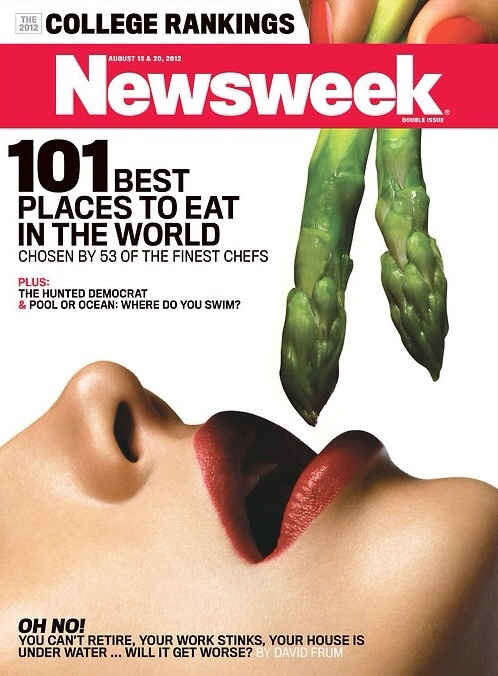
The Hillary Clinton cover isn’t the first time a “news weekly” has borrowed from porn. There was this cover of Newsweek. The subject of the story: great food.

newsweekcover

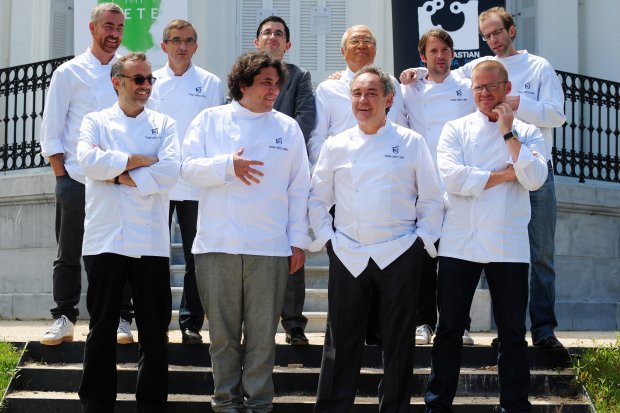
Time also did a story featuring the “best” chefs. No porn, but the magazine opted for this pic. Hmmm…what’s missing here?

godsoffood

That’s right, Time’s “Gods of Food” story featured ZERO women.

Wouldn’t it be nice if “news” magazines weren’t sexist? What would our news look like then? Does anyone even know?