Suffice it to say that the killer was a misogynist, and that lots of women have reacted to his rampage by reflecting on how women are denied full personhood.
The ideology behind these attacks – and there is ideology – is simple. Women owe men. Women, as a class, as a sex, owe men sex, love, attention, “adoration”
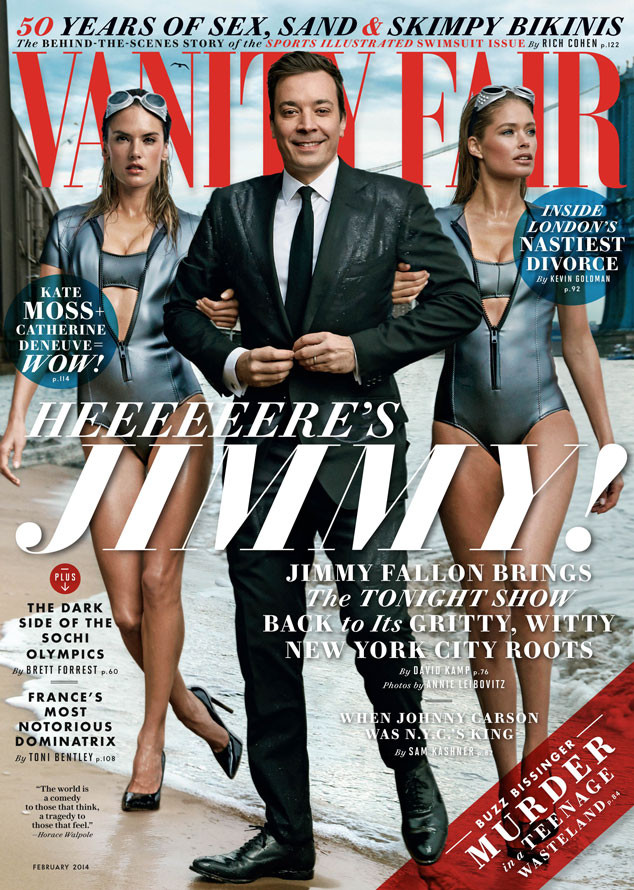
I’m reposting a blog I wrote after seeing Jimmy Fallon’s Vanity Fair cover. Look at these images. When will women in America be recognized as human beings equal to men?
Vanity Fair’s sexist Jimmy Fallon profile erases his wife, highlights Victoria Secret models
Posted on
I’m a huge Jimmy Fallon fan. This is why I bought the new Vanity Fair where he’s on the cover even though it annoyed me that Fallon is shown in a suit while he’s flanked by two nameless women in bathing suits.
There are more pics of Fallon and naked women inside the magazine. Reading the caption, I learned that the women are Victoria’s Secret models.
There is a third picture of Fallon and the women at what looks like New York’s Natural History museum. Once again, the women are in skimpy bikinis and we get a full view of ass. Fallon is once again pictured in a suit.
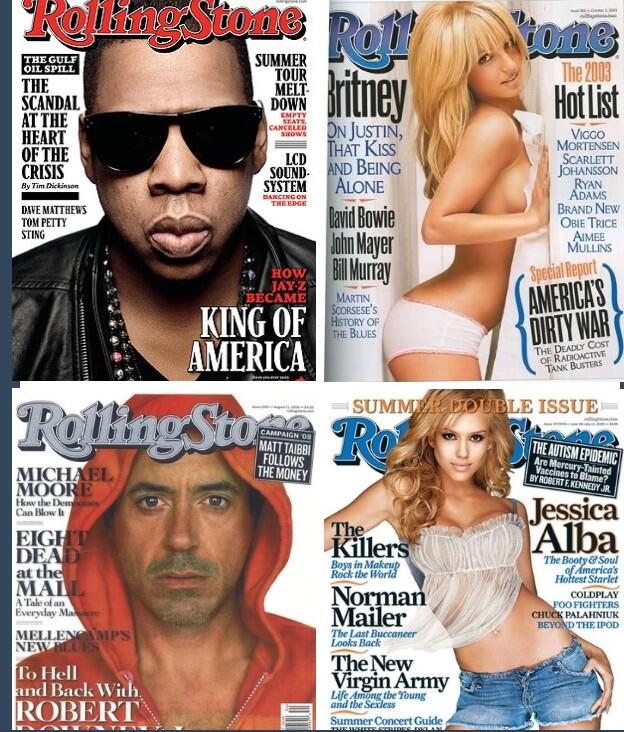
Showing important, powerful men fully clothed while women appear as naked accessories underscores the idea that men valued for what they do and think while women are valued for how they appear. Vanity Fair repetitively resorts to this sexism. There’s a famous photo featuring naked Scarlett Johanssen, Keira Knightly, and Tom Ford. When Rachel McAdams refused to undress, she was asked to leave.
Of course, Vanity Fair is hardly alone in promoting this sexist imagery. Here are five GQ covers that came out simultaneously: four men are shown in suits, one woman is shown naked.
What about Rolling Stone?
There’s Justin Timberlake’s “Tunnel Vision” video where he is clothed and the women are naked.
Many claimed Timberlake was copying Robin Thicke’s “Blurred Lines” video where he is clothed and the women are naked, a pairing repeated in the infamous Miley Cyrus performance (where Miley was blamed for being a slut.)
“Alternative” musicians resort to the same cliche. Did you see Nick Cave’s latest album cover?
The truth is, we’ve been dealing with the clothed man-naked woman pairing for a long time. Here’s a famous painting by Edouard Manet in the Musee D’Orsay in Paris that would make a perfect Vanity Fair cover.
But here’s what really pissed me off about the Jimmy Fallon article. As I wrote, I’m a fan of the comedian, but part of the reason I bought the magazine is because I wanted to know more about his wife, Nancy Juvonen. She’s a film producer and a business partner of Drew Barrymore. Both Barrymore and Juvonen are interested in making movies where cool women get to have adventures. I wanted to hear the whole story about how Juvonen and Fallon met and fell in love, just the kind of thing you’d expect to find in a Vanity Fair profile right? They recently had a daughter, Winnie, so I assumed Fallon would be asked about being a new father. I’m an avid reader of Us Weekly and People and I often see pictures of their family. Fallon is always cuddling his baby, playing with her, smiling at her, and I was curious about his thoughts on raising a girl in the world. Another thing I wanted to hear about: Fallon is 39 while Juvonen is 46, a rare gap in Hollywood where a woman’s age is measured closer to dog years than man years. Do you see my point here? Fallon married a successful career woman who is 7 years older than him, and this, besides his talent, is part of the reason I admire the guy. But here’s the weird thing: Nancy Juvonen is missing from Fallon’s profile.
Juvonen isn’t mentioned at all until 5 pages into the piece. After writing that Fallon always watched “SNL” alone, the text reads:
His one concession to adulthood is that he now watches the program with his wife, the film producer Nancy Juvonen, and if she is awake his baby daughter, Winnie, born last July.
Can you imagine Vanity Fair doing a profile on a famous woman and not mentioning her big time producer husband or her new baby until page 5? The piece goes on for two more pages and there are just two more brief references to Juvonen. Here’s all the magazine has to say on how they met and why they married.
Though the Fever Pitch experience had a saving grace–it was through the film that he met Juvonen, one of its producers who he would marry in 2007– he considers his LA years kind of a lost period.
Here’s the final reference to Juvonen, about persuading Fallon to become the “Tonight Show” host.
It was Fallon’s wife who persuaded him to go with Michael’s instinct. “Nancy was like, ‘You’ve got to try it. You’ll be one of three human beings who have done it– Letterman, Conan, and you. You have to do it. If it doesn’t work, it doesn’t work,’” Fallon said.
That’s it. WTF? All Fallon’s wife gets in a profile is a few sentences in passing coupled with a cover and three photos where he’s shown with naked women? That’s not the Jimmy Fallon I love or wanted to read about.
Why do you think that police thought so little of the killer’s videos ranting misogyny? In 2014 in America the hatred of women is accepted as a normal part of our culture. What if, instead, misogyny were considered a sign of something sick in a person and in a society? How would our world be radically different?
Suffice it to say that the killer was a misogynist, and that lots of women have reacted to his rampage by reflecting on how women are denied full personhood.
If you haven’t yet, please read these posts about the Santa Barbara massacre:
Rather than seeing Elliot Rodger as a product of society, the media has depicted him as a bloodthirsty madman, a mere glitch in the system.
The post goes on to point out that Rodger is not a “glitch” of the system, but a product of it.
Could the Santa Barbara massacre finally teach us to prosecute ‘gender crimes’ in the USA? Violence against women in this country is epidemic. What are we doing to stop it? What are we doing to educate the public about it? When the Santa Barbara massacre is discussed on all the news shows, do you think CNN, MSNBC, and Fox News will have on experts who will speak about violence against women?
If we called ‘gender crimes’ what they are, they would receive the elevated level of attention and punishment that hate crimes do. By identifying ‘gender crimes,’ we could also better address how to stop them, allocating more funding towards education and prevention. Right now, there is far too little public awareness of the ubiquity of violence against women, and insufficient funding for education, prevention, prosecution, or protection for women. “Glitches” happen every single day.
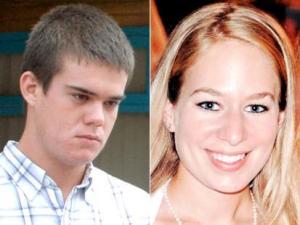
I’m reposting a blog I wrote about prosecuting gender crimes a few years ago in reference to Joran Van Der Sloot who killed Natalie Holloway and then went on to kill Stephany Flores.
Prosecute ‘gender crimes,’ Van der Sloot first up
Posted on
Joran Van der Sloot, the alleged killer of Natalee Holloway, the co-ed who disappeared in Aruba in 2005, was captured tonight in Chile. He’s under suspicion for the stabbing death of 21 year old Peruvian Stephany Flores. On June 2, Flores’s body was found in Lima, Peru in a hotel room registered to Van Der Sloot.
Van der Sloot was arrested twice for Holloway’s killing. He was released twice due to lack of evidence. Part of the “lack of evidence” included Van der Sloot talking on video about Holloway’s death and how her body was taken out to sea. This video “did not incriminate” Van der Sloot because he claimed he was just trying to “impress a drug dealer.”
Violence against women is epidemic, but perpetrators like Van der Sloot, too often don’t get punished and become repeat offenders. There is little public awareness of the ubiquity of the crimes, and insufficient funding for education, prevention, prosecution, or protection for women.
When the media covers stories about victims like Natalee Holloway, it’s usually in the most sensationalistic, ineffective way. If the women are attractive, white, and middle class, as she was, networks endlessly recycle former cheerleading or prom photos. But rarely do Larry King, Greta van Susteren, or Bill O’Reilly and co. accompany these horrific stories with facts about how widespread violence against women is, featuring direct service workers, experts in the field, who can educate the public with real statistics and solutions.
Today, in the Bay Area, Roselyne Swig, founder of Partners Ending Domestic Abuse took a step towards helping to stop the violence in a more effective way. Swig convened a summit in San Francisco with leaders from Bay Area organizations committed to ending violence against women. Swig’s hope is that these Bay Area organizations will collaborate, providing a leadership position, bringing public awareness to this widespread issue, taking action to end it.
JaMel Perkins, Board President of Partners, opened the summit by sharing terrifying statistics including some of these:
31% of American women report being physically or sexually abused by a husband or boyfriend.
Around the world, 1 in 3 women are beaten, coerced into sex or physically abused.
Women of all races and ethnicities are equally vulnerable to violence by a domestic partner.
Homicide is the leading cause of death for pregnant women.
77% of those deaths occur in the first trimester.
Abused women are 60% more likely to require hospitalization while pregnant.
90% of our homeless population are victims of abuse.
The health-related costs of rape, physical assault, stalking and Homicide committed by domestic partners exceed $5.8 Billion each year. Nearly $4.1 billion of this is spent on direct medical and mental health care services.
1 in 5 female high school students reports being physically or sexually abused by a dating partner.
The summit was attended by representatives from Bay Area organizations including SF Child Abuse Center, Blue Shield Against Violence (the leading private DV funder in the state), La Casa de la Madres, the police department and DA’s office who convened to network and collaborate.
“Domestic violence is something we should all be concerned about,” said Swig. “We need to create a collaborative voice.”
Marcia Smolens of HMS Associates, a local lobbying group, urged advocates to use social media to bring awareness to the issue of domestic violence to create change.
Judy Patrick, President and CEO of the Women’s Foundation of California, said that the goal of her foundation is to ensure that women and families are safe, healthy, and economically secure.
Marj Plumb of the Women’s Policy Institute trains women leaders who work in direct service to affect change in Sacramento. Women working on the front lines need the skills to lobby legislators to make policy that will help women and prevent violence.
Plumb had the women at the summit break into groups and identify problems and solutions to eradicate violence. Most groups felt that education was key, including curriculum for kids at middle school level, educating families, cultural awareness, and men.
I wish the media was a better educator. It’s such a missed opportunity. Domestic violence, and all violence against women, should be renamed as “gender crimes,” receiving the elevated level of attention and punishment that hate crimes do. The word “domestic” has always softened the crime for me, a crime that’s already not taken nearly seriously enough. Too often, crimes against women are written off as cultural issues, a misunderstanding, a married woman can’t possibly be raped by her husband or alcohol was involved so no one is to blame, or she’s to blame, or the guy who said he raped her was “just bragging.”
If the Taliban had been named worldwide for what it was– gender apartheid– maybe there would have been the universal outrage against it that people felt for South Africa’s racist government. Instead, most Americans, even good old San Francisco liberals, looked away, ignoring a regime where women were beaten and murdered, daily by their husbands and fathers as part of “cultural ritual.”
This year Yale student Annie Le was murdered and stuffed into a wall; UVA star Lacrosse player, Yeardley Love was murdered by fellow lacrosse player, George Hughley; Bruce Beresford-Redmond, a producer of the show “Survivor” is the prime suspect in the murder of his wife, Monica Beresford-Redmond, who was found dead in Mexico.
All of these killings received media attention, because these women were young, attractive, or middle class. Would we know about Peruvian Stephany Flores if Natalee Holloway hadn’t been killed by the same suspect? Maybe, her father is wealthy, but she’s got a strike against her: she’s not white. How many gender crimes happened today worldwide that we don’t know about? How many are happening right now?
Statistics say that in America 3 women are murdered by their husbands and boyfriends every day.
Last week, four black feminists participated in a panel discussion hosted by the New School titled: “Are You Still a Slave? Liberating the Black Female Body.” The talk– an in depth discussion about the influence of imagery and narrative on our culture and its role in creating our actual reality– went on for almost two hours. Yet, out of all this, the media reduced trenchant analysis into a sound byte, pitting one black woman against another: “Feminist scholar bell hooks calls Beyonce a terrorist.”
I encourage you to watch the whole talk. I know you probably won’t, because, as I wrote, it’s two hours long. I didn’t intend to sit through it all myself, but I was so excited and fascinated by what these women were saying, I couldn’t stop listening to them.
These 4 women are creating new narratives and images, beyond woman as victim, sex object, slave. The discussion about Beyonce, specifically her Time cover where she’s shown in her underwear (which totally bummed me out as well when I saw it– why, why, why, the issue is about the most influential people and she’s practically naked, do you know how few women make it to the cover of Time?) is a few minutes of a larger, important talk about women, power, and the nature of reality.
Here’s how bell hooks began the discussion:
Part of why I’m so excited and proud to be here today is that I’m up here with black women who are all about redefining and creating a different kind of image, liberating the black female body
Not a fan of “12 Years a Slave,” hooks says:
If I never see another naked, enslaved, raped black woman on the screen as long as I live, I’ll be happy.
YES! I could not agree more. I am so sick of watching women get raped. After the talk, someone in the audience challenged hooks, saying she felt conflicted about hooks’ reaction to “12 Years:’
we still need to have those conversations about rape and violence on stage…how can we have those conversations, the role of slavery and colonization on women’s bodies? Can we make space for both?
Here’s how hooks responded:
Because we have been so saturated, I mean, I think one of the big lies that’s going around is, “Oh, we never talked about slavery, oh, we don’t have images of slavery.” We had “Roots” and more “Roots,” and there’ve been all these different books and productions, so that I think of that as a kind of myth building thing when people say, “Oh, we don’t have images.” Notice I didn’t say I don’t want to see anything about slavery. I don’t want to see those same tropes over and over again.
hooks speaks about some narratives that involve slavery she’d like to see, for example, when John Wollman and the Quakers met and decided they could not support slavery and believe in the god they believed in, that in fact, they owed back wages to slaves.
that would be an interesting film for me… more interesting to me as an image, as an idea than the repetitive image of victimhood, and I think that they’re all kinds of images and stories out there that could bring us into a different level of understanding.
hooks was making exactly the same point about Beyonce. She was referring to the repetition of sexualized images of women and how the inundation is an assault on our brains, especially for kids:
I see a part of Beyonce that is, in fact, anti-feminist, that is assaulting, that is a terrorist, in especially terms of the impact on young girls. I actually feel like the major assault of feminism in our society is has come from visual media… The tirades against feminism occur so much in the image making business…What I’m concerned about constantly in my critical imagination is why is it we don’t have liberatory images that are away from, not an inversion of, what society has told us, but our own sense of: what am I looking like when I am free?
The tirades against feminism occur so much in the image making business
hooks wants new images. She says:
I would never want my child to see “12 Years a Slave” because it’s the imprint of the black, female body as victimized.
Again, totally agree. Obviously, “12 Years” isn’t a movie for kids, but I see endless books and movies, supposedly feminist ones where girls are mocked for being girls, then they rise above it and prove everyone wrong. Fuck that. I hope in children’s media I never have to read about or watch another girl dressing up as a boy, fighting or cooking “as good as a boy can,” from Mulan to Tamora Pierce to Elena’s Serenade to endless Minority Feisty. The reason this trope is awful for girls– and boys– is because before your child can understand the narrative, she needs to understand sexism. Instead of having Colette in “Ratatouille” give a whole speech about male dominated kitchens, why not make a movie with a female top chef and her best friend is a female talking-cooking rat? Audiences will buy that a rodent can run a three star restaurant but not a female? Like hooks says, we are saturated with this same old, same old. If we weren’t, it would be a different story (ha.) The slavery narrative in all its forms has its place, but we need a break. It’s too dominant. There are many other stories to tell.
By the way, hooks walks her talk. She wrote Happy to be Nappy for kids in 2001, and in this discussion, she says she includes it in her most important, favorite works.
Another speaker on the panel, Shola Lynch, is a filmmaker whose most recent production is a documentary about Angela Davis.
In referring to her film as “a political crime drama with a love story at the center,” she reframes Davis’ narrative. Next, Lynch is making a movie about Harriet Tubman, who she calls an “action heroine.” Can you believe there hasn’t been a movie about Harriet Tubman? Lynch says that even though Tubman’s story is true, people don’t “believe” it. The same phenomenon happened with the Davis movie. About selling that film, Lynch says:
So then I have conversations where somebody’s like, “Oh, it’s a great film as a documentary, but the only reason I would support it is I have to know who the main male characters are because it’ll be flipped to be a narrative, women’s stories don’t sell”… Her story is true, but not possible. People don’t believe it. But it’s all true.”
Talking about why she would rather make movies about heroes than victims, Lynch refers to “symbolic annihilation:”
Symbolic annihilation is two things: not seeing yourself, but it’s also seeing yourself only denigrated, victimized etc, and what that does to you. We can talk about all the things that denigrate us, but I’d rather shift the camera, shift my gaze, and look for the images and the people and the places that feed me. I really do think, you talk about children, the more we create our culture, our cultural images– the books you write, the films I make, the alternatives, that these are artifacts that live, and they speak to people whether we’re there or not, bodies of work, and that is critical. I want to give one example. My daughter, she’s 4. She’s never known me not working on the Angela Davis film which took 8 years. She was so excited when I could show her the trailer. ..The trailer is like 2 minutes long and she watched that trailer over and over and over again…She would point out all the characters, she loved going ‘That’s Angela’s mom.” So she created Angela’s family and a sense of community just by watching this thing over and over again. But that’s not what I wanted to share. So she’s a little girl, she wants to be a princess, I’m trying to convince her she wants to be a warrior princess, that’s blonde and poofy and glam. She woke up one morning and her hair was all out, just like, you know, big, out, out, out. Usually it’s like, “Oh mom, my hair is too puffy.” This morning, after watching the trailer over and over again, she said, “I have Angela Davis hair.” So I thought I was making this political crime drama with a love story at the center etcetera, etcetera, etcetra, but I was also making another image for young people to see and to perhaps relate to. And I was blown away, because I can tell her she’s beautiful all day long. I’m her mom, doesn’t count. The more we create the alternative universe which then becomes the universe.
Another panelist, writer Marci Blackman, echoes Lynch’s point:
My characters are the people who I grew up seeing every day who I don’t see, not just in literature, I don’t see them on TV…They weren’t there in the worlds that I was inhabiting when I would sit and go to the library and read, so I decided I wanted to write them, and I wanted to write people like me who I wasn’t seeing in the books either. I wanted to create these characters and put them out there, and I think what you say about self-representation and putting it out there to count as a counteract against these other images.
The journey to freedom has also been so much about the journey of imagination, the capacity to imagine yourself differently, counter-hegemonically, and that’s why the imagination is so important because Shola imagined Angela Davis in a different way from the images we had of her. That imagination of oneself, I would like us to end on that note and people can speak about creativity, because it is striking to me and I didn’t think about this when we were putting the panel together that for each of us, creativity and the uses of imagination have been what led us into the freedom we have. It has been what enhances my life every day. To be able to think and create and leap and jump beyond where I feel like we have been told, theoretically, intellectually that we should go.
Imagination inspires reality inspires imagination in an endless loop. It’s magic. That’s the point bell hooks was making about Beyonce. If you still don’t get it, here’s one last quote from hooks and then watch the video for yourself.
We can gather strength from the diversity of people’s stories, the diversity of people’s imagination.
BLAMING WOMEN IS ALWAYS IN FASHION! Never forget it.
I am reminded that times like these call for Jimmy Buffet:
Some people claim that there’s a woman to blame,
But I know, it’s my own damn fault.
Yes, and some people claim that there’s a woman to blame
And I know it’s my own damn fault.
Every time I hear “Margaritaville” on the radio (which is often, I live in San Francisco) I get a feeling of calm and relief. Men can take responsibility for their actions. More importantly, people can. Let’s stop being victims. Stop pointing– or shaking– your finger at someone else and clean up your side of the street. It’s good for America.
First of all, it’s not an interview. Lewinsky isn’t leaving this version up to someone else.
I’ve decided, finally, to stick my head above the parapet so that I can take back my narrative and give a purpose to my past.
In the piece, she lays out her take of the damage done to her:
Sure, my boss took advantage of me, but I will always remain firm on this point: it was a consensual relationship. Any ‘abuse’ came in the aftermath, when I was made a scapegoat in order to protect his powerful position. . . . The Clinton administration, the special prosecutor’s minions, the political operatives on both sides of the aisle, and the media were able to brand me. And that brand stuck, in part because it was imbued with power.
On the rumor that Hillary Clinton called her a “narcissistic loony toon,” Lewinsky responds:
If that’s the worst thing she said, I should be so lucky…Hillary Clinton wanted it on record that she was lashing out at her husband’s mistress. She may have faulted her husband for being inappropriate, but I find her impulse to blame the Woman — not only me, but herself — troubling.”
Lewinsky takes control of the language of her story, refuting Beyonce’s lyrics in her song “Partition:”
Thanks, Beyoncé, but if we’re verbing, I think you meant ‘Bill Clinton’d all on my gown,’ not ‘Monica Lewinsky’d.
Now interested in helping victims of cyberbullying, Lewinsky writes:
Thanks to the Drudge Report, I was also possibly the first person whose global humiliation was driven by the Internet.
Citing the story of Rutgers student Tyler Clementi, who committed suicide after a video was released of him kissing another man, Lewinsky writes that she, too, was suicidal. She’s not anymore.
In these excerpts, Lewinsky comes off as smart and funny. I’m impressed with how she stays committed to writing/ creating her own story. That’s not an easy task for anyone, but it’s got to be epic for Lewinsky, whose narrative has been used and co-opted by the most powerful people in the world. Not to mention, of course, the thousand year old forces of our cultural imaginary– biblical, mythical, symbolic– casting Lewinsky as the young woman seductress along with her co-star, Clinton, the powerful man brought down by lust. Of course, Bill Clinton was able to resurrect himself on the public stage. I’d love to watch Lewinsky triumph as well.
Last December, Salon did a story on why R. Kelly continues to be a star with legions of fans, in spite of the many allegations of sex abuse against him. The reporter who broke the story on R. Kelly is quoted in Salon:
DeRogatis’ response is blunt and troubling and worth reading in full. Throughout his career, DeRogatis interviewed two dozen women, sifted through “hundreds of pages of lawsuits” with nauseating details of abuse and intimidation tactics used against them, and felt the emotional rawness of women whose lives have been ruined. “The saddest fact I’ve learned is: nobody matters less to our society than young black women,” he said.
I was thinking about DeRegatis as I continue to ponder the lack of news coverage in the USA of 234 missing Nigerian girls. I’ve been asking this for years, but what if the Western world took any notice of gender Apartheid of the Taliban before 9/11? What if those women, their education level, their health, their financial state had been important to American political leaders? What if American citizens cared that women worldwide are denied human rights? What if Americans saw the lack of human rights for women as a political issue and not a cultural one?
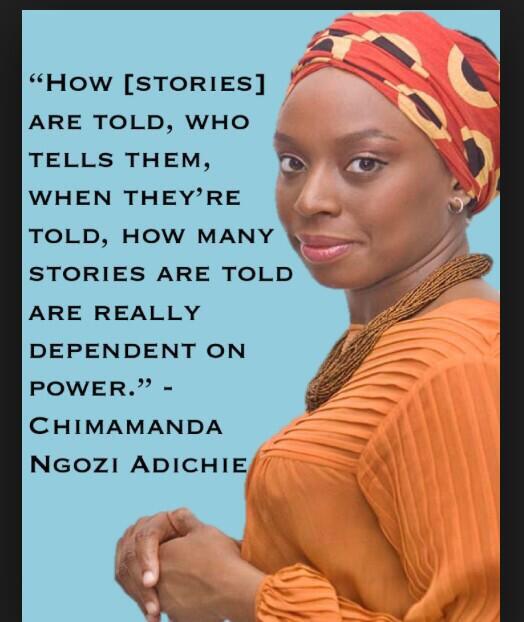
I just saw this on Soraya Chemaly’s Facebook page.
Adiche’s quote is basically the whole reason why I started this blog. What stories get told? What stories are important? What stories matter? How do the images and narratives that we are saturated with– that our kids are saturated with– reinforce whose bodies are important and whose bodies are worth $12? What are you doing to change the stories your children hear or to train them to accept and expect a world where girls and women go missing?
If George Eliot hadn’t pretended to be male, she may never have been published at all. If J.K. Rowling hadn’t taken her publisher’s advice to obscure her gender, she may not have created the Harry Potter franchise and become a billionaire and then a millionaire because she gave so much money away. If rape survivors choose to publicly tell their stories, with their real names and photos they risk a lifelong victimization by a sexist culture.
I wish this culture didn’t make it so preferable for women to keep their stories and gender secret and hidden.
I’m grateful to every woman who publicly tells her story.
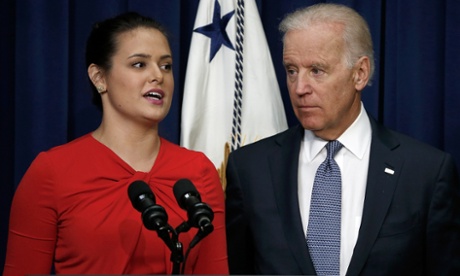
Thank you to Madeleine Smith, a graduate of Harvard University who was raped while attending college and spoke at the release of the first report of the White House Task Force to Protect Students from Sexual Assault. You’re a hero and you’re changing the world for women, something you can’t do without a face and a name. Other women will hear you and see you and they will choose to tell their secret stories too. Seeing you puts the shame where it belongs, back on the perpetrators.
Thank you to another hero, Ashley Sapp of the Survivor Stories Blog Interview Project. In honor of Mother’s Day, the project features an interview per day with a survivor of any form of violence against women (VAW) including domestic violence, rape, sexual assault, female genital mutilation, forced/child marriage, and sex trafficking.
When women stay silent and invisible, all women and girls are affected. We all learn that our stories– whatever they may be– are not important and don’t matter. When women tell the truth publicly, they give us all permission and inspiration to do the same.