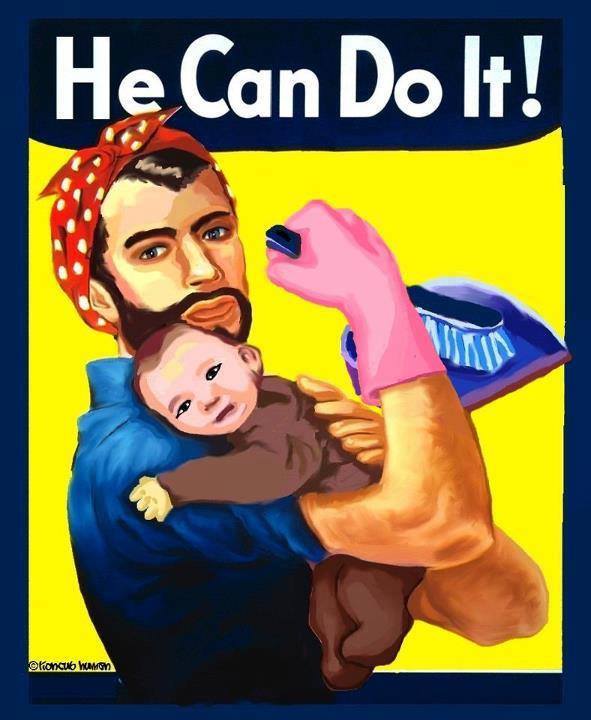
Boxing Day question: Are dads cleaning up and putting away Christmas loot?

My house looks like a tornado blew through. I feel completely overwhelmed when I look at what’s happened.

I just saw this on my Facebook feed from Gallant Girls.

Good morning, Gallant Girls and Guys! Now that the holiday festivities are over (until New Years), hopefully we are ALL working together to clean up and put away the aftermath of the holiday. Right?!

1504070_231932490317323_886412946_n

My husband is cleaning up this morning so I can take a few hours to write. I have to get my next chapter to my editor by tomorrow. Without his help, that would be impossible.

Sheryl Sandberg has said that who you marry is a career decision, and I couldn’t agree more. If I didn’t have a partner who supported my work and my dreams, there is no way, with three kids, I would be able to act towards making them come true.

Erica Jong has said lots of people have talent but what is rare is the courage to follow it. I read a post on Salon that I can’t take the time to find right now (because I’m supposed to be writing my chapter) about sexism, literature, and “chicklit,” where the author writes something like: How many women are going to close the office door and tell their family they need to write?

Now, consider how many men are going to close that office door? How many men have wives who will organize and put away everything without expecting their husbands to do equal work or will be so grateful for any “help?”

There is another reason I get to write today. My three kids are in camp. I can afford to send them there. How many women also have the income to put towards childcare so they can write? And this principle, of course, goes back to Virginia Woolf’s “A Room of One’s Own,” her essay about Shakespeare’s mythical sister. Without the space and the income, women can’t write. If women can’t write, they can’t create narratives with female protagonists. If stories with female protagonists don’t exist, women and men both learn that females belong on the sidelines and in supporting roles.

Once my three hours of writing are up, it’ll be my turn to clean, food shop, and pick the kids up at camp. Because I will have gotten my work done, I’ll be excited to go on with this part of my day and be a better mom.

If dads did half of the childraising and the housekeeping, moms would be that much closer to changing the world.


U.S. lags behind other countries in stopping sexism

This week, Sweden announced it will implement a movie rating system that will inform viewers if the film is sexist. Sweden will use the Bechdel test which requires that the movie have (1) at least two females (2) who talk to each other (3) about something other than a man.

The Guardian reports:

“The entire Lord of the Rings trilogy, all Star Wars movies, The Social Network, Pulp Fiction and all but one of the Harry Potter movies fail this test,” said Ellen Tejle, the director of Bio Rio, an art-house cinema in Stockholm’s trendy Södermalm district…Beliefs about women’s roles in society are influenced by the fact that movie watchers rarely see “a female superhero or a female professor or person who makes it through exciting challenges and masters them”, Tejle said, noting that the rating doesn’t say anything about the quality of the film. “The goal is to see more female stories and perspectives on cinema screens,” he added.


I love the Bechdel test, but I adapted it to rate movies for children to discount the Pink Ghetto. For the Magowan Test for Gender Bias in Children’s Movies (1) at least two females who are friends (2) go on an adventure (3) and don’t wear revealing clothing. Simple requirements, yet surprisingly difficult for Hollywood to even come close to meeting in the many movies put out for little kids every year.

Recently, Saroya Chemaly posted in Salon The MPAA’s backwards logic: Sex is dangerous, sexism is fine:

The real problem in movies today isn’t sex, it’s sexism — often coupled with racist caricatures for even greater effect. Imagine if our movie ratings considered sexism and racism as content that children should not be viewing without parental input. Just a thought.


I couldn’t agree more. The lack of attention to the rampant and repetitive sexism in children’s movies is exactly why I started Reel Girl. I rate children’s movies on a scale of 1 – 3 S’s to denote gender stereotyping. I would much rather my kids hear a swear word than witness more narratives and images where females are sexualized and marginalized. When I started Reel Girl, almost four years ago, I couldn’t find anything else on the internet that rated children’s movies and products for sexism.

The Week also posted recently: Why female pleasure, not sex, is the real taboo:

The common defense of television censorship is the need to protect the young and impressionable. It’s all for the children. So why is it that a national broadcaster in the 21st century feels the need to bleep out a scene of a teenage girl masturbating, while the rest of television is stuffed to the gills with scenes depicting rape, torture, suicide, and sex between middle-aged adults and adolescents?

Sweden gets this hypocrisy and is addressing it. While I am so psyched this country is taking major steps to alert viewers about sexism, I’m upset that the home of the free and the brave remains slow on the uptake. I honestly think my blog, Reel Girl, is the best resource for rating sexism in children’s movies, and I do it for free, when I have a few minutes of time.

It’s not just sexist movies that our country endorses as OK for kids. While the U.S. has made child beauty pageants a national pastime, with TV hits like “Toddlers and Tiaras” and “Honey Boo Boo,” this year, France outlawed the sexist practice. The New York Times reports:


“It is extremely destructive for a girl between the age of 6 and 12 to hear her mother say that what’s important for her is to be beautiful,” Chantal Jouanno, the ban’s champion, said Wednesday. “We are fighting to say: What counts is what they have in their brains.”

Ms. Jouanno, a former junior minister for environment and a senator representing Paris from the center-right party U.D.I., wrote a report on the “hypersexualization” of children in 2011. The report was commissioned by the health minister in response to public outrage over a photo display in Paris Vogue that featured under-age girls in sexy clothes and postures, with high heels, makeup and painted fingernails. The episode drew attention to the increasing use of very young girls in fashion photography and advertisements.

Of course, child beauty pageants don’t just affect the contestants, but everyone who sees the images of these sexualized kids on TV or in magazines.

Moving on to the United Kingdom where after a campaign by Let Toys Be Toys for Girls and Boys, Toys R Us announced it would divide products by type instead of by gender. What about Toys R Us in the USA? Or Target? Not so much.

So why do you think Sweden, France, and the United Kingdom have taken leadership positions in stopping sexism while the U.S. lags behind? I know there’s some bad evidence against us, such as not one female president in our entire history, but aren’t we supposed to support equality and justice for all? Isn’t that our thing?

I have a theory on why the U.S. continues to be a leader in promoting, rather than stopping sexism. While our role as superpower slips as we move further into a global economy, the U.S. remains clearly dominant in one area: culture. American movies dominate the world. While Obama may fall from favor, everyone worldwide knows and adores Angelina Jolie and Brad Pitt. My guess is that because of this role as a culture shaper, the U.S. and its mutinational companies like Disney and everything Hollywood will be reticent to change and risk losing hegemony over world culture. The irony is, if the U.S. continues to lag behind in recognizing sexism, eventually, it will lose its position as #1 culture shaper. The change towards recognizing sexism, so ubiquitous that its, paradoxically, become invisible, is happening much slower than I would like it too, but it is happening. Sweden, France, and Australia are starting to get it. Women are the world’s largest untapped resource. As long as we keep selling women short, we all lose.

On a positive note, I did just get this email from Hillary Clinton.

On Friday, we announced a new initiative to accelerate the progress of women and girls at home and around the world. We call it No Ceilings: The Full Participation Project, and I hope you’ll be a part of it.

No Ceilings has its roots nearly twenty years ago, and we hope it will have an impact just as far into the future.

The great unfinished business of our time In 1995, at the Fourth World Conference on Women in Beijing, 189 countries set an ambitious goal: Women and girls should be able to participate fully in the progress and prosperity of their societies. I was proud to co-lead the American delegation to the conference and to declare to the world that “Human rights are women’s rights and women’s rights are human rights, once and for all.”

We’ve made a lot of progress since that day – more girls are in school, more women hold jobs, and more women serve in public office – but we’re still a long way from the goal of full participation. Women and girls continue to face ceilings that limit what they can achieve and hold back entire economies and societies. More than 100 countries have laws on the books that restrict women’s participation in the economy. Women are nearly half of the world’s population, but hold only 20 percent of all parliamentary seats. Around the world, including in the United States, women tend to earn less than men. And nearly 5 million girls are still married under the age of 15 every year.

The great unfinished business of the 21st century is helping women and girls break through these ceilings and contribute fully in every aspect of life.

I was in Beijing in 1995. I was 26 years old. I felt inspired and hopeful. Maybe what the U.S. needs to risk making change is a female president leading the way.

Art creates reality: Imagining gender equality in the fantasy world

Some good quotes here. Let me know what you think

Bono on Jay-Z in November’s Vanity Fair:

In music, we love the idea of the screwed-up, shooting-up. fucked-up artist. The one bleeding in the garret having cut his own ear off. Jay-Z is a new kind of 21st-century artist where the canvas is not just the 12 notes, the wicked beats, and a rhyming dictionary in his head. It’s commerce, it’s politics, the fabric of the real as well as the imagined life.


Stephen Mitchell in Can Love Last, the Fate of Romance Over Time

It is the hallmark of the shift in basic psychoanalytic sensibility that the prototype of mental health for many contemporary psychoanalyitc authors is not the scientist but the artist. A continual objective take on reality is regarded as neither possible nor valuable in contrast to the ability to develop and move in and out of different perspectives of reality.


New York Times, October:

Public narratives about a career make a difference. The most common career aspiration named on Girls Who Code applications is forensic science. Like Allen, few if any of the girls have ever met anyone in that field, but they’ve all watched “CSI,” “Bones” or some other show in which a cool chick with great hair in a lab coat gets to use her scientific know-how to solve a crime. This so-called “CSI” effect has been credited for helping turn forensic science from a primarily male occupation into a primarily female one.

Jezebel reacting to New York Times piece:

The New York Times today would like to suggest that storytelling is powerful, that, in the whole art/life dynamic, it’s life that imitates art, not the other way around, at least not when it comes to kids imagining viable career paths for themselves.


Whoopi Goldberg:

Well, when I was nine years old Star Trek came on. I looked at it and I went screaming through the house, ‘Come here, mum, everybody, come quick, come quick, there’s a black lady on television and she ain’t no maid!’ I knew right then and there I could be anything I wanted to be.


In the fantasy world, anything is possible, so why do little kids see so few female heroes and female protagonists on TV and in the movies? While boy “buddy stories” are everywhere you look, why is it so hard to see two females working together to save the world? Why are females, half of the kid population, presented as a minority in fantasy world? Why are TV shows, movies, and books about boys “for everyone” while shows and movies about girls “just for girls?” When we pass on stories to our kids, what are we teaching them about gender, about who they are right now and who they will become?

One more quote for you from neuroscientist, Lise Eliot:

“Babies are born ready to absorb the sounds, grammar, and intonation of any language, but then the brain wires it up only to perceive and produce a specific language. After puberty, its possible to learn another language but far more difficult. I think of gender differences similarly. The ones that exist become amplified by the two different cultures that boys and girls are immersed in from birth. This contributes to the way their emotional and cognitive circuits get wired.”

Eliot believes: “Simply put, your brain is what you do with it.”So let’s all use our brains to imagine gender equality in the fantasy world, take actions to manifest that vision, and see what happens next. I bet it’ll be amazing.

When is it OK for kids to read YA books about rape or incest?

I just posted on the excellent Graceling trilogy and added that I would not let my 10 year old read it because of the rape and incest. I suggested 15 might be a good age. Then I went back and edited, remembering the rape and incest, while central to Bitterblue, is only implied near the end of Graceling. It’s not in Fire. So then, I thought maybe 12 years old for the first two and 15 for Bitterblue? And then, it occurred to me that rape and incest happens to kids all the time. In that case, reading about it in this context would be helpful. How ironic to censor something in a book that describes what’s happening in a kid’s real life. So, then I concluded, it’s such an individual choice. With sex, I didn’t want my kids reading about it or seeing movies that referenced it, before I had “the talk.” I wanted them to learn about sex from me first, rather than from a kid at school or from a movie. I had the conversation with my daughter last Spring, when she was nine. It went really well, and since, she’s come to me with questions, and she seems comfortable talking about it. But rape and incest, I’d like to protect her from the knowledge of a little longer.

gracelingtrilogy

I did a Google search, remembering something I’d read on dark YA lit a while ago that was good. Here’s a quote from the post and the link.

The underlying assumptions behind Gurdon’s piece seem to be rooted in the idea that children read books with heavy content and ‘go bad,’ when in fact the opposite is true. Some children lead dark lives and they read books with intense themes to find protagonists they identify with in an often hostile world. Some young adults read about rape and bullying and violence, eating disorders and self harm and mental illness, because these are things they experience.

Alas, the belief that bad things do not happen to children and young adults is not limited to naïve Wall Street Journal columnists, and it does far more damage than mere dubiously-sourced articles that attract a storm of commentary. The belief that childhood is a happy place, where bad things don’t happen, where you don’t need rose-tinted spectacles because everything is already rose-tinted, has direct and harmful impacts on children and young adults in danger.


I don’t think my child would “go bad” from reading about this stuff. Nor do I think if a child is into these books, that means she’s leading a “dark” life. I think, and I could be wrong, if my ten year old daughter picked up Bitterblue, she’d read it cover to cover.

Also, for my kids, I do believe childhood is a pretty happy place for them and should be protected as such. Obviously, that doesn’t mean Disneyworld to me. I think Disneyworld is tremendously warped. But it does mean I want my kids to experience the belief in safety and also in magic. I believe that covering up “reality” to protect a child’s developing imagination is an important part of parenting and also, of being a kid. If your child has safe boundaries, she feels brave enough to take healthy risks. Psychologist Stephen Mitchell explains this well in his excellent book, Can Love Last: the Fate of Romance Over Time:

One of the things good parents provide for their children is a partially illusory, elaborately constructed atmosphere of  safety, to allow for the establishment of “secure attachment.” Good-enough parents, to use D. W. Winnicott’s term, do not talk with young children about their own terrors, worries, and doubts. They construct a sense of buffered permanence, in which the child can discover and explore without any impinging vigilance, her own mind, her creativity, her joy in living. The terrible destructiveness of child abuse lies not just in trauma of what happens but also the tragic loss of what is not provided– protected space for psychological growth.

It is crucial that the child does not become aware of how labor intensive that protracted space is, of the enormous amount of parental activity going on behind the scenes.

What are your thoughts on all this?

Update: Heather comments that her 8 year old daughter learned about rape and incest when a classmate brought porn to school.

Based on the brief snippets of content she saw, I had to not only have “the talk”, but also explain a LOT of things I never thought I’d have to address at that age. Because of this, conversely, she is now very educated on both sex, misogyny, and rape/assault/child abuse.  Therefore, I think these books that are written about very serious issues — but in the comprehension style of a young person who can find the characters identifiable — is a great source of information…I have not read these books to endorse them, but now I am interested and will be checking them out at the library. Thank you.


Heather’s comment make me think that if your child knows about rape or incest, these books are appropriate for her or him. (I really hope parents of sons will get their kids this trilogy.)

Walmart pulls toddler ‘Naughty Leopard’ costume

YAY for social media, us, and, most importantly, kids this Halloween. One costume down!

In response to concerned parents, Walmart pulled the Naughty Leopard costume for little girls off its shelves. Here’s Walmart’s apology:

“It was never our intention to offend anyone and we apologize to any customers who may have been offended by the name of the costume.”


Nice analysis from Babble:

It seems as if the producers of the product just got lazy and slapped on the “naughty” text out of habit since their factories perhaps also churn out outfits  like the Naughty Nurse,Naughty Traffic Officer, or Naughty Little Red Riding Hood.


It’s a small victory in the scheme of things, but it’s something. Thank you to everyone who Tweets, comments on Facebook, or takes any action, no matter how small, to stop the daily sexualizing of little girls. Keep it up.


What’s the difference between parents of pageant kids and you?

Did you know that tween girls spend 40 million a month a beauty products? Another fun fact: The percentage of eight- to twelve-year-olds who regularly use mascara and eyeliner doubled between 2008 and 2010.

This info is from Peggy Orenstein’s best-selling book, Cinderella Ate My Daughter. Here’s the passage where she writes about the difference between the parents of child pageant competitors and “ordinary” parents:

No question, they have taken the obsession with girl’s looks to an appalling extreme; but, one could argue, the difference between them and the rest of us may be more one of degree than of kind.  “Ordinary” parents might balk at the $3,000 dress or the spray tan but guess what? in 2007, we spent a whopping $11.5 billion on clothing for our seven to fourteen-year-olds, up from $10 billion in 2004. Close of half to six to nine year old girls regulatry use lipstick or gloss, presumably with parental approval; the precentage of eight to twelve year olds who regularly use mascara and eyeliner doubled between 2008 and 2010, to 18 and 15 percent respectively. “Tween” girls now spend more than $40 million a month on beauty products. No wonder Nair, the depilatory maker, in 2007 released Nair Pretty, a fruit-scented line designed to make ten-year-old conscious of their “unwanted” body hair. And who, according to the industry tracking group, NPD, most inspires girls’ purchases? Their moms. AS a headline on the cheeky feminist Web site Jezebel.cm asked, “How Many 8 Year Olds Have to Get Bikini Waxes Before We Can All Agree the Terrorists Have Won?

Pigeonholing your kids pigeonholes your kids

If there’s one really useful thing I’ve learned in my 10 years so far of being a parent, it’s not to pigeonhole my kids. Kids change, and when I assign attributes of a certain stage as if they were permanent personality traits, I can see how it limits them. I get the urge to do this. It’s nice to for a parent to feel like a child has a clear identity. Also, if you have multiple kids, putting them in different categories can smooth things out. Every child has her little box and as a parent, you can work to protect those boundaries for her. Pigeonholing kids can reduce conflict in the short term.

The first way I clearly learned that pigeonholing had a negative effect was with food. Since my kids could eat, I encouraged them to try different foods, that there are no “good” foods or “bad” foods. My kids don’t have to eat broccoli and then get dessert. We don’t even do dessert. They can eat what they want, when they want. There is much writing about this on Reel GIrl, more from when I first started this blog then now, because we are practically food conflict free in our house. The segue is that, because of this philosophy, I never said: “This kid likes pizza, that one likes bagels.” Instead, I told them that their taste buds change all the time, and to keep trying foods, even if they think they don’t like them. I honestly believe, just that, has kept their eating open and flexible. They are risk-takers with food, which may not seem to a big deal for an adult, but it is for a kid.

Obviously, I’m also against pigeonholing because I hate how women are continually fragmented: the smart one or the pretty one. Humans are complex. Pigeonholing them is an a illusion of a simplicity.

Finally, not to get too Buddhist here, but change is the only thing that is real. It’s scary for everyone, but I think it’s much healthier to train kids to embrace it rather than avoid it.

Why I’m writing all this right now is because Princess Free Zone just posted a New York Times article: Mystery of the Missing Woman in Science. It’s great, please read the whole thing, but here’s a quote I love:

Students show greater gains when they are taught that the mind, like a muscle, gets stronger with work, as opposed to being told that talents are fixed and you’re born either quick or slow.

And this is true. It’s called brain plasticity. Your brain changes and grows for your whole life, based on your experiences. Your brain grows most rapidly, when you are a kid. The more experiences, the better.

Facebook helps debunk myth of America’s ‘post-feminism’

YAY! Facebook FINALLY recognizes: misogyny exists. It’s real, FB says, and that’s a giant social media step in the right direction. In 2013, gender-based hate and violence is epidemic and still, for the most part, accepted as normal.

I’m  44 years old, a member of the notoriously apathetic Generation X. Since I started speaking out about feminist issues, back in my twenties (not lazy or apolitical, by the way, didn’t really know anyone who was) I’ve been told sexism doesn’t exist. We live in a post-feminist world. What could American women, not to mention white, educated, privileged ones, possibly be whining about? We weren’t under Taliban rule for goodness sake. Not that college kids, all of us so well versed in South Africa’s racist history, had any clue about the gender apartheid of the Taliban. And if we had known of it? Gender bias, while kind of a shame, was just a cultural difference, not a political issue. “Relative ethics” was the term my sociology professor taught us for female genital mutilation: Who were we, in all our privilege to judge?

So for years, Facebook has been receiving reports on posts depicting gender based violence. While the company actively bans religious or racist hate speech, here’s just one example of its past response to misogyny.

facebook

(via Amazing Women Rock . If you go to the link, and you have a strong stomach, you can see many more.)

So why did Facebook change its tune, pledging to take misogyny seriously? Obviously, in no small part, because of a well-run, well organized campaign by Women, Action, and Media. THANK YOU WAM and thank you to all of you who responded. In days, 5,000 emails and 60,000 Tweets went to Facebook’s advertisers who started to take their ads off the site. Facebook, if anyone could, saw where all this viral action was headed. Women have been using social media to change the world for some time now.

In the Nation, Jessica Valenti writes :

Jaclyn Friedman, executive director of WAM… points to the outrage over the social media-documented rape in Steubenville, gang rapes in India and the suicides of several young rape victims as indications that Americans may have had enough of the consequences of rape culture. While she’s still unsure that the country is ready for widespread change, she believes “there’s a critical mass right now; it could be a tipping point moment”…

But this glaring, in-your-face misogyny may be the spark that pushes culture forward—there’s no arguing with these images, these court cases, these stories. Maybe it needed to get a lot worse—or more visible—for it to get better. For years, the most common anti-feminist talking point has been that American women don’t have it all that bad. That we should stop complaining and focus on women in other countries who are “really” oppressed.

But today, telling women that sexism doesn’t exist anymore is a really hard sell. Thanks to the Internet and the speed at which stories move—not to mention the vile sexism in most online spaces—any American woman who spends more than five minutes onlines hears about or experiences misogyny every day.


I started this blog, Reel Girl, because I have 3 daughters, and I was so horrified by the gender stereotyping marketed to kids like it’s okay, like it’s normal, and then how everyone participates in it. It’s so sad that sexism, packaged and sold to kids, is so ubiquitous that, paradoxically, it’s become invisible. I feel like 90% of my work is just pointing out that sexism exists. I’ve posted this a couple times, but here it is again:

Violence against women is epidemic. A first step to abuse is always dehumanizing the victim. Propaganda, in the form of images and narratives, effectively dehumanizes on a mass scale. Here’s some propaganda marketed to kids:


Images/ narratives of Jews circa 1938

nazibook


Africans circa 1931

tin_tin_in_congo11


Females circa 2013

bratzwallpaper-source_4cj

It’s easy to look back on history and wonder: How did people ever put up with that? I’d never buy into it. But what are you participating in right now that is completely accepted, not to mention celebrated, by our culture?


Since my post, I’ve gotten comments asking how dare I compare sexism to racism and antisemitism. I’ve been rebuked for taking sexism seriously for a long time. When I was a senior in high school, I was talking to a good friend of mine about sexism, and he said to me, indignantly, “A woman has never been lynched for being a woman!” Maybe, maybe not, but women have been murdered throughout history for being women. Does getting raped or sexually assaulted qualify as pretty bad treatment?

Here’s a classic comment from Chinwe:

What I find embarrassing, shameful, and flat out appalling is you comparing the current state of girls in 2013 to the days that Blacks and Jews were stereotyped, discriminated, and killed in the early 20th century. Girls and women have gained so many rights in the last 40+ years and you compared its ”oppression” to Blacks and Jews in the 1930s.

Really?

That’s absolutely and utterly lazy comparison and analysis.

Years ago, the Wall Street Journal used to have a Bad Writing Contest where readers can submit writing that’s truly awful. Too bad they don’t have this contest because I would personally submit this post–and your blog–to judges of the Bad Writing Contest and you would win hands down.

Honestly, you need a new hobby because you come across really immature, out-of-touch and bitter towards the world. Once again, do yourself a favor and enroll in an English 101 class at your local community college and learn how to write. Everytime I see a new post, 1) you are embarrassing yourself and 2) you put yourself further down the cultural rabbit hole by making piss poor arguments.

*waiting for your condescending reply*

You are pretty predictable, ya know

Huh, think Chinwe heard about the three women sexually assaulted for 10 years in Cleveland? How their captor, Ariel Castro, got out of domestic abuse charges years earlier because his ex-wife’s lawyer didn’t even show up to prosecute? Or perhaps Chinwe knows that in America, 3 women are murdered by a domestic partner every day? And still, our congress fought over passing the Violence Against Women Act?

I guess that’s my sarcastic, predictable, and, of course, poorly written reply.

We don’t live in a post-feminist world. We never have. According to the Geena Davis Institute, at the rate we’re going, will might in about 700 years. Don’t you think that’s too long for your children to wait?


After massive protest, Disney pulls new Merida from site

Exciting news! Today, Rebecca Hains, blogger and media studies professor, reports:

“As of today, Disney has quietly pulled the 2D image of Merida from its website, replacing it with the original Pixar version. Perhaps we’ll be spared an onslaught of sexy Merida merchandise yet.”

YAY! Check out the link, it’s true! BRAVE Merida is back.

I guess Disney was right to be so terrified of creating a strong, BRAVE, female protagonist (along with Pixar studios which hadn’t had ANY female protags before “Brave.”) It looks like Merida could be turning Disney’s franchise on it’s head. That’s pretty damn heroic.

Another mistake Disney made with “Brave?” They hired a female director. They fired her, but it was too late. Brenda Chapman wrote “Brave” based on her daughter. She was furious with the character’s transformation and wrote publicly about Disney’s terrible mistake.

Of the debacle Hains writes:

That’s right: Although Merida was created by a woman as a role model for girls, the male-dominated consumer product division at Disney has ignored the character’s intended benefits for young girls, sexualizing her for profit. Compared with her film counterpart, this new Merida is slimmer and bustier. She wears makeup, and her hair’s characteristic wildness is gone: It has been volumized and restyled with a texture more traditionally “pretty.” Furthermore, she is missing her signature bow, arrow, and quiver; instead, she wears a fashionable sash around her sparkly, off-the-shoulder gown. (As Peggy Orenstein noted when she broke the news of the redesign, “Moms tell me all the time that their preschool daughters are pitching fits and destroying their t-shirts because ‘princesses don’t cover their shoulders.’” I’ve heard the same from parents, as well.)

Is the sexualized  image of Merida gone for good? Has Disney learned a lesson? Or will that lesson be: No more strong female characters leading a film! No more female directors writing about their daughters! Keep the females weak and quiet!

It’s up to you. This could be a turning point. Parents, please use your voice and your wallet to keep strong, heroic females showing up in narratives and images marketed to your kids. Right now, girls are missing from children’s media and when they do appear, they’re sexualized. This is normal. Not healthy, but tragically, perfectly normal.

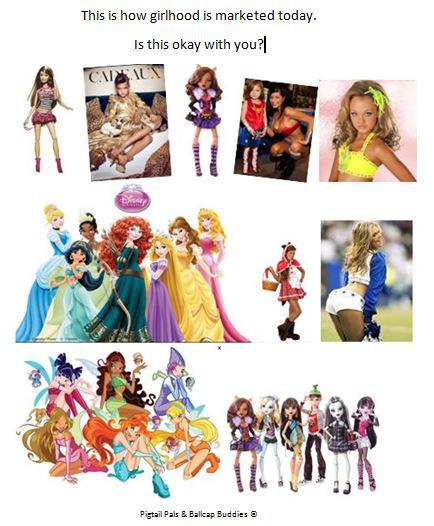
Yesterday, Melissa Wardy posted this image on her Pigtail Pals Facebook page, reminding us Merida’s new image was not created in a vacuum.

pigtails

Objectifying and sexualizing girls is dangerous. A first step to abuse is always dehumanizing the victim. Propaganda, in the form of images and narratives, effectively dehumanizes on a mass scale.

Images/ narratives of Jews circa 1938

nazibook

Africans circa 1931

tin_tin_in_congo11

Females circa 2013

bratzwallpaper-source_4cj


It’s easy to look back on history and wonder: How did people ever put up with that? I’d never buy into it, not to mention expose my child to it. But what are you participating in right now that is completely accepted, not to mention celebrated, by our culture?

Be part of the solution. Demand narratives with strong female characters for your kids.

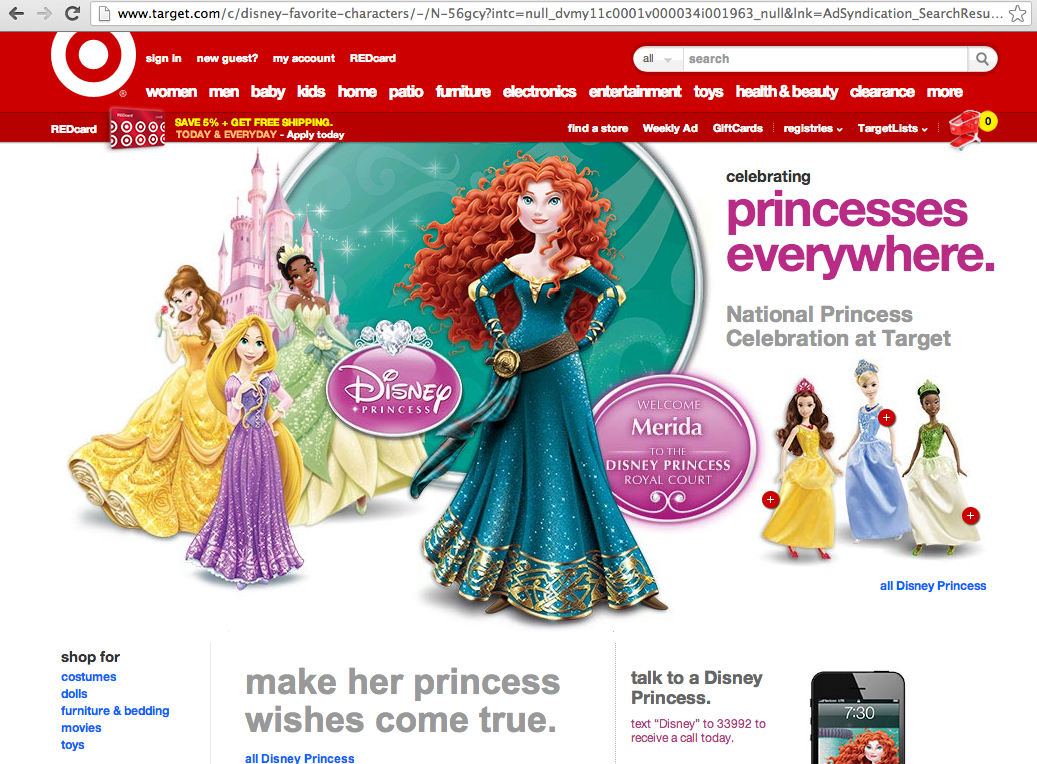
Update: New Merida may be off Disney’s site but she’s showing up all over the place including Target. Below is Target’s web page.

meridatarget