‘Wreck-It Ralph’ and the Minority Feisty

There is a lot to love and admire about “Wreck-It Ralph.” In many ways, both conspicuously and more subversively, the movie challenges gender stereotypes. That said, the gender matrix– a sexist framework that dominates animated films made for children– remains intact. Watching “Wreck-It Ralph,” for me, is like reading the Greek Myths; there are strong, complex females to admire but they are only permitted to demonstrate their power within a firmly established patriarchy.

Vanellope von Schweetz is such a cool Minority Feisty. She is smart, funny, daring, talented, compassionate, and vulnerable. She kicks ass but also has a huge heart. Vanellope is voiced by one of my favorite comedians, Sarah Silverman, and let’s just say, those two have a lot in common. Icing on the cake: Vanellope saves Ralph’s life with her speed and smarts. The cross-gender friendship between Vanellope and Ralph is the heart of the movie.
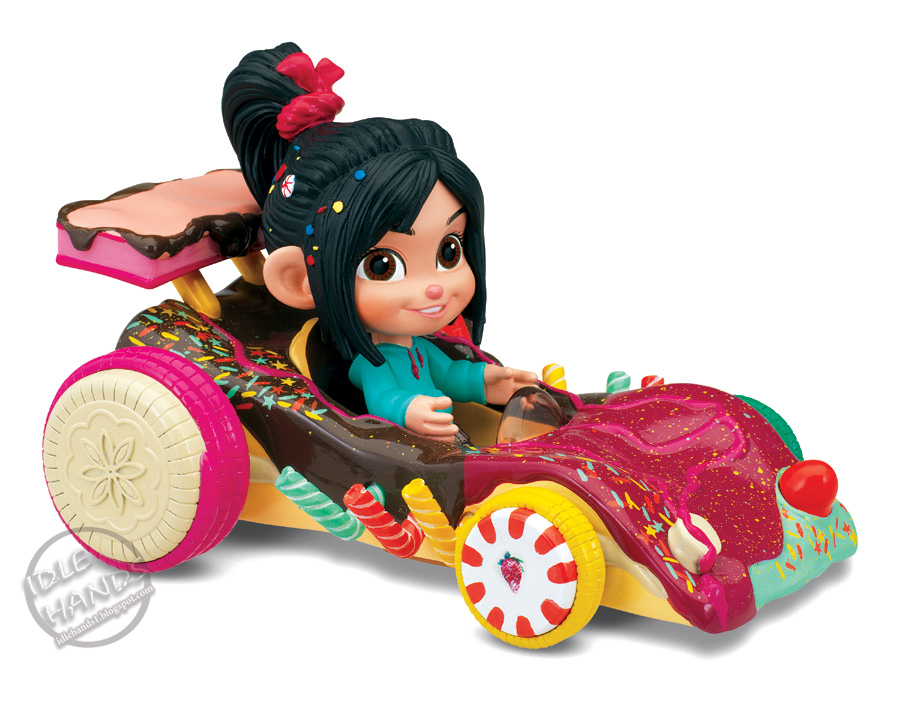
Vanellope is not the only Minority Feisty to love in “Ralph.” Sargeant Calhoun, voiced by Jane Lynch, also plays a complex and cool role. She is a fierce military woman but also passionate with a strong moral fiber.

A third Minority Feisty is Moppet Girl who hangs out at the arcade. Though her gender is a minority in the arcade crowd (I know, I know, that’s how it is is the “real world”) she is there and delivers the key line in the plot. Moppet Girl tells the arcade owner that the Fix-It Felix game is broken. She is also the character who provides the plot bookend, giving a fist bump to Vanellope at the end of the movie when she returns to her rightful position as ruler. It is a rare scene in animation to see two females interacting with each other, expressing power and victory. To put that scene in perspective, the awesome Minority Feisty of “Puss in Boots,”  Kitty Softpaws, never meets any of the other 4 females in the movie.

More coolness: One of the crowd scenes– in Vanellope’s game, Sugar Rush– is female dominated. The trio of girls who actually get to speak in that crowd are a stereotype, the trifecta, of mean girls: one bitchy leader flanked by a pair of followers (as seen in “Mean Girls,” “Heathers” “Never Been Kissed,” and many more “chick flicks”.)

But still, females dominating a crowd scene– a crowd scene of race car drivers, no less– is nothing to sneeze at. Those cars may be made out of cookies and candy, the drivers may have names like Taffyta, reminiscent of “My Little Pony” but, still, progress noted.

There are still more depictions of female power in “Ralph.” A few weeks ago, I posted about “riding bitch:” how whether a female in kidworld is on a magic carpet (“Aladdin”) a dragon (“How to Train Your Dragon”) or a hippogriff (Harry Potter), she’s is almost always found behind the male. The message is: the boy leads, the girl is along for the ride. Not in this movie. In “Wreck-It Ralph” Sargeant Calhoun piloted some kind of motorized, flying surfboard and a space ship while Fix-it Felix rode shotgun. Not only was Felix in the passenger seat, but he gazed, admiringly at Calhoun as he watched her do her stuff. Calhoun was shown as attractive and powerful simultaneously. That, my friend, is almost never depicted. Vanellope, herself, becomes a race car driver. She is also shown in the driver’s seat with Ralph behind her. Ralph does teach her how to drive (when he doesn’t know how either) but her skills surpass his and he is shown admiring her for her talent. (I cannot find images on the web of Calhoun piloting with Fix-It Felix by her side or Vanellope driving with Ralph in the back. If you do, please send me the link.)

But here’s the gender matrix. Even breaking all these sexist barriers, Ralph is clearly the protagonist. The movie is named for him. He’s the hero. Fix-It Felix is the “good guy” to Ralph’s “bad guy.” The real bad guy, the villain of the movie, Turbo, is also male. Turbo masquerades as King Candy but when Vanellope is restored to her rightful role as ruler, she is “princess,” not “queen.” In an often used cliche in children’s movies trying to straddle the princess-empowerment image, Vanellope tears off her puffy, pink dress. Later, in  the movie, when she has to wear the dress to attend a wedding, she is uncomfortable and scratches her neck. (I actually appreciated that detail much more than the overused “rip off your princess-dress/ corset” cliche. Another awesome factor: the toys from the movie. As far as I can see, the Vanellope figure is shown in her regular clothes or driving her car, not wearing the princess outfit she hates in the movie, which is, unfortunately, how Disney sells Mulan.)

The Bad Guy Anon meetings were hilarious and creative. I was cracking up watching them but these scenes fortify the sexist matrix.

The whole thesis of the movie is about being a bad “guy.” There was only one female in the bad “guy” group and she didn’t get a single line. It is mostly that cast of characters that made the poster that is all over San Francisco.

The bad female is not on this poster, nor is Vanellope, Calhoun, and Moppet Girl. When I posted earlier about the sexist poster, “Wreck-It Ralph” fans responded with hundreds of angry comments on Reel Girl and all over the web. Their first complaint was that the movie features strong female characters. It does. But the male is still the lead. That is what this poster clearly shows. That is why the poster was created to look this way and why the film is titled for Ralph.

Also, the poster is its own media. Even if you don’t see the movie, your kids see the poster on buses and looming over them on the sides of buildings. And again, if 50% of posters around town featured females, there would be no problem with “Wreck-It Ralph.” But, “Wreck it Ralph” fits a pattern, echoed and repeated, where males star and females are sidelined or missing.

Commenters on that blog post also told me the movie is called “Sugar Rush” in Japan. I think that’s pretty cool, but it’s still not called “The Racer, Vanellope” and it’s the U.S. version that sets the cultural standards here. Also, once again, Ralph narrates, the movie is Ralph’s story. Vanellope is his friend.

Why is the gender of the protagonist so crucial? We are all the heroes in our own lives. Again and again, with these films, girls see that there is a limit, a ceiling, to their potential, and it is marked with a male. No matter how important they are or how big a role they get to play, there is a guy who gets more.

Reel Girl rates “Wreck-It Ralph ***HH*** Take your kids to see this movie!

Update: A commenter tells me one of the 3 mean girls is, in fact, a boy. The one on the left. Beggars can’t be choosers, and I claimed claimed RF in spite of evil ways, but she is a he.

Remember pathetic children’s movie choices from Thanksgiving 2011?

So sick of people saying I should be grateful for crumbs and the Minority Feisty. If all goes well, My nine year daughter and I are going to see “Wreck-It Ralph” today. I’ll try to review Saturday morning.

Last year’s post:

Thanksgiving movies a feast for boys, girls go hungry

November 23, 2011

Let’s see, no school today and my daughters want to see a movie.

Is it too much to ask for one holiday movie to put a female character front and center as it does for male characters in all 5 holiday movies?

What about a mother-daughter saga instead of father-son one as in “Arthur” (Santa’s incompetent son) and “Happy Feet” (Mumble’s son can’t dance like he can)?

Or a girl buddy movie as in “Puss In Boots” (Puss and Humpty dream, go on adventures, and finally, transition)?

I don’t know what “Hugo” is about but something tells me not a girl.

Puss In Boots:

Hugo:

Happy Feet 2:

Arthur Christmas:

‘The thing is, 89% of engineers are male, so we literally live in a man’s world’

Stanford educated engineer, Debbie Sterling, was always bothered by how few women were in her program. (Of 181 students in her program, she was the lone female.) It’s not that she didn’t understand why the gender gap existed. She related. As a child, her parents didn’t play LEGO or Lincoln Logs with her. It never occurred to them– or to her– to encourage exploration in building toys. Sterling didn’t get interested in engineering until high school. Now, she’s found a way to get more girls into building earlier. And guess what? Her tactic doesn’t involve turning  a toy pink.

Sterling created Goldieblox. She describes it as “a book and a construction toy combined. It stars Goldie, the girl inventor and her motley crew of friends who go on adventures and solve problems by building simple machines.”

One thing I LOVE about this toy is that Sterling created a narrative with a female protagonist around the activity of building. While I don’t necessarily agree with her reason for this tactic (“Boys like to build, girls like to read”) I do think that there are not enough stories starring females that revolve around action, adventure, and building. Most action toys– Batman, Star Wars figures, Superman on and on– have stories that go with them. If you gave a kid a Darth Vader figure without a billion dollar marketing movie machine, let’s just say that toy wouldn’t sell so well. While there is no Goldieblox blockbuster in theaters, helping children to create a story around a character is key to inciting interest and play. I create stories in order to get my kids dressed in the morning or into the bath. Narratives are the most powerful tools we have. Sterling uses narrative brilliantly to sell her toy, not only in the product itself but in the video she created to raise the money she needed to get it in production.

Here’s the video she made for Kickstarter. Please watch, it’s so inspiring.

After this went around the web, Sterling surpassed her goal of 5,000 orders. Goldieblox is in production. Not only that, the company has already started receiving orders from toystores. Goldieblox.com was just launched and you can order your toys there.

Sterling says, “The thing is 89% of engineers are male, so we literally live in a man’s world. Yet 50% of the population is female. So if we want to live in a better world, we need girls building these things too, We need girls solving these problems.”

I started Reel Girl just after Christmas almost three years ago, so freaked out by the pile of pink toys my three daughters received, most involving some form of dressing dolls: paper, wooden, plastic, magnetic, tiny, large, soft, and hard. I have to say, this year, with sites like A Mighty Girl’s and Toward the Stars, new toys like Goldieblox, books and DVDs I’ve sought out (Reel Girl recommends) this is the first year since I had children that I am actually excited about Christmas shopping.

Hawkgirl’s rack

A couple days ago, I posted about how excited I was to buy some female action figures. Some of the new toys have arrived, including one of my all time favorites EVER, Serafina Pekkala from The Golden Compass. I love her.

I can’t wait until Christmas and my kids get Serafina together with Merida and Katniss, there will be an army of archers.

But, I’m kind of bummed about Hawkgirl.

Is it me or are her breasts seriously distracting?

Her head is cool, her wings are cool, but I don’t know if I can get past that bright yellow cleavage.  The whole point of buying these toys is to give kids an alternative so why the torpedo breasts? I get that my kids were not foremost in the toy designer or comic book artist’s mind, but I wish they were. They should be, right? I have 3 girls, but I don’t think I’d be psyched to give this toy to my son either.

But tell me what you think. And what you think a kid would think. Just don’t compare big breasts to big muscles. If you feel tempted, read this post.

Update: So I showed Hawkgirl to my husband: “What do you think of her?” He said: “First she blinds them with her boobs, then she attacks!”

Basically, he thinks she’s fine as long as she’s one of many, diversity is key. He reminded me of a castle the girls had filled with all kinds of magical creatures. Barbie was there, but she was just one of so many different figures. I think I agree. So at this point, it looks like Hawgirl will make it under the tree. I’ll update you on the post-Xmas reaction.

The monster in Elmo

A couple weeks before the creepy news broke that Kevin Clash, the voice of Elmo, was accused of having a sexual relationship with a sixteen year old, I received this email from my daughter’s after school program:

 A man dressed in an Elmo costume was seen in Rossi Playground on Saturday attempting to approach and hug neighborhood children. In addition to approaching children, he yelled obscenities and derogatory remarks. This man was also spotted at parks in New York City.

My first thought was: Elmo, for goodness sake. Holy shit. What is the world coming to?

But my second thought was this. The disturbing story attests to a thesis of my blog, Reel Girl, that is often disputed or questioned: “Lovable” characters created to appeal to children can also be dangerously manipulative of those children. In many cases, that’s why they were created, right? To sell products or push an agenda. Just because a character has oversized pupils doesn’t mean he’s good for kids. Maybe that sounds paranoid or trivial, but children are malleable and vulnerable. Parents should be aware of who they let in their home, even under the badge of PBS (which has a cast of characters just as male dominated as Disney.) G-rated movies can be more sexist, racist, or classist than R movies. That’s why parents should trust their own instincts, be aware, and make careful, informed decisions. There’s a potential monster side to every Elmo

Update: From the NYT

Andreozzi & Associates, a law firm that said it represented the anonymous accuser, said in a statement on Tuesday afternoon that “he wants it to be known that his sexual relationship with Mr. Clash was an adult consensual relationship.” The statement added, “He will have no further comment on the matter”…“We are pleased that this matter has been brought to a close, and we are happy that Kevin can move on from this unfortunate episode,” said Sesame Workshop, the organization that produces “Sesame Street.”

The organization did not say when — or even whether — Mr. Clash would return to work at “Sesame Street.” On Sunday, he took a leave of absence when it became clear that TMZ was going to publish an article about the accusation of inappropriate and possibly illegal conduct.

Update: Jezebel reports: “Well, turns out our collective sigh of relief was short-lived. Though puppeteer Kevin Clash’s first accuser recanted his claims one week ago, Clash officially resigned from Sesame Street today. Though it’s not mentioned in Clash’s official resignation, his departure coincides with new allegations from a second accuser, who claims Clash began a sexual relationship with him when the accuser was just 15.”

Petraeus/ Broadwell conspiracy theories…

The Petraeus/ Broadwell story gets stranger by the minute, but did you see this from The Guardian?

The CIA has dismissed as “baseless” and “uninformed” claims made by the former lover of ex-agency chief David Petraeus that Libyan militants were held in secret US prisons prior to the deadly Benghazi consulate attack.

Paula Broadwell, the biographer whose affair with Petraeus led to his abrupt resignation Friday, alleged that the assault, in which US ambassador Christopher Stevens was killed, was an attempt to free men being detained in a covert CIA annex.

Speaking last month at the University of Denver, Broadwell further alleged that Petreaus knew about the secret holding cells.

President Barack Obama stripped the CIA of its power to take prisoners through an executive order signed soon after his inauguration in January 2009…

The comments were recorded and posted in a YouTube clip which has since been taken down.

Read the rest here.

And this is pretty funny from The New Yorker: “How to Tell If You’re Involved in the Petraeus Scandal.”

How sick are we of this narrative? Powerful man brought down by his lust for younger woman blah blah blah. You know the only thing that will change this tired story? More women in power.

Frank Bruni has a great piece in the NYT about the sexism inherent in the scandal and the coverage of it: “Such adamant women, such pregnable men. We’ve been stuck on this since Eve, Adam and the Garden of Eden. And it’s true: Eve shouldn’t have been so pushy with the apple.” Read Bruni’s post here.

My favorite Tweet from Amanda Marcotte: “I love how sexists both believe men are incapable of impulse control AND should be the holders of all meaningful power.”

Everyone loves “Argo” but where are the women?

Women and Hollywood posted about Ben Affleck’s universally adored “Argo:”

Of the movie’s thirteen or so lead roles, three of them are played by women, and none of them are the caliber you might expect from a film that takes its female characters seriously…

Part of the movie’s marginalization of female characters can be rationalized away by the true-life nature of the film. Because the movie is “based on a true story,” Affleck and his screenwriter, Chris Terrio, have to somewhat stick to the facts and show the story the way things happened. But unlike this year’s Compliance, which told about as accurate of an account of real-life workplace abuse possible, Argo plays fast and loose with the facts for cinematic impact — to ramp up the drama and intensity. (If you needed someone to tell you the airport chase probably didn’t happen that way, you have no idea what the definition of a movie is.) Thus, the “we-had-to-stick-to-the-facts-so-no-lines-for-womenfolk” argument doesn’t hold up. If you can make room for an airport chase, a protracted dénouement where Mendez is awarded an Intelligence Star, a speech from Jimmy Carter (that adds nothing to the film) and a gratuitous shot of Affleck’s abs, you can give one woman something to do. Anything at all.

I’m not saying they should create a new role for a woman or magically create a female spy (it’s not Alias, after all), but the women here deserve more than virtual silence. The film doesn’t take place at an all-boys’ school or a magical world in which all of the women have gone mute. It was the 1970’s, not Spike TV. There were women who had relationships to the story, and the film’s desire to marginalize them or cut them out completely shows how little modern Hollywood thinks of female narratives. Movies actually made in the 70’s had better roles for women than this, and the idea that Affleck gets let off the hook for sexism because he made a period piece is insulting.

Writer Nico Lang is addressing an issue that people always raise on Reel Girl: “a magical world where the women have gone mute.” Fill-in-the-blank movie has to leave females out because that’s just how it is, in the original story, in the time period, in the jungle, whatever i.e. Tintin, Lord of the Rings, Marvel comics, DC comics, pirates, the 70s.

WTF? There is only one female chef in “Ratatouille” because there aren’t female chefs in France. The movie is about a rat who can cook. A talking rodent is more believable than 50% of chefs being female? In “The Lion King” the female lions have to wait until the male lion, our hero, Simba, returns because males lead the pride in the real world. That same “real world” where a lion dances, sings and is BFFs with a warthog and Meekrat? Huh?

The “we-had-to-stick-to-the-facts-so-no-lines-for-womenfolk” argument rarely holds up, yet it gets used all the time.

Lang makes another point in her criticism of “Argo” that I often address on Reel Girl. When a female is allowed to be a lead in a movie, she is surrounded by a constellation of males. You almost never get to see powerful females working together. Lang writes:

Argo isn’t alone in marginalizing women’s roles in film, as all but five of this year’s Top 20 films were dominated by men, and even films that feature women as leads do so in films where their gender is the minority (see: The Hunger GamesBraveSnow White and the Huntsman).Although it may be wrong to criticize Argo for doing the same thing everyone else is (just more egregiously), the film shows that even our “serious films” often do not privilege women’s narratives.

Not serious films and not children’s films. What does that leave? Oh yeah, chick flicks.