Reel Girl is at 1,599 likes and that number is killing me, like an itch I need to scratch. Please help my OCD and “like” Reel Girl. There are many posts up on Facebook and conversations there that don’t happen here on the blog. I’d love you to be a part of all that.
If you’ve already liked Reel Girl and would like to recommend it to someone, please share the link.
How could I forget, we also saw “Labyrinth.” I probably should have put all these in one post, sorry about that. Labyrinth is excellent. The movie is a classic quest myth starring a smart, brave girl played by Jennifer Connelly. She saves her baby brother. (Take that, “Frozen”!) My complaint is that, besides Connelly’s Sarah, all the characters are male. The puppets are done by Jim Henson and they are wonderful and creative and all male. Actually, that’s not true. There are a couple female Fairies who have no speaking lines. There is one cool, scary female puppet who gets to talk. But all Sarah’s companions are male creatures. David Bowie plays the goblin king and he’s great. Even better, he doesn’t take over the movie, the way someone like Jim Carey or Adam Sandler always does. Check out the poster though– Bowie looks like the star and Sarah looks like a princess. In fact, she is the star and is dressed like that for less than 5 minutes of the film. Most of the time, she’s in jeans. ARGH.
I am seeing these movies because we’re on vacation but also I’m working on Reel Girl’s list for kids 10 and up. “Labyrinth” is fine for younger kids, and I’m going to add it to that list. Anyone of any age should enjoy it. Out of these 4 movies I’ve just reviewed, all 3 of my kids say “Labyrinth” is their favorite.
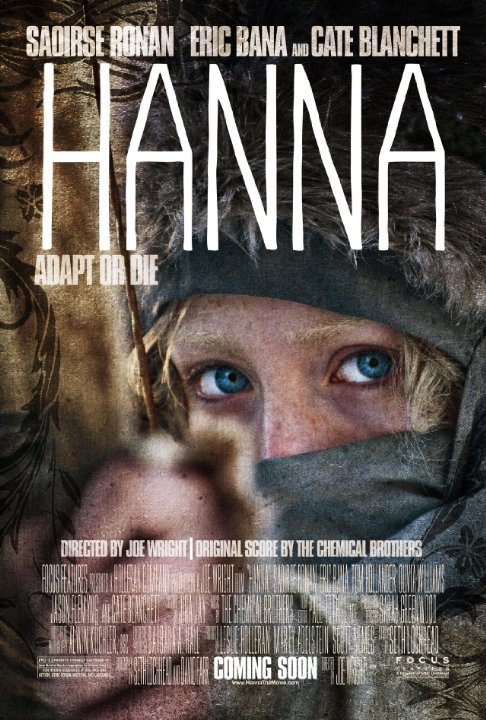
I am so into “Hanna.” This movie has everything I look for.
(1) Powerful girl protagonist Hanna, played by Saorise Ronan, is a 16 year old girl who lives with her father, a former spy, out in the wilderness. He has trained her to be a killer in order to protect herself as powerful people would assassinate her on sight.
(2) Evil female villain The bad guy in this movie, another killer, is a girl, played marvelously by Cate Blanchett.
(3) Great acting I already told you the movie stars Ronan and Blanchett. Need I say more? OK, the dad is Eric Bana.
(4) Great story Usually, on Reel Girl, I don’t mind spoiling stories. I analyze them so I can’t help it. But, I’m not going to tell you this one because so few people have seen the movie. I’ll just say that I love how the narrative is interwoven with Grimm’s Fairy Tales. The symbolism and the filming is beautiful.
(5) Female friendship Hanna makes a friend and their relationship is complex and real.
This movie is violent. More violent than “Hunger Games.” Like “Hunger Games” the camera doesn’t linger over the gore. I let my 10 year old watch it and it’s on my list of recs for 10 and up, but as I’ve written a lot here, I want my daughter to see females with power and agency. If your kid gets scared in movies, this is not the film for her.
“Clueless” is my favorite of the Jane Austen movies. Alicia Silverstone plays a contemporary Emma, muddling in everyone’s private lives until she finally has her own epiphany and finds true love.
I could be wrong here, but I think “Clueless” is the only movie I have ever seen where popular girls are not mean. There is no “mean girl” contingent at all. Maybe, for that reason alone,you should show it to your kids.
There is racial diversity in the typical, sidekick way that I just blogged about in “Freaky Friday:” the best friend of the protagonist is African American.
However, this movie does a great job dealing with class. While both Cher, the protag, and Dionne, her BFF, are rich, the one from the other side of the tracks is a white girl named Tai. Usually, I hate movie makeovers, but when Cher and Dionee make Tai their “project,” the transformation happens with commentary that is insightful and powerful. If you’ve read Emma, Cher is very similar to her literary role– you see that she’s superficial, but she’s also likeable. You hope she will have the courage and insight to live up to her potential and she does.
I am deducting one H for the sexy outfits, though the clothing really didn’t bother me so much in this film. I’m trying to figure out why. Is it because there was no cleavage, it was mostly a leg thing? I don’t know. If you’ve see this movie, tell me your thoughts.
Looking for a movie starring a strong female protagonist to watch with the whole family? Last night, all of us– 3 kids ages 4, 7, 10, husband and me– watched “Freaky Friday.”
We all loved it. I remember reading this book as a kid, also loving it, and seeing the movie with Jodie Foster. I’d like to check out the older movie too, but we opted for the more recent version starring Lindsay Lohan and Jamie Lee Curtis.
The story, you probably know, is about a controlling mom and rebellious daughter, constantly in conflict, who wake up one day to find they are in each other’s bodies.
Whatever you say about Lindsay Lohan, she’s a talented actress. She is great in this part. I don’t remember this from the book or last movie, but in this version, she plays a musician. I appreciated my three daughters getting to see a girl perform on stage without being sexualized. Her character, Anna, rocks out. She’s not even the singer, but the guitarist. Very cool.
Anna is pursued by a hot guy, but when she switches bodies with her mother and thus, her personality changes, the guy loses all interest in Anna. Clearly, he is after her mind.
The mom is ambitious and cool. She also has a hot man in love with her. These females do not have to choose between being attractive and being smart. How often do we see that in a movie?
I am deducting an H for racial stereotyping of Asian women. The “mystical” stuff takes place in a Chinese restaurant, and these scenes made me uncomfortable. There is diversity in the cast, in the typical sidekick way. Anna, the protag, has a best friend, Maddie, who is African-American.
What I want for Christmas is for people to stop objectifying my daughter.
But after I took my 4-year-old daughter Violet to visit you last week, it seems that even YOU can’t deliver on this particular request.
You may recall that we walked into your little house for the family photo and you remarked on every item of clothing Violet was wearing—including her socks.
And then you told her she was the most beautiful and best-dressed person in the shopping center.
Couldn’t you have just stopped there? Hell no! You kept going and suggested that she takes up modeling when she grows up.
I wrote a post about this topic 2 years ago, when my youngest daughter started preschool.
I know making small talk with a two year old is hard. Toddlers can be shy, are easily distracted, and might even burst into tears if you say the wrong thing. It’s not easy to break the ice. But please: if you meet a little girl on the street, in a store, on the playground, try to think of something, anything to say rather than commenting on her hair, dress, shoes, eyes etc.
My two year old just started preschool, and by the time I’ve kissed her good bye and left her in the classroom, she’s gotten about 10 compliments on her appearance. Of course, she’s adorable. All little kids are. But remember, their little brains are getting wired up. Kids love attention, to be smiled at, and to connect– these are exactly the kinds of interactions that make their brains grow. When they learn, this young, that so many responses are based on how they look, it affects them for life.
For alternative ice breakers try “Hi, you seem happy today! What’s going on? (or sad or angry)” or “Is that your kitty? (or bunny, dog) What’s her name?” Talk about the weather, seriously. Ask if they come here often. If you must say something to a little girl about how she looks, balance it out with other topics that have nothing to do with her appearance (meaning don’t talk about how she looks unless this is going to be a long interaction.)
When people tell your daughter how pretty she is, don’t repeat the compliment to her (as in “She loves this dress. It’s her favorite.”) Don’t make her say thank you. Gently deflect the topic. No matter what other people say, you’re the parent whose opinion matters most to her at this age. Do tell your daughters they are beautiful “on the inside and the outside.” It’s something that should be said by you and that she feels confident about. It’s the proportion of looks based comments, the constant repetition of them, and how they form the basis for social interaction that’s damaging.
In her letter to Santa, Edwards also gives some suggestions about how to break the ice when talking to a little girl besides focusing on her appearance, though, obviously, these are geared towards Santa.
– Where have you been today? or Where are you going today?
– How old are you?
– What do you want to be when you grow up?
– What’s your favorite book/toy/sport/animal/food/song?
– Do you know any Christmas carols?
– Check out your surroundings and remark on something such as a flowering plant, a truck, a picture on the wall, Christmas decorations, even the weather.
– Or just imagine what you would say to her if she were boy.
I love the last one. Thinking that way really helps to become aware of our sexist conditioning. I get how challenging this is. Yesterday, my two older daughters dressed my younger one, and she went out into the world looking like this.
I tried my best to get the monster-flower off her head, but had to give up because my struggle was getting counter-productive. I was giving her appearance too much attention. But I knew it was unlikely this kid would go out in the world and no one would comment on that thing, which was, by the way, a Christmas present. That’s its whole purpose, right? It’s going to feel almost rude to an adult to ignore it.
But that’s what I’m asking you to do. Ignore it. But don’t ignore her. Talk about something else. Ask her how her day is going or what she’s on her way to do or if she had a good sleep last night.
In Melissa Wardy’s great new book Redefining Girly, Rosalind Wiseman offers these suggestions:
So compliment her on something she’s specifically doing that you think is great. Ask friends for their support because you’ll be raising your girls together. To strangers, I’d say: “Thanks, but you know what is the coolest thing about her? She draws animals incredibly well!” Yes, the other person may think you’re strange for saying something so random but your daughter will hear you complimenting something she specifically does, bringing attention to a skill you admire. She’ll know that the most important people in her life value her for more than her appearance.
This is messy stuff and you don’t have to fight every single battle that comes your way. If you’re too tired to have these conversations on a particular day, don’t sweat it. You’ll always have another day. Be proud of taking this one on. I see way too many girls whose parents haven’t provided this guidance and support and truly believe their self value is based on looking like the “perfect girl.”
From the moment they are born, girl babies get attention for how they look. They are dressed like dolls and turned into objects by their own parents, a practice reinforced by our powerfully sexist culture. For too many women, how we look is the source of our identity and power or lack there of. When is it going to stop? Why not start with you? Make a different kind of small talk with the next little girl you see. It’s a small but powerful step to change the world.
Update: I’m getting lots of comments where people are saying style and fashion are about free choice and autonomy. When a little kid conforms to certain choices– poofy dresses, giant hairpieces– and receives positive attention from strangers, teachers, doctors, where is her free choice?
Below, I’m posting a video of my daughter talking about getting bullied at preschool for wearing “boy shoes.” If a 4 year old girl gets compliments and positive affirmation for wearing a flower on her head but she gets mocked, ostracized, or ignored for wearing “Star Wars” shoes, what is she going to choose? Where is her free choice?
It’s only going to come when we all stop focusing so much attention on what she looks like.
One solution I tried that worked pretty well when my daughter was two was to have my her pick out 4 favorite dresses and wear them repeatedly. She was pleased b/c she loved the dresses, but at least the preschool parents, teachers, and peers stopped commenting on the same old, same old. I blogged about that here. My daughter has done pretty well holding on to autonomy so far, but I find, every year she gets older, it becomes harder to protect her imagination.
New research from Emory university on how reading boosts brain function, reported in The Independent:
Being pulled into the world of a gripping novel can trigger actual, measurable changes in the brain that linger for at least five days after reading, scientists have said.
The new research, carried out at Emory University in the US, found that reading a good book may cause heightened connectivity in the brain and neurological changes that persist in a similar way to muscle memory.
The changes were registered in the left temporal cortex, an area of the brain associated with receptivity for language, as well as the the primary sensory motor region of the brain.
Neurons of this region have been associated with tricking the mind into thinking it is doing something it is not, a phenomenon known as grounded cognition – for example, just thinking about running, can activate the neurons associated with the physical act of running.
“The neural changes that we found associated with physical sensation and movement systems suggest that reading a novel can transport you into the body of the protagonist,” said neuroscientist Professor Gregory Berns, lead author of the study.
Here is more evidence of how fantasy influences reality. What do you think happens to brains over thousands of years, after reading narratives where males are heroes and females are in supporting roles?
I wonder if this study’s information applies to watching movies as well.
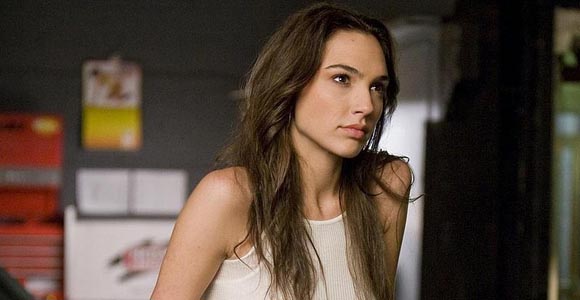
I am so mad right now, I am shaking. Gal Gadot, the actress playing Wonder Women in the Batman vs Superman film (did you get that part about how the film is referred to as Batman vs Superman?) was asked by an interviewer if her small breast size qualified her to play the part.
It’s been said that you’re too skinny for the part. Wonder Woman is large-breasted, is that going to change?
Thank you, media for directing the public to focus on Gadot’s breast size. We all need to pay a little more attention to critiquing female anatomy. Also, since Wonder Woman in a movie probably means Wonder Woman in more merchandise, we really need to make sure we get the character’s breast size right for kids’ toys and games.
And what does this interviewer even mean: “Is that going to change?” Is he asking Gadot if she is going to get breast augmentation? Or is he asking her if the character will no longer be identified with that particular breast size?
Here’s Gadot’s excellent response. She can add me to her fan list.
Hmm. I represent the Wonder Woman of the new world. Breasts… anyone can buy for 9,000 shekels and everything is fine. By the way, Wonder Woman is amazonian, and historically accurate amazonian women actually had only one breast. So, if I’d really go “by the book”…it’d be problematic.
Good morning, Gallant Girls and Guys! Now that the holiday festivities are over (until New Years), hopefully we are ALL working together to clean up and put away the aftermath of the holiday. Right?!
My husband is cleaning up this morning so I can take a few hours to write. I have to get my next chapter to my editor by tomorrow. Without his help, that would be impossible.
Sheryl Sandberg has said that who you marry is a career decision, and I couldn’t agree more. If I didn’t have a partner who supported my work and my dreams, there is no way, with three kids, I would be able to act towards making them come true.
Erica Jong has said lots of people have talent but what is rare is the courage to follow it. I read a post on Salon that I can’t take the time to find right now (because I’m supposed to be writing my chapter) about sexism, literature, and “chicklit,” where the author writes something like: How many women are going to close the office door and tell their family they need to write?
Now, consider how many men are going to close that office door? How many men have wives who will organize and put away everything without expecting their husbands to do equal work or will be so grateful for any “help?”
There is another reason I get to write today. My three kids are in camp. I can afford to send them there. How many women also have the income to put towards childcare so they can write? And this principle, of course, goes back to Virginia Woolf’s “A Room of One’s Own,” her essay about Shakespeare’s mythical sister. Without the space and the income, women can’t write. If women can’t write, they can’t create narratives with female protagonists. If stories with female protagonists don’t exist, women and men both learn that females belong on the sidelines and in supporting roles.
Once my three hours of writing are up, it’ll be my turn to clean, food shop, and pick the kids up at camp. Because I will have gotten my work done, I’ll be excited to go on with this part of my day and be a better mom.
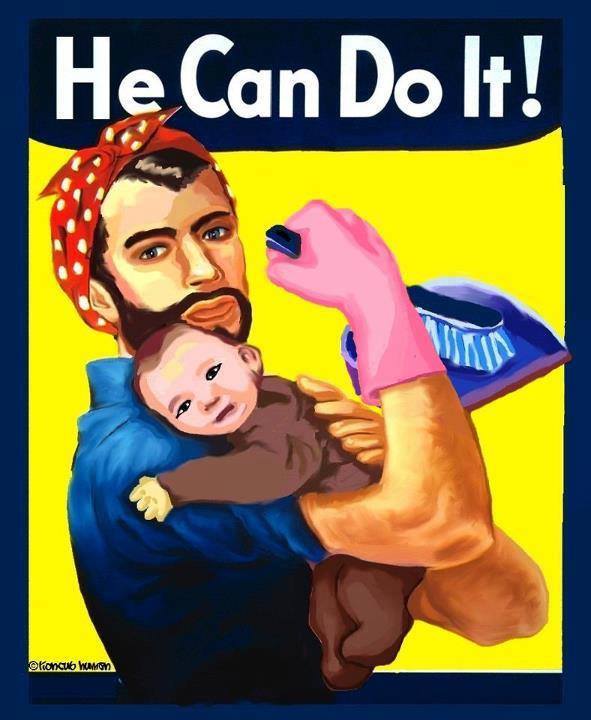
If dads did half of the childraising and the housekeeping, moms would be that much closer to changing the world.
Before I even understood what it was, I had a bias against the Rainbow Loom. As the mother of three young daughters who is continually trying to protect my kids from the gender stereotyping that dominates their world, I tend to steer clear of anything with the word “rainbow.”
Even though I tried my best to block out this toy, I managed to pick up that it involved jewelry. That was the nail in its coffin. With two strikes, the loom had little chance of ever making it into my home. (Generally, how I deal with gendered toys is not to ban them– that only makes my kids want the stuff more– but ignore them, while I give a lot of attention to the toys I like. I play those with my kids.)
A few days ago, we went to my sister’s house, and her kids were making the bracelets. I, as usual, ignored the activity, but then I noticed my seven year old daughter wasn’t part of the group. She was sitting by herself, reading a book, and she looked sad. I asked her why she wasn’t making a bracelet, and she said she didn’t know how, that she couldn’t do it. This information and her expression just about killed me, so I said I’d teach her. She said, “No, other people have tried. I can’t do it.” So at that point, I knew there was no way we were leaving that house until she made a goddam bracelet. I may not like another rainbow/ jewelry toy, but I won’t resist an opportunity to help my kid practice resilience, power through frustration, and keep at something until she masters it.
I got some rubber bands, we started to work, and she was right. She really didn’t know how. For a while, I couldn’t even figure out why she kept messing up– it was just the basic pattern we were doing, nothing complicated. Finally, I realized she wasn’t stretching the hole big enough (mind you, this isn’t my forte either.) We sat there for a fucking hour but something clicked. Here she is after she figured it out.
She was so proud of herself, and I was so proud of her. So what did I do to reinforce that behavior? I went out and bought her a loom. And, because I have three kids– and my ten year old is a whiz at this shit, and I didn’t want her taking over my seven year old’s stuff– I bought three looms.
So there we were, sitting down last night in our living room making bracelets and necklaces, and it was so much fun. We had a blast. Notice the “we.” I got into it, too. You might even say, obsessed. You know how I wrote I can’t help teaching my kid to deal with frustration and power through something until she gets it? These toy is perfect for that, because you can keep challenging yourself– even if you’re a grown-up, maybe especially if you’re a grown-up– making your pattern and stitching more complicated. I’m telling you, this shit is addictive.
While my daughters and I were creating these beautiful things, we talked. At some point, I asked them “Do the boys make these too?” They looked at me like I was crazy, and not for the reason I thought. “Of course, they do. They love it,” my kids told me. I hadn’t even asked if the boys wear them, so I did. All the boys wear them. You probably know this because you have sons or haven’t been blocking out this trend. The kids make this stuff together, put it on, give it away, and, I kid you not, sell it.
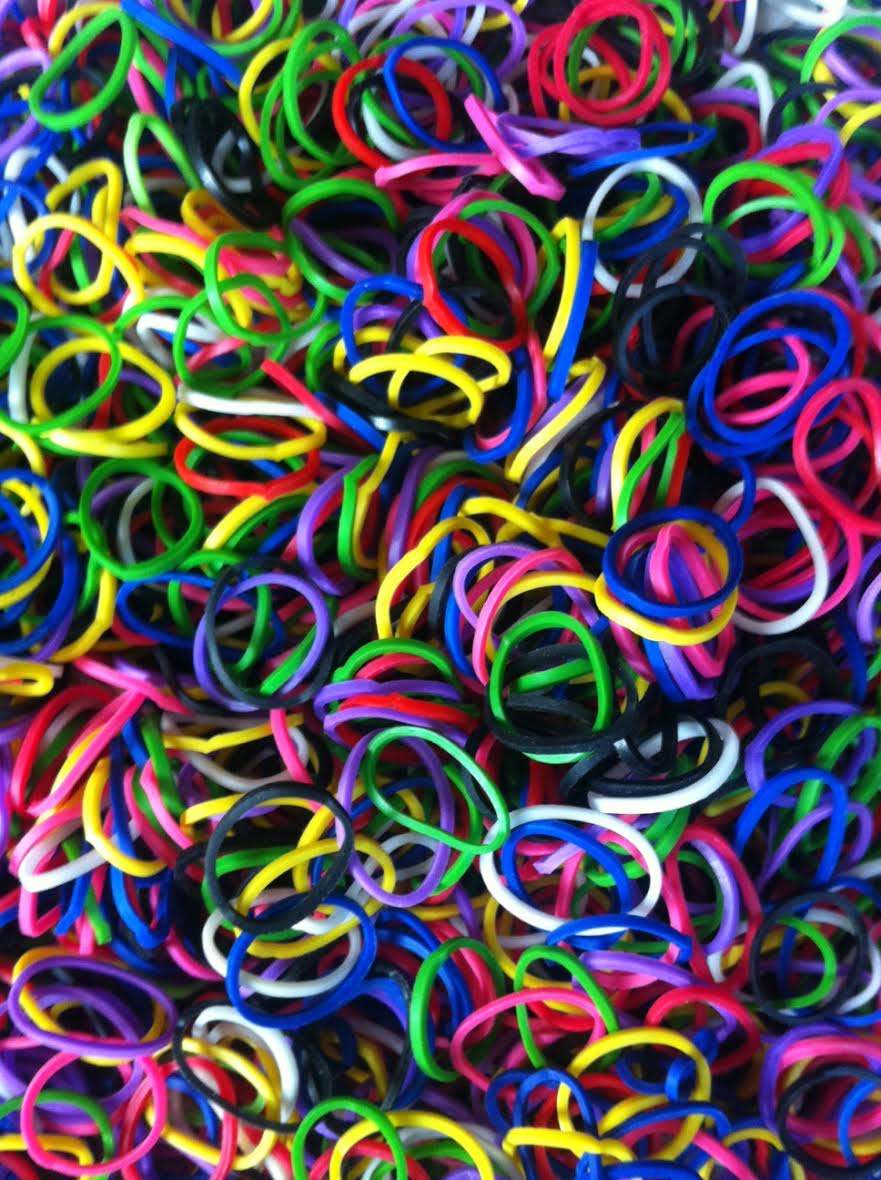
I now believe the Rainbow Loom is nothing less than revolutionary. It’s called The Rainbow Loom for goodness sake, and it’s for everyone. Do you realize what this toy is saying to kids? Colors are for everyone. Look at these colors, please. This is what comes with your loom.
Rainbow Loom also teaches that jewelry, the epitome of a “girl” toy, is for everyone. And finally, that girls and boys can play together. Is there another toy, another trendy, top-selling toy at that, which shows kids all this?
Now, I am new to this trend, so please tell me if I’m wrong here, but as far as I can tell, there is no “girl” version with pink and purple and a “boy” version with blue, red, and black. I’m going to be checking out what the kids are wearing, but mine use all the colors and they tell me the boys do to. Just before I wrote this post, I did a Google search, and I couldn’t find anything to indicate gendered marketing (though I’m supposed to be doing 100 other things right now, on Christmas Eve Day, besides blog, so I could’ve looked longer.) I did see this post from thespec.com
Tricia Ross’s eight-year-old son avoids playing with any of his older sisters’ toys. But he and many of his male classmates in Charlottesville, Va., have seized on loom bands.
“There’s a sense of accomplishment” that comes with finishing a bracelet, Tricia Ross says, and it’s enough to inspire her son to “sit there until it’s complete.” He’s begun taking orders for bracelets from his younger sister, cranking them out in the styles and colour schemes she requests.
Ross and Volkman both find that while many craft products are packaged in pink boxes emblazoned with pictures of smiling girls, the gender-neutral packaging of loom band products make them more boy-friendly. It also helps, Volkman thinks, that they use rubber bands rather than fluffy yarn or delicate materials.
I remember reading in People a couple weeks ago that the founder of Rainbow Loom, Cheong Choon Ng, is the father of two daughters. He watched his kids make bracelets and that inspired him to create the loom which he first did with pins. Here’s his daughter, Julia, age 12, making a complicated design (pic from NYT.)
How cool is that? A toy inspired by 2 girls, teaches boys and girls to play together, and that colors and jewelry are for everyone. The only downside so far is the price. It’s $30 for the one my kids wanted. Because I opted to get three, I bought the travel model at $14 each. The founder has got to be a millionaire– I mean, it’s rubber bands and plastic. But if this guy and his toy are defying gender stereotypes, getting kids to play together, and boys to take orders from girls, IMO he deserves every penny. If you’re doing any last minute shopping today, get this for your kids (and yourself!) That is, if you can find any left in a store.