SF architects’ advice to girls: Blocks, not Barbie

After I posted about Mattel’s new Architect Barbie supposedly designed to inspire girls to become architects, AIA SF invited me to hear a panel discussion: “Ladies (and Gents) Who Lunch with Architect Barbie.” The topic was women and architecture, and it quickly became apparent how the highly successful female architects felt about the infamous doll.

“Maybe if there were an Interior Design Ken,” said Ila Berman, director of Architecture at California College of the Arts and principal of Studio Matrixx. “Or if she were Contractor Barbie and wore a hard hat and held a computer. If she were more subversive, maybe I could go there.” Berman nodded at the doll placed in front of the panelists.  “She makes me nervous.”

Cathy Simon, best known locally for transforming San Francisco’s decrepit Ferry Building into a thriving, open marketplace, was more direct: “Barbie is an embarrassment for women. I’m embarrassed for her. I hate Barbie.”

Anne Tourney, an award winning architect and principal at Daniel Solomon Design Partners, was practical about Barbie’s potential: “Mattel can’t represent us. It’s a toy company.”

EB Min who has her own firm and also a three year old daughter defended the doll slightly, conceding that perhaps she “normalizes the career.”

All of the architects wanted to shift the discussion away from Barbie and to real life women and architecture. As in most professions, women have made huge gains at the bottom. In the 1970s, just 5% of architecture students were women. Today, the number has climbed to 40 – 45%. Of those women, only  17% get licensed and join the AIA. Few make it to principal in their firm or tenured faculty at prestigious universities.

The panel agreed the challenge for women in architecture is retention. Sticking with it in a tough economy, somehow navigating the Catch 22 when top jobs and top salaries go to men.

Berman, who, as she said, “wasn’t that old,”  was the first female tenured in architecture at Tulane.  Today, just 20% of the tenure track positions in architecture go to women. Who gets tenure? “It’s a cloning activity,” she said. “A peer review process.”

How do you succeed and keep the faith with those odds? Simon encouraged the young female architects in the crowd (only three men showed up to the talk) to believe in themselves. “You can do anything,” she said. Better than words, she inspired the women by her own example, as did the whole panel. Clearly, the speakers were passionate about their work and fulfilled financially and creatively. Two spoke of fathers who strongly encouraged them to go into architecture.

Because I write about girls and toys, I brought up Architecture Barbie one more time. “Could she possibly be a gateway to get girls to imagine? You could ask your daughter: what’s she going to build today?”

“I played with blocks,” said Berman. “I loved puzzles. Get your daughters some puzzles.”
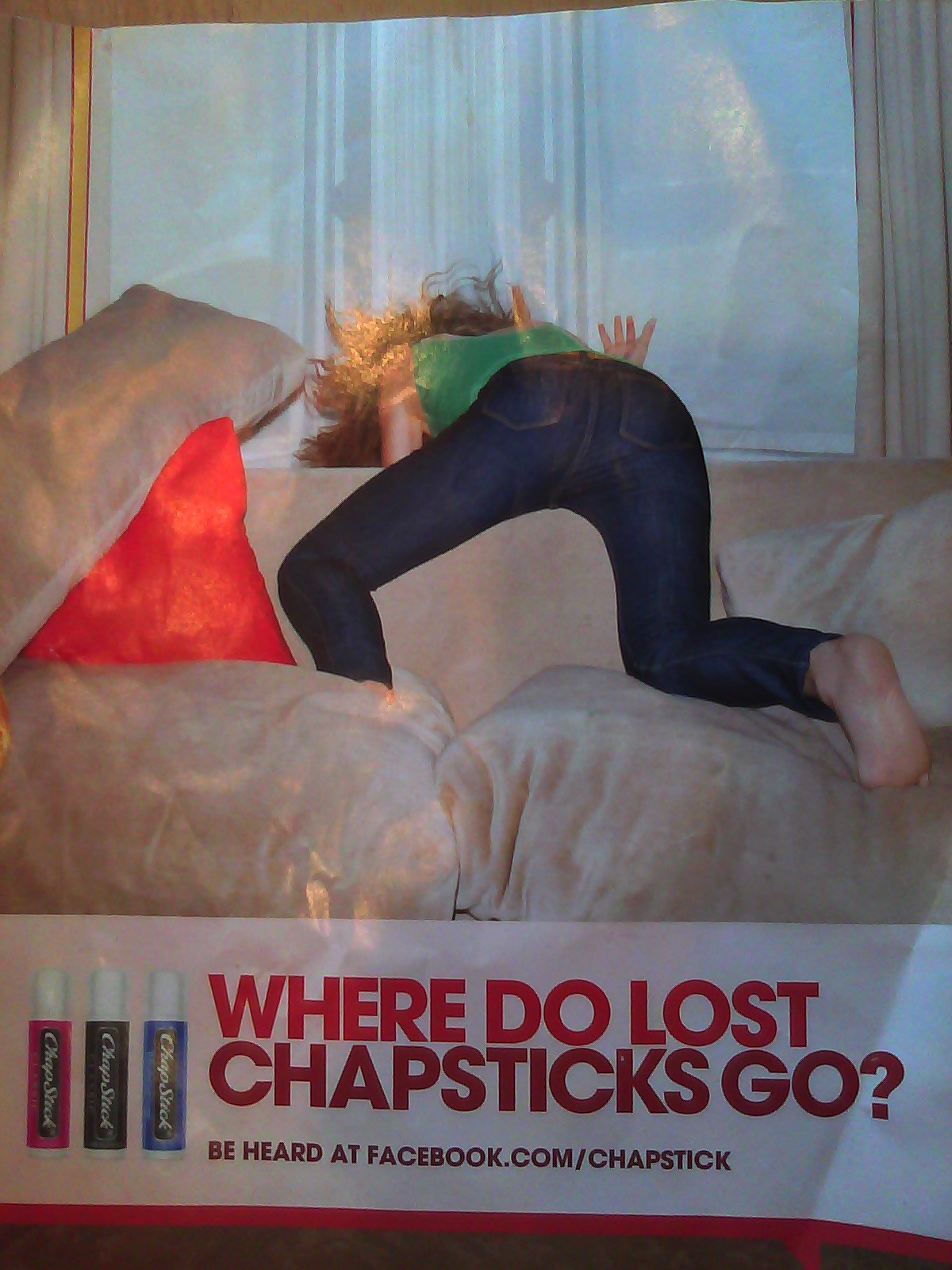
Chapstick sticks it to women by Melissa Spiers, guest post

I have never been to Farmville or Café World or CityWhatever so I have no idea how they work.  But I want to create my own online universe.  It will be a museum, no, it will be a whole village: an online world ‘housing’ the vast collection of media messages that are degrading to women. Hey look, a picture of a woman’s ass.  Members could live in the various apartments, museums, cafes, stores, theaters, and schools where women are sold, displayed, minimized, belittled, objectified …or are just plain missing. Oh, she lost her Chapstick. And they could do their, whatever they do in online universes – work, farm, drink, eat, chat.

Of course, such a collection could only exist online, because there isn’t a building big enough to hold the real accumulation.

Welcome to the Visitor’s Center!  Upstairs is the Liquor Advertisements Wing.  I wonder where she lost it? Across the street, the Music Lyrics building.  And adjacent to that, the Movies and Television compound.

No, wait.  I will organize it according to degradation type instead of media type.  On this street we have the planned housing development of “Women Licking Objects.”   Whoa! Check out her ass! Over here, the ghost town of “Missing: Significant Roles for Women” (which includes, of course, the government buildings, churches, big business boardrooms, and TV & movie studios.)  Gosh, where IS that lost Chapstick?  And of course the shopping mall of “Fetishized Female Body Parts.” Yes, my village will reach to the horizon in every direction, a whole city of buildings filled with sexist advertising, music, books, movies and media of every kind. 

But why would anyone visit my online world, anyway?  Don’t we go online to experience an alternate reality? Chapstick! Woman’s Ass!  Have you ever gone through a day without being bombarded with any sexist messages or images?  Some of them are right out there, nothing subliminal about them  – see exhibits A through Z on the Rap Lyrics floor.  Lost. Chapstick. Ass. Others try to be subtle and sneaky (please take the audio tour in the Museum of Advertising).  Unfortunately, the use of women’s bodies to sell everything from beer to books has become so pervasive that we almost don’t see it anymore.  Hey, I bet I know where the Chapstick is!

So when we see it – what do we do about it? Well, I would encourage you to take Chapstick up on their bold-print offer to “Be Heard at Facebook.com/chapstick” except I’ve tried that: they delete any comments even remotely questioning or critical.  Hmmmm.  What asses.

Because Chapstick continues to delete our comments, Reel Girl started another FB page Butt seriously, Chapstick. Please visit and be heard.

Read Melissa Spiers’ follow-up to the ChapStick controversy:  No Comment! A Commentary on the ChapStick Story

Will Architect Barbie solve architecture’s gender problem?

The Chronicle of Higher Education reports that “while women make up 40% of architecture graduates, just 17% of them go on to join the American Institute of Architects, the discipline’s primary professional group.”

Despina Stratigakos, associate professor of architectural history at the University of Buffalo, isn’t sure why that gender gap persists. She tells The Chronicle:

“There’s been little in the way of research to determine why women aren’t able to make that transition,” says Ms. Stratigakos, who is unwilling to lay the blame on the call of motherhood. “Not all women who leave architecture do so to have children, and not all women who have children leave architecture.”

She calls it “a complex problem that requires a complex solution.” Or maybe a playful one.

So Stratigakos came up with something original. When she won a Fellowship at the University of Michigan, she was asked to organize an exhibition of female architects. Stratigakos wanted to figure out a way to further the debate about gender, architecture, and achievement without the discussion devolving into the same old cliches and ending up stonewalled yet again. So Stratigakos asked

”students and faculty members to develop about a dozen prototypes of Architect Barbie, which she displayed in a gallery in the architecture school. Alongside the dolls she ran a 40-minute film featuring clips of architects as depicted in popular culture: ‘The angry, determined, creative genius, standing above mediocrity,’ and almost always male. The Barbies grabbed the attention of passers-by, she says, inciting discussions about gender and architecture in both the gallery and in classrooms.

Soon after, Stratigakos got a call from Mattel asking for her help to design a new doll. Finally, this year the famed toy company and the American Institute of Architects unveiled Architect Barbie at the AIA’s annual meeting in New Orleans.

So will the doll (action figure?) help to inspire a new generation of girls to become architects?

At the very least, Stratigakos’s exhibition is brilliant and poses important questions by illustrating the huge contradictions women face as they strive to achieve.

As Stratigakos says, for women to take the risks required of them in order to realize their dreams is a complex issue that goes way beyond motherhood.

For men the path to success and power is straight: achieve, become object of female desire, achieve more (more emotional support, more money, more power, more art!) Whereas women are faced with a far more circuitous and complicated route, ominously warned: if you rise too high, you’ll lose your attractiveness to men which happens to be– guess what– your main source of power.

The human drive to create and communicate is universal and genderless. But artists have to be risk takers and the punishments for women are high. I love how Stratigakos put the Barbies next to film clips of angry, male geniuses. Our culture’s idea of what a great artist looks like is so mired in the model of the tortured, solitary male. A model that, as Peter Kramer documented in his book Against Depression (and that I posted about “What if Van Gogh took Prozac?”) happened to be created by tortured, lonely males.

Clearly, its time for new models and maybe Architect Barbie will help us build them.

Update: After seeing the above post AIA San Francisco invited me to hear a panel discussion on gender and architecture. Read my post about that event: “SF architects advice to girls: Blocks, not Barbie.”

The T shirt that’s changing the world

Update: Parents and advocates are now bringing attention to another sexist T, this one by Forever 21 that reads: “Allergic to algebra”

The Mommy Files posts:

Many Reddit readers were outraged. A user who calls herself PrincessJingles chimed in: “‘Allergic to algebra’…really? The last thing the young women of our world need is another reason to think being dumb is cool. This tee is an affront to learned women the world over who have the audacity to dream of a day when women will be respected equally by their male peers, not because of some feminist movement, but simply because we give no reason for our male counterparts to think otherwise. Shame on you.”

Forever 21, a Los Angeles-based retailer that’s popular with teens, is selling the tee for $12.80. This isn’t the retailer’s only shirt implying that girls are stupid and uninterested in school. The words “Skool sucks” are boldly written across one shirt and another reads “I love school” on the front and “Not…” on the back.

After furious parents protested JCPenney’s sexist T shirt that read “I’m too pretty to do my homework so my brother has to do it for me,” the massive chain store pulled it. It’s is a huge victory for parents and kids, boys included, because when kids repeatedly get the message that girls are only supposed to be pretty, it’s bad for everyone.

Melissa Wardy of Pigtail Pals has created an awesome T-shirt that’s selling like hotcakes. The shirt reads: “Pretty has nothing to do with it.” You  can buy the shirt here.

If you don’t know of Wardy or her site and blog, check it out. Here’s how she describes her products/site’s mission:

“Pigtail Pals was created by Melissa Wardy, a mom and entrepreneur who was fed up of the limitations and stereotypes found in children’s clothing. Melissa wanted role models for her daughter that exemplified courage, intelligence, and imagination.

She doesn’t want to confine her little girl to the pink and purple world being marketed to her. When Melissa couldn’t find what she wanted, Pigtail Pals was born. It is our intention to show girls that they may be bold, adventurous and heroic just like the boys!

A Pigtail Pal doesn’t wish upon a star and wait for her prince to show up. A Pigtail Pal gets into her rocket ship and finds that star all on her own!”

An interview with Wardy coming soon.

What’s your Smurf name?

On The Society Pages, Phillip Cohen writes about his McDonald’s experience and being asked, before receiving the Happy Meal, if the child who is eating it is a boy or girl.

“I’m told by the Happy Meal box that ‘Smurfs are named after their individual talents: there’s Farmer, Painter and Baker… Know your talent and find your Smurf name!’…I wondered what Smurfette’s individual talent’ was that got her – the only female Smurf- named ‘Smurfette.'”

(You should visit Cohen’s site, he includes a great table about the lack of women in power positions in the film industry.)

Both of Cohen’s girls chose boy Smurfs. So maybe there’s a positive side to a blatantly sexist Hollywood blockbuster colliding with a blatantly sexist food chain policy: the male privilege becomes so exposed its laughable. What if McDonald’s, after the Smurf experience, decides to change its sexist policy? Forevermore, instead of the servers asking if the customer is a boy or a girl, now they want to know: what talent would you most like to have? What skill would you most like to master? What character would you like to write a story about?

In five minutes, my 5 year old daughter came up with six girl Smurfs: Flyer (she has wings); Magician (she holds a wand); Sky or Weather (she makes rainbows & rain, the sun and moon rise and set, and sunset and sunrise); Singer (she holds a microphone) and Motorcycle (rides a motorcycle.) My eight year old daughter adds: Zombie (covered in mummy bands and blood); Living Dead (skeleton); Fairytale (she jumps into books) and Superhero (wears a cape); X-Ray (can look through walls) Library (holds a library card, shares her library with all the Smurfs, most popular Smurf); Guilty (always lies, holds pen and paper to write down lies so she can remember them) Sporty (holds soccer ball).

My Smurf name, according to my husband: Mouthy.

(Read my earlier Smurf/ McDonald’s post here: Free order of sexism with that happy Meal?

Free order of sexism with that Happy Meal?

When you ask for a Happy Meal, as every non-vegan parent knows, your McDonald’s server always asks: “Is this Happy Meal for a boy or girl?”

“Why?” I asked, my first time, a new parent, totally confused.

“So we know which toy to give the child.”

The whole toy with your Happy Meal is, in itself, gross and disturbing. And in spite being a carnivore, I’ve only subjected my family to the experience a couple times usually because my kids got a glimpse of McDonald’s plastic playground from the freeway by our house. As depicted and deconstructed in the film “Supersize Me” Happy Meal toys are relentlessly marketed to kids during any cartoon they happen to be watching not on  PBS. That’s right– you’re up against Hollywood, the fast food industry, and TV.

But nutrition aside, if you go to McDonald’s right now and you are lucky enough to be a boy, your server will offer you 15 choices from which you can pick your toy. If you are a girl– one. You don’t get a choice.

If a brother and sister– or God forbid, a boy and a girl who actually hang out together in spite of being told by the universe they are radically different species– go to McDonald’s together, what are these little kids learning about who is important, who has options as far as her identity and who doesn’t?

This image via Hoyden About Town/ thesocietypages.org

O Juliet, Juliet, wherefore art thou Juliet?

Driving to school today, my three daughters and I passed a poster for Disney’s new movie “Gnomeo and Juliet” coming to theaters February 11. My kids wanted to know, where’s Juliet?

Can you find her?

How many beards do you see?

If you spot Juliet around town, preferably with eight or so of her girlfriends frolicking behind her, Romeo nowhere in sight, please let me know. Extra points if she’s doing something acrobatic and looking grumpy, instead of standing around beaming at Romeo which, of course, she won’t be because, remember, he’s not in the poster.

Last year, at the same billboard location, around Townsend and Brannan, there was an ad for Tim Burton’s “Alice in Wonderland.” It featured only the flame-haired Madhatter.

I’m sure Alice found her way out of Disney’s marketing machine rabbit hole onto some poster, somewhere in San Francisco, but my daughters and I never discovered her. Maybe we should’ve checked the backs of milk cartons.

Girls in kids’ movies have gone missing.

Just last month, Disney’s male executives announced they were going to stop making princess movies, practically the only animation vehicle where girls were allowed to be stars. It may be a lame genre, but at least it acknowledged that girls do, in fact, exist.

Movies that feature girls in title roles, star girls, or feature female characters of any kind continue to decline. See statistics here.

Research is also showing that the limited role models for girls in the media along with the increasingly gendered toys sold to them is affecting children’s brain development.

Apparently, imaginary land never got the memo that we’ve all achieved gender equality and are living happily ever after in a post-feminist world.

American kids in ‘creativity crisis’

For the first time American children’s scores are going down on creativity scales, Newsweek reports.

How do we know this is happening? The ‘gold standard’ of creativity is measured by a series of tests created in the 50s by psychologist E. Paul Torrance. The tests study ‘divergent thinking’ which means coming up with varied solutions to questions like ‘how many ways can you use a spoon?’

Newsweek reports: “Those who came up with more good ideas on Torrance’s tasks grew up to be entrepreneurs, inventors, college presidents, authors, doctors, diplomats, and software developers.”

But recently, Kyung Hee Kim at the College of William & Mary analyzed almost 300,000 ‘Torrance scores’ of children and adults, discovering that for the first time, creativity in American kids is declining. Kim is quoted in Newsweek: “It’s very clear, and the decrease is very significant…the scores of younger children in America-from kindergarten through sixth grade-for whom the decline is “most serious.”

Why is this downturn happening?

Newsweek reports it’s too early to tell but that “one likely culprit is the number of hours kids now spend in front of the TV and playing videogames rather than engaging in creative activities.”

Peggy Orenstein supports that theory in her new book, Cinderella Ate My Daughter. Orenstein writes that right at the stage when our kids’ brains should be growing by engaging in fantasy play and having varied experiences, instead children are thrust into a monochromatic world, relentlessly bombarded by images and products from corporations like Disney. In her book, Orenstein interviews neuroscientists and educators, showing how the princess culture could be affecting brain development.

In a Mother Jones interview, Orenstein says she was surprised to discover that one of her biggest jobs as a parent was protecting her daughter’s imagination, trying to make sure it isn’t “colonized by these prescribed scripts.”

Yet another good reason to let your daughters skip the ball.