LOVE LOVE LOVE this smart kid, Riley, asking all the right questions


LOVE LOVE LOVE this smart kid, Riley, asking all the right questions
The Journal Inquirer reports that brand new Legos are coming out in 2012: “The Lego Group has inked a deal with Warner Bros. Consumer Products to create building sets based on ‘The Lord of the Rings’ movie trilogy and two new films based on ‘The Hobbit,’ scheduled for release in 2012.”

Lord of the Rings. Hmmm. How many females were in that high grossing, Academy Award winning series? How many males?
Check out the link from the Journal Inquirer that pictures Lego’s new toy. It won’t let me copy the photo, but the Legos pictured are so much cooler than the Friends for girls and guess what– all male.
Other best-selling Lego sets are based on the Indiana Jones and Star Wars movies.
Do you see the sexism chain reaction here? When girl characters are excluded from movies, they’re left out of toys and branding on all kinds of kids clothing and products as well. Please take a look at Reel Girl’s Gallery of Girls Gone Missing from Kids’ Movies in 2011. These movies predominantly star males, feature multiple males in the cast, and have names of males in the movie titles. Whereas in 2010, Disney switched a movie title from “Rapunzel” to “Tangled” just to downplay the female. This kind of blatant sexism repeatedly teaches kids that boys are more important than girls, and that’s a horrible lesson for both genders to learn.
Of course The Hobbit was a book long before it was a movie. J.R.R. Tolkien’s classic came out in 1937. But it’s Hollywood’s appropriation of the story that makes it massively popular with a new generation, grounding it in pop culture and inciting the creation of a slew of toys timed to hit stores around the same time the movie hits theaters.
On Dec 16 PRNewsWire reported on the new Legos and the upcoming movie’s cast:
The Hobbit: An Unexpected Journey will be released beginning December 14, 2012. The second film, The Hobbit: There and Back Again, is slated for release the following year, beginning December 13, 2013.
Ian McKellen returns as Gandalf the Grey, the character he played in “The Lord of the Rings” trilogy, and Martin Freeman in the central role of Bilbo Baggins. Also reprising their roles from “The Lord of the Rings” movies are: Cate Blanchett as Galadriel; Ian Holm as the elder Bilbo; Christopher Lee as Saruman; Hugo Weaving as Elrond; Elijah Wood as Frodo; Orlando Bloom as Legolas; and Andy Serkis as Gollum. The ensemble cast also includes (in alphabetical order) Richard Armitage, John Bell, Jed Brophy, Adam Brown, John Callen, Luke Evans, Stephen Fry, Ryan Gage, Mark Hadlow, Peter Hambleton, Barry Humphries, Stephen Hunter, William Kircher, Evangeline Lilly, Sylvester McCoy, Bret McKenzie, Graham McTavish, Mike Mizrahi, James Nesbitt, Dean O’Gorman, Lee Pace, Mikael Persbrandt, Conan Stevens, Ken Stott, Jeffrey Thomas, and Aidan Turner.
Do you think the 2 females listed above will make it into the Lego set?
As long as Hollywood keeps girl characters out of its films, it’s going to be challenging to convince toy companies to represent heroic females in their toys. It’s asking them to use a lot more imagination. Of course, toy companies should be imaginative. Isn’t that the point of a toy? Especially a toy company like Lego that claims to be a learning toy “fostering creative play?” But instead, Lego prefers to spend its time and money “researching” the best way to copy Disney.
On its Facebook page, Lego keeps responding to hundreds of people upset about the “for girls” sets, that there are many other Legos out there to choose from. But Lego isn’t aggressively marketing those sets to girls. On its own FB welcome page, Lego has two boys pictured flying a Lego airplane. Will Lego be marketing the new “Lord of the Rings” set to girls? How?
If you go into any mega chain like Target or Walmart or Pottery Barn, all of them have “boy aisles” and “girl aisles.” The “Lord of the Rings” sets and the other building sets mostly show boys pictured on the boxes and contain multiple male figs inside of those boxes. Where do you think the “Lord of the Rings” set will be? Where will the Kim Kardashian wannabe Friends Lego set be found? How’s a girl going to feel being dragged by her mother into the “boy aisle” where all the photos are telling her she’s in the wrong place? If a highly paid researcher was studying this girl’s behavior, what do you think he would record?
Maybe Target should stop with the boy and girl aisles. (The London toy store Hamley’s has done just that, giving up gender segregation for sections on arts and crafts, outdoor toys, building toys, soft toys etc.) Maybe Hollywood should make more movies with multiple girl roles and put females front and center. Maybe parents should demand more of those movies and get upset when girls remain invisible.
Hollywood shows our kids animals who talk, rats who cook, toys who come to life, and singing lions who befriend warthogs. Is it too much to ask to see imaginary worlds where girls and boys are treated equally? How long do we have to wait?
Anyone see “Arthur Christmas” this year?

The Journal Inquirer reports that brand new Legos are coming out in 2012: “The Lego Group has inked a deal with Warner Bros. Consumer Products to create building sets based on ‘The Lord of the Rings’ movie trilogy and two new films based on ‘The Hobbit,’ scheduled for release in 2012.”
Lord of the Rings. Hmmm. How many females were in that high grossing, Academy Award winning series? How many males?
Check out the link from the Journal Inquirer that pictures Lego’s new toy. It won’t let me copy the photo, but the Legos pictured are so much cooler than the Friends for girls and guess what– all male.
Other best-selling Lego sets are based on the Indiana Jones and Star Wars movies.
Do you see the sexism chain reaction here? When girl characters are excluded from movies, they’re left out of toys and branding on all kinds of kids clothing and products as well. Please take a look at Reel Girl’s Gallery of Girls Gone Missing from Kids’ Movies in 2011. These movies predominantly star males, feature multiple males in the cast, and have names of males in the movie titles. Whereas in 2010, Disney switched a movie title from “Rapunzel” to “Tangled” just to downplay the female. This kind of blatant sexism repeatedly teaches kids that boys are more important than girls, and that’s a horrible lesson for both genders to learn.
Of course The Hobbit was a book long before it was a movie. J.R.R. Tolkien’s classic came out in 1937. But it’s Hollywood’s appropriation of the story that makes it massively popular with a new generation, grounding it in pop culture and inciting the creation of a slew of toys timed to hit stores around the same time the movie hits theaters.
On Dec 16 PRNewsWire reported on the new Legos and the upcoming movie’s cast:
The Hobbit: An Unexpected Journey will be released beginning December 14, 2012. The second film, The Hobbit: There and Back Again, is slated for release the following year, beginning December 13, 2013.
Ian McKellen returns as Gandalf the Grey, the character he played in “The Lord of the Rings” trilogy, and Martin Freeman in the central role of Bilbo Baggins. Also reprising their roles from “The Lord of the Rings” movies are: Cate Blanchett as Galadriel; Ian Holm as the elder Bilbo; Christopher Lee as Saruman; Hugo Weaving as Elrond; Elijah Wood as Frodo; Orlando Bloom as Legolas; and Andy Serkis as Gollum. The ensemble cast also includes (in alphabetical order) Richard Armitage, John Bell, Jed Brophy, Adam Brown, John Callen, Luke Evans, Stephen Fry, Ryan Gage, Mark Hadlow, Peter Hambleton, Barry Humphries, Stephen Hunter, William Kircher, Evangeline Lilly, Sylvester McCoy, Bret McKenzie, Graham McTavish, Mike Mizrahi, James Nesbitt, Dean O’Gorman, Lee Pace, Mikael Persbrandt, Conan Stevens, Ken Stott, Jeffrey Thomas, and Aidan Turner.
Do you think the 2 females listed above will make it into the Lego set?
As long as Hollywood keeps girl characters out of its films, it’s going to be challenging to convince toy companies to represent heroic females in their toys. It’s asking them to use a lot more imagination. Of course, toy companies should be imaginative. Isn’t that the point of a toy? Especially a toy company like Lego that claims to be a learning toy “fostering creative play?” But instead, Lego prefers to spend its time and money “researching” the best way to copy Disney.
On its Facebook page, Lego keeps responding to hundreds of people upset about the “for girls” sets, that there are many other Legos out there to choose from. But Lego isn’t aggressively marketing those sets to girls. On its own FB welcome page, Lego has two boys pictured flying a Lego airplane. Will Lego be marketing the new “Lord of the Rings” set to girls? How?
If you go into any mega chain like Target or Walmart or Pottery Barn, all of them have “boy aisles” and “girl aisles.” The “Lord of the Rings” sets and the other building sets mostly show boys pictured on the boxes and contain multiple male figs inside of those boxes. Where do you think the “Lord of the Rings” set will be? Where will the Kim Kardashian wannabe Friends Lego set be found? How’s a girl going to feel being dragged by her mother into the “boy aisle” where all the photos are telling her she’s in the wrong place? If a highly paid researcher was studying this girl’s behavior, what do you think he would record?
Maybe Target should stop with the boy and girl aisles. (The London toy store Hamley’s has done just that, giving up gender segregation for sections on arts and crafts, outdoor toys, building toys, soft toys etc.) Maybe Hollywood should make more movies with multiple girl roles and put females front and center. Maybe parents should demand more of those movies and get upset when girls remain invisible.
Hollywood shows our kids animals who talk, rats who cook, toys who come to life, and singing lions who befriend warthogs. Is it too much to ask to see imaginary worlds where girls and boys are treated equally? How long do we have to wait?
Anyone see “Arthur Christmas” this year?
Here’s another two minute blog before I wake up my kids.
Remember, this is not just the big bad toy company. This is about us, too. I blogged earlier about how it’s hard to make small talk with a toddler so we say to a girl, “What a pretty dress!” It’s more difficult to try to think of other subjects. It can be awkward to ask the nurse at the doctor’s office not to offer your daughter a “choice” of three princess stickers. But we should all do it. Please try. I don’t mean to sound preachy and be annoying. I know we have enough people telling us what to do and feeling bad that we’re not parenting right. But it’s these little steps we make that change things. What we do in our own lives as well as the activism, it’s all the same, really.
I think of toys kind of the same way I think about eating which is what I blogged about right when I started Reel Girl. You can’t tell your kid to eat a certain way and not do it yourself. It’s hypocritical, but more importantly, it doesn’t work. If I eat sushi with my kids and get excited about it, they are likely to do the same. I’m not saying my kids will eat sushi if I do, but that they are way more likely to if I do. If it’s something we do together. If it’s fun. (Who cares if my kids eat sushi? It’s just a pain in the ass when they don’t try new foods, life is much easier– and healthier– when they don’t get stuck in a rut. And believe me, it’s hard to get my cooking, as well as my husband’s, out of a rut.)
If you get your kid gender neutral toys like blocks or puzzles or the old Legos, get excited about the toy. Sit on the floor and play with them. Do it often. What little kids want is attention from their parents. With almost any toy, you can incorporate make believe play. This can be tedious (my 5 year old loves a repetitive story with 3 creatures: one doesn’t believe, one does, and the third is the magical one. She will play this with blocks, Legos, or sticks.)
Also, show your sons and daughters movies and TV with powerful girls. Here’s Reel Girl’s recommended list. Read your sons stories that feature girls in strong roles. Here are some questions to think about when you watch a movie.
Encourage cross gender play. Make a play date with your kid and a kid of the opposite gender.
With toys, movies, books, playdates, and food challenge your kid to try new experiences. Kid learn through play. Lure her out of her comfort zone the way you would with “work.” With your attention and encouragement, she will try. If it’s too much for you to buy your son a stroller, don’t freak when he pushes another kid’s in the park. All kids love to push things on wheels, I know for boys we like to call those objects cars or trains.
Good luck this Holiday season!
Starting yesterday, PBG asked people who love the 1981 Lego pic to post it on Lego’s FB page and hundreds of people, men and women, are doing it (thousands??) The posts say how much they love Lego and how much they don’t like the new Friends toy.
Here are a few comments:
You have such an opportunity, right at this moment in time, to be a CHAMPION for childhood … a childhood FREE from gender stereotyping, FREE from limitation … and FULL of IMAGINATION.
Please, please, PLEASE … be a CHAMPION for CHILDHOOD!”
Thank you!

Here’s another:
This letter was inspired by Melissa Wardy of Pigtail Pals. You can read her letter here. Please write to Lego as well.
Here’s an ad for Legos from 1981:

Here’s a photo of the new Friends Legos created in 2011:

Dear Lego,
Legos were special. They were unique and creative and helped kids to build. Legos inspired kids’ imaginations. Boys and girls could play Legos together. But with your new product, Lego Friends created for girls, I can no longer tell the difference between Lego toys and the ubiquitous Disney princess products or Barbies. Is that the point? Because if it is, your copy cat strategy abandons the very qualities that made your toy great.
I have a blog Reel Girl where I rate kids’ media and products. Toys can get 1 – 3 Ss for stereotyping and 1 – 3 Gs for Girlpower. So recently I went to hear women architects talk about the new Architect Barbie. I have three daughters ages 2 – 8, and I asked the architects if I should buy this new Barbie for my kids. They all emphatically said no. Buy them blocks, they said. Buy them Legos. The architects loved Legos as kids. I blogged about their advice and spoke about it, I put it out it on Facebook and Twitter. I am sad and surprised to say that now Reel Girl gives Legos new Friends for girls an SSS rating.
I know Lego didn’t start all this gender stereotyping in kids’ toys. I get that you’re jumping on the bandwagon because you need to sell products. You’re worried because sales are down. But you’re making a mistake.
I know you spent a lot of money on market research. But all you’ve really researched is the effect that mass marketing has on kids. Look at your 1981 girl and your 2011 Kim Kardashian wannabe lounging in her hot tub with a drink. All that you’ve researched is how to help turn our daughters from the beautiful kid into the plastic one. Lego is better than this. That’s why we love your toy. That’s why we buy it. But now, instead of helping kids grow, you’re stunting them.
We’ve all moved beyond the nature versus nurture debate. Now we understand babies brains come into the world full of potential. The experiences they have help to determine how those brains develop. For example, babies are born able to mimic and make all kinds of sounds, but as they learn a particular language, their brains start to wire up to produce particular intonations; they lose their ability to make many other sounds. Kids who learn to speak other languages early retain that ability to make different sounds for a lifetime. Limiting kids’ early experiences limits their brain growth. That’s why gender stereotyping is so dangerous.
Pink is just one color. Girls are not born with a pink gene. Pink used to be a boy color, the pastel version of red. Blue was for girls, the color of the Virgin Mary. Alice in Wonderland and Cinderella wore blue. Sleeping Beauty was switched to pink to differentiate her from Cinderella. This kind of information is what you should be spending your market research budget on because paying experts to ‘observe’ that girls choose pink is only studying the effects of multinational companies. Or maybe that is what you want to know?
The more you split kids and adults into tiny categories, the easier it is to market and sell products. The concept of ‘toddler’ was developed by clothing manufacturers in the 1930s as a stepping stone between infants and older kids to sell clothing. ‘Tween’ was coined in the 1980s.
I know asking you not to mimic what’s out there is challenging. Some of your best selling Lego sets ‘for boys’ like Star Wars and Indiana Jones come from million dollar movies franchises that don’t exactly have many females in them. But I wish you would use your research and marketing money to figure out how to help develop kids brains, the way Lego used to do.
Please consider bringing back the 1981 ad and creating the kinds of toys that the cool kid in the picture would love.
Thank you.
Margot Magowan
Update: People are going to Lego’s Facebook page and posting the 1981 pic asking them to bring beautiful back. If you agree and want to post it, go to Lego’s FB page, click like, and then you can post the pic.
I have 2 minutes to write this before I wake up my kids, but I’ve just been looking at all these new girl Legos before I go on air and it’s such a bummer. It makes me so sad. They look exactly like princesses. A girl in a hot tub with a drink? Are you kidding me? A beauty salon? A curvy girl in a convertible? A rock star? These are Legos? We are going so backward. If you have not seen it yet, please look at this ad for Legos from 1981. Here is the link. Ironically, this pic was going all around the internet when the pics of the new absurd toys came out.
And the whole explanation about pink blocks draw girls in to buy the product, when are we going to stop with the the pink??? Don’t give us more pink for God’s sake, give us less! Kids brains are developing, they are growing, getting wired up. What you give your child to play with helps to make her brain grow. Blocks and Lego toys are about imagination and building. I recently went to hear some women architects talk about the new Architect Barbie. They all said, don’t get your daughter Architect Barbie, get her blocks, get her Legos. That was their favorite toy growing up. Parents, this is about you. Please think about your choices this Christmas.
Reel Girl gives Lego Friends its worst rating, a Triple S (SSS) for major stereotyping.
Lots of feedback about the ChapStick story. Here are a couple classics.
“I have to agree, the person who is complaining about this add has to be totally out of her mind or she is jealous of the fact she doesnt look as good. Just more bullshit from some frustrated lesbian who wants to strip away any feminine attributes for some one who looks more like some dog from mars.”
And another:
“1.) I think the ad is actually in some way calling to the reader to focus on “maybe it’s up her butt” which is hilarious.
2.) Girls work hard to make their bodies sexy, and in the recent 2 decades, a great deal of effort has been put on the butt. Since girls similar to the one pictured in the ad are the target demographic (segment) for this ad, it’s genius.
3.) If you think this is offensive, then get a life”
Besides hundreds of emails attacking Melissa Spiers, who wrote the post on Reel Girl, or me, the issue goes beyond the ad, which everyone is free to have her own opinion about. Or not. ChapStick wrote publicly it wanted its customers to “be heard” and then deleted their comments; then finally apologized to those customers who “felt like” they were being deleted. See Why Chapstick’s bad PR policy matters.
We actually think the Butt seriously, Chapstick Facebook page is pretty funny. But I guess that’s because we’re the perverts.
After ChapStick’s apology to women who “felt like” their posts about a sexist ad were being deleted from the company’s Facebook page, Forbes.com contributor Samantha Ettus suggests a more effective “dream” apology from the company:
“We are so sorry for using poor judgment in putting up this ad. Thanks to social media, our awareness of the reaction emerged speedily and we were able to respond immediately by taking it down. Our consciousness has been raised and for that we are grateful. We have taken this lesson to heart and will not be creating any advertising that is or could be construed as objectifying women in any way. Just like you might forgive an old friend who messes up for the first time, I hope that you will return to us, unscathed from our mishap. Thanks for your understanding.”
WOW, can you imagine? If ChapStick did that, I’d be giving it out on Halloween.
Ettus, a personal branding expert, writes that ChapStick has always been associated with strong women– from the Suzy ChapStick ads, where Suzy was highlighted for her athleticism, to other athletes/ spokespeople such as Olympic skier Picabo Street and ice skater Dorothy Hamill.
What happened to make a brand with a loyal, lifelong following of female customers who buy ChapStick for themselves and their kids, shift its marketing strategy so dramatically?
Ettus writes:
Chapstick’s ads have always been empowering for women. The real question is how they arrived at this point today. Now that Chapstick is owned by Pfizer, I’m envisioning the Viagra advertising team – a few young ad men unfamiliar with the history of the Chapstick brand – creating this off-brand ad. And then finally, the apology from Pfizer spokesman Ray Kerins as quoted in The Wall Street Journal: “This is a good example of us hearing what people have to say, making a determination and taking action,” he said. No real apology at all. Like a child forced to say sorry with no understanding of how this might translate into a similar future scenario, is Chapstick destined to repeat its recent history?
Yesterday, Jezebel and Business Insider posted about ChapStick’s bad PR policy to delete negative feedback about its ad from its Facebook page– an especially questionable practice by ChapStick when its ad copy reads: “Be Heard” and follows with a Facebook page address.
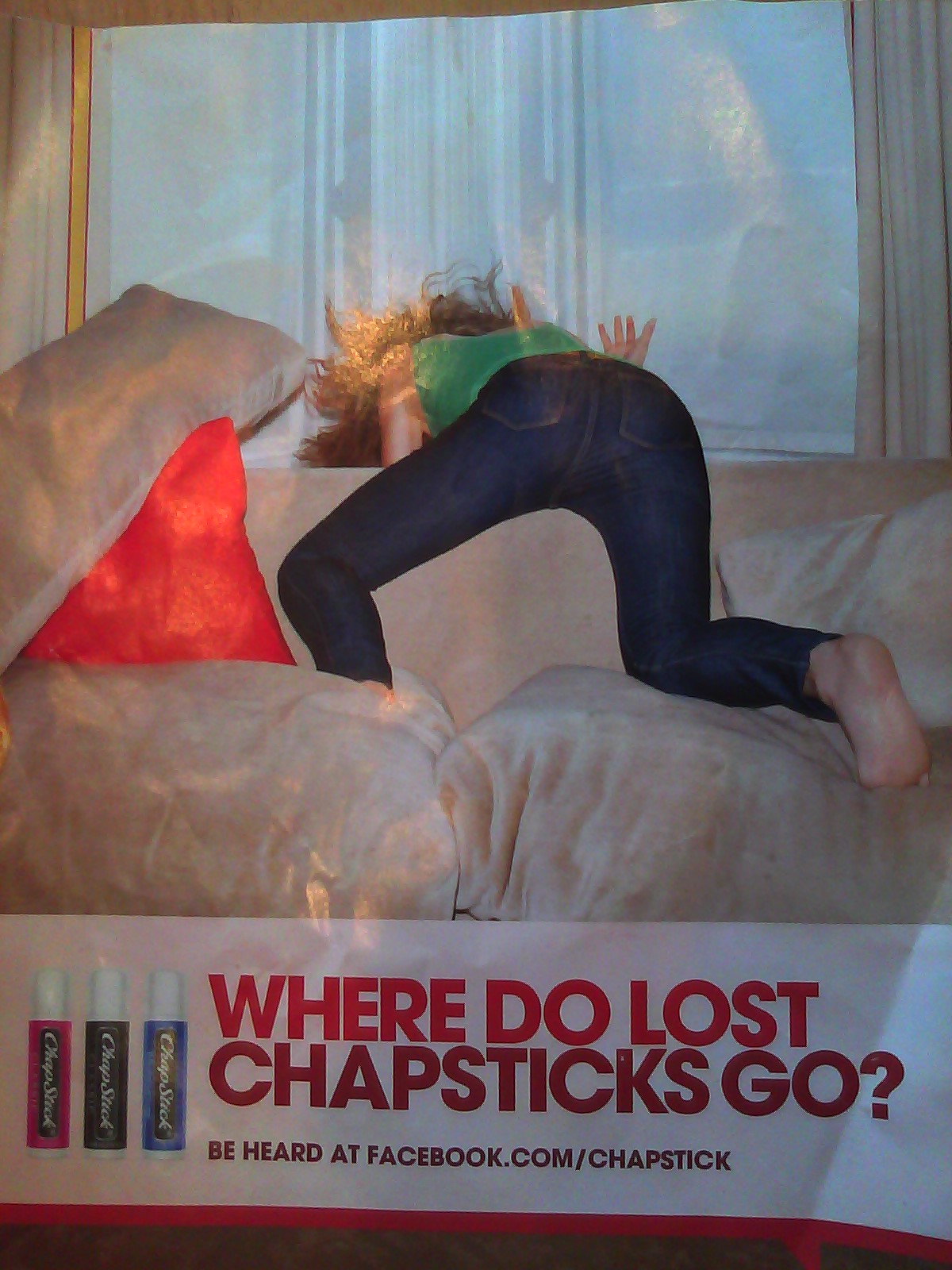
As Jezebel wrote, ChapStick’s practice of deleting negative feedback is not officially censorship:
“Chapstick has no obligation to provide a public forum, and users are free to take their complaints elsewhere, as they have done.”
Last I looked, it appears ChapStick is now deleting the blatantly sexist comments as well, which I guess could be considered progress. But again, the ad implies a public forum. Furthermore, ironically, leaving up the sexist comments about the woman’s ass show that the picture is not just an innocent snapshot of a woman looking for ChapStick, that others besides crazy feminists bloggers find the ad objectifying, though obviously they’re into the objectification.
What Chapstick is guilty of is really bad PR. When Dr. Pepper issued a much more objectionable ad, at least they allowed customers to sound off about it on their Facebook page. By deleting negative comments, Chapstick is sending the message that they can’t handle criticism. And especially if you’re encouraging people to use social media to talk about your brand, that’s a stupid message to send.
Social media is supposed to be a way to communicate with your customers — when you shut that channel down simply because they disagree with you, you totally negate the point of having it in the first place.
Deleting those comments served no purpose for Chapstick but to cause itself PR problems. It’s the Internet — even if you delete something, it’ll appear somewhere, somehow. True to form, many of the comments that Chapstick deleted were compiled by protesters on a new Facebook page (the screenshots show that most were void of profanity and civil).
What should Chapstick have done?
Brands like Chapstick have to learn to accept the negative with the positive, especially in a world with social media. By simply opening a dialogue with those angered and listening to their complaint, this could’ve been avoided. And the folks at Chapstick would’ve generated some goodwill, showing that they actually give a crap about what people think.
But no. They did the exact opposite, giving the perception that the brand doesn’t care.
One follower of the Butt Seriously, Chapstick FB page (created by Reel Girl for those deleted from ChapStick’s page) had a great suggestion that ChapStick show women in its ads being powerful and resourceful, for example lifting up the couch and finding the ChapStick there.
Obviously, this isn’t an earthshaking issue, but it is a striking glimpse into how corporations work behind the scenes to control their public message. And it’s disturbing to see that kind of manipulation operate under the guise of a public forum. The tactic is relevant to girls and women because so often with sexist products– movies that star only boys, the ubiquity of pink and Barbie dolls– the justification for the limited options out there is “we’re just giving the people what they want.” Clearly, there’s more going on in the background involving complex and elaborate marketing strategies. If you’re claiming to give us what we want, you ought to at least listen to what we have to say first.
Through this whole experience, I have learned how to spell ChapStick correctly.
