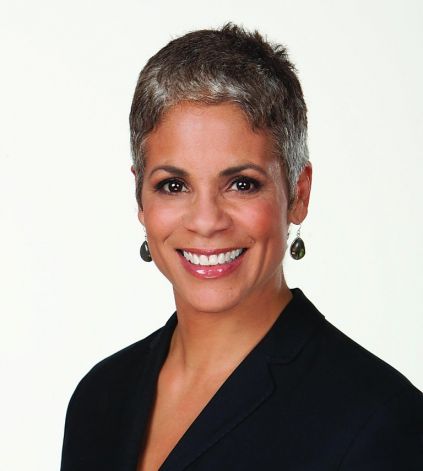
Admittedly, I’m becoming a little obsessed with this hair issue, but I started thinking about a local newscaster here in San Francisco, Dana King. I remembered reading a story about her last year on SFGate (a site I used to blog for.)
When King let her hair go gray, she was flooded with email. So much so that she had to go air, assuring viewers that her health was fine; she’d just made a decision to stop dying her hair.
Can you imagine viewers freaking out about a man with gray hair?
CNN’s Anderson Cooper?
CNN’s John King?
Those are just the first two who pop into my head. I bet on your local news, you’ve probably got co-anchors: a man with gray hair and a woman who is twenty years younger than he is, or trying to look twenty years younger so that she won’t get fired from her job.
When I was a producer for KGO Radio, one of the hosts there, Christine Craft, had been fired years earlier from a TV station for being too ugly and too old. At the time of her dismissal, Craft was 37 years old. She filed a lawsuit for gender and age discrimination. She lost the suit. She wrote a book about her experience and went on to became a lawyer. And, of course, a host on radio.
It is all so fucked up because obviously women are obsessed with their looks. It’s not because women are vain or superficial or born with some girl-vanity gene; women are trying to survive in the world. And what is even more fucked up is that “beauty” has nothing to do with beauty.
Curious about Dana King, today I Googled her. I found out that just last week, she announced she was leaving her post on TV to work on art full time. Here is what she said to The Huffington Post:
“I’ve reported stories from all over the world and yet I got more email reaction for going gray than anything else over my entire career,” King said Wednesday. “And looking back, that might have been the beginning of a huge shift for me — a move to really start following my heart.”
Earlier this year, King moved across the bay to Oakland, purchasing a home and work compound that she shares with several other artists. She bemoaned the fact that when it came time to leave for the station, she would be forced to leave behind her sculpting and “clean the crud out of her hair and fingernails.”
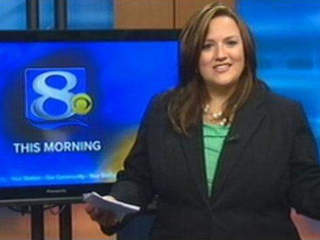
After I posted about Rhonda Lee, a meteorologist who was fired after defending her “ethnic” hair on Facebook to a racist and sexist commenter, I was thinking about black hair.
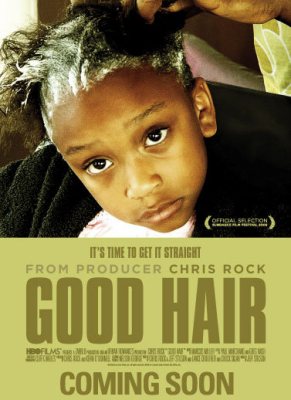
Right after I started Reel Girl, I saw an excellent documentary by Chris Rock on this subject called “Good Hair.”
The film begins with stills of Rock’s two young daughters. (I love that this film was inspired by these girls.) While we look at their pictures on screen, we hear Rock:
Those are my daughters, Lola and Zara. The most beautiful girls in the world. And even though I tell them that they’re beautiful every single day, sometimes it’s just not good enough. Just yesterday, Lola came into the house crying and said ‘Daddy, how come I don’t have good hair?’ I wonder how she came up with that that idea?
The film goes on to document just how these little girls got the idea that their hair wasn’t good enough.
In the film, actress Nia Long tells Rock:
There’s always a sort of pressure within the black community, like, oh, if you have good hair, you’re prettier or better than the brown skinned girl that wears the afro or the dreads or the natural hair style…The lighter, the brighter, the better.
Comedian Paul Mooney explains the phenomenon to Rock most concisely:
If your hair is relaxed, white people are relaxed. If you hair is nappy, they’re not happy.
“Good Hair” ends as it begins, with images of Lola and Zara shown at a playground while Rock muses: “So what do I tell my daughters? I tell them that the stuff on top of their heads is nowhere near as important as the stuff inside of their heads.”
A few months after I saw “Good Hair,” I watched nine year old Willow Smith bust out of the gender/ race matrix, exuberantly celebrating her hair and her independence with her hit song and video, “Whip My Hair.”
Willow sings:
Whip your hair back and forth,
Don’t let haters keep me off my grind,
Keep my head up,
I know I’ll be fine.
She explained the song to MTV:
Whip My Hair’ means don’t be afraid to be yourself, and don’t let anybody tell you that that’s wrong. Because the best thing is you.
Just a couple weeks ago, when this picture of Willow, now 12 years old, made the rounds on the internet, her mother, Jada Pinkett Smith, was derided for bad parenting.
Jada responded to the criticism on her FB page:
This subject is old but I have never answered it in its entirety. And even with this post it will remain incomplete. The question why I would let Willow cut her hair. First the ‘let’ must be challenged. This is a world where women, girls are constantly reminded that they don’t belong to themselves; that their bodies are not their own, nor their power or self determination. I made a promise to endow my little girl with the power to always know that her body, spirit and her mind are her domain.
Willow cut her hair because her beauty, her value, her worth is not measured by the length of her hair. It’s also a statement that claims that even little girls have the right to own themselves and should not be a slave to even their mother’s deepest insecurities, hopes and desires. Even little girls should not be a slave to the preconceived ideas of what a culture believes a little girl should be.
How cool is that? And how different is Jada Pinkett Smith’s public message to her daughter, and about her daughter, than the more conventional and ubiquitous “good mom” message from this Elizabeth Arden ad?
And speaking of beauty, there are few factors more obvious to reveal that what we call “beauty” is indicative of the time we happen to live in than hairstyles. “Beauty” is all about culture and class, status and money.
If African-American women represented the majority of CEOs in America, professors and department heads of Ivy League universities; if they dominated our boards and Academy Award winners, movie dierctors and nightly news anchors and on and on, do you think for one second any viewer would write in that the black lady on TV looks like she has cancer?
The racist comment has nothing to do with hair or “beauty” and everything to do with what it means to be black and a woman in America.
You’ve got a better chance getting into the power ranks if you look the part. Every woman knows how important her appearance is and how intimately what she looks like influences her chances of success.
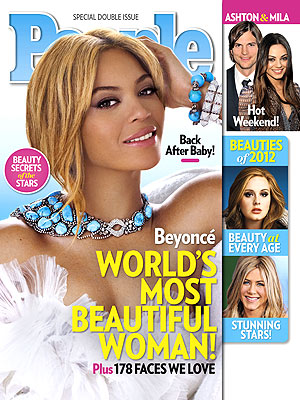
In the history of People Magazine, only two African-Americans have graced the “World’s Most Beautiful Woman” cover. I guess white people are just prettier than black people. Go figure. Note that Beyonce wins the title as a blonde.
If women ran Hollywood, do you think People would create a “most beautiful” issue at all? Or would the magazine come out with something more like “The Sexiest Woman Alive” featuring older stars on its cover? Real life “Sexiest Man Alive” winners include Pierce Brosnan at age 48, Harrison Ford at age 56, and Sean Connery at age 59.
Of course, it helps to come off as “sexy” when you’re portrayed in movie after movie as a hero and shown with “hot” sidekicks who are desperately in love with you. Though People covermen do have one thing in common with the women: Denzel Washington is the only African-American ever deemed “sexy” enough to win.
When Rhonda Lee defended her hair to a racist commenter, she wrote:
Little girls (and boys for that matter) need to see that what you look like isn’t a reason to not achieve their goals.
That’s the same reason Chris Rock made his documentary. It’s the same reason Willow Smith wrote her song, and Jada Pinkett Smith spoke up for her daughter. Is Rhonda Lee not famous enough or powerful enough to speak up for herself without getting punished for it?
the black lady that does the news is a very nice lady. the only thing is she needs to wear a wig or grow some more hair. im not sure if she is a cancer patient. but its still not something myself that i think looks good on tv.
Lee responded:
Hello Emmitt–I am the ‘black lady’ to which you are referring. I’m sorry you don’t like my ethnic hair. And no I don’t have cancer. I’m a non-smoking, 5’3, 121 lbs, 25 mile a week running, 37.5 year old woman, and I’m in perfectly healthy physical condition.
I am very proud of my African-American ancestry which includes my hair. For your edification: traditionally our hair doesn’t grow downward. It grows upward. Many Black women use strong straightening agents in order to achieve a more European grade of hair and that is their choice. However in my case I don’t find it necessary. I’m very proud of who I am and the standard of beauty I display. Women come in all shapes, sizes, nationalities, and levels of beauty. Showing little girls that being comfortable in the skin and HAIR God gave me is my contribution to society. Little girls (and boys for that matter) need to see that what you look like isn’t a reason to not achieve their goals.
Conforming to one standard isn’t what being American is about and I hope you can embrace that.
Thank you for your comment and have a great weekend and thank for watching.
KTBS defends its decision to fire Lee, claiming that she violated a company policy, one that she has allegedly violated before, concerning social media.
If harsh viewer comments are posted on the station’s official website, there is a specific procedure to follow. Ms. Rhonda Lee was let go for repeatedly violating that procedure after being warned multiple times of the consequences if her behavior continued. Rhonda Lee was not dismissed for her appearance or defending her appearance. She was fired for continuing to violate company procedure.
Lee said that she has yet to see this policy.
Lee’s response to the comment couldn’t have been more calm, focused, or right on target. It gave me chills to read it. How could someone in management (if they planned on responding at all rather than ignore it, that is, allow it) have responded any better than that? Do you think they would have or could have written:
Little girls (and boys for that matter) need to see that what you look like isn’t a reason to not achieve their goals.
No one could say that but Lee, the victim of the sexism and racism. She has to speak for herself, without shame. That is the lesson to teach kids about bullying, racism, and sexism.
But instead, the lesson learned is that when Lee refused to be a silent victim, she was punished. Fired. How can a nation that acts like it is concerned about bullying, whose President speaks on the issue and says its important one for the whole country, allow this to happen?
Livingston defended herself in an on air editorial that lasted longer than four minutes. She finished her statement by thanking her colleagues, family, friends and all the others who came to her defense. Her story made headlines and she was on “Good Morning America” talking about her experience.
Just like Lee, Livingston mentioned young people:
“This was a personal attack,” Livingston said. “Calling me obese is one thing. Calling me a bad role model for our community that I’ve worked at for 15 years and especially for young girls when I have three girls was a low blow and I thought it was uncalled for and I wanted to call him out on it.”
Livingston also urged children who were victims of bullying to defend themselves, a lesson she says she teaches her own daughter. By making her speech on TV, Livingston walked her talk.
It is particularly important that women speak out publicly because, historically, women have been shamed into silence. This shaming/silence tactic is evident with everything from rape to sex tapes; again and again, it is the victim and not the perpetrator who is supposed to be humiliated.
Just yesterday, Anne Hathaway was “shamed” when someone took a photo of her. When Matt Lauer smirked during a scheduled interview on the “Today Show” that he’d seen a lot of her lately, Hathaway didn’t hide away, but responded: “I’m sorry that we live in a culture that commodifies the sexuality of unwilling participants.” By speaking out, Hathaway directed the shame back where it belongs, on Lauer for his idiotic comment when she was trying to promote her movie, on the photographer who took the photo, and on the one who paid for the picture.
The attack on Lee is sexist. No one would be upset about that hairstyle if she were male. The taunting and comments that women receive on the internet about our appearance is epidemic and shows that sexism is alive and well in America. Attacking women for how they look, just putting out the threat that women could be attacked for how they look, has been an effective way to keep women in their place for much too long. Courageous and public acts like Lee’s and Livingston’s show all women how to deal effectively with this kind of bullying.
Of course, the attack on Lee is also racist.
It’s great that media outlets, viewers, activists, and colleagues supported Livingston when she defended herself against a bully. Lee deserves that same support now. That racism and sexism are protected in America in 2012 so that a woman defending herself against it loses her job makes me sick.
I am such a fan of Louis C. K. My husband and I stream his show about every other night and it cracks us up. I have never seen a man speak publicly about fatherhood so accurately. Louis has two daughters (we have three) and the conflicted emotions he expresses about raising his kids are spot on.
I just Googled “Louis C. K. contemporary fatherhood” and came up with a recent piece from The Atlantic.
Of course, to earn the title of America’s Dad (from someone other than me, I mean) Louis probably has to have a higher Nielsen share than what he currently pulls in.
So that’s me and the writer of this Atlantic article at least, so far. Join the club! If you are not watching Louis yet and are interested at all in parenting issues, you’ve got to check this guy out. He is X-rated and, at times, his language and the topics he goes into leave my mouth hanging open. But at the same time, he is charming.
The show we watched last night made me really think about all the basic ways in every day life, our culture does not support fatherhood.
Here is Louis C.K. on the challenges of having to use the bathroom the same time his daughters do:
I was at the airport with my kids, I was at JFK, and they had to go to the bathroom and I had to go to the bathroom. So take yourself through that logically. Where do I… What do I do? I can’t take them to the ladies room. I can’t just… “Go on in there, girls… Into the public restroom of an international airport.” Just release my custody of them to whoever’s in there. “Go ahead, good luck to you. Maybe I’ll see you later.”
So I gotta take them into the men’s room, that’s what I have to do, is take them into the John F. Kennedy Airport men’s room. Look here, girls! Nine penises! Nine penises that are all peeing at the same time. Nine farting men from all over the world, with their dicks out, shaking off droplets of pee from their syphilitic penises. Look, three of them have foreskins. You can see the difference now.’
So much of Louis’s show is about these interactions with his daughters, not sanitized. Clearly, his kids are a part of his life. If there were more fathers like Louis C.K., I bet there would be more family bathrooms in airports.
Louis also does an amazing job of expressing the conflicted feeling parents have towards children. He hides his ice cream from his daughters. When his kids are finally asleep, to get them back for staying up so late, Louis takes his bowl of ice cream into their room and eats it in the dark over their sleeping heads.
The Atlantic posts another example of his ambivalence:
“When am I going to go to momma’s again?” Louis’ daughter asks as they do their pre-bedtime routine. “I like momma’s better. I like momma’s better because she makes good food. And I love her more so I like being there, too. I like being here, too. It’s just not as great.” Louis takes it in with great equanimity and, as she turns away to go to sleep, he gives his little daughter the finger.
When we have more fathers like Louis C.K., the world will be a better place.
blue milk blogger saw her three year son watching the Australian animated show for toddlers “Bananas in Pyjamas.” She blogs:
I was so bewildered by it that I ended up watching the whole episode again on iview to be sure about what I was seeing.”
In the series, there are two banana adult figures and three bears, 2 girls and 1 boy, all friends. In the episode blue milk saw, the boy bear buys a Super Bear costume and then causes all sorts of trouble, getting caught up in his imagination and believing he really is a superhero. The bananas try to help out a little, but don’t get too involved, knowing they get to return home soon. So the clean up is left to the girl bears.
Tellingly, the little girl bears deal with these problems in a way that doesn’t involve Super Bear having to know about it because he would only cause more mess if he tried to help and because they do not want to hurt his dignity or spoil his fun. Worse still, his fun interrupts their own fun and plans and when they express some irritation about it all the Bananas encourage them to be careful not to ruin the boy bear’s illusion of himself as a superhero. It wouldn’t have particularly disturbed me as a story if it was about a parent or uncle cleaning up after the little boy teddy bear…But the sight of two little girls doing the cleaning up and taking care of, instead of having fun and adventures themselves? And the idea that the little boy got to experience the thrill of danger while the little girls got to worry about him? It all struck me as so, so wrong.”
First of all, I am amazed, once again, though I know I shouldn’t be, how universal sexism in kidworld is. It doesn’t matter if you’re a kid in Australia or a kid in the USA, if it’s PBS or Disney, if it’s a movie or TV: except for the Minority Feisty, boys will be boys and girls will clean up.
The TV show blue milk describes really irks me because my whole blog, Reel Girl, is about protecting the imagination of children (and hopefully, eventually, the adults they grown into.) I guess you could look at this episode as enlightening: Look, this is just what happens in real life. Males are encouraged and supported by the world to imagine and act; females are not. But somehow, I suspect three year old children don’t get irony.
Maurice Sendak died this week at age 83. Sendak, along with William Steig, is among absolute favorite writers and illustrators of books for children.
Like Steig, Sendak’s writing is poetry and also like Steig, Sendak doesn’t have nearly enough female characters.
Sendak does have some great females in his books that you may never heard of. Soon after I started this blog, I wrote about my favorite Sendak book, Outside Over There, all about a brave girl who rescues her baby sister. My brother-in-law recently sent me a YouTube of “Really Rosie,” a Sendak cartoon with great music by Carole King. Rosie is the imaginative director who casts characters and decides which stories are good and which are not, kind of like the job I’d like to have.
I finally saw the much hyped ‘Girls,’ and I’ve got to say: believe that hype.
I was riveted. I’m also totally impressed that Lena Dunham in twenty-five years old and she is the writer, producer, and star of the show.
I’ve read criticism about the all white foursome and agree completely. There should be women of color on the show. Not just for some kind of cosmetic diversity. By leaving out women of color, the show is missing out on an important part of depicting being young, struggling, and twentysomething in NYC. That is my only negative so far.
Looking forward to watching more and reporting back.
‘Girls’ is for adults, not girls. Reel Girl rates it ***HH***
PBS is “educational television,” so why are its programs for kids as male dominated as animated films from Disney or Pixar?
Every morning, my two older kids go to school a couple hours before the youngest one. In those morning hours, sometime between 7:15 and 8:30, the three year old gets to watch PBS while I do morning chores.
The morning animated programs are charming, sweet, and share something else in common: they star male characters and are titled that male character. The shows are Arthur, Caillou, and Curious George.
This trifecta of male-centered shows is obviously supposed to appeal to both boys and girls. That’s fine, why not put on “WordGirl” during this popular hour? Don’t even tell me that a three old would refuse to watch females. The kid is three!
If I want girl centered shows, I can use On Demand to seek them out. Often, I have to re-order episodes every 12 minutes. Just like with Pepperidge Farm Goldfish or LEGO minifigs, I can find females, but why do parents have to put in extra work to find girl-centered shows?
Wordgirl is amazing, Reel Girl rates it ***HHH***
Another female centered show is “Chloe’s Closet.” Chloe and her best friend, Tara, dress up, and become whatever they dress up as.
As you can see, it’s a little heavy on hearts and rainbows. There are things I like this show: she dresses up as a mermaid, pilot, scuba diver, and engineer. But I am troubled that one of the few shows starring a girl gets a dress up theme. I might be less annoyed by the gendered theme if PBS at least put the shows in the morning program hour so boys and girls would see them. Most kids like to play dress up, but most parents encourage their daughters and not their sons. “Franny’s Feet,” another PBS girl-centered show also depicts adventure through outfits: Franny tries on different shoes and then travel to different place around the world. Reel Girl rates Chloe’s Closet and Franny’s Feet ***HH***
“Angelina Ballerina, ” the third girl-centered show, gets on my nerves. As you can tell from the title, Angelina is into ballet, and she whines all the time. I can’t even listen to this show in the background. Reel Girl rates Angelina Ballerina ***H***
Tell me if I’ve missed a PBS show titled for its female it stars, but I think that’s it.
Male-centered “educational TV” teaches our kids the same gender stereotyping they see everywhere else in the world: boys are more important and get to do more things than girls.
I’m compiling your suggestions in one post. This is a list of what I have NOT seen or read. I will add to it as you do and remove when I officially rate. If you don’t see your suggestions included here, they are elsewhere on Reel Girl already reviewed. To check those, in “categories” click: Reel Girl recommends, Most girlpower, or GGG. Keep the suggestions coming!
Books
Imogene’s Last Stand
Once Upon A Heroine: 450 Books for Girls to Love
Lets Hear it for the Girls: 375 Great Books for Readers 2-14
Sadie and the Snowman
The Twelve Dancing Princesses
Words In The Dust
Millie Gets the Mail
Gwinna
DragonSong and DragonSinger by Anne McCaffrey
Dragon Slippers by Jessica George
Dealing With Dragons
The Kane Chronicles by Rick Riordan: The Red Pyramid, The Throne of Fire, and Serpent’s Shadow
The Melendy Family: The Saturdays, The 4 Story Mistake, Then There Were Five, and Spiderweb for Two
Don’t Bet on the Prince: Contemporary Feminist Fairy Tales in North American and England
The Maid of the North: Feminist Folk Tales from Around the World