Tired of sexed-up, “cute,” and endless princesses and rainbow fairies marketed to your daughters on Halloween?
A Mighty Girl has put together a great collection of awesome costumes.
My three year old is super- psyched to be Batgirl. We actually own this, but I bought a new one because ours is worn, ripped, and missing parts.
(Of course, potential Batgirl enthusiasts would be helped along if there were multiple Batgirl movies and derivative toys, games, and clothing. As is stands now, most kids haven’t heard of her, though her existence makes perfect sense to a three year old. Sadly, an eight year old, not so much.)
While on vacation for a month, I read three absolutely incredible Young Adult books, all starring kick-ass heroines. I’m dying to tell you about them.
Besides Hunger Games, these three stories are the first YA books I’ve read since starting Reel Girl.
Because my three daughters are ages 3 – 9, and because I’m writing a Middle Grade novel, I’ve mostly stayed away from Young Adult books. I don’t have the time to read everything I’d like to (and I really enjoy reading books intended for 43 year olds as well!) But because I have never trusted the rating system of kids’ media– what is deemed “acceptable” or “good” for children and what is not– I decided to venture into YA territory on my own.
Here are my reviews:
Wild Magic by Tamora Pierce
This book is gripping from start to finish. The story follows an intrepid and extremely likeable heroine, Daine, as she discovers her power and uses her magic to save her world. Daine starts out fearing her mysterious skills, her “difference,” but under the guidance of a mentor and a new community of friends and allies, she leans how to wield and tame her wild magic.
The only thing in this whole book that I feel could be inappropriate for young kids is a reference to Daine’s mom being raped. That reference describes bandits who murdered her mother and reads something like, “They would have passed by the house but my mother was pretty.” Otherwise, there is no sex in this book. I gave it to my almost nine year old daughter to read, and she loves it.
Like most girl-centered books for kids, this is a feminist story within the context of the patriarchy: it’s a narrative about the rare women who achieve, for example, who are able to become knights. There is more than one powerful female, which is great, but as usual, while reading, I longed for a magical world gender equality simply exists.
I don’t like this cover much. Daine looks naked and the image does nothing to communicate the magic or power of the book.
Wild Magic is mysterious and beautiful story.
Reel Girl rates Wild Magic ***HHH***
Graceling by Krsitin Cashore
This is my favorite of the three books I read. I could not put it down. The villain is one of the scariest and most compelling bad guys who I’ve ever read about.
This book is violent. Katsa, the heroine, like many in her land, is born with a “grace,” a special talent. Her particular talent is killing. Katsa’s grace is exploited by a power-hungry king who she must serve.
Graceling, like Wild Magic, is the story of how the heroine discovers the true meaning of her magic, how to own it and use it for good.
Though I adored this book, I don’t recommend it for Middle Grade readers. I don’t mind the violence. I’ve blogged about violence in kids’ media quite a bit but to quickly recap: Narratives are metaphors, magnifications of moments that, if successful, allow the reader to experience intense emotions.
Narratives raise the stakes so that experience can happen. We’ve all felt like we were “being attacked” or that “the world was caving in.” Narratives show us that actually happening. The story of David and Goliath is a metaphor, so much so that it’s become part of our language; it’s much more than a story of murder.
In the same vein, to the individual, cleaning out a closet can be a monumental task. We are all the heroes of our own lives. To communicate how huge and overwhelming something so mundane really feels, you don’t write about someone cleaning her closet, you write about Psyche sorting seeds as a matter of life and death.
So this is why I don’t mind violence at all, our psyches are intense, as are the emotions of little kids (and grown-ups.) A good and successful narrative depicts that.
Sex, on the other hand, I mind a lot. I don’t think kids should read about sex before they are ready to, and Graceling is an intensely sexual tale. It’s really a love story between Katsa and another graceling, Po. I love Po. Love him! His relationship with Katsa is so great because he is in awe of her power. He helps her to see it and develop it.
On some level, I suppose a little kid could read this story and totally miss the love affair, but I don’t recommend that. It would be leaving out so much. There are also references in the book to incest, more obtuse than the love story, but without getting that aspect of the tale, the reader misses how creepy the villain is.
Reel Girl rates Graceling ***HHH*** (not for MG Readers!)
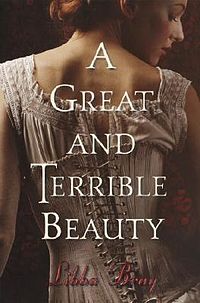
A Great and Terrible Beauty by Libba Bray
Wow, I wish this book was around when I was a kid.
Gemma Doyle is another heroine who fears her magic. This story, like the other two, shows how she comes to understand her power and use it. I loved reading about the secret society of powerful women (the Order) and the power they wield. Also, the setting is a boarding schools for girls in the Victorian Era. How can you resist that?
This book is also the story of an intense and complex mother-daughter relationship, something most teens can relate to.
Even more so than Wild Magic or Graceling, this book is very much about females struggling within the patriarchy. Again, the conflict is very well done, but also again, I long for kids to just be able to see females being strong without claiming the right to be as strong as boys. Can you imagine boys proudly claiming the reverse? It’s patronizing.
There is sex in this book. I don’t recommend it for MG readers.
I hate this cover. At best, we have the tired patriarchy/ corset metaphor; at worst, a “bodice-ripper.” Ugh.
Reel Girl rates A Great and Terrible Beauty ***HHH*** (one more time, not for MG readers!)
I finally finished The Golden Compass. This books features a couple of the most excellent female characters that I have ever read about. Lyra kicks ass. So does the witch queen, Serafina Pekkala.
About half way through the book, I posted on how all of the male characters were annoying me somewhat. Lyra was appearing to be too much of a Token Feisty for me, the lone female allowed to interact with several sexist groups: the Oxford scholars, the gyptians, and the bear community where the males are polygamists. Frustrated, I posted: Are there imaginary worlds where sexism doesn’t exist? Mrs. Coulter, the evil mother character, is powerful but she was also used to show how she was the exception to the other females in the story. It just irritates me that so often, when kids finally get to see a girl being brave, it’s woven into the narrative how she’s the exception of her gender.
But two things changed for me as a I read along to make me a die hard fan of The Golden Compass. The first is I absolutely fell in love Iorek Byrinson, the armored bear character. He’s male of course, but once he came on the scene, the book really came alive for me, and it kept getting better after that. Then came the witches. The witch clans are all female, magical, mysterious, and powerful.
While flying to the armored bear’s palace in a balloon through a starry, cold winter night guided by the witch queen, Lyra ask her: “Are there men witches, or only women?” Here is Serafina’s response:
There are men who serve us, like the consul at Trollesund. And there are men we take for lovers or husbands. You are so young, Lyra, too young to understand this, but I shall tell you anyway and you’ll understand later: men pass in front of our eyes like butterflies. creatures of a brief season. We love them; they are brave, powerful, beautiful, clever; and they die almost at once. They die so soon that our hearts are continually racked with pain. We bear their children who are witches if they are female, human if not; and then in a blink of an eye they are gone, felled, slain, lost. Our sons too. When a little boy is growing, he thinks he is immortal. His mother knows he isn’t. each time become more painful until finally your heart is broken. Perhaps that is when Yambe-Akka coems for you. She is older than the tundra. Perhaps for her, witches lives are as brief as men’s are to us.
Wow, how’s that for an alternate narrative? Clearly, Serafina Pekkala needs her own series. And I no longer mind polygamous bears when kids get to see females in power too.
As you read this book, the writing gets better and better until the end (not the movie ending, the book ending; they are different) which is so dazzling and stunning, it gave me chills.
JoJo’s Flying Side Kick is about a Tae Kwon Do student who must break a board with a flying side kick in order to win her yellow belt.
JoJo is nervous about the test, telling her Grandaddy: “I’m freakin’ out!” He helps her by giving a tutorial on fancy footwork from his boxing days. JoJo experiences other fears– a creepy-looking tree, the swing that hangs from it, a boy from her class tells her she “yells like a mouse.” In order to nail the side kick, JoJo uses the footwork, imagines the board is the tree, and gives a giant yell: “KEEEYAAAHHH!”
This book is really fun to read out loud. I love how all of the protagonist’s fears are woven together and then conquered in unison. The story teaches kids the great lesson that courage doesn’t mean having no fear but doing something even when you’re terrified. Reel Girl rates JoJo’s Flying Side Kick ***GGG***
Adelaide is the story of a kangaroo born with wings. She knows she doesn’t quite belong in her family of wingless creatures, so she hooks up with a pilot and travels the world, exploring and having adventures.
She decides to stick around Paris where she loves the art and culture but misses kangaroos. One day she saves two children from a burning building but is seriously hurt in the fall. (Her wings can’t carry all that weight.) After a hospital stay, she decides to visit the zoo where she meets and falls in love with a kangaroo named Leon. I really like how this story ends with a wedding and then baby kangaroos but its an unexpected surprise. The “happily ever after” finale isn’t the focus of Adelaide’s quest, but its nice that she finds her soulmate showing heroic, powerful females can fall in love, too. Reel Girl rates Adelaide ***GGG***
Shrek the Third: Fiona’s Fairy-tale Five is kind of chesey, and a cheaply made, stapled together book, but I adore it. There is much to love about the first Shrek story/ movie: how Fiona transforms at the end from “beautiful” princess to fat, green, troll to find true love. How great is that? So much potential here to flip fairy tales– and the notion of what it is to be “happily ever after” and what beauty and love is too– on its head. Not to mention that so much of the Shrek franchise is about making fun of Disney.
But as the far as the big screen, the female potential for greatness in this epic remains tragically unexplored. All three movies are Shrek’s stories, not Fiona’s. Fiona is only the Token Feisty, the strong female character included in many contemporary animated films so the audience won’t care or even notice that all of the other characters in the film are male, including the star who the movie is often titled for.
Fiona’s role is the love interest. The Shrek movie sequels are even more disappointing with the third one morphing into another animated father-son type saga (and Justin Timberlake vehicle) where Shrek must find an heir– male, of course. Fiona’s part is reduced to nothing. Where did she go? It sucks to see “Shrek 3” with your daughters, to say the least. But luckily, there is this cheap, little book. From the back of Fiona’s Fairy -tale Five:
“When Shrek is off finding an heir to the throne, Fiona must watch the kingdom. But soon Prince Charming and his band of villains storm the castle. Fiona has little time to turn a group of prim and proper princesses into lean, mean fighting machines. Can the fairy-tale five come together to take back the castle?
This book would make such a great movie, it kills me. Imagine the princesses voiced by Tina Fey, Sarah Silverman, Kristen Wiig and Maya Rudolph joining Cameron Diaz’s Fiona. This little story is so subversive too, because Disney absolutely forbids its princesses to interact with each other. (Or even look at each other, embossed on diapers, T shirts, or coloring books each one gazes off in a different direction, ignoring the other. Great model for female friendship, huh?)
Reel Girl recs this week feature super passionate heroines. All three Reel Girl rates ***GGG*** Triple Girlpower. Make sure you read these to your sons as well as your daughters!
Knuffle Bunny is one of my all time, absolute favorite books for kids. How do I love thee, let me count the ways…
First, the book begins with my total as yet unrealized fantasy: Father and child do the laundry (they go off to a launrdomat in Brooklyn) while the mom sits on the steps, a book you know she’s about to crack open held lovingly on her lap.
Next amazing thing about this book? Our main character, who I think is younger than two, sports no bow or curly eyelashes (just like the female Red Wolf of Reel Girl’s last recs.) With her overalls, Trixie wears a pink T shirt, but it’s no big deal. I’m not against pink for God’s sake, just Pink World Domination.
One of my favorite illustrations is in the laundromat when Trixie puts pants on her head and waves a bra in the air, her dad watching and smiling at her. Maybe I’m reading too much into this picture, but I think it’s a lovely commentary on adulthood and the various costumes we all wear.
Next is the best part of the book: When Trixie and her dad walk home and she realizes that she’s lost Knuffle Bunny, her big eyed, terrified expression is priceless. This picture communicates terror better than Munch’s Scream. Trixie tries desperately to communicate the disappearance to her to her dad (“Aggle flaggle klabble!”) but he’s oblivious.
At this point in the reading, I have never seen a kid not be totally wrapped up in the story, relating to what it’s like to lose a favorite animal and to have your parents not understand what’s going on. Both parent and child become increasingly frustrated which leads to my favorite sentence in the book (that my husband and I have used ever since to describe a tantruming child) “She went boneless.”
I won’t tell you how this story ends, but I have no doubt Knuffle Bunny will be one of your kid’s favorites.
Mary Had a Little Lampis a funny book about a heroine who follows her heart and couldn’t care less what anyone else thinks of her.
This is a great book to read to your kid if she feels uncomfortable around her peers for liking a toy or outfit or anything that the rest of them aren’t into. Kids will also relate to this book because, like Knuffle Bunny, it’s about an attachment object. It’s impossible to read this without a huge grin on your face at the end.
The Old Woman Who Named Things is about another passionate female, but this one starts out afraid of her strong feelings.
She’s elderly so doesn’t want to get attached to something that might die or fall apart, including old furniture or cars. She only wants to get attached to objects she can trust will be there forever. But when a stray puppy befriends her, she can’t help but care for it. (The genderless puppy is either called “it” or “shy brown dog” which I like.) The old woman refuses to name the puppy to try to control her attachment to the animal, but when the dog disappears, she finally starts to take some risks that help to make her feel more alive.
“The Secret World of Arrietty,” which opened Friday, is the latest effort from Studio Ghibli, the same animation studio that created Spirited Away, Kiki’s Delivery Service, Howl’s Moving Castle, Ponyo, Castle in the Sky, and Princess Mononoke. Unlike American animation, many of Ghibli’s films star powerful female protagonists and feature multiple strong female characters. Ghibli doesn’t disappoint with its new movie. Arrietty is smart, resourceful, brave, and beautiful. She is just three inches tall.
The animation style shows what it’s like to be tiny and vulnerable in a world of intimidating giants in countless original and creative ways. Arrietty leaps across a row of nails aligned like a rickety bridge over a chasm. She uses a pin like a sword, shoving it into her dress for easy access. My five-year-old is obsessed with bugs, and those are particularly well done in this movie. We see crickets, roaches, ladybugs, and my daughter’s absolute favorite: roly-polies. Arrietty’s home is so beautiful, colorful, and cozy, we wanted to move in.
Arrietty seems bigger because her courage, along with her fluid form and softly dappled world, come by way of the famed Japanese company Studio Ghibli, where little girls rule, if not necessarily as princesses.
That kind of screen equality is rare in American animation (this year Pixar releases its first movie with a female lead), but it’s never been an issue at Ghibli, where girls have long reigned, without the usual frou-frou, in films like “Spirited Away” and “Ponyo.” In keeping with that tradition, a tiara and pink tulle don’t make Arrietty special: her size and especially her bravery do, as evident when, early on, she sprints across a yard with a few leaves and a sprig of flowers while being chased by a cat that looks like a furry blowfish.
I do have a couple questions about the marketing of this film. Have you heard of it? Seen a poster around town on a bus? A TV commercial? I found the poster weeks ago on the internet while I was briefly researching kids movies coming out in 2012.
From the poster, I could not tell that the female was the star. I thought the boy was. I also couldn’t tell from the poster that the girl pictured was “Arrietty.” I thought the title referred to the name of another world. One more thing: If Arrietty were male, do you think he would be shown walking in front of jar giving the impression he could be easily trapped inside of it, with a giant girl’s face looming over him? Do you think he would share the poster with a human girl at all?
In contrast, the ubiquitous Lorax, all over TV and buses, claims his spot with no doubt about who he is, clearly defining the made up word with his picture.
So I’ll do my best to promote this incredible film right now: it came Friday and daughter has already seen it twice– how good a rec is that? Reel Girl rates ‘The Secret World of Arrietty” ***GGG*** Take your sons and daughters!
One of my first blogs for Reel Girl was about sexism in Dr. Seuss. Here’s a kidlit author with such a fecund imagination, an incredible gift for words, yet when it comes to female characters in his fantasy worlds, he falls flat.
Dr. Seuss’s sexism (just as Herge’s, the creator of Tintin) is loyally and meticulously maintained by contemporary Hollywood. Right now, The Lorax’s mustachioed face all is in ads all over San Francisco as he prepares to make his debut on the big screen. Meanwhile, the “love interest” in the movie, Taylor Swift’s character is nowhere to be seen on the posters plastered all over our city’s buses. As far as marketing, I have seen Swift’s character only in TV commercials. (The one I saw was during the Grammys broadcast.)
So when I discovered the wonderful book, Fearless Girls, Wise Women and Beloved Sisters: Heroines in Folktales From Around the World, I was not surprised that the anthologist, Kathleen Ragan, was driven to seek out female protagonists because of her frustration with the sexism in Dr. Seuss. While reading his many, many books to her young daughter, Kagan became annoyed and then enraged. Here’s what she wrote in her introduction:
We read One fish Two Fish, Red Fish Blue Fish. My daughter loved the rhythm and rhymes, just as I did when I was a little girl. She memorized whole pages on the couch pretending to read “I am Sam/ Sam I am.”
The more I read, the more uncomfortable I became. I found myself changing the pronouns from male to female when I read stories to her. …
One night we read If I Ran the Zoo as bedtime story. A part of the story described hens roosting in each others’ topknots. When it said, “Another one roosts in the the topknot of his/ And another in his, and another in HIS, I got angry. Since when is a hen masculine?”
Ragan’s shock at how far adults will go to maintain male privilege in the imaginary world reminds me of my reaction when I saw the animated film “Barnyard.” The protagonist, Otis, played by Kevin James, is a cow. A cow with an udder. I kid you not. So not only do our kids go to the movies to learn that girls aren’t nearly as important as boys, but they’re getting distorted lessons about basic anatomy.
After the male hen experience, Ragan began counting characters:
As soon as my daughter went to sleep that night, I picked up And to Think That I Saw It on Mulberry Street. I looked for female characters. There were none. In fact, the only mention of a woman occurred in the lines “Why Jack or Fred or Nat/ Say even Jane could think of that.” I picked up the 500 Hats of Bartholomew Cubbins, Even the crowd scenes were male…I did a more thorough survey, hoping to find Dr. Seuss books with positive, exciting female characters. I found that over 90% of the characters were male. …
I continued to count. I counted books in my local library which prides itself on being gender conscious yet there were at least twice as many male protagonists as female protagonists in the children’s fiction section. In the scarcity and poor quality of heroines, my daughter was constantly being told ‘you don’t exist, you’re not important.
Ragan started to research to folktales. In published anthologies of world folktales, she found a low percentage of female characters: 4% female protagonists (not necessarily heroines) in a book of 220 folktales and 2% female protagonists in a book of 107 folktales were standard ratios. When searching through fairytales Ragan found 10% female active protagonists to 90% male. In the first edition of Grimm’s, supposedly more feminist than later adaptations and Disney movies, out of 210 stories, just 40 featured female main characters.
So Ragan decided to create her own anthology. She reviewed over 30,000 folktales from around the world and came up with her fabulous book featuring 103 tales complete with inspiring heroines.
Thrilled to have discovered Ragan’s book and read about a mom’s experiences of frustration with kidlit so like my own, I thumbed to the copyright to see when Fearless Girls was published. I was hoping that this anthology had just come out and was about to inspire Hollywood to make a new slew of movies with female heroines, LEGO to make sets with female adventurers, derivative video games and apps to follow. A new trend of gender equality in kids media was about to begin.
But, no.
Fearless Girls, Wise Women, and Beloved Sisters came out in 1998, 14 years ago. Before Ratatouille, Cars, and Wall-E. Before the Happy Feet 1 and 2 and Tintin. Before Disney announced it will make no more princess movies i.e. the only genre, albeit totally sexist, that allowed in a very limited way for females to be to be front and center, to star, to actually get a movie titled in honor of them.
In 15 years from now, is some other mom with little kids going to come across my blog and think: wow, someone was writing about this years ago and things have only gotten worse?
How can we as parents continue to allow fewer and fewer female characters? There is no reason for fantasy world to be sexist. It’s an imaginary world, equality for our kids should at least be possible there.
And if this phenomenon of missing girls continues to go on at the rate it is now, how does that affect our kids’ imaginations and aspirations? Who they are and the adults they’ll become?
This radical and perpetual gender disparity of choicemaker-hero-male versus passive-sidekick-female (if she’s allowed to exist at all) might continue to replicate in the adult world, as if it’s expected, as if its normal. Here’s an illustration of today’s congressional hearing on contraception that could be right out of a Dr. Seuss book. Not a uterus present but lots of facial hair. Minus a few trees, The Lorax would feel right at home in Washington DC.
When my daughter was seven years old, she turned me on to Taylor Swift. Every time the car radio scanned to a Swift song, she’d call out from the back seat, “I like this!” So last night when Swift sang “Mean” at the Grammys, I got chills. Swift’s original lyrics and radiant performances make her a great role model for girls. She shows kids that, with some creativity and perseverance, you can write your way from victim to hero.
In “Mean” Swift sings:
I bet you got pushed around
Somebody made you cold
But the cycle ends right now
Cause you can’t lead me down that road
And you don’t know, what you don’t know…
Swift’s “Mean” has become a beloved anthem for girls around the world. I think the lyrics resonate with kids in part because the song takes on the false belief that permeates so much of kidworld. Especially for girls, being mean is too often seen as cool or powerful. As you get older, in college, cruelty can continue to be equated with being smart, masquerading as a cynical or skeptical brand of superior intelligence. Whereas being kind can be seen as weak, uncool, or even dumb. Too many grown-ups go on to maintain this warped view.
In contrast, Swift directly challenges the mean-cool dogma with her sweetness, her songs about how she loves her mom, and the devoted way she treats her fans. Swift is also a brilliant lyricist who writes openly about her humiliations and, again and again, turns them into triumphs.
What humiliations? Many involve love and relationships, but some are less personal, more public, and have everything to do with her career.
At the 2009 MTV music awards, after the 19-year-old Swift won Best Female Video for “You Belong to Me,” rapper Kanye West stormed the stage, claiming the award should’ve gone to Beyonce. Both Swift and her mother were reportedly crying backstage. Later that night, when Beyonce won her own MTV award for Video of the Year, she asked Swift to take that time speak (which was cool of Beyonce and a good moment for females supporting each other publicly.)
Swift wrote a song about Kanye West and forgiveness called “Innocent.”
A year later, at the 2010 Grammys, Swift performed a duet with her idol, Stevie Nicks. She sang off key. A well known critic tore her apart, saying that Swift should reconsider her career as a singer.
It was about that experience that Swift wrote “Mean:”
You have pointed out my flaws again
As if I don’t already see them
I walk with my head down
Trying to block you out ’cause I’ll never impress you
I just wanna feel okay again…
And I can see you years from now in a bar
Talking over a football game
With that same big loud opinion
But nobody’s listening
Washed up and ranting about the same old bitter things
Drunk and grumbling on about how I can’t sing…
The chorus goes likes this:
Someday I’ll be living in a big ol’ city
And all you’re ever gonna be is mean
Someday I’ll be big enough so you can’t hit me
And all you’re ever gonna be is mean
Why you gotta be so mean?
Here’s my eight-year-old daughter dressed as Swift for Halloween:
Here are all the lyrics to “Mean.”
You, with your words like knives
And swords and weapons that you use against me
You have knocked me off my feet again
Got me feeling like I’m nothing
You, with your voice like nails on a chalkboard
Calling me out when I’m wounded
You picking on the weaker man
Well you can take me down with just one single blow
But you don’t know, what you don’t know…
Someday I’ll be living in a big ol’ city
And all you’re ever gonna be is mean
Someday I’ll be big enough so you can’t hit me
And all you’re ever gonna be is mean
Why you gotta be so mean?
You, with your switching sides
And your wildfire lies and your humiliation
You have pointed out my flaws again
As if I don’t already see them
I walk with my head down
Trying to block you out ’cause I’ll never impress you
I just wanna feel okay again
I bet you got pushed around
Somebody made you cold
But the cycle ends right now
Cause you can’t lead me down that road
And you don’t know, what you don’t know…
Someday I’ll be living in a big ol’ city
And all you’re ever gonna be is mean
Someday I’ll be big enough so you can’t hit me
And all you’re ever gonna be is mean
Why you gotta be so mean?
And I can see you years from now in a bar
Talking over a football game
With that same big loud opinion
But nobody’s listening
Washed up and ranting about the same old bitter things
Drunk and grumbling on about how I can’t sing
But all you are is mean
All you are is mean
And a liar, and pathetic, and alone in life
And mean, and mean, and mean, and mean
But someday I’ll be living in a big ol’ city
And all you’re ever gonna be is mean, yeah
Someday I’ll be big enough so you can’t hit me
And all you’re ever gonna be is mean
Why you gotta be so?..
Someday I’ll be living in a big ol’ city (Why you gotta be so?..)
And all you’re ever gonna be is mean, yeah (Why you gotta be so?..)
Someday I’ll be big enough so you can’t hit me (Why you gotta be so?..)
And all you’re ever gonna be is mean
Why you gotta be so mean?
All three recs this week are feminist takes on fairytales. Reel Girl is debuting a new rating letter, T for Traditional. Read about it here.
My five year old is absolutely obsessed with The Red Wolf. The illustrations in this book are extraordinary and what is especially cool about them is– see that red wolf– she’s a girl!
No bow! No curly eyelashes! How often do you see a female, magical furry creature like this not in drag in kidworld? And look how happy she is leaping over the forest. It’s impossible to read this book and not smile.
The Red Wolf is a version of the Rapunzel story that rubbed me the wrong way at first. I don’t like to see girls locked up in towers. The princess in this story does free herself, though I worry her liberation is temporary. But I decided that maybe her struggle– the child trying to break free of the overprotective parent who tries to keep her kid safe by teaching her to be fearful of the world– is a universal struggle. Didn’t the father of the Buddha try to isolate his kid from all pain and death? And it was Buddha’s first encounter with an old man that led to his enlightenment, right? With this in mind, and knowing I’m hyper-sensitive to these things, Reel Girl rates The Red Wolf ***GGG/T*** I seriously adore this book.
Next feminist fairytale is Baba Yaga and Vasilisa the Brave.
What is special about this story is it features the rare female friendship and also– are you ready? A positive mother-daughter relationship. OK, the mom is dead, but still. Vasilisa, the protagonist, has a magical doll who helps her. But this story is also clearly a traditional fairytale as well with sentences like: “Whereas the other girls were cruel and ugly, Vasilisa was kindness itself and beautiful beyond measure.” Ugh. I think this equation of beauty-kindness and ugliness-cruelty probably started out right: if you love someone, they appear beautiful. But somehow, the correlation got switched so an “ugly” person implies a “wicked” person. When I come across this correlation in stories, I ask my kids about it and we talk about what it means. The story doesn’t dwell on the beauty issue and Vasilisa is resourceful. Reel Girl rates Vasilisa the Brave ***GGG/T***
Now for my favorite feminist fairytale yet: The Rough-Face Girl. This story also features the rare female friendship. Marriage is the central conflict but its handled in such a beautiful and original way. This is a love story in the best way. Reel Girl rates The Rough Face Girl ***GGG/T***