‘Gender neutral’ not exactly what I’m going for…

Friday, on the local San Francisco public radio station, KQED, I heard a show about children and gender neutral toys. It was a great program, featuring the brilliant Peggy Orenstein, among others, and I was psyched to hear the topic of kids and toys debated as we go into the Christmas season. But, I’ve got to say, I’m not entirely on board with the term “gender neutral” that the host kept using to define a goal. And that is a term that the media seems to cling to when the topic of sexism in kidworld is discussed. When I was on Fox News, the host kept trying to put the same words in my mouth, and I didn’t like it.

Let me be clear here. I absolutely believe toys in stores should be divided by type– building, outdoor, figures/ dolls etc– not by gender. I don’t believe objects should be color coded to imply they should be played with by boys or girls. I am hard pressed to think of something more absurd and simultaneously socially accepted than this. I desperately want to see girls and boys pictured playing together on boxes. When the term “gender neutral” is used, I think this is the goal referred to, a goal I share with all of my heart.

I guess the issue from me is that powerful female characters are already drastically missing from the fantasy world created by grown-ups for children. When we talk about “gender neutral,” I fear that girls will continue to go missing from this debate– about children, toys, play, and sexism– even more. “Gender neutral” needs to be a goal of sorts, but we also have to keep in mind that all kids need to see more girls and women doing more things. Do we call that “gender neutral”?

Another problem for me with the term is that “gender neutral” doesn’t inspire me. “Gender neutral” makes me think of a bunch of grown-ups or academics or psychiatrists sitting around wearing super thick glasses and holding notebooks.

Here is what I want to see in kidworld: More females having adventures. More females doing cool shit. Got it? Do you call that gender neutral or do you call that being alive?

I want options. Variety. Diversity. Multiple narratives. I want all kids to see many more images of powerful and complex females, to see girls taking risks, saving the world, being brave, smart, and going on adventures in the fantasy world and in the real one. You could argue that we need to see more images of boys being kind and geeky and paternal, but from my vantage point, as a reader, movie goer, and watcher of TV shows, that’s pretty covered. I honestly believe the best way to help boys get out of gender stereotypes right now is to show them females being strong, being the star of the movie, or the central figure in a game that everyone wants to play.

But, as it stands, this is not the case at all. Strong female characters have gone missing. Part of this lack is because there are so few female characters in kids’ movies. Those narratives get licensed into LEGO and diapers and clothing. But even when female characters show up, they get “make-overs” or companies like Stride Rite will remove Wonder Woman, Black Widow, and Leia from their Justice League, Avengers, and Star Wars products and marketing. It’s really shocking how strong female characters keep disappearing from toys, clothing, and all kinds of children’s products.

Here’s my four year old daughter (holding a lunchbox from the Seventies.)

supergirl-e1377394963456

My daughter isn’t a “tomboy” or a “girlie-girl.” She likes pants; she likes dresses; she like yellow, she likes pink, she likes black. She likes to race and play soccer and read and make art. She loves superheroes and her mermaid Barbie. But the older she gets, the more I see her choices getting influenced and limited by stores and marketing and media and peers. My goal is to have her world grow, not shrink. I’m not sure that “gender neutral” is what she needs.


Female pilot speaks out against sexism

I got this comment on Reel Girl today:

I just wanted to say thank you so much for making this post on female pilots and the lack of recognition towards important female war heroes. As a female pilot in training, hearing about great female pilots is always encouraging especially when aviation is so dominated by males. It’s disgusting with what happened to the WASPs, it just goes to show the existing sexism towards females in our North American society. I’m so sick of it, but I’m really glad I found your blog.


Thanks again for making this post, shortly after I found it I used the WASPs’ story and made a poem about them for an English Language Arts assignment.


Oh and regarding the movie “Planes” I tried watching it despite having little hope for the story and characters being any bit original. Let’s just say that I gagged when the one female plane glomped the sidekick male plane, and covered him in kisses after he “whooed” her with music the previous night. It made me sick on so many levels, I’m so glad I only watched it online…


Here is the poem she wrote, I love it.

We are the WASP

The women who flew,
60 million miles or more.
Two years of service,
the men demand our lore.

Status denied,
but we didn’t quit.
The men may take glory,
but we still flew in our story.

Our achievements forgotten,
only known by few.
In history books erased,
schools without a trace.

Lest we forget,
The first women of wings.
We are the WASP,
the women who flew.

See how real life inspires art inspires real life?

I assume this commenter is a young woman. Imagine how kids feel when they see sexist scenes like the one in “Planes” again and again, like it’s normal and okay and cute. What kind of art do they make? What kind of imaginary games do they play? At my daughter’s preschool, a three year old girl told the teacher she couldn’t be a pilot, but a pilot’s wife. A three year old. Those limits on her imagination are our fault, grow-ups. Do we really want to train a new generation of children to accept gender stereotypes?

One more time, here’s the preview of Disney’s “Planes.”

Plane One: What’s taking this guy so long? Is he really as good as he says he is?

Plane Two: No, better.

Plane One: Whoa! Who was that?

Plane Three: (Descending fast on top of the other two) Well, hello ladies! Ready to lose?

Plane Three goes on to leave the “ladies” in the dust.

As the commenter points out, that’s just one example of the sexism rampant in “Planes.” Sexism that is mirrored in so many movies made for children in 2013.

And here’s a photo of the real life WASPs

wasp3

Women, please tell your stories, real and fictional, and tell them publicly. It will change the world.

Art creates reality: Imagining gender equality in the fantasy world

Some good quotes here. Let me know what you think

Bono on Jay-Z in November’s Vanity Fair:

In music, we love the idea of the screwed-up, shooting-up. fucked-up artist. The one bleeding in the garret having cut his own ear off. Jay-Z is a new kind of 21st-century artist where the canvas is not just the 12 notes, the wicked beats, and a rhyming dictionary in his head. It’s commerce, it’s politics, the fabric of the real as well as the imagined life.


Stephen Mitchell in Can Love Last, the Fate of Romance Over Time

It is the hallmark of the shift in basic psychoanalytic sensibility that the prototype of mental health for many contemporary psychoanalyitc authors is not the scientist but the artist. A continual objective take on reality is regarded as neither possible nor valuable in contrast to the ability to develop and move in and out of different perspectives of reality.


New York Times, October:

Public narratives about a career make a difference. The most common career aspiration named on Girls Who Code applications is forensic science. Like Allen, few if any of the girls have ever met anyone in that field, but they’ve all watched “CSI,” “Bones” or some other show in which a cool chick with great hair in a lab coat gets to use her scientific know-how to solve a crime. This so-called “CSI” effect has been credited for helping turn forensic science from a primarily male occupation into a primarily female one.

Jezebel reacting to New York Times piece:

The New York Times today would like to suggest that storytelling is powerful, that, in the whole art/life dynamic, it’s life that imitates art, not the other way around, at least not when it comes to kids imagining viable career paths for themselves.


Whoopi Goldberg:

Well, when I was nine years old Star Trek came on. I looked at it and I went screaming through the house, ‘Come here, mum, everybody, come quick, come quick, there’s a black lady on television and she ain’t no maid!’ I knew right then and there I could be anything I wanted to be.


In the fantasy world, anything is possible, so why do little kids see so few female heroes and female protagonists on TV and in the movies? While boy “buddy stories” are everywhere you look, why is it so hard to see two females working together to save the world? Why are females, half of the kid population, presented as a minority in fantasy world? Why are TV shows, movies, and books about boys “for everyone” while shows and movies about girls “just for girls?” When we pass on stories to our kids, what are we teaching them about gender, about who they are right now and who they will become?

One more quote for you from neuroscientist, Lise Eliot:

“Babies are born ready to absorb the sounds, grammar, and intonation of any language, but then the brain wires it up only to perceive and produce a specific language. After puberty, its possible to learn another language but far more difficult. I think of gender differences similarly. The ones that exist become amplified by the two different cultures that boys and girls are immersed in from birth. This contributes to the way their emotional and cognitive circuits get wired.”

Eliot believes: “Simply put, your brain is what you do with it.”So let’s all use our brains to imagine gender equality in the fantasy world, take actions to manifest that vision, and see what happens next. I bet it’ll be amazing.

New evidence shows early women were artists and warriors

All week, I’ve been trying to get a minute to blog about new evidence showing the earliest artists were women. From NBC News:

Alongside drawings of bison and horses, the first painters left clues to their identity on the stone walls of caves, blowing red-brown paint through rough tubes and stenciling outlines of their palms. New analysis of ancient handprints in France and Spain suggests that most of those early artists were women.


This is a surprise, since most archaeologists have assumed it was men who had been making the cave art. One interpretation is that early humans painted animals to influence the presence and fate of real animals that they’d find on their hunt, and it’s widely accepted that it was the men who found and killed dinner.


But a new study indicates that the majority of handprints found near cave art were made by women, based on their overall size and relative lengths of their fingers.

“The assumption that most people made was it had something to do with hunting magic,” Penn State archaeologist Dean Snow, who has been scrutinizing hand prints for a decade, told NBC News. The new work challenges the theory that it was mostly men, who hunted, that made those first creative marks.


Another reason we thought it was men all along? Male archeologists from modern society where gender roles are rigid and well-defined — they found the art. “[M]ale archaeologists were doing the work,” Snow said, and it’s possible that “had something to do with it.”

What, rigid gender roles now, in 2013? But I thought were we beyond all that, living in a post-feminist world and all. Here are some stats on women artists today:

stats

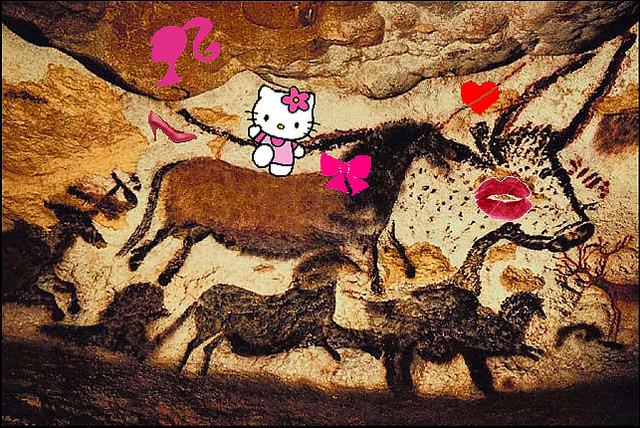
Want to see something else fucked up? Looking for this story, I typed “cavewomen artists” into Google. Here’s the first match I got.cavewomen

A pink bow, are you kidding me? Looks like Disney has been here or perhaps, just Hollywood.

Think gender bias is restricted to archeology “experts”? Here’s another story from NBC News

Last month, archaeologists announced a stunning find: a completely sealed tomb cut into the rock in Tuscany, Italy. The untouched tomb held what looked like the body of an Etruscan prince holding a spear, along with the ashes of his wife. Several news outlets reported on the discovery of the 2,600-year-old warrior prince.


But the grave held one more surprise. A bone analysis has revealed the warrior prince was actually a princess…The mix-up highlights just how easily both modern and old biases can color the interpretation of ancient graves.


I see these two stories as related, showing how gender bias today influences how we interpret at the past. It’s funny because I’ve heard a lot from others that I look at the world through a feminist lens, but what if it’s not me wearing the funny glasses?

 Update: Commenter says pic is satirical (like the first) in which case, I like it. Maybe it’s saying, “Is this the proof archeologists are looking for to attribute work to women?”

Apparently, I need an animator

Look what ad just showed up on my Facebook feed.


Is your face sending mixed messages? It could be. Your “resting face” may make you seem angry, grumpy or unapproachable to others. This may affect both your private and public lives.So what can be done about this problem?Injectable cosmetics can also help women who look grumpy when they are at peace. Botox injections can smooth worry lines between the eyes and raise the eyebrows. Dermal fillers an round out the chin and mouth or fill in deep creases that make you look upset.If you don’t like the way your face looks when you are at rest, you may want to ask Dr. Kulick for advice. He will be able to point you in the direction of aesthetic procedures that could help alleviate this problem:
Is your face sending mixed messages? It could be. Your "resting face" may make you seem angry, grumpy or unapproachable to others. This may affect both your private and public lives.</p><br /><br /><br /><br /><br /><br /><br />
<p>So what can be done about this problem?</p><br /><br /><br /><br /><br /><br /><br />
<p>Injectable cosmetics can also help women who look grumpy when they are at peace. Botox injections can smooth worry lines between the eyes and raise the eyebrows. Dermal fillers an round out the chin and mouth or fill in deep creases that make you look upset.</p><br /><br /><br /><br /><br /><br /><br />
<p>If you don't like the way your face looks when you are at rest, you may want to ask Dr. Kulick for advice. He will be able to point you in the direction of aesthetic procedures that could help alleviate this problem: http://bit.ly/1e337x4</p><br /><br /><br /><br /><br /><br /><br />
<p>F
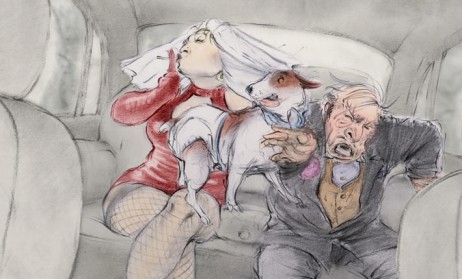
Can’t I just get a Disney animator to fix my image up? Who needs facial expressions anyway? Oh, that’s right, men do.
The Society Pages posts the PR for “The Counselor.”
Screenshot_114
Screenshot_27
 The men are not considered unattractive by virtue of the fact that you can tell they have skin.  The women, in contrast, have faces that are so smooth that they look inhuman; their images are halfway between photograph and cartoon.  Amazingly, this treatment of images of men and women is so ubiquitous that it now looks more or less normal to us.
Fantasy creates reality and reality creates fantasy in an endless loop.

Art teacher for kids says ‘almost without fail, girls create male characters’

Lori comments on Reel Gir’s post Speaking of art as derivative:

I teach clay classes for kids, and we often do character sculptures. I encourage the kids to create characters and make up stories about them, and almost without fail, the girls will create male characters. If they do make female characters, they always have long hair, a dress, and big eyelashes, and are defined by how pretty they are, or some romantic plot point. Any monsters or animals were male by default. I actually ended up running a couple of workshops specifically aimed at girls to encourage them to create stories about female protagonists, and to talk about gender stereotypes in storytelling because of this. It’s so pervasive, they don’t even realize they’re doing it, or that they are free to create anything different.


This makes me so sad about the limits gender bias in our culture is putting on children’s imaginations. Lino DiSalvo and co, do you see the problem now? What are you going to do about it?

Speaking of art as derivative…

My daughter, inspired by the movie, “Soul Surfer”  about champion Bethany Hamilton, made this:

bethanyart

Why do you think so many little girls make art about pretty girls in pretty dresses? Because that’s just “natural”?

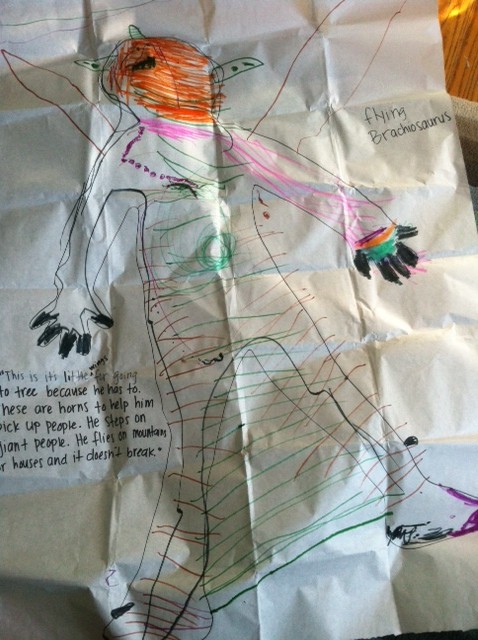
Last Spring, when another daughter of mine was 3 years old, she made made a magical creature called a flying Brachiosaurus.

creature

Here’s what she said to her teacher about it:

This is its little wings for going to tree because it has to. These are horns to help him pick up people. He steps on giant people. He flies on mountains or houses and it doesn’t break.

Why do you think her creature is male? I looked at the other children’s art work in her class, half of them girls. Every picture I saw described a male creature.

When another daughter was asked to write a story during school in third grade, she used a male protagonist. When I asked her why she chose a male, she said, “Because everybody did.”

Can you imagine if in a class of third graders, every kid wrote about about female protagonists? Do you think the teacher would notice?

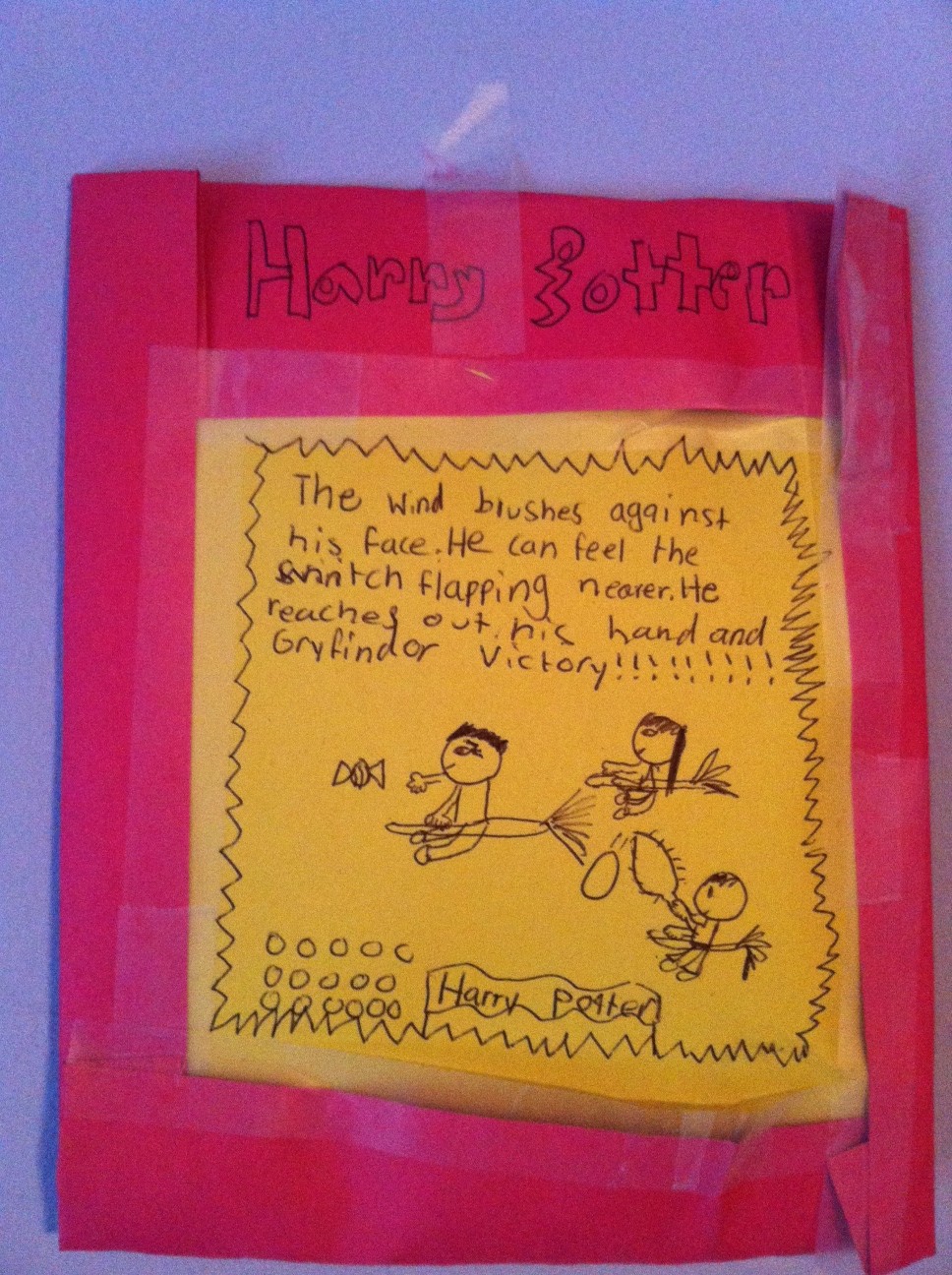
Here is that daughter’s drawing of Harry Potter. This is the same daughter who later drew Bethany Hamilton.

harry

This scene didn’t happen in the book but she was inspired by the book. Her drawing shows a typical gender matrix you see all over children’s media: 2 boys, 1 girl; boy in front, girl behind; text supports male competition and victory.

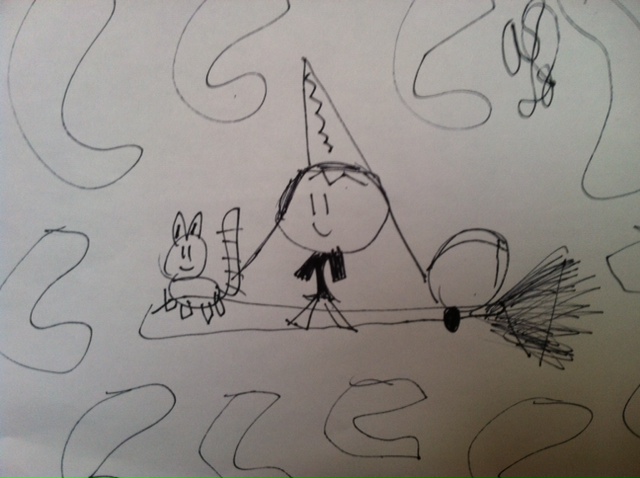
Here is a picture my middle daughter drew at age 6 while I was reading her the first part of the first Harry Potter.

witchphoto

She made up this character, a witch and her cat soaring through the sky on a broom surrounded by many crescent moons. I was pretty psyched about this witch, but then again, we were only at the beginning of Book 1. Would she still make a female character, front and center, after Book 7?

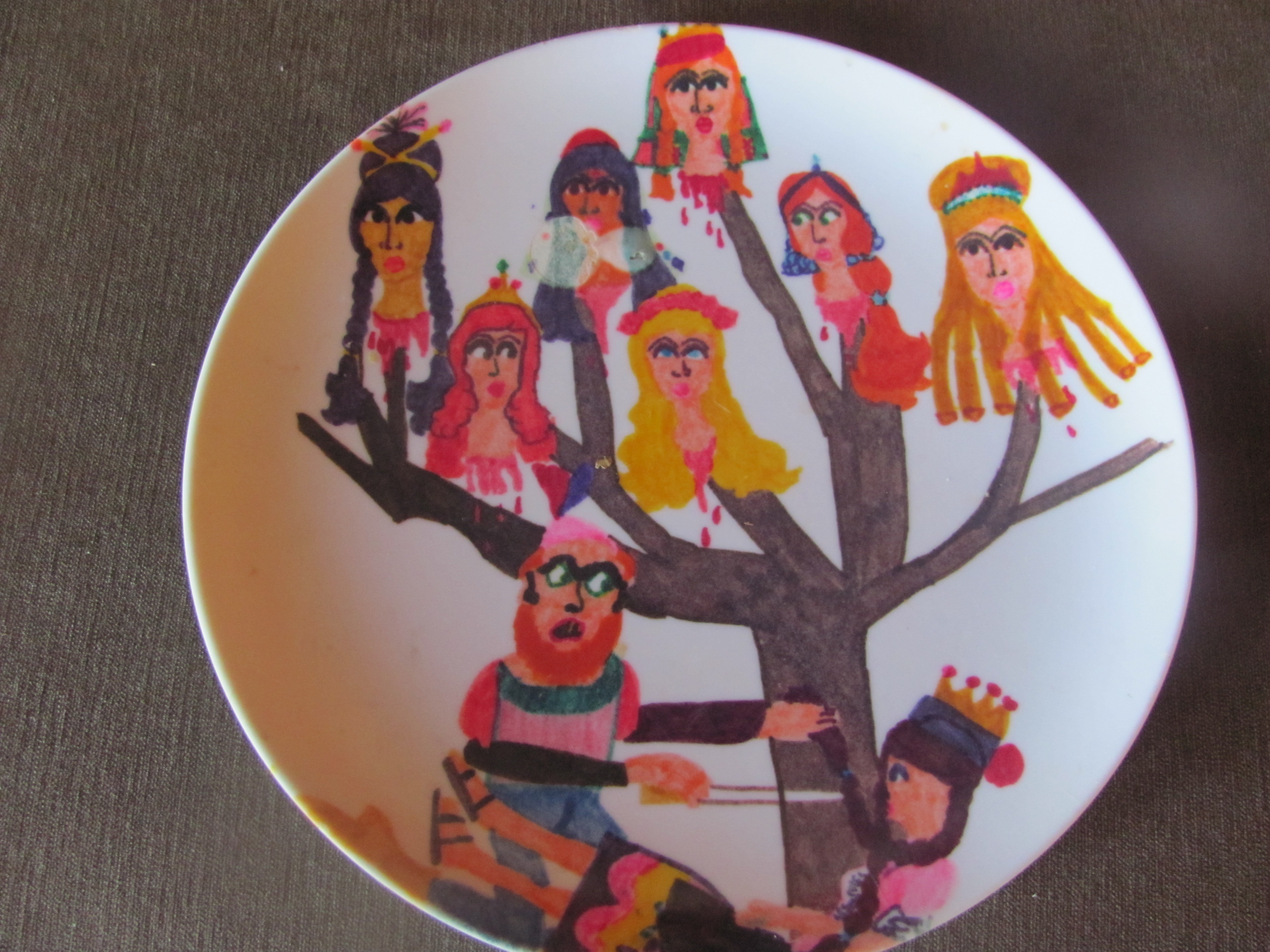
Here is a make-a-plate my older sister made when she was a kid and obsessed with fairytales.

kim

It’s fascinating to me how much care she took to represent ethnic diversity in these women. Also, their faces are so animated, even though they’re dead. I was impressed but grossed out and disturbed when my sister drew this. She wanted to know which one I thought was the prettiest.

I sought out “Soul Surfer” for my daughters, because I’m always on the look out for images and narratives about heroic females to inspire them. That’s why I started this blog, as a place to collect stories and pictures. But unfortunately, these kinds of depictions of women and girls are far too rare in kidworld, not to mention the grown-up one.

What happens to the imagination of children, and the adults they become, when we live in in a world where heroic girls go missing?


But not all female artists are feminists?

After I posted asking what the world would be like if we hadn’t been experiencing it through male artists for thousands of years, commenters respond that not all women are feminists. I agree, absolutely, and many men are feminists. Also, art is derivative, responding to what came before, as Marian writes:

women artists (and writers) being capable of playing into negative gender stereotypes. Even feminist artists, often in unexpected and subtle ways. We’ve all been conditioned and it’s very hard to get beyond it, consistently.

Very true and makes me think of Gloria Steinem’s comment on Miley Cyrus:

“I wish we didn’t have to be nude to be noticed … But given the game as it exists, women make decisions. For instance, the Miss America contest is in all of its states … the single greatest source of scholarship money for women in the United States. If a contest based only on appearance was the single greatest source of scholarship money for men, we would be saying, “This is why China wins.” You know? It’s ridiculous. But that’s the way the culture is. I think that we need to change the culture, not blame the people that are playing the only game that exists.”

I doubt the world will ever be dominated by the vision of one group the way it has been for so long by white men. But what I was imagining in my post is: what if our worldview had always been dominated by women as a group, the way it has been dominated by men? Men’s roles in narratives would repetitively show up as lovers, sex objects, prizes to win after a quest. When we don’t have diversity, we get stereotypes.

Women, just like men, come in all shapes and sizes. The problem is, right now, we are allowed to exist only within extremely limited parameters. Why animation fascinates me is that it’s a clear intersection of art and story, and also, a fantasy world where anything is possible, marketed to children. It’s clear to see how sexism is packaged, recycled, and sold to a new generation. Or at least, clear to me.


What happens when we experience the world through male artists?

Animator and I are in a debate which I just blogged about, and in response, he sent me a link to to a post about Joanna Quinn, one of the top animators in Europe.

Joanna_Quinn_animation_Lg-fmt-462x279

Here’s Quinn’s quote in response to DiSalvo’s comment:

It’s not at all hard to draw women showing emotions. The only challenge is the notion of beauty. It’s really hard to inject lots of emotion because you’re always trying to keep them [as] this sort of shiny, lovely character. I am looking for strong female characters that are not always gorgeous.


So there’s yet another established artist referring to the need for female characters to be pretty.

joannaquinn-women

As I so often do on this blog, I ask again: What is “pretty”? For a male protagonist, his attractiveness is often determined in a narrative by his actions. Rescuing someone, risking pursuing a dream, brilliance, talent, excelling at a sport or at a skill, is all attractive. While for a female character, her “attractiveness” is usually primarily determined by how well her appearance fits into a limited definition of physical beauty.

joannaquinn

Animator directed me to Joanna Quinn’s site, writing that I would enjoy her work. I do! Please check it out, and think about what our world would look like if female artists dominated our cultural imaginary the way male artists do. How differently would we see women and how differently would we see men? For thousands of years, females have been limited to supporting roles in stories that star men. Don’t you think it’s about time for that to change? At least, for our kids?

Sexist comment from animator of ‘Frozen’ typical of industry that limits females

The sexist comment by Lino DiSalvo, head animator of “Frozen” is going around the web. Here’s what he said:

Historically speaking, animating female characters are really, really difficult, ’cause they have to go through these range of emotions, but they’re very, very — you have to keep them pretty and they’re very sensitive to — you can get them off a model very quickly. So, having a film with two hero female characters was really tough, and having them both in the scene and look very different if they’re echoing the same expression; that Elsa looking angry looks different from Anna (Kristen Bell) being angry.

DiSalvo’s comment was made as part of a larger interview. It’s pretty clear the animator wasn’t aware he was being offensive. How could he be so clueless? Because DiSalvo’s belief, that males come in all shapes and sizes, whereas females come in one, is so common, most people think it’s a fact.

Here is Christopher Hart teaching the differences on drawing male and female characters via Escher Girls.

With male comic characters, you can mold their bodies into many different shapes, producing a wide range of cool characters. It’s not so easy with women. Women in comics are, by and large, attractive—even the villains. Especially the villains! The Voluptuous Vixen and the Villainess are much more attractive in cutting-edge comics. So, you have less latitude in altering the body. You can’t draw brutish women or you’ll lose the attractiveness. Therefore, the changes rely less on the body types and more on the pose, costume and attitude.


menbodyshapes

femalebodyshapes

Here’s another how-to video from Marc Crilley. This video is great because Crilley takes you through the steps of just how artists are trained distort female anatomy. First, Crilley draws a regularly proportioned teenage girl. Then, he demonstrates the typical pattern and process of how artists exaggerate her proportions, drawing three well-known, female animated characters.

Crilley narrates:

It’s troubling, really in a way that artists, maybe many of them male, have this way of reducing the width of the female waist when they’re drawing it to just ridiculously small proportions and you know, you do sort of fear that this contributes to women’s body image, this crazy idea of the super narrow waist, but nevertheless you see it again and again. Finally, the big difference here, the knees, the line of the knees, much, much higher than in real life. So what’s interesting is you see that the whole area of the waist is being raised up here so as to create these incredibly long legs as an exaggerated style. To me, its sort of like Barbie doll style legs…

Here’s the video.

While watching Crilley’s video, I was thinking about the incredible influence of the artist to create reality. When you combine images with narratives, it can be so powerful, like being God. Not to mention repeating and repeating the same sequence to the growing brains of little kids, which is what happens when we all see the same old, same old look in animation. (By the way, another criticism I’ve read of “Frozen” is that the female character looks similar to Rapunzel of “Tangled.”)

On my Facebook feed today, Miss Representation posts on photographer and mom Ashlee Wells Jackson showing what women look like:

“Photographer and mom Ashlee Wells Jackson wants all of us to recognize and appreciate how childbirth, breastfeeding, and motherhood change women’s bodies. I’d love for both my daughter and my son to grow up seeing these images instead of the ones of ‘perfection’ they currently see every time we go to the grocery store.” – Laura Willard, Upworthy

4th-trimester-body-project-1

Willard’s photo essay reminds me of the Christopher Hart’s lesson on how to draw men. Guess what, everyone? Females, just like males, come in all shapes and sizes. Females, just like males, are complex creatures with all kinds of hopes and dreams and drives and emotions. Can we please see that on the big screen? Can our children see it?

It’s amusing in a sad way that DiSalvo is so flummoxed by how to make two angry females look different. I wonder if he’s as troubled by making angry females act differently as well. There are so many ways to express and show anger: clam up, punch a wall, flush red, scowl, yell, tear out hair, groan.

The problem here isn’t just that females are supposed to look pretty all the time, but also, that what is considered “pretty” is so cookie-cutter and limited. For a male character, the act of rescuing someone or being heroic makes him attractive. For a female character, being attractive is usually limited to how she looks– her hair, smile, and body.

As I wrote in my last post on “Frozen,” I know I’m supposed to be grateful there’s a movie for children that comes close to centering on a female hero. I actually am. As I blogged, most likely I’ll see it and I’ll take my three daughters because my options are so limited. But I’m pissed that my options, not to mention my children’s options, are this limited. This is the fantasy world, for goodness sake, a place where anything should be possible, so why is the imaginary world so sexist?

See Reel Girl’s Gallery of Girls Gone Missing From Children’s Movies in 2013