Not only will a record 20 women hold U.S. Senate seats next year, but women voters also greatly influenced the 2012 election, making an impact in swing states such as Ohio.
As founder of reelgirl.com Margot Magowan says, Hollywood needs to catch up.
The sheer increase of strong female characters isn’t enough, Magowan said, noting that role models such as “Wreck-It Ralph’s” Vanellope (voiced by Sarah Silverman) are often secondary characters.
“It’s important for the female to be the star of the movie,” the mom of three girls said. ” ‘Harry Potter’ has Hermione, but her role is to help Harry on his quest. … You can be the first lady, but you can’t be the president. … If you can’t imagine it, you can’t be it.”
My favorite quote is from Joss Whedon:
In 2006, while accepting an award from Equality Now (an organization promoting the human rights of women), Joss Whedon (“The Avengers,” “Buffy the Vampire Slayer”) said he’s often asked why he creates such strong women characters.
His response: “Why aren’t you asking 100 other guys why they don’t write strong women characters?”
It’s been three days of straight rain starting out Winter Break. These books are helping us get through:
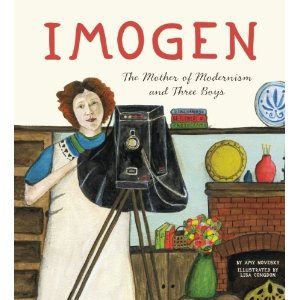
Imogen: The Mother of Modernism and Three Boys
I think this book just came out. In any case, I saw it for the first time a couple days ago, and I love it.
Imogen is the real life story of the great photographer, Imogen Cunningham. What I love most about this book is that it shows the challenge of being and artist and a mother and how that challenge was not only overcome but used to create art. Reading this book made me think of a post I wrote some time ago: Why aren’t there more women artists? The theory I wrote about– and that this book shows– is that in order to create, if you’re a mom as well, you need to be healthy as possible. The tortured, romanticized Marlboro Man, separated from the rest of life, doesn’t apply. This book shows all that beautifully.
Reel Girl rates Imogen: The Mother of Modernism and Three Boys ***HHH***
The Little Old Lady Who Was Not Afraid of Anything
My daughters adore this story about a woman who goes off by herself in the woods to gather herbs, spices, nuts, and seeds.
When she starts back home, she is followed by a pair of shoes. Not freaked out one bit by shoes without feet in them, the woman says: “Get out of my way you two big shoes! I’m not afraid of you!” A pair of pants is added, a shirt, and on and on, each with a different movement: the shoes go clomp, clomp; the pants go wiggle, wiggle, the shirt goes shake, shake. You get the idea.
So my confession here is that I have a hard time with repetition. It gets on my nerves. Goldilocks is an absolute nightmare for me. I get so bored reading the same thing over and over, knowing more of the same is to come. But repetition is in so many stories for kids because they love it; it helps them learn, too. My three daughters get so excited when they know what’s coming next. They call out all the sounds with huge grins on their faces. I love the old lady, so this book works for us.
Reel Girl rates The Little Old Lady Who Was Not Afraid of Anything ***HHH***
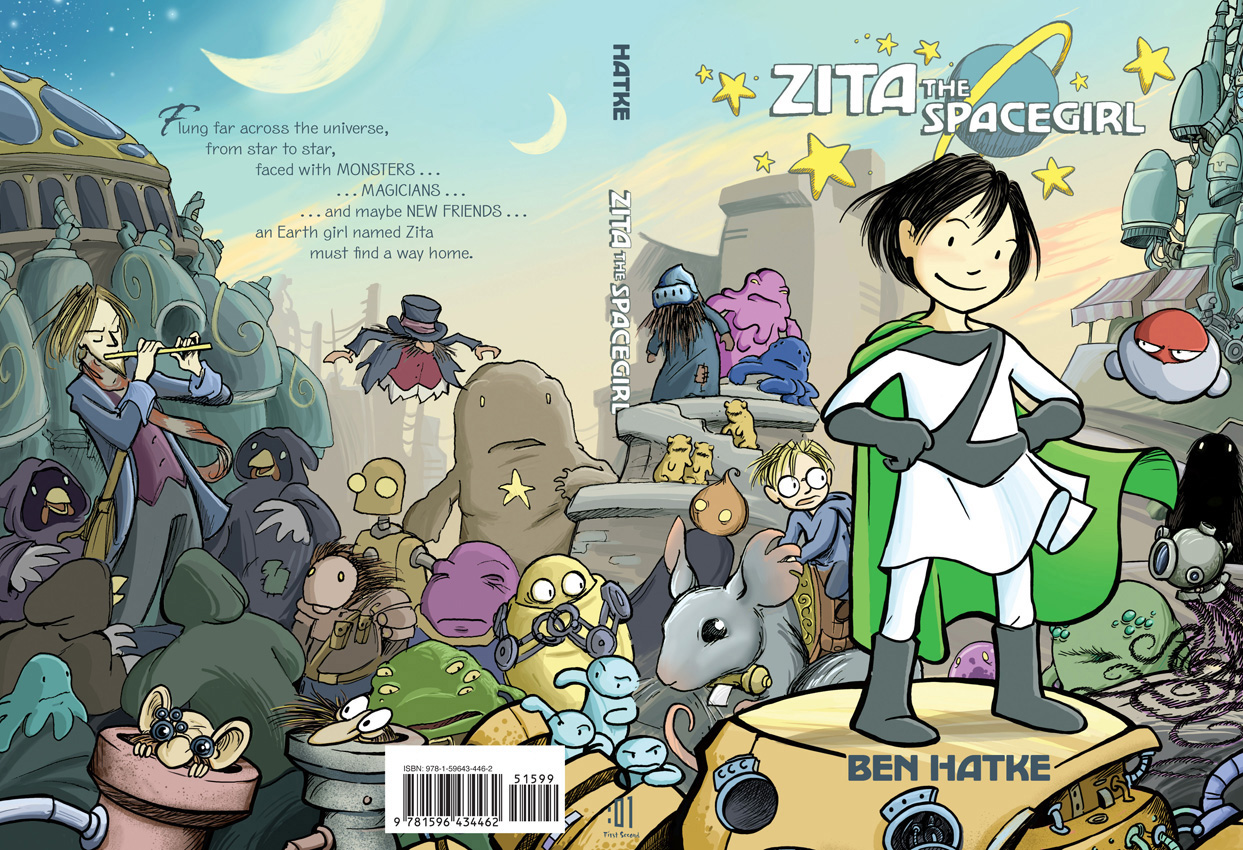
Zita, the Spacegirl
This graphic novel features one of the few female superheroes. Zita is very cool.
This epic describes Zita’s journey from earth to another world, all to rescue her friend, Joseph. This story features monsters, magicians, and all kinds of scary space creatures. My only issue is that most (all?) of the other characters in this story appear to be male. Unfortunately, that gender division– when the female gets to be the protagonist, she is surrounded by males– is all too common in kids media. Still, I cannot wait to see the movie. I wish someone would make it.
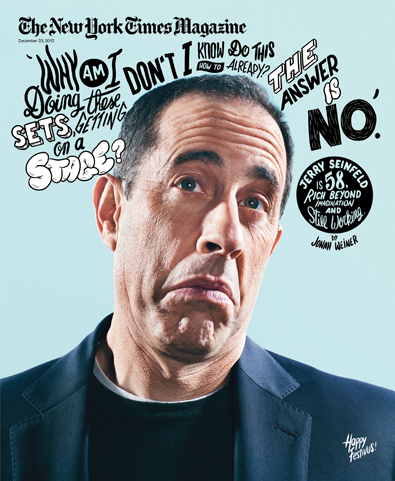
I’m thrilled that my letter is in a national magazine with the reach and audience that the New York Times has. It’s a tiny step, obviously, but I’m hoping that more people, and parents especially, will start realizing and reacting to how sexist kidworld is. Almost every time children go to the movies, they learn that boys are more important than girls.
What about movies for children? I have three young daughters. Aside from the pink ghetto, kids’ media — whether PBS or Disney — put male characters front and center. Female characters are sidelined or not there at all — just look at the posters for children’s movies (with the exception of ‘‘Brave’’). There is no reason for the imaginary world to be sexist.
Margot Magowan, San Francisco, posted on nytimes.com
Here’s to hoping female characters in children’s movies fare better in 2013.
Since the annual issue was created, only four solo women have ever been on that cover.
Until 1999, Time’s title for the honor was “Man of the Year.”
This week, Martha Nelson became Time’s first female Editor-in-Chief in the magazine’s 90 year history.
Here’s to hoping women leaders get recognized more regularly and publicly. “Women’s issues” should be the headlines of the world’s news. We are half of the population.
Malala Yousafazi, the fifteen year old activist, was shot in the head by the Taliban for her activism, fighting for girls to get equal access to education.
Yousafzai is not Time’s “Person of the Year.” That title goes to President Obama.
When a magazine edited by men reports on stories about a world run by men, and designates awards for those major players with an award titled for men, how likely is it that we can imagine women’s stories will break through these ranks?
Until 1999, Time’s title was “Man of the Year.” 1999.
Is the word change just cosmetic?
In 26 years, Time Magazine has not had a solo woman on its cover with this title. Since the issue was created, only four solo women have ever held that title.
This week, Martha Nelson became Time’s first female Editor-in-Chief in the Magazine’s 90 year history. FIRST EVER WOMAN EDITOR IN CHIEF. The year is 2012.
Will things change now?
Of course, you could argue Yousafzai doesn’t influence world events anything like President Obama. She’s not “important.”
I remember before in the late 90s, when I was a producer for a talk radio program, trying to get the liberal talk show host to talk about the Taliban. “Who cares about the Taliban?” he said. “We live in San Francisco. No one even knows what that is.” Of course, on 9/11, everyone knew. You can’t isolate that kind of hatred, but because tha Taliban’s oppressive apartheid government was hurting women, no cared much. It was a “cultural” difference, not a a political one.
How would our world be different if issues that affected women were taken seriously? Certainly, women would be seen regularly on the cover of newsweeklies, not sucking up asparagus.
Miss Representation has popularized the phrase: “If you can’t see it, you can’t be it.”
I would go even further: if you can’t imagine it, you can’t see it, you can’t be it.
Yousafzai blogged her ideas on the internet. She was voted for as Time’s Person of the Year by supporters on the internet. On the internet, we see this picture of her on Time’s cover.
Thank you to the internet for its virtual reality and helping us to imagine it, see it, be it.
Caro gives several examples about how women no longer have to “cop insults about their gender in impotent silence. Thanks to social media and the unmediated access it gave them to the public conversation they could — and did — make their point of view heard loudly.”
Certainly just for basic sanity and health, Caro is right. After Romney made that idiotic comment about “binders full of women” it felt so good to express rage, frustration, and laughter on Twitter with everyone else who “got it.” Romney’s political career didn’t fare too well in that process.
What women have too often been missing is a voice, to express reality as we experience it. Social media allows us to do that, do it easily, and connect with others who are engaged in the same kind of activity.
A few years ago I read a similar article in the New York Times suggesting that instead of getting out of the house, with the internet, women empowered the home. We can all travel the world without getting up from our desks.
Not only that, but given the post I just put up about a less linear, more “looped” understanding and experience of reality, what illustrates the dominance of that symbol better than the “world wide web.” Seriously. Remember when Al Gore, and everyone else, used to describe the internet as a “super highway” that went in “two directions.” Looks like that limited understanding has gone by the wayside…
Can you imagine gender equality? Really see it? What does it look like to you? Or is it impossible to picture because we are so influenced by how things “are?” Or perhaps, too difficult because my idea of gender equality could be different than your idea of gender equality?
I’ve been thinking about all of this because I’ve been hard at work on Reel Girl’s new logo. I’m creating the image with an exceptional artist I met on line, and in order to come up with the right symbol, we’ve been revisiting the blog’s title, tagline, and mission.
“Imagining gender equality in the fantasy world” has never felt more appropriate. Now, more than ever, three years after I started blogging, I am amazed, fascinated, inspired, and disheartened by the way I see fantasy create reality and reality create fantasy in an endless loop.
What happens when children, even pre-birth, experience a world that is so saturated with gender segregation? How do parents’s expectations for their sons versus their daughters affect brain growth?
However, the traditional dichotomy of nature versus nurture that has dominated Western philosophy and psychology has been profoundly challenged by recent advances in neurophysiology. The stratification model of human experience, nature versus nurture– was predicated on the assumption that human biology was a complete package at birth…
The brain of the newborn, we now know, is only partially developed. Nerve cells and neural pathways are incomplete at birth; they are shaped to a considerable extent by the baby’s experience with others.
To show this visually, Mitchell uses Escher’s “Drawing Hands.”
Would this be a great logo for my blog or what? If only Escher wouldn’t mind. I could stick some jewelry on those fingers, maybe some cool nail polish too? A Bic pen “for her” in those big, strong hands?
Too heady, I know. But looking at this image reminded me of Lise Eliot, author of Pink Brain, Blue Brain. She wrote:
“Babies are born ready to absorb the sounds, grammar, and intonation of any language, but then the brain wires it up only to perceive and produce a specific language. After puberty, its possible to learn another language but far more difficult. I think of gender differences similarly. The ones that exist become amplified by the two different cultures that boys and girls are immersed in from birth. This contributes to the way their emotional and cognitive circuits get wired.”
Both Mitchell and Eliot support the idea that humans are born into the world with “potentials.” Qualities humans are designed for can “turn on” or “emerge.”
These ideas on brain development take on the basic assumptions of Enlightenment, the driving theory behind the last century, which Mitchell summarizes as “a correct, rational, scientific, fantasy-free way to understand the world.” Mitchell summarizes the Enlightenment world view into three basic assumptions:
(1) All genuine questions have answers
(2) All true answers are discoverable and teachable to others
(3) All answers are in principle compatible
Mitchell describes reality, or realities, instead where fantasy and reality continually create each other i.e. the Escher drawing. Mitchell writes:
It is the hallmark of the shift in basic psychoanalytic sensibility that the prototype of mental health for many contemporary psychoanalyitc authors is not the scientist but the artist. A continual objective take on reality is regarded as neither possible nor valuable in contrast to the ability to develop and move in and out of different perspectives of reality.
When I read this, it seemed radical to me. Most of everything I’ve ever learned or heard about artists is not a model for psychological health, but rather that they are “totured.” Artists are crazy, art comes out of pain, and all that.
There is one exception I recalled that I blogged about as well: Peter Kramer’s Against Depression. Kramer was inspired to write this book after his more famous Listening to Prozac. Everywhere he went on that book tour, people asked: “What if van Gogh had taken Prozac? What about Kierkegaard?”
Kramer argues artists are not creative because of their depression but in spite of it. Depression is a “stuck switch,” the opposite of resilience. Art, a career of it, requires resilience. (So does long term romance, by the way which is the real topic of Mitchell’s fantastic book.)
I have to say, these theories make sense as far as my experience writing a Middle Grade book. I’ve been working on it for a year and a half, and if I’ve learned one thing about writing: it requires optimism and faith.
I’ve written novels before, but I’ve never been able to stick with one as it gets torn up and put back together multiple times. I think the difference here is that I know a MG book requires plot. (Maybe all books do, but I was never so committed to plot before.) I can’t tell you how many times I’ve faced a plot problem that completely overwhelmed me. The only way to get through the challenge is to believe there is a way out, a solution. The only way to find that solution is to be able to try on multiple outcomes. For me, that is a terrifying process of allowing one version to disintegrate and another to emerge. But, the more I do it, the better I get at it. It’s a skill, like any other skill.
Mitchell wrote Can Love Last in 2002. In the ten years since, more information on “brain plasticity” continues to emerge and support his thesis. It seems that not only is Mitchell correct (he died soon after he wrote the book) but that the only place he was off was in believing “brain plasticity” didn’t last for a lifetime.
Until recently, our 20s were considered the point when our brain’s wiring was basically complete. But new evidence suggests that not only can we learn into old age, but the structure of our brains can continue to change and develop.
Could imagination be far more powerful and useful than we, well, ever imagined?
My daughter is home sick today, and we got under a blanket, lit a fire, and watched “Secret of Kells.” Wow. Besides Miyazaki, I don’t think I I have ever seen an animated film so beautiful. The colors and the patterns are mesmerizing. Not only is this film drop-dead gorgeous, but it features one of the coolest female characters to grace animation. If that’s not enough to gush over, that female character, not the protagonist, is the one on the posters and DVD cover. (On Google, there is an alternative cover featuring the protagonist, Brendan, but I’ve never seen that version off the internet.)
“Secret of Kells” came out before my blog, back in 2009 when I still rented DVDs. The guy at the store recommended it to me. Remembering that today and because my daughter was too sick to argue with any movie choice of mine (i.e. one she’d never heard of) we watched “Kells.” As the film went on, I fell in love with it but also remembered why it slipped off my radar.
The story is about how the famed Book of Kells came to be. The narrative revolves around monks and monasteries. You can’t get a much more exclusively male as far as settings go than that. Today, as a couple years ago, I was impressed with the diversity of the monks. They are all body types, (rectangles and circles); they are old and young; they are varied ethnicities, and they are all male.
Brendan, our hero, is an apprentice monk (I’m sure there is a better term for that.) He is the protagonist of the movie and the narrative follows the traditional quest myth pattern. Brendan goes into the forbidden forest to search for some special berries that will make green ink that an old monk needs for the book. In the forest, Brendan runs into a pack of wolves. He is rescued by the brave fairy, Ainsling when she shouts: “What are you doing in my forest?”
Ainsling has me with that opening line. I love how territorial and confident she is. Her magic and familiarity with the forest is evident throughout her scenes. When Brendan sees the berry tree swarmed with bees, Ainsling assures him: “Don’t worry, I told them not to sting you.”
Not only can Ainlsing talk to and control animals, she can climb the tallest trees. She is totally at home in the forest and a protector of it. She is great looking, with long, white hair, bushy-black eyebrows, and huge green eyes.
Ainsling is wonderful, but she is not in the movie nearly enough. I remembered today that the last time I watched “Kells,” her absence annoyed me. This time, immersed for three years in animation, I know how rare a character like Ainsling is, and how rare it is to see a cross-gender friensship like hers and Brendan’s. I still wish she was in the movie more, but I really love this film.
Scrabble, in some ways, is best board game ever invented, hands down.
Scrabble is fun and educational. Anyone who can read can play, yet the game naturally evolves to meet and match ages and skill level.
Scrabble is in no way sexist, unless you believe in the bullshit that girls are verbal. That’s a generalization fostered by training and reinforcing girls to be well-behaved, quiet bookworms, then calling it a “natural feminine” behavior. A “female” advantage, by the way, that magically vanishes when “being verbal” gains status; males dominate Nobel prize winners and great author lists.
Whether you have girls or boys or both, Scrabble will develop spelling and vocabulary. There’s just one problem my family has playing Scrabble.The game is vicious. It’s rare to play without someone in the family crying or quitting.
Why oh why is this game so competitive? I have tried to figure out what it is about Scrabble that brings out the worst in my kids. The bad behavior happens not only in how my children treat each other but how they treat themselves. They make fun of and cut down each others words, but also they do the same thing to their own creations. Almost never do I see a one of them put out a word and feel really proud of it; more often, she feels like, somehow, she could have done better. Thus, when we play Scrabble we all feel slightly on edge and vaguely dissatisfied, until the inevitable blow up comes and the whole game is ruined.
Scrabble is a great game, but I don’t know if its worth the emotional upheaval. Nonetheless, Reel Girl rates Scrabble ***HHH***
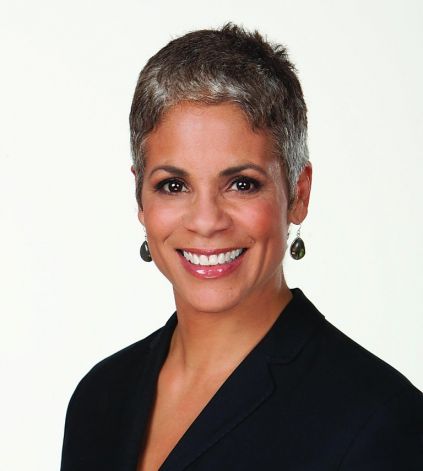
Admittedly, I’m becoming a little obsessed with this hair issue, but I started thinking about a local newscaster here in San Francisco, Dana King. I remembered reading a story about her last year on SFGate (a site I used to blog for.)
When King let her hair go gray, she was flooded with email. So much so that she had to go air, assuring viewers that her health was fine; she’d just made a decision to stop dying her hair.
Can you imagine viewers freaking out about a man with gray hair?
CNN’s Anderson Cooper?
CNN’s John King?
Those are just the first two who pop into my head. I bet on your local news, you’ve probably got co-anchors: a man with gray hair and a woman who is twenty years younger than he is, or trying to look twenty years younger so that she won’t get fired from her job.
When I was a producer for KGO Radio, one of the hosts there, Christine Craft, had been fired years earlier from a TV station for being too ugly and too old. At the time of her dismissal, Craft was 37 years old. She filed a lawsuit for gender and age discrimination. She lost the suit. She wrote a book about her experience and went on to became a lawyer. And, of course, a host on radio.
It is all so fucked up because obviously women are obsessed with their looks. It’s not because women are vain or superficial or born with some girl-vanity gene; women are trying to survive in the world. And what is even more fucked up is that “beauty” has nothing to do with beauty.
Curious about Dana King, today I Googled her. I found out that just last week, she announced she was leaving her post on TV to work on art full time. Here is what she said to The Huffington Post:
“I’ve reported stories from all over the world and yet I got more email reaction for going gray than anything else over my entire career,” King said Wednesday. “And looking back, that might have been the beginning of a huge shift for me — a move to really start following my heart.”
Earlier this year, King moved across the bay to Oakland, purchasing a home and work compound that she shares with several other artists. She bemoaned the fact that when it came time to leave for the station, she would be forced to leave behind her sculpting and “clean the crud out of her hair and fingernails.”