Prisoner of Azkaban and the subtle patriarchy of Harry Potter

First things first: I loved Prisoner of Azkaban. I could not put it down. I am onto book 4. That is a big deal for me. Since I started Reel Girl, I have read the first book of many series, because I want to get a good idea of what is out there. It is rare that I keep going and going, but with Harry Potter, I cannot stop.

Prisoner of Azkaban is my favorite book so far, and I loved the first two. For me, reading Harry Potter is like being in an incredible relationship where you fall more in love everyday.

Part of the reason I was so into this book was the dementors, terrifying and compelling new characters. J. K. Rowling’s description of them is one of the scariest I have read in kidlit:

Standing in the doorway, illuminated by the shivering flames in Lupin’s hand, was a cloaked figure that towered to the ceiling. Its face was completely hidden beneath its hood.  Harry’s eyes darted downward and what he saw made his stomach contract. There was a hand protruding from the cloak and it was glistening, grayish, slimy-looking, and scabbed, like something dead that had decayed in water.

But it was only visible for a split second. As though the creature beneath the cloak sensed Harry’s gaze, the hand was suddenly withdrawn into the folds of its black cloak.

And then the thing beneath the hood, whatever it was, drew a long, slow, rattling breath, as though it were trying to suck something more than air from its surroundings.

An intense cold swept over them all. Harry felt his own breath catch in his chest. Th ecold went deeper than his skin. It was inside his chest. It was inside his very heart…

The scabby hand looking like it had decayed in water! EEK.

So are we clear, I love Harry Potter?

Not only do I love it, J.K. Rowling is the writer. She can call herself the androgynous “J.K.” if she wants to, for God’s sake. And, if she wants to create an imaginary world that is a patriarchy, it is her right to do so.

But this is what I want to write about it: Harry Potter’s world, both the Muggle one and Hogwarts, are patriarchies. Before I read Harry Potter, I was often told that the series is populated with strong females, and it is. But the females are sidelined to the males, and it’s important to recognize that there is not gender equality in this popular series the way there is in the The Hunger Games. The reason this inequality is important to acknowledge is because the imaginary world, 99% of the time, is sexist. If we cannot imagine equality, we cannot create it.

Okay, have I qualified my criticism enough?

Here we go. I am going to point out how the sexism of Hogwarts and the Muggle world that I have already referred to in previous posts is further advanced in Prisoner of Azkaban.

First, the book cover:

The cover shows Harry riding Buckbeak, the Hippogriff, with Hermione clinging to his back. How many times have you seen this image of male in front, girl behind? It’s all over kidlit, in movies and in books, and my God, its all over the grown up world. It’s everywhere on the streets when you see a guy on his bike, the woman behind him. Do you ever see a female alone on her dragon? What about a dragon that is also a female, like in for example the reverse of “How to Train Your Dragon,” which features a male rider and male beast. Do you ever see a female rider with the male behind her, clinging to her back? This gendered, repetitive image sends the message that the male drives while the female is along for the ride. It’s a powerful message and it’s everywhere in the imaginary world. I was disappointed to see it in Harry Potter.

Then there is Lupin. I loved Lupin, but he is the third male Defense Against the Dark Arts teacher, the most important class at Hogwarts.

Sirius Black is a great character, but also male. I loved discovering the history of friendship between Harry Potter’s dad, Lupin, Sirius, Peter Pettigrew, but they are all male. Lily, Harry’s mother, apparently hung out with the group, but she wasn’t an animagus. She was the only female.

Mrs. Weasley and Mrs. Dursley are both homemakers while Mr. Weasley and Mr. Dursley have careers that factor into the plot.

Percy Weasley is the Head Boy. For a while, I couldn’t even figure out if there is a Head Girl. I have, now, seen the Head Girl referred to, but I don’t know her name or what she does. She has no role in the book so far.

The Minister of Magic is male and the headmaster of Hogwarts is male. Hogwarts was started by two males and two females 1000 years ago and that is progressive, but the two houses started by the males, Gryffindor and Slytherin, dominate the series.

Chang Cho, the Ravenclaw seeker, is the only girl on the team. Would there be a Quidditch team with only one male? Is there a female captain? So far the rivalry between Slytherin and Gryffindor is between two male captains.

To me, it seems like Quidditch is a boy’s game in which girls are allowed to play. I feel the same way about the series.

Any monster movies that star females?

After I posted about the dismal representation of females in a trio of new Halloween movies, I got this comment from MonsterLibrarian.com:

Margot,

What do you recommend as far as monster movies intended for kids, then? As the editor for MonsterLibrarian.com and the mother of a monster-loving boy with a sister willing to go along for the ride I’d be interested in what you DO think are good choices. We held Monster Movie Month in July, which, while mostly at choices for adults, was inspired by my son’s love of the classic movies, and the three of us picked some movie choices parents could share with their kids, but I’d love to know what you think. Halloween is our busiest month of the year and our children’s section is one of the most popular parts of our site and that’s something I would love to share there.

I do think there are a lot of interesting influences on girls that come from both media and unwitting family members. My daughter, after watching Scooby Doo with my enthusiastic son, said she wanted to be a ballerina zombie for his Halloween birthday party, but on her own she wanted to be a princess, for the third year running.

I told MonsterLibrarian that I do not know of many monster movies starring females, and that I would put the question out to the Reel Girl community. When I think of monster movies, I think of screaming girl victims. I do like Scooby Doo and my three daughters ages 3 – 9 also like it. There are often monsters in Scooby Doo and sometimes those are female. The problem is, obviously, the star of the series is male as is his best friend Shaggy. There are two females to three males in the crew, which is not a bad ratio. Though, super annoying is that Velma is the “smart” one with glasses and Daphne is the “pretty” one who always wants to shop and do her hair.

I loved “Coraline,” the book and the movie. I think that would qualify as a monster movie. The Other Mother is a monster. That movie is my only real suggestion so far. Please write in yours! I will add suggestions to this post.

Suggestions for monster movies starring females:

CorpseBride

Synposis from Melissa Wardy of Pigtail Pals:

It takes place in the early 1900’s, so you have to put women’s place in history at that time into perspective. But we love it. It is about being true to yourself and good to the people you love. It is a love story, but nothing like Disney. The music and art is incredible. It is kind of dark and creepy (Tim Burton,hello!) but my kids love it.

Story: Victor is set to marry Victoria, but neither feels ready to wed. During rehearsal Victor gets nervous and messes everything up, and gets booted out of the church. He is out in the woods practicing his vows, and unbeknownst to him he is in the presence of a dead woman who rises from the grave and assumes they are married. There are a a bunch of twists and turns as Victor tries to figure out his fate, and the Corpse Bride tries to figure out where fate led her. Victoria has a smaller role. In the end, the Corpse Bride is the shero of the day, and sets everything the way it should be. In the end, the truth inside everyone’s heart is honored.

A Series of Unfortunate Events

Monsters and Aliens I just thought of this one. It stars Reese Witherspoon. I saw it pre-Reel Girl and think I had some issues with it, but I also liked it. I’ll watch it again.

Hocus Pocus stars three witches, and a gang of kids who try to stop them. The kids are two girls and a boy.

Kiki’s Delivery Service About a witch, I’ve seen this and agree, its GREAT

My Neighbor Totoro Also seen, monster is male but stars two sisters, also really great

Fun Size tells the story of a teenage girl who gets saddled with the responsibility of taking her younger brother trick-or-treating before attending a Halloween party. She goes to the party and loses her brother, and (presumably) hilarity ensues as she attempts to find him.

Wizard of Oz

Journey to the Center of the Earth not technically a monster movie, has a great female character who pretty much rolls her eyes and walks away when the hero (Brendan Fraser) states his intention to go back into the crazy falling apart underworld to find his teenage nephew. She coincidentally ends up rescuing them both, but only when they’ve actually made it back to where she left him.

Girls gone missing in new Halloween movies for kids

As if Halloween wasn’t sexist enough already with its sexy “cute” costumes aggressively marketed to little girls, this season Hollywood delivers not one, but three animated male-centered monster movies. In each one, males are front and center while females get relegated to the sidelines.

I just saw this poster for “Frankenweenie:”

The movie is about a boy and his dog and named for the male protagonist. The male/ female ratio on the movie poster 4:1 (I thought that the smaller, sidelined cat could be female, but after looking up the character, I learned his name is Mr. Whiskers.)

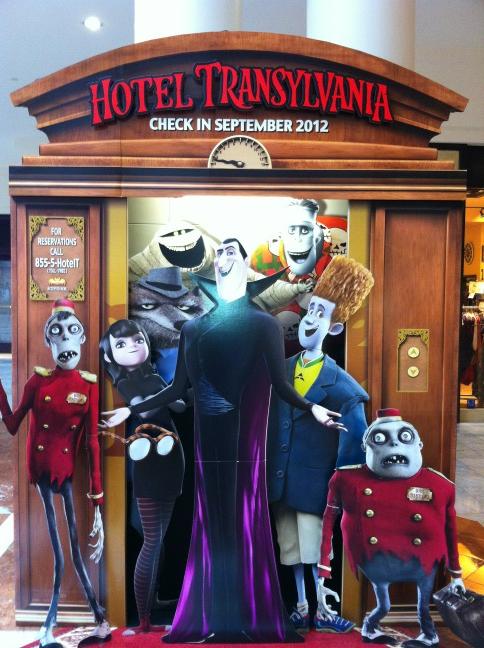
If you’ve been reading Reel Girl, you know I just blogged about all the sexism in “Hotel Transylvania.” Here’s the poster, male/ female ratio 6:2

And a couple weeks ago, I blogged about ParaNorman.

Also named for the male protag (remember, the name of “Rapunzel” had to be switched to “Tangled” because Disney didn’t want a girl’s name in the title.) Male: female ratio 4:1

These repetitive images put females in the minority and on the sidelines. They are reproduced in toys, games, and clothing, and show kids that boys are more important than girls.

See Reel Girl’s Gallery of Girls Gone Missing in Kids’ Movies in 2011.

“Hotel Transylvania” Part 2: boy human steals the show

I blogged about “Hotel Transylvania” before I saw it based on promotional material that features truly pathetic male/ female ratios. I am sorry to report that this movie is more sexist than I assumed. The sexism is so ridiculous, it’s almost funny. Basically, a male human stumbles into a movie about monsters, takes over the whole story, and makes the movie all about him. Seriously. In this way, “Hotel Transylvania” sort of reminded me of “Shrek 3” where Fiona goes missing for the movie while Justin Timberlake steps in as the new costar, playing Shrek’s long, lost only male heir. WTF? (That was before, by the way, sidekick Puss in Boots got his own movie. Not Fiona. But I digress.)

I thought that “Hotel Transylvania,” at the very least, would be a father-daughter bonding film. (Sure, there’s the whole dead mother thing in it, but at least there’s no wicked step-mom.) The movie was supposed to be about the dad, Dracula, giving his daughter, Mavis, a birthday party for turning 118. But then a human, Johnny, finds his way to the monster hotel. Johnny shows everyone how to have fun. After finding himself giggling with Johnny, the stiff, repressed, human-hating Dracula and the boy become BFFs. The last scenes of the movie show Dracula and his all male possy of monsters going into the human world to find Johnny again. Dracula has realized that Johnny and his daughter do, in fact, belong together.

That’s right: Mavis is reduced to love interest, a love sick teenager. She’s not even in the scenes where the monsters go to bring back Johnny. She is crying in her bedroom during all of that bravery. It’s Dracula who courageously risks his life going out in the potentially lethal sunlight, chasing down Johnny’s plane. That scenario really pissed me off, because here the girl could be rushing out to win the guy but her dad does it? ARGH.

There is one great female who has about three lines near the end. She was my favorite character in the movie in spite of being decked out in pink. Blink and you’ll miss her.

While there were several sub groups of all male monsters such as construction workers and rocks bands, guess what the one all female group was? Maids. Yep, the hotel’s housekeeping brigade is made up of witches. Witches with no speaking lines. It’s amazing to me how sexism in professional life consistently persists in the imaginary world.

There were sexist jokes as well, said construction workers reacting to a female, a monster carting off a female mannequin, Johnny groping a skeleton by mistake and pissing off her husband.

Because there is at least a Minority Feisty representation in this movie, Reel Girl rates “Hotel Transylvania” ***H***

One more thing: A commenter pointed out to me that in my last blog on “Hotel Transylvania” I made an incorrect count on males and females. I forgot to include the Invisible Man, represented in the promo material as a pair of floating glasses. That brings the pictured male/ female ratio up to 8:1

“Hotel Transylvania,” 16%, and the Minority Feisty

Hotel Transylvania opens today. What’s wrong with this poster?

That’s right, the usual skewed gender ratio that puts females in the minority. Here we have 6 male characters and 2 females. One female in– surprise, surprise– pink!

Check out this giant promo I walked by in a mall in San Francisco this morning. I count 7:1

If all goes right for me, I actually plan to be sitting in a theater, watching this film in one hour, and maybe, just maybe, I’ll be eating my words and females will fare well in this film. After all, the synopsis reads that the Vampire Dad wants to give his daughter the birthday of her life because she’s turning 118. But I fear that the vampire daughter will not be the star of this movie. One obvious clue is that she’s not front and center in the poster, her dad scores that prime real estate. I worry that males will radically outnumber females in crowd scenes and spoken lines, and that the vampire daughter will be limited to the role of Minority Feisty.

The Minority Feisty refers to how Hollywood represents females, who are half of the kid population, as a minority. But a feisty minority! Isn’t that great?

Parents can point to examples of a powerful female but the power structure is never threatened because there are so few of her. I used to call her the Token Feisty, but that’s not really fair because there can be two or even three of her. The important thing is that, proportionally, she is outnumbered by males. The Minority Feisty’s job is to limit female power in a way that never threatens the power structure. That number seems to be, not only in Hollywood, but across all professions, about 16%.

I’ve got to go now or I’ll miss the movie.

More soon…

ParaNorman: what’s wrong with this picture?

Movie titled for its male protagonist? Check. Male/ female ratio 4:1 (mirrored by monsters/ dead people)? Check. Lone female sexualized? Check.

Girls make up half of the population of children, so why does Hollywood present them as a sexualized minority in movies for kids?

 Update to commenters: Nothing in the plot of this movie changes the sexualization of the female character. Or justifies that sexism for some greater good. Please don’t fall for Hollywood’s m.o. that there’s “a good reason” to marginalize females in animated movies. There isn’t. Sexism is not required for plot or humor, because “there are no female pirates in history” or original versions of adapted stories are sexist. In “Ratatouille” there’s only one female chef to four males, because that’s just how it is in the real world. Huh? It’s okay to make a movie about a rat who can cook but too many female chefs would be unbelievable?

Don’t read comments if you don’t want spoilers.

More fat-shaming in Harry Potter: the inflating of Aunt Marge

Yesterday, I posted about the fat-shaming of Dudley Dursley in the Harry Potter series, specifically quoting from the opening of Chapter 2, Prisoner of Azkaban which I’d just read. I have since finished the chapter. So this what happens: Unable to contain his anger when the evil, annoying, and fat Marge constantly puts his parents down, Harry uses magic illegally to inflate her, making her even fatter. To readers, this punishment comes off as humorous and deserved.

I have not seen “The Prisoner of Azkaban” yet, but looking at the image from the movie pasted below, and after reading J.K. Rowling’s prose, I am wondering if there is a child who could watch (or read about) the fate of wicked Aunt Marge and not burst into laughter. Can you even look at these images and not smile? And again, if this fat-evil-stupid-comic imagery happened once in a while, it would be no big deal, but its ubiquity in kids’ media trains kids that it’s normal to laugh at fat people.

Reading  into night, I was also fascinated that Harry’s act– so far– remains unpunished. Underage wizards are not permitted to practice magic in the Muggle world, and Harry assumes he will be expelled for his act.  Yet, when Cornelius Fudge , the Minister of Magic, meets Harry on Daigon Alley, he assures Harry that he took care of the infraction, deflating Aunt Marge and erasing her memory. Harry wonders why this reaction is so different from the time when he was wrongly blamed for the magic done by Dobby, the house elf, in Book 2. At that time, Harry received a letter of warning from the Ministry threatening expulsion.

Obviously, there is some reason in the plot why Harry is forgiven, given a cozy room in the Leaky Cauldron instead of a letter of expulsion. But the subdued reaction thus far underscores the deserved punishment for Aunt Marge.

I have been trying to think if there are any fat protagonists in kidlit. Please tell me if you know of any: not sidekicks, main characters. So far I’ve thought of one: Wilbur. I just blogged about how Charlotte’s Web may be the best book ever. without even thinking about that. Could E. B. White get any more original?

Maurice Sendak’s forgotten female characters

Maurice Sendak died this week at age 83. Sendak, along with William Steig, is among absolute favorite writers and illustrators of books for children.

Like Steig, Sendak’s writing is poetry and also like Steig, Sendak doesn’t have nearly enough female characters.

Sendak does have some great females in his books that you may never heard of. Soon after I started this blog, I wrote about my favorite Sendak book, Outside Over There, all about a brave girl who rescues her baby sister. My brother-in-law recently sent me a YouTube of “Really Rosie,” a Sendak cartoon with great music by Carole King. Rosie is the imaginative director who casts characters and decides which stories are good and which are not, kind of like the job I’d like to have.

What if male Avengers posed like the female one?

Whenever  I blog about the exaggerated breasts or ass of a female cartoon character, commenters respond that I have nothing to complain about: all cartoons are caricatures.

There’s a difference between exaggerating muscles and exaggerating someone’s butt. Here’s artist Kevin Bolk’s take on “The Avengers.”

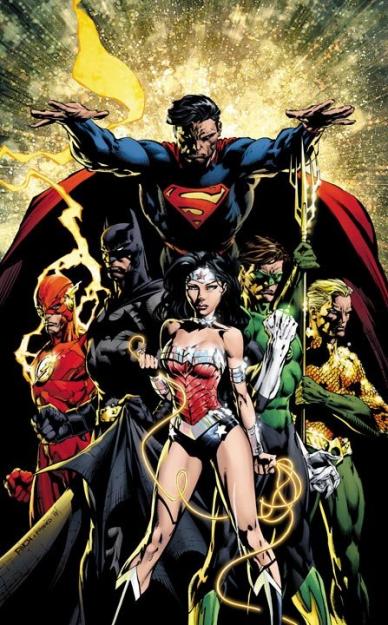
Of course, “The Avengers” model, with its pathetic 5: 1 male/ female ratio and then sexualizing that lone female, is not unique to that group of superheroes.

Check out the Justice League’s latest cover. Notice any similarity?

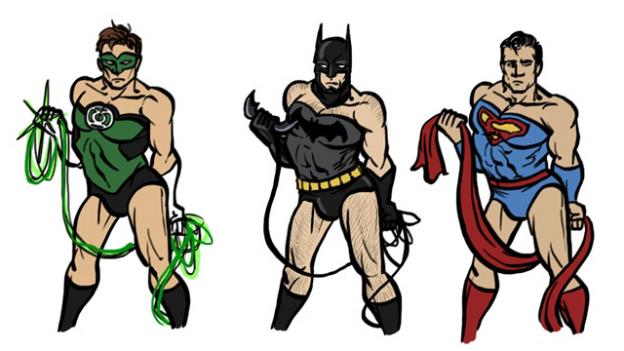
Here’s the artist Coelasquid’s “If Superheroes Posed Like Wonder Woman.”

I love Coelasquid’s art because it shows so clearly that it’s not only the clothes put on female characters but the poses they are in.

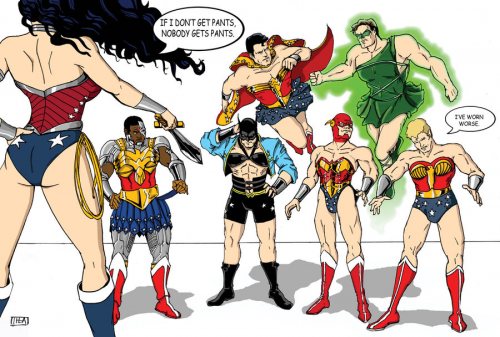
Though of course, the clothes don’t help much. Here’s Theamat’s “If I Don’t Get Pants, Nobody Gets Pants:”

Wonder Woman with no pants was created by (and for?) grown-ups but it leads to Wonder Woman with no pants showing up as a LEGO minifig.

Or most recently, in the ensemble movie “Pirates!” for kids, in theaters right now, there’s one female and she shows up looking like this:

Females are half of the population, yet because they are presented as a sexualized minority in so many movies for adults, they are also presented as a sexualized minority in movies for kids. Those roles are then replicated in kids’ toys and most tragically, in kids’ imaginary play.

Female characters account for only 16% of all characters in movies for kids.

Here’s an interesting coincidence: across the board in all professions, women at the top don’t make it past 16%.

Do you think limiting females in the imaginary world limits them in real life? Unfortunately, your kids do.

‘Pirates’ movie shows kids sexist jokes from start to finish

After seeing the preview for Aardman’s “Pirates” I posted a pretty scathing commentary: Porno or pirate movie for kids?

Some commenters were upset that I judged the movie without seeing it. I wasn’t judging the movie, I was writing about the preview, about how movies are advertised and marketed.

But now, I’ve finally seen the movie and am sorry to report that it’s more sexist than I thought.

When I saw the preview, I was upset that Cutlass Liz, the female pirate, was ogled and hooted at by the male pirates. She wears tight clothing and a belly shirt. Basically, the female pirate is totally sexualized.

But here was my mistake: From the preview, I believed that Cutlass Liz had a major part in the movie. I thought that in spite of her appearance, she would be portrayed as a bad ass, that she’d have a major role in the narrative as a competitor with the Captain (the star of the movie) for the “Pirate of the Year” award.

Cutlass Liz is only in three scenes. She’s a minor character in the film with almost no lines or action sequences at all. One of the few scenes she’s in is a fantasy one: the Captain imagines that he gets awarded the coveted trophy and also the admiration, lust, and batted eyelashes of Cutlass Liz.

After I trashed the preview, I was told by commenters that Queen Victoria has a strong part. In some ways, she does. At one point she rips of her constricting clothing (how original!) and gets into a duel with the Captain. But she is also portrayed as Charles Darwin’s sexual fantasy.  Gross. Why?

Another female is the Surprisingly Curvaceous Pirate. Ironically, she is not curvaceous like Liz, who constantly swishes her hips, or Victoria, who has a hugely exaggerated posterior. SCP has the fate of many heroic females in kidworld: she dresses as a male in order to have adventures and be powerful. She wears a beard and has hardly any lines. Her biggest scenes are when she is naked in a bathtub. More sexist jokes ensue here. Ha ha ha.

The best female character in “Pirates” is the dodo. Her role is central to the plot of the movie, but she can’t talk.

The sexist jokes start with the first lines of the movie where the Captain refers to “scantily clad mermaids” and don’t stop until the finish when Darwin laments about impressing women. Female characters exist mainly for that reason: to provide inspiration for the male characters to be strong, brave, and adventurous.

The only slightly redeeming thing as far as sexism in this movie for kids is the way that the compassionate captain and his crew fail to live up to standards of masculinity, choosing the dodo bird, their friend, over recognition and gold.

Reel Girl rates “Pirates: Band of Misfits” ***SS*** Don’t expose your kids to the sexist stereotypes that this film relentlessly promotes.

By the way, after the leper community complained about bias, Aardman did, in fact, change the line in the movie about the “leper” boat. Now it’s called a “plague” boat.