Peer bullying on the rise when preschool girls wear ‘boy’ shoes

Yesterday, I posted this video of my 4 year old daughter talking about getting bullied at preschool for wearing ‘boy’ shoes.

I’ve gotten so many comments on Reel Girl’s Facebook page about kids being bullied by their peers when they step out of these gender norms that surround them like shrink rap, I’ve started asking parents if they would video their children telling their stories. Meanwhile, I Googled ‘bullied for wearing boy shoes’ and found some stuff that is making me cringe and want to scream, so I’m going to blog about it instead.

From Coupon Cilpinista:

Yesterday my 4 year old wore her waterproof slip-on shoes for boy or girl to school (they are black Timberland moccasins) and she told me this morning, “The girls would not play with me yesterdays because they said I was wearing boys shoes, can you please put sparkly shoes on me ???”

I was in shock. Are you serious? Is this something I should address with the school??? BULLYING starting THIS YOUNG??? I don’t know what to think– my daughter loves those shoes and her sparkly shoes are not comfortable or for winter weather but she wants to wear them to appease the bullies in her classroom.

What would you do?????


Here’s some advice she got from 8 different fans of hers, without irony, each confirmed with multiple likes:

Cover them in glitter. Change the shoelaces to a girlie style.


Bedazzle her moccasins


Add something to moccasins to make it more “girly”


This is so sad – I’d talk to the teacher for sure. I also like the ideas of “girling up” her boots with shoe laces, etc. Good luck CouponClipinista


put sparkles on the shoes…that should do it.


Yep. I would bedazzel the crap out of em. I can tell you from experience, the school wont do anything!!


I agree. Bedazzle them. glue on a few rhinestones or a bow.


Bedazzle her shoes :o)


Note to parents: Gender stereotyping CAUSES bullying. Bedazzling shoes? Not a solution here. What is that teaching your kid? To do whatever the bullies say to do. And what is it teaching the other kids? Keep bullying. Is that the lesson we want to be teaching here? I honestly don’t even think these 4 year olds know they are bullying, because not enough parents and teachers are telling them that. I think these kids believe that they are stating a fact.

Some parents tell Coupon Clipinista similar stories:

At 4 my daughter LOVED Spiderman. There was no talking her out of getting the Spiderman tennis shoes. She wore them to school and was told they were “boy shoes” (They were.) When she came home telling me about it, I told her, “do you like them?” “yes.” I told her to tell the kids when they said that again that anyone can wear Spiderman shoes. She had the same situation about the same age about wearing the color blue (still her favorite color 6 years later.) Her PreK4 classmates told her blue was for boys. We talked again and I told her that she can wear ant color she wants. And if the other kids don’t like it, too bad for them…they are going to miss out on wearing lots of cool colors. She went to school confidently and told them you can wear whatever color if you are a boy or a girl. I liked the idea of teaching her to be confident about her ideas even if they were not always “girly”


Another mom/ teacher:

As a teacher, sad to say, yes, bullying starts this young. My son, at 4 loved his pink t-shirt. Wore it to preschool once, and will not wear it out of the house (so sad) due to peer’s comments – at 4!!!! Yes, speak to the teacher, so he/she knows what is going on in their classroom and can address it. Then talk to you daughter. Don’t let her give in to peers. Point out how to be an individual and to take pride in that. When all is said and done, I woud let her wear the shoes of her choice. Unfortunately, it will be the choice peers, unless she is strong and willing to be her own person.


Apparently, there was a whole controversy around this post:

Yesterday my mom posted a picture on Facebook of my 5-year-old brother … wearing a pair of shoes he picked out for his first day of preschool. She explained to him in the store that they were really made for girls. [The boy] then told her that he didn’t care and that ‘ninjas can wear pink shoes too.’

However, my mom received about 20 comments on the photo from various family members saying how ‘wrong’ it is and how ‘things like this will affect him socially’ and, put most eloquently by my great aunt, ‘that sh*t will turn him gay.’


From that story come links about “gender non-conforming camp.” Seriously? We’re talking about shoes here. Shoes. Preschoolers. Bullying epidemic. The solution is not sending the kids off to some camp. The solution is to stop buying into the gender segregated marketing that is so aggressively targeted at kids and parents from multinational companies.

A Reel Girl Facebook fan posted a great link about the Miller Mix story: 

My daughter, fresh from day one of a much-loved and progressive preschool, announces her sporty blue Toy Story sneakers — once adored — are for boys
and no one at her school likes girls who wear boys’ shoes.


Finally, a great solution posted from Melissa Wardy of Pigtail Pals: A Letter to Bella and Other Girls with Blue Shoes.

I heard from your mom that someone at school said your shoes were for boys. Maybe because they were blue or maybe because Buzz Lightyear was on them. At our house, we say, “Colors are for everyone.” Sometimes people get mixed up about that because they don’t think about it very hard. That makes me feel frustrated. All you have to do is look around the world and know that colors are for everyone.

But Bella, isn’t that silly! How could your blue Buzz Lightyear shoes be for boys if colors are for everyone and Buzz Lightyear is from a movie made for all kids and you are a girl standing in those shoes! I think people get confused about that, because they think something is only for boys because they never took the time to consider girls. I think people should consider girls.

Since you are four years old, you know a lot of stuff, and you know that girls can like or do anything boys can. And boys can like or do anything girls can. Things are kind of silly right now because grown ups keep getting in the way of kids, and some grown ups who are in charge of the companies that make stuff for kids like toys and clothes, they don’t have good imaginations like you and I do. These grown ups try to fit kids into little boxes that are labeled “Boy” or “Girl”, and then they only let certain colors or ideas into each box. They do that because it makes it easier for them to sell their stuff. Since boys and girls don’t grow in boxes, you can see how really goofy this is. But I have to be honest with you, there are a lot of grown ups who don’t question these pink and blue boxes, and then they teach that thinking to their kids, and then their kids lose their imaginations.

I couldn’t agree more. Here’s an ad I saw in a window of a Stride Rite in the neighborhood where my kids go to school. I also speak about one of the times my daughter was teased for her shoes.

striderite

Here’s me on Fox and Friends talking about the gender stereotyping in this ad and what kinds of damaging messages that’s sending to kids. I also speak about one of the times my daughter was teased.

Here’s my letter to Stride Rite Until you stop gender stereotyping, we’re through.

Once again: What happened to my daughter is not an exception. This kind of bullying is happening to kids in preschools all over America. It’s on the rise, because gender stereotyping kids is on the rise. Check out these pictures of kids toys/ clothing from the Seventies and now. What are we doing to stop this? Oh, that’s right, bedazzling.

In Europe, they’re trying something else. Due to a campaign in Europe by Let Toys Be Toys For Girls and Boys, stores in including Toys R Us, stopped segregating products by gender, and instead, are organizing them by type. Here’s what Toys Will Be Toys reported on Toys R Us.


The retailer today confirmed that they would draw up a set of principles for in-store signage meaning that, in the long-term, explicit references to gender will be removed and images will show boys and girls enjoying the same toys. They promised to start by looking at the way toys are represented in their upcoming Christmas catalogue.


But what are we doing in America? Been to a Toys R Us lately? Or a Target? Or a Stride Rite?

 A Mighty Girl has started a similar petition in the U.S. to the Let Toys Be Toys petition in Europe, hoping to stop stores here from selling kids gender segregation. Please sign. Don’t be a passive bystander. Do something to stop the bullying and these limits placed on our children.

If your kids have stories about being bullied for not conforming to these caricature gender stereotypes, please share them. I’d love to see the videos of your kids telling their stories if you would like to post them here.


4 yr old girl bullied for wearing ‘boy’ shoes

Here’s my 4 year old daughter talking about how kids at preschool teased her for wearing “boy” shoes. A group of them wouldn’t let her enter the “train hole,” a play structure shaped like a train, because she was wearing her Star Wars shoes.

After my daughter told me about the teasing, which happened more than once, I spoke to her teacher who then talked with the kids about how anyone can wear any kind of shoe they like.

The bullying that happened to my daughter occurs in schools every day, and we all need to be doing more to stop it. Instead, we’re exacerbating it by buying into gender marketing sold to us by multi-national media companies and chain stores.

A couple of years ago, there was a story about a first grader who brought her Star Wars lunch box to school, and she was teased. That story got some media attention, but it seems like too many people think that incident was some kind of anomaly, have forgotten about it, or still haven’t realized how damaging and limiting it is for kids when we gender stereotype them.

Whenever I blog or speak about gender segregating kids, I get the argument that it’s just “natural,” and if your kid happens to be the rare exception, she can “choose” another toy or T shirt if she wants. (Here I am recently responding to those arguments on Fox News but they are all over this blog as well.) How many kids have the courage to be the “exception?” And why has straying from pink or princess become an exception? How long until my daughter starts “choosing” the shoes that she’s supposed to wear and like, shoes that she doesn’t get teased for wearing? I’m stating what should be obvious here: When one type of product is aggressively marketed to boys, and another type to girls kids don’t have a choice.

Due to a campaign in Europe by Let Toys Be Toys For Girls and Boys, stores in Europe including Toys R us, stopped segregating products by gender, and instead, are organizing them by type. Here’s what Toys Will Be Toys reported on Toys R Us.

The retailer today confirmed that they would draw up a set of principles for in-store signage meaning that, in the long-term, explicit references to gender will be removed and images will show boys and girls enjoying the same toys. They promised to start by looking at the way toys are represented in their upcoming Christmas catalogue.

This is great news for Europe, but go to any Target or Stride Rite in America, and you’ll see how far this country lags behind. Pinkwashed sections of stores marked for girls offer Barbies, dolls, and anything pink, princessy, or sparkly while areas marked for boys sell products in primary colors that have something to do with cars or superheroes. A U.S. organization called A Mighty Girl has started a similar petition in the U.S. to the Let Toys Be Toys petition in Europe, hoping to stop stores here from selling kids gender segregation.

Mass marketing by gender is changing how we see each other and the world around us. On the Huffington Post, Lori Day writes:

I was talking to a teacher friend recently who said that 10 or 15 years ago, if she asked her Kindergarten class what their favorite colors were, she heard many different answers. Now, she still hears the boys name many different colors, but the girls almost all say pink…


There are so many colors in the rainbow. Kids should get exposed to all of them. Please sign A Mighty Girl’s petition.

When is it OK for kids to read YA books about rape or incest?

I just posted on the excellent Graceling trilogy and added that I would not let my 10 year old read it because of the rape and incest. I suggested 15 might be a good age. Then I went back and edited, remembering the rape and incest, while central to Bitterblue, is only implied near the end of Graceling. It’s not in Fire. So then, I thought maybe 12 years old for the first two and 15 for Bitterblue? And then, it occurred to me that rape and incest happens to kids all the time. In that case, reading about it in this context would be helpful. How ironic to censor something in a book that describes what’s happening in a kid’s real life. So, then I concluded, it’s such an individual choice. With sex, I didn’t want my kids reading about it or seeing movies that referenced it, before I had “the talk.” I wanted them to learn about sex from me first, rather than from a kid at school or from a movie. I had the conversation with my daughter last Spring, when she was nine. It went really well, and since, she’s come to me with questions, and she seems comfortable talking about it. But rape and incest, I’d like to protect her from the knowledge of a little longer.

gracelingtrilogy

I did a Google search, remembering something I’d read on dark YA lit a while ago that was good. Here’s a quote from the post and the link.

The underlying assumptions behind Gurdon’s piece seem to be rooted in the idea that children read books with heavy content and ‘go bad,’ when in fact the opposite is true. Some children lead dark lives and they read books with intense themes to find protagonists they identify with in an often hostile world. Some young adults read about rape and bullying and violence, eating disorders and self harm and mental illness, because these are things they experience.

Alas, the belief that bad things do not happen to children and young adults is not limited to naïve Wall Street Journal columnists, and it does far more damage than mere dubiously-sourced articles that attract a storm of commentary. The belief that childhood is a happy place, where bad things don’t happen, where you don’t need rose-tinted spectacles because everything is already rose-tinted, has direct and harmful impacts on children and young adults in danger.


I don’t think my child would “go bad” from reading about this stuff. Nor do I think if a child is into these books, that means she’s leading a “dark” life. I think, and I could be wrong, if my ten year old daughter picked up Bitterblue, she’d read it cover to cover.

Also, for my kids, I do believe childhood is a pretty happy place for them and should be protected as such. Obviously, that doesn’t mean Disneyworld to me. I think Disneyworld is tremendously warped. But it does mean I want my kids to experience the belief in safety and also in magic. I believe that covering up “reality” to protect a child’s developing imagination is an important part of parenting and also, of being a kid. If your child has safe boundaries, she feels brave enough to take healthy risks. Psychologist Stephen Mitchell explains this well in his excellent book, Can Love Last: the Fate of Romance Over Time:

One of the things good parents provide for their children is a partially illusory, elaborately constructed atmosphere of  safety, to allow for the establishment of “secure attachment.” Good-enough parents, to use D. W. Winnicott’s term, do not talk with young children about their own terrors, worries, and doubts. They construct a sense of buffered permanence, in which the child can discover and explore without any impinging vigilance, her own mind, her creativity, her joy in living. The terrible destructiveness of child abuse lies not just in trauma of what happens but also the tragic loss of what is not provided– protected space for psychological growth.

It is crucial that the child does not become aware of how labor intensive that protracted space is, of the enormous amount of parental activity going on behind the scenes.

What are your thoughts on all this?

Update: Heather comments that her 8 year old daughter learned about rape and incest when a classmate brought porn to school.

Based on the brief snippets of content she saw, I had to not only have “the talk”, but also explain a LOT of things I never thought I’d have to address at that age. Because of this, conversely, she is now very educated on both sex, misogyny, and rape/assault/child abuse.  Therefore, I think these books that are written about very serious issues — but in the comprehension style of a young person who can find the characters identifiable — is a great source of information…I have not read these books to endorse them, but now I am interested and will be checking them out at the library. Thank you.


Heather’s comment make me think that if your child knows about rape or incest, these books are appropriate for her or him. (I really hope parents of sons will get their kids this trilogy.)

Stunning YA trilogy: ‘Graceling,’ ‘Fire,’ and ‘Bitterblue’

In the last few months, I was able to finally finish the Harry Potter series, then the Hunger Games series, and last night, finally, Kristen Cashore’s excellent trilogy: Graceling, Fire, and Bitterblue.

gracelingtrilogy

I love this series. Every book stars a brave and complex female protagonist. Every book also features a panoply of strong and fascinating female characters. Females are spies, fighters, queens, healers, on and on. There are also great male characters. The books also have heroic gay characters and disabled characters.

These books are disturbing. They deal with rape and incest, not directly, but implied and discussed in the book. If the reader doesn’t get the horror of those acts, she misses a lot of the story. Also, each book features a passionate love affair. My oldest kid is 10, and I would not let her read these because of the rape/ incest parts of the story. I don’t yet know what age would be appropriate because I’ve learned not to trust the recommendations I see around. In fact, that’s why I started Reel Girl. IMO, Cinderella  gets a triple S for major gender stereotyping/ not appropriate for kids. I’m thinking 15 for Bitterblue because the sexual violence is central to the plot, but Graceling and Fire, age 12? But then again, rape and incest happen in the real world, so if this is going on or has happened in kids’ lives, reading about it would be a good thing. It’s such an individual choice.  Let me know if you or your kids have any experience with these books.

Reel Girl rates Graceling, Fire, and Bitterblue ***HHH****

Walmart pulls toddler ‘Naughty Leopard’ costume

YAY for social media, us, and, most importantly, kids this Halloween. One costume down!

In response to concerned parents, Walmart pulled the Naughty Leopard costume for little girls off its shelves. Here’s Walmart’s apology:

“It was never our intention to offend anyone and we apologize to any customers who may have been offended by the name of the costume.”


Nice analysis from Babble:

It seems as if the producers of the product just got lazy and slapped on the “naughty” text out of habit since their factories perhaps also churn out outfits  like the Naughty Nurse,Naughty Traffic Officer, or Naughty Little Red Riding Hood.


It’s a small victory in the scheme of things, but it’s something. Thank you to everyone who Tweets, comments on Facebook, or takes any action, no matter how small, to stop the daily sexualizing of little girls. Keep it up.


Would you rather your kid see M.I.A.’s finger or underage, half-dressed cheerleaders?

M.I.A. is refusing to pay the 1.5 million fine the NFL claims she owes after giving the finger during Madonna’s half time show.

mia-middle-finger-2012-02-05-300x300

Calling the stiff penalty “corporate dick shaking,” (ha ha, like my world play?) the singer argues that the scantily dressed, teen cheerleaders from Madonna’s show, recruited from a local high school, is worse for kids to see than her raised finger.


“Like, is my finger offensive? Or is an underage black girl with her legs wide open more offensive to the family audience?”


I have 3 daughters, ages 4 – 10, and I’d rather them see M.I.A.’s middle finger than yet another half naked teen celebrated on national TV for baring her body any day. What about you?
While we’re on this topic, here are two more images of females, one allowed on network TV and one not. Again, I ask parents: Which would you rather your child see?
breastfeeding
The breast feeding picture is the “obscene” one, not even allowed on Facebook. So, please, share it widely. Protest the backwards way we value the female body, and of course, females themselves, in America.
Huzzah to M.I.A. Thank you for making these points that should be obvious yet somehow are not. I hope you never pay that fine. You’re a pussy!

In ‘Wildwood,’ once again, boy takes over for girl: Curtis usurps Prue’s quest

My seven year old daughter reported to me this morning that lost baby Mac of Wildwood was discovered by Curtis, not Prue. Oh, this made me mad!

wildwood

Over the weekend, I blogged about Wildwood. I love the elaborate world-building in the book, the complex characters, and the writing, but both my daughter and I were disappointed that a book we thought was about a heroic girl, Prue, turns out to be about a heroic boy, Curtis. It’s Prue’s brother who is lost. Prue ventures into the wild to save him. It’s interesting because Curtis tags along after her, and at first, Prue tries to shake him off, but he won’t go away. Now I feel like Prue’s desire to get rid of Curtis is the manifestation (man-infestation, ha!) of the struggle of so many female characters who are forced to capitulate to the male characters, again and again.

If the gender roles of Wildwood weren’t part of a larger pattern, I’d have no problem with them. But as it stands, in kids media, strong female protagonists go missing. Curtis being the one to find missing baby Mac is such a dis and so intertwined into the story, I feel as pissed off about it as I was when Percy Jackson took over Clarisse’s quest in Sea of Monsters. I hate that my kids have to see this happen again and again.

I’m not done with the book yet and am holding out hope Prue will reclaim her role as the hero of this narrative, but its not looking good.

New study reports co-sleeping not so great for moms

A new study by Project Siesta reports that co-sleeping isn’t so great for mothers. Apparently, co-sleeping moms are tired, and guess what? Exhausted moms don’t make ideal care-givers for babies. My first thought: Did we really need a study to tell us that how tired mothers are? Apparently, yes. Most moms report co-sleeping is a positive experience.

Most other studies have relied solely on moms’ recollections, but the additional data provided some surprising revelations.


Co-sleeping moms thought their babies were waking up more frequently than they were in fact, and reported more wakings than moms of babies who slept by themselves. But actigraph results showed the babies were not actually waking up: The co-sleeping moms appeared to be overly sensitive to nighttime movement by their babies, and were reacting to normal arousals or sounds that take place while the babies continued to sleep soundly.


These findings are significant because co-sleeping moms may believe they’re more sensitive to their child’s night wakings, though in reality they’re ignoring their own needs (and not actually helping baby).


Thank you Project Siesta for studying the well being of MOMS and linking back to what should be obvious: happier moms make happier babies. The study goes on to report co-sleeping moms are more depressed and anxious. This study makes me wonder: What if our culture did a 180 and valued mothers not for their devotion to self-sacrifice but their skills in self-care? And what if our culture understood that self-care for many women, just like for many men, includes a career and a paycheck? Not to mention, of course, that moms who get paychecks provide money to put food on the table, get their kids healthcare, education, and on and on, which is part of ” good mothering” just like it’s part of “good fathering.” Finally, isn’t it healthy for kids to see moms modeling self-care so when they grow up, they know how to do it too and expect their partners to do the same?


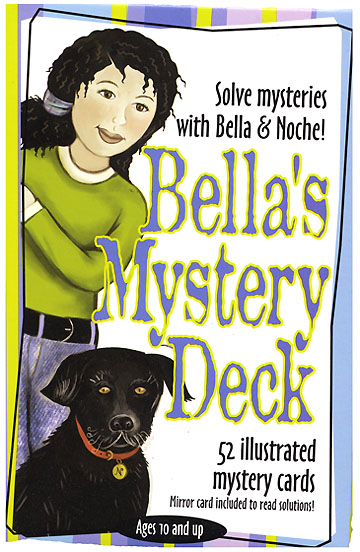
Looking for perfect activity on a rainy day? Bella’s Mystery Deck

When our family plays games, there are fights and tears. I’ve blogged about Scrabble, Clue, card games, and there are moments of fun, but mostly, it’s miserable.

There is an activity that all three kids (ages 4 – 10) my husband, and I love, where everyone works together towards a goal: Bella’s Mystery Deck. We had 3 soccer games scheduled for 3 kids today, but due to bad weather and a scheduling mistake, 0 happened. Bella saved the day.

bella1


Bella is a 13 year old Mexican-American girl who lives in Tucson with her family and black lab, Noche. The game consists of 52 cards, each with a story that describes a mystery to solve.  Besides Bella, the stories are full of colorful characters in Bella’s community. To check your answer, or find it out if you’re stumped, the package comes with a mirror to decipher the backwards writing at the bottom of each card. My kids love that part.

Bella is a female protagonist who is smart, brave, and kind. This game rocks.

The kick-ass Governess of ‘Wildwood’ is a brilliant character

My seven year old daughter and I are reading Wildwood. I was psyched by the description on the back of the book, which is all about a girl, Prue, rescuing her kidnapped brother. Unfortunately, early on, Prue partners up on her mission with a boy, Curtis. The story then alternates between Prue’s POV and Curtis’s, and, as my daughter pointed out, the Curtis parts are much better. While Prue is stuck in a town of boring politicians who speak about issues that Prue (and my daughter) don’t understand, Curtis gallops on a horse through the wilderness with a mysterious woman who lives with coyotes, the Governess.

If you read Reel Girl, you know that I track images in children’s media of females shown riding creatures, many of which are magical. While males are seen in this situation all the time, and the magical creature itself is often male, females, if they are get to do this at all, are relegated to a secondary position, aptly termed “riding bitch.”

Here is a beautiful illustration of the Governess and Curtis.

governess

So far, she kind of reminds me of the latest incarnation of Women Who Run With Wolves.

We are only about one third through the book, so I am hoping that

(1) Prue’s role gets more exciting

(2) The Governess continues to play an important role

(3) Prue is the one to rescue her brother

I’ll keep you posted.