
Since Lino DaSilvo’s sexist comments about how female characters are hard to draw because they’ve got to be pretty, he’s had many defenders comment on how much this artist cares about his movies and characters.
No one is saying DaSilvo doesn’t care about his art. No one is even saying that “Frozen” isn’t a good movie. “Ratatouille” is a great movie, and it also follows the same sexist pattern of most children’s movies where females can’t be heroes. Unfortunately, this sexism is entrenched in our culture, the stories we tell, and the heroes we create. Abnoba makes a great comment about all this on Reel Girl:
And female characters are even more difficult to differentiate because, as he says, they have to be pretty. And pretty, for Disney and other companies, has a very narrow definition. I think that we all know how Disney tried to change Merida. Disney is not only selling a movie. The Disney princess are used to sell clothes, toys, party supplies, make up…and that’s not based in how adventurous or smart they are, their beauty is a big selling point…Maybe Lino DiSalvo is not sexist, maybe he is just too frank for his own good about what that industry require from him, but I think that the comment is pointing to a very big problem in the female representation of women in animation.
You can be frank and sexist at the same time. As I blogged, I don’t think DaSilvo intended to be sexist. He thought he was stating a fact. And he actually is, but the fact is not about real differences between females and males, but about how they are represented in narratives for children in 2013.
Here’s something I wrote a while ago on the differences between drawing females and males:
Whenever I blog about the exaggerated breasts or ass of a female cartoon character, commenters respond that I have nothing to complain about: all cartoons are caricatures.
There’s a difference between exaggerating muscles and exaggerating someone’s butt. Here’s artist Kevin Bolk’s take on “The Avengers.”

Of course, “The Avengers” model, with its pathetic 5: 1 male/ female ratio and then sexualizing that lone female, is not unique to that group of superheroes.
Check out the Justice League cover. Notice any similarity?

Here’s the artist Coelasquid’s “If Superheroes Posed Like Wonder Woman.”
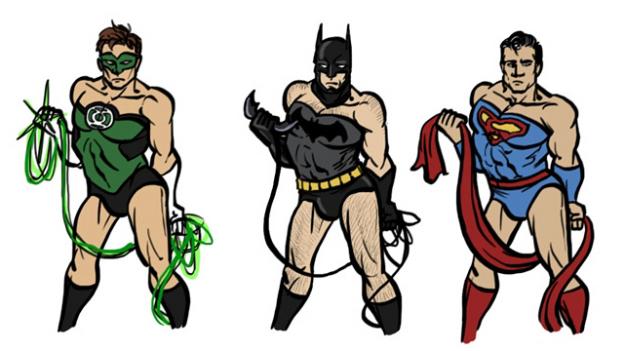
I love Coelasquid’s art because it shows so clearly that it’s not only the clothes put on female characters but the poses they are in.
Though of course, the clothes don’t help much. Here’s Theamat’s “If I Don’t Get Pants, Nobody Gets Pants:”
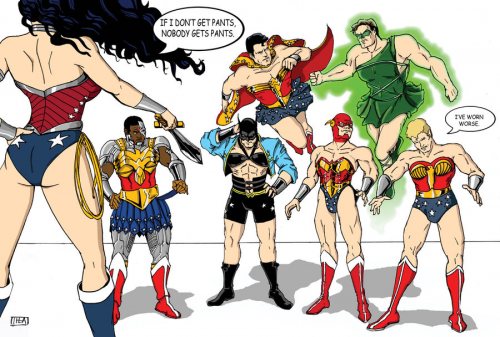
Wonder Woman with no pants was created by (and for?) grown-ups but it leads to Wonder Woman with no pants showing up as a LEGO minifig.

Females are half of the population, yet because they are presented as a sexualized minority in so many movies for adults, they are also presented as a sexualized minority in movies for kids. Those roles are then replicated in kids’ toys and most tragically, in kids’ imaginary play.
Female characters account for only 16% of all characters in movies for kids.
Here’s an interesting coincidence: across the board in all professions, women at the top don’t make it past 16%.
Do you think limiting females in the imaginary world limits them in real life? Unfortunately, your kids do.


