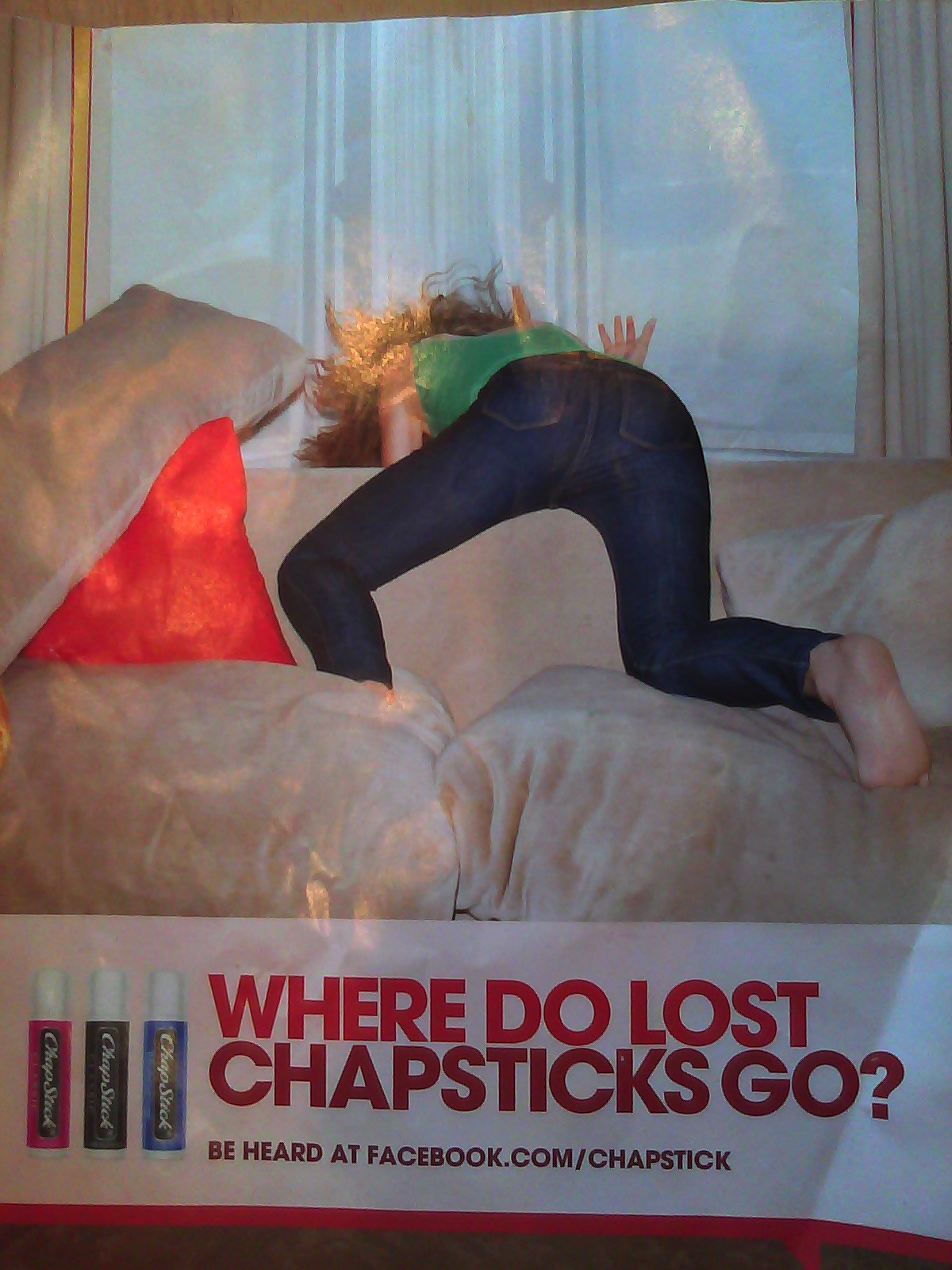
I have never been to Farmville or Café World or CityWhatever so I have no idea how they work. But I want to create my own online universe. It will be a museum, no, it will be a whole village: an online world ‘housing’ the vast collection of media messages that are degrading to women. Hey look, a picture of a woman’s ass. Members could live in the various apartments, museums, cafes, stores, theaters, and schools where women are sold, displayed, minimized, belittled, objectified …or are just plain missing. Oh, she lost her Chapstick. And they could do their, whatever they do in online universes – work, farm, drink, eat, chat.
Of course, such a collection could only exist online, because there isn’t a building big enough to hold the real accumulation.
Welcome to the Visitor’s Center! Upstairs is the Liquor Advertisements Wing. I wonder where she lost it? Across the street, the Music Lyrics building. And adjacent to that, the Movies and Television compound.
No, wait. I will organize it according to degradation type instead of media type. On this street we have the planned housing development of “Women Licking Objects.” Whoa! Check out her ass! Over here, the ghost town of “Missing: Significant Roles for Women” (which includes, of course, the government buildings, churches, big business boardrooms, and TV & movie studios.) Gosh, where IS that lost Chapstick? And of course the shopping mall of “Fetishized Female Body Parts.” Yes, my village will reach to the horizon in every direction, a whole city of buildings filled with sexist advertising, music, books, movies and media of every kind.
But why would anyone visit my online world, anyway? Don’t we go online to experience an alternate reality? Chapstick! Woman’s Ass! Have you ever gone through a day without being bombarded with any sexist messages or images? Some of them are right out there, nothing subliminal about them – see exhibits A through Z on the Rap Lyrics floor. Lost. Chapstick. Ass. Others try to be subtle and sneaky (please take the audio tour in the Museum of Advertising). Unfortunately, the use of women’s bodies to sell everything from beer to books has become so pervasive that we almost don’t see it anymore. Hey, I bet I know where the Chapstick is!
So when we see it – what do we do about it? Well, I would encourage you to take Chapstick up on their bold-print offer to “Be Heard at Facebook.com/chapstick” except I’ve tried that: they delete any comments even remotely questioning or critical. Hmmmm. What asses.
Because Chapstick continues to delete our comments, Reel Girl started another FB page Butt seriously, Chapstick. Please visit and be heard.
I wrote in my post that “feeling beautiful has come to mean feeling good: comfortable, powerful, competent.” But that doesn’t go far enough.
Years ago, getting better from an eating disorder, I had to learn to decode what “feeling fat” really meant. It was like becoming bilingual. Fat is not a feeling, I was told. It’s not? Thin isn’t a feeling either. Who knew? Fat, I finally learned, stood in for all kinds of emotions including anxiety, shame, panic, hopelessness, on and on. Thin included feeling excited, inspired, or happy.
I remember how in the 80s, Gloria Gaynor’s hit “I Will Survive” was supposed to be this anthem of female independence. But I couldn’t imagine a man belting that out and feeling empowered (do men even get “empowered”?). It would be funny, right? Or I think of all the modern day princess movies where the protagonist is so independent she actually chooses who to marry but the whole movie is still all about marriage. Or, as I wrote about the movie “Ratatouille,” the female chef is given a monologue where she complains about sexism but the cartoon itself had no female star. When the framework itself is sexist, it’s practically impossible to break out of the dogma because you’re trapped inside of it. Studies like Dove’s are important because they show the trap but they don’t point the way out.
Last night, my daughter drew two princesses, and she said, “There’s a brave one and a pretty one.” (The princesses, by the way, looked exactly the same.)
I said, “Honey, can’t the brave one be pretty too? Being brave makes her pretty.” Which is the case with men, their attributes make them attractive. But of course, that’s all too cerebral for a 5 year old so I told her a story instead (about a brave princess, loved and admired by all.) I keep thinking that’s the best way to change the world.
Dove reports that according to its global research, only 11% of girls worldwide are comfortable using the word “beautiful” to describe themselves. Even worse, when girls feel bad about their looks, more than 70%avoid normal daily activities, such as attending school, going to the doctor, or even giving their opinion.
Feeling “beautiful” has come to mean feeling good: comfortable, powerful, competent.
Girls learn very young that the main way they have value and interact with the world is through their appearance. We can do a better job intervening.
I know making small talk with a two year old is hard. Toddlers can be shy, are easily distracted, and might even burst into tears if you say the wrong thing. It’s not easy to break the ice. But please: if you meet a little girl on the street, in a store, on the playground, try to think of something, anything to say rather than commenting on her hair, dress, shoes, eyes etc.
My two year old just started preschool, and by the time I’ve kissed her good bye and left in her in the classroom, she’s gotten about 10 compliments on her appearance. Of course, she’s adorable. All little kids are. But remember, their little brains are getting wired up. Kids love attention, to be smiled at, and to connect– these are exactly the kinds of interactions that make their brains grow. When they learn, this young, that so many responses are based on how they look, it affects them for life.
For alternative ice breakers try “Hi, you seem happy today! What’s going on? (or sad or angry)” or “Is that your kitty? (or bunny, dog) What’s her name?” Talk about the weather, seriously. Ask if they come here often. If you must say something to a little girl about how she looks, balance it out with other topics that have nothing to do with her appearance (meaning don’t talk about how she looks unless this is going to be a long interaction.)
When people tell your daughter how pretty she is, don’t repeat the compliment to her (as in “She loves this dress. It’s her favorite.”) Don’t make her say thank you. Gently deflect the topic. No matter what other people say, you’re the parent whose opinion matters most to her at this age. Do tell your daughters they are beautiful “on the inside and the outside.” It’s something that should be said by you and that she feels confident about. It’s the proportion of looks based comments, the constant repetition of them, and how they form the basis for social interaction that’s damaging.
After I posted about Architect Barbie, AIA of San Francisco emailed me about a local, upcoming discussion on women and architecture. Director of Communications, Helen Wong, writes:
This event grew out of the desire by our AIA San Francisco Communications Committee to explore and share the experiences of women in the profession. The association to Barbie has definitely created some interesting dialogue and we’re hoping to continue to engage more people in the conversation. The committee hopes to develop a forum that can serve as an additional resource for women architects.
It looks like a great event, if you’re able to attend, here’s the info:
Ladies (and Gents) Who Lunch with Architect Barbie
October 21, 2011 Noon – 12:30 PM: Networking | 12:30 – 1:30 PM: Presentation
AIA San Francisco, 130 Sutter Street, Suite 600, San Francisco
Representing different paths in the design profession, architects Cathy Simon, FAIA (Perkins + Will), Ila Berman (California College of the Arts), EB Min (Min|Day) and Anne M. Torney (Daniel Solomon Design Partners) will discuss their careers and share their perspectives on women in the profession.
The group will explore the following topics: · What is the current state of women’s participation in the profession? · How does “Architect Barbie” influence roles, including stereotypes for women in the profession? · What does it take to become successful in architecture? · How can women shape the future of the profession?
The seminar format will include audience participation, allowing the architects, designers, and marketing professionals to be fully engaged in the conversation. Designer Jessica Lane, founder and editor in chief of Calx, a design magazine and author of the blog post, “The Audacity of Architect Barbie,” will moderate the presentation.
PRESENTERS:
Ila Berman, director of Architecture at California College of the Arts and principal of Studio Matrixx, is an architect and architectural theorist who holds a doctorate from Harvard University’s Graduate School of Design. Dr. Berman is the recipient of many awards and honors including, among others the J. P. Herndon Traveling Fellowship where she conducted research on contemporary urban and architectural landscapes. In 2005 she was the recipient of the President’s Award at Tulane University, where she was a Favrot Professor and the Associate Dean of the School of Architecture until December 2007. Her design work, which ranges in scale from objects to cities, has been published in GAM Zero Landscape, the Cornell Architecture Journal, Cityscape, c3Korea, JAE, and Appendx among others.
EB Min, AIA is the San Francisco based principal of Min | Day. An honors graduate of Brown University with dual concentrations in Art History and Studio Art, she began her architectural studies as a cross-registered student at Rhode Island School of Design. She received her Master of Architecture from the University of California at Berkeley in 1993. E.B.’s experience in the landscape architecture office of Delaney and Cochran nurtured her interest in the integration of landscapes and buildings. E.B. has taught at U.C. Berkeley and is an Adjunct Professor in the Masters of Architecture Program at California College of the Arts in San Francisco and serves on the Board of Directors of the AIA San Francisco.
Cathy Simon, FAIA, LEED AP is a design principal at Perkins + Will. Her focus on transformative design is evident at all scales. Larger-scale work is best exemplified by San Francisco’s Ferry Building, a once-disused relic reborn as a public marketplace and the site of the nation’s most highly-regarded farmer’s market, as well as a place of vibrant community. Notable smaller projects include numerous independent K-12 projects including the Urban School, a private high school whose identity and relationship to its neighborhood were revolutionized as a result of its new facility. Cathy’s design philosophy and expertise have made her a natural spokesperson for the burgeoning revitalization of post-industrial waterfronts worldwide. She frequently speaks and teaches on issues of urbanization, revitalization and the ways and means of creating these vibrant places that nurture the growth of community.
Anne M. Torney, AIA LEED AP is an architect who has made affordable multi-family housing and transit-oriented urban infill the focus of her work for over 20 years. As a Principal and Director of Housing at the multi-disciplinary San-Francisco-based architectural design firm Daniel Solomon Design Partners, she has led award winning projects in San Francisco, San Jose, Los Angeles, and Seattle, WA. She brings a commitment to community outreach and sustainable design to all her projects, which range in scale from 47 units of supportive housing for formerly homeless seniors, to the master planning and architectural design for the redevelopment of distressed public housing into vibrant new mixed-income and mixed use communities. Anne earned her BA at Princeton University and studied for her Masters Degree at the University of California, Berkeley.
$15 students with valid ID; $25 AIA SF and SMPS members; and $40 nonmembers. Fee includes 1.0 LUs and lunch. Space is limited. Pre-registration is required http://archbarbie.eventbrite.com
Contact: AIA San Francisco info@aiasf.org
In the book, “Van Gogh: The Life,” due out next week, the Pulitzer Prize-winning writers Steven Naifeh and Gregory White Smith present evidence that raises doubts about the source of the gunshot wound van Gogh sustained in or near the town of Auvers-sur-Oise, France, in July 1890.
“No physical evidence of the shooting was ever produced,” they write. “No gun was ever found.” Van Gogh, who “knew nothing about guns,” left no suicide note, and the bullet entered his upper abdomen “from an unusual, oblique angle — not straight on as one would expect in a suicide.” The authors hypothesize that he was shot by a friend’s teenage brother, who carried a gun and “had a history of teasing Vincent in a way intended to provoke him to anger.” (The artist, for his part, “had a history of violent outbursts.”)
As for why van Gogh did not accuse the boy before he died, but instead offered “hesitant, halfhearted, and oddly hedged” confessions of a suicide attempt, the authors speculate that he welcomed his own death and saw no reason to punish anyone for bringing it about.
Read the fascinating essay by Despina Stratigakos, associate professor of architectural history at the University of Buffalo, about how she helped to create the new Architect Barbie here.
The Chronicle of Higher Education reports that “while women make up 40% of architecture graduates, just 17% of them go on to join the American Institute of Architects, the discipline’s primary professional group.”
Despina Stratigakos, associate professor of architectural history at the University of Buffalo, isn’t sure why that gender gap persists. She tells The Chronicle:
“There’s been little in the way of research to determine why women aren’t able to make that transition,” says Ms. Stratigakos, who is unwilling to lay the blame on the call of motherhood. “Not all women who leave architecture do so to have children, and not all women who have children leave architecture.”
She calls it “a complex problem that requires a complex solution.” Or maybe a playful one.
So Stratigakos came up with something original. When she won a Fellowship at the University of Michigan, she was asked to organize an exhibition of female architects. Stratigakos wanted to figure out a way to further the debate about gender, architecture, and achievement without the discussion devolving into the same old cliches and ending up stonewalled yet again. So Stratigakos asked
”students and faculty members to develop about a dozen prototypes of Architect Barbie, which she displayed in a gallery in the architecture school. Alongside the dolls she ran a 40-minute film featuring clips of architects as depicted in popular culture: ‘The angry, determined, creative genius, standing above mediocrity,’ and almost always male. The Barbies grabbed the attention of passers-by, she says, inciting discussions about gender and architecture in both the gallery and in classrooms.
Soon after, Stratigakos got a call from Mattel asking for her help to design a new doll. Finally, this year the famed toy company and the American Institute of Architects unveiled Architect Barbie at the AIA’s annual meeting in New Orleans.
So will the doll (action figure?) help to inspire a new generation of girls to become architects?
At the very least, Stratigakos’s exhibition is brilliant and poses important questions by illustrating the huge contradictions women face as they strive to achieve.
As Stratigakos says, for women to take the risks required of them in order to realize their dreams is a complex issue that goes way beyond motherhood.
For men the path to success and power is straight: achieve, become object of female desire, achieve more (more emotional support, more money, more power, more art!) Whereas women are faced with a far more circuitous and complicated route, ominously warned: if you rise too high, you’ll lose your attractiveness to men which happens to be– guess what– your main source of power.
The human drive to create and communicate is universal and genderless. But artists have to be risk takers and the punishments for women are high. I love how Stratigakos put the Barbies next to film clips of angry, male geniuses. Our culture’s idea of what a great artist looks like is so mired in the model of the tortured, solitary male. A model that, as Peter Kramer documented in his book Against Depression (and that I posted about “What if Van Gogh took Prozac?”) happened to be created by tortured, lonely males.
Clearly, its time for new models and maybe Architect Barbie will help us build them.
Update: After seeing the above post AIA San Francisco invited me to hear a panel discussion on gender and architecture. Read my post about that event: “SF architects advice to girls: Blocks, not Barbie.”
I created Pigtail Pals in honor of my daughter, Amelia, named after Amelia Earhart, when I was looking for a cute outfit for her as an infant and could find only pink and princess. Not a single onesie in all of humankind had a little girl and an airplane on it. I thought girls deserved more empowering and diverse messages than just sparkles and tiaras.
What are your best-sellers?
This fall the best sellers have been my “Pretty’s Got Nothing To Do With It” and “Full of Awesome” designs that I just released in September. Traditional favorites are the astronaut, pilot, carpenter, doctor, military, and scientist designs. And the entire Whimsy Bee line is a hit with its colorful and imaginative designs.
It’s smart of Pigtail Pals to be a for profit instead of a nonprofit! The more successful your company is, the more you can help girls. You call yourself a “mompreneur.” What is that? Who were you inspired by?
Exactly, I want to show other businesses that this is the message parents and girls want, and that a business can be successful doing this. I want to change the way the marketplace looks for young girls. And since Dora has gone the way of the ballerina princess, there is room for the smart and adventurous Pigtail Pals designs to take over. Pigtail Pals has, since the very beginning, made donations to organizations that support girls, and we will continue to do so as our success grows.
A mompreneur is a mother who sees a hole in the marketplace for children, and creates her own product to fill that void. At the time I created Pigtail Pals, there were no other apparel lines on the market that showed girls doing smart, daring, and adventurous things. There were a couple of lines that had empowering phrases, but my preschooler can’t read, so that didn’t mean anything to her. I wanted something in pictures that would really speak to little girls. Girl empowerment is something our daughters need to be raised with, not just something they are introduced to once they are finally old enough to be a Girl Scout or participate in some of the other national programs that only focus on older girls. My girl can’t wait, she needs these messages now.
What do you teach in your workshops? What kind of excercises do you do? Can you see the change before and after or is it more gradual? Do you find parents, teachers, or kids more willing or more resistant?
I teach media literacy in my workshops – a tangible way for parents to digest and parent through all the crap that is out there. I teach how to specifically deal with the highly inappropriate birthday gift, or mother-in-law that bestows makeup and tiny high heels with every visit, or the song that just played on the radio talking about casual or violent sex. Our culture is saturated with this stuff. I find most folks are eager to learn about this, and I see those light bulb moments flash across everyone’s face about 15mintues into every workshop.
The exercises I use are just common sense stuff. For example – I take a box of crayons, and dump it out, but it is full of only pink and purple crayons. I ask the parents, if they had purchased this as a school supply, would they find something wrong with it? Would they return it to the store? I ask them what is missing, and then I ask them to close their eyes and picture their daughter’s closet and toy box. I see little sheepish smiles creep across their face. And they get it – they get how incredibly limiting choices are for girls, and that they bought into it. There is nothing wrong with pink, or purple, but when a girl’s world is full of that and only that, we need to think about what messages that sends. Childhood should be a time full of vibrant, amazing color and learning experiences.
What are your future plans for the company?
In the near future, I’m going to release a line of tee designs that show boys and girls playing together, having great adventures. Also, I’m going to build out the new line of Full of Awesome products. That blog post was such a runaway hit, it is really inspiring to me.
Eventually I want to move into toys and room décor, and I would love to open really special retail spaces.
How do you protect your daughter’s imagination?
We tell stories all the time in the car while driving around town. We create some story to act out while we play outside. My home looks like a preschool with all of the art supplies and learning toys in this place. We take lots of family adventures to educational places like children’s museums and fairs and performances. We read and read and read.
Are there books, TV shows, clothing lines or products you recommend for girls?
There is a lot of good stuff out there, you just have to know where to find it. My daughter is 5 years old, so right now we are really into the Ramona and Judy Moody books. This winter we’re going to start reading the Little House on the Prairie series. Amelia has checked out every single whale and dolphin book our public library offers. For TV, she loves Animal Planet, SciGirls (PBS), National Geographic, Diego, Wild Kratts (they have two female sci/tech assistants that rock the show), Word World, Peppa Pig, and Scooby Doo.
For other clothing lines, I really like Be A Girl Today (http://www.beagirlblog.com/) for awesome girls sports tees. And the Girl Scouts offer great tees, too.
For other products, a few other mompreneur small businesses I love to promote are Cutie Patutus for dress up clothes, Sophie & Lili for wonderful cloth dolls, and Go! Go! Sports Girls for sports-themed dolls. Every girl should have a doctor kit, a tool box, a wooden train, giant floor puzzles, and Legos by the bucket.
On my blog Reel Girl, which is all about imagining gender equality in the fantasy world, people sometimes complain that issues I care about don’t matter because the characters I write about are imaginary. Or that I am limiting imagination by imposing PC dogma on artists. How do you respond to comments like that?
“You can’t be what you can’t see.” –Marie Wilson, the White House Project. Sexualization is an enormous problem, most specifically in the media. The stats on the representation of girls in the media in a non-sexualized manner are so miniscule, I would argue this isn’t ‘PC dogma’, it is a matter of civil rights. Girls get a seat at the table.
In the past year or so, various sites and movements have cropped up to help defend girls from sexist media or at the very least, educate parents about the negative influences out there, so ubiquitous they are ironically invisible. There was Peggy Orenstein’s best seller Cinderella Ate My Daughter, The Geena Davis Institute has been doing studies and releasing statistics about the lack of girl characters in animation, author Lyn Mikel Brown and other founded SPARK and advocated for more girl balloons in the Macy Day Parade. And its great news that parents and advocates got so upset about the JCPenney T shirt and got it off the shelves. At the same time, Disney announced its not doing anymore princess movies which translates to even fewer movies starring girls since girls are mostly only allowed to star if they are princesses. Disney also announced this year that is shifting its tween programming to boy based animated cartoons. Do you see the media and more awareness about the media going in a positive or negative direction? Are there other sites or movements that you know of that support girls and girl media?
I think parents and girls need to be very aware that the media is a long ways off from them content that is fair to girls. Like I said, there is good stuff out there, but in reality it is few and far between. Disney is the very last place I would look for positive girl media. As parents become more aware and more savvy, they will start to demand products and media that reflect that. So Pixar is making “Brave”, and that is tremendous, and that will only fill our appetite for so long. They will need to give us more if they want us to keep consuming.
One under-reported issue is that when girls go missing in kids films, and the toys, clothing, and other products based on and derived from those films, both genders learn that girls are less important than boys. This is a problem with sites and orgs that focus on girls, in some ways, that continue this polarized segregation. Parents are a huge force here– they should be reading their kids stories about girls, taking them to movies with strong girl parts (if they can find any) and encouraging cross gender friendships. What do you think about this issue? Are there sites, movements, blogs that you know of or like that help educate boys also?
I have a three year old son, so this is an equally important issue for me. My colleague Crystal Smith of Achilles Effect (and author of a great book with same name) is awesome. The work of Jackson Katz is like no other when it comes to boys and media. The blog The Mamafesto writes about her son and his adventures through boyhood.
My work focuses on girls, because the crush for them with sexism and sexualization is immense, and it comes at them as soon as they are born. I don’t necessarily think it is easier for boys, but it is different. I think we need to get back to some common sense childhood. Let’s allow our kids the space to play and explore without limitations based on gender. Pigtail Pals also offers a line for young boys called Curious Crickets, meant to honor the creativity and wonder in boyhood.
Both of my children enjoy and thrive in cross gender friendships. These are crucial for the socialization with the opposite sex in their tween/teen years and beyond. We try to find positive media that equally respects boys and girls. My kids will see my husband wash dishes and fold laundry, and they will see me wrestle with the dogs and use tools and run my business. It is all about balance.
Early this morning while I was meditating, a mouse ran up my stairs. I know Buddha had to deal with worse but it wasn’t cool. Alice (age 5) wrote a poem about it:
Mouse in the House
Mouses like crumbs,
But they are so tiny,
And mouses are bigger than crumbs.
Then Lucy made us a special breakfast. Alice doesn’t like butter right now so Lucy used a substitution. Here’s her recipe:
Chocolate cinnamon toast
cinnamon
sugar
chocolate sauce
sliced bread
Mix up the cinnamon and sugar sweet as you like it. Toast the bread. Spread the chocolate sauce on the bread. Sprinkle on the cinnamon sugar.