Stats from Miss Representation

Jennifer Siebel Newsom’s Miss Representation— a documentary about how mainstream media contributes to the under-representation of women in positions of power and influence in America– aired on OWN last week. TV viewers learned the following stats, listed below. Makes you think twice about taking your kid to a movie.

Only 16% of protagonists in film are female. Only 7% of film directors and 10% of writers are female.

Between 1937 and 2005 there were only 13 female protagonists in animated movies. The female characters in G rated movies are just as likely to wear revealing clothing as in R rated movies.

Women and girls are the subject of less than 20% of news stories. “When a group is not featured in the media… it is called symbolic annhilation.” Martha Lauzen, Center for the Study of Women in TV and Film

“All of Hollywood is run on one assumption: That women will watch stories about men, but men won’t watch stories about women. It is a horrible indictment of our society of we assume that one half of our population is just not interested in the other half.”
– Geena Davis

Here’s a a link to Reel Girl’s gallery of girls gone missing from 2011 kids’ films.

More stats and facts here.

Forbes.com posts ‘dream’ apology from ChapStick

After ChapStick’s apology to women who “felt like” their posts about a sexist ad were being deleted from the company’s Facebook page, Forbes.com contributor Samantha Ettus suggests a more effective “dream” apology from the company:

We are so sorry for using poor judgment in putting up this ad. Thanks to social media, our awareness of the reaction emerged speedily and we were able to respond immediately by taking it down. Our consciousness has been raised and for that we are grateful. We have taken this lesson to heart and will not be creating any advertising that is or could be construed as objectifying women in any way. Just like you might forgive an old friend who messes up for the first time, I hope that you will return to us, unscathed from our mishap. Thanks for your understanding.

WOW, can you imagine? If ChapStick did that, I’d be giving it out on Halloween.

Ettus, a personal branding expert, writes that ChapStick has always been associated with strong women– from the Suzy ChapStick ads, where Suzy was highlighted for her athleticism, to other athletes/ spokespeople such as Olympic skier Picabo Street and ice skater Dorothy Hamill.

What happened to make a brand with a loyal, lifelong following of female customers who buy ChapStick for themselves and their kids, shift its marketing strategy so dramatically?

Ettus writes:

Chapstick’s ads have always been empowering for women. The real question is how they arrived at this point today. Now that Chapstick is owned by Pfizer, I’m envisioning the Viagra advertising team – a few young ad men unfamiliar with the history of the Chapstick brand – creating this off-brand ad. And then finally, the apology from Pfizer spokesman Ray Kerins as quoted in The Wall Street Journal: “This is a good example of us hearing what people have to say, making a determination and taking action,” he said. No real apology at all. Like a child forced to say sorry with no understanding of how this might translate into a similar future scenario, is Chapstick destined to repeat its recent history?

Feedback on ChapStick’s apology

Here’s a comment I like on Reel Girl:

Reading the comments to the “apology” is interesting. What I came away with is the conclusion that by calling the removed comments “foul, repetitive, and spam-like,” ChapStick reinforced the notion the people concerned about sexism are foul-mouthed, strident (shrill?), unreasonable, and unprincipled in pursuit of their goals. I don’t know if that was their intention, but if so… brilliantly played, ChapStick.

ChapStick writes: “We apologize that fans have felt like their posts are being deleted…” Huh? If you feel like your post is being deleted, is it actually being deleted?

This is a great comment from Adweek reader Elizabeth Kraus:

I’ve used chapstick for years; I’m dependent.  I didn’t think the ad was offensive, but I do think that the ‘apology’ is. Telling people that you’re sorry for how THEY feel is equivalent to saying that it’s their fault for how they think and feel about what you did.  If the company was silencing critics, own it, fix it and move on. Telling people that they don’t have the proper emotional response, and that you’re sorry about that?  Makes me want Blistex.

Here is Ray Kerins (Of ChapStick I believe) comment back to her:

Elizabeth Kraus – For
us this was about listening, analyzing the feedback and taking action.  So even while social media is so new to so
many of us, we are committed to the dialogue.

As I wrote, I think it’s great ChapStick removed the ad, apologized, and is creating a new ad. But also, as I wrote, the deleted comments that I saw are clearly not foul mouthed, threatening, or spammed as the screen shots show.

Melissa Wardy of Pigtail Pals got this response:

“Thank you for your email. Our new Chaptsick ad was not intended to offend anyone. We are dedicated to listening to the views of our customers. To that end, we are removing the image from all of our properties.
Thank you again for your feedback.
Sincerely,
Raymond Kerins

Melissa Spiers who wrote the original post comments:

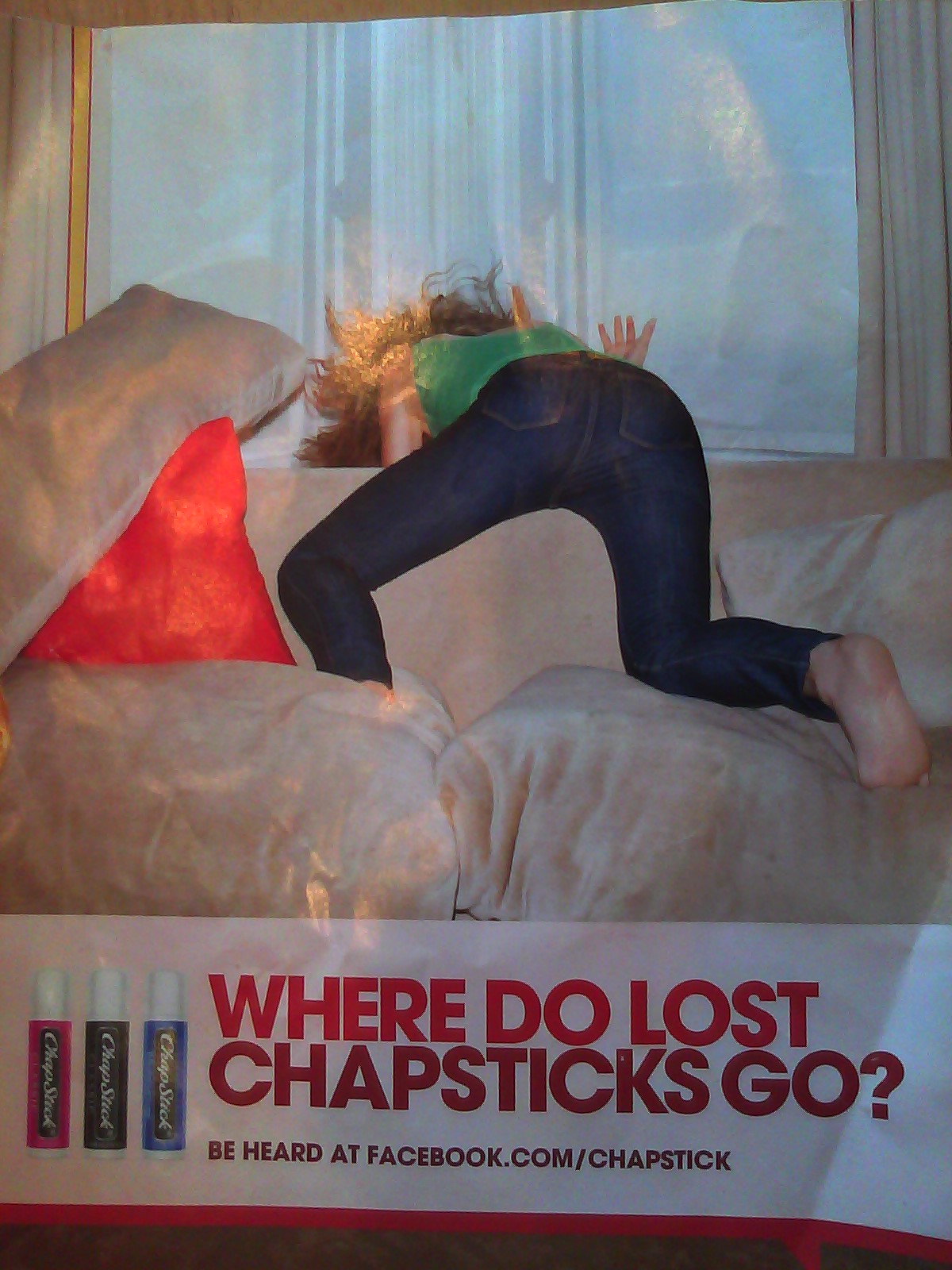
All of the media coverage on this is great but this was not just a photo posted on the internet. When I wrote the original article (with the original photo used here and in Adweek, Business Insider, etc) it was because I saw it as a full page ad in a magazine. It was also apparently a television commercial, featuring a woman’s ass jiggling around on the screen. It wasn’t JUST a picture on ChapStick’s site.

We don’t know if there is a TV commercial. We haven’t seen one, have you? The photo, I believe Melissa photographed from a magazine; it’s certainly running in print. But the point was that ChapStick wasn’t listening to their customers and now they seem to be, so that’s good. There’s still an ad out there that many people find offensive and the company is now saying they hear that and that they are no longer actively circulating it. That is what they’re saying, right?

Read ChapStick’s full apology here.

ChapStick removes ad and apologizes

We see that not everyone likes our new ad, and please know that we certainly didn’t mean to offend anyone! Our fans and their voices are at the heart of our new advertising campaign, but we know we don’t always get it right. We’ve removed the image and will share a newer ad with our fans soon!
We apologize that fans have felt like their posts are being deleted and while we never intend to pull anyone’s comments off our wall, we do comply with Facebook guidelines and remove posts that use foul language, have repetitive messaging, those that are considered spam-like (multiple posts from a person within a short period of time) and are menacing to fans and employees.
As I commented on their page, as far as I know, comments made from Butt, seriously did not use foul language, spammed messages or threats (there are screen shots of some deleted comments on the Butt, seriously page.) I am not sure what they mean they never intend to pull anyone’s comments off. But I am happy they listened. Thank you ChapStick.
Read feedback on ChapStick’s apology here.

Why ChapStick’s bad PR policy matters

Yesterday,  Jezebel and Business Insider posted about ChapStick’s bad PR policy to delete negative feedback about its ad from its Facebook page– an especially questionable practice by ChapStick when its ad copy reads: “Be Heard” and follows with a Facebook page address.

As Jezebel wrote, ChapStick’s practice of deleting negative feedback is not officially censorship:

“Chapstick has no obligation to provide a public forum, and users are free to take their complaints elsewhere, as they have done.”

Last I looked, it appears ChapStick is now deleting the blatantly sexist comments as well, which I guess could be considered progress. But again, the ad implies a public forum. Furthermore, ironically, leaving up the sexist comments about the woman’s ass show that the picture is not just an innocent snapshot of a woman looking for ChapStick, that others besides crazy feminists bloggers find the ad objectifying, though obviously they’re into the objectification.

Jezebel writes:

What Chapstick is guilty of is really bad PR. When Dr. Pepper issued a much more objectionable ad, at least they allowed customers to sound off about it on their Facebook page. By deleting negative comments, Chapstick is sending the message that they can’t handle criticism. And especially if you’re encouraging people to use social media to talk about your brand, that’s a stupid message to send.

Business Insider agrees:

Social media is supposed to be a way to communicate with your customers — when you shut that channel down simply because they disagree with you, you totally negate the point of having it in the first place.

Deleting those comments served no purpose for Chapstick but to cause itself PR problems. It’s the Internet — even if you delete something, it’ll appear somewhere, somehow. True to form, many of the comments that Chapstick deleted were compiled by protesters on a new Facebook page (the screenshots show that most were void of profanity and civil).

What should Chapstick have done?

Brands like Chapstick have to learn to accept the negative with the positive, especially in a world with social media. By simply opening a dialogue with those angered and listening to their complaint, this could’ve been avoided. And the folks at Chapstick would’ve generated some goodwill, showing that they actually give a crap about what people think.

But no. They did the exact opposite, giving the perception that the brand doesn’t care.

One follower of the Butt Seriously, Chapstick FB page (created by Reel Girl for those deleted from ChapStick’s page) had a great suggestion that ChapStick show women in its ads being powerful and resourceful, for example lifting up the couch and finding the ChapStick there.

Obviously, this isn’t an earthshaking issue, but it is a striking glimpse into how corporations work behind the scenes to control their public message. And it’s disturbing to see that kind of manipulation operate under the guise of a public forum. The tactic is relevant to girls and women because so often with sexist products– movies that star only boys, the ubiquity of pink and Barbie dolls– the justification for the limited options out there is “we’re just giving the people what they want.” Clearly, there’s more going on in the background involving complex and elaborate marketing strategies. If you’re claiming to give us what we want, you ought to at least listen to what we have to say first.

Through this whole experience, I have learned how to spell ChapStick correctly.

Butt seriously, Chapstick

After Melissa Spiers posted on Chapstick’s offensive ad, she and many other readers tried to comment on Chapstick’s FB page as invited to in the ad. “BE HEARD,” Chapstick’s ad copy reads, yet all the comments readers made were mysteriously deleted within minutes.

So we’ve created “Butt seriously, Chapstick,” exclusively for those not allowed on Chapstick’s page. Please click like and be heard.

Hopefully, they’ll get it in the end.

7 yr old girl becomes youngest person to swim length of Golden Gate Bridge

This kid is amazing!

Ella Woodhead got in the freezing water and strong currents of the San Francisco Bay and swum a full mile. Her mother swam by her side.

“It was really cold, but I had a wetsuit on so I felt a bit warmer,” a bleary-eyed Ella said Friday morning. “I thought about warm and happy things, warm showers and hot chocolate.”

Woodhead is raising money for her preschool teacher whose husband was killed just before she was due to get a mastectomy. Now Tika Hick is recovering at home with her 9 month old son.

To make a donation to the charity supporting Tika Hick, go to welovetika.com/donate-now.

Read the full story on Ella Woodhead here.

SF architects’ advice to girls: Blocks, not Barbie

After I posted about Mattel’s new Architect Barbie supposedly designed to inspire girls to become architects, AIA SF invited me to hear a panel discussion: “Ladies (and Gents) Who Lunch with Architect Barbie.” The topic was women and architecture, and it quickly became apparent how the highly successful female architects felt about the infamous doll.

“Maybe if there were an Interior Design Ken,” said Ila Berman, director of Architecture at California College of the Arts and principal of Studio Matrixx. “Or if she were Contractor Barbie and wore a hard hat and held a computer. If she were more subversive, maybe I could go there.Berman nodded at the doll placed in front of the panelists.  “She makes me nervous.”

Cathy Simon, best known locally for transforming San Francisco’s decrepit Ferry Building into a thriving, open marketplace, was more direct: “Barbie is an embarrassment for women. I’m embarrassed for her. I hate Barbie.”

Anne Tourney, an award winning architect and principal at Daniel Solomon Design Partners, was practical about Barbie’s potential: “Mattel can’t represent us. It’s a toy company.”

EB Min who has her own firm and also a three year old daughter defended the doll slightly, conceding that perhaps she “normalizes the career.”

All of the architects wanted to shift the discussion away from Barbie and to real life women and architecture. As in most professions, women have made huge gains at the bottom. In the 1970s, just 5% of architecture students were women. Today, the number has climbed to 40 – 45%. Of those women, only  17% get licensed and join the AIA. Few make it to principal in their firm or tenured faculty at prestigious universities.

The panel agreed the challenge for women in architecture is retention. Sticking with it in a tough economy, somehow navigating the Catch 22 when top jobs and top salaries go to men.

Berman, who, as she said, “wasn’t that old,”  was the first female tenured in architecture at Tulane.  Today, just 20% of the tenure track positions in architecture go to women. Who gets tenure? “It’s a cloning activity,” she said. “A peer review process.”

How do you succeed and keep the faith with those odds? Simon encouraged the young female architects in the crowd (only three men showed up to the talk) to believe in themselves. “You can do anything,” she said. Better than words, she inspired the women by her own example, as did the whole panel. Clearly, the speakers were passionate about their work and fulfilled financially and creatively. Two spoke of fathers who strongly encouraged them to go into architecture.

Because I write about girls and toys, I brought up Architecture Barbie one more time. “Could she possibly be a gateway to get girls to imagine? You could ask your daughter: what’s she going to build today?”

“I played with blocks,” said Berman. “I loved puzzles. Get your daughters some puzzles.”

Can you imagine not being able to cry?

Bay Area domestic violence direct service workers convened yesterday at the Ivory Steuben luncheon to discuss the worldwide epidemic and what we can do about it in our community.

The panel of direct responders included Dr. Catherine Main, a therapist in Marin County, Julie Robbins MSW, ACSW, LCSW in SF, Rabbi Sydney Mintz of Temple Emanu-el, and Jill Zawisza of Women, Inc.

Catherine Main spoke about how her goal is to help people to identify DV earlier. The sooner it can be recognized, the more chance we have to stop and change the behavior. She said the beginning is subtle. Typically, it starts with intimidating behavior from the male in the family. He begins to withdraw emotionally, soon exhibiting signs of jealously. The next step is that he restricts the woman’s movement and friendships so she becomes more isolated and more dependent on him.

Julie Robbins began her talk saying she was happy to be with this crowd because the worst part of her job is all the time she’s got to spend just convincing people that the problem actually exists. She said it’s our job as a community to make it visible. Here are some stats:

One in four women (25%) has experienced domestic violence in her lifetime.

85% of domestic violence victims are women.

Women ages 20-24 are at the greatest risk of nonfatal intimate partner violence.

Nearly three out of four (74%) of Americans personally know someone who is or has been a victim of domestic violence.

On average, more than three women are murdered by their intimate partners in this country every day.

Domestic violence is one of the most chronically under reported crimes.

Only approximately one-quarter of all physical assaults, one-fifth of all rapes, and one-half of all stalkings perpetuated against females by intimate partners are reported to the police.

On a positive note, Robbins said that kids who grow up in violent homes can and do get better. She’s seen it. One of the best things about getting older, she said, is seeing a three year old survivor she played with on her office floor all grown up, stopping by to visit her with his new wife. The cycle can be broken, but just as with  other family epidemics like alcoholism, the disease is inter-generational. Everyone is affected. Repair takes time. The first step is recognition.

So how do we break the cycle?

Robbins summarized what happens to a kids in a DV home. A home is supposed to be the safest and most secure place in the world. How do kids deal with the fact that someone they love is hurting someone else they love? How do their developing brains process all the contradictory information? Robbins says kids decide it must be their fault as a coping mechanism. The kid thinks if he can be perfect, he can keep the chronic abuse from happening. Robbins spoke about how these kids become so hyper-vigilant they know when the violence is going to happen. They can recognize signs like hearing a car pulling into a driveway crooked. Kids who have been abused or around abuse have brains that get wired up that are hyper-vigilant and hyper intuitive– they hear, smell, and taste differently.

Rabbi Mintz talked about the caveman model– the cave guy whacks the woman on the head and drags her back to the cave. The rabbi said it may be a cartoon but that this is the model for the first relationship. I like what she said because I write about cartoons. Listening to her, I thought again about the lack of healthy role models for men and women out there. It was also great to hear the rabbi because she called the group to a higher level of action than we are used to. Listening, it almost made me wish I were religious so I would hear these kinds of words more often or more regularly. The rabbi believes we are all first responders. She also said she’s got a kid in her congregation who had just been picked up by Child Protective Services. She wants to know who in her community is going to take this kid in? Who of the Temple Emanu-el families will step forward?

Again, calling individuals to action, the rabbi also spoke about a fundraiser for the public schools where one of the donors said: “The best thing you can do right now is write a check.” The rabbi told us that’s not the best thing you can do. The best thing you can do is send your kid to a public school. Then write checks to that school and get involved in the community there.

Eve Ensler’s talk was amazing and I already posted about part of it, but I didn’t mention yet that she also talked quite a bit about men. Ensler said that in order to stop violence against women, we must include men in the movement. Men need to be able to stand up and say violence against women is wrong. She told a story about getting in a cab in New York and forgetting her wallet. When she realized she had no money, she said, “I’m so sorry. You can take me back home and I can get it or I can mail you a check.”

The driver was furious, screaming at her, shouting, calling her names. Ensler said she saw a man in horrible pain, a man who got no recognition for his work, a man who was angry about sitting in New York traffic, a man who was tired and frustrated. Ensler said that we have no idea the kind of pressure men are under to perform, to please everybody, feeling they are coming up short, feeling they can’t do everything right. She said, “Can you imagine not being able to cry? You cry, you go on, you cry, you go on. If I couldn’t cry, I would’ve been institutionalized fifty years ago.”

Eve Ensler speaks to SF community leaders about stopping violence against women

Yesterday, award-winning writer and activist Eve Ensler spoke to Bay Area domestic violence direct service workers about how to end violence against women. She spoke at the Ivory Steuben luncheon which is organized by Marjorie Swig and named for a survivor of domestic violence.

Ensler had just come from the Occupy Wall Street protest in New York and she spoke about how economic issues are inseparable from stopping violence against women: girls around the world are sold into sex trafficking for less money than the cost of a cell phone; women economically dependent on their partners can’t afford to leave abusive relationships; in Topeka, Kansas, after a 10% budget cut, the DA’s office announced it would decriminalize DV, no longer wasting money prosecuting that misdemeanor. THIS IS HAPPENING IN THE USA.

Ensler said stopping violence against women cannot continue to be our last priority, it has to be our first. Violence against women is inter-related to every issue: health, economy, education, politics, foreign policy.

Other community leaders at the event spoke about how no SF mayoral candidates had put DV in their written platforms. Chris Cunnie who is running for Sheriff was at the event and spoke about his commitment to stop violence against women. He’ll have my vote.

I’ll post more news from the event soon.