A commenter sent in a Hunger Games fan link with photos of the movie poster around America. Most are of the mockingjay symbol but there are a couple of Katniss. Here’s my favorite, above an NYC subway entrance:
The pose and intensity reminds me of the Greek goddess Artemis. LOVE.
Please send photos if you see Katniss in your city. Still looking on the streets of SF.
This post has been updated to include comments from readers:
Here’s the movie poster:
Here’s the book cover:
At least the book isn’t by S. Collins, right? I suppose we should be grateful for that.
Reel Girl blog readers from the UK and New Zealand report spotting the protagonist, Katniss Everdeen, on posters in their countries. Katniss was also pictured on the first paperback UK version. Since the movie, she’s vanished from all covers.
The U.S. pb edition never showed Katniss.
Google images also shows “Hunger Games” movie posters with Katniss, but I haven’t seen any around the Bay Area. Have you? Or in your city/ town? Please let me know and even better, send me a photo.
Katniss Everdeen is played in the movie by Jennifer Lawrence who was nominated for an Academy Award for “Winter’s Bone.” You’d think that “The Hunger Games” marketing department would want to highlight such a popular and critically acclaimed actress.
The WSJ also reports that the film studio, Lion’s Gate, is hopeful that in spite of the female protagonist, males will go see this movie:
“Set in a dystopian future, “The Hunger Games” centers on Katniss Everdeen, a 16-year-old girl who is called upon to fight 23 other teens to the death in a twisted annual survival competition that is televised to the nation of Panem. The quick pace, strong characters and blood sport of author Suzanne Collins’s trilogy helped attract a robust male readership.”
In some ways, this marketing strategy is good news, because Hollywood will not be toning down Katniss’s character to play up the romance angle:
“They’ve taken away the love story and focused on the hero, who, by virtue of her altruism and fire, is going to stand up against this situation,” says Vincent Bruzzese, president of Ipsos MediaCT’s Motion Picture Group, which does market research for movie studios and filmmakers. “What they are doing is marketing the archetypal themes that are gender-neutral.”
Jezebel posts: “Maybe, though, it’d be encouraging to see a movie with a dominant female lead transcend the demographic corrals studio analysts have split us all into.”
If “gender neutral” means keeping the focus on Katniss’s heroics and not her relationship, I’m all for that. Moving past those limited “demographic corrals” would be great. So if I have to give up Katniss on the movie poster to keep the narrative from getting watered down to romance, I suppose that’s a sacrifice I’m willing to make.
Still, I look forward to the day when a Academy Award nominee can show up on the poster for her own movie without fear that she’ll scare the boys away.
Also, if they let Lawrence on the poster, maybe they’d pay her more money. Women and Hollywood reports that she’s earning $500,000 for her role. Compare that to Chris Pine, a young male action star and not Academy Award nominated, who earned $3 million for “Unstoppable.” Women and Hollywood writes: “She’s on the poster, is clearly the lead, yet still doesn’t get paid the same as the guys.”
Parents should not let five year old boys have the power to make five year old girls disappear. The gender imbalance in animated movies isn’t really about five year old boys anyway. It’s about their parents. Parents are the ones who buy books, movie tickets, and toys. Just because adults live in a sexist world, doesn’t mean our kids should be trained to keep repeating it. At the very least, adults could be doing much more to present the next generation with imaginary worlds where sexism doesn’t exist. Yet, in kid-movie-world, females are represented as a tiny minority. Girls are half of the kid population. It’s time that Hollywood recognized that by putting females on movie posters, and of course, in the movies as well.
At least the book isn’t by S. Collins, right? I suppose we should be grateful for that.
According to Google images, there are other movie posters that show the protagonist, Katniss Everdeen, but I haven’t seen one anywhere around the Bay Area. Have you? Please let me know if you do see one and even better, send me a photo.
According to the Wall Street Journal: The publisher, Scholastic, considered dozens of cover designs, including portraits of Katniss, before settling on a more ‘iconic’ image of a bird pendant that plays a role in the story.
Lion’s Gate is hopeful that in spite of the female protagonist, males will go see “The Hunger Games:”
“Set in a dystopian future, “The Hunger Games” centers on Katniss Everdeen, a 16-year-old girl who is called upon to fight 23 other teens to the death in a twisted annual survival competition that is televised to the nation of Panem. The quick pace, strong characters and blood sport of author Suzanne Collins’s trilogy helped attract a robust male readership.”
In some ways, I think that the marketing strategy is great news, because they are not playing up the romance to attract females to the movie.
“They’ve taken away the love story and focused on the hero, who, by virtue of her altruism and fire, is going to stand up against this situation,” says Vincent Bruzzese, president of Ipsos MediaCT’s Motion Picture Group, which does market research for movie studios and filmmakers. “What they are doing is marketing the archetypal themes that are gender-neutral.”
If “gender neutral” means not playing up the love story to attract females, I’m all for that.
Jezebel posts: “Maybe, though, it’d be encouraging to see a movie with a dominant female lead transcend the demographic corrals studio analysts have split us all into.”
Absolutely! Moving past those limited “demographic corrals” would be great. If I have to give up Katniss on the movie poster, I suppose that’s a sacrifice I’m willing to make. I have high expectations for this movie.
I’m half way through the book and I love it. Katniss is smart, cool, complex, beautiful and a total bad ass. She is not a Token Feisty. In the narrative, she is never referred to as unusual or an exception of her gender because of she’s brave and skillful. I’ve continually asked on this blog if there are imaginary worlds where sexism doesn’t exist. Though Panem is a dystopia, this may be it.
I do look forward to the day when a female protagonist can show up on her own poster or book cover without scaring boys away.
Also, while I understand the marketing strategy for “The Hunger Games” it’s unacceptable for the exact same kind of invisible female sexism have such a powerful influence on movies for little kids. Parents should not let five year old boys have the power to make five year old girls invisible. And this isn’t really about five year old boys anyway, but their parents. It’s parents who buy books, buy movie tickets, and buy toys. It’s absurd for movie posters for kids to continuously picture no girls at all or girls on the sidelines as do almost all of the children’s movies in 2011. Just because adults live is a sexist world doesn’t mean our kids have to. At the very least, adults should be trying much harder to present the next generation with imaginary worlds where females are not a tiny minority. Girls are, after all, half of the kid population. It’s time for Hollywood to recognize that.
It’s been almost a half-century since the modern women’s movement began. So why aren’t more women in positions of power?
Bennetts begins with the contraceptions hearings in congress where Rep. Carolyn Maloney made news by asking: Where are the women?
Bennetts writes:
Throughout American society, the dramatic underrepresentation of women at the top remains the norm, despite widespread misconceptions to the contrary….The truth is that men continue to run most major institutions and make most of the important political, executive, policy and other decisions in the United States. And as demonstrated by the current battle over contraceptive coverage in health insurance, the dearth of women decision-makers often results in policies that fail to serve women’s needs, let alone the larger goal of equality….
“Women remain hugely underrepresented at positions of power in every single sector across this country,” said Barnard College president Debora Spar at a White House conference on urban economic development last month.
“We have fallen into what I call the 16 percent ghetto, which is that if you look at any sector, be it aerospace engineering, Hollywood films, higher education, or Fortune 500 leading positions, women max out at roughly 16 percent,” Spar said. “That is a crime, and it is a waste of incredible talent”… Kathryn Kolbert, director of the Athena Center for Leadership Studies at Barnard. “We made great progress on the rights front in the 1970’s, and life has changed significantly, but progress for women has plateaued in rights, in leadership, and in the ability to contribute equally in social and cultural affairs.”
Here are more stats from the post:
Women are 51% of the U.S. population
17% of U.S. senators are women
16.8% of House of Representatives are women
3 Justices out of 9 on the Supreme Court are women
6 Governors out of 50 are women (12%)
23.6% of state legislators are women
9% of Mayors are women in largest 100 cities in U.S.
U.S. ranks 71st in the world in female legislative representation, behind Bangladesh, Sudan and United Arab Emirates
Over half of college graduates but less than a quarter of full professors and a fifth of college presidents are female
Women are one third of M.B.A. classes and 2% of Fortune 500 CEOs
6 % of top earners
16 %t of board directors and corporate officers
Women are 50% of new entrants to the profession, but less than a fifth of law firm partners, federal judges, law school deans, and Fortune 500 general counsels
In the financial services industry, 57 percent of the workers are women but 1.5 percent of the CEO’s are female
Women are 50% of divinity students but 3 percent of the pastors of large congregations in protestant churches that have been ordaining women for decades
95% of top grossing Hollywood films directed by men
In 84 years, 4 women have been nominated for best director, only one has won
2012 Academy Award nominations, 98% movies directed by men, 84% written by men, 70% starring men
“M&Ms already has characters based on the other colors in its candy rainbow (red, yellow, blue, orange and green), but until now the candy has gone largely male-centric. Green has been the lone female. Brown will join her, with high heels in full view.”
I suppose we grateful she’s not Mrs. Brown and that she’s wearing glasses. I hope with those pumps that it’s before Labor day.
CNN.com reports today on Jennifer Siebel Newsom and her film Miss Representation:
Here’s the fantasy: A half-naked women lies across a couch, lips pouty and cleavage prominent as her sultry gaze implores you to buy this bottle of perfume.
The reality: Women make up 51% of the United States yet only 17% of seats in the House of Representatives. They’re 3% of Fortune 500 CEOs and 7% of directors in the top 250 grossing films.
What’s the connection? We live in a sexualized society where the gap between fantasy and reality is vast and harmful, director and activist Jennifer Siebel-Newsom says.
“Women are aspiring to do great things in leadership, yet the glass ceiling is still there because of the way media depict women,” Siebel-Newsom said. “It influences our culture and dictates our gender norms and values.”
Male characters in kids movies almost always outnumber female characters. These films are also often titled for the male protagonist. Watching an animated movie is kind of like First Lady training for girls: learn how to play the supporting role and cheer on the real star! Often, females have gone missing from kids media all together as with many of the posters advertising animated movies from 2011.
How do you think these images and narratives are influencing a generation of future leaders?
I was always kind of bored by the Flintstones when I was a kid, but the episodes where Pebbles came on were my favorite. As were the episodes with Tabitha, Samantha’s daughter on Bewitched. Probably because I was a kid and a girl and I liked seeing a kid and a girl on TV. Remember Pebbles? Fred and Wilma’s kid?
Well, guess what: She’s gone missing from her eponymous cereal. No kidding. It’s all Fred and Barney. Do you know how hard it is for a girl to get a cereal named after her? And then no picture? WTF?
I know what you’re thinking. Cocoa Pebbles is bad for you anyway. Who cares? But this is fucked up. Kids study these boxes.
The only female represented on all four sides of this box is one small picture of Wilma. She’s not in the games or activities section either. She’s not doing anything remotely fun or cool. Unlike Fred and Barney, she’s not driving a car. I suppose women in the Stone Age couldn’t drive.
What’s Wilma doing in her little pictture? She’s pouring milk above a caption that reads: “Are your kids getting enough Vitamin D?” See her there above the advertisement for no less than four products starring with Fred? I guess the moms are supposed to relate, but what about the kids? The female kids.
Why is Pebbles missing? Where has she gone?
Cereal boxes are yet another way the media tells kids: males are important, females are invisible.
And let’s not forget that the Flintstones is derived from The Honeymooners. All these shows, all these narratives about women and men and the roles they are supposed to play are in life are showing up to teach our kids in 2012.
(Sorry to the subscribers for the repitition, took me 3x to get this post right.)
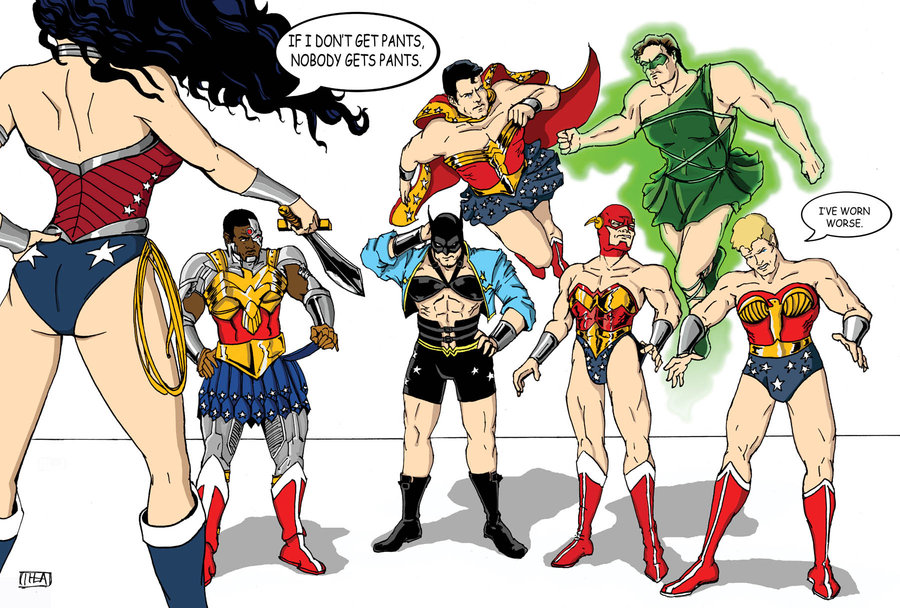
Hey, kids, meet Wonder Woman, one of the few female superheroes.
Which one of these LEGO minifigs is not like the other? Why do you think the most powerful and famous female superhero is shown in her underwear?
(Read more about about sexism marketed to kids through LEGO sets here.)
The first time I showed Wonder Woman to my daughter (the Lynda Carter TV series) she was five years old. She asked me: “Why is she in her underwear?” This was pre-Reel Girl, and I hadn’t even noticed. Women shown in their underwear in the media was so normal to me. How long before my daughter stops noticing as well? Don’t we owe our kids more than programming yet another generation to accept these ridiculous gender roles as normal?
I finally finished The Golden Compass. This books features a couple of the most excellent female characters that I have ever read about. Lyra kicks ass. So does the witch queen, Serafina Pekkala.
About half way through the book, I posted on how all of the male characters were annoying me somewhat. Lyra was appearing to be too much of a Token Feisty for me, the lone female allowed to interact with several sexist groups: the Oxford scholars, the gyptians, and the bear community where the males are polygamists. Frustrated, I posted: Are there imaginary worlds where sexism doesn’t exist? Mrs. Coulter, the evil mother character, is powerful but she was also used to show how she was the exception to the other females in the story. It just irritates me that so often, when kids finally get to see a girl being brave, it’s woven into the narrative how she’s the exception of her gender.
But two things changed for me as a I read along to make me a die hard fan of The Golden Compass. The first is I absolutely fell in love Iorek Byrinson, the armored bear character. He’s male of course, but once he came on the scene, the book really came alive for me, and it kept getting better after that. Then came the witches. The witch clans are all female, magical, mysterious, and powerful.
While flying to the armored bear’s palace in a balloon through a starry, cold winter night guided by the witch queen, Lyra ask her: “Are there men witches, or only women?” Here is Serafina’s response:
There are men who serve us, like the consul at Trollesund. And there are men we take for lovers or husbands. You are so young, Lyra, too young to understand this, but I shall tell you anyway and you’ll understand later: men pass in front of our eyes like butterflies. creatures of a brief season. We love them; they are brave, powerful, beautiful, clever; and they die almost at once. They die so soon that our hearts are continually racked with pain. We bear their children who are witches if they are female, human if not; and then in a blink of an eye they are gone, felled, slain, lost. Our sons too. When a little boy is growing, he thinks he is immortal. His mother knows he isn’t. each time become more painful until finally your heart is broken. Perhaps that is when Yambe-Akka coems for you. She is older than the tundra. Perhaps for her, witches lives are as brief as men’s are to us.
Wow, how’s that for an alternate narrative? Clearly, Serafina Pekkala needs her own series. And I no longer mind polygamous bears when kids get to see females in power too.
As you read this book, the writing gets better and better until the end (not the movie ending, the book ending; they are different) which is so dazzling and stunning, it gave me chills.