Time Magazine is reporting that new research shows “preschool girls are 16% less likely than boys their age to be taken outside by their parents to play.”
This is a fascinating article and you should read it. It speaks a lot to parents expectations of their children. I really think that parents still have drastically different expectations for their daughters than sons.
How to change that? Try to be aware of how your expectations are gendered, even if you think they’re not. Try to be more open. For moms, that may mean going out of your comfort zone. Sign your daughter up for a class where someone else will challenge her in a way that maybe you can’t, in a way that she isn’t used to. Get excited about whatever that class/ skill is. Parenting is so challenging but be careful not reinforce stereotypical “feminine” qualities that are useful to you because they make your kid easy to parent. Get your daughter used to healthy risk taking, speaking out, using her body, and most importantly, trying new things. Be careful not to pigeonhole your kids: the smart one, the athletic one, the artsy one etc. Kids are changing, even their taste buds are constantly changing. Obviously, parents want to hep kids establish a strong identity but pigeonholing is limiting.
To anyone who thinks this S & M-M & M is outdated because it’s from a few years back:
Here is Ms. Brown on back cover of the 2012 Sports Illustrated swimsuit issue:
To anyone who thinks that I just have a dirty mind and there’s nothing sexualized about M & Ms for God’s sake, here is how Sports Illustrated promotes the ad on its own Facebook page: Sports Illustrated Swimsuit: “Did you see the sexy Ms. Brown made the cover of the Swimsuit issue again!? Welllll, the back cover; Check her out.”
Keep in mind that Ms. Brown is the new female, that before her debut on TV during this year’s Superbowl, even Time Magazine called the animated M & M characters “male-centric.” Ms. Brown has since been called the feminist M & M (as opposed to the boy-crazy Ms. Green.) Brown wears glasses (that means she’s smart!) and tweets empowering messages about women’s issues.
So why is our token feminist character peeking out the window with kissy-lips waving a towel (implying she’d naked, I guess?) on the back cover of SI, so in full view of any kid whose parents have this magazine at home?
Why does M & Ms have to sexualize its female cartoon characters? Before Ms. Brown, there was only one female out of five; now there are 2 out of 6, and this is what M & Ms does to them? These cartoon characters appear in toys, games, and in full size at CVS and Party City stores.
Why are we allowing these stereotypes to sell sexism to kids in any available blank space? If M & Ms promoted racial stereotypes, there would outrage. Parents, this is not OK.
Please go to M & Ms Facebook page and tell the company to stop sexualizing females. As I posted earlier, the M &Ms marketing strategy is just as sick as using a cartoon camel to sell cigarettes to kids.
Update: I am getting comments that the M & M pictured above is actually Ms. Green, that green thing she’s waving? It’s her shell which she has stripped off and is waving to show that she’s naked. I have seriously lost my appetite for M & Ms. Gross. Thoughts?
Wow, so many commenters are upset that I described Cutlass Liz’s breasts as “beach ball” when clearly, her breasts are not large enough to beach balls. I was referring not to size but shape; they are ball-like. Perhaps baseballs would’ve been a better simile. Of course, my point here guys, is that in “Pirates!” one of the very few female characters in the movie is sexualized and that sucks for kids, especially girls, who go to see this movie.
Secondly, people keep writing that there are no female pirates in real life. I have answered this so many times before but here I go again: Who gives a shit? In the animated world, toys come to life, rats cook, and lions befriend warthogs. Why when it comes to gender roles do people suddenly become so dedicated to depicting a sexist “reality?”
Update: People are already sending me lists of female pirates in real life. Thank you! I think the commenters would still say the majority of pirates are male, therefore the majority of male pirates in the movie is accurate. To which I still say, who cares? Be creative, people! Isn’t that what you get paid for?
And that’s not just some crazy notion. Being “beautiful” for a woman has come to mean being successful, powerful, or important; being “beautiful” in our culture means that you exist. If you are “beautiful,” there is the promise that things will happen in your life: you will have adventures, excitement, love, and admiration. If you are fat, you may as well be invisible, right? I get that. You want your daughter to be popular, you want her to have friends, you want to spare her unhappiness.
But here’s the problem. It’s all a big lie, because what’s really happening is that you’re setting Bea up for a lifetime of enduring a distorted relationship with food, you, her own body, success, competition, power, and love.
You write that as a child, you suffered through your own issues of food, eating, and weight. That you hated your body and spent an inordinate amount of time trying to change it. Even now, you write: “I have not ingested any food, looked at a restaurant menu, or been sick to the point of vomiting without silently launching a complicated mental algorithm about how it will affect my weight.”
It’s clear from your article that you have an eating disorder. You are still sick. In your NYC subculture, your behavior may even be “normal,” but it’s not healthy. You’re obsessed with food and weight. Your disease is contagious, and you’re passing it onto your daughter. The best way for you to help Bea is to stop focusing on her and start focusing on getting yourself better.
I know you have a book deal now. It’s going to be so damaging to Bea if you keep writing about her weight publicly this way. If you are really going to write that book, please consider really researching this topic. There is an excellent book called Preventing Childhood Eating Disorders by Jane Hirschmann. The whole book is about intuitive eating: letting kids eat what they want, when they want. It would be a great program for Bea. They also help adults. Jane Hirschmann is based in NYC.
You write in Vogue that when you could totally control your daughter’s eating, up until age three, she was fine. “The world of sweets and junk food from which she has been shielded, was now available to her at social gatherings and there wasn’t anything she didn’t absolutely love eating.”
When candy and sugar came into her world, all hell broke loose. But, of course it did. She’d never seen it before. All of your anxiety and control around food would make any kid want to break free.
The Hirschmann book teaches you how to do something completely different than monitoring your kid’s every mouthful. It teaches parents how to let their kids trust their own bodies. And once kids get to do this, the practice goes much deeper than trusting their bodies: it becomes about trusting their intuition, themselves, looking inward for guidance instead of outward for direction and approval.
One of the many things you worry about is Halloween: “Who’s informing parents of treats distributed on Halloween?”
What if no one is? My kids are allowed to eat candy whenever they want, all year long. Halloween is not a big deal to them. They eat a couple candies and forget about it. Candy is not forbidden to them. It is not a prize or a reward. It’s not even a dessert. I learned all of this from Hirschmann’s book, and it works so well.
Hirschmann also wrote a book for adults that I used to get better from bulimia (along with a program in San Rafael, CA called Beyond Hunger which is similar to Hirschmann’s program in NYC) I am 100% cured from my eating disorder. I am not “sick for life” as I was told I would be by so many therapists. Now I never think about food except when I’m hungry. I eat whatever I want. My weight is normal. After I had three daughters, I wanted to make sure not to pass any sickness I may not have been aware of onto them; I am bringing them up based on Hirschmann’s book, and I’ve written about this extensively on my blog.
In Vogue, you write: “And so Bea wouldn’t feel isolated with her comparatively meager lunch, I joined her, eating exactly what she did.”
Your identity is completely entwined with your daughter’s through food. What about what you want to eat? What you’re hungry for? Eating your daughter’s food and portions is not good for you; it won’t protect her or help her. It will confuse her.
You write about Bea: “Sometimes she cheated and ate what she wasn’t supposed to. And sometimes she lied about it, such as the time she assured me she’d only had one slice of pizza at school, only to confess several days later that it had been three…I once reproachfully deprived Bea of her dinner after learning that her observation of French Heritage Day at school involved nearly 800 calories…I stopped letting her enjoy Pizza Fridays when she admitted to adding a corn salad as a side dish one week…I cringe when I recall the many times I had it out with Bea over a snack given to her by a friend or a friend’s parent or caretaker… rather than direct my irritation at the caregiver I often derided Bea for not refusing the appropriate snack.”
Bea is seeking approval and love from you through what she eats and what she tells you about what she eats. She is also using food to rebel against you. This kind of behavior is dangerous, and it’s at the heart of the sickness. Her eating disorder is not about food; it’s about her relationship with you.
You write: “The struggle is not over. I don’t think it will ever be, for either of us.”
But it can be, if you get yourself better, for her, at least. You don’t need to live with your food obsession for the rest of your life.
You write (italics mine): “As a result of our amazing efforts over the past year, Bea showed up at her doctor’s office for her eight year check up sixteen pounds lighter and almost two inches taller. She is now at a healthy weight and seems to takes enormous pride in her appearance.”
Is that really an accomplishment? That she takes “enormous pride” in her appearance? She is being set up for a life of rating her success, value, and her mother’s love for her based on what she eats, what she weighs, and how she looks. Again, is Bea’s weight about Bea or about you?
You end your article with this:
For Bea, the achievement is bittersweet. When I asks her if she likes how she looks now, if she’s proud of what she’s accomplished, she says yes. We’ve celebrated with the purchase of many new dresses. And when she officially reached her goal, I took her to a salon and let her get feather hair extentsions as a reward, a trend I’d staunchly resisted. Even so, the person she used to be still weighs in her. Tears of pain filed her eyes as she reflected on her yearlong journey. ‘That’s still me,’ she said. ‘I’m not a different person because I lost sixteen pounds.’ I protest that indeed she is different. At this moment, the fat girls is a thing of the past. A tear rolls down her beautiful cheek, past the glued in feather. ‘Just because its in the past, she says, ‘doesn’t mean it didn’t happen.’
Though Bea lost weight, your obsession with that is making her unhealthy in a multitude of other ways. What would happen if you risked letting that obsession go?
Again, I know you love your daughter. I know you’ve been criticized for what you’ve done, and that it seems like everyone is always telling mothers what to do; we can’t get it right no matter what. But I’m writing you because you wrote about this publicly and from your article, it is so obvious to me, as someone who has recovered from an eating disorder and also has three daughters, what is happening. Please at least, check out the book and see what you think of it.
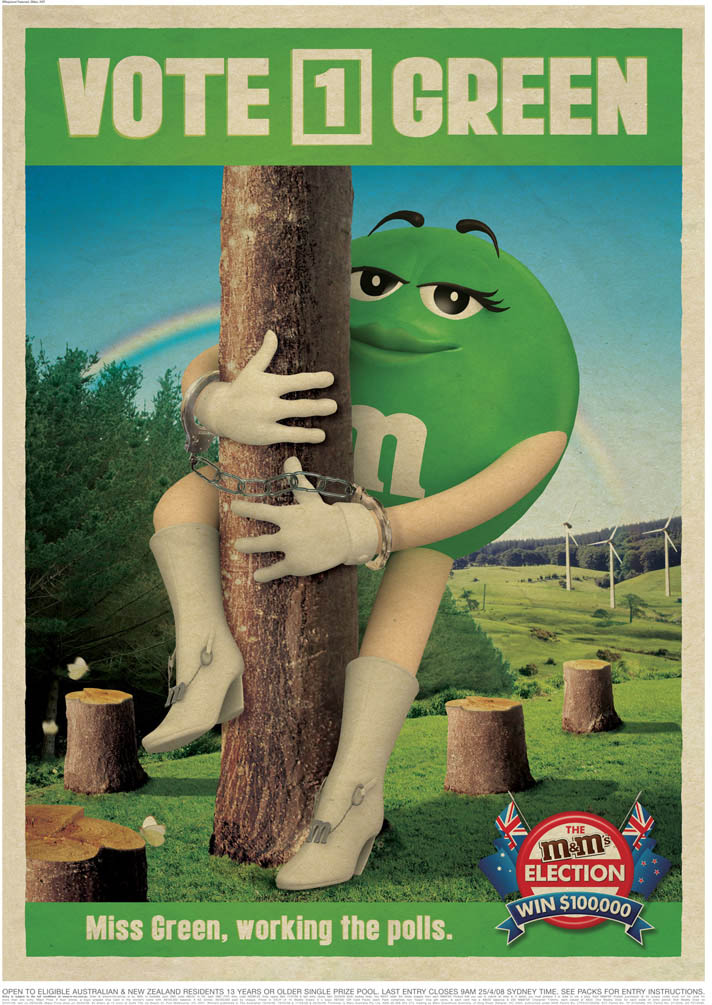
Go go boots and handcuffs? Straddling a tree “working the polls?” Ugh.
This ad is from a few years ago. Times have changed. Now she’s Ms. Green. Whoo-hoo. Here’s a recent pic from Sports Illustrated, guess what themed issue?
Male M&Ms, on the other hand, get to wear sneakers and act goofy.
Ms. Green is everywhere: on TV, at Party City stores, in toys, games, magazines, and billboards. There is no way to protect our kids from seeing this offensive stereotype. Not to mention it’s candy marketed to kids.
Please go to M&Ms Facebook page and ask them to stop sexualizing female M & Ms. Our kids deserve more than to see females depicted in this degrading way.
“I’ll bet you money that if he didn’t have that hoodie on, that nutty neighborhood watch guy wouldn’t have responded in that violent and aggressive way,” Rivera said.
Geraldo, I’m a 5’3 white female. Do you think if I were wearing a hoodie, someone would think I was a menace and shoot me? If I were wearing a short skirt and heels, someone might rape me. African-Americans and women really ought to choose clothing more carefully.
I just saw it. LOVED it! The acting is so great. It is perfectly cast from Jennifer Lawrence as Katniss to Wes Bentley as the gamemaker to Donald Sutherland as President Snow.
I was concerned that Hollywood would mess up the book somehow, but I was so impressed with this adaptation. Here are some aspects of the movie that I was especially grateful for:
Hollywood does not sexualize Jennifer Lawrence’s Katniss in any way: When I was reading the book and came across certain scenes, I was sure this would happen. When Katniss strips down before she meets her stylist, Cinna (another perfect casting, played by Lenny Kravitz) I thought to myself: Here’s where they’re going to show her naked. But they didn’t. Not even a bare shouldered camera shot to hint at nudity. In that particular scene, she’s shown wearing a hospital gown. In the book, where a female tribute traces Katniss’s lips with her knife, I thought: In the movie, there’s going to be some kind of S & M lesbian vibe going on. Negative thoughts, I know, but so many great books have been ruined on the screen. Turns out, in the movie this knife scene is only frightening.
They are an equal number of male and female tributes: A male and female are chosen from each district. I thought about this because when I get upset about the lack of females in Hollywood roles, I get comments all the time like: Do you want equal rights in drafting? Do you want equal rights for characters who play dumb people? Yes and yes. I’m against drafting, but also against men being drafted and not women. As far as men playing more dumb people (I just got this comment again in response to my criticism about the lack of female characters in the upcoming, animated “Pirates!”) I don’t want females to be only portrayed as smart, brave heroines. Women are no better than men. I want women portrayed as the complex characters that they are. In movies, often different character traits get assigned to different characters. I want women to get to play all the parts. I want women to exist. In “The Hunger Games” females span the spectrum: they are lethal, kind, cruel, weak, brave, shy, serious, superficial and complicated.
There is no mention in the movie that Katniss is the exception of her gender: So often when you see a female protagonist who you could call a feminist, she is portrayed as the exception of her gender. You’ll see her surrounded by males or even see her dressed up as a male, Mulan style. I don’t mind this once in a while, but it happens too often. Never in “The Hunger Games” does any character say that Katniss can fight as well as a boy, is as smart as a boy, acts like a boy, or can do anything a boy can. No character reacts to her skill or bravery with: “Wow, a girl can shoot!” In this way, “The Hunger Games” breaks free of Hollywood’s gender matrix to create a truly feminist movie.
Females work together to save each other: It is so rare in Hollywood to get to see two females in an action adventure movie act bravely in order to save each other. The scenes with Katniss and Rue were my favorite in the book and my favorite in the movie. (Part of what is so great about these scenes is also the lethal Tracker Jackers, genetically engineered wasps whose poison stings make the victim go mad with hallucinations before she dies.)
Besides my own personal feminist take on everything, this is such a great movie. All of the acting was impressive. I’d read the book so I knew what was going to happen, and I was still on the edge of my seat. The filming was engrossing, it was done with lots of close camera shots; everything seemed so close and real, it was terrifying. I loved the scenery, watching how the Capital was depicted as well as the Districts and the arena. The whole commentary on reality TV and selling out to please the crowd is well communicated. Hollywood added just a little more perspective from the Gamemakers than is in the book, and I thought those scenes were also really well done. If you’re concerned about violence, the movie is not gory. Also, please remember that violence in the imaginary world is metaphorical. Don’t take that metaphor away from females. Katniss shows us how to be a survivor without losing your soul, how to play to win but keep your morals. That’s a universal, human lesson. Katniss is a great heroine, a modern day Artemis. I can’t wait for the next two movies.
Reel Girls rates “The Hunger Games” ***HHH*** (I’m replacing Gs for Girlpower with H for Heroine in Reel Girls’ rating system. Girlpower seems over used and to have lost its meaning to me; I’ll change it throughout Reel Girl when I get a chance)
So why is this cover claiming women are “The Richer Sex” coming out right when America seems to be finally catching on that women’s rights are under attack?
The spin on this article is pretty brilliant. From the cover, you can tell it’s not going to be that “women are achieving so much, so fast that males are the ones who need support.” No, it’s going to be that “women are achieving so much so fast, getting so very rich, becoming richer than men, and that’s good for men!” That way, feminists are supposed to be grateful for Time’s piece and somehow not notice that a national news magazine’s cover is actually referring to women as the richer sex. WTF?
I will read this article and see why the cover reads: “Women are overtaking men as America’s breadwinners” because right now I say BULLSHIT! There you have it in writing.
Not long after preschool started, the second someone would see her, my daughter, just like her two sisters before her, would immediately rip off her sweatshirt as if she were Wonder Woman, exposing her cuteness to be admired by all. Everyone wants to be admired, right? That’s human. What isn’t OK is for girls to funnel so much of that desire for attention and admiration, for success and achievement through their appearance. My God, the training starts young.
So this is my third daughter that I’ve been through this pre-school/ dress obsession metamorphosis with. I’ve tried so many things: not putting them in dresses which led to tantrums. (These kids are smart. They know what’s happening. No one is going to take away the spotlight.) I tried deflecting comments from grown ups which can lead to awkward silences and confusion. I tried having adult conversations with my daughter that there was no way she could understand.
Then, something amazing happened. My washing machine broke down. Unable to wash many clothes, I let my daughter pick her favorites and made sure to keep those clean. When my daughter wore the same three or four dresses, her VERY favorites, over and over for three weeks, her teachers, the other moms, everyone stopped telling her how cute her dress was all the time. People started thinking of other things to say when they saw her in the morning. Truly. And my kid is still thrilled to be in her favorite duds; she hasn’t figured out that she’s got to have variety to get the same people to ooh and aaah. Hee hee.
This is the first tactic that has ever worked for me. So here’s my suggestion: let your daughter pick out her absolute favorites and keep them in a tight rotation. People might feel sorry for your kid, wish she had more clothes, think you’re a bad mom, but this is all good. It further inspires them to come up with other ways to make your daughter feel good. People are not trying to hurt your daughter, their intentions are good; they just want to be nice. I think that may be why this strategy works so well.