Thank you, Daisy Coleman, for telling your own story.
Please read Coleman’s story and share it. And then ask yourself, what happens when women tell the truth about their lives? How could the world change?
Whether a woman tells her story or not is her choice, but how much of a “choice” does she really have? I wrote “The shame of rape” on this topic for Salon. Ten years later, in too much media and public opinion, shame still goes to the wrong person.
When will we learn to honor rape survivors as the heroes that they are instead of shaming them into silence?
When 7-year-old Erica Pratt was abducted on July 22 and tied up in a basement by her kidnapper, she chewed through the duct tape that covered her mouth, freed her hands and feet, and broke through a door to escape. Electrified by the young girl’s feat, the media celebrated Pratt with a prolonged blitz of coverage. She smiled luminously for cameras as awed police officers praised her bravery. Her photo graced the front pages of newspapers across the nation, and she was named Time magazine’s “Person of the Week.”
When Tamara Brooks and Jacqueline Marris were abducted at gunpoint nine days later from a remote teenage trysting spot in Lancaster, Calif., they devised a plan to break free by stabbing their abductor in the neck. When one girl had the chance to escape, she didn’t take it for fear that the other girl — whom she hadn’t met before that night — would be killed if she abandoned her. These were brave and loyal girls — heroines who endured mind-numbing terror before police found them and killed their captor, who authorities believe was preparing to murder them and dump their bodies.
But Brooks and Marris were not honored by Time magazine or identified as heroes in other media outlets. Why not? What made their story so different?
Just as newspapers and the networks were scrambling to cover the story, they learned that the girls had been sexually assaulted during their ordeal. Because most mainstream media observes a self-imposed policy of withholding the names and faces of sexual assault victims, the coverage abruptly, and somewhat awkwardly, ground to a halt.
Newspapers and TV broadcasters explained the shift as a matter of courtesy. But in concealing the identities of the young women on the grounds that rape is so intimate and horrendous that they should be spared undue attention, the media helped to promote the unspoken societal belief that somehow, when sexual assault is involved, the victim is partly — or wholly — to blame, and should be hidden from view.
TV stations began digitally obscuring the girls’ faces. Newspapers like the New York Times rushed to delete the names and photos of the girls from the next day’s paper. Some publications, like USA Today, had already gone to press, and printed the story with photos and names on the front page.
The lopsided coverage was especially disorienting because early in the story, the girls’ identities were broadcast everywhere — constantly — as a means of saving their lives. The idea was to familiarize as many Americans as possible with the girls’ names and faces so that average citizens might assist in tracking them, and their kidnapper, down. And it worked. But once the teens went from being kidnapped youths to rescued rape survivors, their status changed. They were branded with the Scarlet R. They had been raped. It was suddenly better for them, and us, to contemplate this shame without fanfare.
In effect, the girls disappeared twice — once when abducted, and again when the media erased them.
The policy of hiding the rape survivor makes the media complicit in shaming and stigmatizing her. It reinforces the myth that women are too weak, traumatized and tainted to decide whether they want to tell their own stories — of victory, not victimhood. And this assumption becomes a self-fulfilling prophecy. If raped women were granted the same status as Erica Pratt, there would be no reflex to make them disappear. Their survival would be cause for public honor and respect. Their rescues would be complete; their recovery would begin with heartfelt acceptance by everyone who prayed for their return.
Silence and shame protected the Catholic Church and one of its dirtiest secrets for years. And church officials made the right assumption: If you can’t see it, no one will believe it is happening and, more importantly, victims who are shamed and controlled will be quiet, silenced by a sense of complicity and sin. What if all those alleged male sexual assault survivors who went on “60 Minutes” and “20/20″ had their faces covered with a gray dot? What if no newspapers or magazines had been willing to publish their names? How much credibility or validity or power can you have when you have no face and no name? Would the public have believed these things had happened if faces had not been attached to the charges?
You can’t put a faceless woman on the cover of Time magazine.
Not all rape survivors take the media’s cue and withdraw. Many have told their stories as part of their recovery, most famously authors like Maya Angelou in “I Know Why the Caged Bird Sings” and Dorothy Allison (“Bastard Out of Carolina”), and singers including Fiona Apple and Tori Amos. Current bestselling author Alice Sebold has said repeatedly in interviews that she could not have written “The Lovely Bones” until she wrote the story of her rape in her first book, “Lucky.”
With each of these acts of bravery has come further acknowledgment that rape is a horrible event and that everyone abhors it, yet hypocrisy — public and institutional — still exists. Rapists are rarely successfully prosecuted. For every 100 rapes reported in this country, only five rapists end up in prison. Sentences are relatively light, averaging just 10.5 years, and the usual time served is approximately five years.
U.S. Attorney General John Ashcroft doesn’t support the notion that a raped woman should have the right to an abortion. And U.S. foreign policy does not include sanctions, even strongly stated warnings, against countries like Saudi Arabia where men are allowed to rape their wives, and married women raped by men other than their spouses are punished for adultery. In Pakistan, when a young woman was ordered raped by a tribal council as punishment when her brother was seen in public with a woman not in his family, the U.S. State Department took no action.
At the same time that it is no longer socially acceptable to blame or stigmatize a rape survivor for what has happened to her, it appears to be socially unacceptable to recognize her as a hero and honor her for survival. But that may be about to change, thanks, in large part, to Marris and Brooks, two rape survivors who demanded to be seen.
A day after she was rescued and her identity had been quickly masked in the media, Marris appeared on KABC, the local Los Angeles news station, to talk frankly, without embarrassment, about her ordeal. She revealed, among other details, the fact that she and Brooks had tried to escape by stabbing their abductor in the neck.
A few days later, Brooks and Marris both appeared on the “Today” show to tell the story of their capture and captivity, a gripping account in which they described being threatened with a loaded gun, smashing their abductor in the face with a whiskey bottle, and later watching him die.
When asked why they chose to talk about their experience, Brooks said that she wanted to do it, and came forward with the support of her parents, who braved some criticism about the decision. She and Marris, Brooks said, “want to get the message across to everybody to never give up on anything. If you ever give up, you’ve lost. Whatever obstacles you have, you’ve got to fight your way through it.”
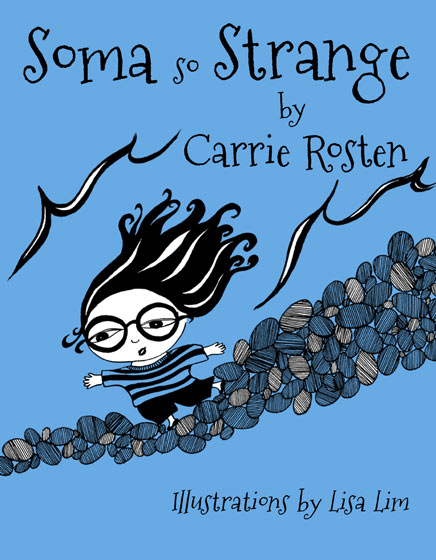
With the fabulous book, Soma So Strange, not only did I read a cool story starring a fascinating girl, but I finally got past my ebook block. YAY. I’ve been trying to liberate myself for years, and Soma is only an ebook, so if I wanted to read it, I had no choice but to break free of paper.
Soma lives is a dull, small place, “on a map, it’s the size of a sixth of a pea” where “all the villagers obey ancient, old rules/ Like walking on tip toes and eating fish and gruel.” Soma loves sushi, “she can’t stand fish and gruel!” For this, and many other “strange” attributes, Soma is mocked. “She can’t help but make noise at her school. Asking how and why are quite natural for her. Tip toe around? Stompin’s what she prefers.”
Not only do the townspeople, the Meanies, treat Soma terribly, but her own mother “can’t stand her.” I love this aspect of Soma’s story, because, though lots of children’s narratives refer to mean kids, fewer refer to the feeling of being a stranger in your own family which can be more common than kidlit lets on.
Soma’s physical differences match her mental ones: “Her glasses are funny, she won’t brush her hair/ When she walks into town, you can’t help but stare/ Soma’s so messy, so odd-shaped, so strange, the Meanies say Soma is simply deranged.”
Soma goes on to meet a talking cat who gives her a magical potion allowing her to turn the Meanines into pies. How cool is that?
The lyrics in Soma are beautiful and well, strange. Reading this story, I felt like I’d found a feminist Dr. Seuss or Shel Silverstein. I love look of Soma, too, with her billowy dark hair, striped shirt, and big glasses. The black and white illustrations pop. Not to mention, reading an ebook is really fun. The pages turn beautifully. My kids loved the story and reading it on my ipad too. Here’s to hoping author, Carrie Rosten, writes many more.
Click here to buy Soma So Strange and use the code SomaFam to get a dollar off.
Read more about Soma So Strange and author Carrie Rosten here.
For the past couple of years, people have been recommending I see “Soul Surfer,” the real life story of champion girl surfer, Bethany Hamilton, who resurrected her career after her arm was bit off by a shark.
I delayed seeing the movie because I wasn’t sure at what age my kids would be ready to see a shark attack. I remember being traumatized by “Jaws,” and it’s hard enough to get them in the ocean. But I was in a store– I think it was Office Depot– and there was the DVD, and I bought it.
I told my oldest daughter Bethany’s story, she is 10, and planned to watch it with her. My husband, who is into surfing, sat down with us. My two younger daughters, usually not interested in what my 10 year old is watching, couldn’t resist seeing their parents captivated by something and joined the party.
I love the movie. It’s all about competition, winning, excelling, resilience, faith, and love. The montage at the end showing real life Bethany Hamilton will make you cry. It is so amazing. Here she is in real life.
But watching the montage won’t be the first time you cry during this movie. My babysitter texted me when my kids were seeing it for the third time: “I’m in tears!”
So what age do I recommend “Soul Surfer” for? My 4 year old daughter can’t get enough of the movie. Her favorite part is the shark attack– which is very quick. I actually think it’s scarier waiting for the attack then the actual attack. My 7 year old daughter kept glaring at me through the whole movie, furious that I “made” her watch it, but she never left the couch. She has watched it twice since but says she hates it. My 10 year old daughter likes it as well, but not as much as my 4 year old. I don’t really know what to say, except to tell you our experience. “Soul Surfer” is the first movie that my whole family has watched together, fro beginning to end, and all of us were into it. That was so much fun, by the way. I loved everyone sitting together, watching a movie. It is the best feeling.
Jon Stewart asks Malala Yousafzai, the 16 yr old activist for girls education who was shot in the head by the Taliban, how she found the courage to speak out. She replies:
Why should I wait for someone else? Why should I be looking to the government, to the army, that they would help us. Why don’t I raise my voice? Why don’t we speak up for our rights? The girls of Swat, they spoke up for their rights. I started writing daily. I spoke out on every media channel that I could, and I raised my voice on every platform that I could. I said I need to tell the world what is happening in Swat.
Malala didn’t wait around for someone to else to tell her story for her. She rescued herself through the act of writing and speaking. She risked telling the truth about her life and telling it publicly, and in doing so, she is changing the world. Please show this video to your children and teach them to do the same. I can’t wait to get Malala’s book and show it to my daughters as well.
In the last few months, I was able to finally finish the Harry Potter series, then the Hunger Games series, and last night, finally, Kristen Cashore’s excellent trilogy: Graceling, Fire, and Bitterblue.
I love this series. Every book stars a brave and complex female protagonist. Every book also features a panoply of strong and fascinating female characters. Females are spies, fighters, queens, healers, on and on. There are also great male characters. The books also have heroic gay characters and disabled characters.
These books are disturbing. They deal with rape and incest, not directly, but implied and discussed in the book. If the reader doesn’t get the horror of those acts, she misses a lot of the story. Also, each book features a passionate love affair. My oldest kid is 10, and I would not let her read these because of the rape/ incest parts of the story. I don’t yet know what age would be appropriate because I’ve learned not to trust the recommendations I see around. In fact, that’s why I started Reel Girl. IMO, Cinderella gets a triple S for major gender stereotyping/ not appropriate for kids. I’m thinking 15 for Bitterblue because the sexual violence is central to the plot, but Graceling and Fire, age 12? But then again, rape and incest happen in the real world, so if this is going on or has happened in kids’ lives, reading about it would be a good thing. It’s such an individual choice. Let me know if you or your kids have any experience with these books.
Reel Girl rates Graceling, Fire, and Bitterblue ***HHH****
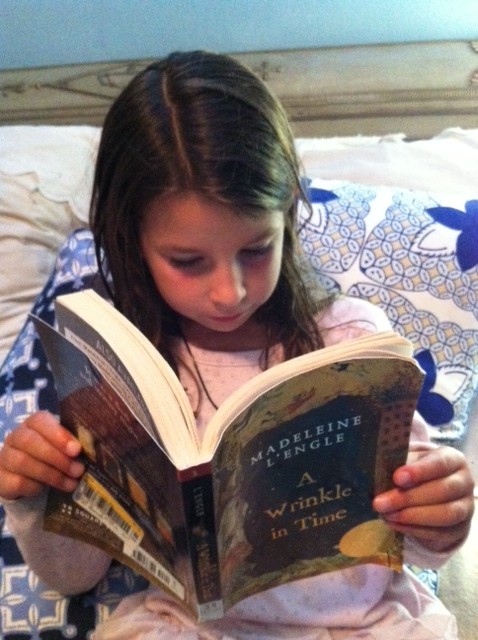
I just finished A Wrinkle in Time, and I have chills. This is the book I have been waiting to read. Not only do I love the story and the characters, but it’s beautifully written.
So many books I love with strong female protagonists like The Wizard of Oz, Lion, the Witch and the Wardrobe, Alice and Wonderland, The Golden Compass, surround the girl with males, males, males. So many writers seem comfortable allowing a female be powerful as long as her gender is resresented by a minority of characters in the book. Not so with Wrinkle. Not only do we have Meg, but also Meg’s mother, a scientist. Wrinkle is, in fact, all about science. How cool is that?
Besides Meg’s mother, there is a trio of powerful and magical females: Mrs. Whatsit, Mrs. Who, and Mrs. Which. That’s not all. Near the end of the book we meet another amazing female, the incredible Aunt Beast. In Wrinkle in Time, readers see five powerful females mentor a female protagonist. Does anyone know of another narrative on earth where we see this? If so, please tell me, because from my experience, this scenario is like seeing a unicorn in the real world.
Here’s the passage where Aunt Beast names herself for Meg:
“What should I call you, please?” Meg asked.
“Well, now. First, try not to say any words for a moment. Think within your own mind. Think of all the things you call people, different kinds of people.”
While Meg thought, the beast murmured to her gently. “No, mother is a special,a one-name; and a father you have here. Not just friend, nor teacher, nor brother, nor sister. What is acquaintance? What a funny, hard word. Aunt. Maybe. Yes, perhaps that will do. And you think of such odd words about me. Thing, and monster! Monster, what a horrid sort of word. I really do not think I a am a monster. Beast. That will do. Aunt Beast.“
Part of what I love about this passage is that every writer goes through a similar process as she thinks of how to name a character. So often, a writer will assign this kind of powerful character the male gender, but the character could be any gender as this writing shows.
For much of Wrinkle, there is the typical one female (Meg) to two male (Charles Wallace and Calvin) trio. But given all the female characters in the book, Meg is still, not a Minority Feisty.
Narratives mimic real life and real life mimics narratives, it’s all the same thing really. If we are willing to recognize it, we all get to the point where we realize we must do it alone. Sometimes that thing is dramatic, when we give birth or it could be when we write a novel or when we confront someone we’ve been afraid to. But it can also be something like cleaning your house or making your bed. If you live your life heroically, realizing only you can do it, happens all the time, without resentment but with a sense of destiny. It is this revelation upon which endless narratives are based, but so often, in fiction, this human situation is assigned to males. I just wrote about an exception to this rule in Land of Stories. Here it is in Wrinkle the whole sequence: Someone else do it, I can’t; okay, I will. I must be me, here I go. Resistance, choice, action:
Meg could no longer stand it,and she cried out desparingly, “Then what are you going to do? Are you just going to throw Charles Wallace away?”
Mrs Which’s voice rolled formidably across the hall. “Ssilencce cchilldd.”
But Meg could not be silent. She pressed closely against Aunt Beast, but Aunt Beast did not put the protecting tentacles around her. “I can’t go!” Meg cried. “I can’t! You know I can’t.”
“Did annybbodyy ask yyou ttoo?” The grim voice made Meg’s skin prickle into gooseflesh.
She burst into tears. She started beating at Aunt Beast like a small child having a tantrum. Her tears rained down her face and spattered Aunt Beast’s fur. Aunt Beast stood quietly against the assault.
“All right, I’ll go!” Meg sobbed. “I know you want me to go!”
“We want nothing from you that you do without grace,” Mrs. Whatsit said, “or that you do without understanding.”
Meg’s tears stopped as abruptly as they had started. “But I do understand.” She felt tired and unexpectedly peaceful. Now the coldness that, under Aunt Beast’s ministrations, had left her body had also left her mind. She looked toward her father and her confused anger was gone and she felt only love and pride. She smiled at him, asking forgiveness, and then pressed up against Aunt Beast. This time Aunt Beast’s arms went around her.
Mrs. Which’s voice was grave. “Whatt ddoo yyou unnnddersstanndd?”
“That it has to be me. It can’t be anyone else. I don’t understand Charles, but he understands me. I’m the one who’s closets to him. Father’s been away for so long, since Charles Wallace was a baby. They don’t know each other. And Calvin’s only known Charles for such a little time. If it had been longer, then he would have been the one, but–oh, I see, I understand. It has to be me. There isn’t anyone else.”
In the passage where Meg fights IT, just as Harry Potter with Voledemort, she wins by using love over hate. This is the scene I was longing for in kidlit while reading all 7 of the Harry Potter series. Reading ‘A Wrinkle in Time’ felt, to me, like a starving person getting food.
Though Wrinkle is not without sexism. Here’s a scene from the planet Camazotz:
She walked along the quiet street. It was dark and the street was deserted. No children playing ball or skipping rope. No mother figures at the doors. No father figures returning from work.
There are other instances like that one, but there is so much positive here. Wrinkle is a writer’s book, too. I’ll leave you with one last passage that is one of the most beautiful metaphors for creativity, God, raising children, life, that I’ve ever read. Here’s Mrs Whatsit explaining a sonnet to Calvin.
“It is a very strict form of poetry, is it not?”
“Yes.”
“There are fourteen lines, I believe, all in iambic pentameter. That’s a very strict rhythm or meter, yes?”
“Yes,” Calvin nodded.
“And each line has to end with a rigid rhyme pattern. And if the poet does not do it exactly this way, it is not a sonnet, is it?”
“No.”
“But within this strict form, the poet has complete freedom to say whatever he wants, doesn’t he?”
“Yes,” Calvin nodded again.
The trick here, for me anyway, is figuring out what the form is. Sometimes, we believe that the “rules” are the rule, that they are “natural.” For example, in so many narratives for kids, not to mention adults, like Ratatouille, have seen a Minority Feisty complain about sexism, instead of getting to see a female hero. That is “rule” that desperately needs to be broken. The resistance, choice, action is a rule I believe in.
Many of you have asked me to clarify what ages books are appropriate for. It’s hard for me to say that. We get different things about books at different times.
When I look at books or movies for my kids, the number one offensive thing is sexism. I would rather my kids hear swear words than see Cinderella any day. I’ve also written quite a lot of Reel Girl about violence. I don’t like gore, but much of violence in stories is metaphorical, it raises the stakes to depict visually what we, as humans, feel. Can you imagine dreams without violence? My daughter whipped through Wrinkle in Time. She just turned 7. I’m 44 and I’m blogging about it. I could tell my daughter really liked it, and she read a lot of it by herself. I’m not sure what she ‘got.’ I remember being confused by parts of this book as a kid. I do know that while reading this book, my daughter saw many females being brave and heroic, respected, admired, and loved my the males in their lives.
I work for the American Psychological Association. This is my work project. This video titled, “GIRLS TALK: SEXUALIZATION OF GIRLS”, shows the reactions and commentary of 6 middle school girls towards various forms of media, pop culture, and people who are associated with or directly influenced by over-sexualization of girls.
Can you share with others?
I really like the video, and I’m happy Wolridge made it. It’s important to hear girls give their own point of view about what they see and experience in the media. These girls are smart, perceptive, and articulate. They also seem real and passionate, not rehearsed or coached. Watching the video, though, I still feel like these girls believe there is some “right” way that a woman should look. It kind of reminds me of how it makes my skin crawl when I hear people talk about how this movie star or that one is too skinny. I feel like responding to those kinds of comments, “Fuck you. Can you just stop talking about her size?” I understand the point of the focus on appearance in this video, but it still makes me sad that these girls have to spend so much time thinking about this. Maybe that’s part of what makes the video powerful but I wish the emphasis were addressed more directly. Michelle Obama is celebrated by the girls for looking “right.” It’s good to show examples of the positive but can you imagine Barack being celebrated for his outfits? I posted something on Reel Girl a while back from a Vanity Fair article by Michael Lewis where Obama actually says he only wears gray or blue suits because he doesn’t have the mental energy to focus on what he is wearing. I get that. Especially since I’ve become a mom, or maybe it’s also being in my 40s, but there is only so much brain power I have. There’s only so much time. I need to choose carefully what to focus my mental energy on. We all do.
And one more thing this video brought up for me. Sexuality is different from sexualization. I don’t know if these girls know that. I want to end this post with a quote from Peggy Orenstein on this issue. Hopefully, these girls will grow up into women who celebrate and honor their sexuality. Female sexuality should not be oppositional to being smart or successful. Females, like males, shouldn’t have to make that choice. These girls are too young to understand sexuality but I worry that sexualization has already become conflated with sexuality for them. Here’s the Peggy Orenestein quote:
“Let me be clear here: I object– strenuously– to the sexualization of girls but not necessarily to girls having sex. I expect and want my daughter to have a healthy, joyous erotic life before marriage. Long, long, long before marriage. I do, however, want her to understand why she’s doing it: not for someone else’s enjoyment, not to keep a boyfriend from leaving, not because everyone else is. I want her to explore and understand her body’s responses, her own pleasure, her own desire. I want her to be able to express her needs in a relationship, to say no when she needs to, to value reciprocity, and to experience true intimacy. The virgin/ whore cycle of the pop princesses, like so much of the girlie girl culture, pushes in the opposite direction, encouraging girls to view self-objectification as a feminist rite of passage.”
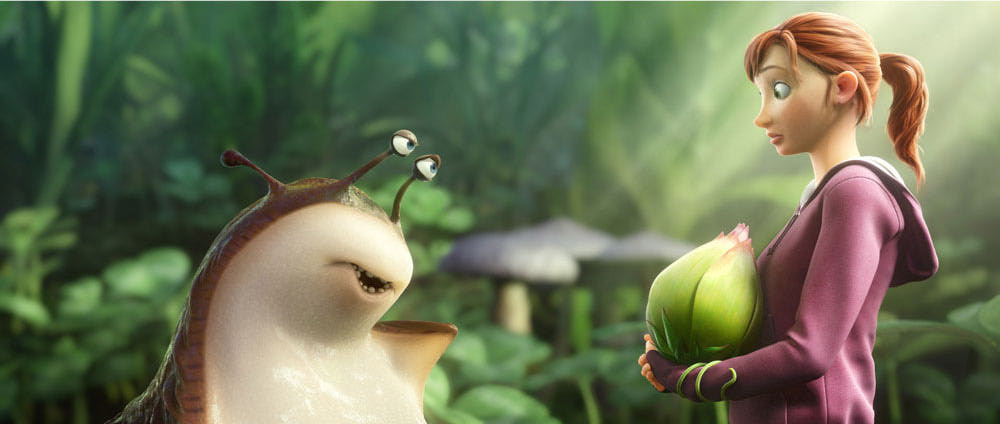
My three daughters and I loved “Epic.” The central heroine, M.K. is smart, brave, funny, compassionate, and independent. I loved her look, too. She’s dressed in a hoodie with a messy ponytail. She doesn’t have a Barbie face, I’d recognize this girl in a crowd.
M.K. narrates the movie. YAY. Do you know how rare it is to get a female narrator in an animated movie for children?
There’s more good news. Queen Tara is another brave, powerful female in this movie who is central to the narrative. Please note QUEEN, not princess. Not only that, GOOD queen, not evil. And…she’s not white. This may be a first, but let me know if there is another animated film with a good queen of color.
Queen Tara is played by Beyonce, and the movie concludes with an awesome song about the matriarchy. The matriarchy, people! It’s so fitting and perfect because the whole movie is about protecting the heir. I was super worried that the next ruler would be male, especially because the evil character, Mandrake, keeps referring to said heir as his “dark prince.” Luckily, the evil dude is wrong, and just after you find that out, the matriarchy song comes on. I laughed when I heard it because I felt like Beyonce was saying to me, “Don’t worry, Margot, I got the girls covered.”
I do have some complaints. I wish M.K. was in the movie more. Much more. You cannot deny she is the protagonist– she is the narrator, she has the quest, and she goes through the transition. M.K. acts, takes risks, and makes choices. She is such a great character, but based on lines and screen time, “Epic” is pretty much an ensemble movie. Most of the other characters are male. The Queen dies early. M.K.’s mother is also dead. The central relationship in the movie is with M.K. and her father.
The evil character is male and he has an evil son. M.K. pals around with two male heroes, so in most of the action scenes, the same old Minority Feisty gender ratio is in your face. Speaking of, M.K. is riding bitch most of the time. Her position “makes sense” in the story because she’s the visitor to the tiny world, but still, writers can make anything happen. I am sick of sexism making sense in plots, and I had hope for M.K. taking the lead here. At one point, she gamely hops on a bird and says, “Come on, let’s go!” Nod, the young male hero, hops on behind her, but in the following scenes, Nod is the one in the driver’s seat again. Argh.
There’s an army of Leafmen, and from what I could tell, they are, in fact, men: 100% male. Comic relief is a male slug and his BFF, a male snail. That pair kind of reminded me of the male krills who steal the show in “Happy Feet 2” or the meerkat/ warthog duo in “Lion King” and countless other cartoon buddy boys. It would be so nice to see a couple of females being friends and being funny in an animated movie.
Finally, I wrote I love M.K.’s look and I do, but both she and Queen Tara are super skinny, and why not give her a blue hoodie, or brown, or red, or any goddam color in the entire universe but pinkpurple?
M.K. is prominently featured on many of the posters seen around San Francisco, another total rarity for children’s movies. Though I didn’t see this one, I want to order it for my kids.
“As of today, Disney has quietly pulled the 2D image of Merida from its website, replacing it with the original Pixar version. Perhaps we’ll be spared an onslaught of sexy Merida merchandise yet.”
I guess Disney was right to be so terrified of creating a strong, BRAVE, female protagonist (along with Pixar studios which hadn’t had ANY female protags before “Brave.”) It looks like Merida could be turning Disney’s franchise on it’s head. That’s pretty damn heroic.
Another mistake Disney made with “Brave?” They hired a female director. They fired her, but it was too late. Brenda Chapman wrote “Brave” based on her daughter. She was furious with the character’s transformation and wrote publicly about Disney’s terrible mistake.
That’s right: Although Merida was created by a woman as a role model for girls, the male-dominated consumer product division at Disney has ignored the character’s intended benefits for young girls, sexualizing her for profit. Compared with her film counterpart, this new Merida is slimmer and bustier. She wears makeup, and her hair’s characteristic wildness is gone: It has been volumized and restyled with a texture more traditionally “pretty.” Furthermore, she is missing her signature bow, arrow, and quiver; instead, she wears a fashionable sash around her sparkly, off-the-shoulder gown. (As Peggy Orenstein noted when she broke the news of the redesign, “Moms tell me all the time that their preschool daughters are pitching fits and destroying their t-shirts because ‘princesses don’t cover their shoulders.’” I’ve heard the same from parents, as well.)
Is the sexualized image of Merida gone for good? Has Disney learned a lesson? Or will that lesson be: No more strong female characters leading a film! No more female directors writing about their daughters! Keep the females weak and quiet!
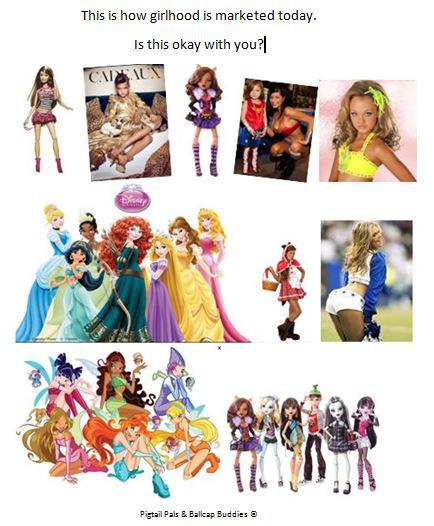
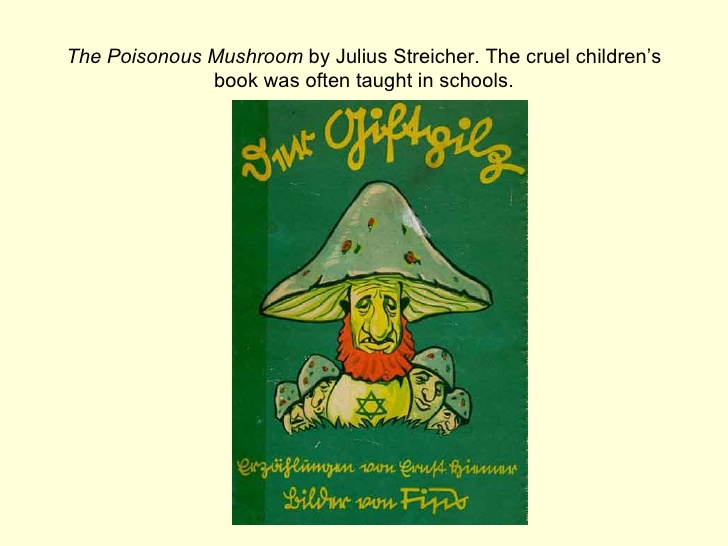
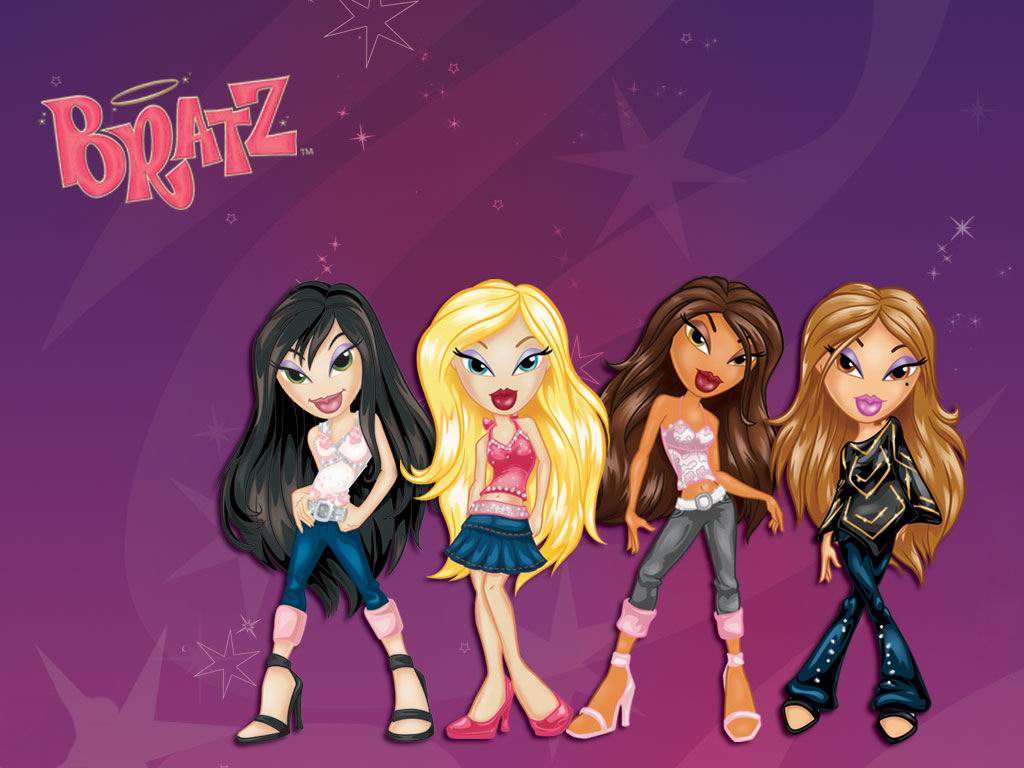
Objectifying and sexualizing girls is dangerous. A first step to abuse is always dehumanizing the victim. Propaganda, in the form of images and narratives, effectively dehumanizes on a mass scale.
Images/ narratives of Jews circa 1938
Africans circa 1931
Females circa 2013
It’s easy to look back on history and wonder: How did people ever put up with that? I’d never buy into it, not to mention expose my child to it. But what are you participating in right now that is completely accepted, not to mention celebrated, by our culture?
Be part of the solution. Demand narratives with strong female characters for your kids.
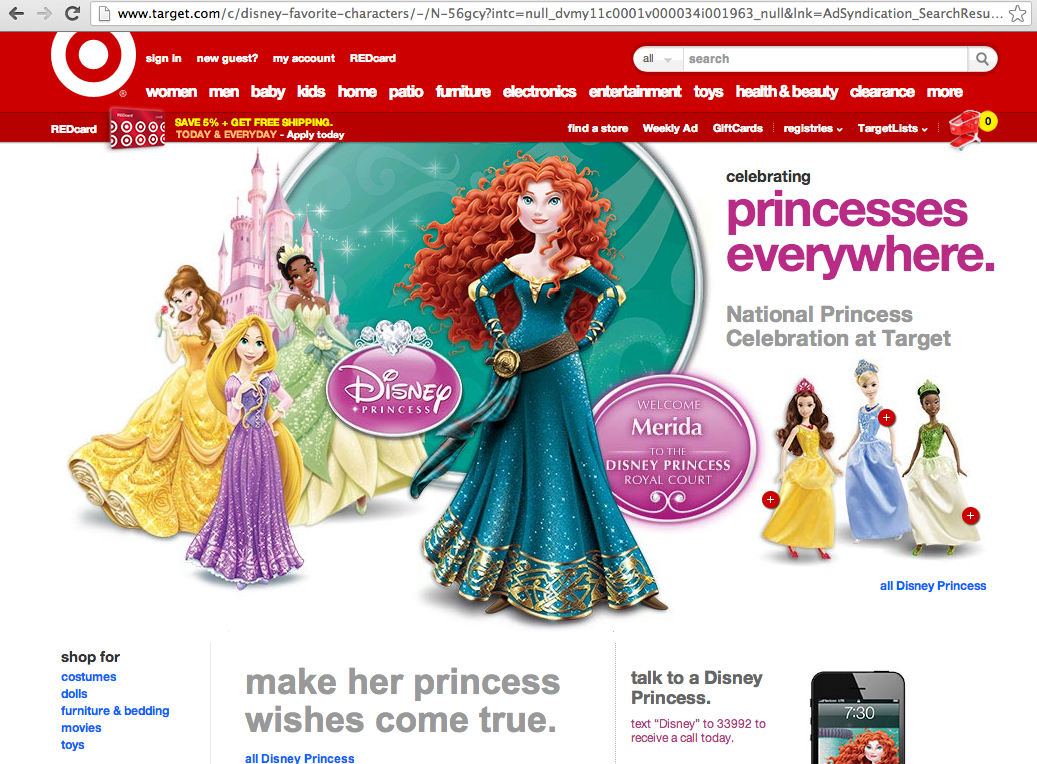
Update: New Merida may be off Disney’s site but she’s showing up all over the place including Target. Below is Target’s web page.
Since his daughter, Princess Merida, made national headlines with her makeover– she’s skinnier with tamed curls, a new off the shoulder gown, and the belt that once held her quiver has morphed into a fashion sash– King Fergus wants to know: “Where’s my makeover?”
Fergus says, “It’s not fair. I’m the King! Why are princesses always the ones who get to look pretty? Some would call me fat, hairy, and I’m missing a leg for goodness sake. Where’s my stylist?” Throughout DunBroch, Fergus has posted these before and after pics of Merida:
Now, King Fergus wants to know: “Artists, what can you do for me?”