Since I started this blog, I’ve been avoiding writing about Dr. Suess.
He’s one of the best kid lit author-illustrators of all time, talented and creative with the creatures he dreamed up and the wise and hilarious things they say– words that make perfect sense even though they don’t. I’m not familiar with the history of children’s books, but I feel like Seuss’s rhyming style revolutionized kid lit, inspiring generations to read.
But there’s a big problem in his stories: the girls are missing; they’re so invisible that going into Seussworld becomes creepy, like being transported to a dystopia where females don’t matter at all.
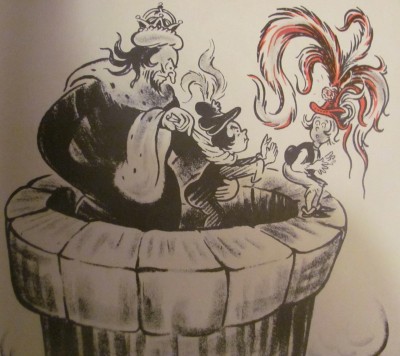
If you think I’m over-reacting, take a look at The 500 Hats of Bartholmew Cubbins. I read it to my kids tonight. It’s such a long book– about 40 pages and atypical Seuss with lots of text. Just one sentence mentions the existence of women: “Lords and ladies stared from the widows of their turrets, wondering what the strange stream of hats could mean.” There is no lady shown in the accompanying picture or in any of the pages of illustrations that follow, including crowd shots of the city of Didd and the people at court. Every single character in this story is male: the king, Bartholomew, the boy in the title, the gaurds, coachmen, noblemen, lords, record keepers, wise men, archers, magicians, the executioner, and the king’s
nephew.
Along with every college student in America, I received Oh, the Places You’ll Go for graduation. I love the book and still read it when I get depressed. But the uplifting tone almost abandons me when I read: “You’re the guy who’ll decide where to go.”
To all those people that say the words don’t matter (we’re talking about writers here— words matter!) you’d notice, I think you’d care, if you’re about to graduate from college and embark on the professional world and you receive a gift of poetic maxims that’s supposed to inspire and invigorate you, when they, in fact, exclude you. Say you’re a guy, and you get a book that says: “You’re the girl who’ll decide where to go.” Trust me, you’d notice. And all I’m asking is how could a writer as prolific as Dr. Seuss, a guy who probably made up more creatures, at least of the hairy mammal species, than exist on the planet, a writer whose sheer production of stories rivals Joyce Carol Oates, who knows he is teaching and inspiring little kids to read for the first time– how could he exclude girls to the extent he did?
Oh, the Places You’ll Go has a few females, most notably standing on line in the Waiting Place. Possibly a long eye-lashed elephant is feminine. But certainly not the Hakken Kraks howling, the monsters who pop out of manholes, the strange birds who mix up their right foot with their left; not one of the bearded boom band players is a girl.
Horton hatches an Egg features a leading female– a bad mother bird who abandons her egg to vacation off in Florida (typical kid lit bad mom who abandons her child) Horton is a father-son story about the amazing nurturing characteristics of a determined elephant (nevermind that Seuss’s much loved elephants are, in reality, a matriarchal society) Horton reappears, showing his same super-paternal tendancies in a book where he rescues a Who.
A girl character sneaks her way into Seuss stories now and then– there’s Cindy Lu, the Who in The Grinch Who Stole Christmas, who catches him stealing her tree. Cat and the Hat has a sister character, though she’s drastically outnumbered by males: her brother who narrates the story, the pissed off fish, Thing One and Thing Two, and the cat, of course. You do see the missing mother’s shoe.
Dr. Seuss– just like the guys at Pixar and Disney– is so creative in so many ways, why does he become trite and cliche when it comes to gender? Why is it so beyond the male imagination to create a magical world where girls and boys are equally important?