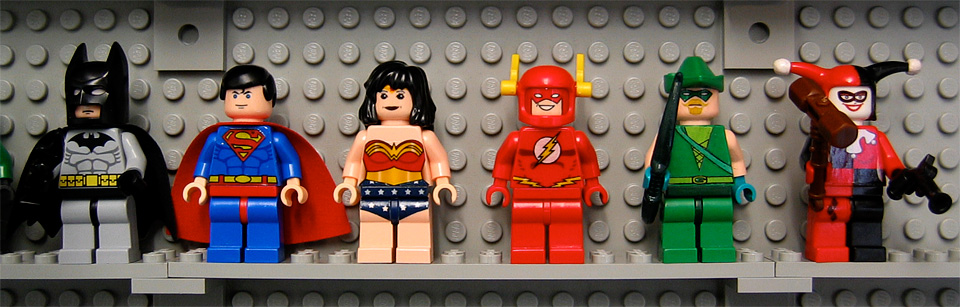
How is a girl going to feel when she looks at this set? Included? Important? Like she exists at all?
So because of this “boys only” or “mostly boys only” rules of LEGO sets like this one and the new superheroes sets, LEGO comes up with the sexist Friends? Apparently, if girls get to play, they must participate in stereotype.
I’m so glad I found your blog! I have known there was something wrong with the media’s portrayal of women for as long as I remember. When I was little I always played Batman or Superman or just boys in general because the only thing I saw girls doing on TV was being rescued, then getting married off, then…
And because of this I think I may have actually thought I was a boy at one point.
As a beginner writer I would love to write an imaginary world without sexism! I’m trying to do it now.
The appalling lack of female characters in movies and such is so aggressively brainwashed into us that I didn’t even notice it until I read it in your blog. It is so bad, that it wasn’t until I read your blog that I realised my first wannabe-feminist-and-spiritual-soapbox novel has a male main character and a mostly male cast
Your blog has inspired me even more to write more and better females! For some reason my characters just ‘look’ and ‘feel’ male when they come into my head. Even the genderless ones. And now I am trying to figure out why.
Do you think it might have something to do with how I have seen women portrayed in the media?
Have you heard of the Bechdel Test created by Alison Bechdel in 1985 to check for sexism in movies? The Bechdel Test names the following three criteria for a movie: (1) it has to have at least two women in it, who (2) who talk to each other, about (3) something besides a man.
So here’s my version for kids’ movies: The criteria is it has to have (1) at least two females who are friends (2) who go on an adventure (3) and don’t wear revealing clothing
What do you think?
To clarify given your comments: Kiki and the mom figure are friends, Ponyo and the mom figure are friends as well.
Before you worry over the films with token “feisty” female characters that won’t make the cut, think about how easy it is for so many movies starring males to sail through this challenging criteria.
I’m reading The Golden Compass and I absolutely love it. The main character is Lyra. She is fierce, smart, and brave. The villain is also female: Mrs. Coulter. She’s brilliant, beautiful, and wicked.
There are several indirect references to sexism in the book. When Lyra first meets Mrs. Coulter she is shocked that the woman is a scholar because female scholars are few and dowdy. Lyra notes many times that the male scholars get access to special rooms. Just like in the real world, right? We all know real life Oxford is sexist as hell. So what’s wrong with referencing that sexism in the story?
There are further parts of the story that make note of sexism. Only the male gyptians are allowed on the boat to recover the children. The female gyptians argue they should be included, not to battle, but because someone will need to be there to look after the children once they are rescued.
Of course Lyra, just a child, goes and battles and is the heroine of the story. But I’m wondering as I read, are there imaginary worlds where there is no sexism? I would love girls and boys to be exposed to this fantasy much more than they currently are. Before we can realize it, we’ve got to be able to imagine it. We get to that surprisingly little if at all.
Obviously, the challenge is that writers exist in real life sexist worlds so as Luce Irigaray wrote, even creating a “female imaginary” can be practically impossible to fantasize about. Though, honestly, it doesn’t seem like it should be that hard. Remember, battles are symbolic and metaphorical as are magical powers.
Just put a female front and center. Have some other females helping her out, they don’t have to be human, just female. That’s a start. Maybe the Oz series would fit? It had Glinda but a lot of makes around Dorothy. Alice in Wonderland? Same thing, but I think that would fit, at least the movie version with the White Queen. Is she in the book? There is the Red Queen, though she’s evil. I like evil female characters but I like good ones as well. The only thing that bums me out about Tim Burton’s Alice, which I loved, was that the story was bookended with a wedding scene. Like so many modern day feminist heroines, Alice’s independent act is that she refuses to marry who she is supposed to. But why mention marriage at all?
Update: Commenters and I agree on these: Oz, Wonderland, and Miyazaki’s imagination
The more I blog about the lack of females front and center in kids’ media, it all seems to come down to this: Why aren’t there more women artists?
The obvious answer is that so many women lack access to money and power as Virginia Woolf told us years ago. In order to create, you need a room of your own.
I read another great theory in a book I love called Goddesses in Every Woman. I first read this book in a feminist theory class in college. I re-read it every few years and can’t wait to give it to my daughters when they are old enough. The author, Jean Shinoda Bolen, writes that artists need someone to hold their dream, to believe in them. Many men get this faith and support from the women in their lives, but how many women get the same from men? Partners can give lip service to supporting art, but how many allow for the time and mental obsession it actually requires? Or are secure enough to tolerate the exposure art can result in?
I have a theory as well. I think that the whole “tortured artist” archetype doesn’t apply to most women. This is not to say that women don’t experience pain and despair. But rather, if women are going to create, especially mothers, it’s fairly impossible to get stuck in those emotions. And getting stuck is the closest definition I’ve found to sickness. I think in health, you experience the same range of emotions, just as intensely if not more so, but there is movement instead of stagnation. That movement is key to creating.
Please read my blog post on the book Against Depression titled: What if van Gogh took Prozac? The author, Peter Kramer, shares his fascinating theory on how the origin of our standards for measuring great art came from the depressed Greeks. We’ve been stuck in that warped and limited model ever since. I love this theory because, as a former philosophy major, I am no fan of how those guys screwed up our views on reality and women.
Update: The Guerilla Grrls suggest that a better question would be: Why aren’t more women artists noticed? While I understand this sentiment and agree that much more art by women needs to be recognized and celebrated, so much of art has to do with communication; it’s challenging for it to exist in isolation. I believe that more women need to dedicate themselves to creating.
Women, please write, make art, and change the world.
The rumors are true! We are teaming up with DC Comics and Marvel to bring new super hero sets including characters like Batman, Superman, Iron Man, The Hulk, and many others! What hero are you most excited for?
On bricksuperheroes.com, you can see also see photos of Green Lantern, the Joker, Nightwing, Lex Luthor. Superhero sets also include: Robin, the Riddler, Killer, Mr. Freeze, Scarecrow, Bruce Wayne, Mr. Freeze’s Henchman, Bane and Twoface. The females I can find are Wonder Woman, Catwoman, Harley Quinn, Poison Ivy, and Hawkgirl. That’s 17 male characters to 5 female ones. Please let me know if you find anymore!
At least there are 5 females, and I would advocate buying these for your kids, but I am so annoyed with LEGO for its hyper-sexist Friends sets that I can’t support this company.
In recent years, child development experts, parents, and scientists have been sounding an increasingly urgent alarm about the decreasing amount of time that children – and adults, for that matter – spend playing. A combination of social forces, from a No Child Left Behind focus on test scores to the push for children to get ahead with programmed extracurricular activities, leaves less time for the roughhousing, fantasizing, and pretend worlds advocates say are crucial for development.
So what happens when kids’ toys and media– major tools for fantasy play– increasingly focus on perpetuating limited gender stereotypes? Unlike in the past, TV series and movies today are often created around products in hope of moving merchandise. The Christian Science Monitor reports:
In the early 1980s, the federal government deregulated children’s advertising, allowing TV shows to essentially become half-hour-long advertisements for toys such as Power Rangers, My Little Ponies, and Teenage Mutant Ninja Turtles. Levin says that’s when children’s play changed. They wanted specific toys, to use them in the specific way that the toys appeared on TV.
Even Lego’s Friends toys eagerly promises movies and games to accompany the sexist sets.
In the same post, I wrote about United Nations world population fund director Nafis Sadik, widely credited with bringing attention to the correlation between over population and the status of women. When women are educated, when they achieve economic independence, when they have access to good health care, when they are valued in society for their intellect and their accomplishments, they have fewer babies.
The Lancet has just released a study on global trends in abortion, focusing on overall rates, access to safe vs. unsafe abortions, and how the legal status of abortion impacts abortion rates. The results shed some interesting light on the effects of efforts to reduce abortion by outlawing or restricting access to it. Looking at data from 1995 to 2008, the authors found that abortion rates were actually lower in areas of the world with less restrictive abortion laws:
The Guttmacher Institute provides a full summary of the article. Not surprisingly, the more restrictive abortion laws are, the higher the proportion of unsafe abortions (with Eastern Europe being a significant outlier, with the highest global abortion rates). About half of all abortions are unsafe, leading to the deaths of roughly 47,000 women each year, or 13 percent of all global maternal deaths—almost entirely in developing nations, where restrictive abortion laws are more common and access to contraception and medical care are generally lower.
It’s clear that top Republican candidates are being short-sighted and ineffective, rushing off in the precisely the wrong direction if their goal is truly to reduce abortions.
As governor, Mitt Romney vetoed a bill that would have given rape survivors access to emergency contraception. As a presidential candidate, he’s promising to defund Planned Parenthood and eliminate federal funding for birth control.
As a member of Congress, Newt Gingrich voted anti-choice 72 times. He voted for “personhood” rights, which would make abortion and many forms of birth control illegal. He voted 10 times to bar the city of Washington, D.C. from using its locally raised tax dollars to provide abortion care to low-income women. He voted to eliminate Title X, the nation’s family-planning program.
And this from Rick Santorum:
Well, you can make the argument that if she doesn’t have this baby, if she kills her child, that that, too, could ruin her life. And this is not an easy choice. I understand that. As horrible as the way that that son or daughter and son was created, it still is her child. And whether she has that child or doesn’t, it will always be her child. And she will always know that. And so to embrace her and to love her and to support her and get her through this very difficult time, I’ve always, you know, I believe and I think the right approach is to accept this horribly created — in the sense of rape — but nevertheless a gift in a very broken way, the gift of human life, and accept what God has given to you. As you know, we have to, in lots of different aspects of our life. We have horrible things happen. I can’t think of anything more horrible. But, nevertheless, we have to make the best out of a bad situation.