When Michelle Obama went on national TV to say she put her daughters on a diet, the internet went into uproar, including me. Please see my post on girls and food and also here.
Obama girls put on diet
Reply

When Michelle Obama went on national TV to say she put her daughters on a diet, the internet went into uproar, including me. Please see my post on girls and food and also here.

 Since I started this blog, I’ve been avoiding writing about Dr. Suess.
He’s one of the best kid lit author-illustrators of all time, talented and creative with the creatures he dreamed up and the wise and hilarious things they say– words that make perfect sense even though they don’t. I’m not familiar with the history of children’s books, but I feel like Seuss’s rhyming style revolutionized kid lit, inspiring generations to read.
But there’s a big problem in his stories: the girls are missing; they’re so invisible that going into Seussworld becomes creepy, like being transported to a dystopia where females don’t matter at all.
If you think I’m over-reacting, take a look at The 500 Hats of Bartholmew Cubbins. I read it to my kids tonight. It’s such a long book– about 40 pages and atypical Seuss with lots of text. Just one sentence mentions the existence of women: “Lords and ladies stared from the widows of their turrets, wondering what the strange stream of hats could mean.” There is no lady shown in the accompanying picture or in any of the pages of illustrations that follow, including crowd shots of the city of Didd and the people at court. Every single character in this story is male: the king, Bartholomew, the boy in the title, the gaurds, coachmen, noblemen, lords, record keepers, wise men, archers, magicians, the executioner, and the king’s
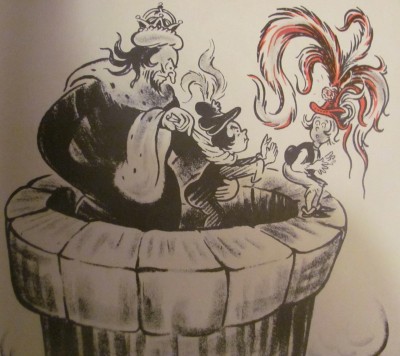
nephew.
Along with every college student in America, I received Oh, the Places You’ll Go for graduation. I love the book and still read it when I get depressed. But the uplifting tone almost abandons me when I read: “You’re the guy who’ll decide where to go.”
To all those people that say the words don’t matter (we’re talking about writers here— words matter!) you’d notice, I think you’d care, if you’re about to graduate from college and embark on the professional world and you receive a gift of poetic maxims that’s supposed to inspire and invigorate you, when they, in fact, exclude you. Say you’re a guy, and you get a book that says: “You’re the girl who’ll decide where to go.” Trust me, you’d notice. And all I’m asking is how could a writer as prolific as Dr. Seuss, a guy who probably made up more creatures, at least of the hairy mammal species, than exist on the planet, a writer whose sheer production of stories rivals Joyce Carol Oates, who knows he is teaching and inspiring little kids to read for the first time– how could he exclude girls to the extent he did?
Oh, the Places You’ll Go has a few females, most notably standing on line in the Waiting Place. Possibly a long eye-lashed elephant is feminine. But certainly not the Hakken Kraks howling, the monsters who pop out of manholes, the strange birds who mix up their right foot with their left; not one of the bearded boom band players is a girl.
Horton hatches an Egg features a leading female– a bad mother bird who abandons her egg to vacation off in Florida (typical kid lit bad mom who abandons her child) Horton is a father-son story about the amazing nurturing characteristics of a determined elephant (nevermind that Seuss’s much loved elephants are, in reality, a matriarchal society) Horton reappears, showing his same super-paternal tendancies in a book where he rescues a Who.
A girl character sneaks her way into Seuss stories now and then– there’s Cindy Lu, the Who in The Grinch Who Stole Christmas, who catches him stealing her tree. Cat and the Hat has a sister character, though she’s drastically outnumbered by males: her brother who narrates the story, the pissed off fish, Thing One and Thing Two, and the cat, of course. You do see the missing mother’s shoe.
Dr. Seuss– just like the guys at Pixar and Disney– is so creative in so many ways, why does he become trite and cliche when it comes to gender? Why is it so beyond the male imagination to create a magical world where girls and boys are equally important?
Some British guy just proposed to Alice on the TV commercial previewing the movie. I am so bummed. I’ve been hoping they didn’t fuck up Alice in Wonderland. Now, I’m worried.
Alice replies, “This is all happening so fast. Let me just take minute.” Then she goes down the rabbit hole. Maybe this ad is skewing the story, and the film is not really about this (which would still annoy me with lame advertising, but not as much as if they really messed up the movie) Isn’t Alice a kid, anyway? Doesn’t she fall asleep while her sister is reading her a book without pictures? Maybe that abstinence only study for sixth graders is relevant after all (see my last post.)
I am frustrated that the plotlines of so many (all?) contemporary movies with girls in big parts always feature marriage as central issue.
Yes, now the girl protagonist is often reluctant to marry, she doesn’t go off with the first guy who kisses her out of unconsciousness; she doesn’t make the obvious, predictable choice (see Mulan, Ariel, Belle and now possibly Alice escaping off to Wonderland) but the plotline is still focused on marriage, rebellion within the safest possible framework. I’d prefer no marriage debate at all, just like in the boy movies. Did Fantasic Mr. Fox or Up have its main characters face this dilemma? In case you didn’t see them, rhetorical question. Actually, I didn’t even see Up and I know I’m right.
I hope Tim Burton doesn’t pull a Dora and turn another cool girl into a Princess. I’d feel better if the film had a female director and a female star whose name I recognized instead of promoting Johnny Depp all over the place. Things are not looking good, but it’s Alice in Wonderland for God’s sake, I’m holding out hope.
It’s all over the internet that a study has found abstinence only programs may work for teens. The headlines fail to mention to mention the teens being studied are sixth and seventh graders! Barely “teens.” I’d be encouraging these kids not to have sex too. It’s a completely different demographic and maturity level than highschool kids. Its so misleading for the media to present the story this way.
I saw Naomi Wolf on Joy Behar’s show the other night talking about “sexual gradulaism.” I love that term which I am pretty sure she made up. Wolf wants to bring back heavy petting and argues that when girls learn about their own bodies and how they work, they delay sex and don’t get pregnant. Research of lower teen pregnancy rates in Europe where sex ed is part of the curriculum (and female sexuality seems to me much more accepted and celebrated than in my puritanical home country) back her up. Though the guy on the show with Wolf would not shut up about abstinence. I think his name was Steve, because Naomi kept saying, “Were you abstinent until marriage, Steve?” Steve thought his personal behavior wasn’t relevant to the discussion.
 This is a totally random book, part of the Shrek franchise, cheaply made and printed (the same soft, stapled cover as My Little Pony & Berenstain Bears series.) I have no idea how it got on our bookshelf, but I love it. It’s hilarious.
I’m mostly a Shrek fan, because the whole message that beauty is found on the inside is communicated in an original and effective way. The final makeunder when Fiona transforms into an ogre is well done. I’m so sick of the “beauty and the beast” scenario repeated ad infintum in kids movies and adult ones (see latest Judd Apatow flick) where the overwieght, dorky stoner scores the beauty. I do look forward to the day when the hot guy falls for the “ugly” or fat girl– in cartoon world and the grown up one– because her humor or brains make her so compelling. But at least two beasty green creatures in love is one step in that direction. I have my other complaints about Shrek: he’s the star in his eponymous movie, and Fiona’s storyline is the typical princess scenario culminating with the marriage and happily ever after.
I was most disappointed with Shrek 3 where Fiona’s part is drasticaly reduced, becoming primarily a father/ son story, with Justin Timberlake as the new co-star. Now I know what was happening when Fiona was MIA. Fiona’s Fairy-tale Five is about the drama back at the castle when Shrek went off on his (very male) quest to find an heir.
Fiona is home having a baby shower with her friends Snow White, Sleeping Beauty, Rapunzel etc when Prince Charming storms the castle, trying to stage a coup. The princesses must stop the festivities and defend the castle. Charming is one of my favorite movie bad guys; I love how his suaveness comes off as smarmy and how he’s so un-charming. The story shows the gang of princesses work together (rare to get to see princesses in any kind of group and functioning as a team) to vanquish Charming. It’s fun to see all the princesses in one story and also totally consistent with the Shrek movies which always feature mutiple fairy tale characters meeting up. I think this flimsy book would make a great movie, so much better than boring Shrek 3.
All the princesses surprise themselves and each other, becoming brave heroines. I especially like how Sleeping Beauty snaps out of her daze with some awesome fight moves and when Fiona’s mom says to her, “You didn’t actually think you got these fighting skills from your father, did you?”

This book is by famed soccer player, Mia Hamm. It’s about her childhood when she spent her days playing soccer with her family. “Tap, tap, tap. Her toes kept the ball exactly where she wanted it. She’d kick the ball straight into the net. Goal! Everybody on her team would cheer.”

But then Mia has a bad day, and she doesn’t score any goals; there’s no cheering for her. Her older brother puts his arm arund her and says, “Better luck next time.” But Mia says “I quit,” and storms off the field.
The next day when she shows up to play, her brother won’t let her. “Sorry, Mia. Quitters can’t play on my team.” Mia is forced on the sidelines, just watching. The next day she is allowed to play again, and when she doesn’t make the goal “she feels tears in her eyes.” She hears whispering that she’s going to quit, but she realizes she loves playing soccer even more than she hates losing, and she keeps playing. “Maybe she’d score a goal, maybe she wouldn’t.”
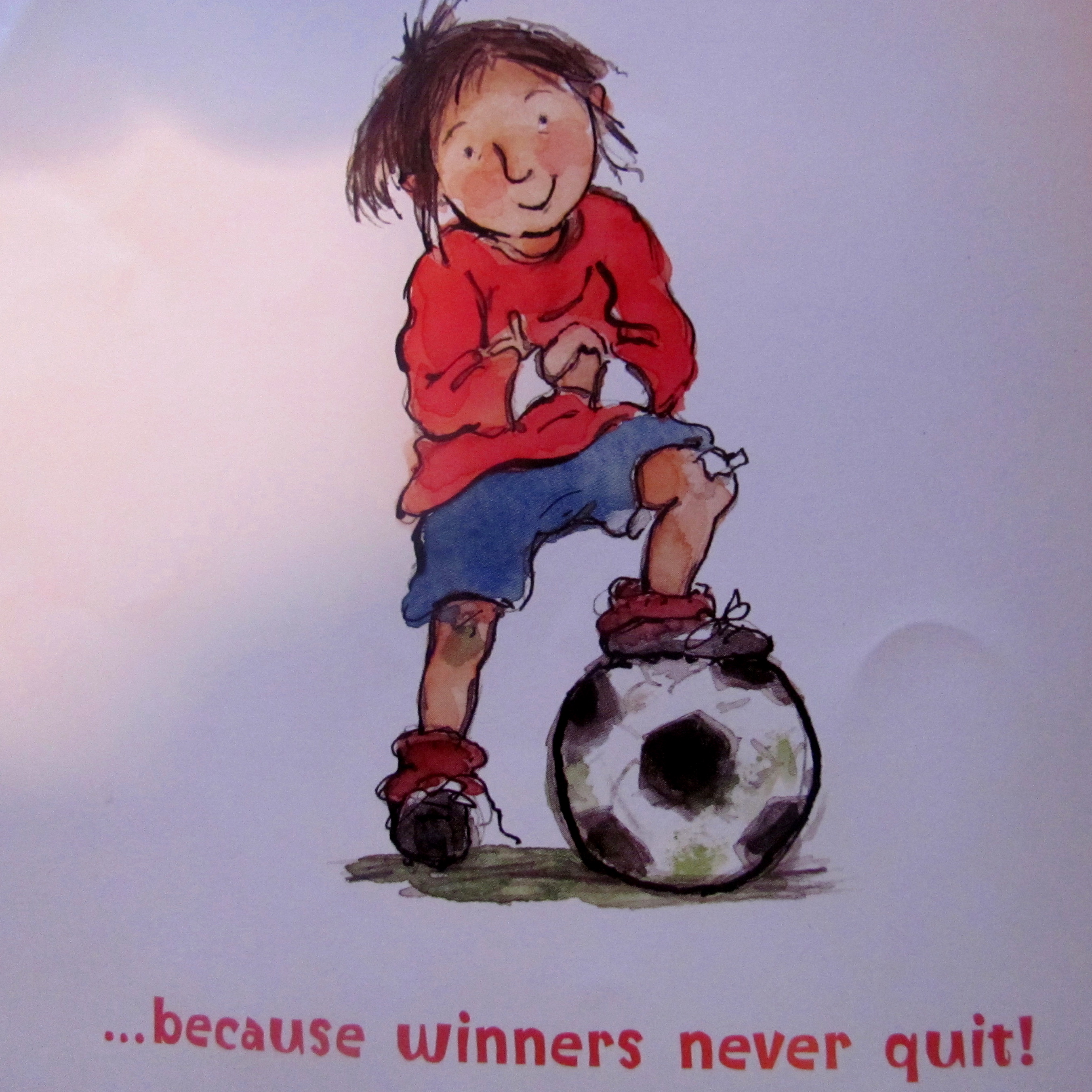
Obviously the message here is that its not whether you win or lose, its how you play the game. But its shown as a real life story, in a way kids can understand; Mia has intense emotions readers witness her learning how to deal with.
I feel like Mia wrote this book just for my daugter Lucy who is incredibly athletic at everything she tries– soccer, T-ball, basketball, air hockey (she didn’t inherit this from me.) At six years old, it is kind of rare to see a kid so aggressive, not wandering off the field or playing house in the goal. Lucy just keeps going after that ball. I obviously want to encourage her passion and skill. But she does cry when she doesn’t play well and says things like, “I’m terrible, I’m the worst.” And when she gets mad, she cheats.
I don’t understand her drive and skill because I wasn’t into sports as a kid. So I especially value this book, because it shows girls that competition is OK, which is something I wish I’d learned in sports and way beyond. I think it’s crucial to teach girls how to compete openly and ethically for victories that matter, so they don’t funnel those drives into backhanded ambitions too often focused on beauty, boys, and popularity, the venues through which girls have historically been allowed to win power.
Humans are competitive. Girls, too often aren’t taught how to deal with that, or even told that to engage in competition is bad. You’ve got to be especially wary where I live, in San Francisco, where many “progressive” schools believe every kid should be in the school play, on the team etc. I get this up to point, but learning to play fair, to want to win, that it feels good when you do, are important lessons, key to helping girls grow into successful women.
At the end of the book, there are several photographs of Mia Hamm winning trophies, being carried by her teammates, and action shots of her playing soccer as a kid. I love all this imagery, illustrated and real, of a girl displaying her amazing skills and enjoying winning.
Thank you Mia Hamm!
 Sadly, just like two of my other favorite childrens’ book authors, Dr. Seus and William Steig, Maurice Sendak often leaves female characters completely out of his stories or gives them tiny parts.
Outside Over There is different–the three main characters are female. it’s a perfect story: strange, scary, and feminist. This book would make a great movie (are you listening Spike Jonze and Dave Eggers– or some female moviemakers out there?) It’s about a brave girl who rescues her baby sister after she is stolen away by goblins.
The prose is classic Sendak– concise and beautiful. It begins, “When Papa was away at sea, and Mama in the arbor, Ida played her wonder horn, to rock the baby still, but never watched.” The accompanying illustrations are creepy and intense. The mother is shown in a daze, staring out to sea, obviously missing her husband horribly, not paying any attention to Ida who holds her crying baby sister. You can feel the aloneness and the abdonment the whole family is experiencing, but especially Ida, who is trying her best to take care of the baby, before she makes her fateful mistake of not watching.
Goblins sneak in the window and steal the baby, leaving one made of ice (an image that’s never completely left me) When Ida turns to hug the baby and feels her melt, she makes a fist: ” ‘They stole my sister away,’ she cried. ” ‘To be a nasty goblin’s bride.’ ” She climbs out her window into “outside over there” guided by the voice of her father from the sea. When she finds the goblins, she plays her horn until they dance into such a frenzy “they quick churned into a dancing stream.” Ida grabs up her sister, and brings her home to their mother, still in the arbor, now holding a letter from their father: “I’ll be home one day, and my brave, bright little Ida must watch the baby and her Mama for her Papa who loves her always. Which is just what Ida did.”
Like his much more famous book Where the Wild Things Are, this adventure story is told in less words than this review. Sendak is amazing. I wish more people knew about his best book.

The following standards would urge caution for parents: any movie
1. where the leading woman is ten years younger (or more) than the leading man
2. where the mother’s real life age is the same as the guy playing her son
3. with a sidekick best friend who is super attractive but supposed to be unattractive because she’s wearing glasses
4. where the girl in glasses gets a makeover
5. where all the female roles are girlfriends or supporting
6. with cheerleaders
male frontal nudity is OK
female frontal nudity is OK only if it’s shown as a quick glimpse, coming out of the shower or in the locker room, not in a lingering sexual way (or the whole movie gets an NC-17 or X rating)

 Every parent has a book that drives her crazy, that she hopes and prays her kid will not choose yet again, that she dreads reading. For me this book is Amelia Bedilia. Worse than Eloise, the fairies, even the ponies, AB is so annoying. That’s the point of all the stories, she misunderstands– whether its how to clean a house or play baseball.
Kids do think its funny when grown ups don’t get something obvious. The other day, my brother-in-law came out of the kitchen with a banana on his head, asking my three year old, “Have you seen a banana anywhere?” She was cracking up. The kid could not stop laughing. She thought it was the most hilarious thing she’d ever seen.
If Alice laughed like this when I was reading, I would forgive Amelia for being so irritating. But Alice sits there, totally straight faced– yet intrigued- while Amelia sprinkles face powder all over the sofa after she was told to dust it.
Amelia is so annoying, she doesn’t even fit in my rating system. She’s does nothing for girlpower, but she’s not really stereotyping either. Hate her.


 This story gets a ***GG*** rating, and it has no major female characters. How is this possible?
Because it breaks stereotypes with a simple reversal. When I read stories, I often make gender switches in my head, to reveal the kinds of characteristics and plotlines we’ve heard so many times that we just take them for granted as something believable or successful. Anytime a story does the shake up for me, inspiring a jaded reader to think in a new way, I’m grateful. Next to the helpless, passive princess, wolves are probably the most maligned creature in fairy tale world. (About ten years a go, another writer made the same kind of connection when she compiled an anthology of myths about brave female protagonists called Women who Run with the Wolves.)
In the first scene of Three Little Wolves, we see these wolves as vulnerable, they are shown with their mother, described as cuddly, with soft fur and fluffy tails. Their mother urges them to go out in the world with the warning, “But beware of the big, bad pig.”
The story follows the classic model, describing the wolves’ adventures and challenges as they attempt to build safe homes for themselves, continually destroyed by the malicious, resourceful pig. I highly recommend this book. It’s so funny and poetic, reminiscent of Steig stories, and it has a beautiful ending.