It’s a well know fact that Scorsese made Hugo for his 12 year old daughter!! He mentioned it again last night in his speech.
So what? The movie also has a strong female character, but it’s yet another movie centered on the quest of the male main character: five out of five nominated.
Shouldn’t the lack of females not be a problem for you if you’d considered men and women really equal? if you could really identify yourself to a man, and a man to a woman?
So maybe the problem is that men will not identify to women, not the other way around. My point is: the lack of female character is not the problem, the problem is the abundance of women in stupid roles
Huh? Sorry, I identified with females as a child (when I loved Charlie’s Angels because it was one of the few shows on TV where girls actually got to do stuff) and I do now. Those are my choices? No females or females in stupid roles? Really?
People, I don’t know how to write this more clearly. The females in kids’ movies have gone missing. Kids movies. Is “Adventures of Tintin”– created by a misogynist who believed women have no place in his imaginary world– going to win the Academy Award now for best animated film? Is that OK with you? Yes, the animation is spectacular, but would anyone EVER even consider making a kids’ movie based on a series created by a female artist who believed males didn’t belong in her movie? Can you even imagine that movie? If that movie were made, do you think people might notice that males were missing from it?
Every weekend day, while my two-year-old naps, the older two kids get to watch a movie. We just got a flat screen TV and can stream Netflix. So exciting for movie lovers. Wow. Have you all been doing this for years? My husband starts going through the options, and the photos come up of all the movies. My kids shout: “Thumbelina! Tangled!”
We say: “Look! “Howl’s Moving Castle!” Miyazaki. I bet that’s great.”
Kids: “No, no, no!”
Grown-ups: “It’ll be so good!”
Kids: “NO!”
One kid bursts into tears. The other sulks.
This is the point where you give in, right? It’s a movie for God’s sake. Who cares? Let them choose. Just as long as they stay quiet so the little one can sleep. They hardly get to pick anything in life. Why not a movie? What’s the big deal?
But this is where you need to resist. What they watch is really important, and kids are going to choose what they are familiar with. They love routine. So pick for them. Get them to try something new.
This is how our story ends:
We put on “Howl’s Moving Castle.” They keep crying and sulking. We leave the room. Not a word came out of those kids for the next two hours. They loved it. Today, they asked to see it again. They just need a little push, the same way with everything else, to try something new. Give it to them. It’s worth it.
Last night, “Adventures of Tintin” won the Golden Globe for best animated film. Director Steven Spielberg thanked the studio for taking a chance on an “80 year old comic book series;” he didn’t add a series whose creator believed females didn’t belong in his imaginary world.
Other nominations in the best animation category? Rango, Puss In Boots, Arthur Christmas, and Cars 2. Out of five nominations, four were named for the male star of the movie. This after Disney switched the movie title from “Rapunzel” to “Tangled” to hide its female star. Not a single clip shown in the animated film category during the Golden Globes ceremony featured a female voice.
Best Director win? Martin Scorsese for “Hugo,” yet another kids film titled for its male star.
Which new movie do you think this line comes from?
Could it possibly be in an animated film where the intended audience is little girls? Little girls who probably love to pillow fight? Who are probably awesome at it? Yep, it’s in the new “Madagascar 3: Europe’s Most Wanted.”
Why would kids need to hear a line making fun of how girls fight? What writer or producer or director could possibly think perpetuating that stereotype would be funny for girls to hear? Or were they, more likely, not thinking about little girls at all?
“Madagascar 3,” by the way, features the same 4 main characters as in 1 and 2. Guess how many are female? One, Gloria the Hippo. She has hardly any lines in this preview. There is a female villain played by Frances McDormand who is featured prominently in the preview. I hope she has a big part in the movie as well.
This frat boy mentality that looms over kids movies has to end. Hollywood, please stop programming sexism to kids. It’s not funny.
I’ve gotten hundreds of comments on Tintin at Reel Girl and SFGate, two I find really interesting. One is an interview with Herge I can’t find right now, but when I have time to sort through the comments, I’ll post for you (Or if you come across it, resend!) The one below is kind of fascinating about how extremely male Tintin’s world truly is– the part about Tintin “graduating from housekeeper to a male butler.” Wow. But the point Lucas makes about “going even further” with my argument into exploring heteronormativity in Tintin as more interesting than “Tintin is sexist” is funny to me. That’s not a more interesting argument to me, Lucas.
Hey there –
Yeah, the early Tintin is amazingly racist. (But at the same time, “The Blue Lotus,” despite its structural racism and the racist/colonial project that drove Hergé to do albums in Africa, in India, in South America, in China, etc., actually allowed Hergé to work through his racist bias and produce what has been describe as a – for its time – very culturally-sensitive and even subversive piece of work.)
More importantly, the entire Tintin opus is intensely homosocial: all men and boys. Tintin even “graduates” from his female housekeeper to sharing a male butler with Captain Haddock when they move in together. The entire economy of the books is male-centered enough to become a little queer, actually. A more interesting argument than “Tintin is sexist” might be “Tintin is sexist to the point that it subverts itself, and starts to push heteronormativity into different patterns of gender and sexuality.” You don’t have to make that argument, of course, but it would be more surprising.
One of the key exceptions to the rule of Tintin’s masculine universe is Bianca Castafiore. Catherine Clément gives a wonderful reading of Castafiore in her famous and important feminist text “Opera, or the Undoing of Women.” In the comics, Castafiore is portrayed as an almost entirely negative figure. Her signature aria, which she performs at every opportunity, is presented as shrill and unpleasant; Captain Haddock, in particular, is constantly pained by her singing.
It’s a shame you were in the bathroom during the Castafiore scene in Spielberg’s movie. That’s where you get to see the adaptation really, well, adapting. The new film actually portrays Castafiore as a magnetic, powerful, and happy woman – not a “beautiful” one, not a “thin” one, not even an accessible one, but as a talented woman whose voice (and the film gives itself fully over to her aria, allowing Renée Fleming to sing without interruption) charms and enchants all who hear it. It’s quite a turn-around from the albums, and portrays her character as something that, according to the sexist logic surrounding the diva, should not exist – an ambitious, successful, and self-defined woman.
Without any consideration of this scene, your argument about the movie and its relationship to its source-text is undeveloped. You don’t have to agree with me, but it’s worth thinking about a moment like this because it would make your overall argument more complex and powerful. There’s also a worthwhile recent volume on the political/social implications of Tintin published last year (“Tintin aux pays des philosophes”), which includes several surprising essays about race and gender in Tintin. This all by way of suggestion, if you would like to make your arguments about this subject more nuanced or compelling.
I am reposting with art for those who argue “Tintin in the Congo” is not racist. Also, one more time: the point is that the lack of female roles in the Tintin movie’s cast is consistent with most of the movies made for kids today. Girls have gone missing in kids’ movies and that means that both genders learn that boys are more important than girls. Parents, this is not okay. If you can’t see it, you can’t be it.
Commenters are defending the Tintin movie, writing that creator Herge’s sexism was simply a product of his times.
Margot, you are aware that Hergé wrote most of his comic books (including the three on which the film is based) before WWII, at a time when women in his home country of Belgium as in many others didn’t even have the right to vote? Of course his work reflects the prejudices of that era, not only towards women but towards just about everyone who wasn’t a white Christian male (the most egregious example being Tintin in the Congo)!
Would Steven Spielberg adapt Herge’s racist views (“of his times”) expressed in Tintin in the Congoto make a movie in 2012 and market that movie to kids?
Of course not. No one would see it. People would be horrified. Herge’s racist views are universally recognized as the aberration that they are. Why is Herge’s “dated” sexism celebrated in a loyal adaptation from one of our most acclaimed directors?
There are two answers, both are true. The first one is that in 2012 sexism is, in many ways, just as accepted and “normal” as it was in 1932. Women are humiliated and degraded all the time, but while racism is seen as a political issue, sexism is still seen as a “cultural” one.
The second, less controversial explanation is that in Herge’s comics, he directly degrades and humiliates Africans whereas his sexism mostly manifests as an omission. His racism is worse. Herge believes women have no place in his imaginary world. Is that offensive? Is it even sexist?
It’s an annihilation.
What is remarkable about this annihilation, and what I was writing about, is that it’s consistent with the casts of most animated movies made today.A story originally created by an artist who spoke openly of how he didn’t think females should be included in his imaginary world is almost indistinguishable from the majority of films made for kids right now. Steven Spielberg probably didn’t even notice.
What does that say about how important we think girls are?
Commenters are defending the Tintin movie, writing that creator Herge’s sexism was simply a product of his times.
Margot, you are aware that Hergé wrote most of his comic books (including the three on which the film is based) before WWII, at a time when women in his home country of Belgium as in many others didn’t even have the right to vote? Of course his work reflects the prejudices of that era, not only towards women but towards just about everyone who wasn’t a white Christian male (the most egregious example being Tintin in the Congo)!
Would Steven Spielberg adapt Herge’s racist views (“of his times”) expressed in Tintin in the Congo to make a movie in 2012 and market that movie to kids?
Of course not. No one would see it. People would be horrified. Herge’s racist views are universally recognized as the aberration that they are. Why is Herge’s “dated” sexism celebrated in a loyal adaptation from one of our most acclaimed directors?
There are two answers, both are true. The first one is that in 2012 sexism is, in many ways, just as accepted and “normal” as it was in 1932. Women are humiliated and degraded all the time, but while racism is seen as a political issue, sexism is still seen as a “cultural” one.
The second, less controversial explanation is that in Herge’s comics, he directly degrades and humiliates Africans whereas his sexism mostly manifests as an omission. His racism is worse. Herge believes women have no place in his imaginary world. Is that offensive? Is it even sexist?
It’s an annihilation.
What is remarkable about this annihilation, and what I was writing about, is that it’s consistent with the casts of most animated movies made today. A story originally created by an artist who spoke openly of how he didn’t think females should be included in his imaginary world is almost indistinguishable from the majority of filmsmade for kids right now. Steven Spielberg probably didn’t even notice.
What does that say about how important we think girls are?
Funny, my wife, daughters, son and parents didn’t notice this absence. They saw a film they enjoyed. As a reader of the original series I can tell that you’ll be disheartened to learn that this absence continues. Stop badgering Spielberg about this. You should be congratulating Kathleen Kennedy who is one of the producers and a long time collaborator of Spielbergs.
If Neal went to a film where the three main characters were female, all the heroes and all the villains were also female, do you think he might notice?
Sexism is so ingrained, people use it to defend sexism. Wow.
After my rant on Herge, the author of Tintin, a commenter sent me a link to a post by New York Times opinion writer Nicholas Kristof called “Misogyny Vs. Sexism.” As you may know, Kristof is a huge feminist. With his wife, Sheryl WuDunn, he wrote the excellent book Half the Sky which argues that establishing equal rights and equal status for women worldwide is the central struggle of the our time.
In his NYT column, Kristof writes that he used to think misogyny was the force holding women back. Now he wonders if its sexism. Here’s an excerpt from his column about what the difference may be:
Then in the reporting for this column, I spoke to evolutionary psychologists who emphasized the distinct origins of racism and misogyny/sexism. Racism seems based in a hard-wired tendency of ancient humans to divide into groups to improve odds of survival, and it was an evolutionary advantage to be able to identify strongly with your own tribe and to fear or kill members of other tribes. That may be why even very small children — even infants — draw racial distinctions or other in-group/out-group distinctions.
In contrast, the evolutionary origins of attitudes toward women were based presumably less on hatred and more on desire to control them and impregnate them, so as to pass on one’s genes. Acquiring and enforcing a harem, so as to improve the odds of one’s own genes being passed on, might involve ruthlessness, enslavement and brutal beatings, but there was no evolutionary incentive for gender hatred as there was for hatred of different tribes. And of course much of the anti-women behavior around the world, from genital cutting to bride burnings to sex trafficking, is typically overseen by women themselves, and it’s easier to see their behavior as opportunism or deeply-embedded sexism than as hatred of fellow women. So that’s why I wonder if sexism, in the sense of discriminatory attitudes toward males and females, isn’t a better way of thinking about the issue than misogyny, in the sense of hatred toward women.
Other anthropologists I spoke to also noted that the most discriminatory restrictions against women tend to come not from those who profess to hate women, but from those who profess to honor and protect them. Think of Afghan society, for example. After interviewing many men who beat and lock up women and threaten to kill them if they take a false step, I’d say that their attitudes for females are a mix of bizarre honor and contempt, but not usually hatred.
I can’t say I’m fully convinced of the argument I’m making. There are still the acid attacks and similar behavior, which I find hard to explain short of misogyny…”
It’s fascinating to think about, but I guess I’m wondering how much it matters. It all comes down to this: women need power– political and financial, in order to change the world.
How do we get it?
As far as the issues I write about in this blog (and back to Herge) for me, it comes down to this: women need to write more stories. Women need to grow their financial resources so that they can amplify their voices, opinions, and views to influence the world. Women need to create books, films, television series, and products.
This is not the fastest way to influence people. Of course, a law against burning women would be much better.
Obviously, people need to be working hard simultaneously in politics, finance, and all professions as well. The resistance to change is enormous. I was in the nonprofit world for a long time, but it’s hard to help women get power when you don’t have much yourself.
So I’m kind of tired asking why. I understand it’s important to figure it out: knowing how situations got to be the way they are helps to change them. But I only have so many brain cells and so much time. Sometimes when I focus on why things are so fucked up, I get stuck there. I will say that, as I’ve written many times, I don’t think that men are evil or have some conspiracy going on. I think men are self-centered like all humans are. They’re telling stories from their point of view. Because they dominate the narratives, women live in the warped experience of existing through other peoples eyes. But we can’t expect men to tell our stories, not even Steven Spielberg. We have to tell our own.
Of course, that would be much easier to do if there were Sandra Spielbergs out there. Many of them. It would help if Steven committed to helping women directors. It would help a lot if we had thousands of years of narratives written by women to draw from including something like the Bible.
But I guess we have blogging. I am working on a Middle Grade book, and I think its going to be really good. I hope all the women reading this blog are writing as well.
Meanwhile, please give money to support nonprofits that are working worldwide to change the status of women. Please support politicians who are committed to this as well.
Steven Spielberg’s “Adventures of Tintin” may have the best animation style I’ve ever seen in a kids’ film. It’s almost as if you can’t tell if the characters are real people or art. It’s spectacular.
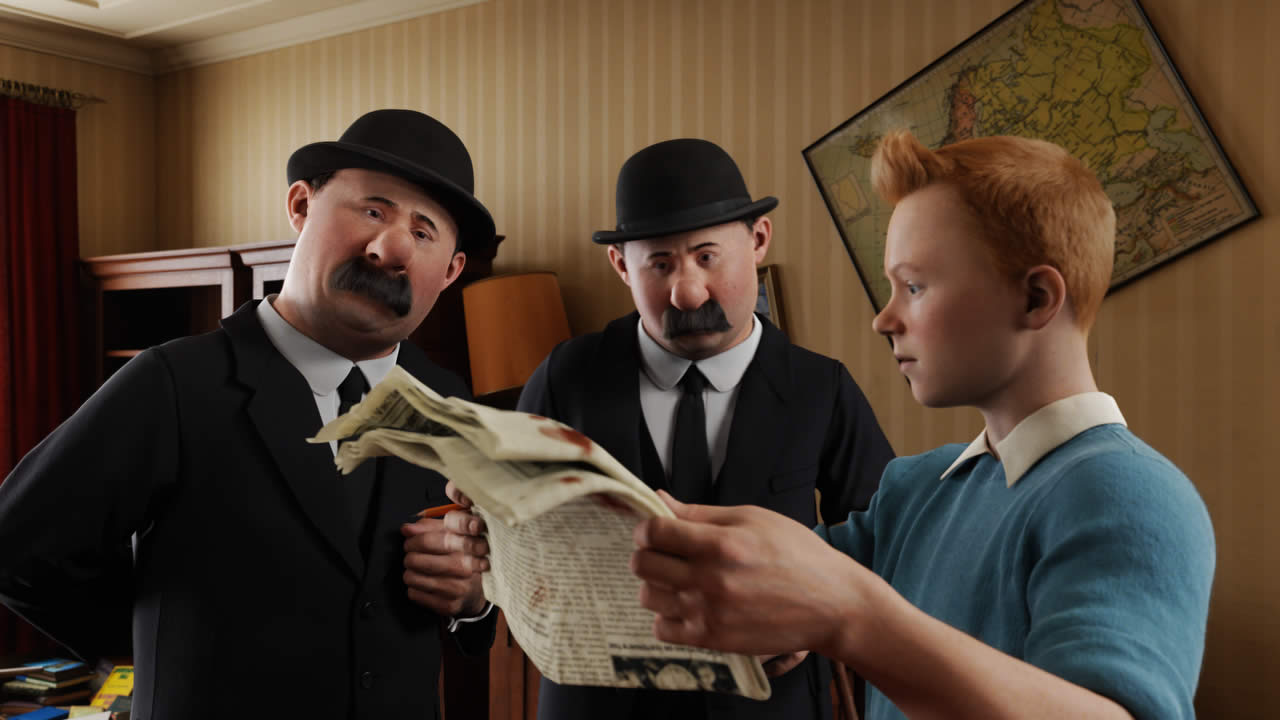
But I guess Spielberg was so focused on the animation, he forgot about half of the kid population. There are so many males and so few females in this movie that I– even me– was blown away. If a Martian came to Earth and saw this film, she would think our species was the type that clones itself to reproduce. The movie even has two twin mustachioed investigators that would seem to support that hypothesis.
Like most kids movies, this is a buddy movie (can I say “friendship” movie?) The three buddies, the main characters in the film– Tintin, Captain Haddock, and Snowy the dog– are male.
All the villains are also male, the gangs of them. The good guys are male as well, almost to caricature as mentioned with the clone investigators.
For female roles, there is a housekeeper, an old lady that hits someone with her bag, and a third who my daughter spotted when I went to the women’s room. My daughter said she was a singer.
I know, I know: Tintin was a book before it was a movie. What’s Spielberg supposed to do about that? He’s just one director trying to be faithful to his inspiration.
Tintin was actually many books, and “Adventures” ended with a teaser that practically announced the next film.
Reel Girl gives “The Adventures of Tintin” an SS rating. In spite of its almost total lack of females, Tintin escapes the dreaded Triple S. The females in the movie don’t do anything terribly, stereotypically offensive such as talk about their hair or their boyfriends, though they don’t interact with each other at all and one is a housekeeper.
Update:
After I posted about the lack of females in the new Tintin movie, a commenter wrote in this quote from Herge: “For me, women have nothing to do in a world like Tintin’s, which is the realm of male friendship.”
I googled the quote and all kinds of references came up, this one from Wikipedia:
Hergé has also been accused of sexism, due to the almost complete lack of female characters in his books. The only woman character of importance is Bianca Castafiore, who is potrayed to be foolish and nearly oblivious to all negative reactions to her behaviour — though she does show loyalty, presence of mind and quick wit when hiding Tintin and Haddock from Colonel Sponsz in The Calculus Affair.
Hergé himself denied being a misogynist, saying that “for me, women have nothing to do in a world like Tintin’s, which is the realm of male friendship”.[10]
Other reasons were because he believed that sentimentality had little to do in Tintin’s stories, which are mainly about men getting into all sorts of “misadventures rather than adventures”, and wherein “mocking women would not be nice”. He also felt that a man slipping on a banana skin, providing he does not break a leg, is much funnier than if it happened to a woman. As a female interviewer put it, “It has nothing to do with the misogynist world of the boy scout,”[11] referring to the fact that Hergé was a scout in his youth.
OK, Herge denied being a misogynist and then says “women have no place in a world like Tintin’s.” Um, that is misogyny.
Wikipedia tells us: “Tintin’s stories, which are mainly about men getting into all sorts of ‘misadventures rather than adventures’, and wherein ‘mocking women would not be nice.’ ”
Maybe that isn’t the full quote. Maybe it’s not in right context, but as it stands, Herge implies that the only reason to include women would be to mock them? Is there no other reason to include female characters in a story?
“Other reasons were because he believed that sentimentality had little to do in Tintin’s stories…”
So including women requires sentimentality?
And slipping on a banana peel is funny if you’re a man but not a woman? What?
I don’t get it. All the ways the Wikipedia writers and Herge attempt to explain away his sexism are sexist. What do they think sexism is? Maybe they excuse Herge for similar reasons that Reel Girl rated “Tintin” with two SSs for gender stereotyping instead of three; there weren’t blatant offensive acts in the movie, so the movie didn’t get the worst rating. Females aren’t “mocked” because of their gender, they’re just not there.
The sick thing is that when you see “Tintin,” when it comes to women, you can tell there’s something off in the mind of the creator. The lack of females is glaring and weird and disturbing. And this is a movie for kids! Doesn’t Stephen Spielberg care? Don’t parents? When Spielberg shopped this film around to studios (maybe Spielberg doesn’t do that) did anyone say, “Interesting story, but there are no females in the entire series. That might be a problem for us. Half of kids, after all, are girls.”
I guess no one said that. Sadly, Tintin” is actually not disturbing to audiences, because most of the movies made for kids today have casts pretty much identical to this one, a series created by an artist who believes women have no place in his imaginary world.
Update:
I got this comment on my Tintin post from Neal:
Funny, my wife, daughters, son and parents didn’t notice this absence. They saw a film they enjoyed. As a reader of the original series I can tell that you’ll be disheartened to learn that this absence continues. Stop badgering Spielberg about this. You should be congratulating Kathleen Kennedy who is one of the producers and a long time collaborator of Spielbergs.
If Neal went to a film where the three main characters were female, all the heroes and all the villains were also female, do you think he might notice?
Sexism is so ingrained, people use it to defend sexism. Wow.
Update:
Commenters are defending the Tintin movie, writing that creator Herge’s sexism was simply a product of his times.
Margot, you are aware that Hergé wrote most of his comic books (including the three on which the film is based) before WWII, at a time when women in his home country of Belgium as in many others didn’t even have the right to vote? Of course his work reflects the prejudices of that era, not only towards women but towards just about everyone who wasn’t a white Christian male (the most egregious example being Tintin in the Congo)!
Would Steven Spielberg adapt Herge’s racist views (“of his times”) expressed in Tintin in the Congoto make a movie in 2012 and market that movie to kids?
Of course not. No one would see it. People would be horrified. Herge’s racist views are universally recognized as the aberration that they are. Why is Herge’s “dated” sexism celebrated in a loyal adaptation from one of our most acclaimed directors?
There are two answers, both are true. The first one is that in 2012 sexism is, in many ways, just as accepted and “normal” as it was in 1932. Women are humiliated and degraded all the time, but while racism is seen as a political issue, sexism is still seen as a “cultural” one.
The second, less controversial explanation is that in Herge’s comics, he directly degrades and humiliates Africans whereas his sexism mostly manifests as an omission. His racism is worse. Herge believes women have no place in his imaginary world. Is that offensive? Is it even sexist?
It’s an annihilation.
What is remarkable about this annihilation, and what I was writing about, is that it’s consistent with the casts of most animated movies made today.A story originally created by an artist who spoke openly of how he didn’t think females should be included in his imaginary world is almost indistinguishable from the majority of films made for kids right now. Steven Spielberg probably didn’t even notice.
What does that say about how important we think girls are?